instrument panel CHRYSLER CROSSFIRE 2008 1.G Workshop Manual
[x] Cancel search | Manufacturer: CHRYSLER, Model Year: 2008, Model line: CROSSFIRE, Model: CHRYSLER CROSSFIRE 2008 1.GPages: 358, PDF Size: 4.7 MB
Page 158 of 358
5. Air Conditioning ON/OFF
6. Rear Window Defroster
7. Air Distribution (Mode) Control
The climate control system allows you to balance the
temperature, amount and direction of the air circulating
throughout the vehicle.
The system is always at operational readiness, except
when manually switched off. The climate control only
operates with the engine running.
The climate control removes a considerable amount of
moisture from the air during operation in the air condi-
tioning mode, therefore it is considered normal operation
for water to drip on the ground through ducts in the
underbody.
The settings and controls are as follows:Temperature Control
Use the driver or passenger temperature control to
regulate the temperature of the air inside the passenger
compartment. The blue area of the control indicates
cooler temperatures, while the red area indicates warmer
temperatures.
The temperature selector should be left at the desired
temperature setting so that the system can automatically
reach that selection as quickly as possible. The inside
temperature will not heat or cool any quicker by setting
the selector higher or lower upon initial start up.
Fan Control
Use this control to regulate the amount of air
volume moving through the system in any
mode you select. Turn the control clockwise to
increase fan speed; counterclockwise to de-
crease fan speed.
156 UNDERSTANDING YOUR INSTRUMENT PANEL
Page 159 of 358
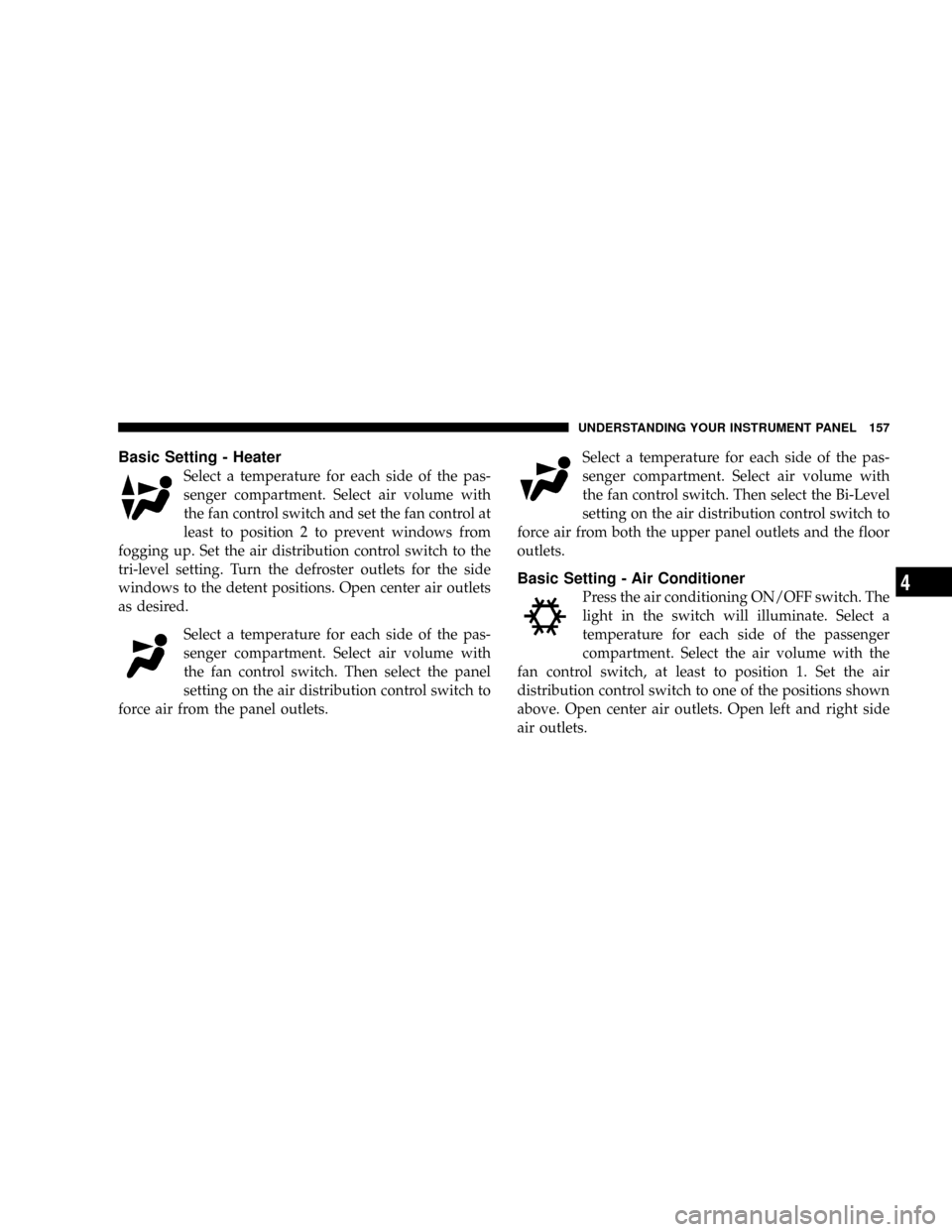
Basic Setting - Heater
Select a temperature for each side of the pas-
senger compartment. Select air volume with
the fan control switch and set the fan control at
least to position 2 to prevent windows from
fogging up. Set the air distribution control switch to the
tri-level setting. Turn the defroster outlets for the side
windows to the detent positions. Open center air outlets
as desired.
Select a temperature for each side of the pas-
senger compartment. Select air volume with
the fan control switch. Then select the panel
setting on the air distribution control switch to
force air from the panel outlets.Select a temperature for each side of the pas-
senger compartment. Select air volume with
the fan control switch. Then select the Bi-Level
setting on the air distribution control switch to
force air from both the upper panel outlets and the floor
outlets.
Basic Setting - Air Conditioner
Press the air conditioning ON/OFF switch. The
light in the switch will illuminate. Select a
temperature for each side of the passenger
compartment. Select the air volume with the
fan control switch, at least to position 1. Set the air
distribution control switch to one of the positions shown
above. Open center air outlets. Open left and right side
air outlets.
UNDERSTANDING YOUR INSTRUMENT PANEL 157
4
Page 160 of 358
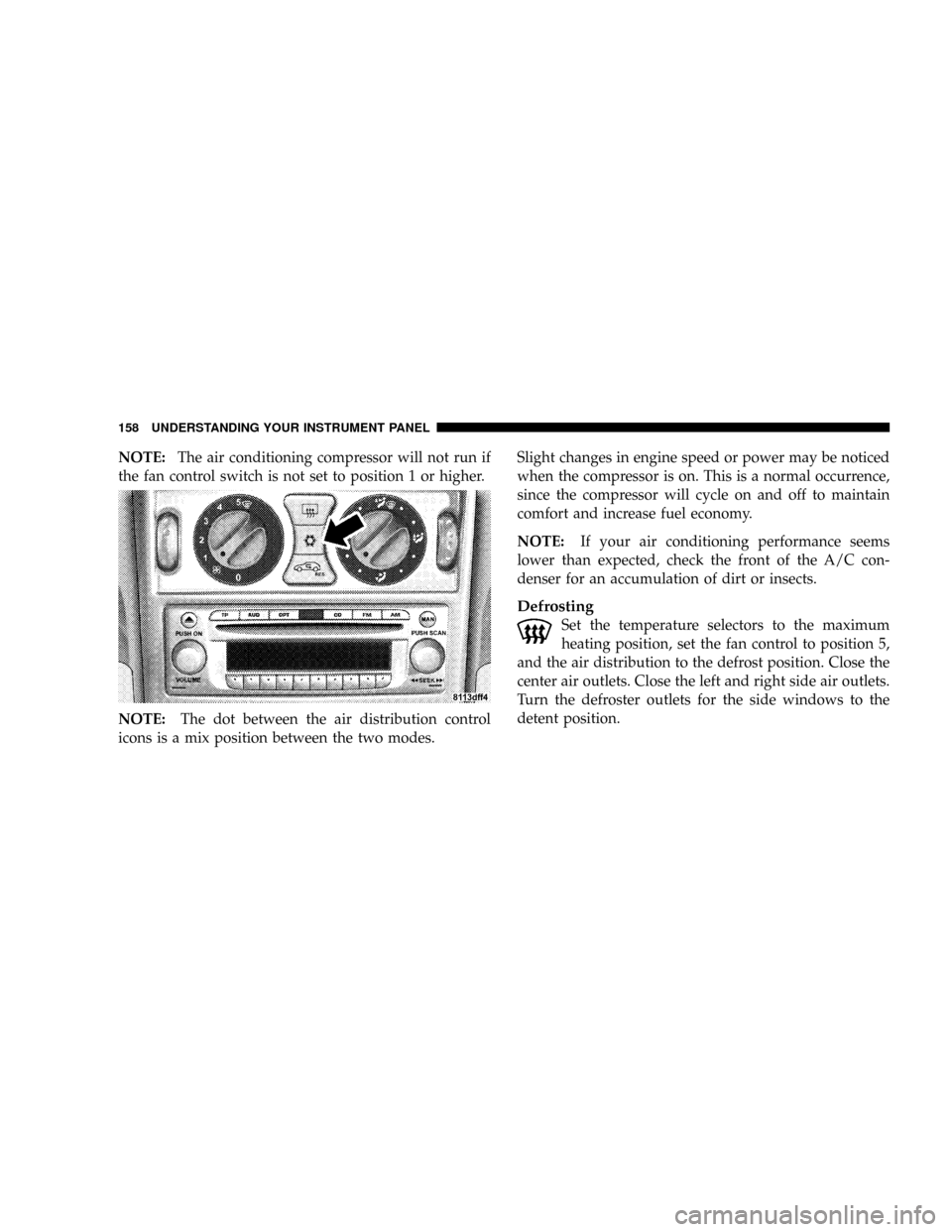
NOTE:The air conditioning compressor will not run if
the fan control switch is not set to position 1 or higher.
NOTE:The dot between the air distribution control
icons is a mix position between the two modes.Slight changes in engine speed or power may be noticed
when the compressor is on. This is a normal occurrence,
since the compressor will cycle on and off to maintain
comfort and increase fuel economy.
NOTE:If your air conditioning performance seems
lower than expected, check the front of the A/C con-
denser for an accumulation of dirt or insects.
Defrosting
Set the temperature selectors to the maximum
heating position, set the fan control to position 5,
and the air distribution to the defrost position. Close the
center air outlets. Close the left and right side air outlets.
Turn the defroster outlets for the side windows to the
detent position.
158 UNDERSTANDING YOUR INSTRUMENT PANEL
Page 161 of 358
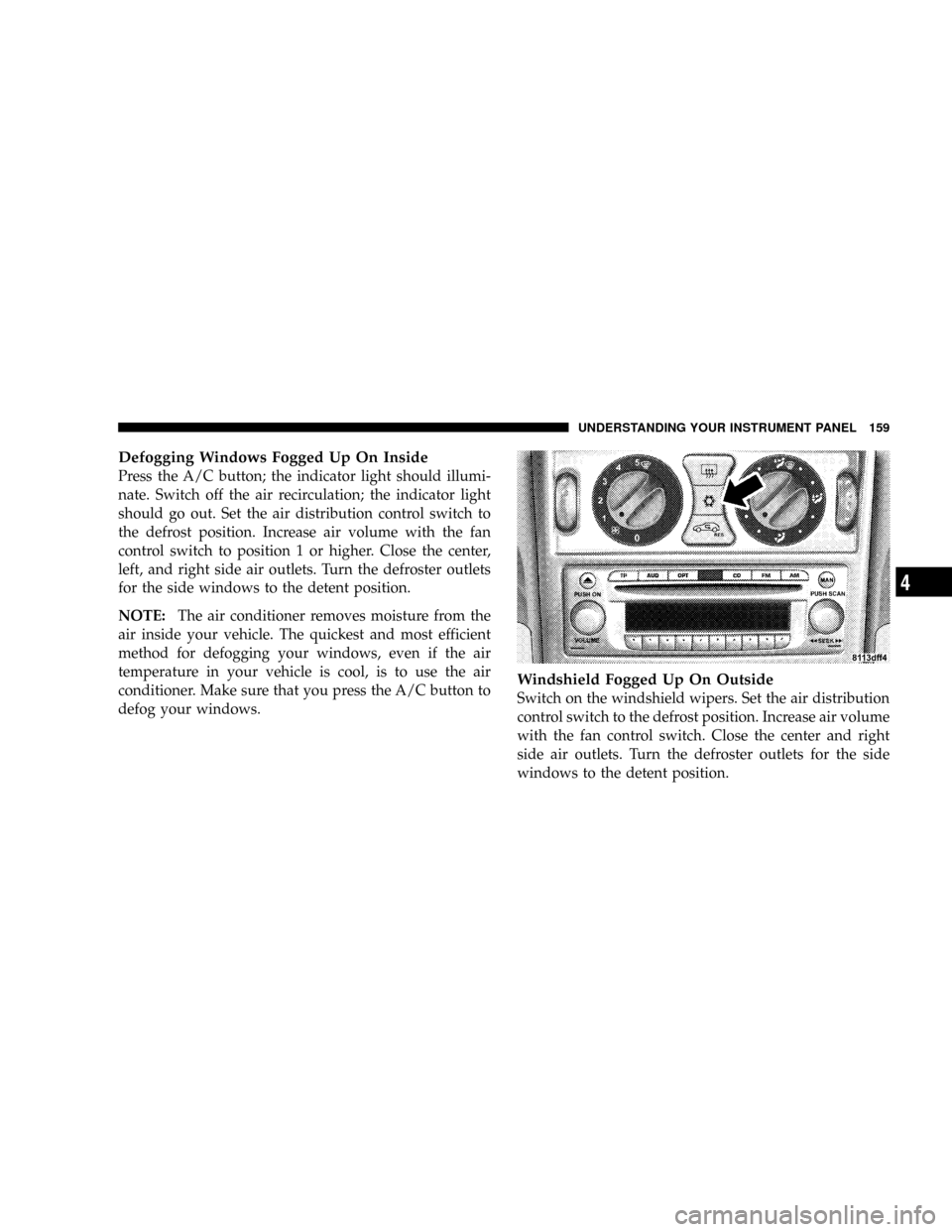
Defogging Windows Fogged Up On Inside
Press the A/C button; the indicator light should illumi-
nate. Switch off the air recirculation; the indicator light
should go out. Set the air distribution control switch to
the defrost position. Increase air volume with the fan
control switch to position 1 or higher. Close the center,
left, and right side air outlets. Turn the defroster outlets
for the side windows to the detent position.
NOTE:The air conditioner removes moisture from the
air inside your vehicle. The quickest and most efficient
method for defogging your windows, even if the air
temperature in your vehicle is cool, is to use the air
conditioner. Make sure that you press the A/C button to
defog your windows.
Windshield Fogged Up On Outside
Switch on the windshield wipers. Set the air distribution
control switch to the defrost position. Increase air volume
with the fan control switch. Close the center and right
side air outlets. Turn the defroster outlets for the side
windows to the detent position.
UNDERSTANDING YOUR INSTRUMENT PANEL 159
4
Page 162 of 358
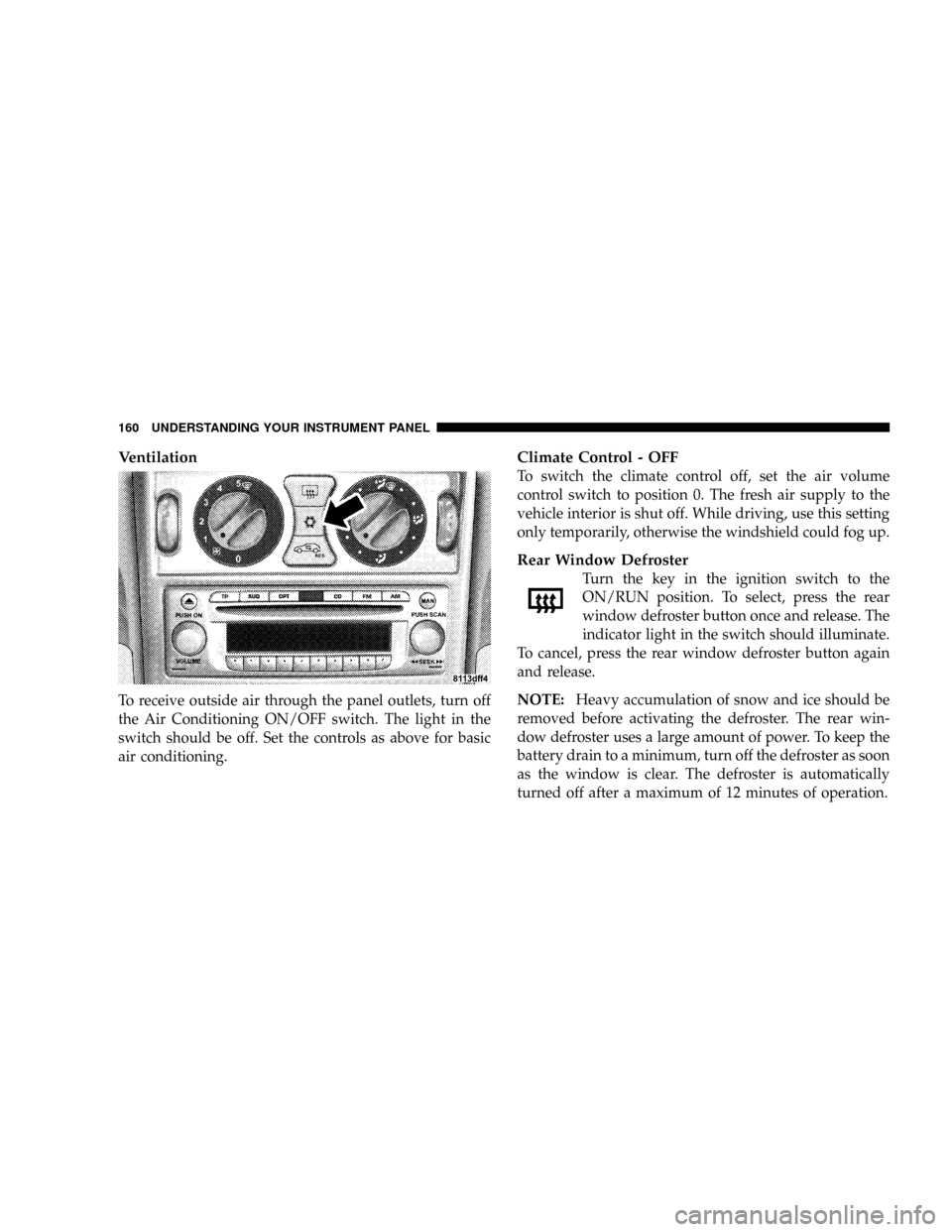
Ventilation
To receive outside air through the panel outlets, turn off
the Air Conditioning ON/OFF switch. The light in the
switch should be off. Set the controls as above for basic
air conditioning.
Climate Control - OFF
To switch the climate control off, set the air volume
control switch to position 0. The fresh air supply to the
vehicle interior is shut off. While driving, use this setting
only temporarily, otherwise the windshield could fog up.
Rear Window Defroster
Turn the key in the ignition switch to the
ON/RUN position. To select, press the rear
window defroster button once and release. The
indicator light in the switch should illuminate.
To cancel, press the rear window defroster button again
and release.
NOTE:Heavy accumulation of snow and ice should be
removed before activating the defroster. The rear win-
dow defroster uses a large amount of power. To keep the
battery drain to a minimum, turn off the defroster as soon
as the window is clear. The defroster is automatically
turned off after a maximum of 12 minutes of operation.
160 UNDERSTANDING YOUR INSTRUMENT PANEL
Page 163 of 358
If several components in the vehicle are consuming
power simultaneously, or the battery is only partially
charged, it is possible that the defroster will automati-
cally turn itself off. When this happens, the indicator light
inside the switch starts blinking. As soon as the battery
has sufficient voltage, the defroster automatically turns
itself back on.
CAUTION!
To avoid damaging the electrical conductors, do not
use scrapers, sharp instruments, or abrasive window
cleaners on the interior surface of the rear window.
Labels can be peeled off by soaking with warm
water.
Air Recirculation/REST
This mode can be selected to temporarily re-
duce the entry of annoying odors or dust into
the vehicle's interior. Outside air does not flow
into the vehicle's interior. To select, press the
recirculation button. To cancel, press the recirculation
button again.
The system will automatically switch from recirculated
air to fresh air after approximately five minutes at
outside temperatures below approximately 40ÉF (5ÉC);
after approximately 30 minutes, at outside temperatures
above approximately 40ÉF (5ÉC); after approximately five
minutes, if the A/C button is pressed.
At high outside temperatures, the system automatically
engages the recirculated air mode for approximately 30
minutes, thereby increasing the cooling capacity perfor-
mance. Press the recirculation button again to extend the
recirculated air mode.
UNDERSTANDING YOUR INSTRUMENT PANEL 161
4
Page 164 of 358
Residual Engine Heat Utilization (REST)
With the engine switched off, it is possible to
continue heating the interior for a short while.
Air volume is controlled automatically. Select a
temperature for each side of the passenger
compartment. Set the air distribution control switch to
the desired position.
To select, turn the key in the ignition switch to the ACC
or the OFF/LOCK position or remove. Press the recircu-
lation button. The indicator light in the button illumi-
nates. This function selection will not activate if the
battery charge level is insufficient.
To cancel, press the recirculation button. The indicator
light in the button goes out. The system will automati-
cally shut off if you turn the key in the ignition switch to
the ON/RUN position, after approximately 30 minutes,
or if the battery voltage drops.NOTE:This vehicle is equipped with an air conditioner
system that uses R-134a (HFC: hydrofluorocarbon) as a
refrigerant. Repairs should always be performed by a
qualified technician, and refrigerant should be collected
in a recovery system for recycling.
Dust Filter (If Equipped)
Nearly all dust particles and pollen are filtered out before
outside air enters the passenger compartment through
the air distribution system.
NOTE:Keep the air intake grille in front of windshield
free of snow and debris.
162 UNDERSTANDING YOUR INSTRUMENT PANEL
Page 165 of 358
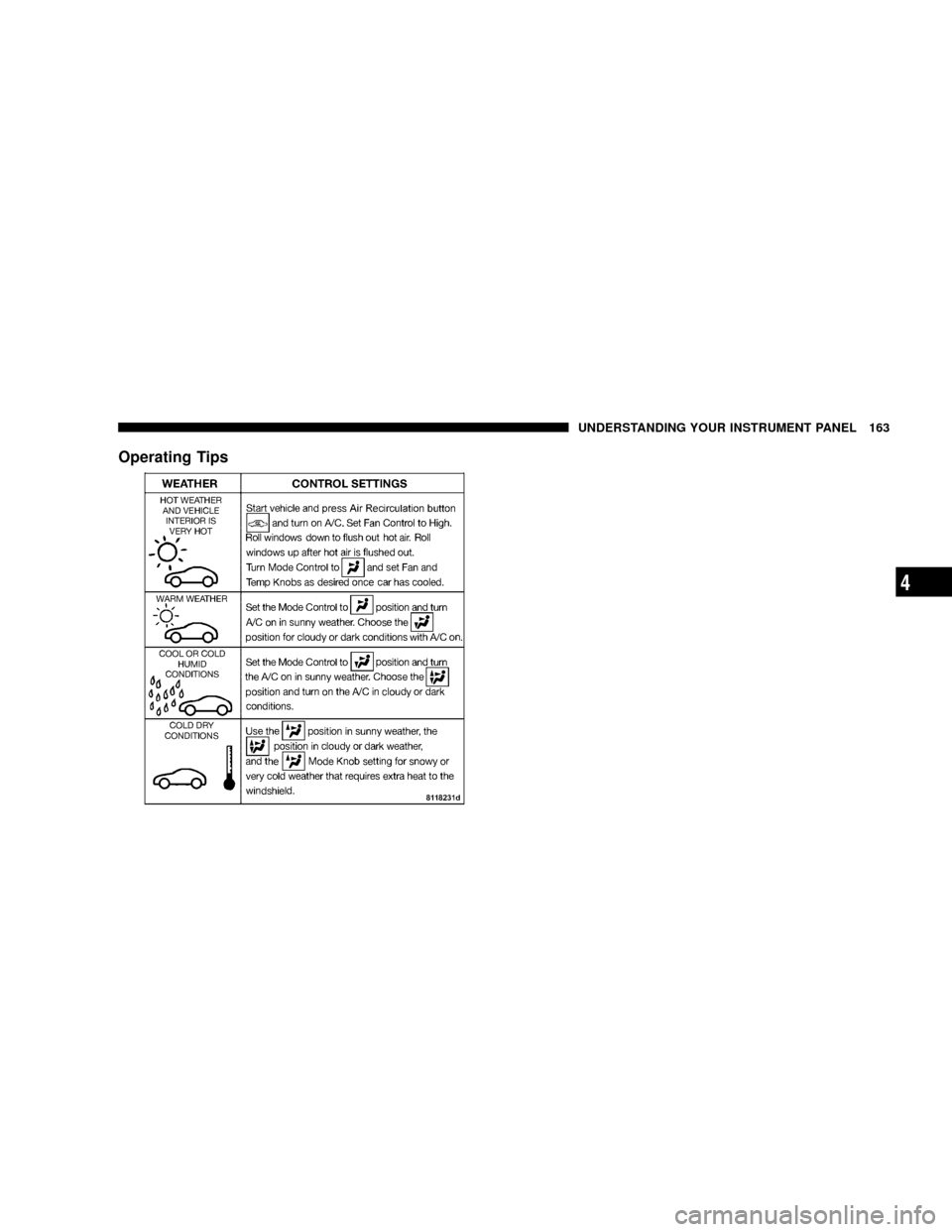
Operating Tips
UNDERSTANDING YOUR INSTRUMENT PANEL 163
4
Page 238 of 358
8. Unscrew the valve cap from the valve on the deflated
tire.
9. Screw the filler hose from the sealant bottle on the tire
valve.
10. Insert the power plug (4) into the power point on the
instrument panel.
11. Turn the ignition key to the ON/RUN position.
12. Press the switch on the air pump to 1. The air pump
should start to inflate the tire.
13. After five minutes, the tire should be inflated to at
least 26 psi (180 kPa) on the pressure gauge.
14. If the tire doesn't inflate to this level, press the air
pump switch to 0, disconnect the TIREFIT system from
the tire, and drive the vehicle back and forth approxi-
mately 30 feet (9 m) to distribute the sealant more evenly
within the tire.15. Attach the air pump hose directly to the tire, press the
switch to 1, and inflate the tire again.NOTE:If a tire
pressure of 26 psi (180 kPa) is not reached after five
minutes, the tire is too badly damaged. Do not attempt to
drive the vehicle further, and call for assistance.
16. If a tire pressure of 26 psi (180 kPa) is obtained, press
the air pump switch to 0, turn the ignition switch to the
OFF/LOCK position, and disconnect the TIREFIT sys-
tem.
17. Drive the vehicle for about 10 minutes to ensure
optimum distribution of the tire sealant within the tire.
18. Check the pressure in the tire. If the pressure is above
19 psi (130 kPa), inflate the tire to the pressure indicated
on the tire pressure label on the driver side latch pillar.
19. Have the tire inspected at the earliest opportunity at
an authorized dealer or tire service center.
236 WHAT TO DO IN EMERGENCIES
Page 267 of 358
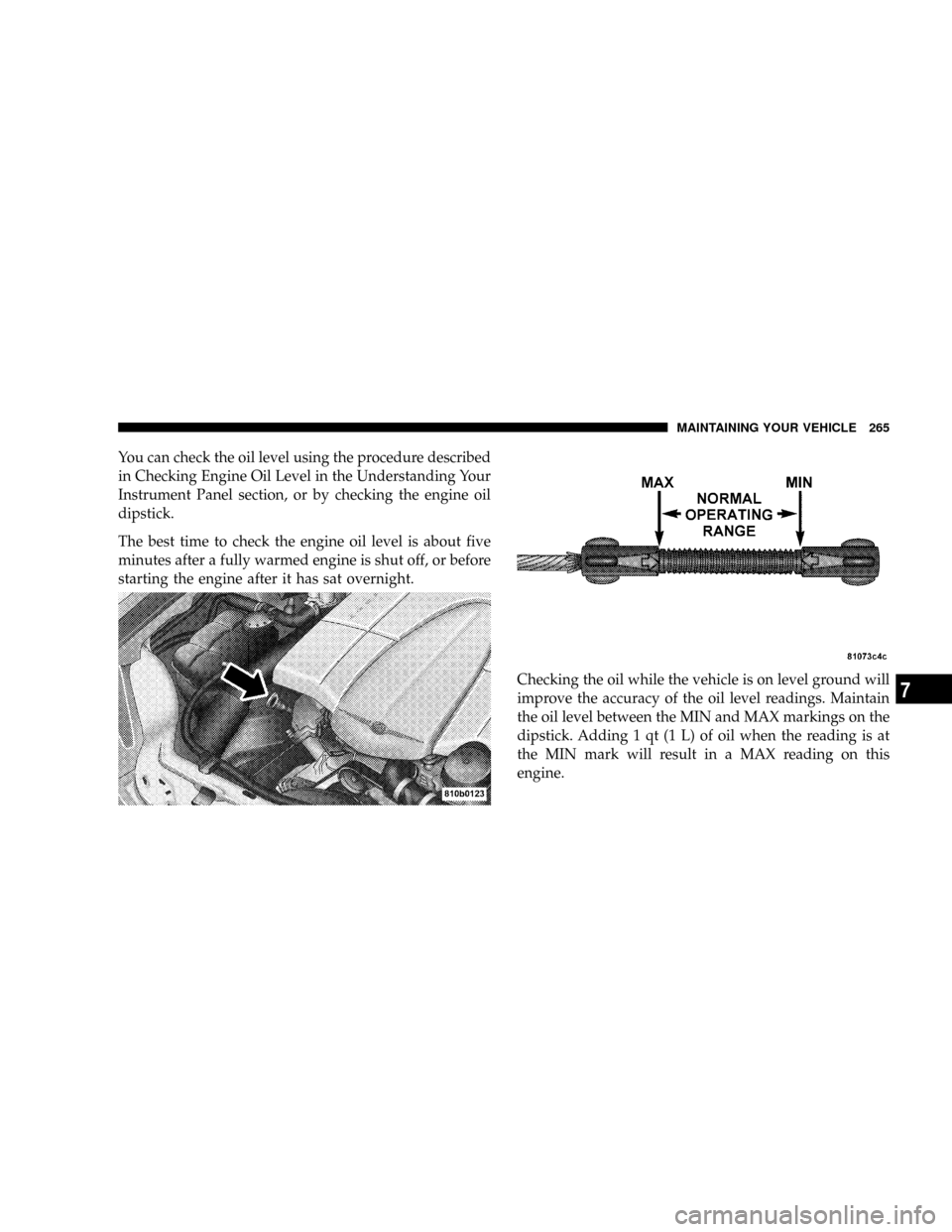
You can check the oil level using the procedure described
in Checking Engine Oil Level in the Understanding Your
Instrument Panel section, or by checking the engine oil
dipstick.
The best time to check the engine oil level is about five
minutes after a fully warmed engine is shut off, or before
starting the engine after it has sat overnight.
Checking the oil while the vehicle is on level ground will
improve the accuracy of the oil level readings. Maintain
the oil level between the MIN and MAX markings on the
dipstick. Adding 1 qt (1 L) of oil when the reading is at
the MIN mark will result in a MAX reading on this
engine.
MAINTAINING YOUR VEHICLE 265
7