instrument panel CHRYSLER CROSSFIRE 2008 1.G Repair Manual
[x] Cancel search | Manufacturer: CHRYSLER, Model Year: 2008, Model line: CROSSFIRE, Model: CHRYSLER CROSSFIRE 2008 1.GPages: 358, PDF Size: 4.7 MB
Page 268 of 358
Change Engine Oil
The oil change interval for yourvehicle is initially set at
7,000 mi (Canada: 11 000 km).
The Flexible Service System (FSS) in your vehicle evalu-
ates engine temperature, oil level, vehicle speed, engine
speed, distance driven, and the time elapsed since your
last service. It determines when your vehicle needs
maintenance service and alerts you in advance. The next
necessary service is indicated by the FSS in your instru-
ment cluster.
NOTE:Also see the FSS system details in the Under-
standing Your Instrument Panel section of this manual.
Very light duty driving cycles (most trips more than 10
mi [16 km]) at moderate speeds in moderate temperature
conditions) can extend the service interval beyond 7,000
mi (Canada: 11 000 km).IfANYof the following apply to your driving, the oil
change interval can be reduced significantly:
²Day and night temperatures are below 32ÉF (0ÉC)
²Stop-and-go driving
²Extensive engine idling
²Driving in dusty conditions
²Short trips of less than 10 mi (16 km)
²More than 50% of your driving is at sustained high
speeds during hot weather, above 90ÉF (32ÉC)
²Taxi, Police, or delivery service (commercial service)
Observe the oil change interval indicated by your FSS
system. This system will monitor the driving conditions
seen by your vehicle, and will recommend the best
interval for servicing your vehicle to maintain it in top
condition.
266 MAINTAINING YOUR VEHICLE
Page 296 of 358
CAUTION!
The use of vinyl, leather or plastic protectants may
cause excessive gloss and/or discoloration of interior
trim parts.
WARNING!
Do not use volatile solvents for cleaning purposes.
Many are potentially flammable, and if used in
closed areas they may cause respiratory harm.
Cleaning Headlights
Your vehicle has plastic headlights that are lighter and
less susceptible to stone breakage than glass headlights.
Plastic is not as scratch resistant as glass and therefore
different lens cleaning procedures must be followed.To minimize the possibility of scratching the lenses and
reducing light output, avoid wiping with a dry cloth. To
remove road dirt, wash with a mild soap solution fol-
lowed by rinsing.
Do not use abrasive cleaning components, solvents, steel
wool or other aggressive material to clean the lenses.
Glass Surfaces
All glass surfaces should be cleaned on a regular basis
with any commercial household-type glass cleaner.
Never use an abrasive-type cleaner. Use caution when
cleaning inside rear windows equipped with electric
defrosters. Do not use scrapers or other sharp instru-
ments which may scratch the elements.
Instrument Panel Cover
The instrument panel cover has a low glare surface which
minimizes reflections in the windshield. Do not use
294 MAINTAINING YOUR VEHICLE
Page 306 of 358
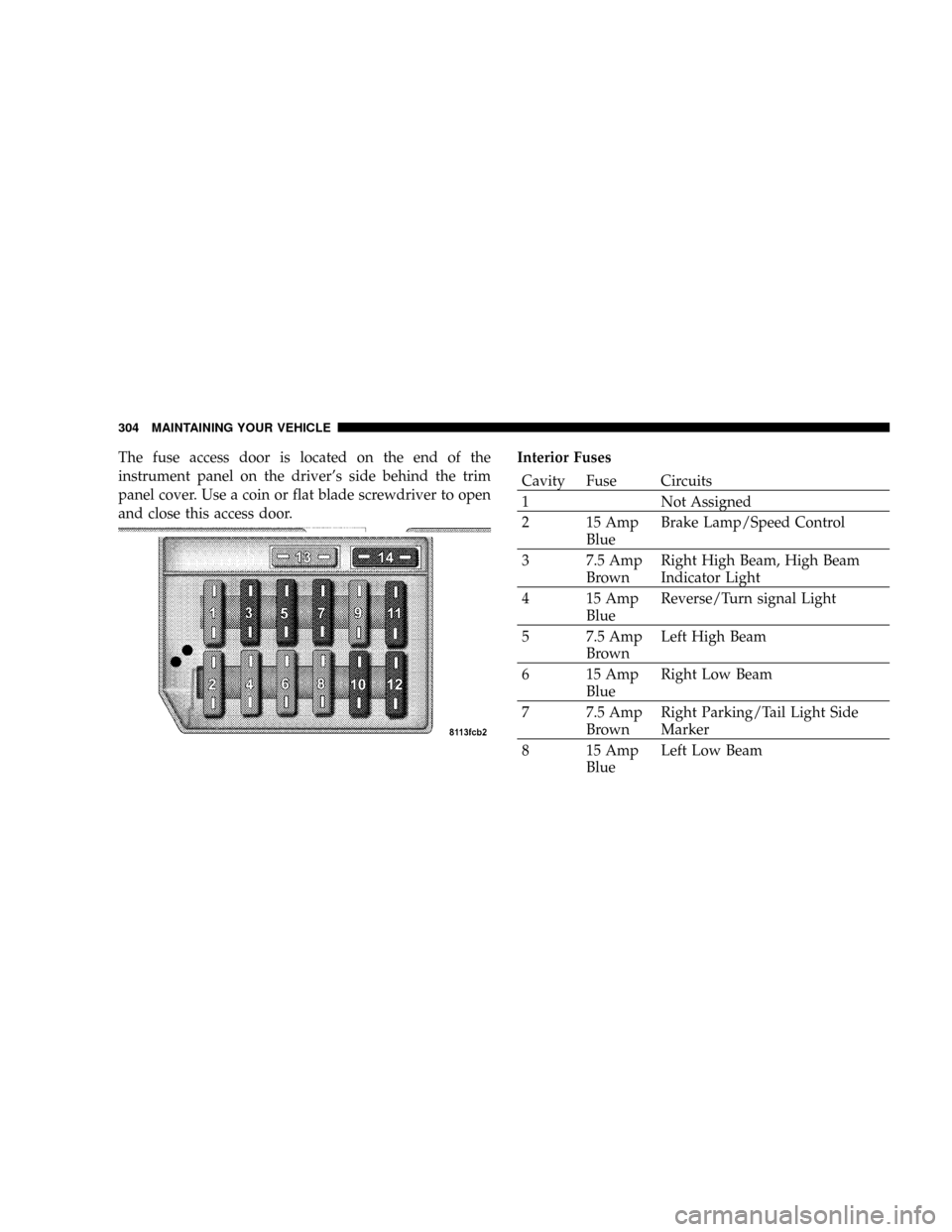
The fuse access door is located on the end of the
instrument panel on the driver's side behind the trim
panel cover. Use a coin or flat blade screwdriver to open
and close this access door.Interior Fuses
Cavity Fuse Circuits
1 Not Assigned
2 15 Amp
BlueBrake Lamp/Speed Control
3 7.5 Amp
BrownRight High Beam, High Beam
Indicator Light
4 15 Amp
BlueReverse/Turn signal Light
5 7.5 Amp
BrownLeft High Beam
6 15 Amp
BlueRight Low Beam
7 7.5 Amp
BrownRight Parking/Tail Light Side
Marker
8 15 Amp
BlueLeft Low Beam
304 MAINTAINING YOUR VEHICLE
Page 324 of 358
MAINTENANCE SCHEDULES
There are two maintenance schedules that show the
requiredservice for your vehicle.
Schedule ªAº typically rotates with Schedule ªB.º Follow
Schedule ªAº after the first service interval, Schedule ªBº
after the second service interval, and so on. In some cases
where the service interval has been extended due to very
light duty driving, a Schedule ªBº service may be indi-
cated following a previous Schedule ªBº service. There
are additional service tasks required under Schedule ªB.º
Your Flexible Service System (FSS) Ð see Understanding
Your Instrument Panel section Ð should give you an
exact indication of when your vehicle should be sched-
uled for service and which schedule to follow.
Additional Periodic Maintenanceitems should also be
performed beyond the items listed in the following charts
to assure the optimum performance of your vehicle.
SCOPE OF WORK FOR ªAº SCHEDULE
MAINTENANCE SERVICE
Oil Change
²Change oil and replace filter
Maintenance
²Lubricate hood hinges, latch, and secondary latch
²Reset FSS Display
Function Check
²Horn, hazard warning flashers, turn signals, and indi-
cator lamps
²Headlamps and exterior lighting
²Windshield wipers and washer system
Inspection
²Check front and rear brake pads for lining thickness
322 MAINTENANCE SCHEDULES
8
M
A
I
N
T
E
N
A
N
C
E
S
C
H
E
D
U
L
E
S
Page 327 of 358
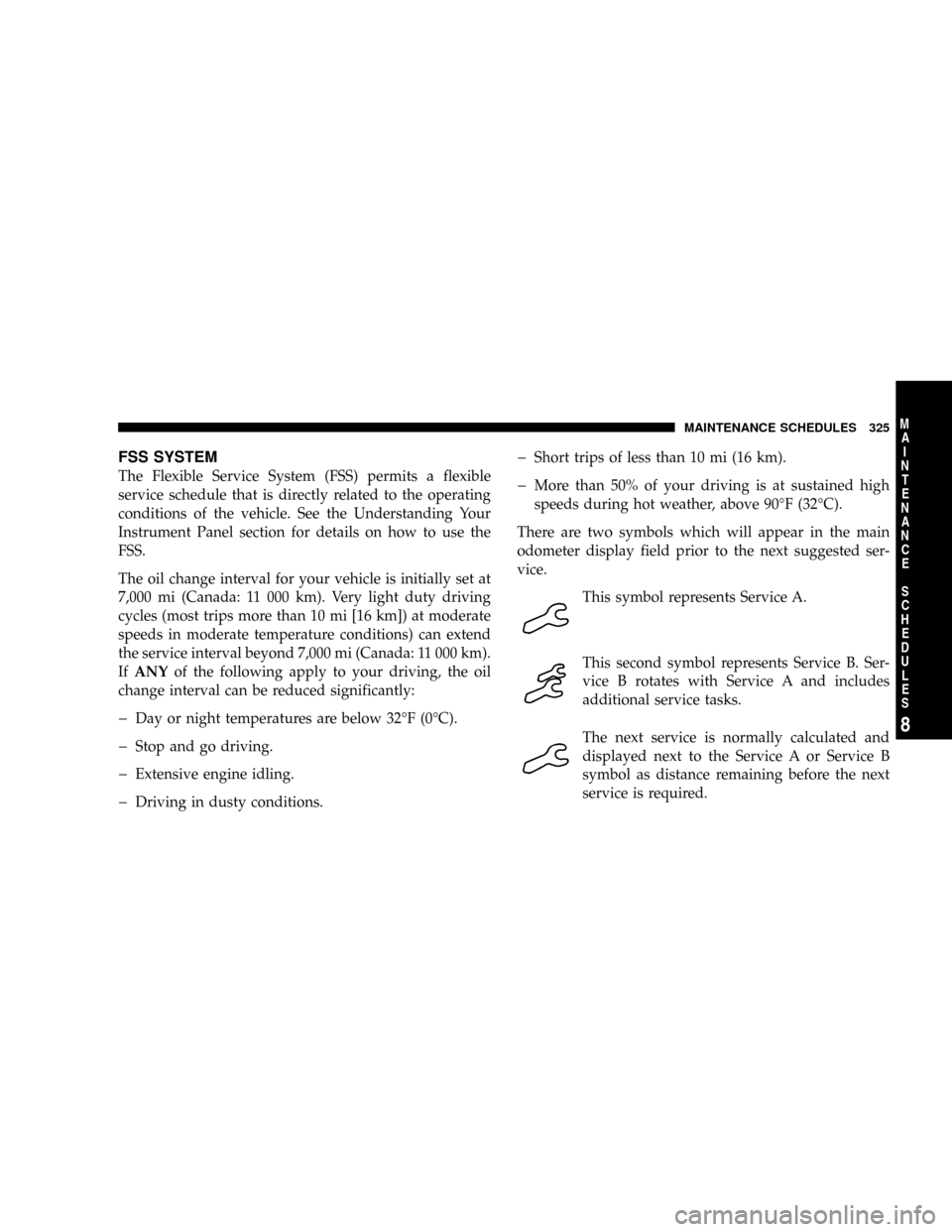
FSS SYSTEM
The Flexible Service System (FSS) permits a flexible
service schedule that is directly related to the operating
conditions of the vehicle. See the Understanding Your
Instrument Panel section for details on how to use the
FSS.
The oil change interval for your vehicle is initially set at
7,000 mi (Canada: 11 000 km). Very light duty driving
cycles (most trips more than 10 mi [16 km]) at moderate
speeds in moderate temperature conditions) can extend
the service interval beyond 7,000 mi (Canada: 11 000 km).
IfANYof the following apply to your driving, the oil
change interval can be reduced significantly:
þDay or night temperatures are below 32ÉF (0ÉC).
þStop and go driving.
þExtensive engine idling.
þDriving in dusty conditions.
þShort trips of less than 10 mi (16 km).
þMore than 50% of your driving is at sustained high
speeds during hot weather, above 90ÉF (32ÉC).
There are two symbols which will appear in the main
odometer display field prior to the next suggested ser-
vice.
This symbol represents Service A.
This second symbol represents Service B. Ser-
vice B rotates with Service A and includes
additional service tasks.
The next service is normally calculated and
displayed next to the Service A or Service B
symbol as distance remaining before the next
service is required.
MAINTENANCE SCHEDULES 325
8
M
A
I
N
T
E
N
A
N
C
E
S
C
H
E
D
U
L
E
S
Page 329 of 358
At Each Stop for Fuel
²Check the engine oil level about five minutes after a
fully warmed engine is shut off. Checking the oil level
while the vehicle is on level ground will improve the
accuracy of the oil level reading. See the procedure
described in Checking Your Engine Oil in the Under-
standing Your Instrument Panel section or under En-
gine Oil in the Maintaining Your Vehicle section. Add
oil only when the level is at or below the ADD or MIN
mark.
²Check the windshield washer solvent and add if
required.
²Inspect wiper blade condition.
²Check operation of lighting systems.
²Inspect tires for unusual wear, damage, and pressure
(at least every 14 days).
²Mechanical assemblies (e.g., engine, transmission, etc.)
- check for leaks.
Once a Month
²Inspect the battery and clean and tighten the terminals
as required.
²Check the fluid levels of coolant reservoir, brake
master cylinder and power steering and add as
needed.
²Check all lights and all other electrical items for correct
operation.
Additional Periodic Maintenance
The following maintenance items should be performed
during the scheduled maintenance nearest the time
elapsed and/or distance shown. Follow the interval that
occurs first.
MAINTENANCE SCHEDULES 327
8
M
A
I
N
T
E
N
A
N
C
E
S
C
H
E
D
U
L
E
S
Page 348 of 358
Glass Cleaning.......................... 294
Glove Compartment...................... 84
Hazard
Driving Through Flowing, Rising, or Shallow
Standing Water........................ 183
Hazard Warning Flasher................... 232
Headlights
Aiming............................. 310
Cleaning............................ 294
Dimmer Switch....................... 100
Heater............................... 155
Hood Latch Maintenance.................. 276
Hood Release........................... 93
Hoses................................ 284
Ignition
Key ................................. 9
Wiring System (Spark Plug Wires).......... 271Illuminated Entry........................ 96
Infant Restraint.......................... 52
Inflation Pressure Tires.................... 208
Inside Rearview Mirror.................... 85
Instrument Cluster....................... 128
Instrument Panel and Controls.............. 127
Instrument Panel Cover................... 294
Instrument Panel Lens Cleaning............. 295
Interior Appearance Care.................. 293
Introduction............................. 4
Jack Location........................... 239
Jack Operation.......................... 234
Jump Starting.......................... 241
Key-In Reminder......................... 11
Keyless Entry System...................... 16
Keys.................................. 9
Knee Bolster............................ 33
346 INDEX
Page 355 of 358

INTRODUCTION INTRODUCTION HOW TO USE THIS MANUAL WARNINGS AND CAUTIONS VEHICLE IDENTIFICATION NUMBER THINGS TO KNOW BEFORE STARTING YOUR VEHICLE A WORD ABOUT YOUR KEYS KeysObtaining Replacement KeysIgnition
Key RemovalKey-In-Ignition ReminderGLOVE COMPARTMENT LOCK DOOR LOCKS Central Locking SwitchAutomatic Central LockingGeneral Notes On the Central Locking SystemEmergency Unlocking FeatureStart LockoutREMOTE KEYLESS ENTRY To Unlock the
DoorsTo Lock The DoorsPanic AlarmTo Use the Panic AlarmGeneral InformationTransmitter Battery ServiceSECURITY ALARM SYSTEM Tow-Away AlarmDECKLID INTERNAL EMERGENCY RELEASE - ROADSTER POWER WINDOWS Power Window Operation With
The Convertible Top Switch (Roadster Only)REAR LIFTGATE/DECKLID RELEASE OCCUPANT RESTRAINTS Lap/Shoulder BeltsSeat Belts and Pregnant WomenSeat Belt ExtenderSupplemental Restraint System (SRS) - AirbagChild RestraintENGINE BREAK-IN
RECOMMENDATIONS SAFETY TIPS Exhaust GasSafety Checks You Should Make Inside the VehiclePeriodic Safety Checks You Should Make Outside the VehicleUNDERSTANDING THE FEATURES OF YOUR VEHICLE CONVERTIBLE TOP OPERATION To Lower
The TopTo Raise The TopConvertible Top Lamp and Audible Signal ChartCONSOLE FEATURES Storage Compartments (If Equipped)AshtrayCoin HolderPower Outlet/Cigar LighterGlove CompartmentCUPHOLDER (If Equipped) MIRRORS Inside Day/Night MirrorExterior
Mirrors Folding FeatureHeated Remote Control Mirrors (If Equipped)Outside MirrorsPower Remote Control Outside MirrorsVanity Mirrors SEATS Manual Seat Adjustments (If Equipped)Driver Eight-Way Power Seat (If Equipped)Passenger Four-Way Power Seat (If Equipped)
Heated Seats (If Equipped)TO OPEN AND CLOSE THE HOOD INTERIOR LIGHTS Front Map/Reading LightsBattery Saver FeatureInstrument Panel LightingNightSecurity IlluminationEXTERIOR LIGHTS Headlights and Parking LightsDaytime Running Lights (Where
Applicable)Fog Lights (If Equipped)Standing LightsMULTIFUNCTION CONTROL LEVER Turn SignalsHeadlight Dimmer SwitchPassing LightWindshield Wipers And WasherMist FunctionTELESCOPING STEERING COLUMN REAR SPOILER BRAKE ASSIST SYSTEM
(BAS) ELECTRONIC STABILITY PROGRAM (ESP) Synchronizing ESPELECTRONIC SPEED CONTROL To Vary The Speed SettingTo DeactivateTo Resume SpeedUsing Speed Control On HillsGARAGE DOOR OPENER (If Equipped) Programming The Universal
TransceiverGate Operator/Canadian ProgrammingUsing the Universal TransceiverErasing Universal Transceiver ButtonsReprogramming a Single ButtonSecurityUMBRELLA HOOK UNDERSTANDING YOUR INSTRUMENT PANEL INSTRUMENTS AND CONTROLS
NSTRUMENT CLUSTER INSTRUMENT CLUSTER DESCRIPTION INFINITY MODULUS AM/FM STEREO RADIO WITH SINGLE-DISC CD PLAYER AND GPS NAVIGATION AM/FM STEREO RADIO WITH SINGLE-DISC CD PLAYER INFINITY MODULUS Entertainment
SystemsCD Player OperationUser MenuUser Memory (USER - 1, 2, 3)Mono/StereoDriver - L/RTelephone mute characteristicsCOMPACT DISC MAINTENANCE RADIO ANTENNA RADIO OPERATION AND CELLULAR PHONES CLIMATE CONTROLS Temperature Control
Fan ControlBasic Setting - HeaterBasic Setting - Air ConditionerDust Filter (If Equipped)Operating Tips STARTING AND OPERATING STARTING PROCEDURES Normal StartingExtremely Cold Weather (below -20 degrees F or -29 degrees C)If Engine Fails to StartAfter
StartingTRANSMISSION SHIFTING Manual Transmission Recommended Shift SpeedsAutomatic Transmission StoppingManeuveringPark PositionReverseNeutralDriveAutoStick Gear selectionGear RangesProgram mode selector switchEmergency Operation (Limp Home
Mode)DRIVING ON SLIPPERY SURFACES Traction DRIVING THROUGH WATER Flowing/Rising WaterPARKING BRAKE BRAKE SYSTEM Brake Assist System (BAS)Electronic Stability Program (ESP)Synchronizing ESPESP Control switchAnti-Lock Brake System (ABS)
Brake Pad Break-InPOWER STEERING TIRE SAFETY INFORMATION TIRE MARKINGS TIRE LOADING AND TIRE PRESSURETIRES - GENERAL INFORMATION Tire PressureTire Inflation PressuresTire Pressures For High Speed OperationRadial-Ply TiresTire Spinning
Tread Wear IndicatorsLife Of TireReplacement TiresAlignment And BalanceTIRE PRESSURE MONITOR SYSTEM General InformationTIRE CHAINS ORIGINAL EQUIPMENT TIRES SNOW TIRES TIRE ROTATION RECOMMENDATIONS FUEL REQUIREMENTS
Reformulated GasolineGasoline/Oxygenate BlendsMMT in GasolineMaterials Added to FuelSulfur in GasolineADDING FUEL Fuel Filler Cap (Gas Cap)VEHICLE LOADING Roof Luggage RackTRAILER TOWING WHAT TO DO IN EMERGENCIES HAZARD WARNING
FLASHER IF YOUR ENGINE OVERHEATS TIREFIT TIRE REPAIR AND JACKING TIREFITPreparations for JackingJack Location and Instructions JUMP-STARTING THEBATTERY FREEING A STUCK VEHICLE TOWING A DISABLED VEHICLE Towing EyesTow-Away
AlarmCONVERTIBLE TOP EMERGENCY OPERATION Relieving Hydraulic PressureOpening a Locked DecklidMAINTAINING YOUR VEHICLE 3.2L ENGINE ONBOARD DIAGNOSTIC SYSTEM (OBD II) EMISSIONS INSPECTION AND MAINTENANCE PROGRAMS
REPLACEMENT PARTS AUTHORIZED DEALER SERVICE MAINTENANCE PROCEDURES Engine OilIgnition Wiring SystemCrankcase Emission Control SystemMaintenance-Free BatteryAir ConditionerPower Steering FluidChassis LubricationBody LubricationWindshield
Wiper BladesWindshield Wiper Blade ReplacementWindshield Washer ReservoirExhaust SystemCooling SystemHoses And Vacuum/Vapor HarnessesBrakesAutomatic TransmissionManual TransmissionAppearance Care and Protection from CorrosionCONVERTIBLE TOP
CARE WashingGeneral CleaningWeather Strip CareFUSES Underhood Accessory Fuse Block FusesRelay Control Module Fuses Interior Fuses REPLACEMENT BULBS Interior Light BulbsExterior Light BulbsEXTERIOR LIGHT BULB SERVICE HeadlightsFront Turn Signal
and Parking/Standing LightsFront and Rear Sidemarker LightsTail, Stop, Back Up and Turn Signal LightsLicense Plate LightHeadlight AimingVEHICLESTORAGE SPECIFICATIONS FLUID CAPACITIES RECOMMENDED FLUIDS, LUBRICANTS AND GENUINE PARTS
EngineChassisBodyMAINTENANCE SCHEDULES INTRODUCTION WARRANTY EMISSION CONTROL SYSTEM MAINTENANCE MAINTENANCE SCHEDULES SCOPE OF WORK FOR A SCHEDULE MAINTENANCE SERVICESCOPE OF WORK FOR B SCHEDULE
MAINTENANCE SERVICEFSS SYSTEM REGULAR CHECK-UPS Additional Periodic MaintenanceSPECIAL MAINTENANCE REQUIREMENTS CoolantDust Filter for Heating/Ventilation Replacement (If Equipped)ENGINE OIL CHANGE AND FILTER REPLACEMENT IF
YOU NEED CONSUMER ASSISTANCE SUGGESTIONS FOR OBTAINING SERVICE FOR YOUR VEHICLE Prepare For The AppointmentPrepare A ListBe Reasonable With RequestsIF YOU NEED ASSISTANCE Chrysler Motors LLC Customer CenterChrysler Canada
Inc. Customer CenterIn Mexico contactCustomer Assistance For The Hearing Or Speech Impaired (TDD/TTY)Service ContractWARRANTY INFORMATION (U.S. Vehicles Only) MOPAR PARTS REPORTING SAFETY DEFECTS In The 50 United States And Washington,
D.CIn CanadaPUBLICATION ORDER FORMS DEPARTMENT OF TRANSPORTATION UNIFORM TIRE QUALITY GRADES TreadwearTraction GradesTemperature GradesINDEX