lock CHRYSLER CROSSFIRE 2008 1.G Repair Manual
[x] Cancel search | Manufacturer: CHRYSLER, Model Year: 2008, Model line: CROSSFIRE, Model: CHRYSLER CROSSFIRE 2008 1.GPages: 358, PDF Size: 4.7 MB
Page 194 of 358
To improve the vehicle's traction when driving with
snow chains, or starting off in deep snow, sand, or gravel,
switch off the ESP by pressing the upper half of the ESP
switch. The ESP warning light will then be continuously
illuminated. With the ESP system switched off, the en-
gine torque reduction feature is cancelled. Therefore, the
enhanced vehicle stability offered by ESP is unavailable.
CAUTION!
Snow chains should never be used without the
recommended mud and snow (M+S) rated radial-ply
tires. Damage to your vehicle may result from such
usage.
ESP always operates under braking, even with the switch
in the OFF position.If one drive wheel loses traction and begins to spin, the
ESP system will apply the brake at the affected wheel
until the wheel regains sufficient traction. The traction
control engages at approximately 24 mph (40 km/h), and
switches off at 50 mph (80 km/h).
To return to the enhanced vehicle stability offered by ESP,
press the lower half of the switch (the ESP warning light
goes out).Anti-Lock Brake System (ABS)
The ABS gives increased vehicle stability and brake
performance under most braking conditions. The system
automatically ªpumpsº the brakes during severe braking
conditions to prevent wheel lock-up. The system operates
to prevent wheel lock-up and help avoid skidding on
slippery surfaces.
NOTE:The ABS improves steering control of the vehicle
during hard braking maneuvers.
192 STARTING AND OPERATING
Page 195 of 358
The ABS prevents the wheels from locking up above a
vehicle speed of approximately 5 mph (8 km/h) indepen-
dent of road surface conditions.
At the instant one of the wheels is about to lock up, a
slight pulsation can be felt in the brake pedal, indicating
that the ABS is in the regulating mode.
Keep firm and steady pressure on the brake pedal while
experiencing the pulsation. Continuous, steady brake
pedal pressure results in optimal braking power while
maintaining the ability to steer the vehicle.
In the case of an emergency brake maneuver, keep
continuous full pressure on the brake pedal. In this
manner only can the ABS be most effective.
On slippery road surfaces, the ABS will respond even
with light brake pedal pressure because of the increased
likelihood of locking wheels. The pulsating brake pedalcan be an indication of hazardous road conditions and
functions as a reminder to take extra care while driving.
WARNING!
Significant over- or under-inflation of tires, or mix-
ing sizes of front or rear tires or wheels on the vehicle
can reduce braking effectiveness. Maintain proper
tire pressure and always use the tires and wheels
specified in this manual for your vehicle.
The anti-lock brake system conducts a low-speed self-test
at about 12 mph (20 km/h). If you have your foot lightly
on the brake while this test is occurring, you may feel
slight pedal movement. The movement can be more
apparent on ice and snow. The anti-lock brake system
pump motor makes a low humming noise during opera-
tion, which is normal.
STARTING AND OPERATING 193
5
Page 196 of 358
WARNING!
Pumping of the brake pedal will diminish the effec-
tiveness of the anti-lock brakes and may lead to an
accident. Pumping makes the stopping distance
longer. Just press firmly on your brake pedal when
you need to slow down or stop.
NOTE:During severe braking conditions, a pulsing
sensation may occur and a clicking noise will be heard.
This is normal, indicating that the anti-lock brake system
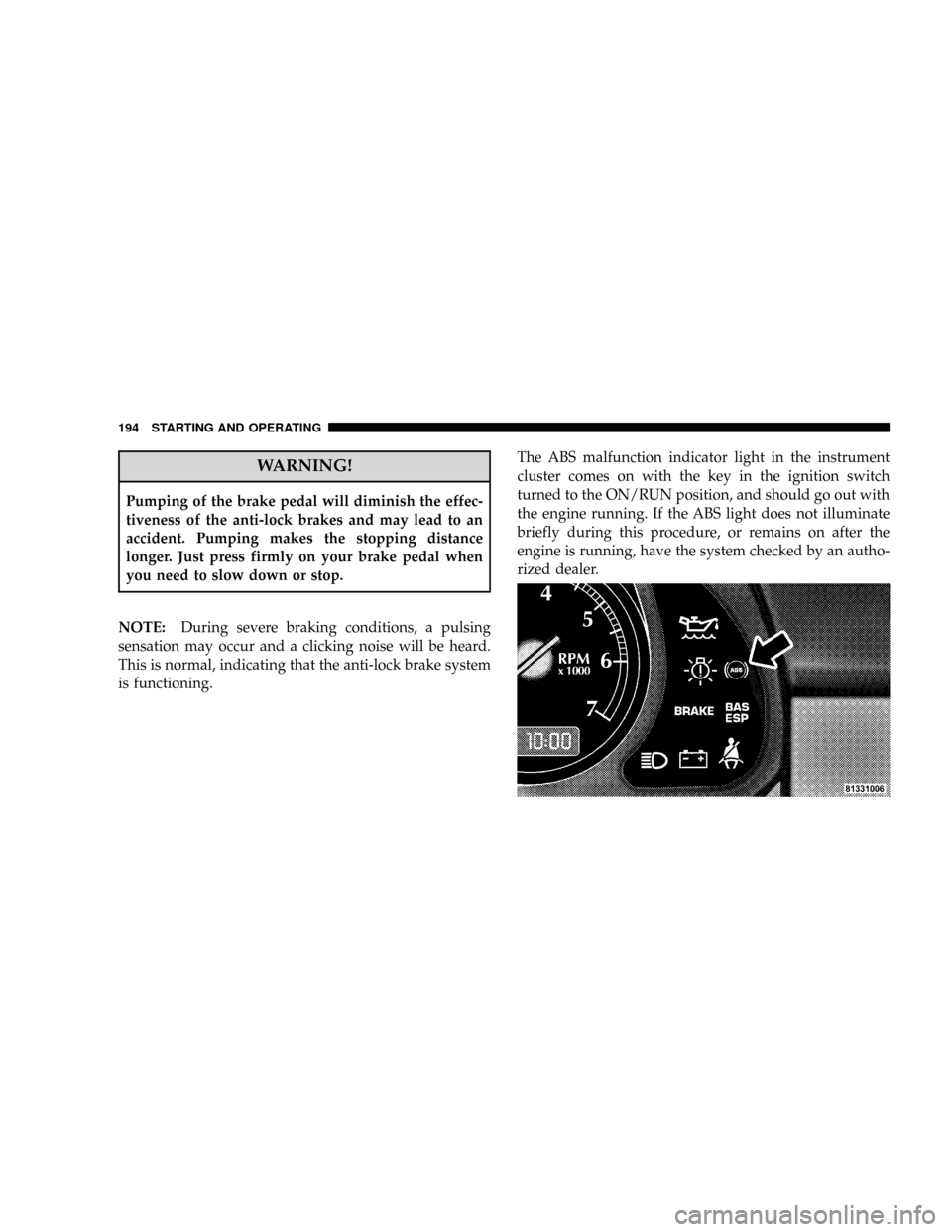
is functioning.The ABS malfunction indicator light in the instrument
cluster comes on with the key in the ignition switch
turned to the ON/RUN position, and should go out with
the engine running. If the ABS light does not illuminate
briefly during this procedure, or remains on after the
engine is running, have the system checked by an autho-
rized dealer.
194 STARTING AND OPERATING
Page 197 of 358
When the ABS malfunction indicator light in the instru-
ment cluster comes on while the engine is running, it
indicates that the ABS has detected a malfunction and has
switched off. In this case, the brake system functions in
the usual manner, but without antilock assistance. With
the ABS malfunctioning, the BAS and ESP are also
switched off. Both malfunction indicator lights come on
with the engine running. If the charging voltage falls
below 10 volts, the malfunction indicator light comes on
and the ABS is switched off. When the voltage is above
this value again, the malfunction indicator light should
go out and the ABS is operational. If the malfunction
indicator light stays illuminated, have the system
checked at your authorized dealer as soon as possible.WARNING!
ABS cannot prevent the natural laws of physics from
acting on the vehicle, nor can it increase braking or
steering efficiency beyond that afforded by the con-
dition of the vehicle brakes and tires or the traction
afforded. The ABS cannot prevent accidents, includ-
ing those resulting from excessive speed in turns,
following another vehicle too closely, or hydroplan-
ing. Only a safe, attentive, and skillful driver can
prevent accidents. The capabilities of an ABS-
equipped vehicle must never be exploited in a reck-
less or dangerous manner which could jeopardize the
user's safety or the safety of others.
STARTING AND OPERATING 195
5
Page 227 of 358
states adopting California emission standards, your ve-
hicle will operate satisfactorily on fuels meeting Federal
specifications, but emission control system performance
may be adversely affected.
Gasoline sold outside of California is permitted to have
higher sulfur levels, which may affect the performance of
the vehicle's catalytic converter. This may cause the
CHECK ENGINE light to illuminate. DaimlerChrysler
Corporation recommends that you try a different brand
of unleaded gasoline having lower sulfur to determine if
the problem is fuel-related prior to returning your vehicle
to an authorized dealer for service.CAUTION!
If the CHECK ENGINE Light is flashing, immediate
service is required. See the Onboard Diagnostic
System (OBDII) paragraph in the Maintaining Your
Vehicle section of this manual.
ADDING FUEL
Fuel Filler Cap (Gas Cap)
The gas cap is located under the fuel filler door, on the
passenger's side of the vehicle. To open the door, be sure
it is unlocked, then gently press the rear edge of the door
until a click can be heard, then release. The door rear
edge will spring open enough to grasp and pull it
completely open. If the central locking system does not
release the fuel filler door, see your authorized dealer for
STARTING AND OPERATING 225
5
Page 233 of 358
WHAT TO DO IN EMERGENCIES
CONTENTS
mHazard Warning Flasher..................232
mIf Your Engine Overheats.................232
mTIREFIT Tire Repair And Jacking............234
NTIREFIT............................234
NPreparations For Jacking................237
NJack Location And Instructions............239
mJump-Starting The Battery.................241mFreeing A Stuck Vehicle..................244
mTowing A Disabled Vehicle................245
NTowing Eyes.........................247
NTow-Away Alarm.....................248
mConvertible Top Emergency Operation........249
NRelieving Hydraulic Pressure.............250
NOpening a Locked Decklid...............256
6
Page 234 of 358
HAZARD WARNING FLASHER
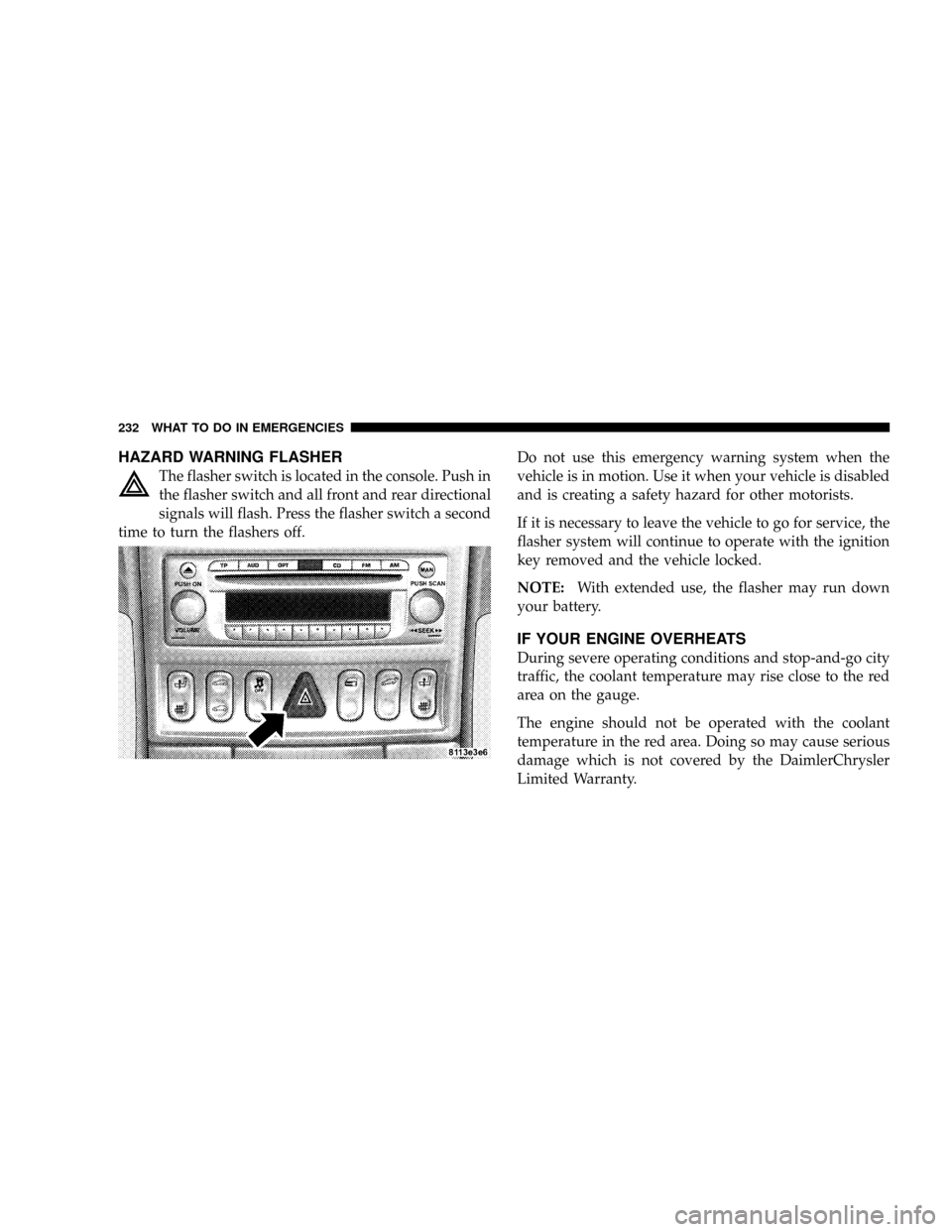
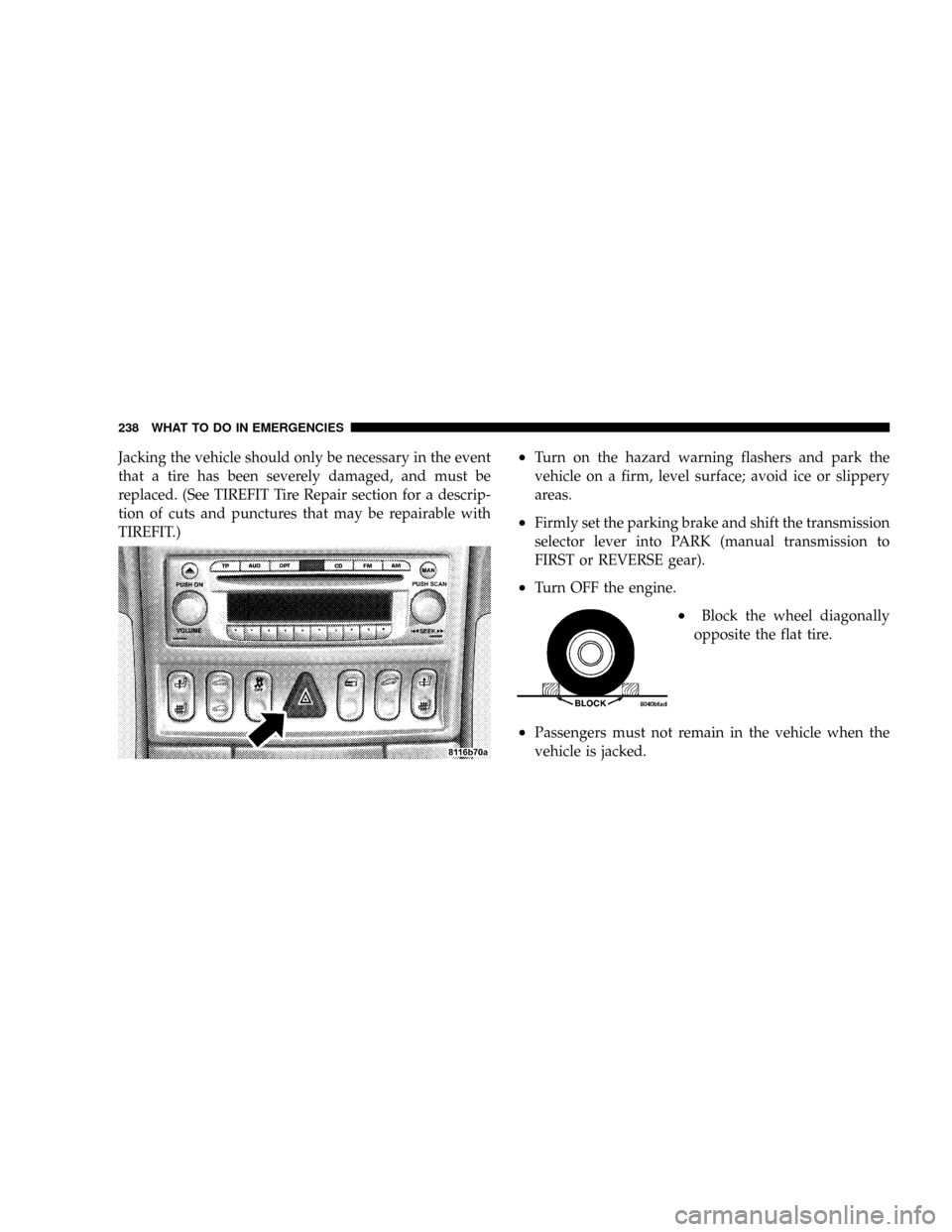
The flasher switch is located in the console. Push in
the flasher switch and all front and rear directional
signals will flash. Press the flasher switch a second
time to turn the flashers off.Do not use this emergency warning system when the
vehicle is in motion. Use it when your vehicle is disabled
and is creating a safety hazard for other motorists.
If it is necessary to leave the vehicle to go for service, the
flasher system will continue to operate with the ignition
key removed and the vehicle locked.
NOTE:With extended use, the flasher may run down
your battery.
IF YOUR ENGINE OVERHEATS
During severe operating conditions and stop-and-go city
traffic, the coolant temperature may rise close to the red
area on the gauge.
The engine should not be operated with the coolant
temperature in the red area. Doing so may cause serious
damage which is not covered by the DaimlerChrysler
Limited Warranty.
232 WHAT TO DO IN EMERGENCIES
Page 238 of 358
8. Unscrew the valve cap from the valve on the deflated
tire.
9. Screw the filler hose from the sealant bottle on the tire
valve.
10. Insert the power plug (4) into the power point on the
instrument panel.
11. Turn the ignition key to the ON/RUN position.
12. Press the switch on the air pump to 1. The air pump
should start to inflate the tire.
13. After five minutes, the tire should be inflated to at
least 26 psi (180 kPa) on the pressure gauge.
14. If the tire doesn't inflate to this level, press the air
pump switch to 0, disconnect the TIREFIT system from
the tire, and drive the vehicle back and forth approxi-
mately 30 feet (9 m) to distribute the sealant more evenly
within the tire.15. Attach the air pump hose directly to the tire, press the
switch to 1, and inflate the tire again.NOTE:If a tire
pressure of 26 psi (180 kPa) is not reached after five
minutes, the tire is too badly damaged. Do not attempt to
drive the vehicle further, and call for assistance.
16. If a tire pressure of 26 psi (180 kPa) is obtained, press
the air pump switch to 0, turn the ignition switch to the
OFF/LOCK position, and disconnect the TIREFIT sys-
tem.
17. Drive the vehicle for about 10 minutes to ensure
optimum distribution of the tire sealant within the tire.
18. Check the pressure in the tire. If the pressure is above
19 psi (130 kPa), inflate the tire to the pressure indicated
on the tire pressure label on the driver side latch pillar.
19. Have the tire inspected at the earliest opportunity at
an authorized dealer or tire service center.
236 WHAT TO DO IN EMERGENCIES
Page 240 of 358
Jacking the vehicle should only be necessary in the event
that a tire has been severely damaged, and must be
replaced. (See TIREFIT Tire Repair section for a descrip-
tion of cuts and punctures that may be repairable with
TIREFIT.)²Turn on the hazard warning flashers and park the
vehicle on a firm, level surface; avoid ice or slippery
areas.
²Firmly set the parking brake and shift the transmission
selector lever into PARK (manual transmission to
FIRST or REVERSE gear).
²Turn OFF the engine.
²Block the wheel diagonally
opposite the flat tire.
²Passengers must not remain in the vehicle when the
vehicle is jacked.
238 WHAT TO DO IN EMERGENCIES
Page 242 of 358
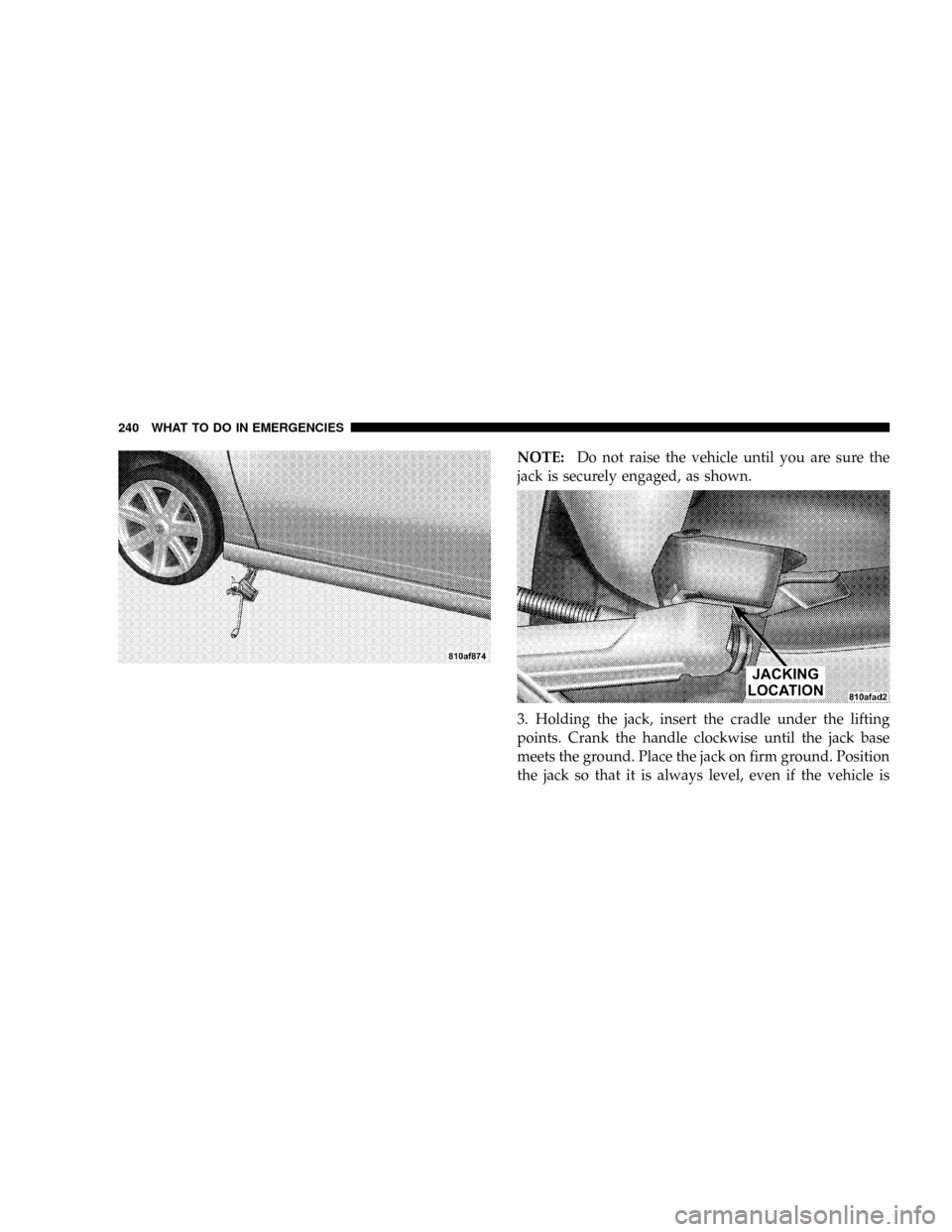
NOTE:Do not raise the vehicle until you are sure the
jack is securely engaged, as shown.
3. Holding the jack, insert the cradle under the lifting
points. Crank the handle clockwise until the jack base
meets the ground. Place the jack on firm ground. Position
the jack so that it is always level, even if the vehicle is
240 WHAT TO DO IN EMERGENCIES