lock CHRYSLER CROSSFIRE 2008 1.G Workshop Manual
[x] Cancel search | Manufacturer: CHRYSLER, Model Year: 2008, Model line: CROSSFIRE, Model: CHRYSLER CROSSFIRE 2008 1.GPages: 358, PDF Size: 4.7 MB
Page 171 of 358
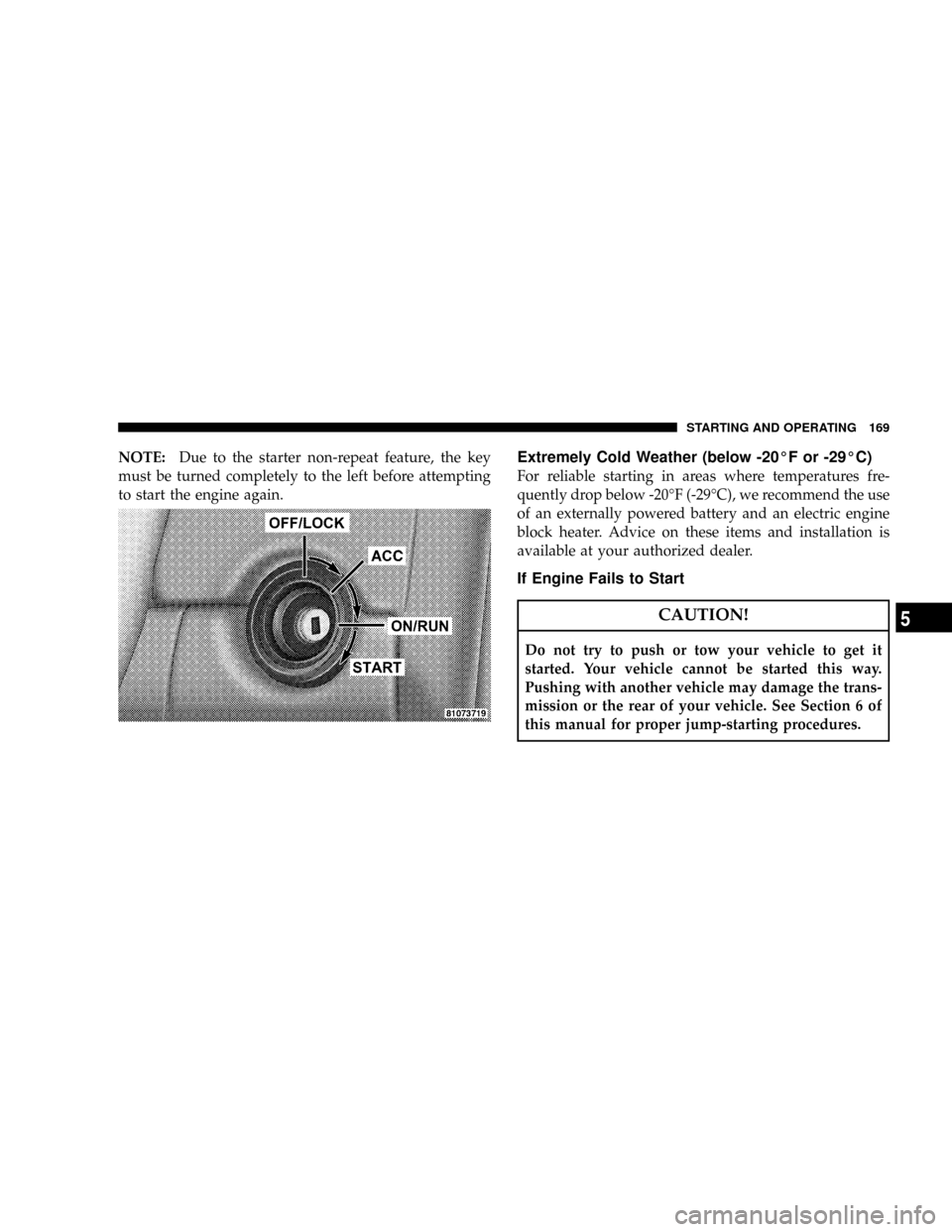
NOTE:Due to the starter non-repeat feature, the key
must be turned completely to the left before attempting
to start the engine again.Extremely Cold Weather (below -20ÉF or -29ÉC)
For reliable starting in areas where temperatures fre-
quently drop below -20ÉF (-29ÉC), we recommend the use
of an externally powered battery and an electric engine
block heater. Advice on these items and installation is
available at your authorized dealer.
If Engine Fails to Start
CAUTION!
Do not try to push or tow your vehicle to get it
started. Your vehicle cannot be started this way.
Pushing with another vehicle may damage the trans-
mission or the rear of your vehicle. See Section 6 of
this manual for proper jump-starting procedures.
STARTING AND OPERATING 169
5
Page 175 of 358
WARNING!
When leaving the vehicle, always remove the key
from the ignition switch, and lock the vehicle. Do not
leave children unattended in the vehicle, or with
access to an unlocked vehicle. Children could move
the gearshift lever, which could result in an accident
or serious injury.
WARNING!
Skipping more than one gear while downshifting
could cause you to lose control of your vehicle. You
could have an accident.
CAUTION!
If you skip more than one gear while downshifting
or downshift at too high an engine speed, you could
damage the engine, transmission, or clutch.
STARTING AND OPERATING 173
5
Page 176 of 358
Automatic Transmission
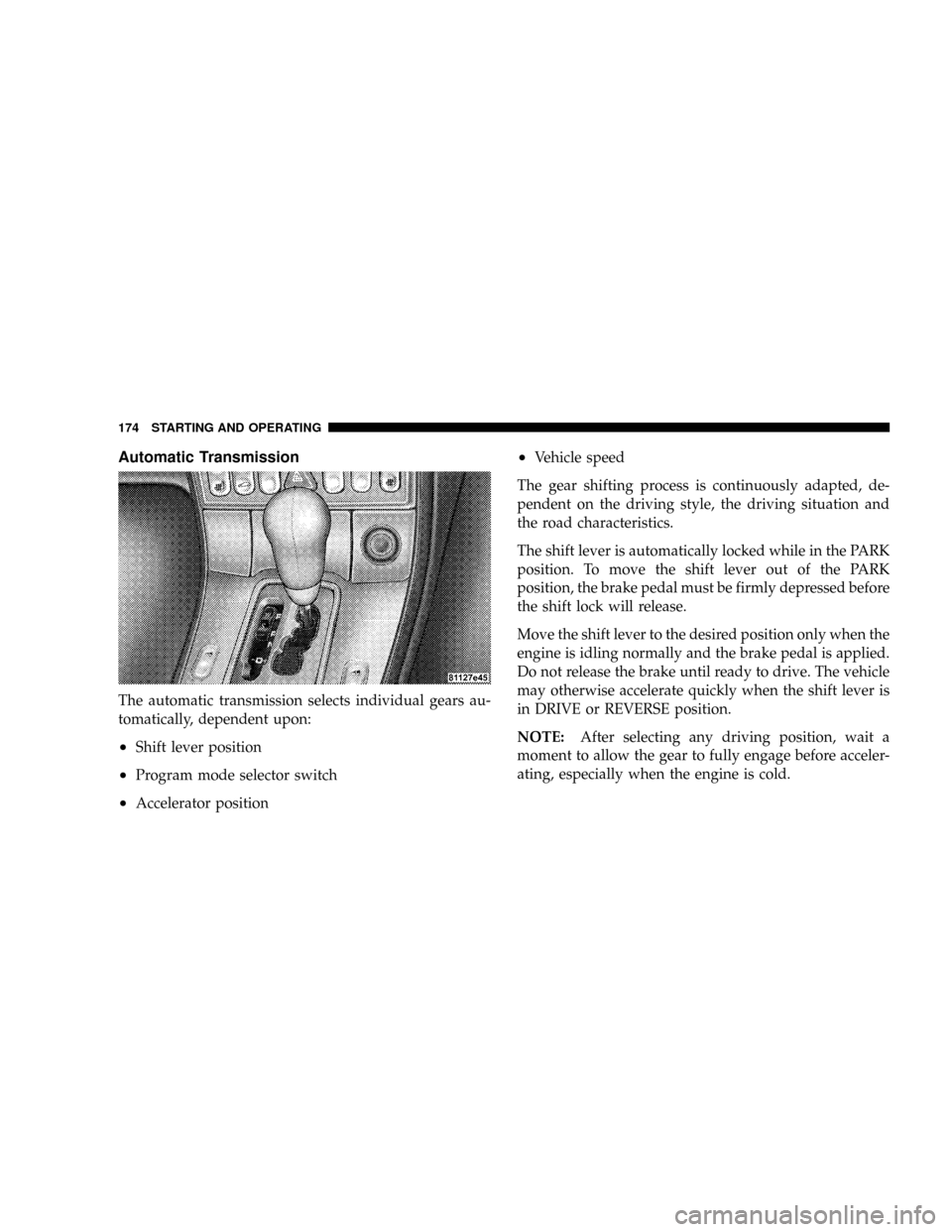
The automatic transmission selects individual gears au-
tomatically, dependent upon:
²Shift lever position
²Program mode selector switch
²Accelerator position
²Vehicle speed
The gear shifting process is continuously adapted, de-
pendent on the driving style, the driving situation and
the road characteristics.
The shift lever is automatically locked while in the PARK
position. To move the shift lever out of the PARK
position, the brake pedal must be firmly depressed before
the shift lock will release.
Move the shift lever to the desired position only when the
engine is idling normally and the brake pedal is applied.
Do not release the brake until ready to drive. The vehicle
may otherwise accelerate quickly when the shift lever is
in DRIVE or REVERSE position.
NOTE:After selecting any driving position, wait a
moment to allow the gear to fully engage before acceler-
ating, especially when the engine is cold.
174 STARTING AND OPERATING
Page 178 of 358
Park Position
The PARK position is to be used when parking the
vehicle. Engage only with the vehicle stopped. The PARK
position is not intended to serve as a brake when the
vehicle is parked. Rather, the driver should always use
the parking brake in addition to placing the shift lever in
PARK to secure the vehicle.
NOTE:The key can be removed from the ignition
switch only with the shift lever in the PARK position.
With the key removed, the shift lever is locked in the
PARK position.
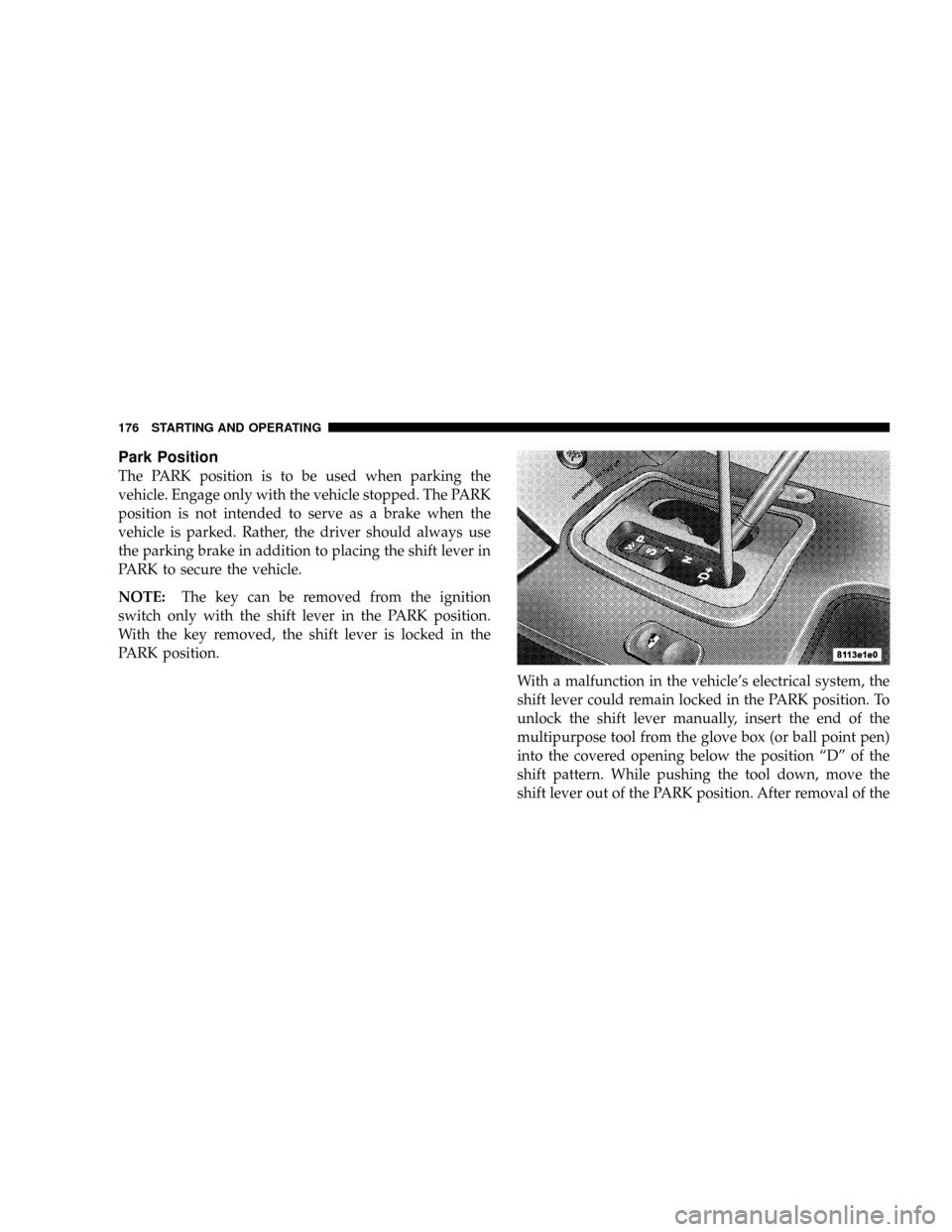
With a malfunction in the vehicle's electrical system, the
shift lever could remain locked in the PARK position. To
unlock the shift lever manually, insert the end of the
multipurpose tool from the glove box (or ball point pen)
into the covered opening below the position ªDº of the
shift pattern. While pushing the tool down, move the
shift lever out of the PARK position. After removal of the
176 STARTING AND OPERATING
Page 181 of 358
WARNING!
On slippery road surfaces, never downshift in order
to obtain braking action. This could result in drive
wheel slip and reduced vehicle control. Your vehi-
cle's ABS will not prevent this type of loss of control.
You could lose control of your vehicle and have an
accident.
NOTE:With transmission in gear ªD,º ª4,º or ª3,º
upshifting from FIRST to SECOND to THIRD gear may
be delayed, depending on vehicle speed and engine
temperature. This allows the catalytic converter to heat
up more quickly to operating temperatures.
The delayed upshift is effective with vehicle speeds
below 31 mph (50 km/h) at partial throttle and engine
temperatures below 95ÉF (35ÉC). To prevent the engine
from laboring at low RPM when driving uphill or withyour vehicle heavily loaded, the automatic transmission
will downshift when necessary to maintain engine RPM
within the best torque range.
Gear Ranges
PARK
NOTE:If the key is in the ON/RUN position, you must
press the brake pedal to shift out of the PARK position.
PARK supplements the parking brake by locking the
transmission. The engine can be started in this range.
Never attempt to use PARK while the vehicle is in
motion.
Apply the parking brake when leaving the vehicle in this
range.
REVERSE
Shift into this range only after the vehicle has come to a
complete stop.
STARTING AND OPERATING 179
5
Page 186 of 358
CAUTION!
²Driving through standing water may cause dam-
age to your vehicle's drivetrain components. Al-
ways inspect your vehicle's fluids (i.e., engine oil,
transmission, axle, etc.) for signs of contamination
(i.e., fluid that is milky or foamy in appearance)
after driving through standing water. Do not con-
tinue to operate the vehicle if any fluid appears
contaminated, as this may result in further dam-
age. Such damage is not covered by the New
Vehicle Limited Warranty.
²Getting water inside your vehicle's engine can
cause it to lock up and stall out, and cause serious
internal damage to the engine. Such damage is not
covered by the New Vehicle Limited Warranty.
WARNING!
²Driving through standing water limits your vehi-
cle's traction capabilities. Do not exceed 5 mph (8
km/h) when driving through standing water.
²Driving through standing water limits your vehi-
cle's braking capabilities, which increases stop-
ping distances. Therefore, after driving through
standing water, drive slowly and lightly press on
the brake pedal several times to dry the brakes.
²Getting water inside your vehicle's engine can
cause it to lock up and stall out, and leave you
stranded.
²Failure to follow these warnings may result in
injuries that are serious or fatal to you, your
passengers, and others around you.
184 STARTING AND OPERATING
Page 187 of 358
PARKING BRAKE
When you apply the parking brake with engine
running, the brake system warning light in the
instrument cluster will come on.
NOTE:This light, when illuminated with parking brake
application, shows only that the parking brake is on. It
does not show the degree of brake application.
NOTE:If the light remains on with the parking brake
released, a brake system malfunction is indicated. Have
the brake system serviced by an authorized dealer im-
mediately.
Before leaving the vehicle, make sure that the parking
brake is fully applied. For manual transmission vehicles,
place the shift lever in REVERSE. For vehicles equipped
with automatic transmissions, place the shift lever in the
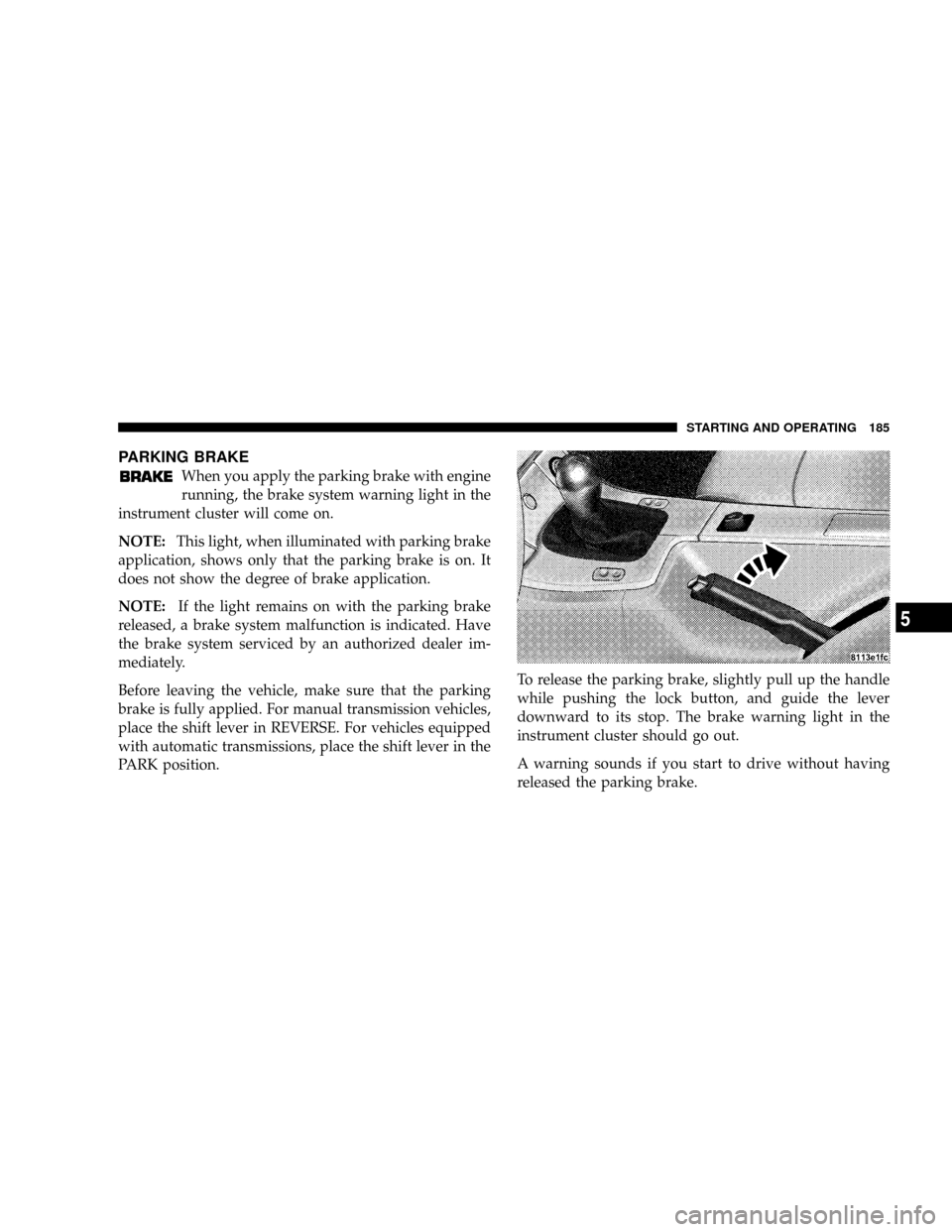
PARK position.To release the parking brake, slightly pull up the handle
while pushing the lock button, and guide the lever
downward to its stop. The brake warning light in the
instrument cluster should go out.
A warning sounds if you start to drive without having
released the parking brake.
STARTING AND OPERATING 185
5
Page 188 of 358
When parking on a hill, you must set the parking brake
beforeplacing the shift lever in PARK. If you don't, the
load on the transmission locking mechanism may make it
difficult to move the shift lever out of PARK. As an added
precaution, turn the front wheels toward the curb on a
downhill grade and away from the curb on an uphill
grade.
The parking brake should always be applied when the
driver is not in the vehicle.
WARNING!
Be sure the parking brake is fully disengaged before
driving; failure to do so can lead to brake failure and
an accident.
WARNING!
Do not leave children unattended in a vehicle. A
child could be injured, or could injure others, if left
unattended.
BRAKE SYSTEM
Your vehicle is equipped with power brakes as standard
equipment. In the event power assist is lost for any
reason (for example, repeated brake applications with the
engine off), the brakes will still function. The effort
required to brake the vehicle will be much greater than
that required with the power system operating.
If either the front or rear hydraulic system loses normal
capability, the remaining system will still function with
some loss of overall braking effectiveness. This will be
evident by increased pedal travel during application,
186 STARTING AND OPERATING
Page 189 of 358
greater pedal force required to slow or stop, and activa-
tion of the brake warning light during brake use.
Brake Assist System (BAS)
The BAS is designed to maximize the vehicle's braking
capability during emergency braking maneuvers. Maxi-
mum power boost is applied to the brakes more quickly
in emergency braking conditions. This can help reduce
braking distances relative to what ordinary driving and
braking style might do.
The BAS complements the antilock brake system (ABS).
Applying the brakes very quickly results in maximum
BAS assistance. To receive the benefit of the system you
must apply continuous, full braking power during the
stopping sequence. Do not reduce brake pedal pressure.
WARNING!
BAS cannot prevent the natural laws of physics from
acting on the vehicle, nor can it increase braking
efficiency beyond that afforded by the condition of
the vehicle brakes and tires or the traction afforded.
The BAS cannot prevent accidents, including those
resulting from excessive speed in turns, following
another vehicle too closely, or hydroplaning. Only a
safe, attentive, and skillful driver can prevent acci-
dents. The capabilities of a BAS-equipped vehicle
must never be exploited in a reckless or dangerous
manner which could jeopardize the user's safety or
the safety of others.
Once the brake pedal is released, the BAS is deactivated.
STARTING AND OPERATING 187
5
Page 192 of 358
The ESP warning light starts to flash at any vehicle speed
as soon as the tires lose traction and the wheels begin to
spin.
If the ESP warning light flashes during acceleration, ease
up on the accelerator and apply as little throttle as
possible. While driving, adapt your speed to the prevail-
ing road conditions.
CAUTION!
If the vehicle is towed with the front axle raised (see
the What To Do In Emergencies section in this
manual), the engine must be shut off (key in the
ignition switch turned to the OFF/LOCK or ACC
position). Otherwise, the ESP will immediately be
engaged and will apply the rear wheel brakes.NOTE:When the ESP warning light is illuminated
continuously, the ESP is switched off. Adapt your speed
and driving to the prevailing road conditions.
NOTE:Avoid spinning of one drive wheel. This may
cause serious damage to the drivetrain which is not
covered by the DaimlerChrysler Limited Warranty.
NOTE:If the ESP warning light flashes during accelera-
tion, ease up on the accelerator.
NOTE:ESP should not be switched off during normal
driving. Disabling of the system under normal operating
conditions will eliminate the benefits of the ESP system.
190 STARTING AND OPERATING