ECU CHRYSLER CROSSFIRE 2008 1.G Owners Manual
[x] Cancel search | Manufacturer: CHRYSLER, Model Year: 2008, Model line: CROSSFIRE, Model: CHRYSLER CROSSFIRE 2008 1.GPages: 358, PDF Size: 4.7 MB
Page 10 of 358
NGeneral Information....................19
NTransmitter Battery Service...............20
mSecurity Alarm System....................21
NTow-Away Alarm......................21
mDecklid Internal Emergency Release - Roadster . . .22
mPower Windows........................24
NPower Window Operation With The
Convertible Top Switch (Roadster Only)......25
mRear Liftgate/Decklid Release...............25
mOccupant Restraints......................26
NLap/Shoulder Belts.....................27NSeat Belts And Pregnant Women............32
NSeat Belt Extender......................32
NSupplemental Restraint System (SRS) - Airbag . .33
NChild Restraint........................52
mEngine Break-In Recommendations...........61
mSafety Tips............................61
NExhaust Gas..........................61
NSafety Checks You Should Make Inside The
Vehicle..............................62
NPeriodic Safety Checks You Should Make
Outside The Vehicle....................63
8 THINGS TO KNOW BEFORE STARTING YOUR VEHICLE
Page 12 of 358
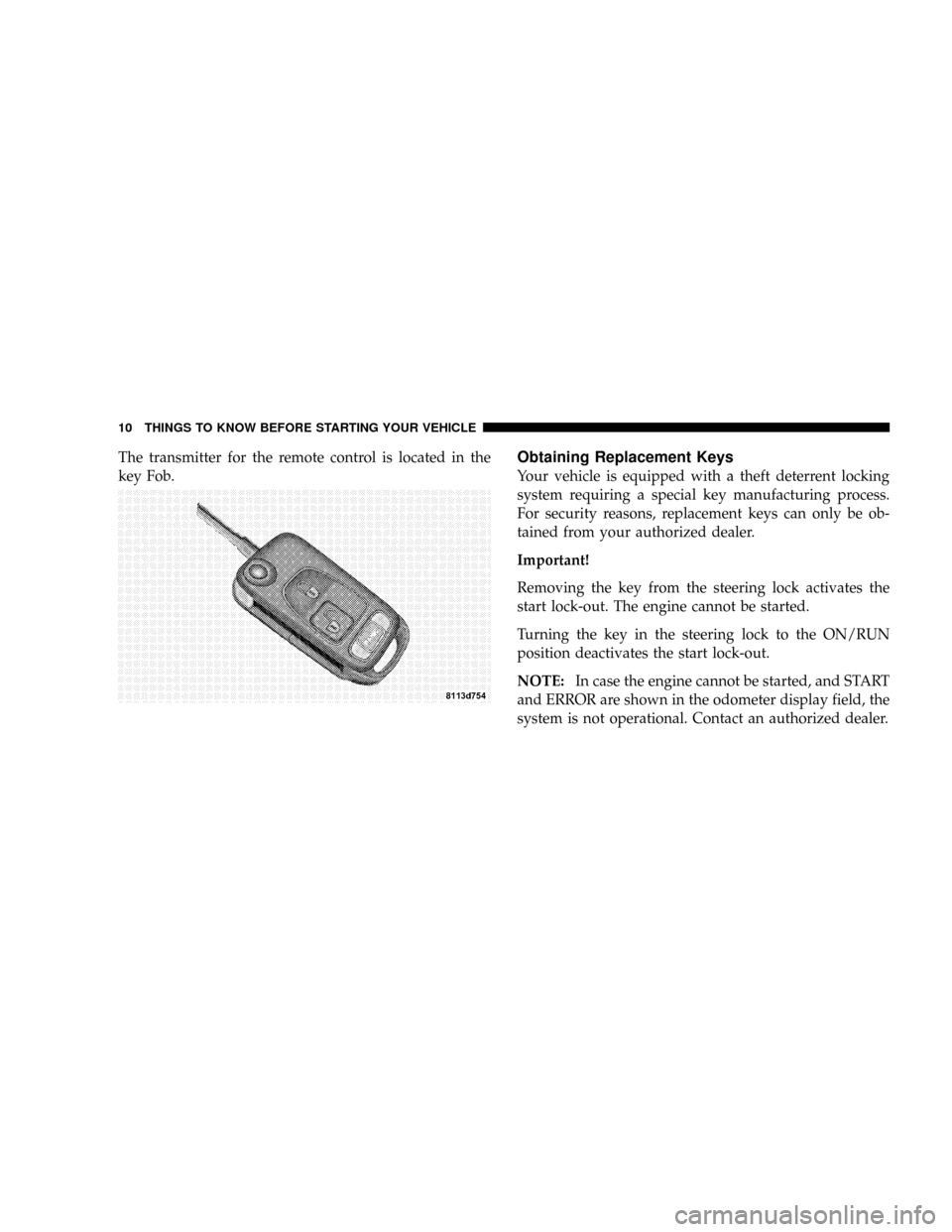
The transmitter for the remote control is located in the
key Fob.Obtaining Replacement Keys
Your vehicle is equipped with a theft deterrent locking
system requiring a special key manufacturing process.
For security reasons, replacement keys can only be ob-
tained from your authorized dealer.
Important!
Removing the key from the steering lock activates the
start lock-out. The engine cannot be started.
Turning the key in the steering lock to the ON/RUN
position deactivates the start lock-out.
NOTE:In case the engine cannot be started, and START
and ERROR are shown in the odometer display field, the
system is not operational. Contact an authorized dealer.
10 THINGS TO KNOW BEFORE STARTING YOUR VEHICLE
Page 16 of 358
clockwise, or push down the LOCK buttons. To unlock,
turn the key in the driver's door lock counterclockwise,
or pull the inside door handles.
WARNING!
For personal security and safety in the event of an
accident, lock the vehicle doors as you drive and
when you park and leave the vehicle.
Central Locking Switch
The central locking switch is located in the console. The
doors and rear liftgate/decklid can only be locked with
the central locking switch if both doors are closed.
If the vehicle was previously locked with the remote
control or key, the doors and rear liftgate/decklid cannot
be unlocked with the central locking switch. If the vehiclewas previously locked with the central locking switch,
the complete vehicle is unlocked when a door is opened
from the inside.
NOTE:The fuel filler door and center console (roadster
only) cannot be locked or unlocked with the central
locking switch.
Automatic Central Locking
The central locking switch also operates the automatic
central locking feature. With the automatic central lock-
ing feature activated, the doors and rear liftgate/decklid
are locked at vehicle speeds of approximately 9 mph (15
km/h) or more; however, the fuel filler door remains
unlocked.
To activate this feature, turn the key to the ON/RUN
position and hold the upper portion of the switch for a
minimum of five seconds. To deactivate, turn the key to
the ON/RUN position and hold the lower portion of the
switch for a minimum of five seconds.
14 THINGS TO KNOW BEFORE STARTING YOUR VEHICLE
Page 23 of 358
NOTE:Only replace the batteries in pairs.
The system may have to be re-synchronized if the trans-
mitter is without voltage for several minutes. To synchro-
nize, aim the transmitter eye at the vehicle and briefly
press either the LOCK or the UNLOCK button twice.
Within approximately 30 seconds, insert the key in the
ignition and turn it to the ON/RUN position. The remote
control should once again be operational.
SECURITY ALARM SYSTEM
The Security Alarm system monitors the doors, rear
liftgate/decklid, hood, and ignition for unauthorized
operation. The Security Alarm system is automatically
armed or disarmed with the remote control or any of
your vehicle's keys by locking or unlocking the vehicle.
The antitheft alarm is armed within approximately 10
seconds after locking the vehicle. A blinking light in the
tow away alarm switch indicates that the alarm is armed.
Once the Security Alarm system has been armed, theexterior vehicle lights will flash and an alarm will sound
when a door, the rear liftgate/decklid, the hood, or glove
compartment is opened, or if someone attempts to raise
the vehicle for towing. The Security Alarm will flash the
exterior lamps for approximately three minutes and
sound an audible alarm for 30 seconds. The Security
Alarm will stay on even if the activating element is
immediately closed.
Tow-Away Alarm
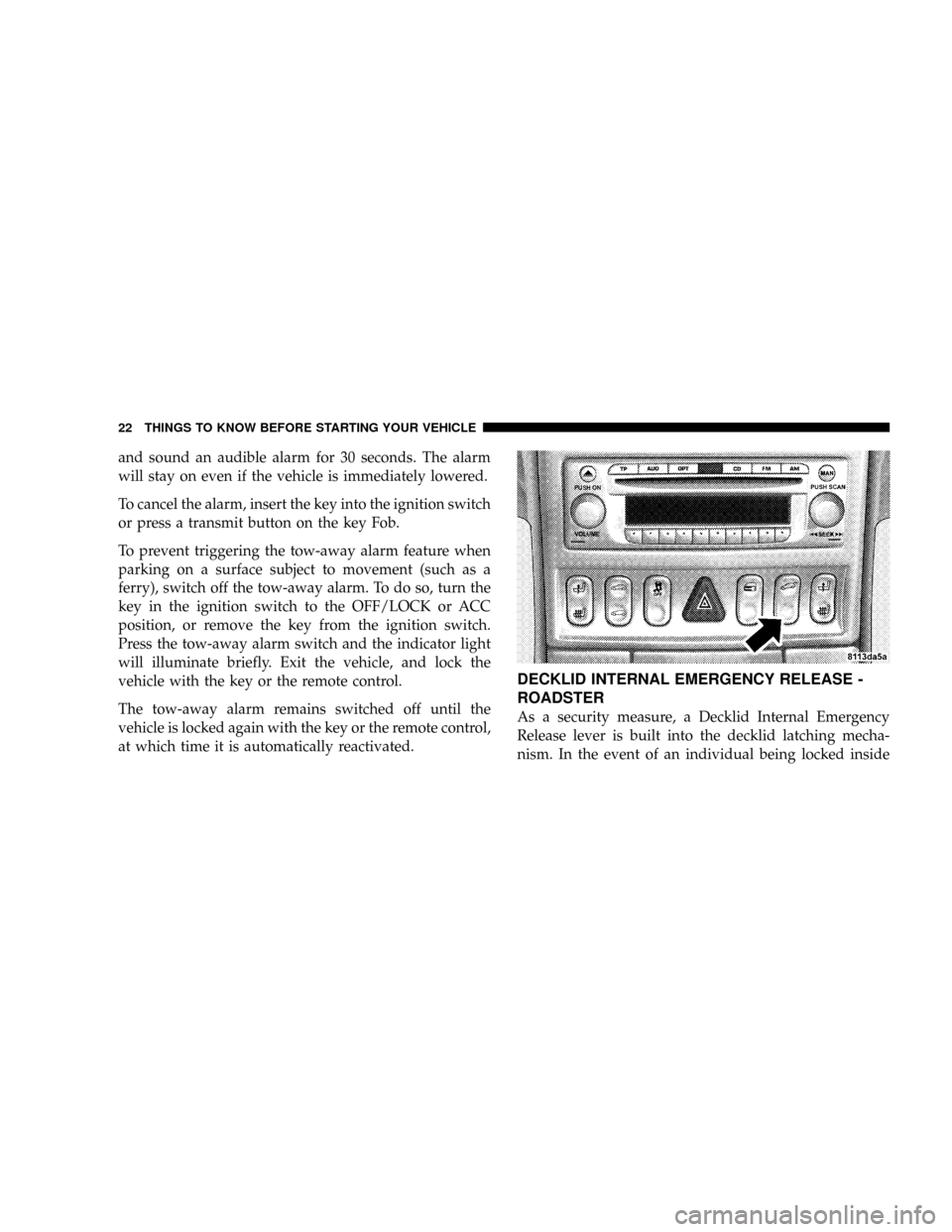
The tow-away alarm switch is located on the console. To
deactivate for towing or jacking up the vehicle, press and
release the upper portion of the switch. Press and release
the upper portion to activate it again.
After the alarm system has been armed, the exterior
vehicle lights will flash and an alarm will sound when
someone attempts to raise the vehicle. The alarm will
flash the exterior lamps for approximately three minutes
THINGS TO KNOW BEFORE STARTING YOUR VEHICLE 21
2
Page 24 of 358
and sound an audible alarm for 30 seconds. The alarm
will stay on even if the vehicle is immediately lowered.
To cancel the alarm, insert the key into the ignition switch
or press a transmit button on the key Fob.
To prevent triggering the tow-away alarm feature when
parking on a surface subject to movement (such as a
ferry), switch off the tow-away alarm. To do so, turn the
key in the ignition switch to the OFF/LOCK or ACC
position, or remove the key from the ignition switch.
Press the tow-away alarm switch and the indicator light
will illuminate briefly. Exit the vehicle, and lock the
vehicle with the key or the remote control.
The tow-away alarm remains switched off until the
vehicle is locked again with the key or the remote control,
at which time it is automatically reactivated.
DECKLID INTERNAL EMERGENCY RELEASE -
ROADSTER
As a security measure, a Decklid Internal Emergency
Release lever is built into the decklid latching mecha-
nism. In the event of an individual being locked inside
22 THINGS TO KNOW BEFORE STARTING YOUR VEHICLE
Page 37 of 358
NOTE:The passenger front airbag may not deploy even
when the driver front airbag has deployed if the Occu-
pant Classification System (refer to ªOccupant Classifi-
cation Systemº in this section) has determined the seat is
empty or is occupied by someone that is classified in the
ªchildº category. This could be a child, a teenager, or
even a small adult. The side airbags on the crash side of
the vehicle is triggered in moderate to severe side colli-
sions. However even in collisions where the airbags
work, you need the seat belts to keep you in the right
position for the airbags to protect you properly.
The seat belts are designed to protect you in many types
of collisions. The front airbags deploy only in moderate
to severe front collisions. In certain types of collisions,
both the front and side airbags may be triggered.
Here are some simple steps you can take to minimize
the risk of harm from a deploying airbag.1. Infants in rear-facing child safety seats shouldNEVER
ride in the front seat of a vehicle with a passenger frontal
airbag unless the airbag is shut OFF. See ªPassenger
Airbag On/Off Switchº and ªTo Shut Off the Passenger
Airbag.º The rear-facing seat places them too close to the
passenger air bag in the event of a crash. An airbag
deployment can cause severe injury or death to infants in
this position.
Children that are not big enough to properly wear the
vehicle seat belt (see section on ªChild Restraintº) should
be secured in child safety seats or booster seats that are
appropriate for the child's age, height, and weight.
Older children who do not use child safety seats or
booster seats should ride properly buckled. Never allow
children to place the shoulder belt behind them or under
the arm.
THINGS TO KNOW BEFORE STARTING YOUR VEHICLE 35
2
Page 54 of 358
Child Restraint
Everyone in your vehicle needs to be buckled up all the
time, including babies and children. Every state in the
United States and all Canadian provinces require that
small children ride in proper restraint systems. This is the
law, and you can be prosecuted for ignoring it.
WARNING!
In a collision, an unrestrained child, even a tiny baby,
can become a missile inside the vehicle. The force
required to hold even an infant on your lap could
become so great that you could not hold the child, no
matter how strong you are. The child and others
could be badly injured. Any child riding in your
vehicle should be in a proper restraint for the child's
size.
Infants and Child Restraints
There are different sizes and types of restraints for
children from newborn size to the child almost large
enough for an adult safety belt. Always check the child
seat Owner's Manual to ensure you have the right seat
for your child. Use the restraint that is correct for your
child:
²Safety experts recommend that children ride
rearward-facing in the vehicle until they are at least
one year old and weigh at least 20 lbs (9 kg). Two types
of child restraints can be used rearward-facing: infant
carriers and convertible child seats.
²The infant carrier is only used rearward-facing in the
vehicle. It is recommended for children who weigh up
to about 20 lbs (9 kg). Convertible child seats can be
used either rearward-facing or forward-facing in the
vehicle. Convertible child seats often have a higher
weight limit in the rearward-facing direction than
52 THINGS TO KNOW BEFORE STARTING YOUR VEHICLE
Page 56 of 358
Here are some tips on getting the most out of your child
restraint:
²Before buying any restraint system, make sure that it
has a label certifying that it meets all applicable Safety
Standards. We also recommend that you make sure
that you can install the child restraint in the vehicle
where you will use it before you buy it.
²The restraint must be appropriate for your child's
weight and height. Check the label on the restraint for
weight and height limits.
²Carefully follow the instructions that come with the
restraint. If you install the restraint improperly, it may
not work when you need it.
²Buckle the child into the seat according to the seat
manufacturer's directions.
²When your child restraint is not in use, secure it in the
vehicle with the seat belt or remove it from the vehicle.Do not leave it loose in the vehicle. In a sudden stop or
collision, it could strike the occupants and cause
serious personal injury.
NOTE: For additional information refer to
www.seatcheck.org or call 1±866±SEATCHECK.
Older Children and Child Restraints
Children who weigh more than 20 lbs (9 kg) and who are
older than one year can ride forward-facing in the
vehicle. Forward-facing child seats and convertible child
seats used in the forward-facing direction are for children
who weigh 20 to 40 lbs (9 to 18 kg) and who are older
than one year. These child seats are also held in the
vehicle by the lap/shoulder belt or the LATCH child
restraint anchorage system. (See LATCH - Child Seat
Anchorage System section.)
The belt-positioning booster seat is for children weighing
more than 40 lbs (18 kg), but who are still too small to fit
the vehicle's seat belts properly. If the child cannot sit
54 THINGS TO KNOW BEFORE STARTING YOUR VEHICLE
Page 57 of 358
with knees bent over the vehicle's seat cushion while the
child's back is against the seatback, they should use a
belt-positioning booster seat. The child and belt-
positioning booster seat are held in the vehicle by the
lap/shoulder belt.
Children Too Large For Booster Seats
Children who are large enough to wear the shoulder belt
comfortably, and whose legs are long enough to bend
over the front of the seat when their back is against the
seatback, should use the lap/shoulder belt.
²Make sure that the child is upright in the seat.
²The lap portion should be low on the hips and as snug
as possible.
²Check belt fit periodically. A child's squirming or
slouching can move the belt out of position.
²If the shoulder belt contacts the face or neck, move the
child closer to the center of the vehicle. Never allow a
child to put the shoulder belt under an arm or behind
their back.
LATCH - Child Seat Anchorage System (Lower
Anchors and Tether for Children)
Your vehicle's passenger seat is equipped with the child
restraint anchorage system called LATCH. The LATCH
system provides for the installation of the child restraint
without using the vehicle's belts, instead securing the
child restraint using lower anchorages and upper tether
straps from the child restraint to the vehicle structure.
LATCH-compatible child restraints are now available.
THINGS TO KNOW BEFORE STARTING YOUR VEHICLE 55
2
Page 60 of 358
WARNING!
After installing a child safety seat or booster seat on the
passenger seat, do not adjust the back rest forward. This
could cause a higher load being perceived by the OCS
system which in turn could lead to the passenger airbag
being turned on. Failure to follow this warning could
result in serious or fatal injury. It is always recom-
mended to turn off the passenger front air bags using
the passenger front airbags on/off switch located at the
right end of the instrument panel when the passenger is:
²an infant (less than 1 year old),
²a child, age 1 to 12,
²an adult with a medical condition which makes
passenger airbags inflation (deployment) a greater
risk for the passenger than the risk of hitting the
dashboard (instrument panel) or windshield in a
crash.
The on/off switch is accessible by opening the passen-
ger door.
WARNING!
Improper installation of a child restraint to the
LATCH anchorages can lead to failure of an infant or
child restraint. The child could be badly injured or
killed. Follow the manufacturer's directions exactly
when installing an infant or child restraint.
Installing Child Restraints Using the Vehicle Seat
Belt
Child restraints can be securely fastened in the passenger
seat using the seat belts. For this purpose, the passenger
seat belt retractor provides two modes of operation -
normal emergency locking and automatic locking. For
child restraint installation, the retractor switches to auto-
matic locking when the belt is pulled out to the full extent
of its travel. As the belt retracts, the retractor locks to
prevent the belt from being pulled out again. Pulling the
58 THINGS TO KNOW BEFORE STARTING YOUR VEHICLE