service CHRYSLER CROSSFIRE SRT 2005 1.G Owner's Guide
[x] Cancel search | Manufacturer: CHRYSLER, Model Year: 2005, Model line: CROSSFIRE SRT, Model: CHRYSLER CROSSFIRE SRT 2005 1.GPages: 280, PDF Size: 14.34 MB
Page 200 of 280

Catalytic Converter
The catalytic converter requires the use of unleaded fuel
only. Leaded gasoline will destroy the effectiveness of the
catalyst as an emission control device.
Under normal operating conditions, the catalytic con-
verter will not require maintenance. However, it is im-
portant to keep the engine properly serviced to assure
proper catalyst operation and prevent possible catalyst
damage.
If the CHECK ENGINE light is flashing, immediate
service is required.CAUTION!
Damage to the catalytic converter can result if your
vehicle is not kept in proper operating condition. In
the event of engine malfunction, particularly involv-
ing engine misfire or other apparent loss of perfor-
mance, have your vehicle serviced promptly. Contin-
ued operation of your vehicle with a severe
malfunction could cause the converter to overheat,
resulting in possible damage to the converter and the
vehicle.
WARNING!
A hot exhaust system can start a fire if you park over
materials that can burn. Such materials might be
grass or leaves coming into contact with your ex-
haust system. Do not park or operate your vehicle in
areas where your exhaust system can contact any-
thing that can burn.
200 MAINTAINING YOUR VEHICLE
Page 201 of 280

In unusual situations involving grossly malfunctioning
engine operation, a scorching odor may suggest severe
and abnormal catalyst overheating. If this occurs, stop
the vehicle, turn off the engine and allow it to cool.
Service, including a tune up to DaimlerChrysler Corpo-
ration’s specifications, should be obtained immediately.
To minimize the possibility of catalyst damage:
•Do not shut off the engine or interrupt the ignition
when the transmission is in gear and the vehicle is in
motion.
•Do not try to start the engine by pushing or towing the
vehicle.
•Do not idle the engine with any spark plug wires
disconnected for a prolonged period.
Ignition Wiring System
The ignition cables should be kept clean and properly
connected. Terminals should be fully seated. Cracked,
damaged, or faulty cables should be replaced.
Crankcase Emission Control System
Proper operation of this system depends on freedom
from sticking or plugging due to deposits.
Check ventilation hose for indication of damage or
plugging deposits. Replace if necessary.
Maintenance-Free Battery
The top of the maintenance-free battery is permanently
sealed. You will never have to add water, nor is periodic
maintenance required.
MAINTAINING YOUR VEHICLE 201
7
Page 203 of 280
NOTE:If your air conditioning performance seems
lower than expected, check the front of the A/C con-
denser for an accumulation of dirt or insects. Clean with
a gentle water spray from behind the radiator and
through the condenser as required. Fabric front fascia
protectors may reduce air flow to the condenser, reducing
air conditioning performance.
WARNING!
The air conditioning system contains refrigerant
under high pressure. To avoid risk of personal injury
or damage to the system, adding refrigerant or any
repair requiring lines to be disconnected should be
done by an experienced repair person.
Refrigerant Recovery And Recycling
The air conditioning system of your vehicle contains
R-134a, a refrigerant that does not deplete the ozone layer
in the upper atmosphere. The DaimlerChrysler Corpora-
tion recommends that air conditioning service be done by
facilities using refrigerant recycling and recovery equip-
ment that meets SAE standard J1991.
Power Steering Fluid
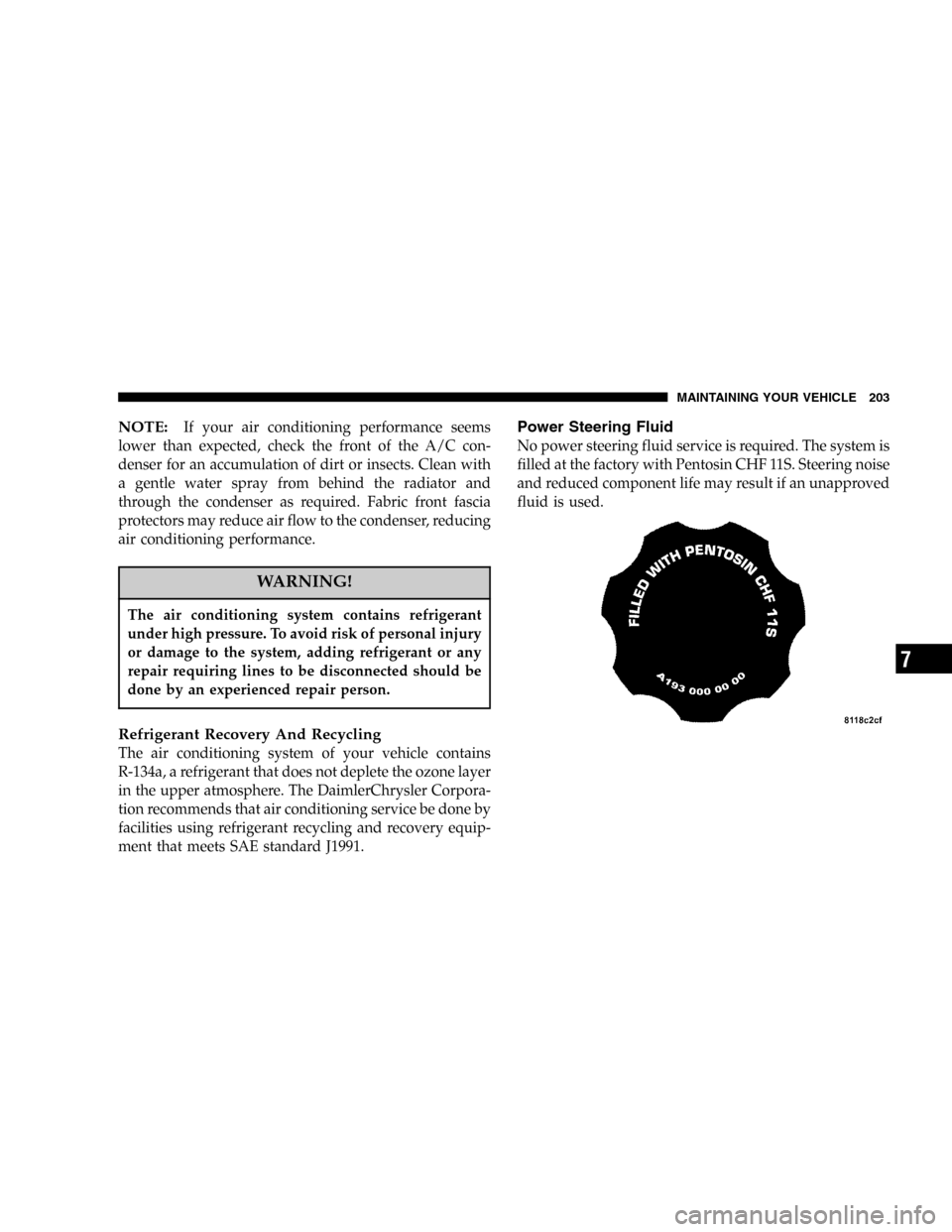
No power steering fluid service is required. The system is
filled at the factory with Pentosin CHF 11S. Steering noise
and reduced component life may result if an unapproved
fluid is used.
MAINTAINING YOUR VEHICLE 203
7
Page 204 of 280

Chassis Lubrication
Front Suspension Ball Joints
There are two front suspension lower ball joints that are
permanently lubricated. Inspect these ball joints when-
ever under-vehicle service is done.
Steering Linkage
Inspect tie rod ends whenever the vehicle is serviced.
They are permanently lubricated and do not require
periodic lubrication.
Drive Shaft Universal Joints
Your vehicle has four constant velocity universal joints.
Periodic lubrication of these joints is not required. How-
ever, the joint boots should be inspected for external
leakage or damage when other maintenance is per-
formed.
If leakage or damage is evident, replace the universal
joint boot and grease immediately.
Continued operation could result in failure of the univer-
sal joint due to water and dirt contamination of the
grease. This would require complete replacement of the
joint assembly.
Body Lubrication
Locks and all body pivot points, including such items as
seat tracks, doors, and rear liftgate / decklid hinges,
should be lubricated periodically to assure quiet, easy
operation and to protect against rust and wear.
Hood Latch
When performing other under hood services, the hood
latch release mechanism and safety catch should be
inspected, cleaned, and lubricated.
204 MAINTAINING YOUR VEHICLE
Page 211 of 280

•If frequent coolant additions are required, or if the
level in the recovery bottle does not drop when the
engine cools, the cooling system should be pressure
tested for leaks.
•Maintain a coolant concentration of a minimum of 50%
ethylene glycol Extended Life Coolant and high qual-
ity water with recommended antifreeze for proper
corrosion protection of your engine cooling system
that contains aluminum components.
•Make sure that the radiator and coolant bottle hoses
are not kinked or obstructed.
•Keep the front of the radiator clean. If your vehicle has
air conditioning, keep the front of the condenser clean,
also.
•Do not change the thermostat for summer or winter
operation. If replacement is ever necessary, install
ONLY the correct type thermostat. Other designs may
result in unsatisfactory coolant performance, poor fuel
economy, and increased emissions.
Hoses And Vacuum/Vapor Harnesses
Inspect surfaces of hoses and nylon tubing for evidence
of heat and mechanical damage. Hard or soft spots,
brittle rubber, cracking, checking, tears, cuts, abrasions,
and excessive swelling indicate deterioration of the rub-
ber.
Pay particular attention to the hoses nearest to high heat
sources such as the exhaust manifold. Inspect hose rout-
ing to be sure hoses do not touch any heat source or
moving component that may cause heat damage or
mechanical wear.
Insure nylon tubing in these areas has not melted or
collapsed. Inspect all hose connections such as clamps
and couplings to make sure they are secure and no leaks
are present. Components should be replaced immedi-
ately if there is any evidence of degradation that could
cause failure.
Brakes
In order to assure brake system performance, all brake
system components should be inspected periodically.
Suggested service intervals can be found in the Mainte-
nance section.
MAINTAINING YOUR VEHICLE 211
7
Page 212 of 280

WARNING!
Riding the brakes can lead to brake failure and
possibly an accident. Driving with your foot resting
or riding on the brake pedal can result in abnormally
high brake temperatures, excessive lining wear, and
possible brake damage. You wouldn’t have your full
braking capacity in an emergency.
Brake and Power Steering System Hoses
When servicing the vehicle for scheduled maintenance,
inspect surface of hoses and nylon tubing for evidence of
heat and mechanical damage. Hard and brittle rubber,
cracking, checking, tears, cuts, abrasions, and excessive
swelling suggest deterioration of the rubber. Particular
attention should be made to examining those hose sur-
faces nearest to high heat sources, such as the exhaust
manifold.
Inspect all hose clamps and couplings to make sure they
are secure and no leaks are present.
Insure nylon tubing in these areas has not melted or
collapsed.
NOTE:Often, fluids such as oil, power steering fluid,
and brake fluid are used during assembly plant opera-
tions to ease the assembly of hoses to couplings. There-
fore, oil wetness at the hose-coupling area is not neces-
sarily an indication of leakage. Actual dripping of hot
fluid when systems are under pressure (during vehicle
operation) should be noted before a hose is replaced
based on leakage.
NOTE:Inspection of brake hoses should be done
whenever the brake system is serviced and at every
engine oil change.
WARNING!
Worn brake hoses can burst and cause brake failure.
You could have an accident. If you see any signs of
cracking, scuffing, or worn spots, have the brake
hoses replaced immediately.
212 MAINTAINING YOUR VEHICLE
Page 213 of 280

Brake Master Cylinder
The fluid level in the master cylinder should be checked
when performing under hood services, or immediately if
the brake system warning light is on.
Be sure to clean the top of the master cylinder area before
removing the cap. If necessary, add fluid to bring the
fluid level up to the requirements described on the brake
fluid reservoir. Fluid level can be expected to fall as the
brake pads wear. Brake fluid level should be checked
when pads are replaced. However, low fluid level may be
caused by a leak and a checkup may be needed.Use brake fluid approved to MB 331.0, or a DOT 4 brake
fluid with: minimum dry boiling point (ERBP) 500°F,
minimum wet boiling point (WERBP) 356°F, maximum
viscosity 1500 mm
2/s, conforming to FMVSS 116 and
ISO 4925.
WARNING!
Use of a brake fluid that may have a lower initial
boiling point or unidentified as to specification, may
result in sudden brake failure during hard pro-
longed braking. You could have an accident.
WARNING!
Use only brake fluid that has been in a tightly closed
container to avoid contamination from foreign mat-
ter. Use of contaminated fluid may result in reduced
brake performance or a sudden brake failure. You
could have an accident.
MAINTAINING YOUR VEHICLE 213
7
Page 228 of 280

REPLACEMENT BULBS
Interior Light Bulbs
For lighted switches and interior lights, see your autho-
rized dealer for servicing requirements.
Exterior Light Bulbs
Bulb Bulb No.
Headlight - High and Low Beam......12V55W H7U
Front Turn Signal.......................Y21W
Front Parking/Standing Light.............. W5W
Front Side Marker Light.................. W5W
Rear Marker Light...................... W5W
Center High-Mounted Stop Light (CHMSL)..... LED
Front Fog Lights.....................HB455W
Rear Turn Signal Light...................Y21W
Rear Tail and Stop Light.................21/5W
Backup Light........................... 21W
License................................ 168
EXTERIOR LIGHT BULB SERVICE
Headlights
WARNING!
Halogen lamps contain pressurized gas. A bulb can
explode if you:
•Touch or move it when hot
•Drop the bulb
•Scratch the bulb
Wear eye and hand protection.
NOTE:To prevent a possible electrical short circuit,
switch off light prior to replacing a bulb.
1. Push the tab down at the top end of the cover and
remove.
2. Disconnect the electrical connector.
228 MAINTAINING YOUR VEHICLE
Page 231 of 280

NOTE:Always test the operation of all lights after
service operations have been performed to validate an
effective repair.
Headlight Aiming
The headlights on your new vehicle were aimed at the
factory. The factory setting was made at a no load setting.
A great increase in weight will change the aiming and it
may be necessary to readjust the headlights if carrying an
excessive amount of weight in the rear cargo area. To
readjust the headlights first mark the position of the
headlights on a wall prior to loading the vehicle. Loadthe vehicle and then readjust the headlights to the
original position. If any further adjustments are neces-
sary contact your manufacturer’s dealer. A detailed ser-
vice procedure is contained in the manufacturer’s Service
Manual. Information on purchasing a Service Manual can
be found at the back of this Owner’s Manual.
VEHICLE STORAGE
We recommend that you follow these guidelines before
storing your Crossfire for extended periods.
•Fill the gas tank. This will prevent water condensation
inside the tank. If you plan on storing your vehicle
more than two months, add an anti-oxidant fuel
stabilizer to the gas tank.
•Change the oil to remove any corrosive combustion-
related acids in the crankcase.
•Wash and wax the vehicle to protect the finish.
•Cover the vehicle whenever possible to prevent acci-
dental damage to the finish.
•Store the vehicle in a dry, well-ventilated location.
MAINTAINING YOUR VEHICLE 231
7
Page 232 of 280

•If the vehicle will be subjected to freezing tempera-
tures, remove the battery and store it in a dry, well-
ventilated place. If the vehicle is not going to be driven
in the next three weeks, follow the battery recharge
procedure in the Service Manual, then disconnect the
battery at the negative terminal.
CAUTION!
Use care when disconnecting the remote positive
cable. It is connected to the battery and can short out
to any metal on the vehicle. Always tape or wrap the
exposed cable end to prevent electrical shorts.
Disconnecting the battery causes the engine control sys-
tem to lose memory of some“learned”functions. The
engine may run rough when first started after a battery
disconnect until the control module“relearns”these
functions.Check the battery every four to six weeks to ensure that
the voltage is above 12.40. Voltage will drop more rapidly
in hot temperatures. If battery voltage drops below 12.40,
follow the battery recharge procedure in the Service
Manual.
•Check that the radiator coolant level of protection is to
at least -20°F (-29°C).
•Block the wheels. Do not apply the parking brake.
•Make sure that all tires are inflated to the optimum
pressure.
•Cut blocks of plywood about the same size of the tires.
Cover each block with indoor/outdoor carpeting and
place them between the tires and concrete. This will
prevent tire flat spotting.
•For long term storage, remove the tires and put the
vehicle up on blocks. Stack the tires on plywood and
cover with a tarp to prevent flat spotting.
•Move the wiper blades away from the windshield.
232 MAINTAINING YOUR VEHICLE