switch CHRYSLER PACIFICA 2005 1.G Owners Manual
[x] Cancel search | Manufacturer: CHRYSLER, Model Year: 2005, Model line: PACIFICA, Model: CHRYSLER PACIFICA 2005 1.GPages: 420, PDF Size: 5.83 MB
Page 300 of 420

HAZARD WARNING FLASHER
The hazard flasher switch is located in the center of the
instrument panel above the center air outlets.To engage the Hazard Warning Flashers, depress the
switch on the instrument panel. When the Hazard Warn-
ing Switch is activated, all directional turn signals will
flash on and off to warn oncoming traffic of an emer-
gency. Push the switch a second time to turn off the
flashers.
This is an emergency warning system and should not be
used when the vehicle is in motion. Use it when your
vehicle is disabled and is creating a safety hazard for
other motorists.
When you must leave the vehicle to seek assistance, the
Hazard Warning Flashers will continue to operate even
though the ignition switch is OFF.
NOTE:With extended use, the Hazard Warning Flash-
ers may wear down your battery.
Hazard Flasher Switch
300 WHAT TO DO IN EMERGENCIES
Page 309 of 420

•Turn the wheel so that the valve-stem is down. Slide
the wheel retainer through the center of the wheel
and position it properly across the wheel opening.
•For convenience in checking the spare tire inflation,
stow with the valve-stem toward the rear of the
vehicle.
•Using the jack-handle, rotate the drive nut to the
right until the wheel is drawn into place against the
underside of the vehicle.
•Continue to rotate the nut until you hear the mecha-
nism click three times. It cannot be overtightened.
Push against the tire several times to be sure it is
securely in place.
13. Stow the jack and jack handle.
14. Check the tire pressure as soon as possible. Correct
pressure as required.NOTE:When reinstalling the wheel center cap, insure
that the valve stem symbol on the back of the cap is
pointed toward the wheel valve stem. Install the center
cap using hand pressure only. Do not use a hammer.
JUMP-STARTING PROCEDURES IF BATTERY IS
LOW
WARNING!
Take care to avoid the radiator cooling fan whenever
the hood is raised. It can start anytime the ignition
switch is on. You can be hurt by the fan.
WHAT TO DO IN EMERGENCIES 309
6
Page 310 of 420

WARNING!
•Do not attempt to push or tow your vehicle to get it
started. Vehicles equipped with an automatic transmis-
sion cannot be started this way. Unburned fuel could
enter the catalytic converter and once the engine has
started, ignite and damage the converter and vehicle. If
the vehicle has a discharged battery, booster cables may
be used to obtain a start from another vehicle. This type
of start can be dangerous if done improperly, so follow
this procedure carefully.
•Battery fluid is a corrosive acid solution; do not allow
battery fluid to contact eyes, skin or clothing. Don’t lean
over battery when attaching clamps or allow the clamps
to touch each other. If acid splashes in eyes or on skin,
flush contaminated area immediately with large quan-
tities of water.
•A battery generates hydrogen gas which is flammable
and explosive. Keep flame or spark away from the vent
holes. Do not use a booster battery or any other booster
source with an output that exceeds 12 volts.
1. Wear eye protection and remove any metal jewelry
such as watch bands or bracelets that might make an
inadvertent electrical contact.
2. When boost is provided by a battery in another
vehicle, park that vehicle within booster cable reach and
without letting the vehicles touch. Set the parking brake,
place the automatic transmission in PARK and turn the
ignition switch to the OFF position for both vehicles.
3. Turn off the heater, radio and all unnecessary electrical
loads.
4. Connect one end of a jumper cable to the positive
terminal of the discharged battery. Connect the other end
of the same cable to the positive terminal of the booster
battery.
310 WHAT TO DO IN EMERGENCIES
Page 324 of 420

Your vehicle has a simple ignition key actuated test
which you can use prior to going to the test station. To
check if your vehicle’s OBD system is ready, you must do
the following:
1. Insert your ignition key into the ignition switch.
2. Turn the ignition to the ON position, but do not crank
or start the engine.
3. If you crank or start the engine, you will have to start
this test over.
4. As soon as you turn your key to the ON position, you
will see your MIL symbol come on as part of a normal
bulb check.
5. Approximately 15 seconds later, one of two things will
happen:a. The MIL will flash for about 10 seconds and then
return to being fully illuminated until you turn off the
ignition key or start the engine. This means that your
vehicle’s OBD system isnot readyand you shouldnot
proceed to the I/M station.
b. The MIL will not flash at all and will remain fully
illuminated until you turn off the ignition key or start
the engine. This means that your vehicle’s OBD system
isreadyand you can proceed to the I/M station.
If your OBD system isnot ready,you should see your
authorized dealer or repair facility. If your vehicle was
recently serviced or had a battery failure or replacement,
you may need to do nothing more than drive your
vehicle as you normally would in order for your OBD
system to update. A recheck with the above test routine
may then indicate that the system is now ready.
324 MAINTAINING YOUR VEHICLE
Page 340 of 420

Whenever a change is noticed in the sound of the exhaust
system, when exhaust fumes can be detected inside the
vehicle, or when the underside or rear of the vehicle is
damaged, have a competent mechanic inspect the com-
plete exhaust system and adjacent body areas for broken,
damaged, deteriorated, or mispositioned parts. Open
seams or loose connections could permit exhaust fumes
to seep into the passenger compartment. In addition,
inspect the exhaust system each time the vehicle is raised
for lubrication or oil change. Replace as required.
WARNING!
Exhaust gases can injure or kill. They contain carbon
monoxide (CO) which is colorless and odorless.
Breathing it can make you unconscious and can
eventually poison you. To avoid breathing CO, fol-
low the preceding safety tips.
Cooling System
WARNING!
•When working near the radiator cooling fan, dis-
connect the fan motor lead or turn the ignition
switch to the OFF position. The fan is temperature
controlled and can start at any time the ignition
switch is in the ON position.
•You or others can be badly burned by hot coolant
or steam from your radiator. If you see or hear
steam coming from under the hood, don’t open
the hood until the radiator has had time to cool.
Never try to open a cooling system pressure cap
when the radiator is hot.
340 MAINTAINING YOUR VEHICLE
Page 360 of 420
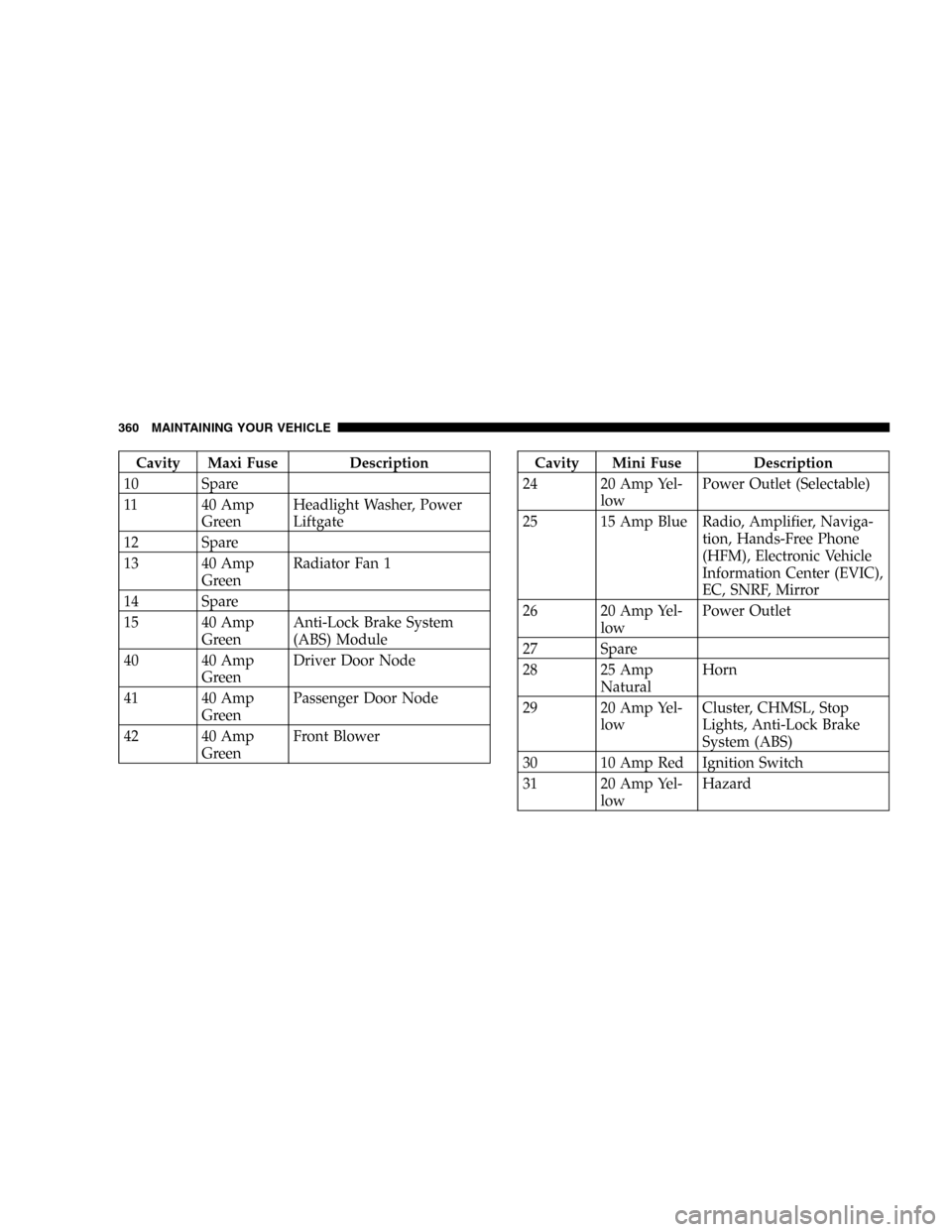
Cavity Maxi Fuse Description
10 Spare
11 40 Amp
GreenHeadlight Washer, Power
Liftgate
12 Spare
13 40 Amp
GreenRadiator Fan 1
14 Spare
15 40 Amp
GreenAnti-Lock Brake System
(ABS) Module
40 40 Amp
GreenDriver Door Node
41 40 Amp
GreenPassenger Door Node
42 40 Amp
GreenFront BlowerCavity Mini Fuse Description
24 20 Amp Yel-
lowPower Outlet (Selectable)
25 15 Amp Blue Radio, Amplifier, Naviga-
tion, Hands-Free Phone
(HFM), Electronic Vehicle
Information Center (EVIC),
EC, SNRF, Mirror
26 20 Amp Yel-
lowPower Outlet
27 Spare
28 25 Amp
NaturalHorn
29 20 Amp Yel-
lowCluster, CHMSL, Stop
Lights, Anti-Lock Brake
System (ABS)
30 10 Amp Red Ignition Switch
31 20 Amp Yel-
lowHazard
360 MAINTAINING YOUR VEHICLE
Page 363 of 420

REPLACEMENT LIGHT BULBS
LIGHT BULBS—Interior Bulb Number
Center & Rear Reading Lights............... 578
Front Door Courtesy Light.................. 578
Liftgate Light(s).......................... 578
Overhead Console Reading Lights...........212–2
Visor Vanity Lights.....................V26377
NOTE:For lighted switches, see your dealer for replace-
ment instructions.
All of the interior bulbs are glass wedge base or glass
cartridge types. Aluminum base bulbs are not approved
and should not be used for replacement.LIGHT BULBS—Exterior Bulb Number
Back-up............................... 921
Rear Stop, Turn Signal....................3157
Rear Sidemarker......................... 168
Fog Light.............................9145
Front Turn Signal.......................3157A
Front Sidemarker......................... 194
Standard Headlight....................... H7
License................................ 168
MAINTAINING YOUR VEHICLE 363
7
Page 365 of 420
High Intensity Discharge Headlights (HID)—If
Equipped
The headlights are a type of high voltage discharge tube.
High voltage can remain in the circuit even with the
headlight switch off and the key removed.Because of
this, you should not attempt to service a headlight bulb
yourself. If a headlight bulb fails, take your vehicle to
an authorized dealer for service.
WARNING!
A transient high tension occurs at the bulb sockets of
High Intensity Discharge (HID) headlights when the
headlight switch is turned ON. It may cause serious
electrical shock or electrocution if not serviced prop-
erly. See your authorized dealer for service.
NOTE:On vehicles equipped with High Intensity Dis-
charge Headlights (HID), when the headlights are turned
on there is a blue hue to the lights. This diminishes and
becomes more white after approximately 10 seconds, as
the system charges.
MAINTAINING YOUR VEHICLE 365
7
Page 407 of 420

Adding Coolant (Antifreeze).............. 342
Coolant Capacity...................... 368
Coolant Level......................341,344
Disposal of Used Coolant................ 344
Drain, Flush, and Refill.................. 341
Inspection........................... 344
Points to Remember.................... 344
Pressure Cap......................... 343
Radiator Cap......................... 343
Selection of Coolant...............341,368,369
Cruise Control (Speed Control).............. 134
Cruise Light........................... 170
Cup Holder.........................150,358
Customer Assistance..................... 394
Dealer Service.......................... 325
Defroster, Rear Window................... 243
Defroster, Windshield................69,228,239
Delay (Intermittent) Wipers................. 127Diagnostic System, Onboard................ 322
Digital Video Disc Player.................. 203
Dimmer Switch, Headlight................. 125
Dipsticks
Automatic Transmission................. 350
Oil (Engine).......................... 326
Disabled Vehicle Towing................... 313
Disarming, Theft System................... 26
Disposal
Antifreeze (Engine Coolant)............... 344
Engine Oil........................... 330
Door Ajar Light......................... 173
Door Locks............................. 16
Door Locks, Automatic.................... 17
Door Opener, Garage..................... 138
Drive Belts............................ 330
Drive Shaft Universal Joints................ 337
Driving
On Slippery Surfaces.................... 311
INDEX 407
10
Page 410 of 420

Garage Door Opener..................... 138
GasCap ...........................290,323
Gasoline.............................. 287
Gasoline, Clean Air...................... 287
Gasoline, Reformulated................... 288
Gauges
Coolant Temperature.................... 165
Fuel................................ 166
Speedometer......................... 166
Tachometer.......................... 169
Gearshift.............................. 253
General Information..................15,23,284
Glass Cleaning.......................... 357
Grocery Bag Retainer..................... 115
Gross Axle Weight Rating.................. 292
Gross Vehicle Weight Rating................ 292
Hands-Free Phone........................ 79
Hazard Warning Flasher................... 300Head Phones........................... 211
Head Restraints......................... 104
Headlights............................ 365
Bulb Replacement...................... 364
High Beam........................... 125
High Beam/Low Beam Select Switch........ 125
Passing............................. 125
Replacing............................ 364
Switch.............................. 122
Time Delay.......................... 124
Heated Seats........................... 105
Heater............................... 223
Heater, Engine Block..................... 250
Holder, Cup........................... 150
Homelink Transmitter.................... 138
Hood Release.......................... 119
Hoses.............................345,349
410 INDEX