light CHRYSLER PACIFICA 2008 1.G Owners Manual
[x] Cancel search | Manufacturer: CHRYSLER, Model Year: 2008, Model line: PACIFICA, Model: CHRYSLER PACIFICA 2008 1.GPages: 457, PDF Size: 6.7 MB
Page 315 of 457

The TPMS will warn the driver of a low tire pressure if
the tire pressure falls below the low pressure warning
threshold for any reason, including low temperature
effects, or natural air pressure loss through the tire.
The TPMS will continue to warn the driver of low tire
pressure as long as the condition exists, and will not turn
off until the tire pressure is at or above recommended
cold placard pressure. Once the low tire pressure warn-
ing has been illuminated, the tire pressure must be
increased to the recommended cold placard pressure in
order for the TPMS warning lamp to be turned off. The
system will automatically update and the TPMS warning
lamp will extinguish once the updated tire pressures
have been received. The vehicle may need to be driven
for up to 10 minutes above 15 mph (25 km/h) to receive
this information.For example, your vehicle may have a recommended
cold (parked for more than 3 hours) placard of 35 ÉF (241
kPa). If the ambient temperature is 68 ÉF (20 ÉC) and the
measured tire pressure is 30 psi (207 kPa), a temperature
drop to 20 ÉF (-7 ÉC) will decrease the tire pressure to
approximately 26 psi (179 kPa). This tire pressure is
sufficiently low enough to turn ON the ªTire Pressure
Monitoring Light.º Driving the vehicle may cause the tire
pressure to rise to approximately 30 psi (207 kPa), but the
ªTire Pressure Monitoring Lightº will still be ON. In this
situation, the ªTire Pressure Monitoring Lightº will turn
OFF only after the tires have been inflated to the vehicle's
recommended cold placard pressure value.
STARTING AND OPERATING 315
5
Page 317 of 457

²The TPMS is not a substitute for proper tire mainte-
nance, and it is the driver's responsibility to maintain
correct tire pressure, using an accurate tire pressure
gage, even if under-inflation has not reached the level
to trigger illumination of the TPMS Telltale Lamp.
²Seasonal temperature changes will affect tire pressure,
and the TPMS will monitor the actual tire pressure in
the tire.
Basic TPMS without EVIC Ð If Equipped
The TPMS uses wireless technology with wheel rim
mounted electronic sensors to monitor tire pressure lev-
els. Sensors, mounted to each wheel as part of the valve
stem, transmit tire pressure readings to the Receiver
Module.
NOTE:It is particularly important, for you to check the
tire pressure in all of your tires regularly and too main-
tain the proper pressure.The Basic TPMS consists of the following components:
²Receiver Module
²4 Tire Pressure Monitoring Sensors
²Tire Pressure Monitoring Telltale Lamp
The Tire Pressure Monitoring Telltale Lamp
will illuminate in the instrument cluster and an
audible chime will be activated when one or
more of the four active road tire pressures are
low. Should this occur you should stop as soon as
possible, check the inflation pressure of each tire on your
vehicle, and inflate each tire to the manufacturer recom-
mended pressure, located on the tire pressure placard.
The system will automatically update and the TPMS
warning light will extinguish once the updated tire
pressure(s) have been received.
STARTING AND OPERATING 317
5
Page 321 of 457

NOTE:It is particularly important, for you to check the
tire pressure in all of your tires regularly and to maintain
the proper pressure.
The TPMS consists of the following components:
²Receiver Module
²4 Tire Pressure Monitoring Sensors
²3 Trigger Modules (mounted in three of the four wheel
wells)
²Various TPMS Messages, which display in the Elec-
tronic Vehicle Information Center (EVIC), and a
graphic displaying tire pressures.
²Yellow Tire Pressure Monitoring Telltale Light
Tire Pressure Monitoring Low Pressure Warnings
The TPMS Telltale Lamp will illuminate in the instru-
ment cluster, and an audible chime will be activated
when one or more of the four active road tire pressures
are low. The EVIC will show a graphic display of the
pressure value(s) with the low tire(s) flashing.
Low Tire Pressure Display
STARTING AND OPERATING 321
5
Page 323 of 457

If the ignition key is cycled, this sequence will repeat,
providing the system fault still exists If the system fault
no longer exists, the TPMS Telltale Light will no longerflash, theªSERVICE TIRE SYSTEM SOONºtext mes-
sage will not be present, and a pressure value will be
displayed instead of dashes. A system fault can occur
with any of the following scenarios:
1. Jamming due to electronic devices or driving next to
facilities emitting the same radio frequencies as the TPMS
sensors.
2. Installing some form of aftermarket window tinting
that affects radio wave signals.
3. Accumulation of excessive snow and/or ice around
the wheels or wheel housings.
4. Using tire chains on the vehicle.
5. Using wheels/tires not equipped with TPMS sensors.
Check TPM System Display
STARTING AND OPERATING 323
5
Page 325 of 457

FUEL REQUIREMENTS
3.8L GASOLINE ENGINES
The 3.8L engine is designed to meet all
emissions regulations and provide excel-
lent fuel economy and performance when
using high quality unleaded ªregularº
gasoline having an octane rating of 87. The
use of premium gasoline is not recom-
mended. Under normal conditions, the use of premium
gasoline will not provide a benefit over high quality
regular gasolines, and in some circumstances may result
in poorer performance.
4.0L GASOLINE ENGINES
The 4.0L engine is designed to meet all
emissions regulations and provide satisfac-
tory fuel economy and performance whenusing high quality unleaded gasoline having an octane
range of 87 to 89. The manufacturer recommends the use
of 89 octane for optimum performance. The use of
premium gasoline is not recommended. Under normal
conditions, the use of premium gasoline will not provide
a benefit over high quality regular and mid-grade gaso-
lines, and in some circumstances may result in poorer
performance.
Light spark knock at low engine speeds is not harmful to
your engine. However, continued heavy spark knock at
high speeds can cause damage and immediate service is
required.
Poor quality gasoline can cause problems such as hard
starting, stalling and hesitations. If you experience these
symptoms, try another brand of gasoline before consid-
ering service for the vehicle.
STARTING AND OPERATING 325
5
Page 328 of 457
²An out-of-tune engine, or certain fuel or ignition
malfunctions, can cause the catalytic converter to
overheat. If you notice a pungent burning odor or
some light smoke, your engine may be out of tune or
malfunctioning and may require immediate service.
Contact your dealer for service assistance.
²The use of fuel additives which are now being sold as
octane enhancers is not recommended. Most of these
products contain high concentrations of methanol.
Fuel system damage or vehicle performance problems
resulting from the use of such fuels or additives is not
the responsibility of the manufacturer.
NOTE:Intentional tampering with emissions control
systems can result in civil penalties being assessed
against you.
Carbon Monoxide Warnings
WARNING!
Carbon monoxide (CO) in exhaust gases is deadly.
Follow the precautions below to prevent carbon
monoxide poisoning:
²Do not inhale exhaust gases. They contain carbon
monoxide, a colorless and odorless gas which can kill.
Never run the engine in a closed area, such as a
garage, and never sit in a parked vehicle with the
engine running for an extended period. If the vehicle is
stopped in an open area with the engine running for
more than a short period, adjust the ventilation system
to force fresh, outside air into the vehicle.
328 STARTING AND OPERATING
Page 329 of 457

²Guard against carbon monoxide with proper mainte-
nance. Have the exhaust system inspected every time
the vehicle is raised. Have any abnormal conditions
repaired promptly. Until repaired, drive with all side
windows fully open.
²Keep the liftgate closed when driving your vehicle to
prevent carbon monoxide and other poisonous ex-
haust gases from entering the vehicle.
ADDING FUEL
Fuel Filler Cap (Gas Cap)
As a reminder, a fuel icon with an arrow
indicating which side of the vehicle the fuel
filler door is located on, is located in the
instrument cluster, just below the Fuel Gage.
The gas cap is located behind the fuel filler door on the
left side of the vehicle. If the gas cap is lost or damaged,
be sure the replacement cap is for use with this vehicle.
CAUTION!
Damage to the fuel system or emission control sys-
tem could result from using an improper fuel tank
filler tube cap (gas cap). A poorly fitting cap could let
impurities into the fuel system and may cause the
Malfunction Indicator Light (MIL) to turn on due to
fuel vapors escaping from the system.
CAUTION!
To avoid fuel spillage and overfilling, do not ªtop
offº the fuel tank after filling.
NOTE:When the fuel nozzle ªclicksº or shuts off, the
fuel tank is full.
STARTING AND OPERATING 329
5
Page 330 of 457

WARNING!
²Never have any smoking materials lit in or near
the vehicle when the gas cap is removed or the
tank filled.
²Never add fuel when the engine is running. This is
in violation of most state and federal fire regula-
tions and may cause the malfunction indicator
light to turn on.
²Failure to follow the above may result in serious
injury or even death.
NOTE:
²Tighten the fuel filler cap until you hear a ªclickingº
sound. This is an indication that the fuel filler cap is
properly tightened.
²If the gas cap is not tighten properly, the Malfunction
Indicator Light may come on. Be sure the gas cap is
tightened every time the vehicle is refueled.
WARNING!
A fire may result if gasoline is pumped into a
portable container that is inside of a vehicle. You
could be burned. Always place gas containers on the
ground while filling.
Loose Fuel Filler Cap Message
²
If thegASCAPmessage is displayed in the instrument
cluster, this signifies a leak or change in the evapora-
tive system is detected. Sometimes this is the result of
a loosely fitting (or possibly damaged) filler cap.
330 STARTING AND OPERATING
Page 338 of 457
Trailer Hitch Classification
Your vehicle may be factory equipped for safe towing of
trailers weighing over 2,000 lbs (907 kg) with the optional
Trailer Tow Prep Package. See your dealer for package
content.
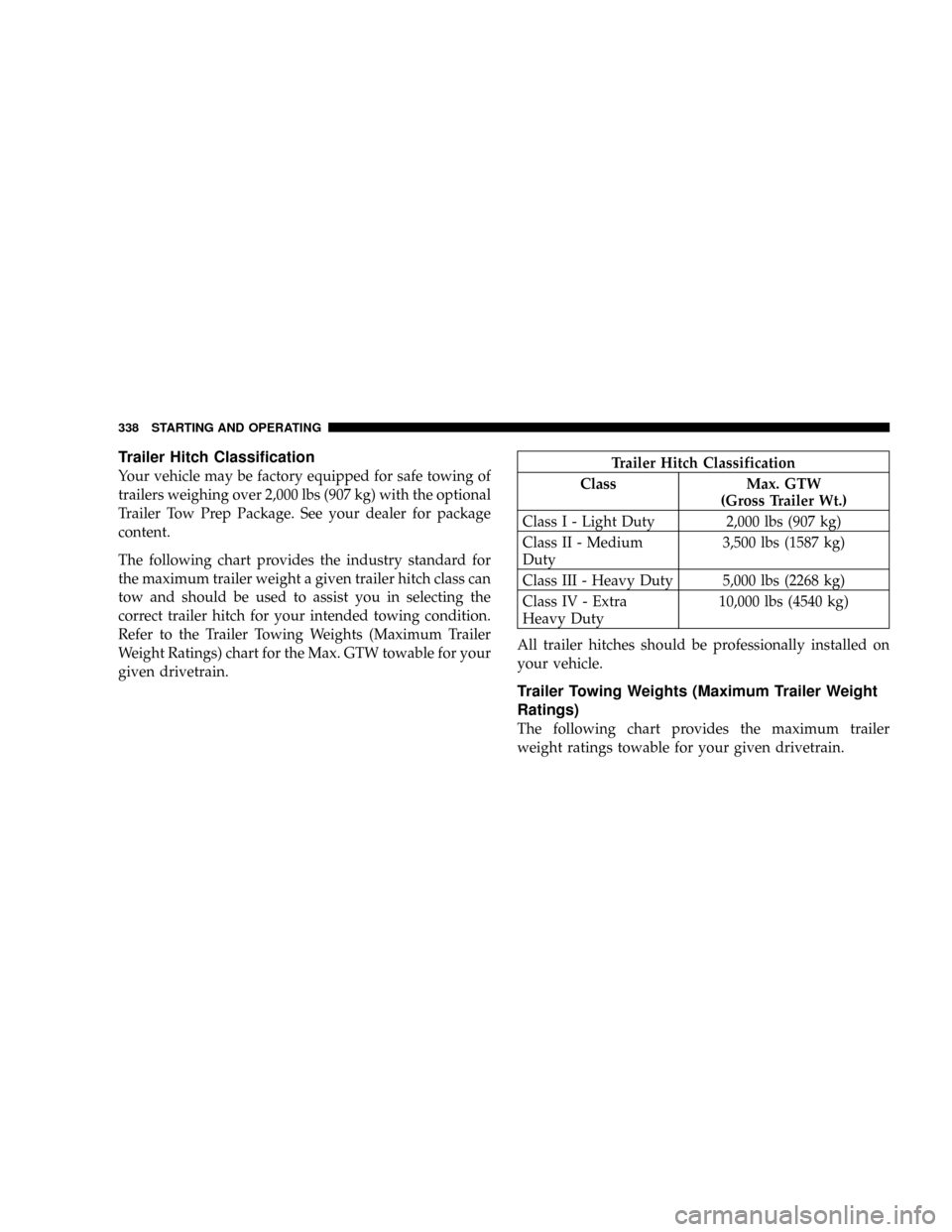
The following chart provides the industry standard for
the maximum trailer weight a given trailer hitch class can
tow and should be used to assist you in selecting the
correct trailer hitch for your intended towing condition.
Refer to the Trailer Towing Weights (Maximum Trailer
Weight Ratings) chart for the Max. GTW towable for your
given drivetrain.Trailer Hitch Classification
Class Max. GTW
(Gross Trailer Wt.)
Class I - Light Duty 2,000 lbs (907 kg)
Class II - Medium
Duty3,500 lbs (1587 kg)
Class III - Heavy Duty 5,000 lbs (2268 kg)
Class IV - Extra
Heavy Duty10,000 lbs (4540 kg)
All trailer hitches should be professionally installed on
your vehicle.
Trailer Towing Weights (Maximum Trailer Weight
Ratings)
The following chart provides the maximum trailer
weight ratings towable for your given drivetrain.
338 STARTING AND OPERATING
Page 345 of 457
þTrailer brakes are recommended for trailers over 1,000
lbs (454 kg) and required for trailers in excess of 2,000
lbs (907 kg).
CAUTION!
If the trailer weighs more than 1,000 lbs (454 kg)
loaded, it should have its own brakes and they
should be of adequate capacity. Failure to do this
could lead to accelerated brake lining wear, higher
brake pedal effort, and longer stopping distances.
WARNING!
Do not connect trailer brakes to your vehicle's hy-
draulic brake lines. It can overload your brake sys-
tem and cause it to fail. You might not have brakes
when you need them and could have an accident.
Towing any trailer will increase your stopping dis-
tance. When towing you should allow for additional
space between your vehicle and the vehicle in front
of you. Failure to do so could result in an accident.
Towing Requirements Ð Trailer Lights & Wiring
Whenever you pull a trailer, regardless of the trailer size,
stop lights and turn signals on the trailer are required for
motoring safety.
STARTING AND OPERATING 345
5