light CHRYSLER PACIFICA 2008 1.G Owners Manual
[x] Cancel search | Manufacturer: CHRYSLER, Model Year: 2008, Model line: PACIFICA, Model: CHRYSLER PACIFICA 2008 1.GPages: 457, PDF Size: 6.7 MB
Page 348 of 457

Towing Tips Ð Electronic Speed Control (If
Equipped)
þ
Don't use in hilly terrain or with heavy loads.
þWhen using the speed control, if you experience speed
drops greater than 10 mph (16 km/h), disengage until
you can get back to cruising speed.
þUse speed control in flat terrain and with light loads to
maximize fuel efficiency.
Towing Tips Ð Cooling System
To reduce potential for engine and transmission over-
heating, take the following actions:
þCity Driving
When stopped for short periods of time, put transmission
in neutral but do not increase engine idle speed.
þHighway Driving
Reduce speed.
þAir Conditioning
Turn off temporarily.
þrefer to Cooling System Operating information in the
Maintenance section of this manual for more informa-
tion.
RECREATIONAL TOWING (BEHIND
MOTORHOME, ETC.)
TOWING THIS VEHICLE BEHIND ANOTHER
VEHICLE (Flat towing with all four wheels on the
ground)
Recreational towing for this vehicle is not recommended.
NOTE:If the vehicle requires towing make sure all four
wheels are off the ground.
348 STARTING AND OPERATING
Page 358 of 457

location.Do not raise the vehicle until you are sure the
jack is securely engaged. Never jack up the vehicle
using any suspension components.
6. Raise the vehicle by turning the jack screw to the right,
using the swivel wrench. Raise the vehicle only until the
tire just clears the surface and enough clearance is
obtained to install the spare tire. Minimum tire lift
provides maximum stability.
WARNING!
Raising the vehicle higher than necessary can make
the vehicle less stable. It could slip off the jack and
hurt someone near it. Raise the vehicle only enough
to remove the tire.7. Remove the wheel lug nuts, for vehicles with wheel
covers, remove the cover from the wheel by hand. Do not
pry the wheel cover off. Then pull the wheel off the hub.
8. Install the spare wheel, for vehicles with wheel covers,
align the notch in the wheel cover with the valve stem on
the wheel. Install the cover on the wheel by hand only
and install the wheel lug nuts with the cone shaped end
of the nut toward the wheel. Lightly tighten the lug nuts.
To avoid the risk of forcing the vehicle off the jack, do not
tighten the lug nuts fully until the vehicle has been
lowered.
NOTE:Do not install the wheel cover on the compact
spare.
Do not use a hammer or force to install the wheel covers.
9. Lower the vehicle by turning the jack screw to the left.
10. Finish tightening the lug nuts. Push down on the
wrench while tightening for increased leverage. Alternate
358 WHAT TO DO IN EMERGENCIES
Page 368 of 457

NFront & Rear Suspension Ball Joints........385
NSteering Shaft Seal....................385
NSteering Linkage......................386
NDrive Shaft Universal Joints..............386
NBody Lubrication.....................386
NWindshield Wiper Blades................387
NWindshield And Rear Window Washers.....387
NExhaust System......................388
NCooling System.......................389
NHoses And Vacuum/Vapor Harnesses.......394
NBrakes.............................394
NMaster Cylinder Ð Brake Fluid Level Check . . 396
NFuel System Hoses....................397NAutomatic Transmission................398
NAll Wheel Drive (AWD) Ð If Equipped.....400
NFront And Rear Wheel Bearings...........401
NAppearance Care And Protection From
Corrosion...........................401
NCleaning The Center Console Cup Holders . . . 406
mFuses (Integrated Power Module)...........407
mVehicle Storage........................410
mReplacement Light Bulbs.................411
mBulb Replacement......................412
NHeadlights..........................412
NHigh Intensity Discharge Headlights (HID) Ð
If Equipped.........................413
368 MAINTAINING YOUR VEHICLE
Page 369 of 457

NFront Park/Turn Signal And Sidemarker
Lights.............................413
NFront Fog Light......................414
NRear Tail, Stop, Turn Signal, Side Marker And
Back-Up Lights.......................415
NLicense Light........................415mFluids And Capacities...................416
mFluids, Lubricants And Genuine Parts........417
NEngine.............................417
NChassis............................418
MAINTAINING YOUR VEHICLE 369
7
Page 372 of 457

ONBOARD DIAGNOSTIC SYSTEM Ð OBD II
Your vehicle is equipped with a sophisticated onboard
diagnostic system called OBD II. This system monitors
the performance of the emissions, engine, and automatic
transmission control systems. When these systems are
operating properly, your vehicle will provide excellent
performance and fuel economy, as well as engine emis-
sions well within current government regulations.
If any of these systems require service, the OBD II system
will turn on the ªMalfunction Indicator Light.º It will
also store diagnostic codes and other information to
assist your service technician in making repairs. Al-
though your vehicle will usually be drivable and not
need towing, see your dealer for service as soon as
possible.CAUTION!
²Prolonged driving with the ªMalfunction Indica-
tor Lightº on could cause further damage to the
emission control system. It could also affect fuel
economy and driveability. The vehicle must be
serviced before any emissions tests can be per-
formed.
²If the ªMalfunction Indicator Lightº is flashing
while the engine is running, severe catalytic con-
verter damage and power loss will soon occur.
Immediate service is required.
372 MAINTAINING YOUR VEHICLE
Page 373 of 457

Loose Fuel Filler Cap Message
Should the ªLoose Fuel Filler Capº or ªgASCAPº mes-
sage appear, there may be a problem in the evaporative
system. Before taking the vehicle into a qualified Dealer-
ship Service center, check first to see if the fuel filler cap
is possibly loose, improperly installed, or damaged. A
loose fuel filler cap message will be displayed in the
instrument cluster. Tighten the gas cap until a9clicking9
sound is heard. This is an indication that the gas cap is
properly tightened. Press the odometer reset button to
turn the message off. If the problem persists, the message
will appear the next time the vehicle is started. If the
problem is detected twice in a row, the system will turn
on the Malfunction Indicator Light (MIL). Resolving the
problem will turn the MIL light off. Take your vehicle in
to a qualified Dealership Service center.
EMISSIONS INSPECTION AND MAINTENANCE
PROGRAMS
In some localities, it may be a legal requirement to pass
an inspection of your vehicle's emissions control system.
Failure to pass could prevent vehicle registration.
For states, which have an I/M (Inspection and
Maintenance) requirement, this check verifies the
following: the MIL (Malfunction Indicator Light)
is functioning and is not on when the engine is running,
and that the OBD (On Board Diagnostic) system is ready
for testing.
Normally, the OBD system will be ready. The OBD
system maynotbe ready if your vehicle was recently
serviced, if you recently had a dead battery, or a battery
replacement. If the OBD system should be determined
not ready for the I/M test, your vehicle may fail the test.
MAINTAINING YOUR VEHICLE 373
7
Page 387 of 457

Windshield Wiper Blades
The rubber edges of the wiper blades and the windshield
should be cleaned periodically with a sponge or soft cloth
and a mild nonabrasive cleaner. This will remove accu-
mulations of salt or road film.
Operation of the wipers on dry glass for long periods
may cause deterioration of the wiper blades. Always use
washer fluid when using the wipers to remove salt or dirt
from a dry windshield.
Avoid using the wiper blades to remove frost or ice from
the windshield. Keep the blade rubber out of contact with
petroleum products such as engine oil, gasoline, etc.
Windshield and Rear Window Washers
The fluid reservoir for the windshield washers and the
rear window washer is shared. It is located in the engine
compartment and should be checked for fluid level at
regular intervals. Fill the reservoir with windshieldwasher solvent (not radiator antifreeze) and operate the
system for a few seconds to flush out the residual water.
The washer fluid reservoir will hold a full gallon of fluid
when the Low Washer Fluid Light illuminates.
Washer Fluid Reservoir
MAINTAINING YOUR VEHICLE 387
7
Page 396 of 457

should be replaced immediately! Eventual deterioration
of the hose can take place resulting in a possibility of a
burst failure.
WARNING!
Worn brake hoses can burst and cause brake failure.
You could have an accident. If you see any signs of
cracking, scuffing, or worn spots, have the brake
hoses replaced immediately.
Master Cylinder Ð Brake Fluid Level Check
The fluid level in the master cylinder should be checked
when performing underhood services, or immediately if
the brake system warning light indicates system failure.Clean the top of the master cylinder area before removing
the cap. Add fluid to bring the level up to the top of the
ªFULLº mark on the side of the master cylinder reservoir.
Overfilling of fluid is not recommended because it may
cause leaking in the system.
Add enough fluid to bring the level up to the require-
ments described on the brake fluid reservoir. With disc
brakes, fluid level can be expected to fall as the brake
pads wear. However, low fluid level may be caused by a
leak and a checkup may be needed.
Use only manufacturers recommended brake fluid, refer
to Fluids, Lubricants and Genuine Parts for correct fluid
type.
396 MAINTAINING YOUR VEHICLE
Page 407 of 457
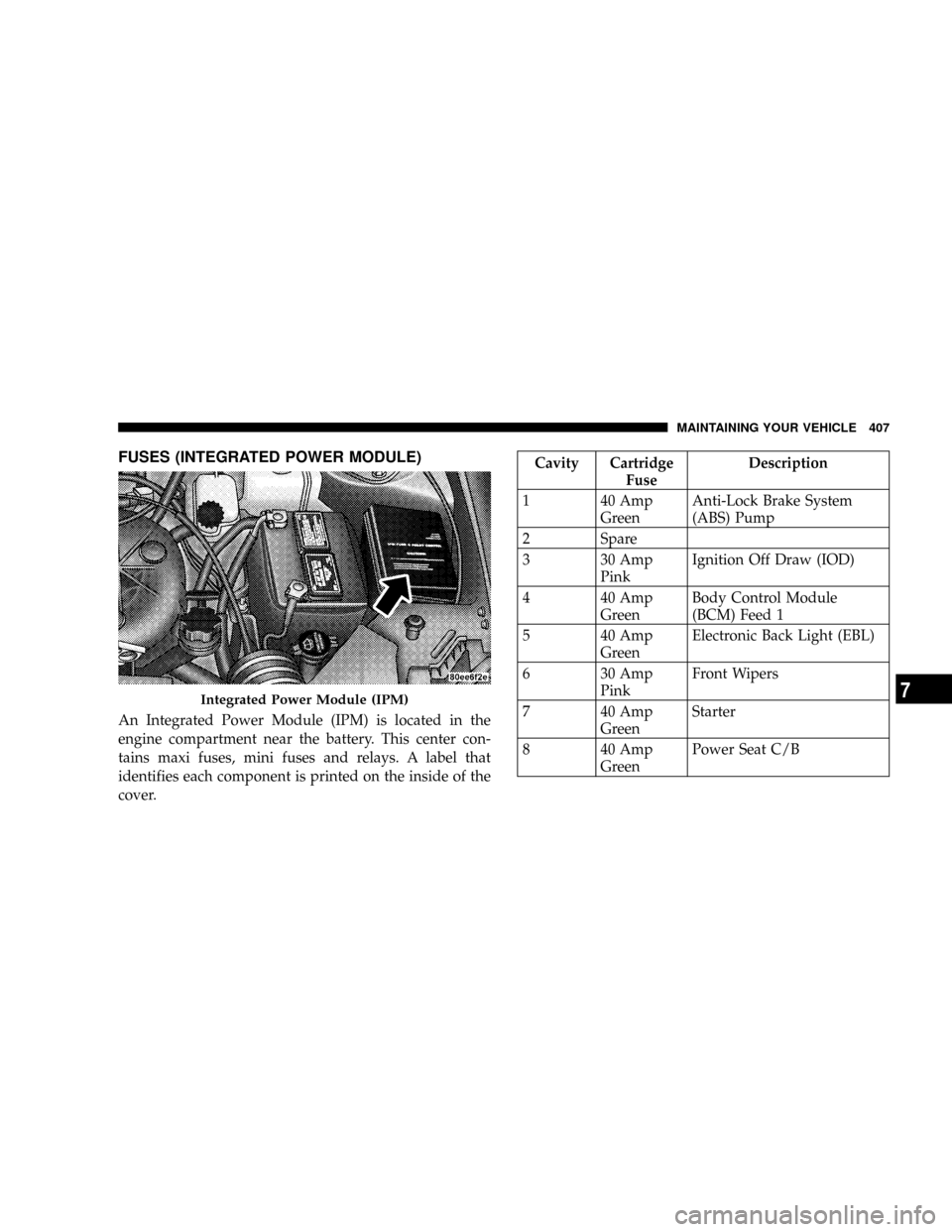
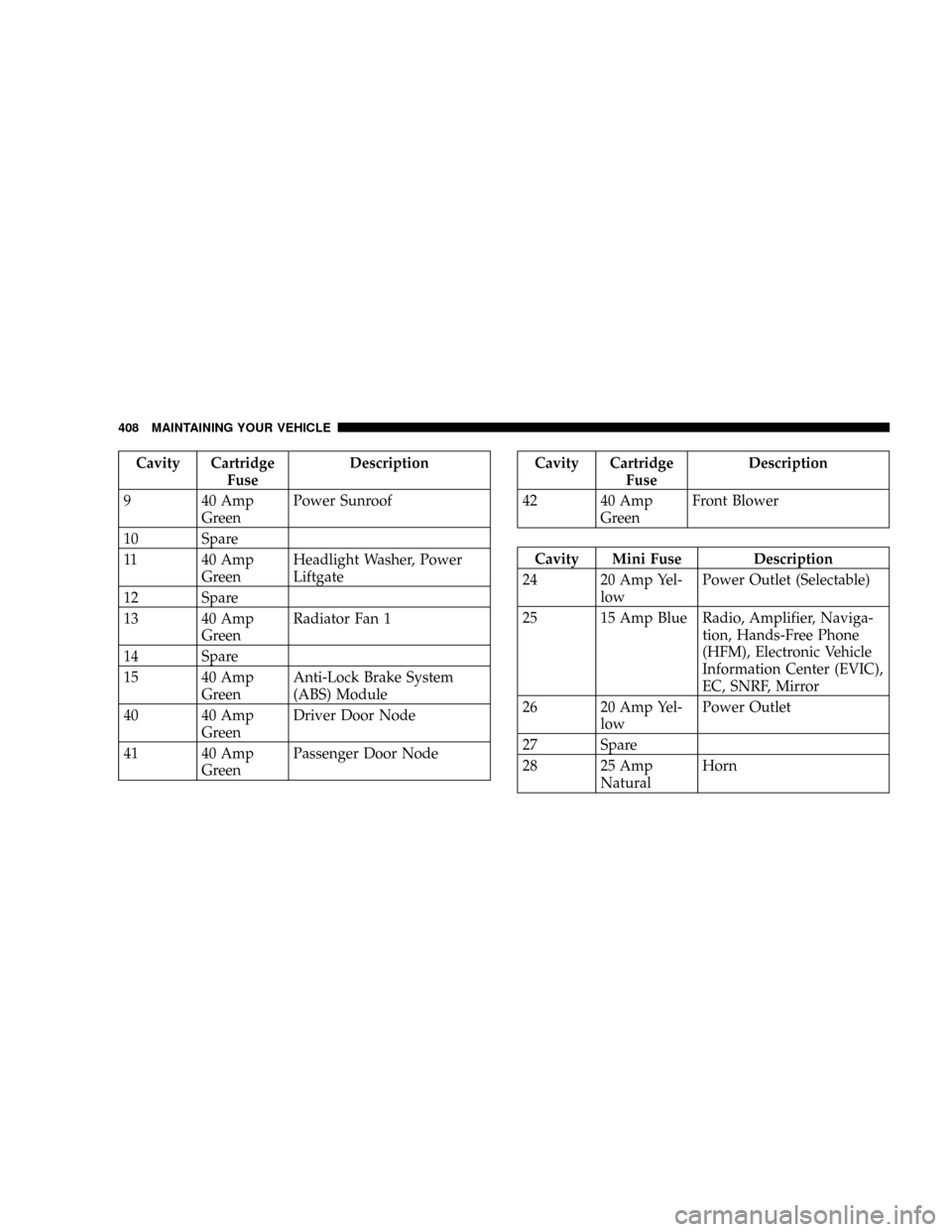
FUSES (INTEGRATED POWER MODULE)
An Integrated Power Module (IPM) is located in the
engine compartment near the battery. This center con-
tains maxi fuses, mini fuses and relays. A label that
identifies each component is printed on the inside of the
cover.
Cavity Cartridge
FuseDescription
1 40 Amp
GreenAnti-Lock Brake System
(ABS) Pump
2 Spare
3 30 Amp
PinkIgnition Off Draw (IOD)
4 40 Amp
GreenBody Control Module
(BCM) Feed 1
5 40 Amp
GreenElectronic Back Light (EBL)
6 30 Amp
PinkFront Wipers
7 40 Amp
GreenStarter
8 40 Amp
GreenPower Seat C/B
Integrated Power Module (IPM)
MAINTAINING YOUR VEHICLE 407
7
Page 408 of 457
Cavity Cartridge
FuseDescription
9 40 Amp
GreenPower Sunroof
10 Spare
11 40 Amp
GreenHeadlight Washer, Power
Liftgate
12 Spare
13 40 Amp
GreenRadiator Fan 1
14 Spare
15 40 Amp
GreenAnti-Lock Brake System
(ABS) Module
40 40 Amp
GreenDriver Door Node
41 40 Amp
GreenPassenger Door NodeCavity Cartridge
FuseDescription
42 40 Amp
GreenFront Blower
Cavity Mini Fuse Description
24 20 Amp Yel-
lowPower Outlet (Selectable)
25 15 Amp Blue Radio, Amplifier, Naviga-
tion, Hands-Free Phone
(HFM), Electronic Vehicle
Information Center (EVIC),
EC, SNRF, Mirror
26 20 Amp Yel-
lowPower Outlet
27 Spare
28 25 Amp
NaturalHorn
408 MAINTAINING YOUR VEHICLE