battery CHRYSLER PACIFICA 2008 1.G Owner's Manual
[x] Cancel search | Manufacturer: CHRYSLER, Model Year: 2008, Model line: PACIFICA, Model: CHRYSLER PACIFICA 2008 1.GPages: 457, PDF Size: 6.7 MB
Page 360 of 457

NOTE:When reinstalling the wheel center cap, insure
that the valve stem symbol on the back of the cap is
pointed toward the wheel valve stem. Install the center
cap using hand pressure only. Do not use a hammer.
Wheel Nuts
All wheel nuts should be tightened occasionally to elimi-
nate the possibility of wheel studs being sheared or the
bolt holes in the wheels becoming elongated. This is
especially important during the first few hundred miles
of operation, and after each time a tire is changed, to
allow the wheel nuts to become properly set. All nuts
should first be firmly seated against the wheel. The nuts
should then be tightened to recommended torque.
Tighten the nuts to final torque in increments. Progress
around the bolt circle, tightening the nut opposite to the
nut just previously tightened until final torque is
achieved. Recommended torque is 130 N´m (95 ft. lbs).
JUMP-STARTING PROCEDURE
WARNING!
²Do not attempt to push or tow your vehicle to get it started.
Vehicles equipped with an automatic transmission cannot
be started this way. Unburned fuel could enter the catalytic
converter and once the engine has started, ignite and
damage the converter and vehicle. If the vehicle has a
discharged battery, booster cables may be used to obtain a
start from another vehicle. This type of start can be danger-
ous if done improperly, so follow this procedure carefully.
²Battery fluid is a corrosive acid solution; do not allow
battery fluid to contact eyes, skin or clothing. Don't lean
over battery when attaching clamps or allow the clamps to
touch each other. If acid splashes in eyes or on skin, flush
contaminated area immediately with large quantities of
water.
²A battery generates hydrogen gas which is flammable and
explosive. Keep flame or spark away from the vent holes.
Do not use a booster battery or any other booster source
with an output that exceeds 12 volts.
²Take care to avoid the radiator cooling fan whenever the
hood is raised. It can start anytime the ignition switch is on.
You can be hurt by the fan.
360 WHAT TO DO IN EMERGENCIES
Page 361 of 457

When jump starting, proceed as follows:
1. Wear eye protection and remove any metal jewelry
such as watch bands or bracelets that might make an
inadvertent electrical contact.
2. When boost is provided by a battery in another
vehicle, park that vehicle within booster cable reach and
without letting the vehicles touch. Set the parking brake,
place the automatic transmission in PARK and turn the
ignition switch to the OFF position for both vehicles.
3. Turn off the heater, radio and all unnecessary electrical
loads.
4. Connect one end of a jumper cable to the positive
terminal of the discharged battery. Connect the other end
of the same cable to the positive terminal of the booster
battery.WARNING!
Do not permit vehicles to touch each other as this
could establish a ground connection and personal
injury could result.
5. Connect the other cable, first to the negative terminal
of the booster battery andthen to the engine of the
vehicle with the discharged battery.Make sure you have
a good contact on the engine.
WHAT TO DO IN EMERGENCIES 361
6
Page 362 of 457

WARNING!
Do not connect the cable to the negative post of the
discharge battery. The resulting electrical spark could
cause the battery to explode.
During cold weather when temperatures are below
freezing point, electrolyte in a discharged battery
may freeze. Do not attempt jump starting because the
battery could rupture or explode. The battery tem-
perature must be brought up above freezing point
before attempting jump start.
6. Start the engine in the vehicle which has the booster
battery, let the engine idle a few minutes, then start the
engine in the vehicle with the discharged battery.
7. When removing the jumper cables, reverse the above
sequence exactly. Be careful of the moving belts and fan.
WARNING!
Any procedure other than above could result in:
1. Personal injury caused by electrolyte squirting out
the battery vent;
2. Personal injury or property damage due to battery
explosion;
3. Damage to charging system of booster vehicle or
of immobilized vehicle.
FREEING A STUCK VEHICLE
If your vehicle becomes stuck in mud, sand or snow, it
can often be moved by a rocking motion. Turn your
steering wheel right and left to clear the area around the
front wheels. Then shift back and forth between Reverse
362 WHAT TO DO IN EMERGENCIES
Page 367 of 457

MAINTAINING YOUR VEHICLE
CONTENTS
m3.8L Engines..........................370
m4.0L Engines..........................371
mOnboard Diagnostic System Ð OBD II........372
NLoose Fuel Filler Cap Message............373
mEmissions Inspection And Maintenance
Programs............................373
mReplacement Parts......................375
mDealer Service.........................375
mMaintenance Procedures..................376NEngine Oil..........................376
NEngine Oil Filter......................379
NDrive Belt...........................379
NSpark Plugs.........................379
NEngine Air Cleaner Filter................380
NCatalytic Converter....................380
NMaintenance-Free Battery................382
NAir Conditioner Maintenance.............383
NPower Steering Ð Fluid Check............385
7
Page 373 of 457

Loose Fuel Filler Cap Message
Should the ªLoose Fuel Filler Capº or ªgASCAPº mes-
sage appear, there may be a problem in the evaporative
system. Before taking the vehicle into a qualified Dealer-
ship Service center, check first to see if the fuel filler cap
is possibly loose, improperly installed, or damaged. A
loose fuel filler cap message will be displayed in the
instrument cluster. Tighten the gas cap until a9clicking9
sound is heard. This is an indication that the gas cap is
properly tightened. Press the odometer reset button to
turn the message off. If the problem persists, the message
will appear the next time the vehicle is started. If the
problem is detected twice in a row, the system will turn
on the Malfunction Indicator Light (MIL). Resolving the
problem will turn the MIL light off. Take your vehicle in
to a qualified Dealership Service center.
EMISSIONS INSPECTION AND MAINTENANCE
PROGRAMS
In some localities, it may be a legal requirement to pass
an inspection of your vehicle's emissions control system.
Failure to pass could prevent vehicle registration.
For states, which have an I/M (Inspection and
Maintenance) requirement, this check verifies the
following: the MIL (Malfunction Indicator Light)
is functioning and is not on when the engine is running,
and that the OBD (On Board Diagnostic) system is ready
for testing.
Normally, the OBD system will be ready. The OBD
system maynotbe ready if your vehicle was recently
serviced, if you recently had a dead battery, or a battery
replacement. If the OBD system should be determined
not ready for the I/M test, your vehicle may fail the test.
MAINTAINING YOUR VEHICLE 373
7
Page 374 of 457

Your vehicle has a simple ignition key actuated test,
which you can use prior to going to the test station. To
check if your vehicle's OBD system is ready, you must do
the following:
1. Insert your ignition key into the ignition switch.
2. Turn the ignition to the ON position, but do not crank
or start the engine.
3. If you crank or start the engine, you will have to start
this test over.
4. As soon as you turn your key to the ON position, you
will see your MIL symbol come on as part of a normal
bulb check.
5. Approximately 15 seconds later, one of two things will
happen:
a. The MIL will flash for about 10 seconds and then
return to being fully illuminated until you turn off theignition key or start the engine. This means that your
vehicle's OBD system isnot readyand you shouldnot
proceed to the I/M station.
b. The MIL will not flash at all and will remain fully
illuminated until you turn off the ignition key or start
the engine. This means that your vehicle's OBD system
isreadyand you can proceed to the I/M station.
If your OBD system isnot ready,you should see your
authorized dealer or repair facility. If your vehicle was
recently serviced or had a battery failure or replacement,
you may need to do nothing more than drive your
vehicle as you normally would in order for your OBD
system to update. A recheck with the above test routine
may then indicate that the system is now ready.
Regardless of whether your vehicle's OBD system is
ready or not ready, if the MIL symbol is illuminated
during normal vehicle operation, you should have your
374 MAINTAINING YOUR VEHICLE
Page 382 of 457

To minimize the possibility of catalyst damage:
²Do not shut off the engine or interrupt the ignition
when the transmission is in gear and the vehicle is in
motion.
²Do not try to start engine by pushing or towing the
vehicle.
²Do not idle the engine with any spark plug wires
disconnected or removed, such as when diagnostic
testing, or for prolonged periods during very rough
idling or malfunctioning operating conditions.
Maintenance-Free Battery
The top of the MAINTENANCE-FREE battery is perma-
nently sealed. You will never have to add water, nor is
periodic maintenance required.
WARNING!
²Battery fluid is a corrosive acid solution and can
burn or even blind you. Don't allow battery fluid
to contact your eyes, skin or clothing. Don't lean
over a battery when attaching clamps. If acid
splashes in eyes or on skin, flush the area imme-
diately with large amounts of water.
²Battery gas is flammable and explosive. Keep
flame or sparks away from the battery. Don't use a
booster battery or any other booster source with an
output greater than 12 volts. Don't allow cable
clamps to touch each other.
²Battery posts, terminals and related accessories
contain lead and lead compounds. Wash hands
after handling.
382 MAINTAINING YOUR VEHICLE
Page 383 of 457

CAUTION!
²It is essential when replacing the cables on the
battery that the positive cable is attached to the
positive post and the negative cable is attached to
the negative post. Battery posts are marked posi-
tive (+) and negative (-) and identified on the
battery case. Cable clamps should be tight on the
terminal posts and free of corrosion.
²If a ªfast chargerº is used while battery is in
vehicle, disconnect both vehicle battery cables
before connecting the charger to battery. Do not
use a ªfast chargerº to provide starting voltage.
Air Conditioner Maintenance
For best possible performance, your air conditioner
should be checked and serviced by an Authorized Dealer
at the start of each warm season. This service should
include cleaning of the condenser fins and a system
performance check. Drive belt tension should also be
checked at this time.
MAINTAINING YOUR VEHICLE 383
7
Page 407 of 457
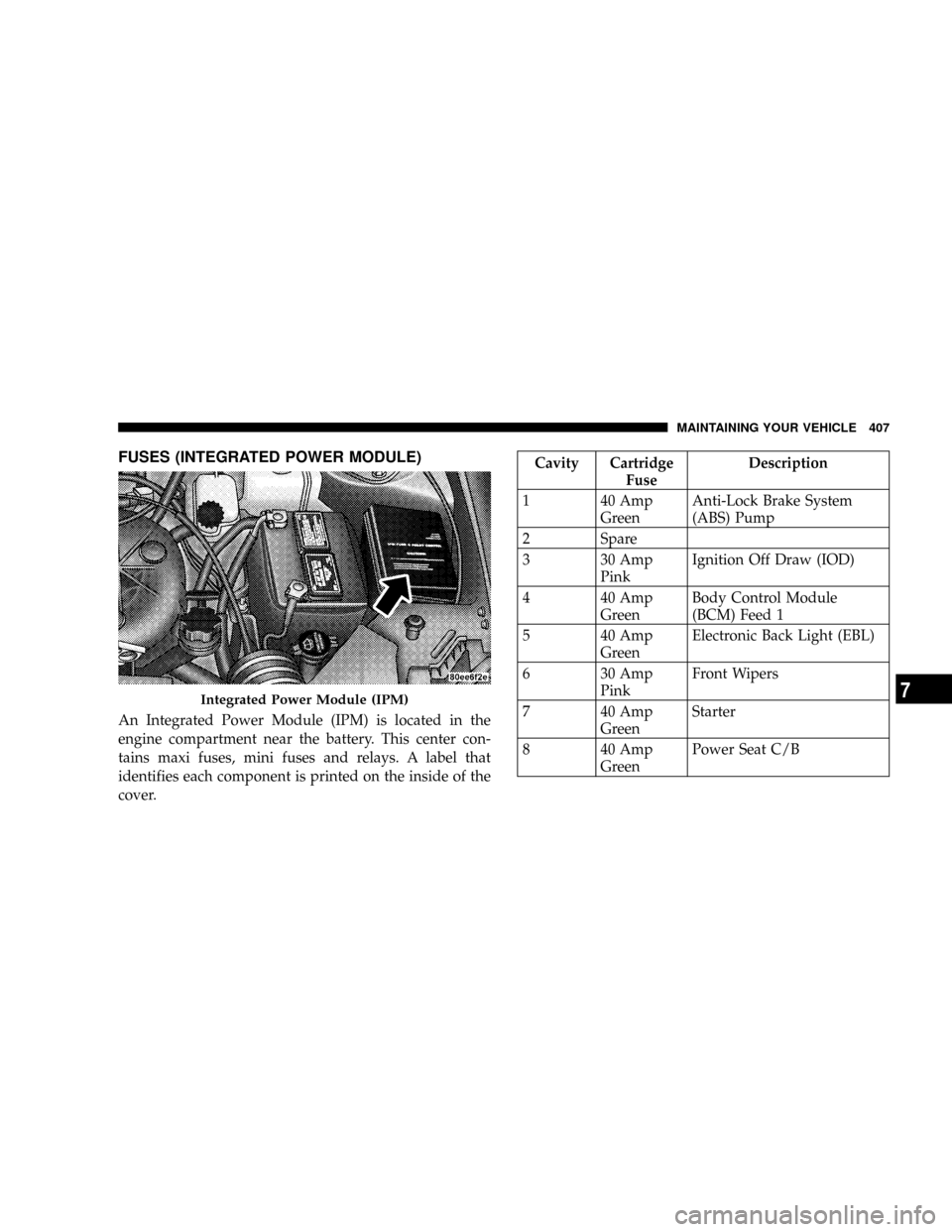
FUSES (INTEGRATED POWER MODULE)
An Integrated Power Module (IPM) is located in the
engine compartment near the battery. This center con-
tains maxi fuses, mini fuses and relays. A label that
identifies each component is printed on the inside of the
cover.
Cavity Cartridge
FuseDescription
1 40 Amp
GreenAnti-Lock Brake System
(ABS) Pump
2 Spare
3 30 Amp
PinkIgnition Off Draw (IOD)
4 40 Amp
GreenBody Control Module
(BCM) Feed 1
5 40 Amp
GreenElectronic Back Light (EBL)
6 30 Amp
PinkFront Wipers
7 40 Amp
GreenStarter
8 40 Amp
GreenPower Seat C/B
Integrated Power Module (IPM)
MAINTAINING YOUR VEHICLE 407
7
Page 410 of 457

CAUTION!
²When installing the Integrated Power Module
cover, it is important to ensure the cover is prop-
erly positioned and fully latched. Failure to do so
may allow water to get into the Integrated Power
Module, and possibly result in a electrical system
failure.
²When replacing a blown fuse, it is important to
use only a fuse having the correct amperage rating.
The use of a fuse with a rating other than indicated
may result in a dangerous electrical system over-
load. If a properly rated fuse continues to blow, it
indicates a problem in the circuit that must be
corrected.
VEHICLE STORAGE
If you are leaving your vehicle dormant for more than 21
days you may want to take steps to protect your battery.
You may:
²Disconnect the negative cable from the battery.
²Anytime you store your vehicle, or keep it out of
service (i.e. vacation) for two weeks or more, run the
air conditioning system at idle for about five minutes
in the fresh air and high blower setting. This will
insure adequate system lubrication to minimize the
possibility of compressor damage when the system is
started again.
410 MAINTAINING YOUR VEHICLE