ECU CHRYSLER PACIFICA 2018 Workshop Manual
[x] Cancel search | Manufacturer: CHRYSLER, Model Year: 2018, Model line: PACIFICA, Model: CHRYSLER PACIFICA 2018Pages: 696, PDF Size: 8.48 MB
Page 421 of 696
Recreational towing is allowed ONLY if the front wheels
areOFF the ground. This may be accomplished using a tow
dolly (front wheels off the ground) or vehicle trailer (all
four wheels off the ground). If using a tow dolly, follow this
procedure:
1. Properly secure the dolly to the tow vehicle, following the dolly manufacturer’s instructions.
2. Drive the front wheels onto the tow dolly.
3. Apply the park brake.
4. Place the transmission in PARK.
5. Turn the ignition OFF.
6. Properly secure the front wheels to the dolly, following the dolly manufacturer’s instructions.
7. Turn the ignition to the ON/RUN mode, but do not start the vehicle.
8. Press and hold the brake pedal.
9. Release the park brake.
10. Turn the ignition OFF.
11. Release the brake pedal.DRIVING TIPS
Driving On Slippery Surfaces
Information in this section will aid in safe controlled
launches in adverse conditions.
Acceleration
Rapid acceleration on snow covered, wet, or other slippery
surfaces may cause the driving wheels to pull erratically to
the right or left. This phenomenon occurs when there is a
difference in the surface traction under the front (driving)
wheels.
WARNING!
Rapid acceleration on slippery surfaces is dangerous.
Unequal traction can cause sudden pulling of the front
wheels. You could lose control of the vehicle and
possibly have a collision. Accelerate slowly and care-
fully whenever there is likely to be poor traction (ice,
snow, wet, mud, loose sand, etc.).
6
STARTING AND OPERATING 419
Page 441 of 696
Fuse Location
The fuses are grouped into a controller located in the
engine compartment.
Underhood Fuses
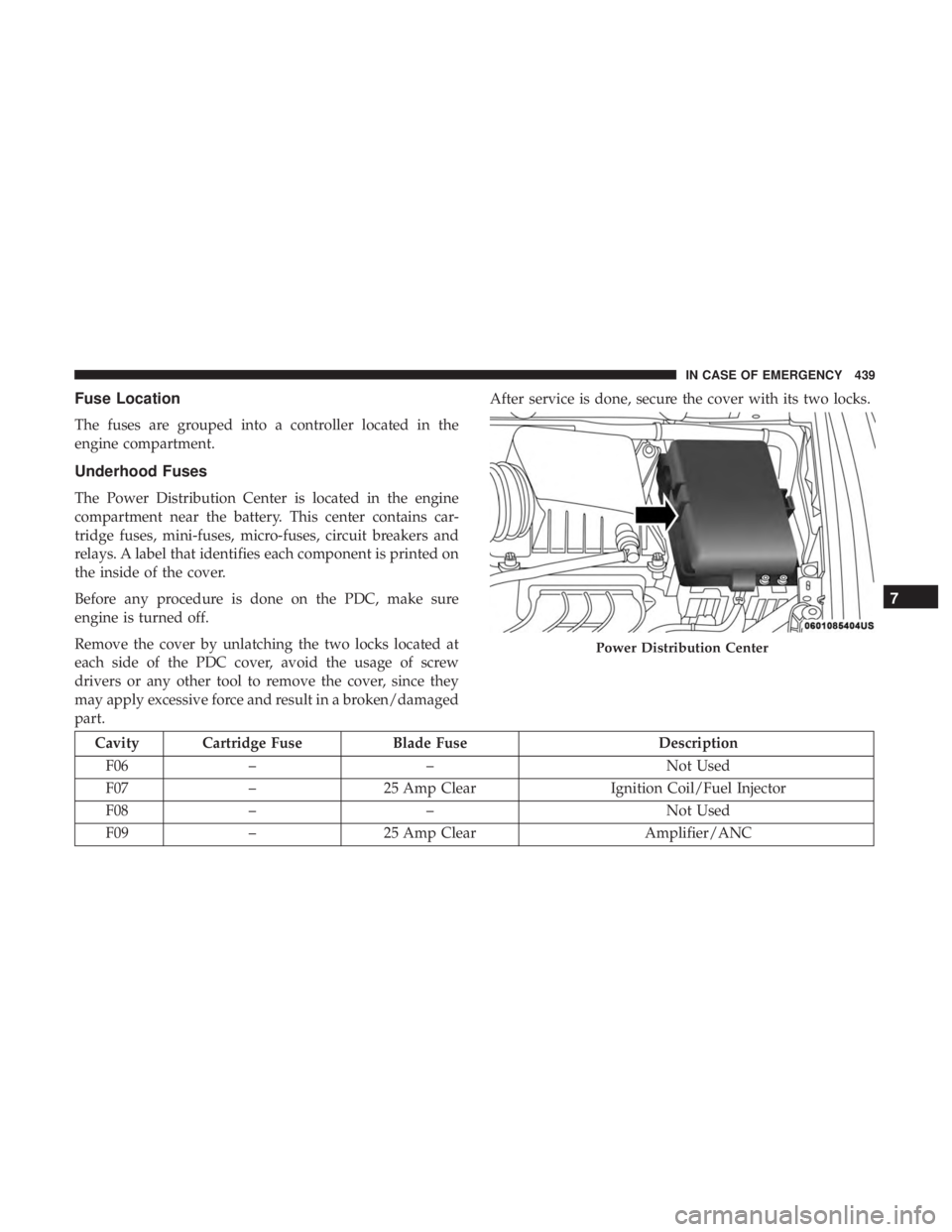
The Power Distribution Center is located in the engine
compartment near the battery. This center contains car-
tridge fuses, mini-fuses, micro-fuses, circuit breakers and
relays. A label that identifies each component is printed on
the inside of the cover.
Before any procedure is done on the PDC, make sure
engine is turned off.
Remove the cover by unlatching the two locks located at
each side of the PDC cover, avoid the usage of screw
drivers or any other tool to remove the cover, since they
may apply excessive force and result in a broken/damaged
part.After service is done, secure the cover with its two locks.
Cavity Cartridge Fuse
Blade FuseDescription
F06 – – Not Used
F07 –25 Amp Clear Ignition Coil/Fuel Injector
F08 – – Not Used
F09 –25 Amp Clear Amplifier/ANC
Power Distribution Center
7
IN CASE OF EMERGENCY 439
Page 444 of 696
Cavity Cartridge FuseBlade FuseDescription
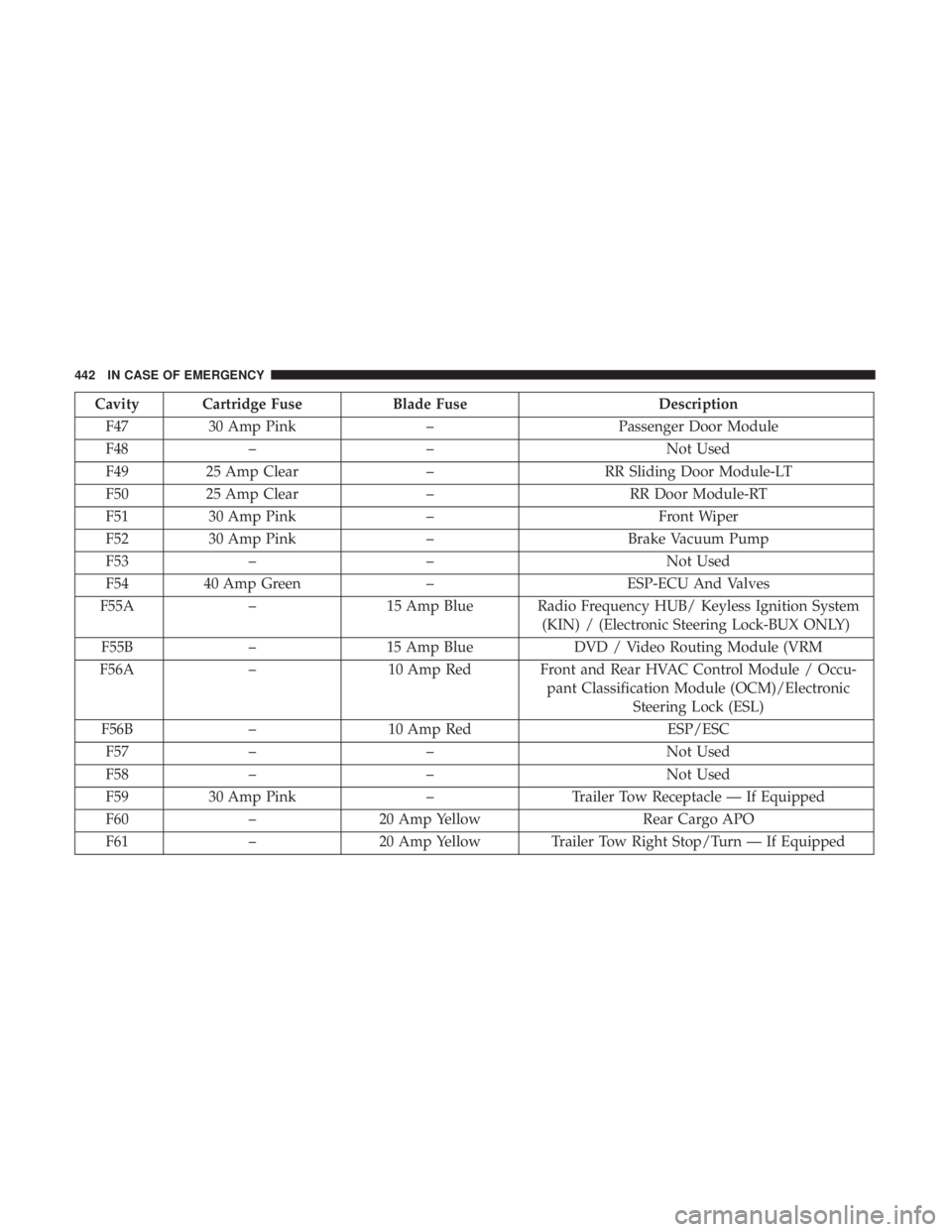
F47 30 Amp Pink –Passenger Door Module
F48 – – Not Used
F49 25 Amp Clear –RR Sliding Door Module-LT
F50 25 Amp Clear –RR Door Module-RT
F51 30 Amp Pink – Front Wiper
F52 30 Amp Pink –Brake Vacuum Pump
F53 – – Not Used
F54 40 Amp Green –ESP-ECU And Valves
F55A –15 Amp Blue Radio Frequency HUB/ Keyless Ignition System
(KIN) / (Electronic Steering Lock-BUX ONLY)
F55B –15 Amp Blue DVD / Video Routing Module (VRM
F56A –10 Amp Red Front and Rear HVAC Control Module / Occu-
pant Classification Module (OCM)/ElectronicSteering Lock (ESL)
F56B –10 Amp Red ESP/ESC
F57 – – Not Used
F58 – – Not Used
F59 30 Amp Pink –Trailer Tow Receptacle — If Equipped
F60 –20 Amp Yellow Rear Cargo APO
F61 –20 Amp Yellow Trailer Tow Right Stop/Turn — If Equipped
442 IN CASE OF EMERGENCY
Page 447 of 696
Cavity Cartridge FuseBlade FuseDescription
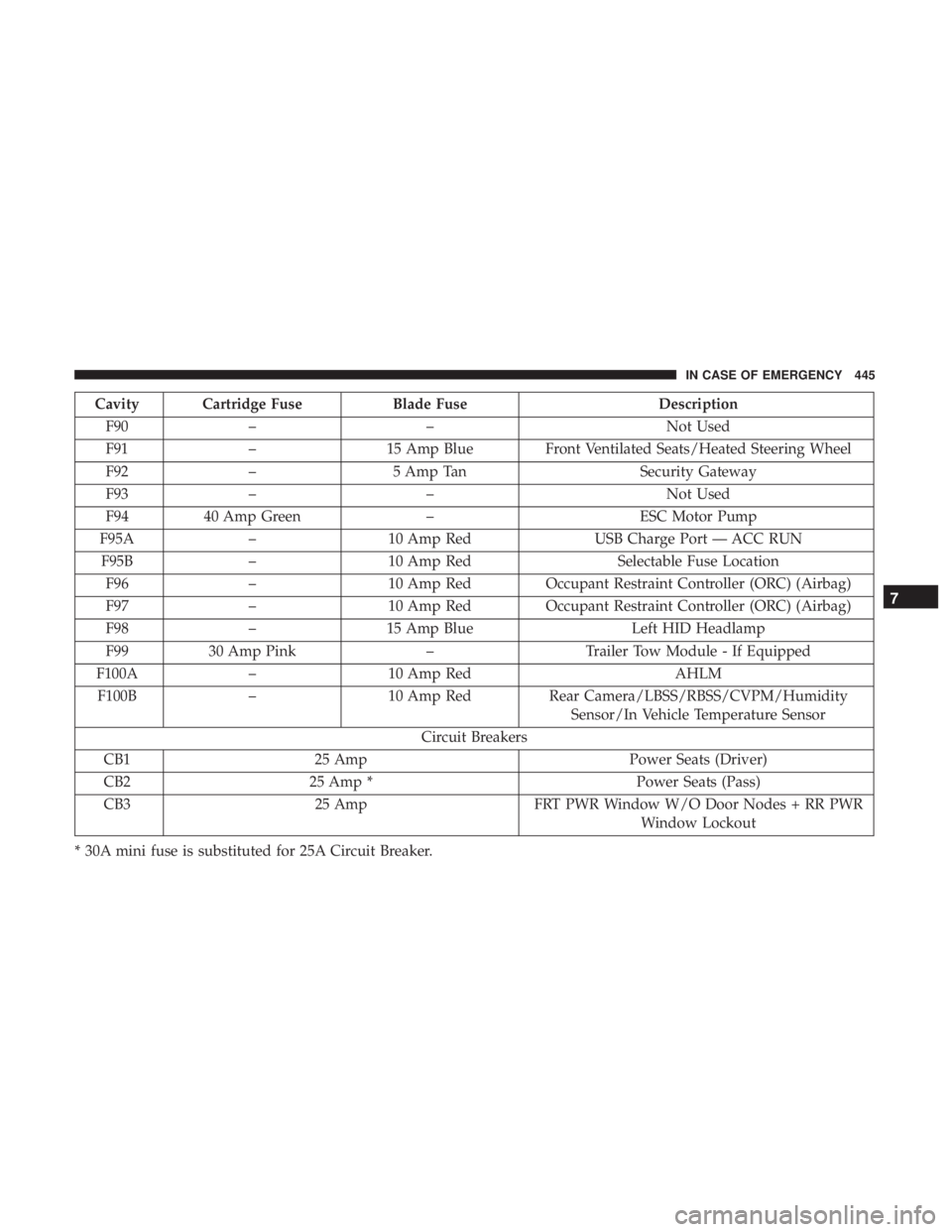
F90 – – Not Used
F91 –15 Amp Blue Front Ventilated Seats/Heated Steering Wheel
F92 – 5 Amp Tan Security Gateway
F93 – – Not Used
F94 40 Amp Green –ESC Motor Pump
F95A –10 Amp Red USB Charge Port — ACC RUN
F95B –10 Amp Red Selectable Fuse Location
F96 –10 Amp Red Occupant Restraint Controller (ORC) (Airbag)
F97 –10 Amp Red Occupant Restraint Controller (ORC) (Airbag)
F98 –15 Amp Blue Left HID Headlamp
F99 30 Amp Pink –Trailer Tow Module - If Equipped
F100A –10 Amp Red AHLM
F100B –10 Amp Red Rear Camera/LBSS/RBSS/CVPM/Humidity
Sensor/In Vehicle Temperature Sensor
Circuit Breakers
CB1 25 Amp Power Seats (Driver)
CB2 25 Amp * Power Seats (Pass)
CB3 25 Amp FRT PWR Window W/O Door Nodes + RR PWR
Window Lockout
* 30A mini fuse is substituted for 25A Circuit Breaker.
7
IN CASE OF EMERGENCY 445
Page 454 of 696
CAUTION!
Do not attempt to raise the vehicle by jacking on
locations other than those indicated.
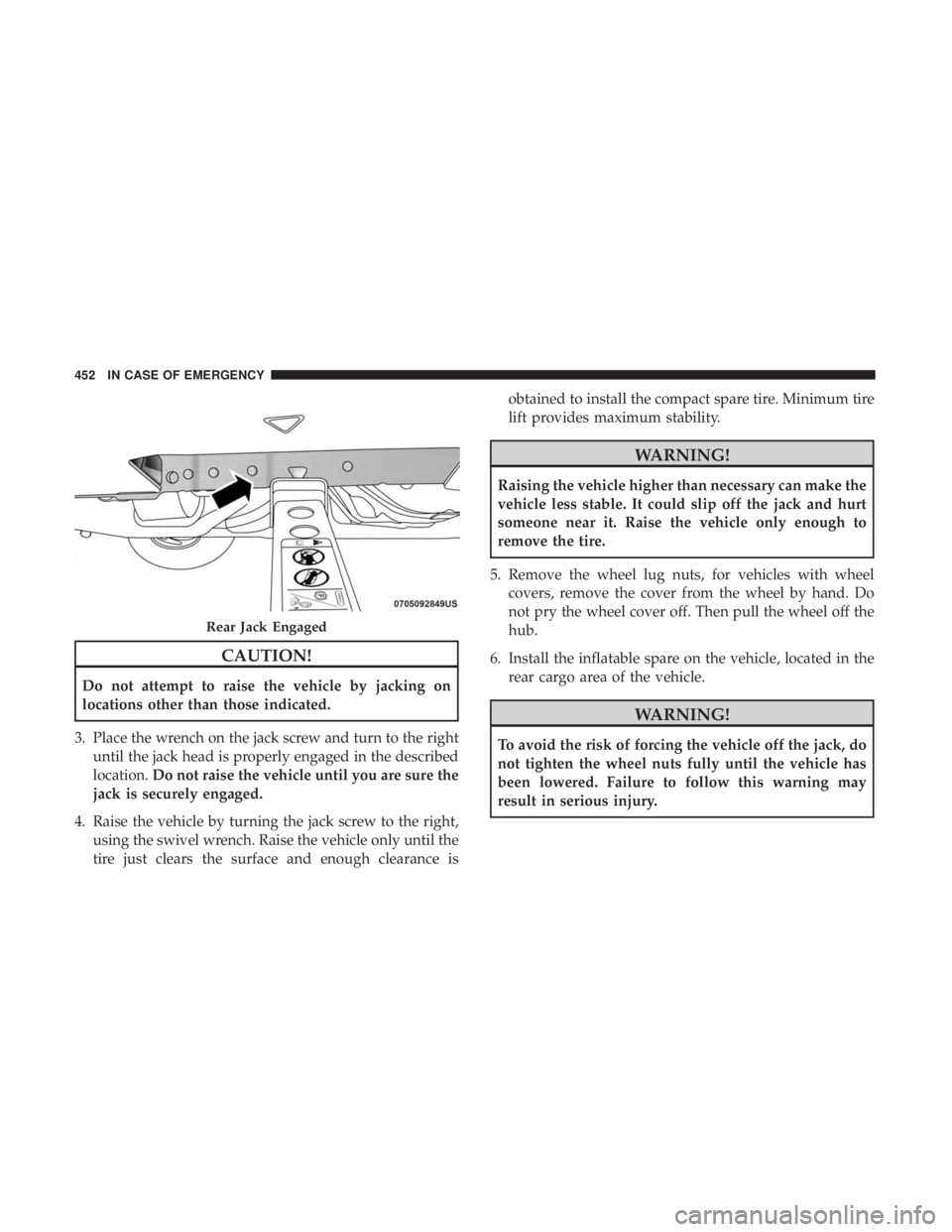
3. Place the wrench on the jack screw and turn to the right until the jack head is properly engaged in the described
location. Do not raise the vehicle until you are sure the
jack is securely engaged.
4. Raise the vehicle by turning the jack screw to the right, using the swivel wrench. Raise the vehicle only until the
tire just clears the surface and enough clearance is obtained to install the compact spare tire. Minimum tire
lift provides maximum stability.
WARNING!
Raising the vehicle higher than necessary can make the
vehicle less stable. It could slip off the jack and hurt
someone near it. Raise the vehicle only enough to
remove the tire.
5. Remove the wheel lug nuts, for vehicles with wheel covers, remove the cover from the wheel by hand. Do
not pry the wheel cover off. Then pull the wheel off the
hub.
6. Install the inflatable spare on the vehicle, located in the rear cargo area of the vehicle.
WARNING!
To avoid the risk of forcing the vehicle off the jack, do
not tighten the wheel nuts fully until the vehicle has
been lowered. Failure to follow this warning may
result in serious injury.
Rear Jack Engaged
452 IN CASE OF EMERGENCY
Page 455 of 696
CAUTION!
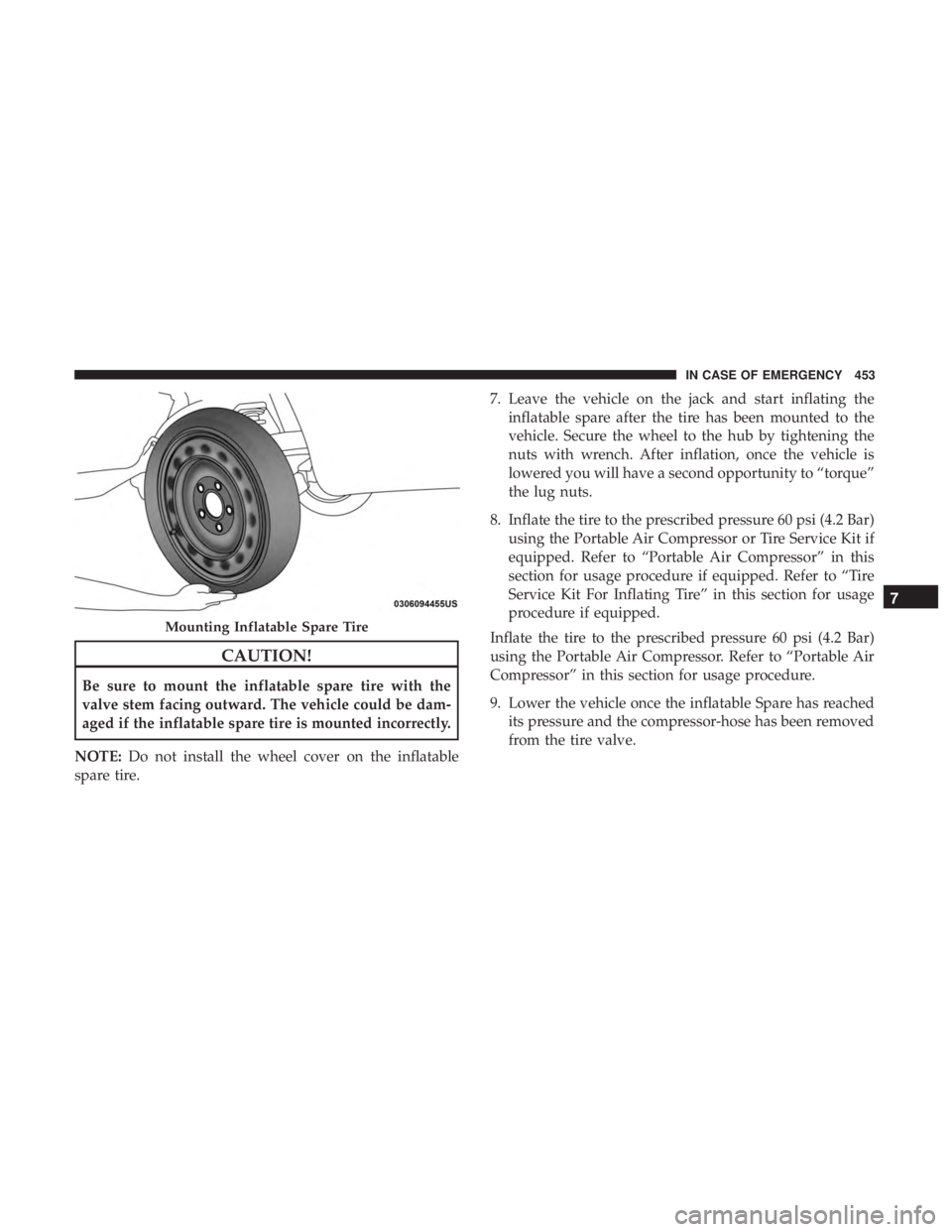
Be sure to mount the inflatable spare tire with the
valve stem facing outward. The vehicle could be dam-
aged if the inflatable spare tire is mounted incorrectly.
NOTE: Do not install the wheel cover on the inflatable
spare tire. 7. Leave the vehicle on the jack and start inflating the
inflatable spare after the tire has been mounted to the
vehicle. Secure the wheel to the hub by tightening the
nuts with wrench. After inflation, once the vehicle is
lowered you will have a second opportunity to “torque”
the lug nuts.
8. Inflate the tire to the prescribed pressure 60 psi (4.2 Bar) using the Portable Air Compressor or Tire Service Kit if
equipped. Refer to “Portable Air Compressor” in this
section for usage procedure if equipped. Refer to “Tire
Service Kit For Inflating Tire” in this section for usage
procedure if equipped.
Inflate the tire to the prescribed pressure 60 psi (4.2 Bar)
using the Portable Air Compressor. Refer to “Portable Air
Compressor” in this section for usage procedure.
9. Lower the vehicle once the inflatable Spare has reached its pressure and the compressor-hose has been removed
from the tire valve.
Mounting Inflatable Spare Tire
7
IN CASE OF EMERGENCY 453
Page 456 of 696
10. Finish tightening the lug nuts. Push down on thewrench while at the end of the handle for increased
leverage. Tighten the lug nuts in a star pattern until
each nut has been tightened twice. Refer to “Torque
Specifications” in “Technical Specifications” for proper
wheel lug nut torque. If in doubt about the correct
tightness, have them checked with a torque wrench by
your authorized dealer or at a service station.
11. Lower the jack to its fully-closed position.
WARNING!
A loose tire or jack thrown forward in a collision or
hard stop could endanger the occupants of the vehicle.
Always stow the jack parts and the spare tire in the
places provided. Have the deflated (flat) tire repaired
or replaced immediately.
12. Place the deflated (flat) tire and foam tray cover assembly in the rear cargo area. Do not stow the
deflated tire in the inflatable spare tire location. Have
the full-sized tire repaired or replaced, as soon as
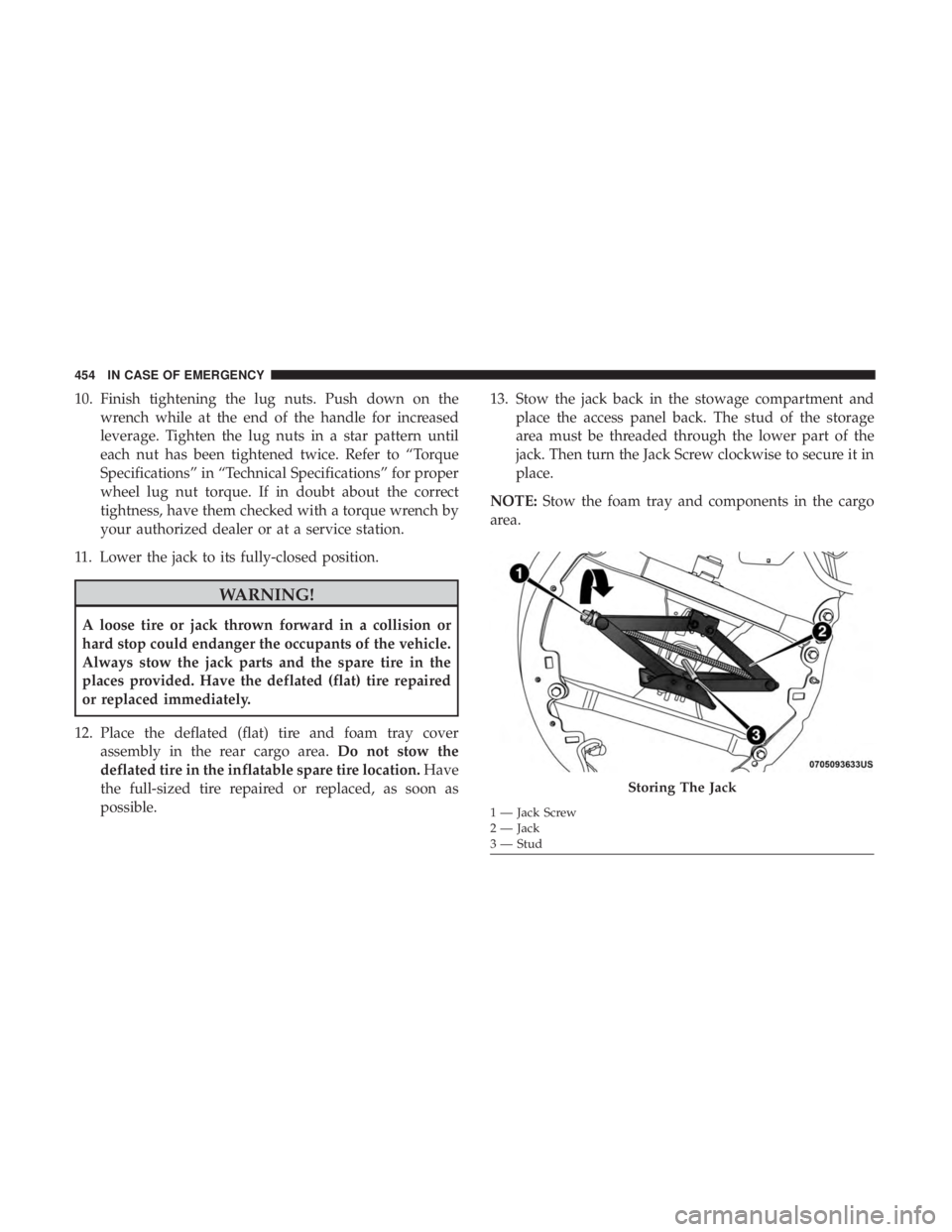
possible. 13. Stow the jack back in the stowage compartment and
place the access panel back. The stud of the storage
area must be threaded through the lower part of the
jack. Then turn the Jack Screw clockwise to secure it in
place.
NOTE: Stow the foam tray and components in the cargo
area.
Storing The Jack
1 — Jack Screw
2 — Jack
3 — Stud
454 IN CASE OF EMERGENCY
Page 461 of 696
9. Remove the speed limit label sticker from the PortableAir Compressor and place it on the
center of the steering wheel.
10. Return the Portable Air Compressor to the foam tray and secure it with the strap. Store the foam tray in the
cargo area.
WARNING!
•Do not lift or carry the Portable Air Compressor by
the hose.
• Always stow the Portable Air Compressor only in the
provided place.
• The metal end fitting from Power Plug may get hot
after use, so it should be handled carefully.
• Keep the Portable Air Compressor away from open
flames or heat source.
Tire Service Kit For Inflating Tire — If Equipped
Your vehicle may be equipped with a Tire Service Kit. Use
the Tire Service Kit located in the side compartment of the
cargo area to inflate the inflatable tire to 60 psi (4.2 Bar).
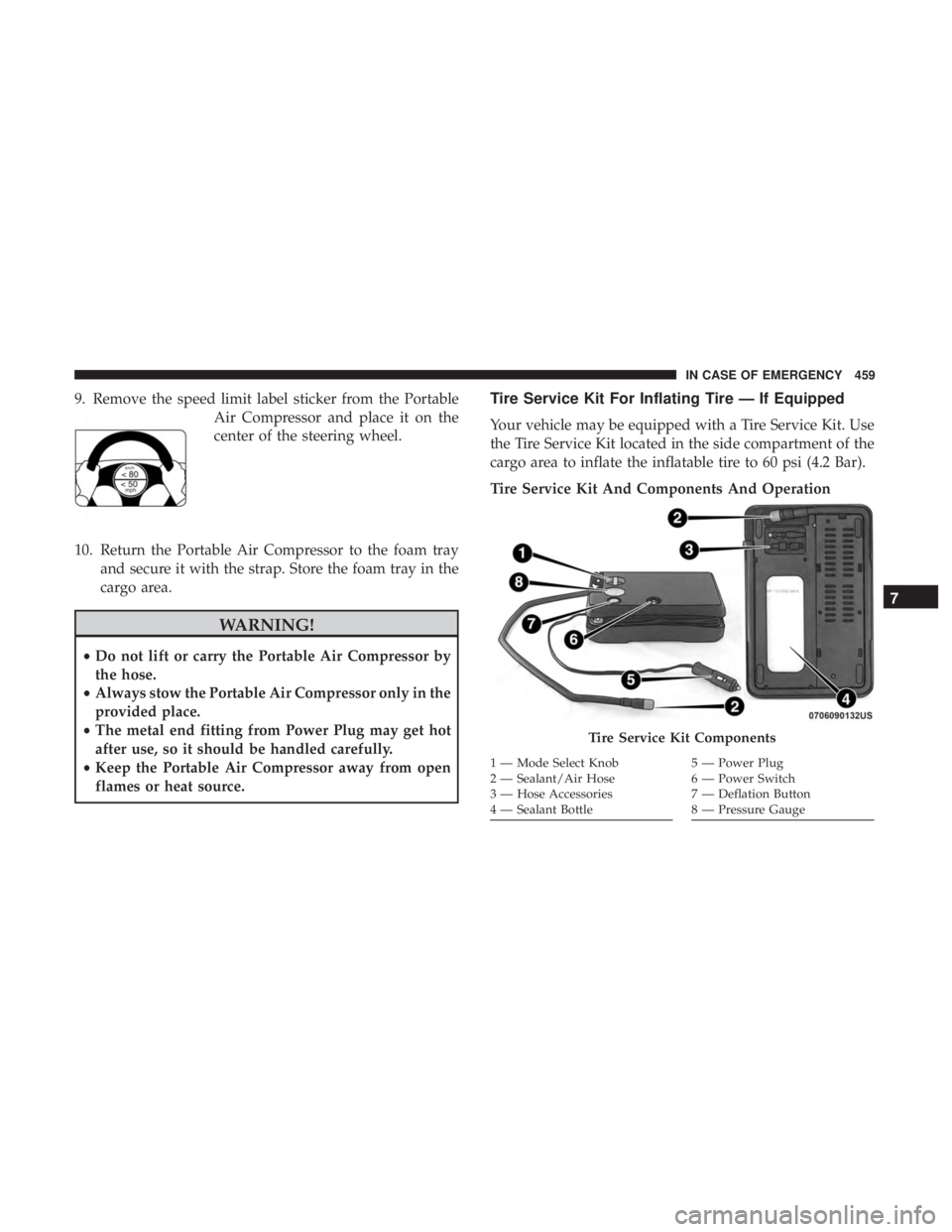
Tire Service Kit And Components And Operation
Tire Service Kit Components
1 — Mode Select Knob
2 — Sealant/Air Hose
3 — Hose Accessories
4 — Sealant Bottle5 — Power Plug
6 — Power Switch
7 — Deflation Button
8 — Pressure Gauge
7
IN CASE OF EMERGENCY 459
Page 465 of 696
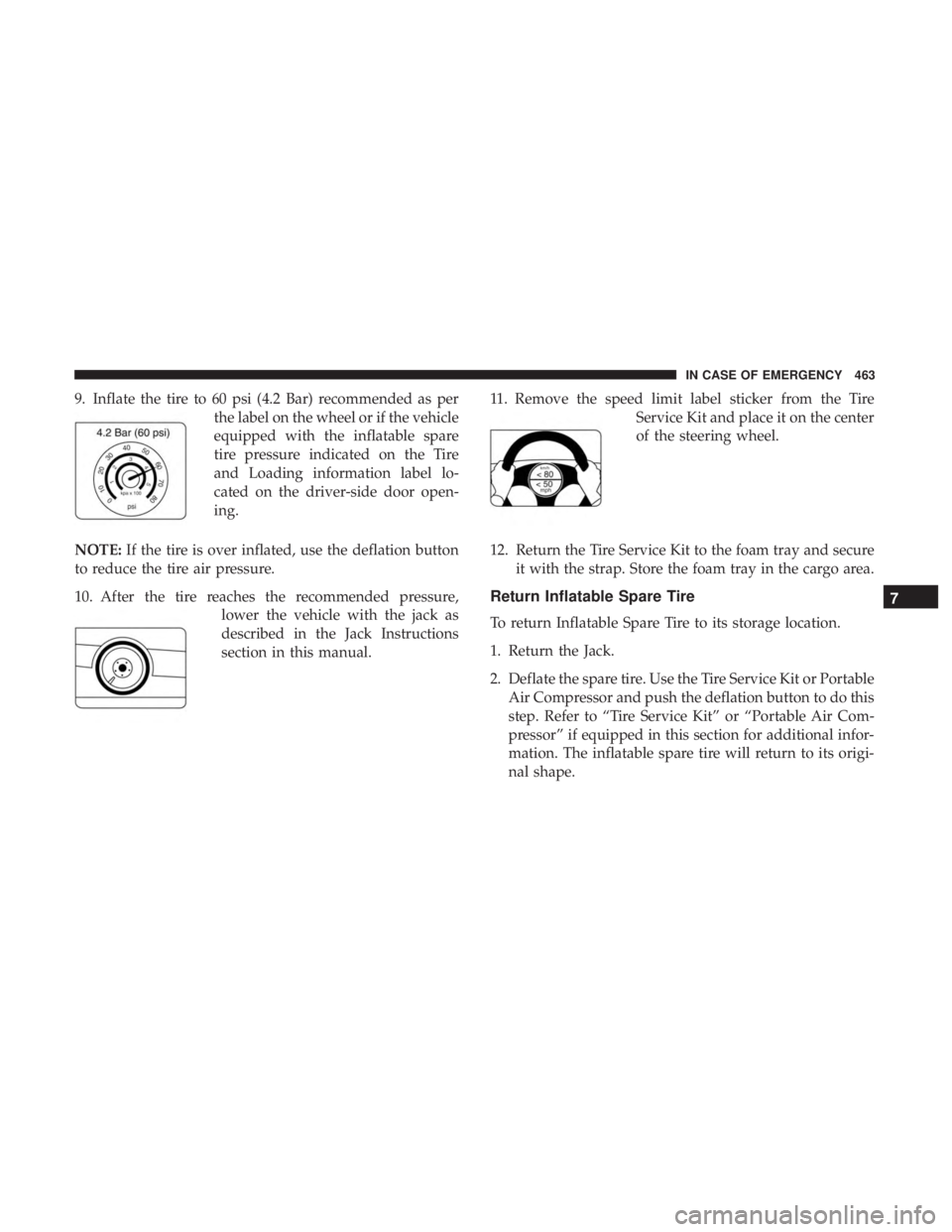
9. Inflate the tire to 60 psi (4.2 Bar) recommended as perthe label on the wheel or if the vehicle
equipped with the inflatable spare
tire pressure indicated on the Tire
and Loading information label lo-
cated on the driver-side door open-
ing.
NOTE: If the tire is over inflated, use the deflation button
to reduce the tire air pressure.
10. After the tire reaches the recommended pressure, lower the vehicle with the jack as
described in the Jack Instructions
section in this manual. 11. Remove the speed limit label sticker from the Tire
Service Kit and place it on the center
of the steering wheel.
12. Return the Tire Service Kit to the foam tray and secure it with the strap. Store the foam tray in the cargo area.
Return Inflatable Spare Tire
To return Inflatable Spare Tire to its storage location.
1. Return the Jack.
2. Deflate the spare tire. Use the Tire Service Kit or PortableAir Compressor and push the deflation button to do this
step. Refer to “Tire Service Kit” or “Portable Air Com-
pressor” if equipped in this section for additional infor-
mation. The inflatable spare tire will return to its origi-
nal shape.
7
IN CASE OF EMERGENCY 463
Page 466 of 696
3. Install the inflatable spare tire back into its originalstowage location and position facing outward.
4. Install the foam tray with wrench and funnel installed.
5. Install and tighten the wing nut by hand.
6. Install the Tire Service Kit or Portable Air Compressor if equipped and tighten the strap.
7. Install access panel door.
TIRE SERVICE KIT — IF EQUIPPED
Your vehicle may be equipped with a Tire Service Kit.
Small punctures up to 1/4 inch (6 mm) in the tire tread can
be sealed with Tire Service Kit. Foreign objects (e.g., screws
or nails) should not be removed from the tire. Tire Service
Kit can be used in outside temperatures down to approxi-
mately -4°F (-20°C). This kit will provide a temporary tire
seal, allowing you to drive your vehicle up to 100 miles
(160 km) with a maximum speed of 50 mph (80 km/h). Tire Service Kit Storage
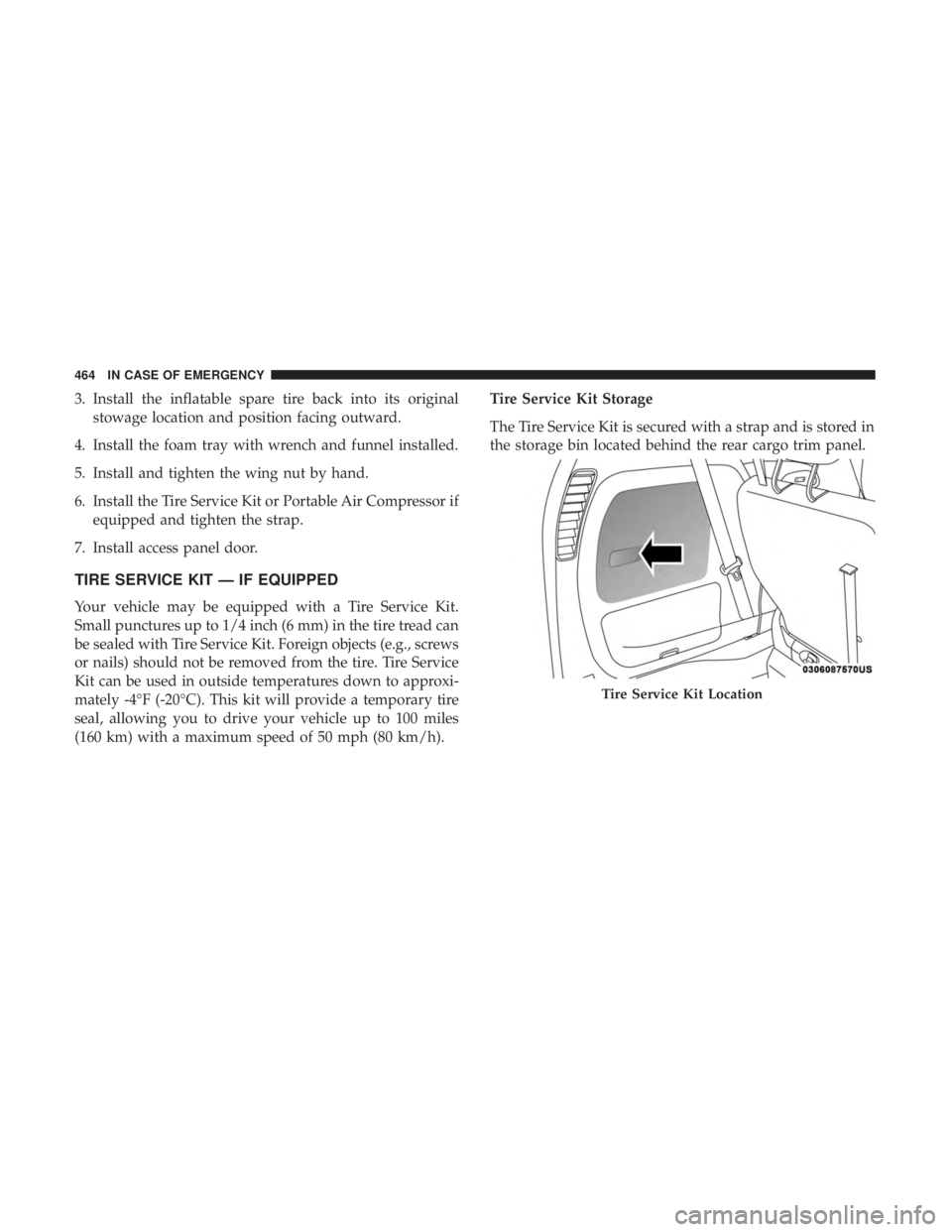
The Tire Service Kit is secured with a strap and is stored in
the storage bin located behind the rear cargo trim panel.
Tire Service Kit Location
464 IN CASE OF EMERGENCY