engine overheat CHRYSLER PACIFICA 2021 User Guide
[x] Cancel search | Manufacturer: CHRYSLER, Model Year: 2021, Model line: PACIFICA, Model: CHRYSLER PACIFICA 2021Pages: 401, PDF Size: 26.88 MB
Page 343 of 401
SERVICING AND MAINTENANCE341
(Continued)
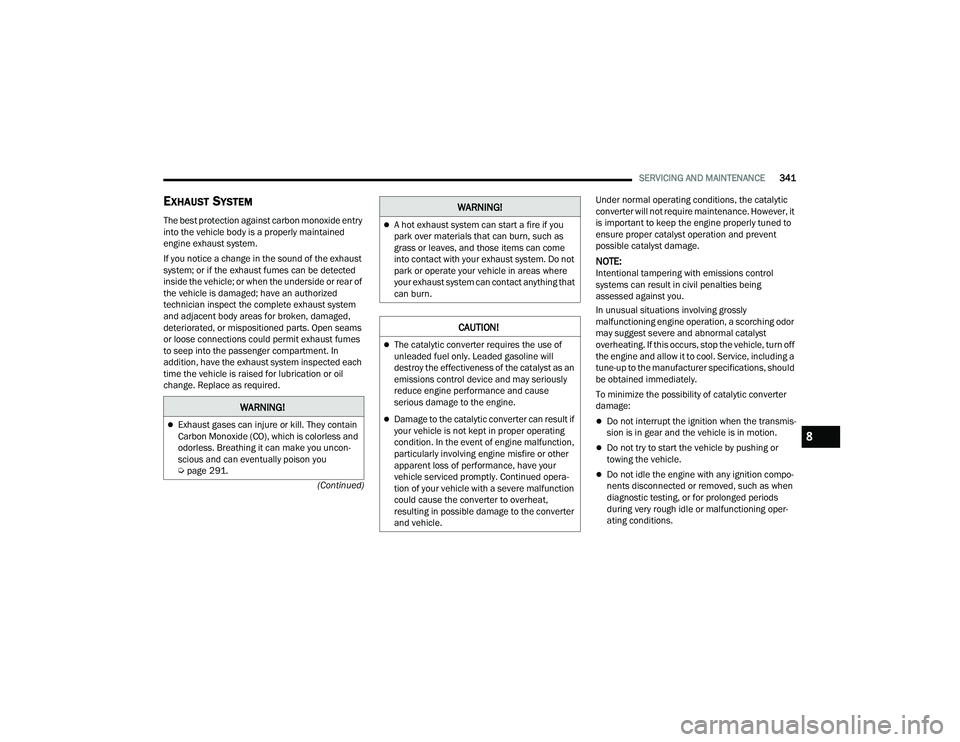
EXHAUST SYSTEM
The best protection against carbon monoxide entry
into the vehicle body is a properly maintained
engine exhaust system.
If you notice a change in the sound of the exhaust
system; or if the exhaust fumes can be detected
inside the vehicle; or when the underside or rear of
the vehicle is damaged; have an authorized
technician inspect the complete exhaust system
and adjacent body areas for broken, damaged,
deteriorated, or mispositioned parts. Open seams
or loose connections could permit exhaust fumes
to seep into the passenger compartment. In
addition, have the exhaust system inspected each
time the vehicle is raised for lubrication or oil
change. Replace as required. Under normal operating conditions, the catalytic
converter will not require maintenance. However, it
is important to keep the engine properly tuned to
ensure proper catalyst operation and prevent
possible catalyst damage.
NOTE:Intentional tampering with emissions control
systems can result in civil penalties being
assessed against you.
In unusual situations involving grossly
malfunctioning engine operation, a scorching odor
may suggest severe and abnormal catalyst
overheating. If this occurs, stop the vehicle, turn off
the engine and allow it to cool. Service, including a
tune-up to the manufacturer specifications, should
be obtained immediately.
To minimize the possibility of catalytic converter
damage:
Do not interrupt the ignition when the transmis
-
sion is in gear and the vehicle is in motion.
Do not try to start the vehicle by pushing or
towing the vehicle.
Do not idle the engine with any ignition compo -
nents disconnected or removed, such as when
diagnostic testing, or for prolonged periods
during very rough idle or malfunctioning oper -
ating conditions.
WARNING!
Exhaust gases can injure or kill. They contain
Carbon Monoxide (CO), which is colorless and
odorless. Breathing it can make you uncon -
scious and can eventually poison you
Ú page 291.
A hot exhaust system can start a fire if you
park over materials that can burn, such as
grass or leaves, and those items can come
into contact with your exhaust system. Do not
park or operate your vehicle in areas where
your exhaust system can contact anything that
can burn.
CAUTION!
The catalytic converter requires the use of
unleaded fuel only. Leaded gasoline will
destroy the effectiveness of the catalyst as an
emissions control device and may seriously
reduce engine performance and cause
serious damage to the engine.
Damage to the catalytic converter can result if
your vehicle is not kept in proper operating
condition. In the event of engine malfunction,
particularly involving engine misfire or other
apparent loss of performance, have your
vehicle serviced promptly. Continued opera -
tion of your vehicle with a severe malfunction
could cause the converter to overheat,
resulting in possible damage to the converter
and vehicle.
WARNING!
8
21_RUP_OM_EN_USC_t.book Page 341
Page 345 of 401
SERVICING AND MAINTENANCE343
This vehicle has not been designed for use with
propylene glycol-based engine coolant. Use of
propylene glycol-based engine coolant is not
recommended.
Some vehicles require special tools to add
coolant properly. Failure to fill these systems
properly could lead to severe internal engine
damage. If any coolant is needed to be added to
the system please contact an authorized dealer.
Adding Coolant
Your vehicle has been built with an improved
engine coolant (OAT coolant conforming to
MS.90032) that allows extended maintenance
intervals. This engine coolant (antifreeze)
can be used up to ten years or 150,000 miles
(240,000 km) before replacement. To prevent
reducing this extended maintenance period, it is
important that you use the same engine coolant
(OAT coolant conforming to MS.90032) throughout
the life of your vehicle.
Please review these recommendations for using
OAT engine coolant that meets the requirements of
the manufacturer Material Standard MS.90032.
When adding engine coolant:
We recommend using Mopar® Antifreeze/
Coolant 10 Year/150,000 Mile (240,000 km)
Formula OAT that meets the requirements of the
manufacturer Material Standard MS.90032.
Mix a minimum solution of 50% OAT engine
coolant that meets the requirements of the
manufacturer Material Standard MS.90032
and distilled water. Use higher concentrations
(not to exceed 70%) if temperatures below
−34°F (−37°C) are anticipated. Please contact
an authorized dealer for assistance.
Use only high purity water such as distilled or
deionized water when mixing the water/engine
coolant solution. The use of lower quality water
will reduce the amount of corrosion protection
in the engine cooling system.
NOTE:
It is the owner's responsibility to maintain the
proper level of protection against freezing
according to the temperatures occurring in the
area where the vehicle is operated.
Some vehicles require special tools to add
coolant properly. Failure to fill these systems
properly could lead to severe internal engine
damage. If any coolant is needed to be added to
the system, please contact an authorized
dealer.
Mixing engine coolant types is not recom -
mended and can result in cooling system
damage. If HOAT and OAT coolant are mixed in
an emergency, have an authorized dealer drain,
flush, and refill with OAT coolant (conforming to
MS.90032) as soon as possible.
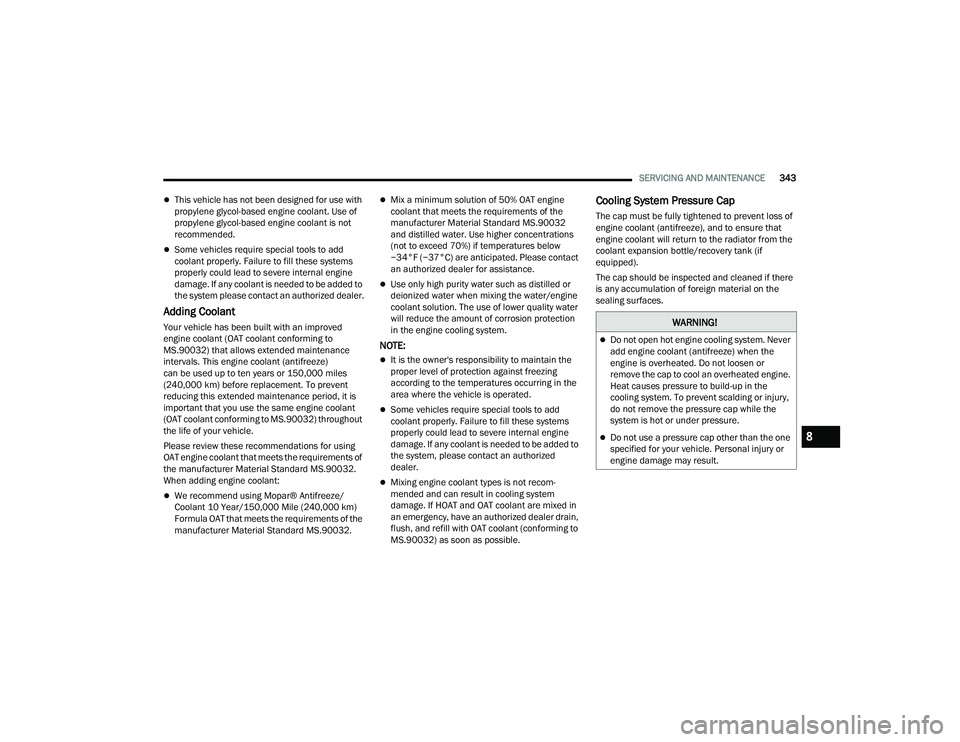
Cooling System Pressure Cap
The cap must be fully tightened to prevent loss of
engine coolant (antifreeze), and to ensure that
engine coolant will return to the radiator from the
coolant expansion bottle/recovery tank (if
equipped).
The cap should be inspected and cleaned if there
is any accumulation of foreign material on the
sealing surfaces.
WARNING!
Do not open hot engine cooling system. Never
add engine coolant (antifreeze) when the
engine is overheated. Do not loosen or
remove the cap to cool an overheated engine.
Heat causes pressure to build-up in the
cooling system. To prevent scalding or injury,
do not remove the pressure cap while the
system is hot or under pressure.
Do not use a pressure cap other than the one
specified for your vehicle. Personal injury or
engine damage may result.8
21_RUP_OM_EN_USC_t.book Page 343
Page 382 of 401
380TECHNICAL SPECIFICATIONS
(Continued)
MATERIALS ADDED TO FUEL
Besides using unleaded gasoline with the proper
octane rating, gasolines that contain detergents,
corrosion and stability additives are
recommended. Using gasolines that have these
additives will help improve fuel economy, reduce
emissions, and maintain vehicle performance.Designated TOP TIER Detergent
Gasoline contains a higher level of
detergents to further aide in minimizing
engine and fuel system deposits. When
available, the usage of TOP TIER Detergent
gasoline is recommended. Visit
www.toptiergas.com for a list of TOP TIER
Detergent Gasoline Retailers.
Indiscriminate use of fuel system cleaning agents
should be avoided. Many of these materials
intended for gum and varnish removal may contain
active solvents or similar ingredients. These can
harm fuel system gasket and diaphragm materials.
FUEL SYSTEM CAUTIONS
NOTE:Intentional tampering with the emissions control
system can result in civil penalties being assessed
against you.
CAUTION!
Follow these guidelines to maintain your
vehicle’s performance:
The use of leaded gasoline is prohibited by
Federal law. Using leaded gasoline can impair
engine performance and damage the emis -
sions control system.
An out-of-tune engine or certain fuel or ignition
malfunctions can cause the catalytic
converter to overheat. If you notice a pungent
burning odor or some light smoke, your engine
may be out of tune or malfunctioning and may
require immediate service. Contact an autho -
rized dealer for service assistance.
The use of fuel additives, which are now being
sold as octane enhancers, is not recom -
mended. Most of these products contain high
concentrations of methanol. Fuel system
damage or vehicle performance problems
resulting from the use of such fuels or addi -
tives is not the responsibility of the manufac-
turer and may void or not be covered under
the New Vehicle Limited Warranty.
CAUTION!
21_RUP_OM_EN_USC_t.book Page 380
Page 392 of 401
390 Corrosion Protection
...................................... 374Cruise Control................................................ 147Cruise Control (Speed Control)...................... 149Cruise Light......................................... 129, 130Customer Assistance..................................... 384Cybersecurity................................................. 188
D
Daytime Brightness, Interior Lights.................. 67Daytime Running Lights................................... 63Dealer Service............................................... 333Defroster, Windshield.................................... 292Delay (Intermittent) Wipers.............................. 68Diagnostic System, Onboard......................... 130Dimmer Switch Headlight..................................................... 63DipsticksOil (Engine)................................................ 332Disable Vehicle Towing.................................. 324DisposalAntifreeze (Engine Coolant)....................... 344Door Ajar.............................................. 124, 125Door Ajar Light..................................... 124, 125Driver’s Seat Back Tilt.............................. 32, 33DrivingThrough Flowing, Rising, Or ShallowStanding Water
..................................... 187DVD Player (Video Entertainment System).... 214
E
Electric Brake Control System....................... 235Anti-Lock Brake System............................ 234Traction Control System........................... 239Electric Parking Brake................................... 137Electric Remote Mirrors................................... 58Electronic Stability Control (ESC).................. 236Electronic Throttle Control Warning Light...... 124Emergency Braking....................................... 246Emergency, In Case OfHazard Warning Flasher........................... 295Jacking............................................ 298, 301Jump Starting........................................... 318Overheating.............................................. 321Towing...................................................... 324Emission Control System Maintenance........ 131Engine........................................................... 331Air Cleaner................................................ 334Block Heater............................................. 136Break-In Recommendations..................... 136Checking Oil Level.................................... 332Compartment........................................... 331Compartment Identification...................... 331Coolant (Antifreeze).................................. 382Cooling..................................................... 342Exhaust Gas Caution................................ 294Fails To Start............................................ 135Flooded, Starting...................................... 135
Fuel Requirements................................... 378Oil...........................................333, 381, 382Oil Filler Cap............................................. 331Oil Filter.................................................... 334Oil Selection..................................... 333, 381Oil Synthetic.............................................. 334Overheating.............................................. 321Starting..................................................... 132Enhanced Accident Response
Feature................................................ 272, 326Ethanol.......................................................... 379Exhaust Gas Cautions................................... 294Exhaust System................................... 294, 341Exterior Lighting..................................... 63, 355Exterior Lights...................... 63, 293, 354, 355
F
FiltersAir Cleaner
................................................ 334Air Conditioning................................. 82, 336Engine Oil........................................ 334, 382Engine Oil Disposal................................... 334FlashersHazard Warning........................................ 295Turn Signals..................... 63, 129, 293, 355Flash-To-Pass............................................ 63, 65Flat Tire Changing.......................298, 355, 367Flat Tire Stowage........................ 306, 355, 367
21_RUP_OM_EN_USC_t.book Page 390
Page 396 of 401
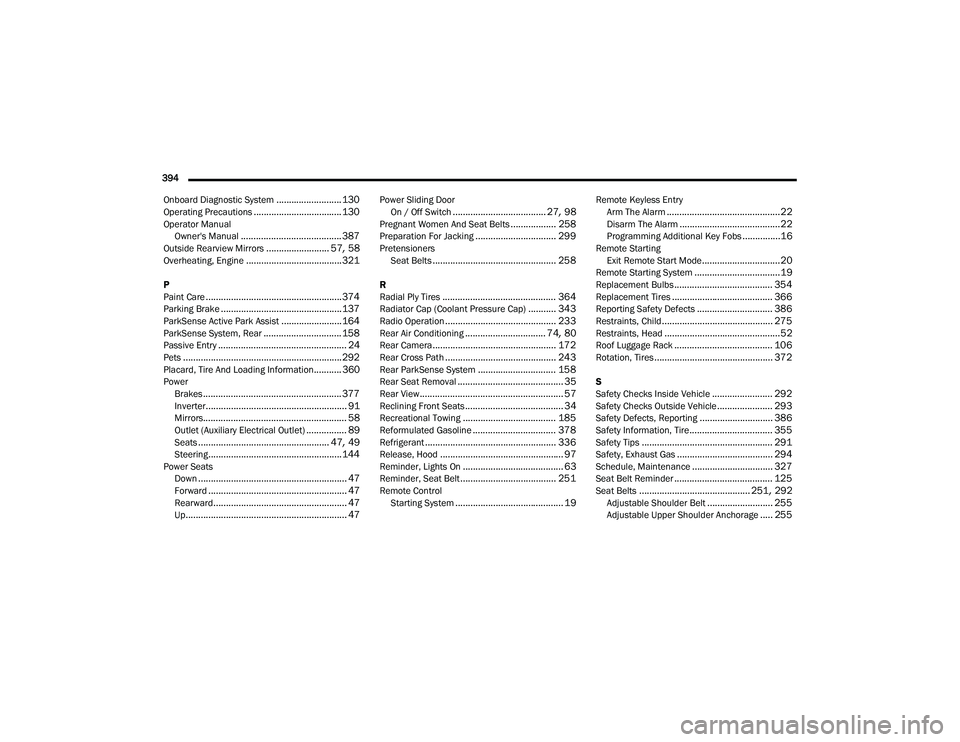
394 Onboard Diagnostic System
.......................... 130Operating Precautions................................... 130Operator Manual Owner's Manual........................................ 387Outside Rearview Mirrors......................... 57, 58Overheating, Engine...................................... 321
P
Paint Care...................................................... 374Parking Brake................................................ 137ParkSense Active Park Assist........................ 164ParkSense System, Rear............................... 158Passive Entry................................................... 24Pets............................................................... 292Placard, Tire And Loading Information........... 360PowerBrakes....................................................... 377Inverter........................................................ 91Mirrors......................................................... 58Outlet (Auxiliary Electrical Outlet)................ 89Seats.................................................... 47, 49Steering..................................................... 144Power SeatsDown........................................................... 47Forward....................................................... 47Rearward..................................................... 47Up................................................................ 47
Power Sliding DoorOn / Off Switch..................................... 27, 98Pregnant Women And Seat Belts.................. 258Preparation For Jacking................................ 299PretensionersSeat Belts................................................. 258
R
Radial Ply Tires............................................. 364Radiator Cap (Coolant Pressure Cap)........... 343Radio Operation............................................ 233Rear Air Conditioning................................ 74, 80Rear Camera................................................. 172Rear Cross Path............................................ 243Rear ParkSense System............................... 158Rear Seat Removal.......................................... 35Rear View......................................................... 57Reclining Front Seats....................................... 34Recreational Towing..................................... 185Reformulated Gasoline................................. 378Refrigerant.................................................... 336Release, Hood................................................. 97Reminder, Lights On........................................ 63Reminder, Seat Belt...................................... 251Remote ControlStarting System........................................... 19
Remote Keyless EntryArm The Alarm.............................................22Disarm The Alarm........................................22Programming Additional Key Fobs...............16Remote StartingExit Remote Start Mode...............................20Remote Starting System..................................19Replacement Bulbs....................................... 354Replacement Tires........................................ 366Reporting Safety Defects.............................. 386Restraints, Child............................................ 275Restraints, Head..............................................52Roof Luggage Rack....................................... 106Rotation, Tires............................................... 372
S
Safety Checks Inside Vehicle........................ 292Safety Checks Outside Vehicle...................... 293Safety Defects, Reporting............................. 386Safety Information, Tire................................. 355Safety Tips.................................................... 291Safety, Exhaust Gas...................................... 294Schedule, Maintenance................................ 327Seat Belt Reminder....................................... 125Seat Belts............................................ 251, 292Adjustable Shoulder Belt.......................... 255Adjustable Upper Shoulder Anchorage..... 255
21_RUP_OM_EN_USC_t.book Page 394