AXLE CHRYSLER PACIFICA 2022 User Guide
[x] Cancel search | Manufacturer: CHRYSLER, Model Year: 2022, Model line: PACIFICA, Model: CHRYSLER PACIFICA 2022Pages: 384, PDF Size: 23.92 MB
Page 231 of 384

SAFETY229
If one wheel on a driven axle is spinning faster than
the other, the system will apply the brake of the
spinning wheel. This will allow more vehicle torque
to be applied to the wheel that is not spinning. BLD
may remain enabled even if TCS and the Electronic
Stability Control (ESC) are in reduced modes.
Trailer Sway Control (TSC)
TSC uses sensors in the vehicle to recognize an
excessively swaying trailer and will take the
appropriate actions to attempt to stop the sway.
Note that TSC cannot stop all trailers from swaying.
Always use caution when towing a trailer and follow
the trailer tongue weight recommendations
Ú page 174.
When TSC is functioning, the ESC Activation/
Malfunction Indicator Light will flash, the engine
power may be reduced and you may feel the
brakes being applied to individual wheels to
attempt to stop the trailer from swaying. TSC is
disabled when the ESC system is in the “Partial
Off” mode.
AUXILIARY DRIVING SYSTEMS
BLIND SPOT MONITORING (BS M) —
I
F EQUIPPED
The BSM system uses two radar sensors, located
inside the rear fascia/bumper, to detect highway
licensable vehicles (automobiles, trucks,
motorcycles, etc.) that enter the blind spot zones
from the rear/front/side of the vehicle.
Rear Detection Zones
When the vehicle is started, the BSM Warning Light
will momentarily illuminate in both outside
rearview mirrors to let the driver know that the
system is operational. The BSM system sensors
operate when the vehicle is in any forward gear
and enters standby mode when the vehicle is in
PARK (P). The BSM detection zone covers approximately one
lane width on both sides of the vehicle 12 ft
(3.7 m). The zone length starts at the outside
rearview mirror and extends approximately 10 ft
(3 m) beyond the rear fascia/bumper of the
vehicle. The BSM system monitors the detection
zones on both sides of the vehicle when the vehicle
speed reaches approximately 6 mph (10 km/h) or
higher and will alert the driver of vehicles in these
areas.
NOTE:
The BSM system DOES NOT alert the driver
about rapidly approaching vehicles that are
outside the detection zones.
The BSM system detection zone DOES NOT
change if your vehicle is towing a trailer. There
-
fore, visually verify the adjacent lane is clear for
both your vehicle and trailer before making a
lane change. If the trailer or other object
(i.e., bicycle, sports equipment) extends beyond
the side of your vehicle, this may result in false
detections. The BSM Warning Light may even
remain illuminated the entire time the vehicle is
in a forward gear.
WARNING!
If TSC activates while driving, slow the vehicle
down, stop at the nearest safe location, and
adjust the trailer load to eliminate trailer sway.
6
22_RUP_OM_EN_USC_t.book Page 229
Page 294 of 384
292IN CASE OF EMERGENCY
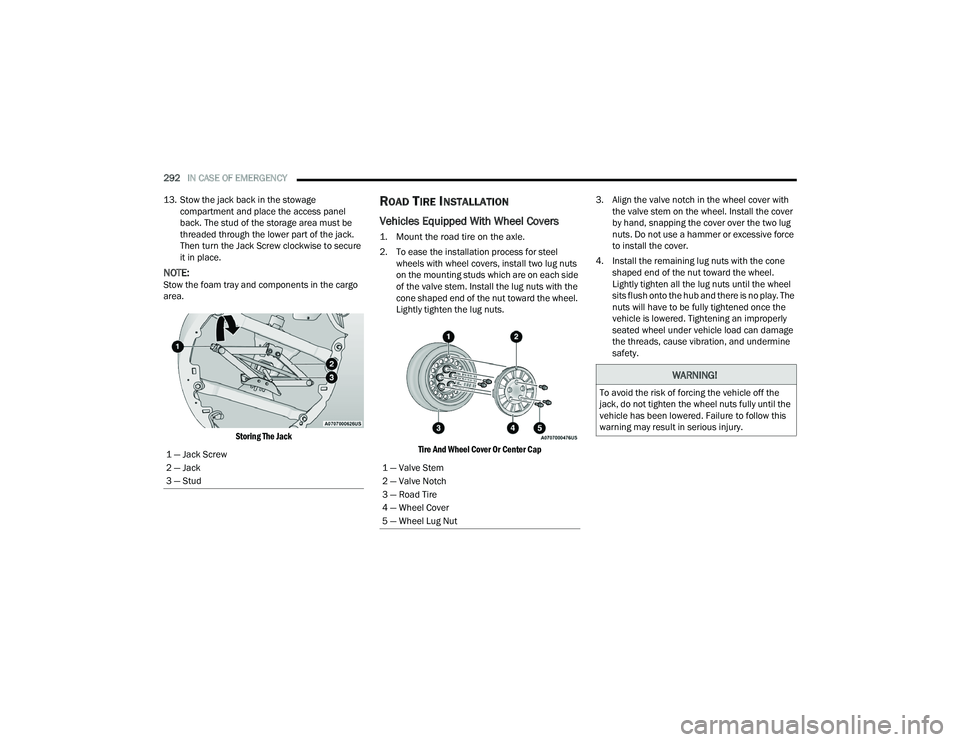
13. Stow the jack back in the stowage compartment and place the access panel
back. The stud of the storage area must be
threaded through the lower part of the jack.
Then turn the Jack Screw clockwise to secure
it in place.
NOTE:Stow the foam tray and components in the cargo
area.
Storing The Jack
ROAD TIRE INSTALLATION
Vehicles Equipped With Wheel Covers
1. Mount the road tire on the axle.
2. To ease the installation process for steel wheels with wheel covers, install two lug nuts
on the mounting studs which are on each side
of the valve stem. Install the lug nuts with the
cone shaped end of the nut toward the wheel.
Lightly tighten the lug nuts.
Tire And Wheel Cover Or Center Cap
3. Align the valve notch in the wheel cover with
the valve stem on the wheel. Install the cover
by hand, snapping the cover over the two lug
nuts. Do not use a hammer or excessive force
to install the cover.
4. Install the remaining lug nuts with the cone shaped end of the nut toward the wheel.
Lightly tighten all the lug nuts until the wheel
sits flush onto the hub and there is no play. The
nuts will have to be fully tightened once the
vehicle is lowered. Tightening an improperly
seated wheel under vehicle load can damage
the threads, cause vibration, and undermine
safety.
1 — Jack Screw
2 — Jack
3 — Stud
1 — Valve Stem
2 — Valve Notch
3 — Road Tire
4 — Wheel Cover
5 — Wheel Lug Nut
WARNING!
To avoid the risk of forcing the vehicle off the
jack, do not tighten the wheel nuts fully until the
vehicle has been lowered. Failure to follow this
warning may result in serious injury.
22_RUP_OM_EN_USC_t.book Page 292
Page 307 of 384
IN CASE OF EMERGENCY305
To Reset The Manual Park Release:
1. Apply firm pressure to the brake pedal while seated in the driver’s seat.
2. Pull the tether strap out again, then release it.
3. Allow the tether to retract with the lever back to its original position.
4. Verify that the transmission is in PARK (P).
5. Confirm that the tether has retracted fully and reinstall the access cover. If the access
cover cannot be reinstalled, repeat
steps 1 through 4.
FREEING A STUCK VEHICLE
If your vehicle becomes stuck in mud, sand or
snow, it can often be moved using a rocking
motion. Turn the steering wheel right and left to
clear the area around the front wheels. Then shift
back and forth between DRIVE (D) and REVERSE
(R) while gently pressing the accelerator.
NOTE:Shifts between DRIVE and REVERSE can only be
achieved at wheel speeds of 5 mph (8 km/h) or
less. Whenever the transmission remains in
NEUTRAL (N) for more than two seconds, you must
press the brake pedal to engage DRIVE or
REVERSE.
Use the least amount of accelerator pedal
pressure that will maintain the rocking motion
without spinning the wheels or racing the engine.
NOTE:Push the ESC OFF button to place the Electronic
Stability Control (ESC) system in “Partial Off”
mode, before rocking the vehicle Ú page 225.
Once the vehicle has been freed, push the ESC OFF
button again to restore “ESC On” mode.
WARNING!
Fast spinning tires can be dangerous. Forces
generated by excessive wheel speeds may
cause damage, or even failure, of the axle and
tires. A tire could explode and injure someone.
Do not spin your vehicle's wheels faster than
30 mph (48 km/h) or for longer than
30 seconds continuously without stopping when
you are stuck and do not let anyone near a
spinning wheel, no matter what the speed.
CAUTION!
Racing the engine or spinning the wheels may
lead to transmission overheating and failure.
Allow the engine to idle with the transmission
in NEUTRAL for at least one minute after every
five rocking-motion cycles. This will minimize
overheating and reduce the risk of transmis -
sion failure during prolonged efforts to free a
stuck vehicle.
When “rocking” a stuck vehicle by shifting
between DRIVE and REVERSE, do not spin the
wheels faster than 15 mph (24 km/h), or
drivetrain damage may result.
Revving the engine or spinning the wheels too
fast may lead to transmission overheating and
failure. It can also damage the tires. Do not
spin the wheels above 30 mph (48 km/h)
while in gear (no transmission shifting
occurring).
7
22_RUP_OM_EN_USC_t.book Page 305
Page 345 of 384
SERVICING AND MAINTENANCE343
Tire Loading And Tire Pressure
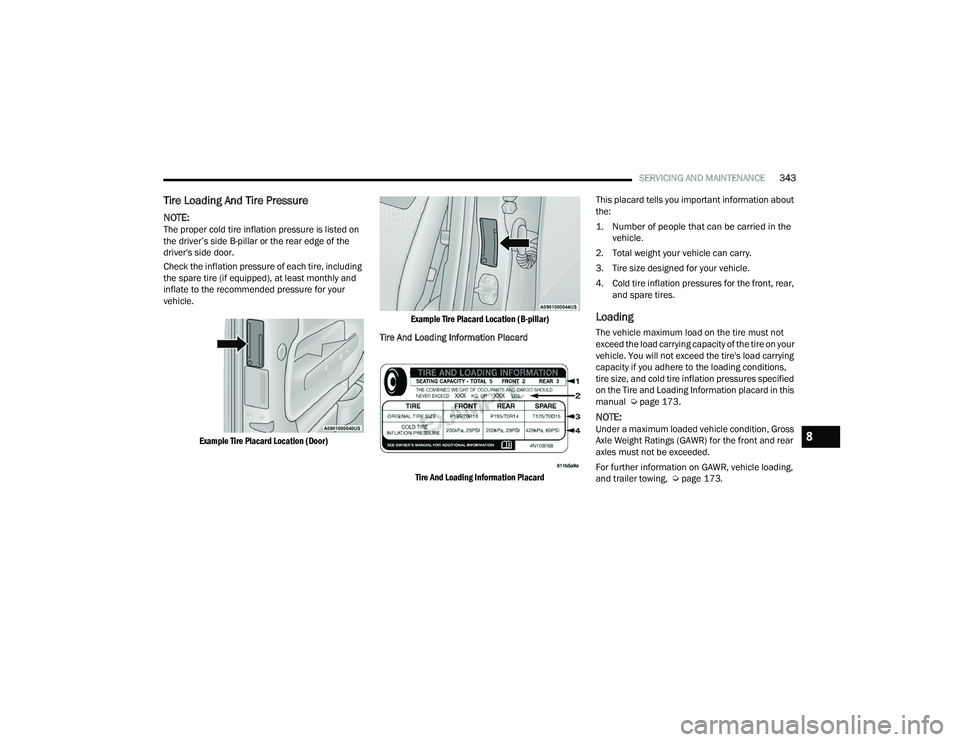
NOTE:The proper cold tire inflation pressure is listed on
the driver’s side B-pillar or the rear edge of the
driver's side door.
Check the inflation pressure of each tire, including
the spare tire (if equipped), at least monthly and
inflate to the recommended pressure for your
vehicle.
Example Tire Placard Location (Door) Example Tire Placard Location (B-pillar)
Tire And Loading Information Placard
Tire And Loading Information Placard
This placard tells you important information about
the:
1. Number of people that can be carried in the
vehicle.
2. Total weight your vehicle can carry.
3. Tire size designed for your vehicle.
4. Cold tire inflation pressures for the front, rear, and spare tires.
Loading
The vehicle maximum load on the tire must not
exceed the load carrying capacity of the tire on your
vehicle. You will not exceed the tire's load carrying
capacity if you adhere to the loading conditions,
tire size, and cold tire inflation pressures specified
on the Tire and Loading Information placard in this
manual Ú page 173.
NOTE:Under a maximum loaded vehicle condition, Gross
Axle Weight Ratings (GAWR) for the front and rear
axles must not be exceeded.
For further information on GAWR, vehicle loading,
and trailer towing, Ú page 173.8
22_RUP_OM_EN_USC_t.book Page 343
Page 353 of 384

SERVICING AND MAINTENANCE351
Spare Tire Matching Original Equipped Tire
And Wheel — If Equipped
Your vehicle may be equipped with a spare tire and
wheel equivalent in look and function to the
original equipment tire and wheel found on the
front or rear axle of your vehicle. This spare tire
may be used in the tire rotation for your vehicle. If
your vehicle has this option, refer to an authorized
tire dealer for the recommended tire rotation
pattern.
Compact Spare Tire — If Equipped
The compact spare is for temporary emergency
use only. You can identify if your vehicle is
equipped with a compact spare by looking at the
spare tire description on the Tire and Loading
Information Placard located on the driver’s side
door opening or on the sidewall of the tire.
Compact spare tire descriptions begin with the
letter “T” or “S” preceding the size designation.
Example: T145/80D18 103M.
T, S = Temporary Spare Tire
Since this tire has limited tread life, the original
equipment tire should be repaired (or replaced)
and reinstalled on your vehicle at the first
opportunity. Do not install a wheel cover or attempt to mount a
conventional tire on the compact spare wheel,
since the wheel is designed specifically for the
compact spare tire. Do not install more than one
compact spare tire and wheel on the vehicle at any
given time.
Collapsible Spare Tire — If Equipped
The collapsible spare is for temporary emergency
use only. You can identify if your vehicle is
equipped with a collapsible spare by looking at the
spare tire description on the Tire and Loading
Information Placard located on the driver’s side
door opening or on the sidewall of the tire.
Collapsible spare tire description
example: 165/80-17 101P.Since this tire has limited tread life, the original
equipment tire should be repaired (or replaced)
and reinstalled on your vehicle at the first
opportunity.
Inflate collapsible tire only after the wheel is
properly installed to the vehicle. Inflate the
collapsible tire using the electric air pump before
lowering the vehicle.
Do not install a wheel cover or attempt to mount a
conventional tire on the collapsible spare wheel,
since the wheel is designed specifically for the
collapsible spare tire.
WARNING!
Compact and collapsible spares are for
temporary emergency use only. With these
spares, do not drive more than 50 mph
(80 km/h). Temporary use spares have limited
tread life. When the tread is worn to the tread
wear indicators, the temporary use spare tire
needs to be replaced. Be sure to follow the
warnings, which apply to your spare. Failure to
do so could result in spare tire failure and loss of
vehicle control.
WARNING!
Compact and collapsible spares are for
temporary emergency use only. With these
spares, do not drive more than 50 mph
(80 km/h). Temporary use spares have limited
tread life. When the tread is worn to the tread
wear indicators, the temporary use spare tire
needs to be replaced. Be sure to follow the
warnings, which apply to your spare. Failure to
do so could result in spare tire failure and loss of
vehicle control.
8
22_RUP_OM_EN_USC_t.book Page 351
Page 354 of 384
352SERVICING AND MAINTENANCE
Full Size Spare — If Equipped
The full size spare is for temporary emergency use
only. This tire may look like the originally equipped
tire on the front or rear axle of your vehicle, but it is
not. This spare tire may have limited tread life.
When the tread is worn to the tread wear
indicators, the temporary use full size spare tire
needs to be replaced. Since it is not the same as
your original equipment tire, replace (or repair) the
original equipment tire and reinstall on the vehicle
at the first opportunity.
Limited Use Spare — If Equipped
The limited use spare tire is for temporary
emergency use only. This tire is identified by a label
located on the limited use spare wheel. This label
contains the driving limitations for this spare. This
tire may look like the original equipped tire on the
front or rear axle of your vehicle, but it is not.
Installation of this limited use spare tire affects
vehicle handling. Since it is not the same as your
original equipment tire, replace (or repair) the
original equipment tire and reinstall on the vehicle
at the first opportunity.
WHEEL AND WHEEL TRIM CARE
All wheels and wheel trim, especially aluminum
and chrome plated wheels, should be cleaned
regularly using mild (neutral Ph) soap and water to
maintain their luster and to prevent corrosion.
Wash wheels with the same soap solution
recommended for the body of the vehicle and
remember to always wash when the surfaces are
not hot to the touch. Your wheels are susceptible to deterioration
caused by salt, sodium chloride, magnesium
chloride, calcium chloride, etc., and other road
chemicals used to melt ice or control dust on dirt
roads. Use a soft cloth or sponge and mild soap to
wipe away promptly. Do not use harsh chemicals or
a stiff brush. They can damage the wheel’s
protective coating that helps keep them from
corroding and tarnishing.
WARNING!
Limited use spares are for emergency use only.
Installation of this limited use spare tire affects
vehicle handling. With this tire, do not drive
more than the speed listed on the limited use
spare wheel. Keep inflated to the cold tire
inflation pressures listed on your Tire and
Loading Information Placard located on the
driver’s side B-pillar or the rear edge of the
driver’s side door. Replace (or repair) the original
equipment tire at the first opportunity and
reinstall it on your vehicle. Failure to do so could
result in loss of vehicle control.
CAUTION!
Avoid products or automatic car washes that use
acidic solutions or strong alkaline additives or
harsh brushes. Many aftermarket wheel
cleaners and automatic car washes may
damage the wheel's protective finish. Such
damage is not covered by the New Vehicle
Limited Warranty. Only car wash soap, Mopar®
Wheel Cleaner or equivalent is recommended.
22_RUP_OM_EN_USC_t.book Page 352
Page 355 of 384
SERVICING AND MAINTENANCE353
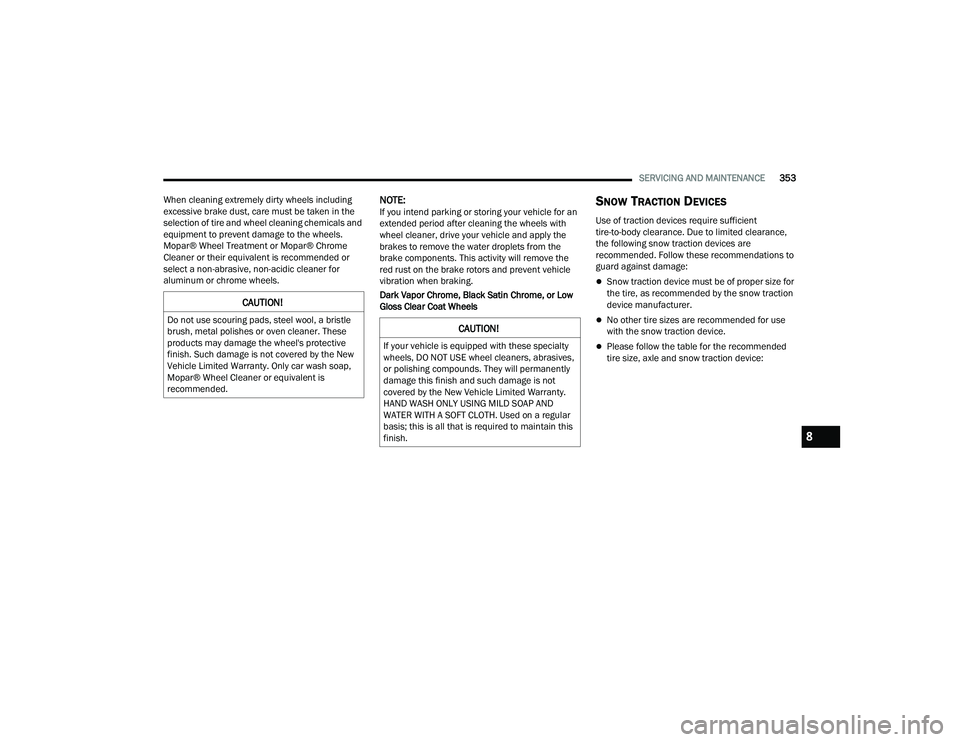
When cleaning extremely dirty wheels including
excessive brake dust, care must be taken in the
selection of tire and wheel cleaning chemicals and
equipment to prevent damage to the wheels.
Mopar® Wheel Treatment or Mopar® Chrome
Cleaner or their equivalent is recommended or
select a non-abrasive, non-acidic cleaner for
aluminum or chrome wheels.
NOTE:If you intend parking or storing your vehicle for an
extended period after cleaning the wheels with
wheel cleaner, drive your vehicle and apply the
brakes to remove the water droplets from the
brake components. This activity will remove the
red rust on the brake rotors and prevent vehicle
vibration when braking.
Dark Vapor Chrome, Black Satin Chrome, or Low
Gloss Clear Coat WheelsSNOW TRACTION DEVICES
Use of traction devices require sufficient
tire-to-body clearance. Due to limited clearance,
the following snow traction devices are
recommended. Follow these recommendations to
guard against damage:
Snow traction device must be of proper size for
the tire, as recommended by the snow traction
device manufacturer.
No other tire sizes are recommended for use
with the snow traction device.
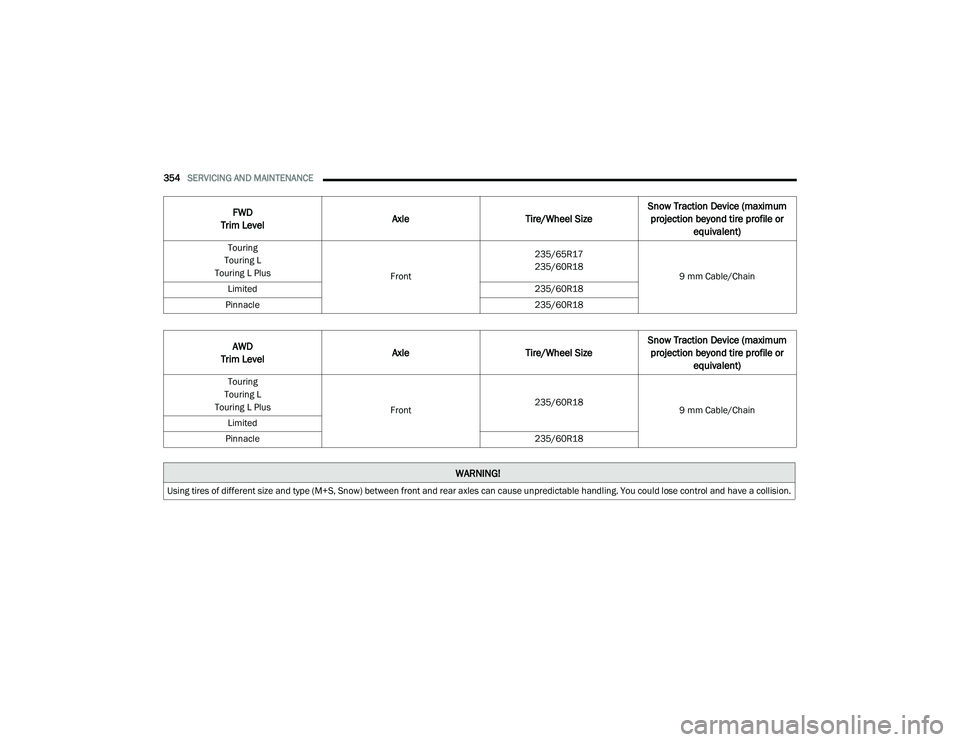
Please follow the table for the recommended
tire size, axle and snow traction device:
CAUTION!
Do not use scouring pads, steel wool, a bristle
brush, metal polishes or oven cleaner. These
products may damage the wheel's protective
finish. Such damage is not covered by the New
Vehicle Limited Warranty. Only car wash soap,
Mopar® Wheel Cleaner or equivalent is
recommended.CAUTION!
If your vehicle is equipped with these specialty
wheels, DO NOT USE wheel cleaners, abrasives,
or polishing compounds. They will permanently
damage this finish and such damage is not
covered by the New Vehicle Limited Warranty.
HAND WASH ONLY USING MILD SOAP AND
WATER WITH A SOFT CLOTH. Used on a regular
basis; this is all that is required to maintain this
finish.
8
22_RUP_OM_EN_USC_t.book Page 353
Page 356 of 384
354SERVICING AND MAINTENANCE
FWD
Trim Level Axle
Tire/Wheel SizeSnow Traction Device (maximum
projection beyond tire profile or equivalent)
Touring
Touring L
Touring L Plus Front235/65R17
235/60R18
9 mm Cable/Chain
Limited 235/60R18
Pinnacle 235/60R18
AWD
Trim Level Axle
Tire/Wheel SizeSnow Traction Device (maximum
projection beyond tire profile or equivalent)
Touring
Touring L
Touring L Plus Front235/60R18
9 mm Cable/Chain
Limited
Pinnacle 235/60R18
WARNING!
Using tires of different size and type (M+S, Snow) between front and rear axles can cause unpredictable handling. You could lose control and have a collision.
22_RUP_OM_EN_USC_t.book Page 354
Page 373 of 384
371
INDEX
A
About Your Brakes......................................... 360Adaptive Cruise Control (ACC)
(Cruise Control).................................... 146, 147Adding Engine Coolant (Antifreeze)............... 325Additives, Fuel............................................... 363AdjustDown........................................................... 47Forward....................................................... 47Rearward..................................................... 47Up................................................................ 47Air Bag........................................................... 251Air Bag Operation...................................... 252Air Bag Warning Light...................... 250, 252Driver Knee Air Bag................................... 257Enhanced Accident Response......... 260, 308Event Data Recorder (EDR)....................... 308Front Air Bag............................................. 252If Deployment Occurs................................ 259Knee Impact Bolsters................................ 256Maintaining Your Air Bag System.............. 261Maintenance............................................. 261
Redundant Air Bag Warning Light............. 251Side Air Bags............................................ 257Transporting Pets..................................... 279Air Bag Light................................ 121, 250, 279Air Cleaner, Engine
(Engine Air Cleaner Filter)............................. 316Air Conditioner Maintenance........................ 317Air Conditioner Refrigerant.................. 317, 318Air Conditioner System................................. 317Air Conditioning Filter..............................83, 318Air Conditioning, Operating Tips....................... 83Air Filter........................................................ 316Air PressureTires......................................................... 347AlarmArm The System.......................................... 22Disarm The System..................................... 22Security Alarm.......................................... 124All Wheel DriveTowing...................................................... 308All Wheel Drive (AWD)................................... 143Alterations/ModificationsVehicle......................................................... 10
Amazon FireTV..................................... 213, 218Amazon FireTV Built-In.................................. 213Antifreeze (Engine Coolant).................. 325, 364Disposal.................................................... 326Anti-Lock Brake System (ABS)....................... 223Anti-Lock Warning Light................................ 124Assist, Hill Start............................................. 227Audio Jack........................................................87Audio Systems (Radio).................................. 187Auto Up Power Windows..................................93Automatic Dimming Mirror...............................57Automatic Headlights.......................................67Automatic Temperature Control (ATC)..............82Automatic Transaxle..................................... 139Automatic Transmission................................ 140Adding Fluid..................................... 328, 366Fluid And Filter Change............................. 328Fluid Change............................................. 328Fluid Level Check...................................... 328Fluid Type........................................ 328, 366Special Additives...................................... 328
11
22_RUP_OM_EN_USC_t.book Page 371
Page 374 of 384
372 AutoPark
........................................................ 132AUX Cord.......................................................... 87Auxiliary Electrical Outlet (Power Outlet).......... 89AWD Towing....................................................... 308Axle Lubrication............................................. 366
B
Back-Up Camera............................................ 168Battery................................................. 121, 314Charging System Light............................... 121Jump Starting............................................ 300Keyless Key Fob Replacement.................... 15Battery Saver Feature...................................... 68Belts, Seat..................................................... 279Blind Spot Monitoring.................................... 229Body Mechanism Lubrication........................ 320B-Pillar Location............................................. 343Brake Assist System...................................... 224Brake Control System, Electronic.................. 224Brake Fluid.................................................... 366Brake System...................................... 327, 360Anti-Lock (ABS).......................................... 360Fluid Check..................................... 327, 366Master Cylinder......................................... 327Parking...................................................... 136Warning Light............................................ 122
Brake/Transmission Interlock...................... 140Brightness, Interior Lights................................ 69Bulb Replacement............................... 337, 338Bulbs, Light................................. 281, 337, 338
C
Camera......................................................... 168Camera, Rear....................................... 168, 169Capacities, Fluid........................................... 364Caps, FillerFuel.......................................................... 172Oil (Engine)............................................... 313Radiator (Coolant Pressure)..................... 326Car Washes................................................... 357Carbon Monoxide Warning............................ 281CargoVehicle Loading........................................ 100Cargo Area Cover.......................................... 100Cargo CompartmentLuggage Carrier........................................ 106Cargo Load Floor........................................... 100Cargo Tie-Downs........................................... 100Cellular Phone.............................................. 222Certification Label......................................... 173Chains, Tire................................................... 353Change Oil Indicator..................................... 114
Changing A Flat Tire...................................... 286Chart, Tire Sizing........................................... 340Check Engine Light
(Malfunction Indicator Light)......................... 130Checking Your Vehicle For Safety.................. 278Checks, Safety.............................................. 278Child Restraint.............................................. 262Child RestraintsBooster Seats........................................... 265Center Seat LATCH................................... 271Child Seat Installation...................... 273, 275How To Stow An unused ALR Seat Belt..... 272Infant And Child Restraints....................... 263Lower Anchors And Tethers For Children.......................................... 266Older Children And Child Restraints.......... 264Seating Positions...................................... 266Using The Top Tether Anchorage.............. 276Clean Air Gasoline......................................... 361CleaningWheels...................................................... 352Climate Control................................................72Automatic....................................................72Manual........................................................77Rear......................................................76, 81Cold Weather Operation................................ 134
22_RUP_OM_EN_USC_t.book Page 372