seat adjustment CHRYSLER PACIFICA 2023 User Guide
[x] Cancel search | Manufacturer: CHRYSLER, Model Year: 2023, Model line: PACIFICA, Model: CHRYSLER PACIFICA 2023Pages: 328, PDF Size: 16.37 MB
Page 48 of 328
46GETTING TO KNOW YOUR VEHICLE
Head Restraints — Second Row Quad
Seats
The second row outboard head restraints, as well as the
removable 8th passenger seat (if equipped), may have
adjustable head restraints.
NOTE:If equipped with Stow ‘n Go seating, the head restraints
are non-adjustable and non-removable. Do not pull on
non-adjustable head restraints when folding the seat.
To raise the head restraint, pull upward on the head
restraint. To lower the head restraint, push the adjustment
button, located at the base of the head restraint, and push
downward.
To remove the head restraint, raise it as far as it can go.
Then, push the release button and the adjustment button
at the base of each post while pulling the head restraint
up. Seatback angle may need to be adjusted to fully
remove the head restraint. To reinstall the head restraint, put the head restraint posts into the holes and push
downward. Then, adjust the head restraint to the
appropriate height.
Head Restraints — Third Row
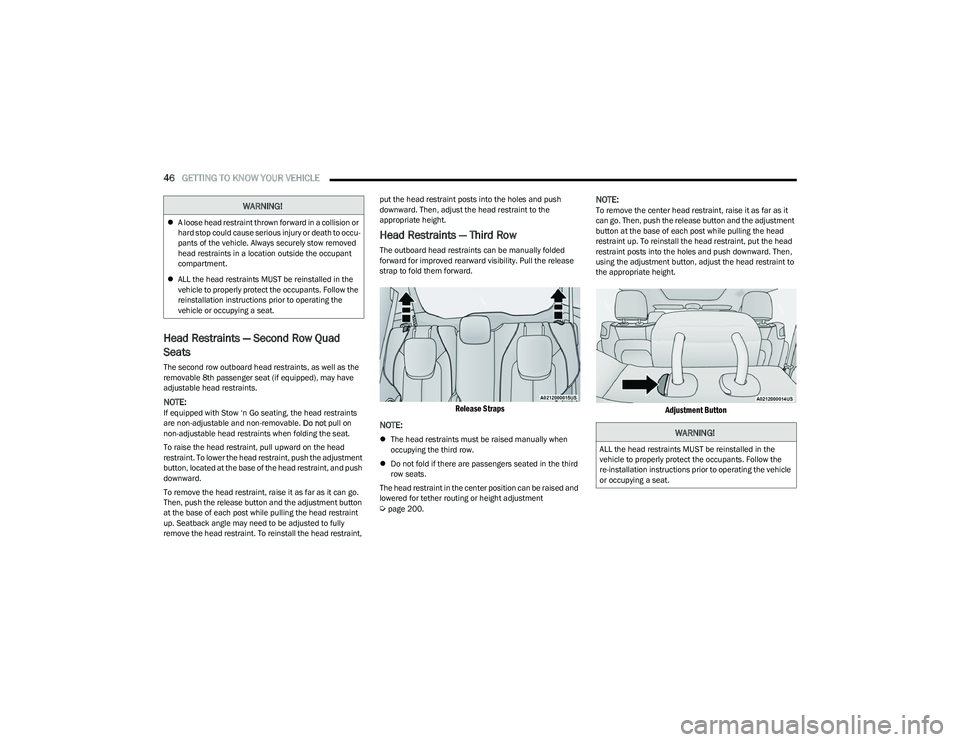
The outboard head restraints can be manually folded
forward for improved rearward visibility. Pull the release
strap to fold them forward.
Release Straps
NOTE:
The head restraints must be raised manually when
occupying the third row.
Do not fold if there are passengers seated in the third
row seats.
The head restraint in the center position can be raised and
lowered for tether routing or height adjustment
Úpage 200.
NOTE:To remove the center head restraint, raise it as far as it
can go. Then, push the release button and the adjustment
button at the base of each post while pulling the head
restraint up. To reinstall the head restraint, put the head
restraint posts into the holes and push downward. Then,
using the adjustment button, adjust the head restraint to
the appropriate height.
Adjustment Button
WARNING!
A loose head restraint thrown forward in a collision or
hard stop could cause serious injury or death to occu -
pants of the vehicle. Always securely stow removed
head restraints in a location outside the occupant
compartment.
ALL the head restraints MUST be reinstalled in the
vehicle to properly protect the occupants. Follow the
reinstallation instructions prior to operating the
vehicle or occupying a seat.
WARNING!
ALL the head restraints MUST be reinstalled in the
vehicle to properly protect the occupants. Follow the
re-installation instructions prior to operating the vehicle
or occupying a seat.
23_RUP_OM_EN_USC_t.book Page 46
Page 75 of 328
GETTING TO KNOW YOUR VEHICLE73
NOTE:
Push the lock rod inward for the locked position.
Pull outward on the lock rod for the unlocked posi -
tion.
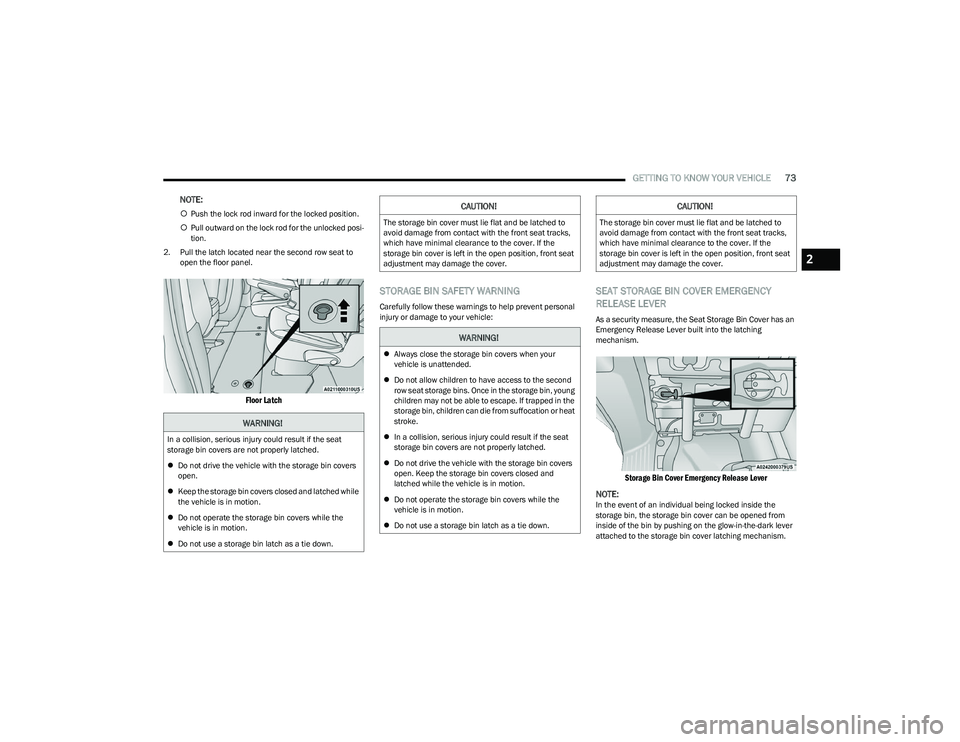
2. Pull the latch located near the second row seat to open the floor panel.
Floor Latch
STORAGE BIN SAFETY WARNING
Carefully follow these warnings to help prevent personal
injury or damage to your vehicle:
SEAT STORAGE BIN COVER EMERGENCY
RELEASE LEVER
As a security measure, the Seat Storage Bin Cover has an
Emergency Release Lever built into the latching
mechanism.
Storage Bin Cover Emergency Release Lever
NOTE:
In the event of an individual being locked inside the
storage bin, the storage bin cover can be opened from
inside of the bin by pushing on the glow-in-the-dark lever
attached to the storage bin cover latching mechanism.
WARNING!
In a collision, serious injury could result if the seat
storage bin covers are not properly latched.
Do not drive the vehicle with the storage bin covers
open.
Keep the storage bin covers closed and latched while
the vehicle is in motion.
Do not operate the storage bin covers while the
vehicle is in motion.
Do not use a storage bin latch as a tie down.
CAUTION!
The storage bin cover must lie flat and be latched to
avoid damage from contact with the front seat tracks,
which have minimal clearance to the cover. If the
storage bin cover is left in the open position, front seat
adjustment may damage the cover.
WARNING!
Always close the storage bin covers when your
vehicle is unattended.
Do not allow children to have access to the second
row seat storage bins. Once in the storage bin, young
children may not be able to escape. If trapped in the
storage bin, children can die from suffocation or heat
stroke.
In a collision, serious injury could result if the seat
storage bin covers are not properly latched.
Do not drive the vehicle with the storage bin covers
open. Keep the storage bin covers closed and
latched while the vehicle is in motion.
Do not operate the storage bin covers while the
vehicle is in motion.
Do not use a storage bin latch as a tie down.
CAUTION!
The storage bin cover must lie flat and be latched to
avoid damage from contact with the front seat tracks,
which have minimal clearance to the cover. If the
storage bin cover is left in the open position, front seat
adjustment may damage the cover.
2
23_RUP_OM_EN_USC_t.book Page 73
Page 129 of 328
STARTING AND OPERATING127
If ACC is set when the vehicle speed is below 20 mph
(32 km/h), the set speed will default to 20 mph
(32 km/h).
NOTE:Fixed Speed Cruise Control cannot be set below 20 mph
(32 km/h).
If either system is set when the vehicle speed is above
20 mph (32 km/h), the set speed shall be the current speed of the vehicle.
NOTE:
Keeping your foot on the accelerator pedal can cause
the vehicle to continue to accelerate beyond the set
speed. If this occurs, the message “Driver Override” will
display in the instrument cluster display.
If you continue to accelerate beyond the set speed
while an ACC is enabled, the system will not be
controlling the distance between your vehicle and the
vehicle ahead. The vehicle speed will only be deter -
mined by the position of the accelerator pedal.
To Cancel
The following conditions cancel the ACC or Fixed Speed
Cruise Control systems:
The brake pedal is applied
The CANC (cancel) button is pushed
The Anti-Lock Brake System (ABS) activates
The gear selector is removed from the DRIVE position
The Electronic Stability Control/Traction Control
System (ESC/TCS) activates
The vehicle parking brake is applied
The braking temperature exceeds normal range (over -
heated)
The following conditions will only cancel the ACC system:
Driver seat belt is unbuckled at low speeds
Driver door is opened at low speeds
To Turn Off
The system will turn off and clear the set speed in
memory if:
The Adaptive Cruise Control (ACC) on/off button is
pushed
The Fixed Speed Cruise Control on/off button is pushed
The ignition is placed in the OFF position
To Resume
If there is a set speed in memory, push the RES (resume)
button and then remove your foot from the accelerator
pedal. The instrument cluster display will display the last
set speed.
Resume can be used at any speed above 20 mph
(32 km/h) when only Fixed Speed Cruise Control is being
used.
NOTE:
If your vehicle is at a standstill longer than two
seconds, the driver will either have to push the RES
(resume) button, or apply the accelerator pedal to reen -
gage the Adaptive Cruise Control (ACC) to the existing
set speed.
ACC cannot be resumed if there is a stationary vehicle
in front of your vehicle in close proximity.
To Vary The Speed Setting
To Increase Or Decrease The Set Speed
After setting a speed, you can increase the set speed by
pushing the SET (+) button, or decrease speed by pushing
the SET (-) button.
U.S. Speed (mph)
Pushing the SET (+), or SET (-) button once will result in
a 1 mph speed adjustment. Each subsequent tap of
the button results in an adjustment of 1 mph.
If the button is continually pushed, the set speed will
continue to adjust in 5 mph increments until the button
is released. The new set speed is reflected in the instru -
ment cluster display.
Metric Speed (km/h)
Pushing the SET (+), or SET (-) button once will result in
a 1 km/h speed adjustment. Each subsequent tap of
the button results in an adjustment of 1 km/h.
If the button is continually pushed, the set speed will
continue to adjust in 10 km/h increments until the
button is released. The new set speed is reflected in
the instrument cluster display.
WARNING!
The Resume function should only be used if traffic and
road conditions permit. Resuming a set speed that is
too high or too low for prevailing traffic and road
conditions could cause the vehicle to accelerate or
decelerate too sharply for safe operation. Failure to
follow these warnings can result in a collision and death
or serious personal injury.
4
23_RUP_OM_EN_USC_t.book Page 127
Page 206 of 328
204SAFETY
Lap/Shoulder Belt Untwisting Procedure
Use the following procedure to untwist a twisted lap/
shoulder belt.
1. Position the latch plate as close as possible to the
anchor point.
2. At about 6 to 12 inches (15 to 30 cm) above the latch plate, grab and twist the seat belt webbing
180 degrees to create a fold that begins immediately
above the latch plate.
3. Slide the latch plate upward over the folded webbing. The folded webbing must enter the slot at the top of
the latch plate.
4. Continue to slide the latch plate up until it clears the folded webbing and the seat belt is no longer twisted.
Adjustable Upper Shoulder Belt Anchorage
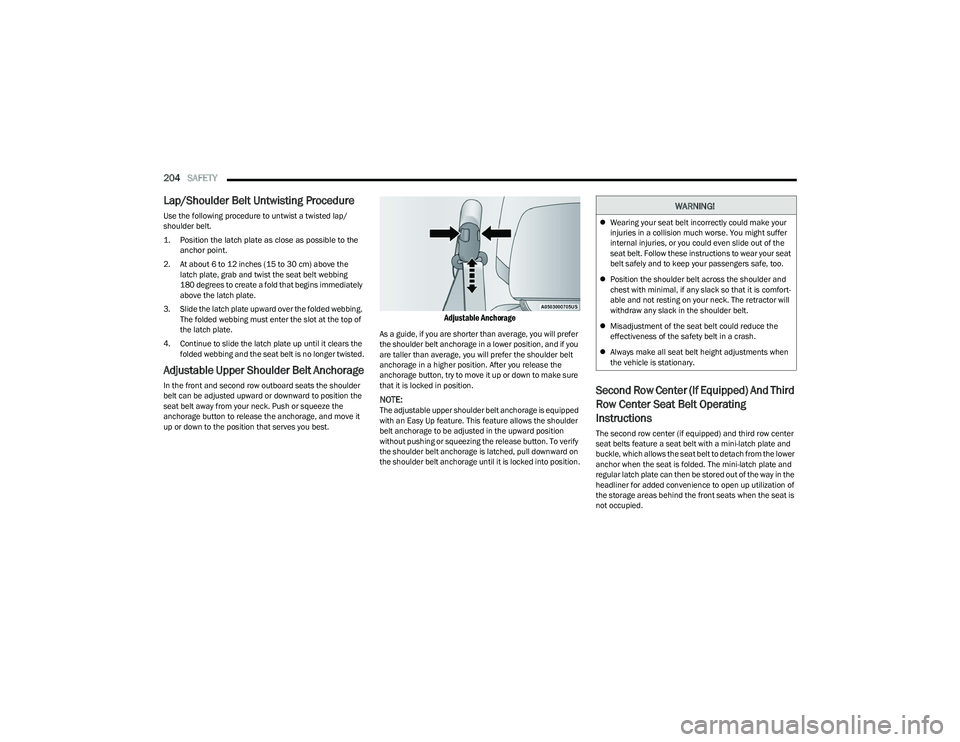
In the front and second row outboard seats the shoulder
belt can be adjusted upward or downward to position the
seat belt away from your neck. Push or squeeze the
anchorage button to release the anchorage, and move it
up or down to the position that serves you best.
Adjustable Anchorage
As a guide, if you are shorter than average, you will prefer
the shoulder belt anchorage in a lower position, and if you
are taller than average, you will prefer the shoulder belt
anchorage in a higher position. After you release the
anchorage button, try to move it up or down to make sure
that it is locked in position.
NOTE:The adjustable upper shoulder belt anchorage is equipped
with an Easy Up feature. This feature allows the shoulder
belt anchorage to be adjusted in the upward position
without pushing or squeezing the release button. To verify
the shoulder belt anchorage is latched, pull downward on
the shoulder belt anchorage until it is locked into position.
Second Row Center (If Equipped) And Third
Row Center Seat Belt Operating
Instructions
The second row center (if equipped) and third row center
seat belts feature a seat belt with a mini-latch plate and
buckle, which allows the seat belt to detach from the lower
anchor when the seat is folded. The mini-latch plate and
regular latch plate can then be stored out of the way in the
headliner for added convenience to open up utilization of
the storage areas behind the front seats when the seat is
not occupied.
WARNING!
Wearing your seat belt incorrectly could make your
injuries in a collision much worse. You might suffer
internal injuries, or you could even slide out of the
seat belt. Follow these instructions to wear your seat
belt safely and to keep your passengers safe, too.
Position the shoulder belt across the shoulder and
chest with minimal, if any slack so that it is comfort -
able and not resting on your neck. The retractor will
withdraw any slack in the shoulder belt.
Misadjustment of the seat belt could reduce the
effectiveness of the safety belt in a crash.
Always make all seat belt height adjustments when
the vehicle is stationary.
23_RUP_OM_EN_USC_t.book Page 204
Page 322 of 328
320
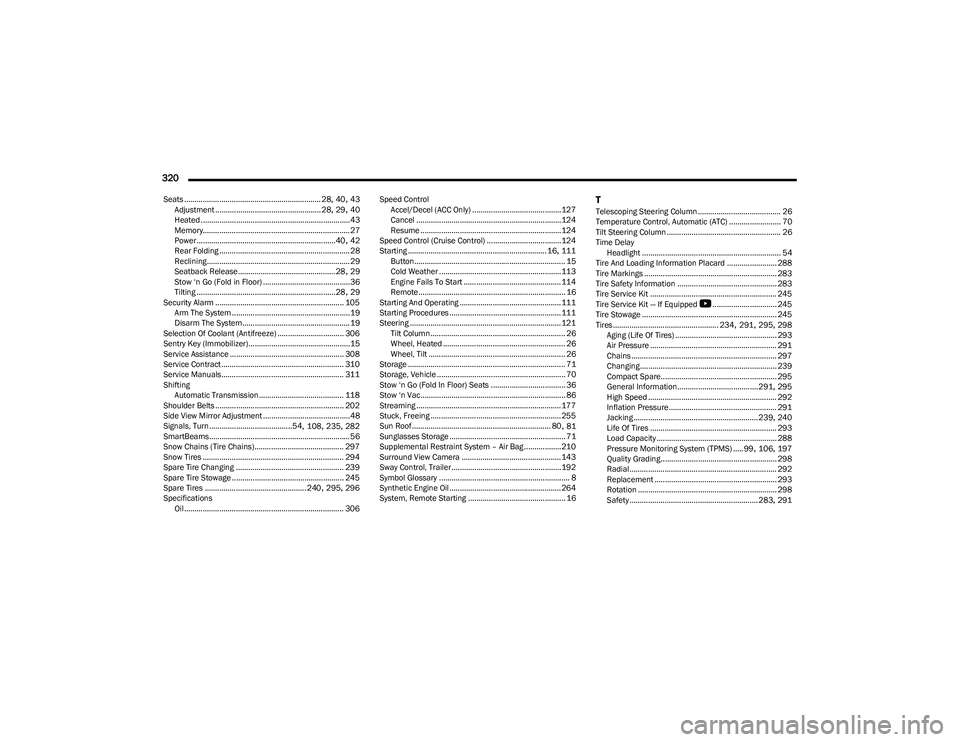
Seats .................................................................. 28, 40, 43
Adjustment ................................................... 28, 29, 40
Heated ........................................................................43
Memory....................................................................... 27
Power ...................................................................40
, 42
Rear Folding ............................................................... 28
Reclining .....................................................................29
Seatback Release ............................................... 28
, 29
Stow ‘n Go (Fold in Floor) ..........................................36
Tilting ...................................................................28
, 29
Security Alarm .............................................................. 105 Arm The System .........................................................19
Disarm The System....................................................19
Selection Of Coolant (Antifreeze) ................................ 306
Sentry Key (Immobilizer).................................................15
Service Assistance ....................................................... 308
Service Contract ........................................................... 310
Service Manuals........................................................... 311
Shifting Automatic Transmission......................................... 118
Shoulder Belts .............................................................. 202
Side View Mirror Adjustment ..........................................48
Signals, Turn........................................54
, 108, 235, 282
SmartBeams....................................................................56
Snow Chains (Tire Chains)........................................... 297
Snow Tires .................................................................... 294
Spare Tire Changing .................................................... 239
Spare Tire Stowage ...................................................... 245
Spare Tires .................................................240
, 295, 296
Specifications Oil ............................................................................. 306 Speed Control
Accel/Decel (ACC Only) ...........................................127
Cancel ...................................................................... 124
Resume ....................................................................124
Speed Control (Cruise Control) ....................................124
Starting ...................................................................16
, 111
Button......................................................................... 15
Cold Weather ...........................................................113
Engine Fails To Start ............................................... 114
Remote....................................................................... 16
Starting And Operating ................................................. 111
Starting Procedures ...................................................... 111
Steering ......................................................................... 121 Tilt Column ................................................................. 26
Wheel, Heated ........................................................... 26
Wheel, Tilt .................................................................. 26
Storage ............................................................................ 71
Storage, Vehicle .............................................................. 70
Stow ‘n Go (Fold In Floor) Seats .................................... 36
Stow ‘n Vac...................................................................... 86
Streaming ...................................................................... 177
Stuck, Freeing ............................................................... 255
Sun Roof ................................................................... 80
, 81
Sunglasses Storage ........................................................ 71
Supplemental Restraint System – Air Bag ..................210
Surround View Camera ................................................ 143
Sway Control, Trailer..................................................... 192
Symbol Glossary ............................................................... 8
Synthetic Engine Oil ...................................................... 264
System, Remote Starting ............................................... 16
TTelescoping Steering Column ........................................ 26
Temperature Control, Automatic (ATC) ......................... 70
Tilt Steering Column ....................................................... 26 Time Delay Headlight ................................................................... 54
Tire And Loading Information Placard ........................ 288
Tire Markings ................................................................ 283
Tire Safety Information ................................................ 283
Tire Service Kit ............................................................. 245
Tire Service Kit — If Equipped
b
............................... 245
Tire Stowage ................................................................. 245
Tires ................................................... 234
, 291, 295, 298
Aging (Life Of Tires) ................................................. 293 Air Pressure ............................................................. 291
Chains ...................................................................... 297Changing.................................................................. 239
Compact Spare........................................................ 295General Information.......................................291
, 295
High Speed .............................................................. 292 Inflation Pressure .................................................... 291
Jacking ............................................................ 239
, 240
Life Of Tires ............................................................. 293
Load Capacity .......................................................... 288
Pressure Monitoring System (TPMS) ..... 99
, 106, 197
Quality Grading........................................................ 298 Radial ....................................................................... 292
Replacement ........................................................... 293
Rotation ................................................................... 298
Safety .............................................................. 283
, 291
23_RUP_OM_EN_USC_t.book Page 320