charging CHRYSLER PACIFICA HYBRID 2017 2.G User Guide
[x] Cancel search | Manufacturer: CHRYSLER, Model Year: 2017, Model line: PACIFICA HYBRID, Model: CHRYSLER PACIFICA HYBRID 2017 2.GPages: 592, PDF Size: 6.73 MB
Page 28 of 592
TheFault Indicator displays the status of the Portable
EVSE Cordset and the vehicle connection. The Portable
EVSE Cordset will not allow charging while the fault
indicator is red. If it is off, the Portable EVSE Cordset has
not detected any internal faults, or faults with the vehicle
connection. If the Fault Indicator is flashing red, there is a
fault detected either with the Portable EVSE Cordset,
electronics, or with the vehicle connection. The Portable
EVSE Cordset may attempt to retry to provide current to
the vehicle if the fault is cleared. If the Portable EVSE
Cordset does not attempt to provide charge to the vehicle,
the charge connector will need to be removed from the
vehicle to clear the fault.
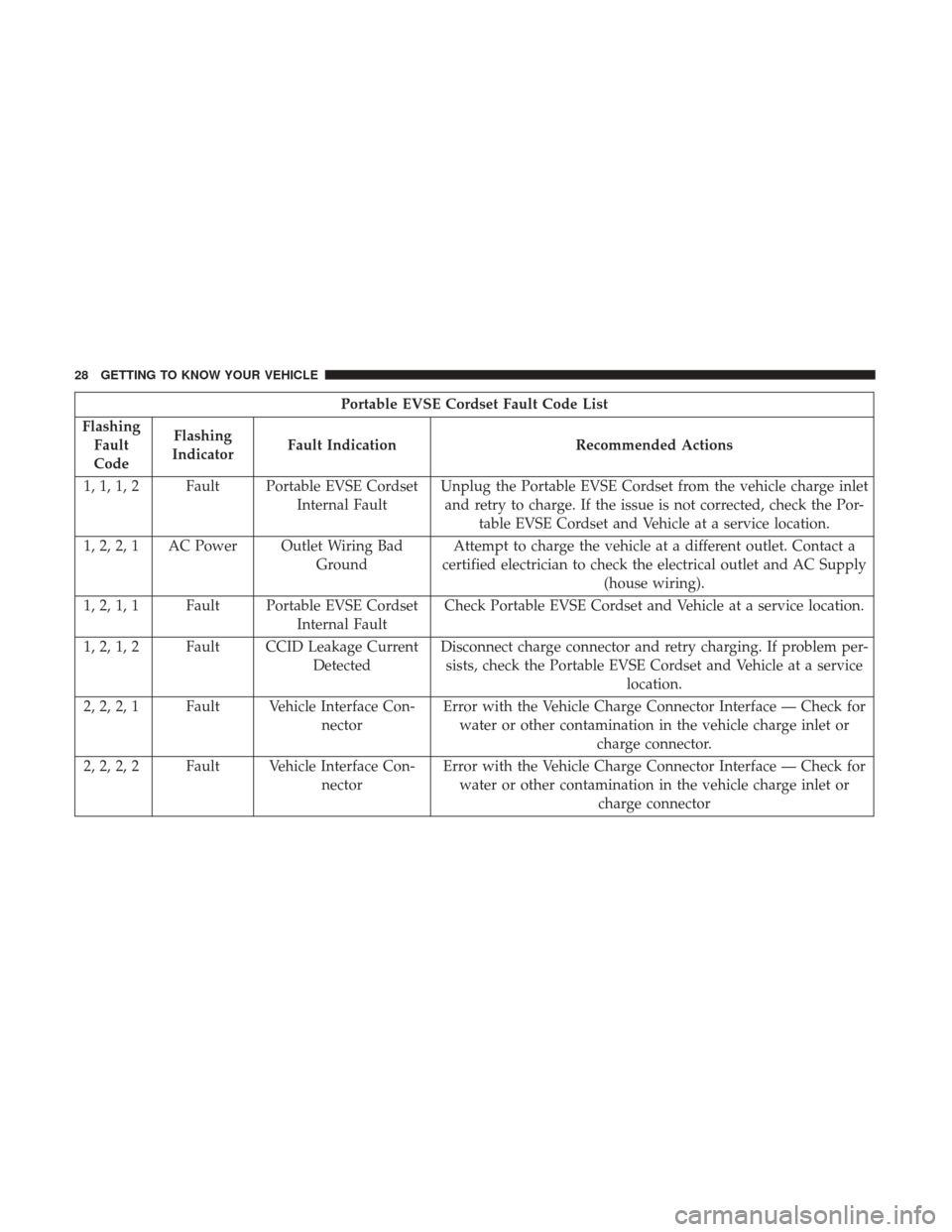
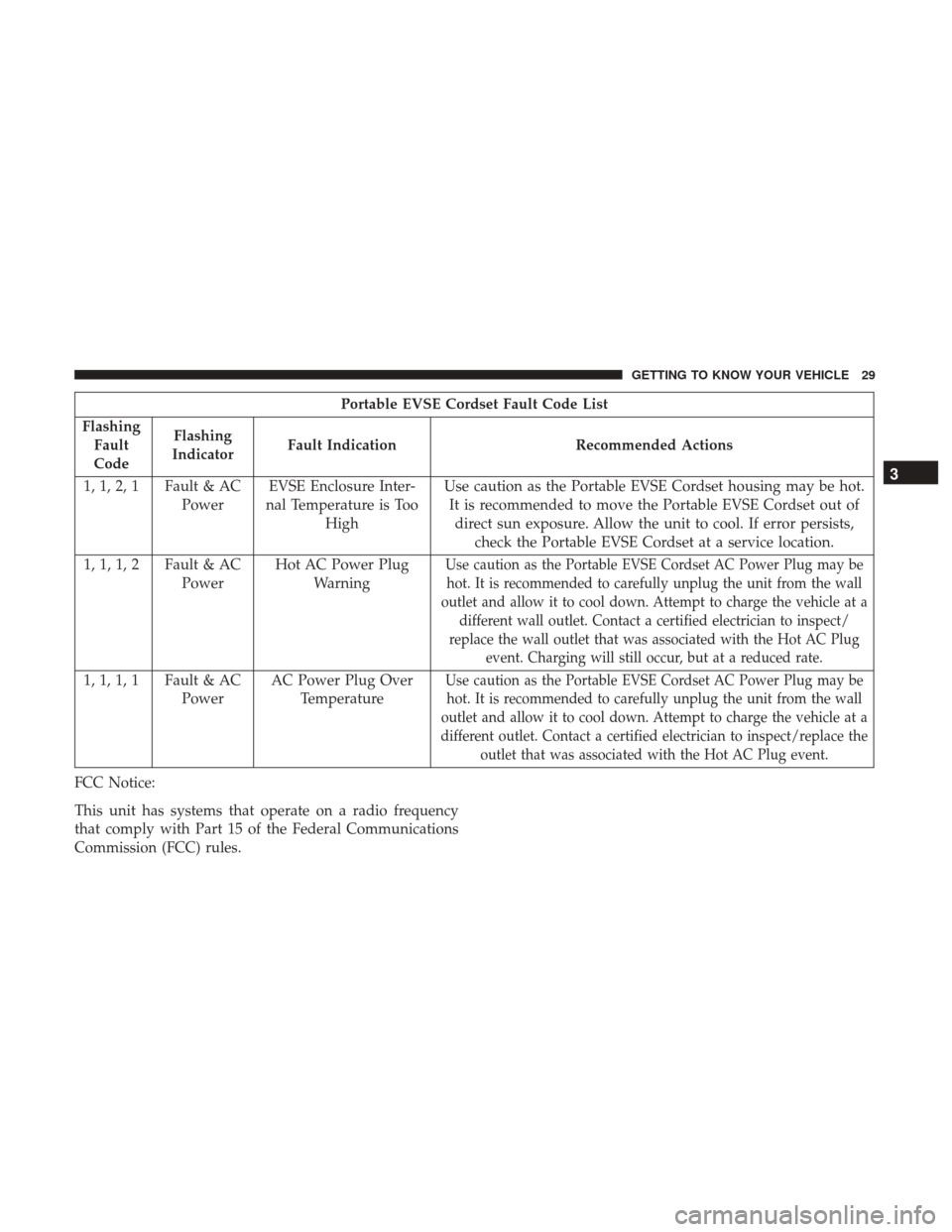
The fault code list in the table below provides a reference
for the important faults that are detected by the Portable
EVSE Cordset. When a fault is detected, the AC Power
Indicator, the Fault Indicator, or both the AC Power and
Fault Indicators will flash red. If only the AC Power Indicator is red, there is a problem on the AC Power side of
the unit. If only the Fault Indicator is flashing red, there is
a problem internal to the unit or with the vehicle. If both
the AC Power and Fault Indicators are flashing red, an over
temperature condition is detected at either the AC plug or
within the enclosure. Additional information about the
faults is provided by a fault code that is displayed on the
two green Charge Rate Indicators. The fault code consists
of four digits, each with a value of 1 or 2. The value of a
digit is the number of indicators illuminated for that part of
the sequence. For example, fault code (1, 2, 1, 1) will
display the following sequence: One indicator will illumi-
nate for 0.3 seconds, then two indicators will illuminate,
then one indicator, and finally one indicator will illumi-
nate. After all four fault code digits have been displayed,
the indicators will remain off for one second before repeat-
ing the sequence.
26 GETTING TO KNOW YOUR VEHICLE
Page 30 of 592
Portable EVSE Cordset Fault Code List
Flashing Fault
Code Flashing
Indicator Fault Indication Recommended Actions
1, 1, 1, 2 Fault Portable EVSE Cordset Internal FaultUnplug the Portable EVSE Cordset from the vehicle charge inlet
and retry to charge. If the issue is not corrected, check the Por- table EVSE Cordset and Vehicle at a service location.
1, 2, 2, 1 AC Power Outlet Wiring Bad GroundAttempt to charge the vehicle at a different outlet. Contact a
certified electrician to check the electrical outlet and AC Supply (house wiring).
1, 2, 1, 1 Fault Portable EVSE Cordset Internal FaultCheck Portable EVSE Cordset and Vehicle at a service location.
1, 2, 1, 2 Fault CCID Leakage Current DetectedDisconnect charge connector and retry charging. If problem per-
sists, check the Portable EVSE Cordset and Vehicle at a service location.
2, 2, 2, 1 Fault Vehicle Interface Con- nectorError with the Vehicle Charge Connector Interface — Check for
water or other contamination in the vehicle charge inlet or charge connector.
2, 2, 2, 2 Fault Vehicle Interface Con- nectorError with the Vehicle Charge Connector Interface — Check for
water or other contamination in the vehicle charge inlet or charge connector
28 GETTING TO KNOW YOUR VEHICLE
Page 31 of 592
Portable EVSE Cordset Fault Code List
Flashing Fault
Code Flashing
Indicator Fault Indication Recommended Actions
1, 1, 2, 1 Fault & AC PowerEVSE Enclosure Inter-
nal Temperature is Too High Use caution as the Portable EVSE Cordset housing may be hot.
It is recommended to move the Portable EVSE Cordset out of direct sun exposure. Allow the unit to cool. If error persists, check the Portable EVSE Cordset at a service location.
1, 1, 1, 2 Fault & AC PowerHot AC Power Plug
Warning
Use caution as the Portable EVSE Cordset AC Power Plug may behot. It is recommended to carefully unplug the unit from the wall
outlet and allow it to cool down. Attempt to charge the vehicle at a different wall outlet. Contact a certified electrician to inspect/
replace the wall outlet that was associated with the Hot AC Plug event. Charging will still occur, but at a reduced rate.
1, 1, 1, 1 Fault & AC PowerAC Power Plug Over
TemperatureUse caution as the Portable EVSE Cordset AC Power Plug may behot. It is recommended to carefully unplug the unit from the wall
outlet and allow it to cool down. Attempt to charge the vehicle at a
different outlet. Contact a certified electrician to inspect/replace the outlet that was associated with the Hot AC Plug event.
FCC Notice:
This unit has systems that operate on a radio frequency
that comply with Part 15 of the Federal Communications
Commission (FCC) rules.
3
GETTING TO KNOW YOUR VEHICLE 29
Page 32 of 592
Operation is subject to the following two conditions:
1. The device may not cause interference
2. The device must accept any interference received, in-cluding interference that may cause undesired operation
of the device.
Changes or modifications to any of these systems by other
than an authorized service facility could void authorization
to use this equipment.
This unit complies with ICES-003E of Industry Canada,
and EMC Directive 2004/108/EC.
Guidelines for preventing fire and electric shock:
• Ensure the charging cable is positioned so it will not be
stepped on, tripped over, or otherwise subjected to
damage or stress.
• There are no user serviceable parts inside.
• Do not use the charging cordset if it is visibly damaged.
Contact your authorized dealer for service.
• Do not place fingers, or any other objects inside the
charge connector. •
Do not allow children to operate this device. Adult
supervision is mandatory when children are in proxim-
ity when the charging cordset is in use.
NOTE: During normal operation, the charge connector or
AC plug may feel warm. If either one feels hot during
charging, unplug the charging cordset and have a qualified
electrician inspect the wall receptacle before you continue
charging.
WARNING!
Do not use the charging cordset with a receptacle that
is worn or damaged. Using the charging cordset with a
worn or damaged receptacle may cause burns or start a
fire.
AC Level 2 Charging (240V, 30 Amp)
AC Level 2 (240 V) charging requires a 240 V, Level 2 EVSE
(Charging station). A 30 A Level 2 EVSE for home instal-
lation is recommended.
30 GETTING TO KNOW YOUR VEHICLE
Page 33 of 592
When using public charging stations, ensure the charging
station is ready to provide charge and the vehicle is in
PARK before the charge connector is plugged into the
vehicle’s charge inlet. You will hear a “click” when the
charge connector is inserted correctly and is coupled with
the vehicle’s charge inlet. The vehicle should start charging
automatically. If not, please check the instructions at the
charging station.
NOTE:The vehicle should start charging automatically. If
not, please check the following:
• Charging Station – Check the indications and instruc-
tions at the charging station or
• Charging Schedule – Check whether the charging sched-
ule is enabled and if so, whether the vehicle is currently
within the scheduled charge time/date. If the charging
schedule is enabled within the vehicle, you may over-
ride them for this charging event by plugging in the
charge connector, unplugging it, and then plugging it
back into the vehicle charge inlet. Complete the double
plug sequence within 10 seconds for it to override the set
schedule. To stop the charging process:
•
Press the “STOP” button located on the front of the
EVSE station.
• Press the button on the charge connector first and then
remove the connector from the vehicle charge inlet
• Plug the charge handle into the EVSE station and coil the
charging cord onto its holder. Do not leave the charging
cord laying on the ground.
Charging Times
The following factors determine the time it takes to charge
the high voltage battery:
• The high voltage battery’s current state of charge
• The type of EVSE used (Level 1 - 120V or Level 2 – 240V)
• Ambient temperature
• Whether the vehicle is ON during charging
3
GETTING TO KNOW YOUR VEHICLE 31
Page 34 of 592
NOTE:
•The charging times below are estimates based on a
completely discharged high voltage battery
• Charging times will vary based on the age, condition,
state of charge and temperature of the high voltage
battery.
• Charging times may be longer if a thermal self-
protection reduces the charging current from the EVSE.
• If the vehicle’s ignition is in either the ACC or RUN
position, the vehicle charge indicator may not indicate
greater than a 99% state of charge, and will continue to
charge the vehicle, due to the vehicle loads.
Type of EVSE Estimated Charge Time
Level 1 (120V/12A) Approximately 14 hours
Level 2 (240V/30A) Approximately 2 hours
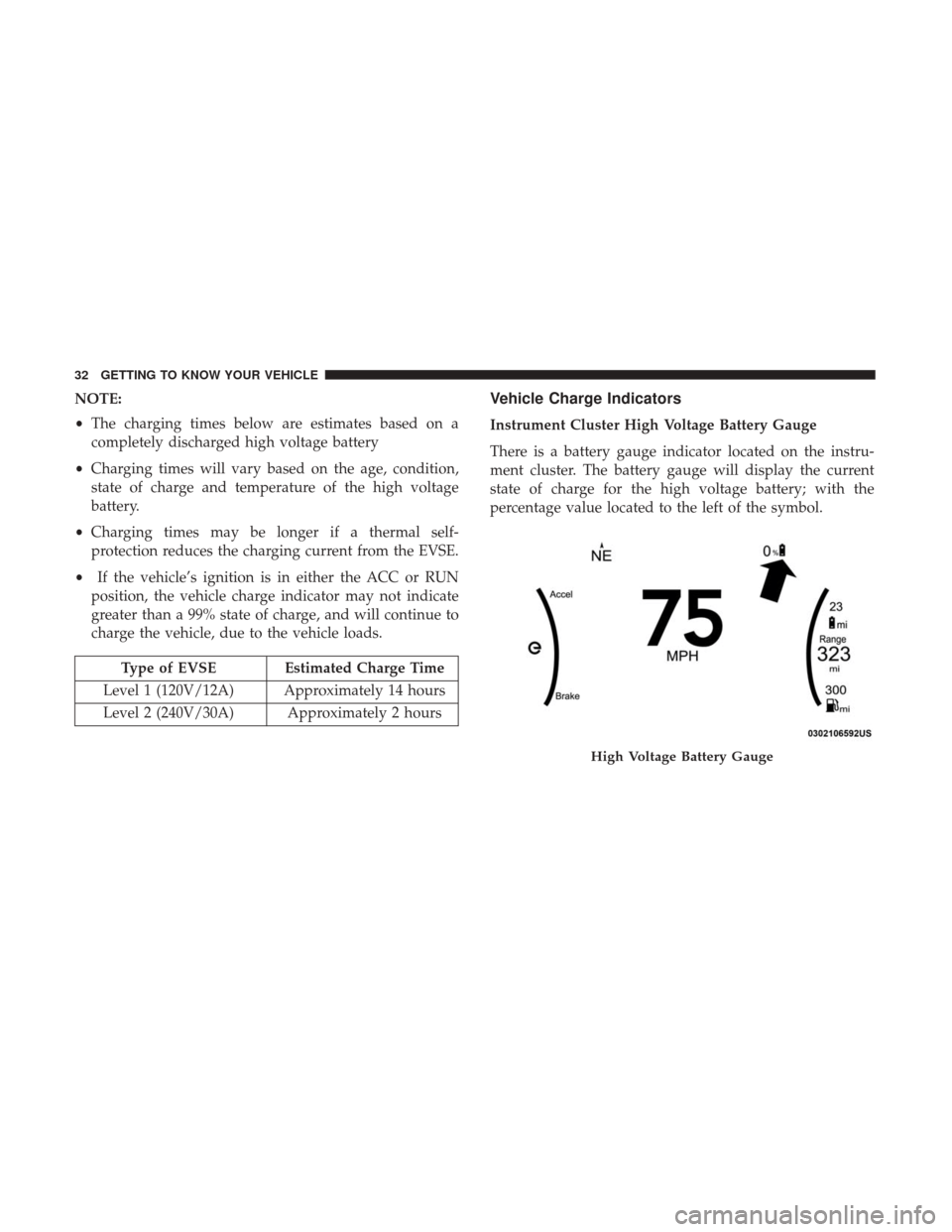
Vehicle Charge Indicators
Instrument Cluster High Voltage Battery Gauge
There is a battery gauge indicator located on the instru-
ment cluster. The battery gauge will display the current
state of charge for the high voltage battery; with the
percentage value located to the left of the symbol.
High Voltage Battery Gauge
32 GETTING TO KNOW YOUR VEHICLE
Page 35 of 592
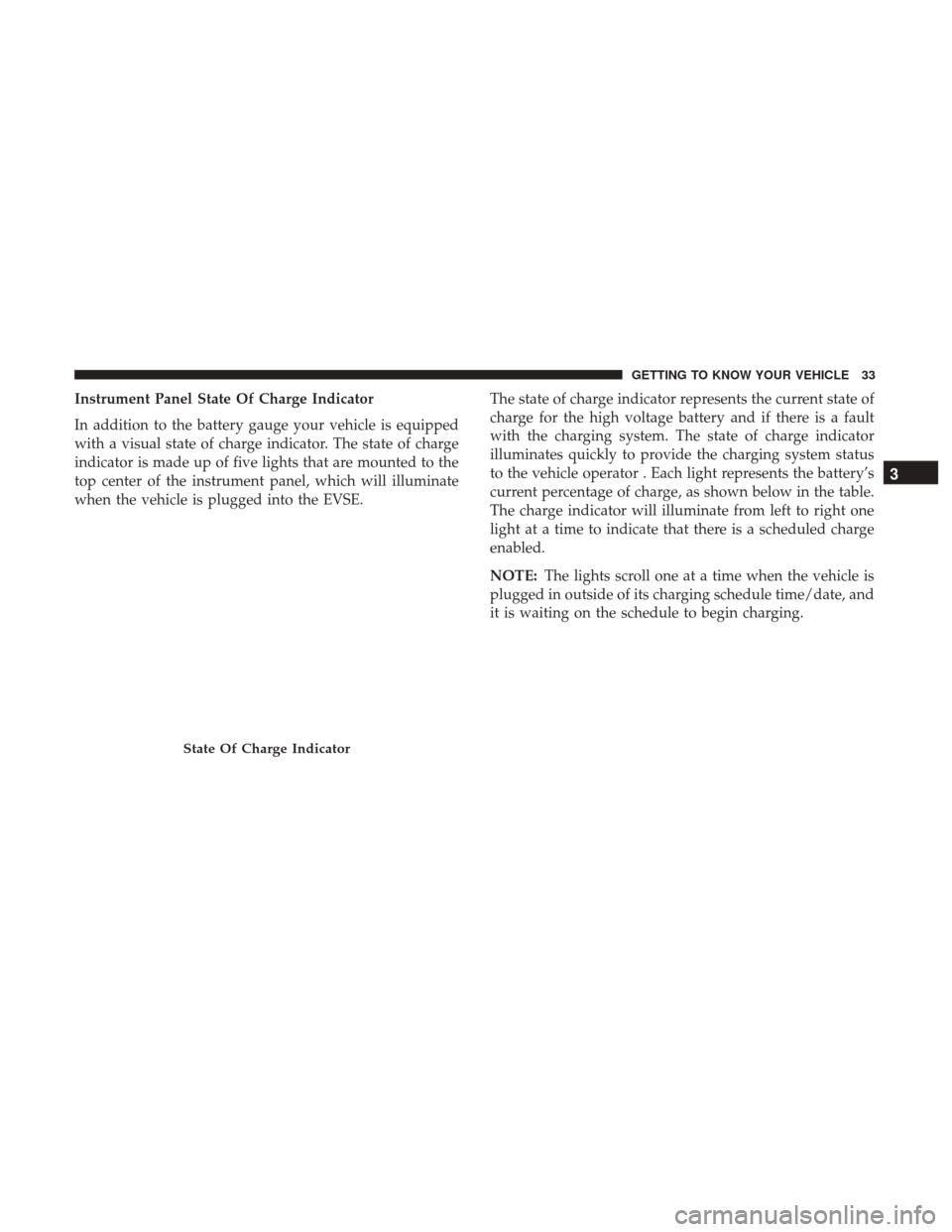
Instrument Panel State Of Charge Indicator
In addition to the battery gauge your vehicle is equipped
with a visual state of charge indicator. The state of charge
indicator is made up of five lights that are mounted to the
top center of the instrument panel, which will illuminate
when the vehicle is plugged into the EVSE.The state of charge indicator represents the current state of
charge for the high voltage battery and if there is a fault
with the charging system. The state of charge indicator
illuminates quickly to provide the charging system status
to the vehicle operator . Each light represents the battery’s
current percentage of charge, as shown below in the table.
The charge indicator will illuminate from left to right one
light at a time to indicate that there is a scheduled charge
enabled.
NOTE:
The lights scroll one at a time when the vehicle is
plugged in outside of its charging schedule time/date, and
it is waiting on the schedule to begin charging.
State Of Charge Indicator
3
GETTING TO KNOW YOUR VEHICLE 33
Page 36 of 592
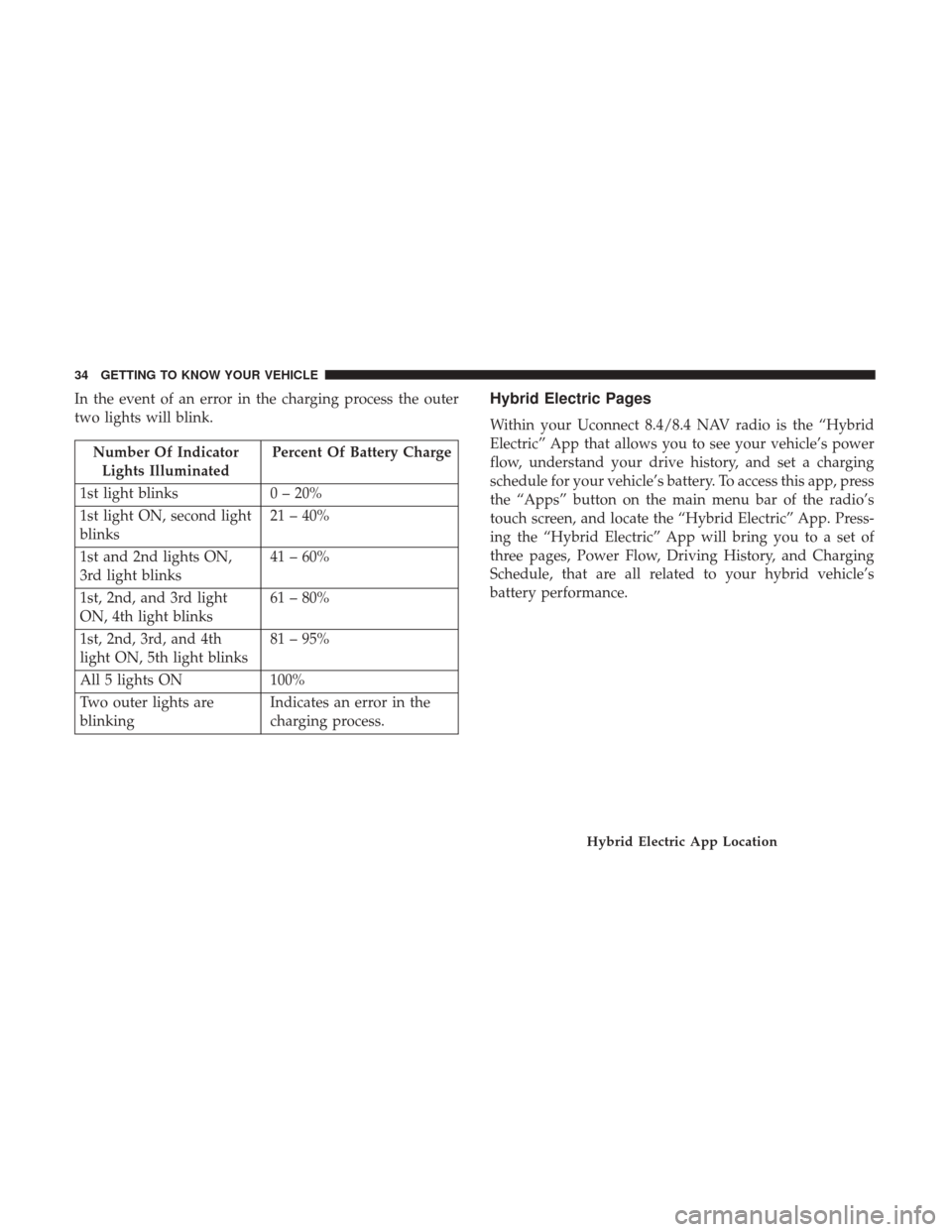
In the event of an error in the charging process the outer
two lights will blink.
Number Of IndicatorLights Illuminated Percent Of Battery Charge
1st light blinks 0 – 20%
1st light ON, second light
blinks 21 – 40%
1st and 2nd lights ON,
3rd light blinks 41 – 60%
1st, 2nd, and 3rd light
ON, 4th light blinks 61 – 80%
1st, 2nd, 3rd, and 4th
light ON, 5th light blinks 81 – 95%
All 5 lights ON 100%
Two outer lights are
blinking Indicates an error in the
charging process.
Hybrid Electric Pages
Within your Uconnect 8.4/8.4 NAV radio is the “Hybrid
Electric” App that allows you to see your vehicle’s power
flow, understand your drive history, and set a charging
schedule for your vehicle’s battery. To access this app, press
the “Apps” button on the main menu bar of the radio’s
touch screen, and locate the “Hybrid Electric” App. Press-
ing the “Hybrid Electric” App will bring you to a set of
three pages, Power Flow, Driving History, and Charging
Schedule, that are all related to your hybrid vehicle’s
battery performance.
Hybrid Electric App Location
34 GETTING TO KNOW YOUR VEHICLE
Page 38 of 592
NOTE:The teal color represents the data while under
Electric power and the blue color represents the data while
under Hybrid power.
Charging Schedule
The third screen within the “Hybrid Electric” App is the
Charging Schedule screen. From this screen you can set
when you want you vehicle to charge. To do so, press the
check box next to the setting “Enable Schedule” until a
check mark appears in the box, from there you can set the
schedule. The Charging Schedule can also be set using the
Uconnect App on your smartphone.
Driving History Screen
Charging Schedule Screen
36 GETTING TO KNOW YOUR VEHICLE
Page 39 of 592
NOTE:If the vehicle is plugged in outside of the charging
schedule set in the Uconnect 8.4 radio, the vehicle’s battery
will not charge. Charging will only begin immediately if
the vehicle is plugged in within the time and date set in the
schedule. Otherwise, charging will automatically begin
when the selected charge time/date occurs.
This feature can be overridden if the vehicle is plugged in,
unplugged, and then plugged in a second time. This
“double plugged-in” feature will override the schedule
that is set in the radio, and begin charging the vehicle
immediately. The double plug sequence must be completed
within 10 seconds for it to override the programed sched-
ule.
If the vehicle is turned off outside of the charging window
a radio pop-up message will be displayed, that allows the
user to charge it immediately. If “Yes” is selected, the
vehicle will begin charging immediately, ignoring the
charge schedule, if plugged in within an hour of turning
the vehicle off.KEYS
The keyless ignition system consists of a key fob with a
built in emergency key and a Keyless Push Button Ignition
system.
Key Fob
This system allows you to lock or unlock the doors and
liftgate, and activate the Panic Alarm, optional power
liftgate, left power sliding door, and right power sliding
door from distances up to approximately 66 ft (20 m) using
a hand-held key fob. The key fob does not need to be
pointed at the vehicle to activate the system.
3
GETTING TO KNOW YOUR VEHICLE 37