ECU CHRYSLER PACIFICA HYBRID 2017 2.G Service Manual
[x] Cancel search | Manufacturer: CHRYSLER, Model Year: 2017, Model line: PACIFICA HYBRID, Model: CHRYSLER PACIFICA HYBRID 2017 2.GPages: 592, PDF Size: 6.73 MB
Page 291 of 592
Brake Service Mode has requirements that must be met in
order to be activated:
•The vehicle must be at a standstill.
• The park brake must be unapplied.
• The transmission must be in PARK or NEUTRAL.
While in service mode, the Electric Park Brake fault lamp
will flash continuously while the ignition switch is ON.
When brake service work is complete, the following steps
must be followed to reset the parking brake system to
normal operation:
• Ensure the vehicle is at a standstill.
• Press the brake pedal with moderate force.
• Apply the Electric Park Brake Switch.
WARNING!
You can be badly injured working on or around a
motor vehicle. Do only that service work for which you
have the knowledge and the right equipment. If you
have any doubt about your ability to perform a service
job, take your vehicle to a competent mechanic.
AUTOMATIC TRANSMISSION
WARNING!
•It is dangerous to shift out of PARK or NEUTRAL if
the engine speed is higher than idle speed. If your
foot is not firmly pressing the brake pedal, the
vehicle could accelerate quickly forward or in re-
verse. You could lose control of the vehicle and hit
someone or something. Only shift into gear when the
engine is idling normally and your foot is firmly
pressing the brake pedal.
•
Unintended movement of a vehicle could injure those in
or near the vehicle. As with all vehicles, you should never
exit a vehicle while the engine is running or propulsion
system is active. Before exiting a vehicle, always apply
the park brake, shift the transmission into PARK, turn
the ignition OFF, and remove the key fob. When the
ignition is in the OFF mode, the transmission is locked in
PARK, securing the vehicle against unwanted movement.
• When leaving the vehicle, always make sure the
ignition is in the OFF mode, remove the key fob from
the vehicle, and lock the vehicle.
(Continued)
6
STARTING AND OPERATING 289
Page 295 of 592
WARNING!(Continued)
engine is idling normally (or stopped) and your foot
is firmly pressing the brake pedal.
• Unintended movement of a vehicle could injure
those in or near the vehicle. As with all vehicles, you
should never exit a vehicle while the engine is
running or the propulsion system is active. Before
exiting a vehicle, always apply the park brake, shift
the transmission into PARK, and turn the ignition
OFF. When the ignition is in the OFF mode, the
transmission is locked in PARK, securing the vehicle
against unwanted movement.
• When leaving the vehicle, always make sure the
ignition is in the OFF mode, remove the key fob from
the vehicle, and lock the vehicle.
• Never leave children alone in a vehicle, or with
access to an unlocked vehicle. Allowing children to
be in a vehicle unattended is dangerous for a number
of reasons. A child or others could be seriously or
fatally injured. Children should be warned not to
touch the park brake, brake pedal or the transmis-
sion gear selector.
(Continued)
WARNING! (Continued)
•Do not leave the key fob in or near the vehicle (or in
a location accessible to children), and do not leave
the ignition in the ACC or ON/RUN mode. A child
could operate power windows, other controls, or
move the vehicle.
CAUTION!
• Before moving the transmission gear selector out of
PARK, you must place the ignition from the LOCK/
OFF mode to the ON/RUN mode, and also press the
brake pedal. Otherwise, damage to the gear selector
could result.
• DO NOT race the engine when shifting from PARK
or NEUTRAL into another gear range, as this can
damage the drivetrain.
The following indicators should be used to ensure that you
have engaged the transmission into the PARK position:
• Look at the transmission gear position display and
verify that it indicates the PARK position (P), and is not
blinking.6
STARTING AND OPERATING 293
Page 297 of 592
NOTE:Based on the drive gear and/or speed of the
vehicle, the Quiet Vehicle Pedestrian Module (QVPM) will
broadcast a sound to warn nearby pedestrians that a
vehicle is approaching. In addition, the module will indi-
cate change in speed by varying the pitch of sound.
LOW (L)
This range should be used when descending very steep
grades. Using the LOW position will increase the rate of
deceleration when the accelerator pedal is released in
comparison to the DRIVE position. To access the LOW
position, push down on the gear selector and rotate it fully
clockwise.
Transmission Limp Home Mode
Transmission function is monitored electronically for ab-
normal conditions. If a condition is detected that could
result in transmission damage, Transmission Limp Home
Mode is activated. In this mode, vehicle speed is limited to
about 20 mph. In addition to the Malfunction Indicator
Light (MIL), the Service Hybrid System Telltale, the Red
Turtle indication, and a popup message indicating that
vehicle speed may be limited may all be illuminated. Limp
Home Mode allows the vehicle to be driven to an autho-
rized dealer for service without damaging the transmis-
sion. In the event of a momentary problem, the transmission can
be reset to regain all forward gears by performing the
following steps:
1. Stop the vehicle.
2. Shift the transmission into PARK, if possible. If not, shift
the transmission to NEUTRAL.
3. Push and hold the ignition switch until the vehicle turns OFF.
4. Wait approximately 30 seconds.
5. Restart the vehicle.
6. Shift into the desired gear range. If the problem is no longer detected, the transmission will return to normal
operation.
NOTE: Even if the transmission can be reset, we recom-
mend that you visit your authorized dealer at your earliest
possible convenience. Your authorized dealer has diagnos-
tic equipment to determine if the problem could recur. If
the transmission cannot be reset, authorized dealer service
is required.
6
STARTING AND OPERATING 295
Page 311 of 592
NOTE:The “Brake!” Screen in the instrument cluster
display is a warning for the driver to take action and does
not necessarily mean that the Forward Collision Warning
system is applying the brakes autonomously.
Overtake Aid
When driving with ACC engaged and following a vehicle,
the system will provide an additional acceleration up to the
ACC set speed to assist in passing the vehicle. This
additional acceleration is triggered when the driver utilizes
the left turn signal and will only be active when passing on
the left hand side.
ACC Operation At Stop
In the event that the ACC system brings your vehicle to a
standstill while following a target vehicle, if the target
vehicle starts moving within two seconds of your vehicle
coming to a standstill, your vehicle will resume motion
without the need for any driver action.
If the target vehicle does not start moving within two
seconds of your vehicle coming to a standstill, the driver
will either have to push the RES (resume) button, or apply
the accelerator pedal to reengage the ACC to the existing
Set Speed.
NOTE: After the ACC system holds your vehicle at a
standstill for approximately 3 consecutive minutes, the
parking brake will be activated, and the ACC system will
be cancelled.
While ACC is holding your vehicle at a standstill, if the
driver seatbelt is unbuckled or the driver door is opened,
the parking brake will be activated, and the ACC system
will be cancelled.
Brake Alert
6
STARTING AND OPERATING 309
Page 381 of 592
Loading
The actual total weight and the weight of the front and rear
of your vehicle at the ground can best be determined by
weighing it when it is loaded and ready for operation.
The entire vehicle should first be weighed on a commercial
scale to insure that the GVWR has not been exceeded. The
weight on the front and rear of the vehicle should then be
determined separately to be sure that the load is properly
distributed over the front and rear axle. Weighing the
vehicle may show that the GAWR of either the front or rear
axles has been exceeded but the total load is within the
specified GVWR. If so, weight must be shifted from front to
rear or rear to front as appropriate until the specified
weight limitations are met. Store the heavier items down
low and be sure that the weight is distributed equally. Stow
all loose items securely before driving.
Improper weight distributions can have an adverse effect
on the way your vehicle steers and handles and the way
the brakes operate.
CAUTION!
Do not load your vehicle any heavier than the GVWR
or the maximum front and rear GAWR. If you do, parts
on your vehicle can break, or it can change the way
your vehicle handles. This could cause you to lose
control. Also overloading can shorten the life of your
vehicle.
TRAILER TOWING
Trailer towing is not permitted with this vehicle.
6
STARTING AND OPERATING 379
Page 383 of 592
Recreational towing is allowed ONLY if the front wheels
areOFF the ground. This may be accomplished using a tow
dolly (front wheels off the ground) or vehicle trailer (all
four wheels off the ground). If using a tow dolly, follow this
procedure:
1. Properly secure the dolly to the tow vehicle, following the dolly manufacturer’s instructions.
2. Drive the front wheels onto the tow dolly.
3. Apply the park brake.
4. Place the transmission in PARK.
5. Turn the ignition OFF.
6. Properly secure the front wheels to the dolly, following the dolly manufacturer’s instructions.
7. Turn the ignition to the ON/RUN position, but do not start the vehicle.
8. Press and hold the brake pedal.
9. Release the park brake.
10. Turn the ignition OFF.
11. Release the brake pedal.DRIVING TIPS
Driving On Slippery Surfaces
Information in this section will aid in safe controlled
launches in adverse conditions.
Acceleration
Rapid acceleration on snow covered, wet, or other slippery
surfaces may cause the driving wheels to pull erratically to
the right or left. This phenomenon occurs when there is a
difference in the surface traction under the front (driving)
wheels.
WARNING!
Rapid acceleration on slippery surfaces is dangerous.
Unequal traction can cause sudden pulling of the front
wheels. You could lose control of the vehicle and
possibly have a collision. Accelerate slowly and care-
fully whenever there is likely to be poor traction (ice,
snow, wet, mud, loose sand, etc.).
6
STARTING AND OPERATING 381
Page 405 of 592
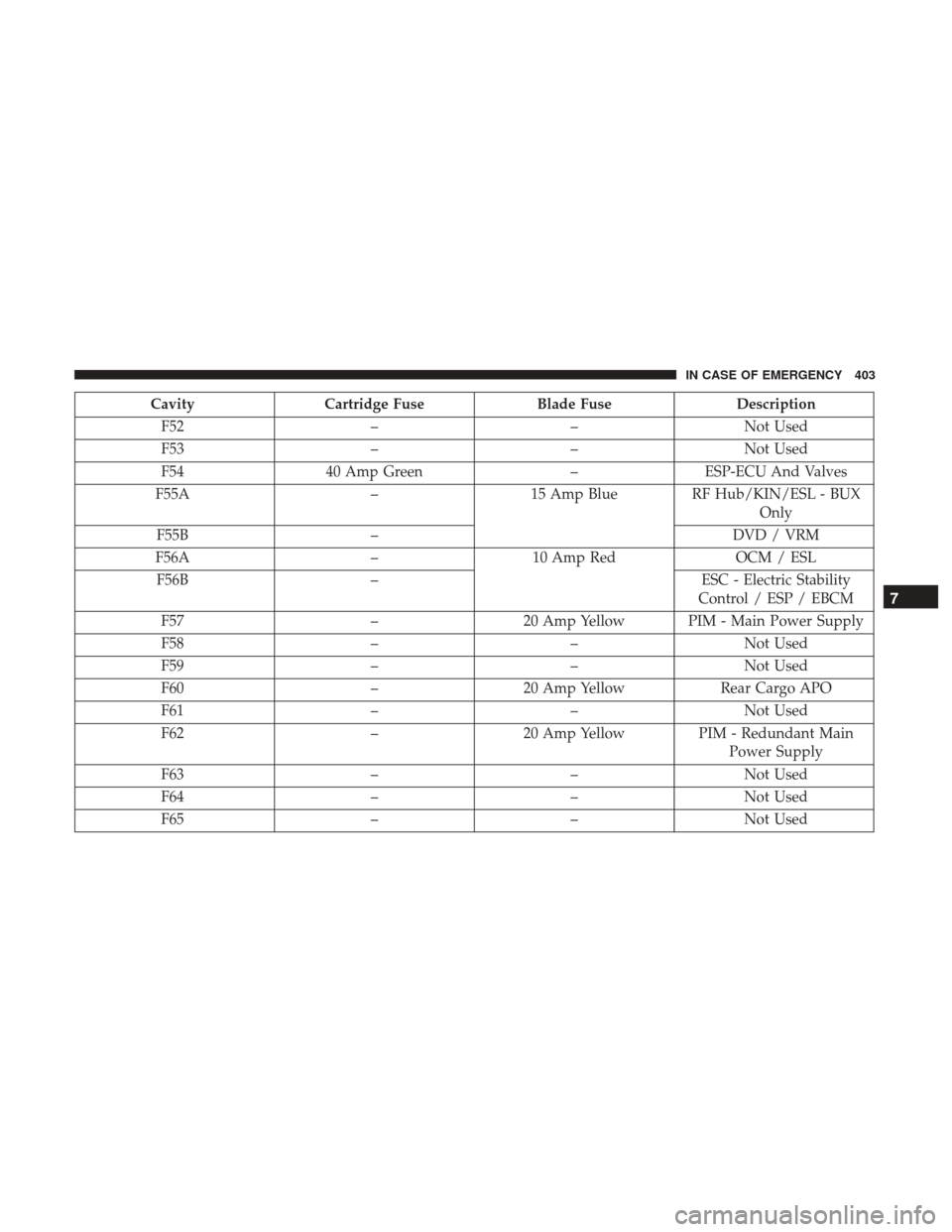
CavityCartridge Fuse Blade FuseDescription
F52 ––Not Used
F53 ––Not Used
F54 40 Amp Green –ESP-ECU And Valves
F55A –15 Amp Blue RF Hub/KIN/ESL - BUX
Only
F55B – DVD / VRM
F56A –10 Amp Red OCM / ESL
F56B – ESC - Electric Stability
Control / ESP / EBCM
F57 –20 Amp Yellow PIM - Main Power Supply
F58 ––Not Used
F59 ––Not Used
F60 –20 Amp Yellow Rear Cargo APO
F61 ––Not Used
F62 –20 Amp Yellow PIM - Redundant Main
Power Supply
F63 ––Not Used
F64 ––Not Used
F65 ––Not Used
7
IN CASE OF EMERGENCY 403
Page 407 of 592
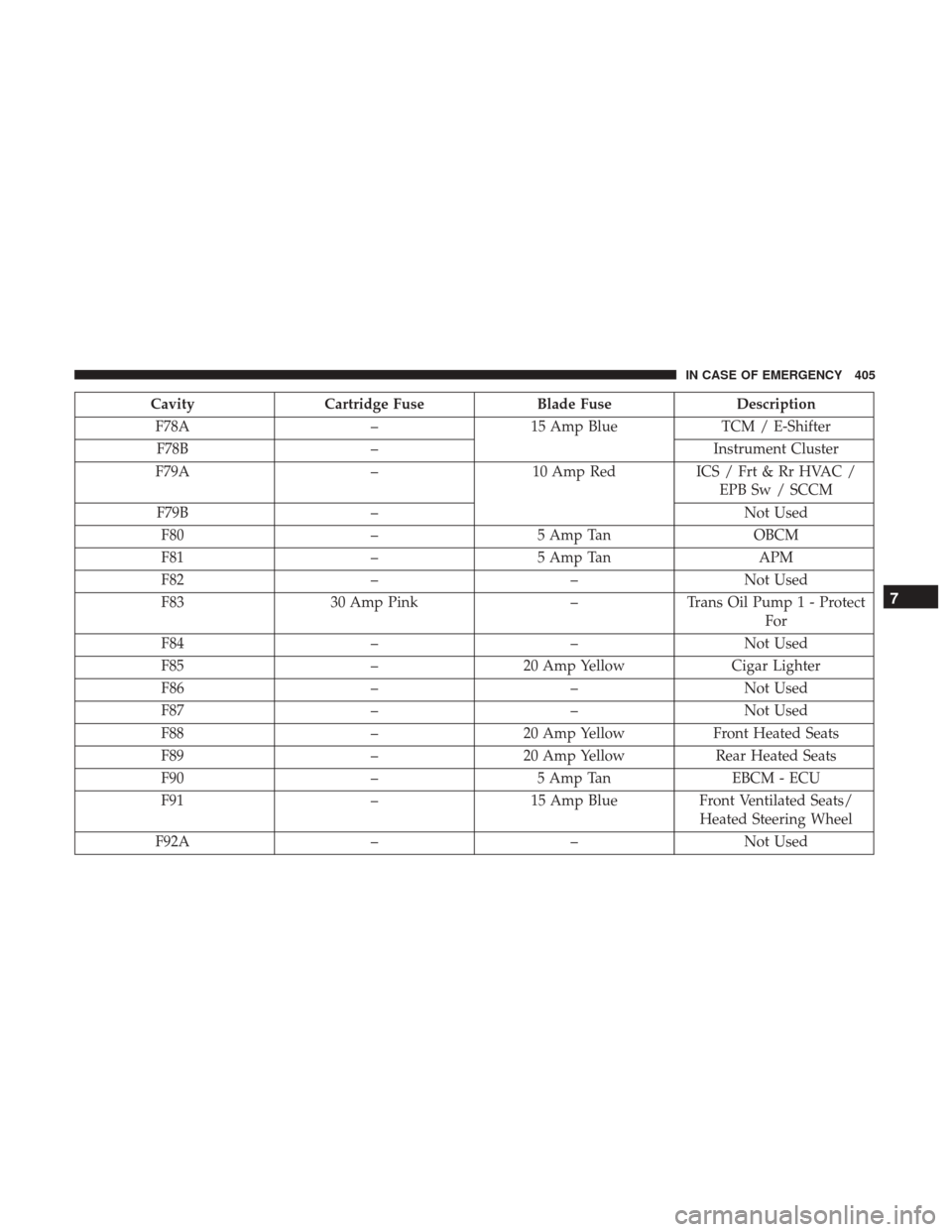
CavityCartridge Fuse Blade FuseDescription
F78A –15 Amp Blue TCM / E-Shifter
F78B – Instrument Cluster
F79A –10 Amp Red ICS / Frt & Rr HVAC /
EPB Sw / SCCM
F79B – Not Used
F80 –5 Amp Tan OBCM
F81 –5 Amp Tan APM
F82 ––Not Used
F83 30 Amp Pink –Trans Oil Pump 1 - Protect
For
F84 ––Not Used
F85 –20 Amp Yellow Cigar Lighter
F86 ––Not Used
F87 ––Not Used
F88 –20 Amp Yellow Front Heated Seats
F89 –20 Amp Yellow Rear Heated Seats
F90 –5 Amp Tan EBCM - ECU
F91 –15 Amp Blue Front Ventilated Seats/
Heated Steering Wheel
F92A ––Not Used
7
IN CASE OF EMERGENCY 405
Page 409 of 592
Tire Service Kit Storage
The Tire Service Kit is secured with a strap and is stored in
the storage bin located behind the rear cargo trim panel.Tire Service Kit And Components And Operation
Tire Service Kit Location
Tire Service Kit Components
1 — Mode Select Knob
2 — Sealant/Air Hose
3 — Hose Accessories
4 — Sealant Bottle
5 — Power Plug
6 — Power Switch
7 — Deflation Button
8 — Pressure Gauge
7
IN CASE OF EMERGENCY 407
Page 420 of 592
NOTE:Be careful when moving the vehicle - ensure that
control of the vehicle is maintained. Also, ensure that
vehicle is secured to prevent unintentional movement
during and after moving the vehicle. If the external 12V
power becomes disconnected from the vehicle jump posts
or there is an interruption of the 12V power while moving
the vehicle, the vehicle’s transmission may engage Park.
When the vehicle is at the charging location, shift the
transmission back to Park, apply the electric park brake,
and start the high voltage battery charging. Once the
vehicle has been secured against unintentional movement
and high voltage battery charging has been initiated, the
jumper cables can be removed from the vehicle jump posts.
Jump-starting can be dangerous if done improperly so
please follow the procedures in this section carefully.
NOTE: When using a portable battery booster pack follow
the manufacturer ’s operating instructions and precautions.
WARNING!
Do not attempt jump-starting if the battery is frozen. It
could rupture or explode and cause personal injury.
CAUTION!
Do not use a portable battery booster pack or any other
booster source with a system voltage greater than 12
Volts or damage to the battery, starter motor, alternator
or electrical system may occur.
Preparations For Jump-Start
The remote battery posts in your vehicle is located on the
left side of the engine compartment.
418 IN CASE OF EMERGENCY