roof CHRYSLER PACIFICA HYBRID 2019 User Guide
[x] Cancel search | Manufacturer: CHRYSLER, Model Year: 2019, Model line: PACIFICA HYBRID, Model: CHRYSLER PACIFICA HYBRID 2019Pages: 620, PDF Size: 4.92 MB
Page 163 of 620
CAUTION!(Continued)
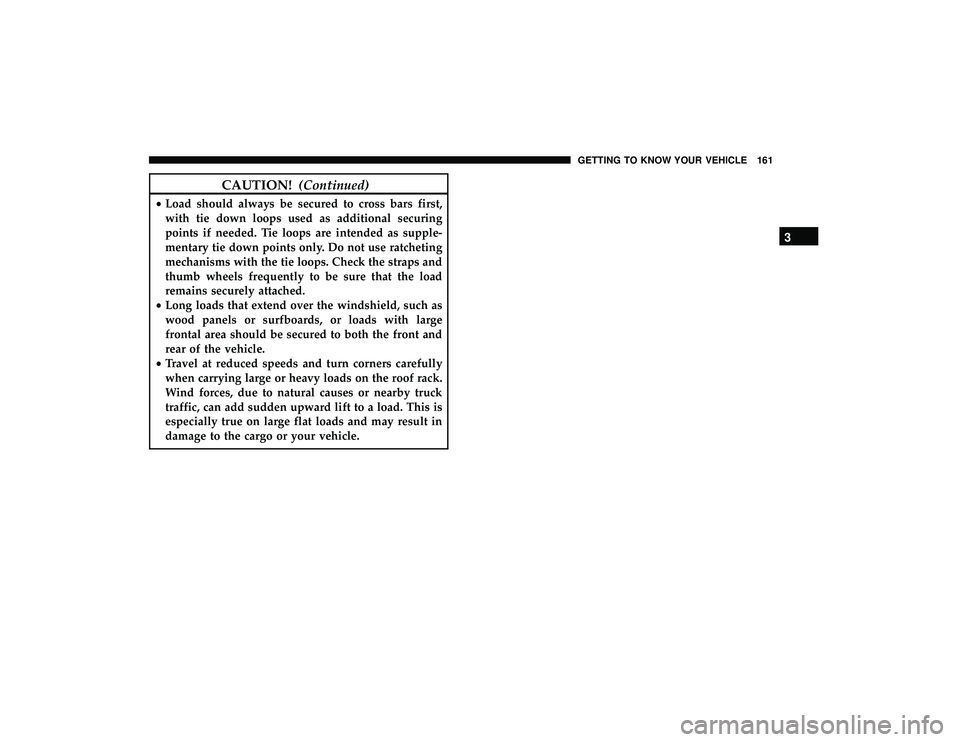
•Load should always be secured to cross bars first,
with tie down loops used as additional securing
points if needed. Tie loops are intended as supple-
mentary tie down points only. Do not use ratcheting
mechanisms with the tie loops. Check the straps and
thumb wheels frequently to be sure that the load
remains securely attached.
• Long loads that extend over the windshield, such as
wood panels or surfboards, or loads with large
frontal area should be secured to both the front and
rear of the vehicle.
• Travel at reduced speeds and turn corners carefully
when carrying large or heavy loads on the roof rack.
Wind forces, due to natural causes or nearby truck
traffic, can add sudden upward lift to a load. This is
especially true on large flat loads and may result in
damage to the cargo or your vehicle.
3
GETTING TO KNOW YOUR VEHICLE 161
Page 252 of 620
The SABICs may help reduce the risk of partial or complete
ejection of vehicle occupants through side windows in
certain side impact events.
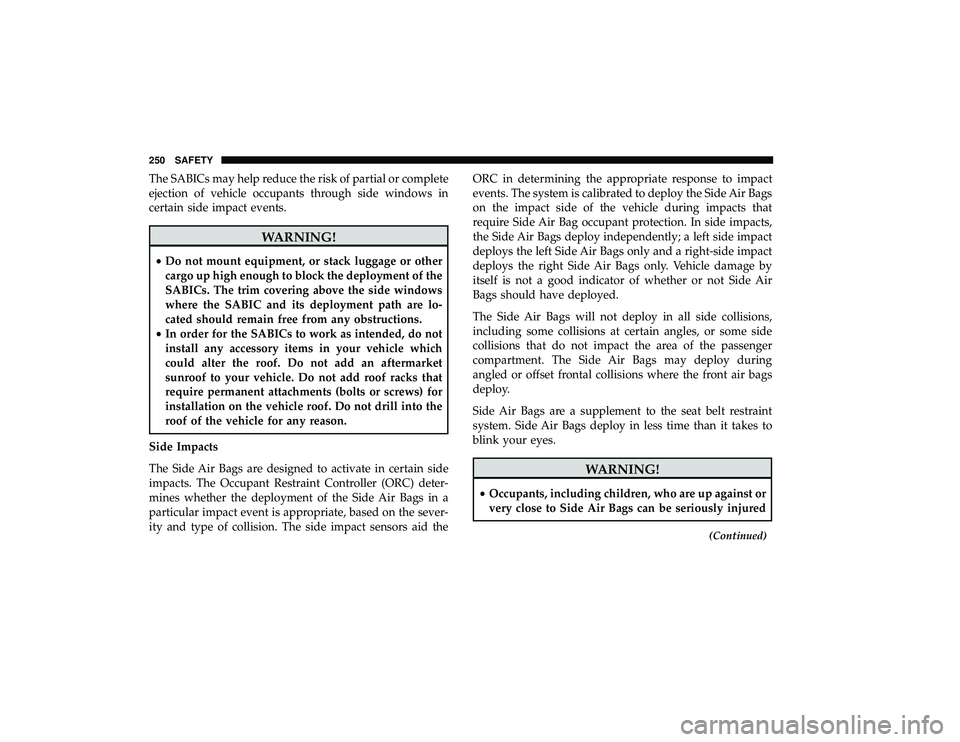
WARNING!
•Do not mount equipment, or stack luggage or other
cargo up high enough to block the deployment of the
SABICs. The trim covering above the side windows
where the SABIC and its deployment path are lo-
cated should remain free from any obstructions.
• In order for the SABICs to work as intended, do not
install any accessory items in your vehicle which
could alter the roof. Do not add an aftermarket
sunroof to your vehicle. Do not add roof racks that
require permanent attachments (bolts or screws) for
installation on the vehicle roof. Do not drill into the
roof of the vehicle for any reason.
Side Impacts
The Side Air Bags are designed to activate in certain side
impacts. The Occupant Restraint Controller (ORC) deter-
mines whether the deployment of the Side Air Bags in a
particular impact event is appropriate, based on the sever-
ity and type of collision. The side impact sensors aid the ORC in determining the appropriate response to impact
events. The system is calibrated to deploy the Side Air Bags
on the impact side of the vehicle during impacts that
require Side Air Bag occupant protection. In side impacts,
the Side Air Bags deploy independently; a left side impact
deploys the left Side Air Bags only and a right-side impact
deploys the right Side Air Bags only. Vehicle damage by
itself is not a good indicator of whether or not Side Air
Bags should have deployed.
The Side Air Bags will not deploy in all side collisions,
including some collisions at certain angles, or some side
collisions that do not impact the area of the passenger
compartment. The Side Air Bags may deploy during
angled or offset frontal collisions where the front air bags
deploy.
Side Air Bags are a supplement to the seat belt restraint
system. Side Air Bags deploy in less time than it takes to
blink your eyes.
WARNING!
•
Occupants, including children, who are up against or
very close to Side Air Bags can be seriously injured
(Continued)
250 SAFETY
Page 409 of 620
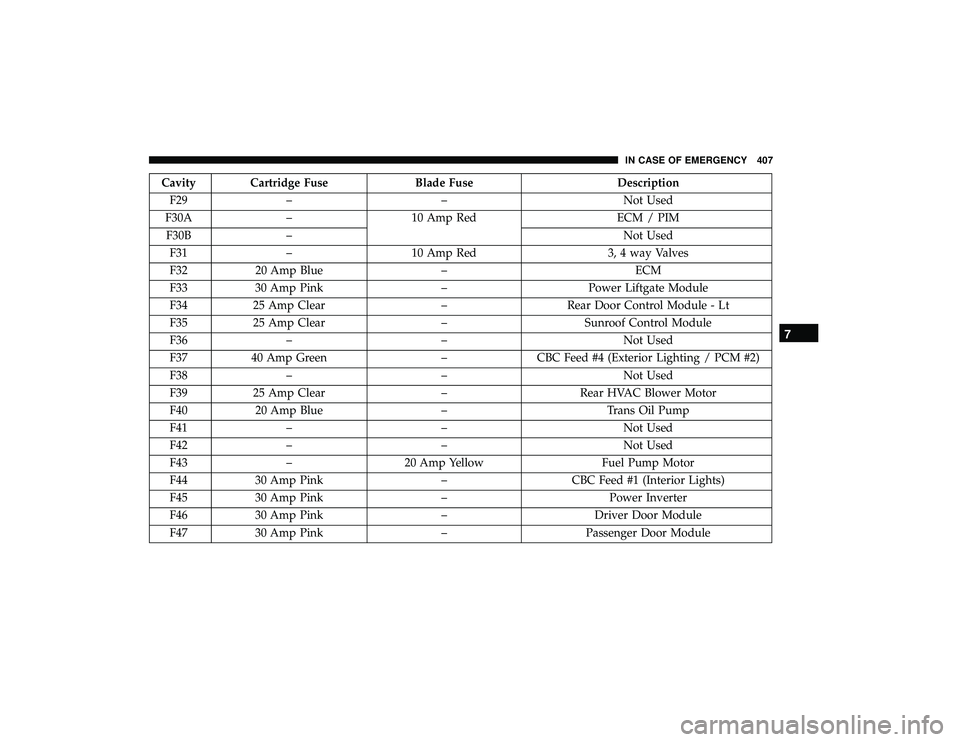
Cavity Cartridge FuseBlade FuseDescription
F29 – – Not Used
F30A – 10 Amp Red ECM / PIM
F30B – Not Used
F31 – 10 Amp Red 3, 4 way Valves
F32 20 Amp Blue – ECM
F33 30 Amp Pink –Power Liftgate Module
F34 25 Amp Clear –Rear Door Control Module - Lt
F35 25 Amp Clear –Sunroof Control Module
F36 – – Not Used
F37 40 Amp Green –CBC Feed #4 (Exterior Lighting / PCM #2)
F38 – – Not Used
F39 25 Amp Clear –Rear HVAC Blower Motor
F40 20 Amp Blue –Trans Oil Pump
F41 – – Not Used
F42 – – Not Used
F43 – 20 Amp Yellow Fuel Pump Motor
F44 30 Amp Pink –CBC Feed #1 (Interior Lights)
F45 30 Amp Pink –Power Inverter
F46 30 Amp Pink –Driver Door Module
F47 30 Amp Pink –Passenger Door Module
7
IN CASE OF EMERGENCY 407
Page 411 of 620
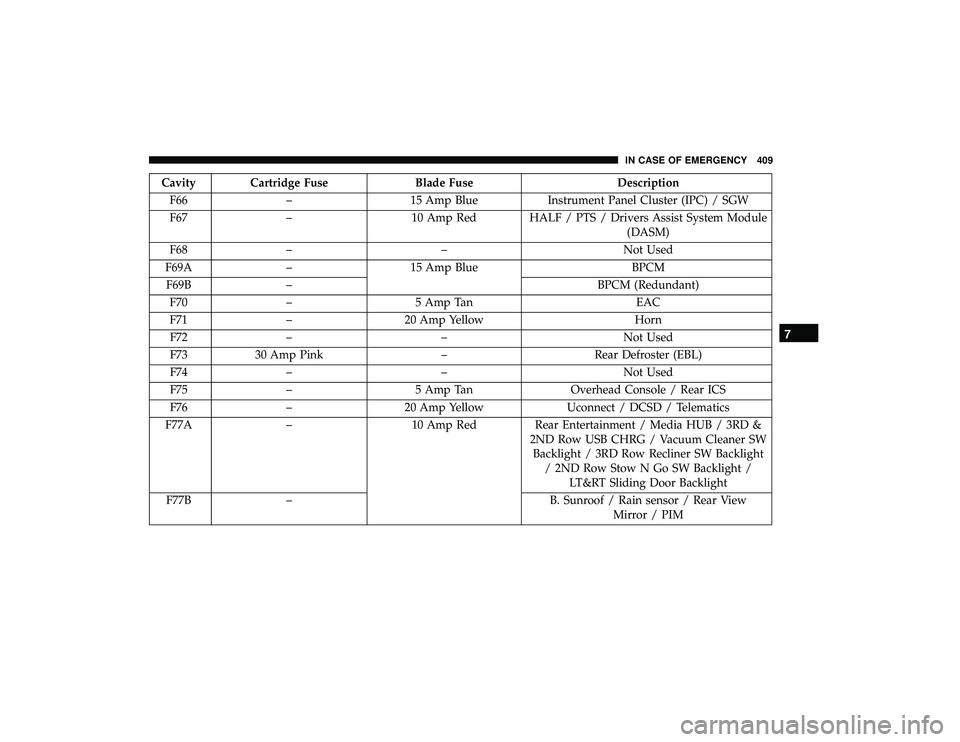
Cavity Cartridge FuseBlade FuseDescription
F66 – 15 Amp Blue Instrument Panel Cluster (IPC) / SGW
F67 – 10 Amp Red HALF / PTS / Drivers Assist System Module
(DASM)
F68 – – Not Used
F69A – 15 Amp Blue BPCM
F69B – BPCM (Redundant)
F70 – 5 Amp Tan EAC
F71 – 20 Amp Yellow Horn
F72 – – Not Used
F73 30 Amp Pink –Rear Defroster (EBL)
F74 – – Not Used
F75 – 5 Amp Tan Overhead Console / Rear ICS
F76 – 20 Amp Yellow Uconnect / DCSD / Telematics
F77A – 10 Amp RedRear Entertainment / Media HUB / 3RD &
2ND Row USB CHRG / Vacuum Cleaner SW Backlight / 3RD Row Recliner SW Backlight / 2ND Row Stow N Go SW Backlight / LT&RT Sliding Door Backlight
F77B – B. Sunroof / Rain sensor / Rear View
Mirror / PIM
7
IN CASE OF EMERGENCY 409
Page 539 of 620
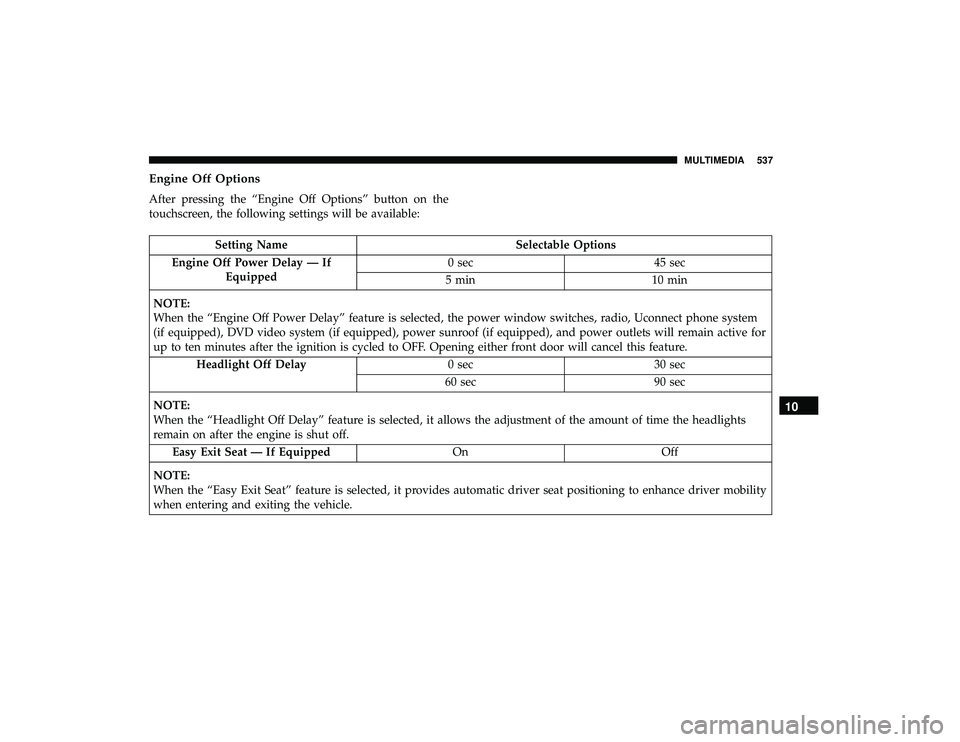
Engine Off Options
After pressing the “Engine Off Options” button on the
touchscreen, the following settings will be available:
Setting NameSelectable Options
Engine Off Power Delay — If Equipped 0 sec
45 sec
5 min 10 min
NOTE:
When the “Engine Off Power Delay” feature is selected, the power window switches, radio, Uconnect phone system
(if equipped), DVD video system (if equipped), power sunroof (if equipped), and power outlets will remain active for
up to ten minutes after the ignition is cycled to OFF. Opening either front door will cancel this feature. Headlight Off Delay 0 sec30 sec
60 sec 90 sec
NOTE:
When the “Headlight Off Delay” feature is selected, it allows the adjustment of the amount of time the headlights
remain on after the engine is shut off. Easy Exit Seat — If Equipped OnOff
NOTE:
When the “Easy Exit Seat” feature is selected, it provides automatic driver seat positioning to enhance driver mobility
when entering and exiting the vehicle.
10
MULTIMEDIA 537
Page 613 of 620
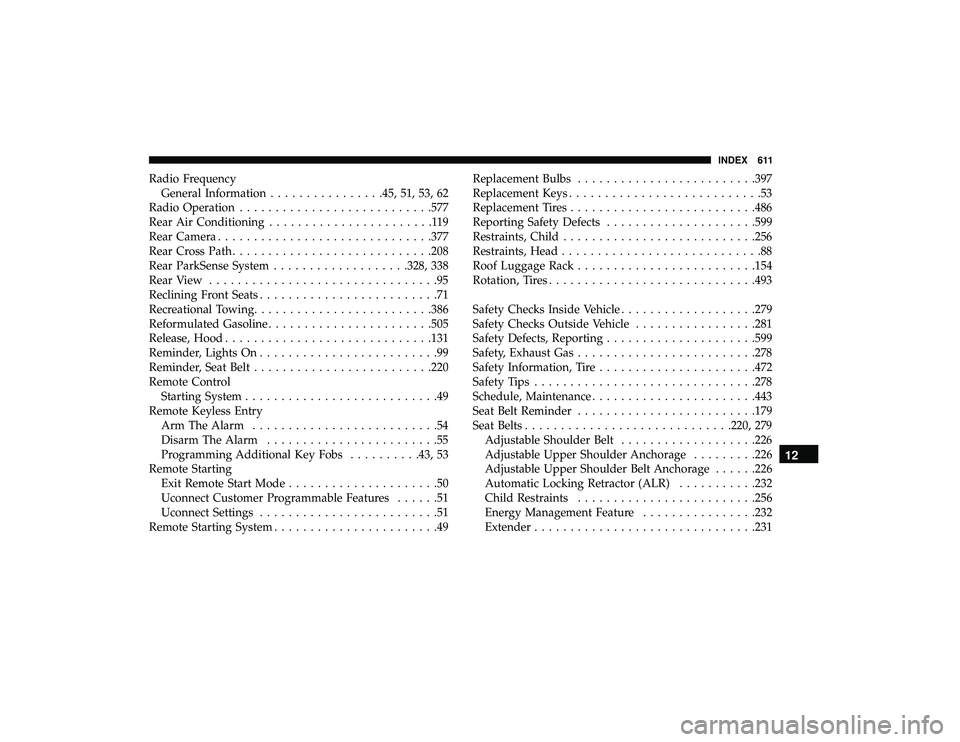
Radio FrequencyGeneral Information ................45, 51, 53, 62
Radio Operation .......................... .577
Rear Air Conditioning .......................119
Rear Camera ............................. .377
Rear Cross Path ........................... .208
Rear ParkSense System .................. .328, 338
Rear View ................................95
Reclining Front Seats .........................71
Recreational Towing ........................ .386
Reformulated Gasoline ...................... .505
Release, Hood ............................ .131
Reminder, Lights On .........................99
Reminder, Seat Belt ........................ .220
Remote Control Starting System ...........................49
Remote Keyless Entry Arm The Alarm ..........................54
Disarm The Alarm ........................55
Programming Additional Key Fobs ..........43, 53
Remote Starting Exit Remote Start Mode .....................50
Uconnect Customer Programmable Features ......51
Uconnect Settings .........................51
Remote Starting System .......................49 Replacement Bulbs
........................ .397
Replacement Keys ...........................53
Replacement Tires ......................... .486
Reporting Safety Defects .................... .599
Restraints, Child .......................... .256
Restraints, Head ............................88
Roof Luggage Rack ........................ .154
Rotation, Tires ............................ .493
Safety Checks Inside Vehicle ...................279
Safety Checks Outside Vehicle .................281
Safety Defects, Reporting .................... .599
Safety, Exhaust Gas ........................ .278
Safety Information, Tire ..................... .472
Safety Tips .............................. .278
Schedule, Maintenance ...................... .443
Seat Belt Reminder ........................ .179
Seat
Belts ............................ .220, 279
Adjustable Shoulder Belt ...................226
Adjustable Upper Shoulder Anchorage .........226
Adjustable Upper Shoulder Belt Anchorage ......226
Automatic Locking Retractor (ALR) ...........232
Child Restraints ........................ .256
Energy Management Feature ................232
Extender .............................. .231
12
INDEX 611
Page 615 of 620
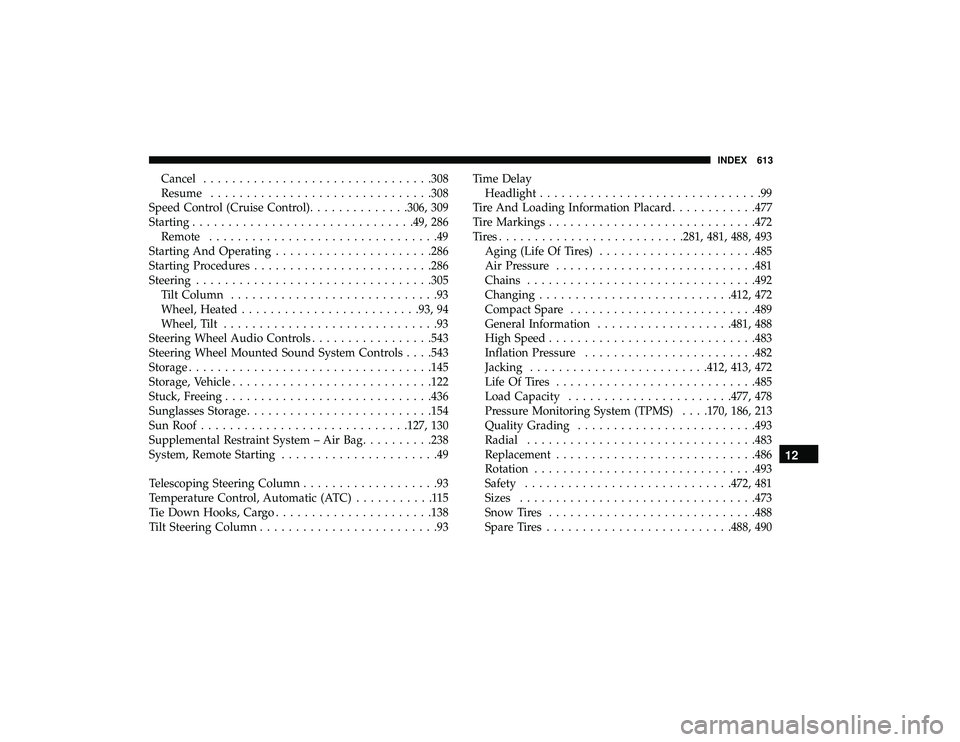
Cancel............................... .308
Resume .............................. .308
Speed Control (Cruise Control) ..............306, 309
Starting .............................. .49, 286
Remote ................................49
Starting And Operating ..................... .286
Starting Procedures ........................ .286
Steering ................................ .305
Tilt Column .............................93
Wheel, Heated ........................ .93, 94
Wheel, Tilt ..............................93
Steering Wheel Audio Controls .................543
Steering Wheel Mounted Sound System Controls . . . .543
Storage ................................. .145
Storage, Vehicle ........................... .122
Stuck, Freeing ............................ .436
Sunglasses Storage ......................... .154
Sun Roof ............................ .127, 130
Supplemental Restraint System – Air Bag ..........238
System, Remote Starting ......................49
Telescoping Steering Column ...................93
Temperature Control, Automatic (ATC) ...........115
Tie Down Hooks, Cargo ..................... .138
Tilt Steering Column .........................93 Time Delay
Headlight ...............................99
Tire And Loading Information Placard ............477
Tire Markings ............................ .472
Tires......................... .281, 481, 488, 493
Aging (Life Of Tires) ..................... .485
Air Pressure ........................... .481
Chains ............................... .492
Changing .......................... .412, 472
Compact Spare ......................... .489
General Information .................. .481, 488
High Speed ............................ .483
Inflation Pressure ....................... .482
Jacking ........................ .412, 413, 472
Life
Of Tires ........................... .485
Load Capacity ...................... .477, 478
Pressure Monitoring System (TPMS) . . . .170, 186, 213
Quality Grading ........................ .493
Radial ............................... .483
Replacement ........................... .486
Rotation .............................. .493
Safety ............................ .472, 481
Sizes ................................ .473
Snow Tires ............................ .488
Spare Tires ......................... .488, 490
12
INDEX 613
Page 619 of 620
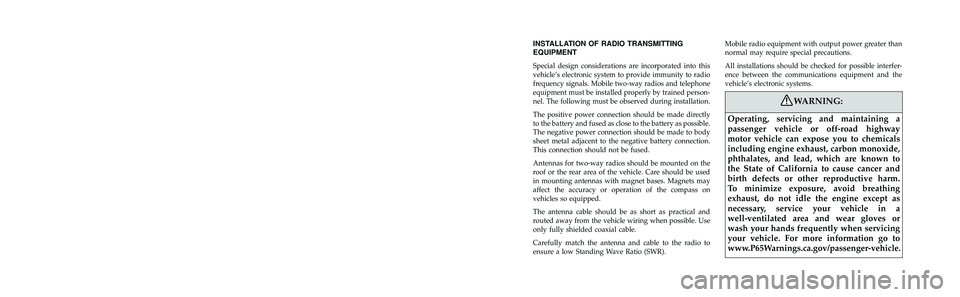
INSTALLATION OF RADIO TRANSMITTING
EQUIPMENT
Special design considerations are incorporated into this
vehicle’s electronic system to provide immunity to radio
frequency signals. Mobile two-way radios and telephone
equipment must be installed properly by trained person-
nel. The following must be observed during installation.
The positive power connection should be made directly
to the battery and fused as close to the battery as possible.
The negative power connection should be made to body
sheet metal adjacent to the negative battery connection.
This connection should not be fused.
Antennas for two-way radios should be mounted on the
roof or the rear area of the vehicle. Care should be used
in mounting antennas with magnet bases. Magnets may
affect the accuracy or operation of the compass on
vehicles so equipped.
The antenna cable should be as short as practical and
routed away from the vehicle wiring when possible. Use
only fully shielded coaxial cable.
Carefully match the antenna and cable to the radio to
ensure a low Standing Wave Ratio (SWR).Mobile radio equipment with output power greater than
normal may require special precautions.
All installations should be checked for possible interfer-
ence between the communications equipment and the
vehicle’s electronic systems.
WARNING:
Operating, servicing and maintaining a
passenger vehicle or off-road highway
motor vehicle can expose you to chemicals
including engine exhaust, carbon monoxide,
phthalates, and lead, which are known to
the State of California to cause cancer and
birth defects or other reproductive harm.
To minimize exposure, avoid breathing
exhaust, do not idle the engine except as
necessary, service your vehicle in a
well-ventilated area and wear gloves or
wash your hands frequently when servicing
your vehicle. For more information go to
www.P65Warnings.ca.gov/passenger-vehicle.
VEHICLES SOLD IN CANADA
With respect to any Vehicles Sold in Canada, the name
FCA US LLC shall be deemed to be deleted and the name
FCA Canada Inc. used in substitution therefore.
DRIVING AND ALCOHOL
Drunken driving is one of the most frequent causes of
accidents.
Your driving ability can be seriously impaired with blood
alcohol levels far below the legal minimum. If you are
drinking, don’t drive. Ride with a designated non-
drinking driver, call a cab, a friend, or use public trans-
portation.
WARNING!
Driving after drinking can lead to an accident.
Your perceptions are less sharp, your reflexes are
slower, and your judgment is impaired when you
have been drinking. Never drink and then drive.
This manual illustrates and describes the operation of
features and equipment that are either standard or op-
tional on this vehicle. This manual may also include a
description of features and equipment that are no longer
available or were not ordered on this vehicle. Please
disregard any features and equipment described in this
manual that are not on this vehicle.
FCA US LLC reserves the right to make changes in design
and specifications, and/or make additions to or improve-
ments to its products without imposing any obligation
upon itself to install them on products previously manu-
factured.
Copyright © 2018 FCA US LLC