battery CHRYSLER PACIFICA HYBRID 2019 Manual PDF
[x] Cancel search | Manufacturer: CHRYSLER, Model Year: 2019, Model line: PACIFICA HYBRID, Model: CHRYSLER PACIFICA HYBRID 2019Pages: 620, PDF Size: 4.92 MB
Page 469 of 620
Please note that it is the owner’s responsibility to maintain
the proper level of protection against freezing according to
the temperatures occurring in the area where the vehicle is
operated.
NOTE:
•Mixing coolant (antifreeze) types is not recommended
and can result in cooling system damage. If HOAT and
OAT coolant are mixed in an emergency, have a autho-
rized dealer drain, flush, and refill with OAT coolant
(conforming to MS.90032) as soon as possible.
• Low pressure expansion bottles for power electronics
and battery cooling require a special tool for removing
the cap from the expansion bottle. For the battery
coolant bottle, it is important to not add coolant if level
is low. The vehicle should be taken to an authorized
dealer for proper servicing of the battery coolant loop if
this should occur.
Cooling System Pressure Cap
The cap must be fully tightened to prevent loss of engine
coolant (antifreeze), and to ensure that engine coolant
(antifreeze) will return to the radiator from the coolant
expansion bottle/recovery tank if so equipped. The cap should be inspected and cleaned if there is any
accumulation of foreign material on the sealing surfaces.
WARNING!
•
Do not open hot engine cooling system. Never add
engine coolant (antifreeze) when the engine is over-
heated. Do not loosen or remove the cap to cool an
overheated engine. Heat causes pressure to build up
in the cooling system. To prevent scalding or injury,
do not remove the pressure cap while the system is
hot or under pressure.
• Do not use a pressure cap other than the one speci-
fied for your vehicle. Personal injury or engine
damage may result.
Disposal Of Used Coolant
Used ethylene glycol-based coolant (antifreeze) is a regu-
lated substance requiring proper disposal. Check with your
local authorities to determine the disposal rules for your
community. To prevent ingestion by animals or children,
do not store ethylene glycol-based coolant in open contain-
ers or allow it to remain in puddles on the ground. If
ingested by a child or pet, seek emergency assistance
immediately. Clean up any ground spills immediately.
8
SERVICING AND MAINTENANCE 467
Page 470 of 620
Coolant Level
The coolant expansion bottle provides a quick visual
method for determining that the coolant level is adequate.
With the engine off and cold, the level of the coolant
(antifreeze) in the bottle should be between the “MAX” and
“MIN” lines marked on the bottle.
As long as the engine operating temperature is satisfactory,
the coolant bottle need only be checked once a month.
When additional coolant (antifreeze) is needed to maintain
the proper level, it should be added to the coolant bottle.
Do not overfill.
See an authorized dealer for service.
Points To Remember
NOTE:When the vehicle is stopped after a few miles/
kilometers of operation, you may observe vapor coming
from the front of the engine compartment. This is normally
a result of moisture from rain, snow, or high humidity
accumulating on the radiator and being vaporized when
the thermostat opens, allowing hot engine coolant (anti-
freeze) to enter the radiator. If an examination of your engine compartment shows no
evidence of radiator or hose leaks, the vehicle may be
safely driven. The vapor will soon dissipate.
•
Do not overfill the coolant expansion bottle.
• Check the coolant freeze point in the radiator and in the
coolant expansion bottle. If engine coolant (antifreeze)
needs to be added, the contents of the coolant expansion
bottle must also be protected against freezing.
• If frequent engine coolant (antifreeze) additions are
required, the cooling system should be pressure tested
for leaks.
• Maintain coolant (antifreeze) concentration at a mini-
mum of 50% OAT coolant (conforming to MS.90032) and
deionized, or distilled water.
• Use only high purity water such as deionized, or dis-
tilled water when mixing the water/coolant (antifreeze)
solution for the engine, battery or high voltage electron-
ics cooling systems. The use of lower quality water will
reduce the amount of corrosion protection in the cooling
system.
• Make sure that the coolant expansion bottle overflow
hoses are not kinked or obstructed.
468 SERVICING AND MAINTENANCE
Page 471 of 620
•Keep the front of the radiator clean. If your vehicle is
equipped with air conditioning, keep the front of the
condenser clean.
• Do not change the thermostat for Summer or Winter
operation. If replacement is ever necessary, install ONLY
the correct type thermostat. Other designs may result in
unsatisfactory engine coolant (antifreeze) performance,
poor gas mileage, and increased emissions.
• The coolant freeze point in the battery and power
electronics loop should be checked by an authorized
dealer as a special tool is required to remove the cap
from those expansion bottles.
• Electric/Battery coolant system must be serviced by an
authorized dealer. If the coolant level is below what is
specified on the reservoir, contact an authorized dealer
for service. These systems require the use of high purity
water such as deionized, or distilled water when mixing
the water and coolant (antifreeze) solution. The use of
lower quality water will reduce the amount of corrosion
protection in the cooling systems.Brake System
In order to assure brake system performance, all brake
system components should be inspected periodically. Refer
to the “Maintenance Plan” in this section for the proper
maintenance intervals.
WARNING!
Riding the brakes can lead to brake failure and possi-
bly a collision. Driving with your foot resting or riding
on the brake pedal can result in abnormally high brake
temperatures, excessive lining wear, and possible
brake damage. You would not have your full braking
capacity in an emergency.
Brake Master Cylinder
The fluid in the master cylinder should be checked when
performing under hood services or immediately if the
“Brake Warning Light” is illuminated.
Be sure to clean the top of the master cylinder area before
removing the cap. If necessary, add fluid to bring the fluid
level up to the requirements described on the brake fluid
reservoir. With disc brakes, fluid level can be expected to
fall as the brake pads wear. Brake fluid level should be
8
SERVICING AND MAINTENANCE 469
Page 497 of 620
WARNING!
The temperature grade for this tire is established for
a tire that is properly inflated and not overloaded.
Excessive speed, under-inflation, or excessive load-
ing, either separately or in combination, can cause
heat buildup and possible tire failure.
STORING THE VEHICLE
If the vehicle should remain stationary for more than a
month, observe the following precautions:
• Park your vehicle in a covered, dry and possibly airy
location with the windows open slightly.
• Check that the Electric Park Brake is not engaged.
• Disconnect the negative (-) terminal from the battery
post and be sure that the battery is fully charged. During
storage check battery charge quarterly.
• If you do not disconnect the battery from the electrical
system, check the battery charge every 30 days.
• Clean and protect the painted parts by applying protec-
tive waxes.
• Clean and protect polished metal parts by applying
protective waxes. •
Apply talcum powder to the front and rear wiper blades
and leave raised from the glass.
• Cover the vehicle with an appropriate cover taking care
not to damage the painted surface by dragging across
dirty surfaces. Do not use plastic sheeting which will not
allow the evaporation of moisture present on the surface
of the vehicle.
• Inflate the tires at a pressure of +7.25 psi (+0.5 bar)
higher than recommended on the tire placard and check
it periodically.
• Do not drain the vehicle cooling system.
• Whenever you leave the vehicle stationary for two
weeks or more, idle the vehicle for approximately five
minutes, with the air conditioning system on and high
fan speed. This will ensure proper lubrication of the
system, thus minimizing the possibility of damage to the
compressor when the vehicle is put back into operation.
• Plug in the vehicle when not using it whenever possible.
NOTE: The hybrid has feature of periodic wake-up that
occurs every 21 days. This feature charges the 12V battery
from the high voltage battery. This will happen as long as
the high voltage battery remains above the minimum state
8
SERVICING AND MAINTENANCE 495
Page 498 of 620
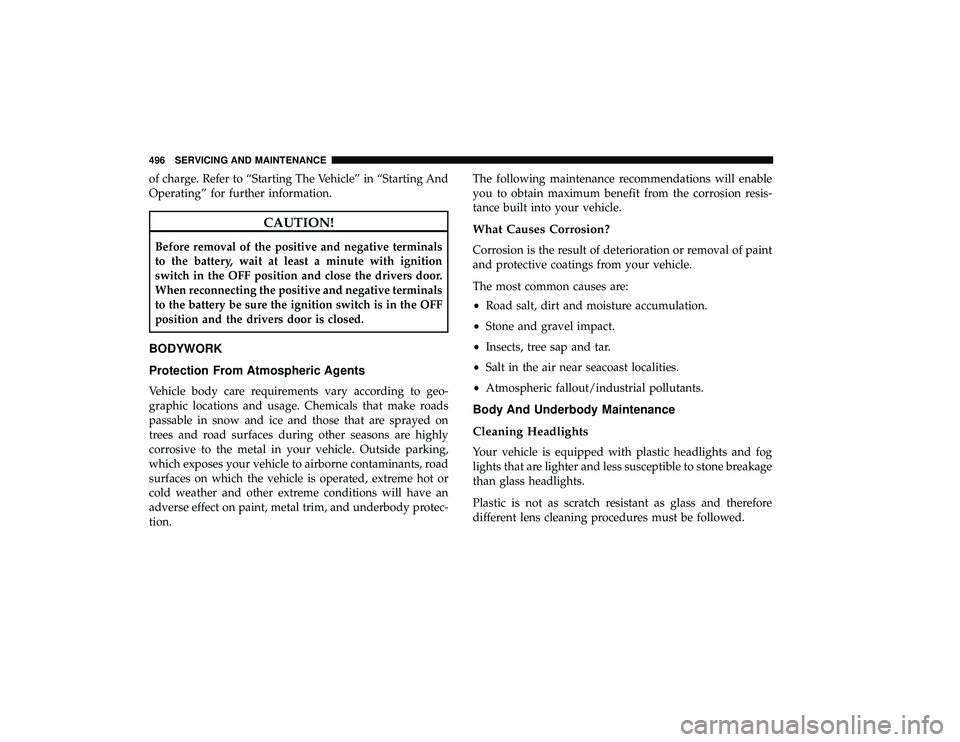
of charge. Refer to “Starting The Vehicle” in “Starting And
Operating” for further information.
CAUTION!
Before removal of the positive and negative terminals
to the battery, wait at least a minute with ignition
switch in the OFF position and close the drivers door.
When reconnecting the positive and negative terminals
to the battery be sure the ignition switch is in the OFF
position and the drivers door is closed.
BODYWORK
Protection From Atmospheric Agents
Vehicle body care requirements vary according to geo-
graphic locations and usage. Chemicals that make roads
passable in snow and ice and those that are sprayed on
trees and road surfaces during other seasons are highly
corrosive to the metal in your vehicle. Outside parking,
which exposes your vehicle to airborne contaminants, road
surfaces on which the vehicle is operated, extreme hot or
cold weather and other extreme conditions will have an
adverse effect on paint, metal trim, and underbody protec-
tion.The following maintenance recommendations will enable
you to obtain maximum benefit from the corrosion resis-
tance built into your vehicle.
What Causes Corrosion?
Corrosion is the result of deterioration or removal of paint
and protective coatings from your vehicle.
The most common causes are:
•
Road salt, dirt and moisture accumulation.
• Stone and gravel impact.
• Insects, tree sap and tar.
• Salt in the air near seacoast localities.
• Atmospheric fallout/industrial pollutants.
Body And Underbody Maintenance
Cleaning Headlights
Your vehicle is equipped with plastic headlights and fog
lights that are lighter and less susceptible to stone breakage
than glass headlights.
Plastic is not as scratch resistant as glass and therefore
different lens cleaning procedures must be followed.
496 SERVICING AND MAINTENANCE
Page 510 of 620
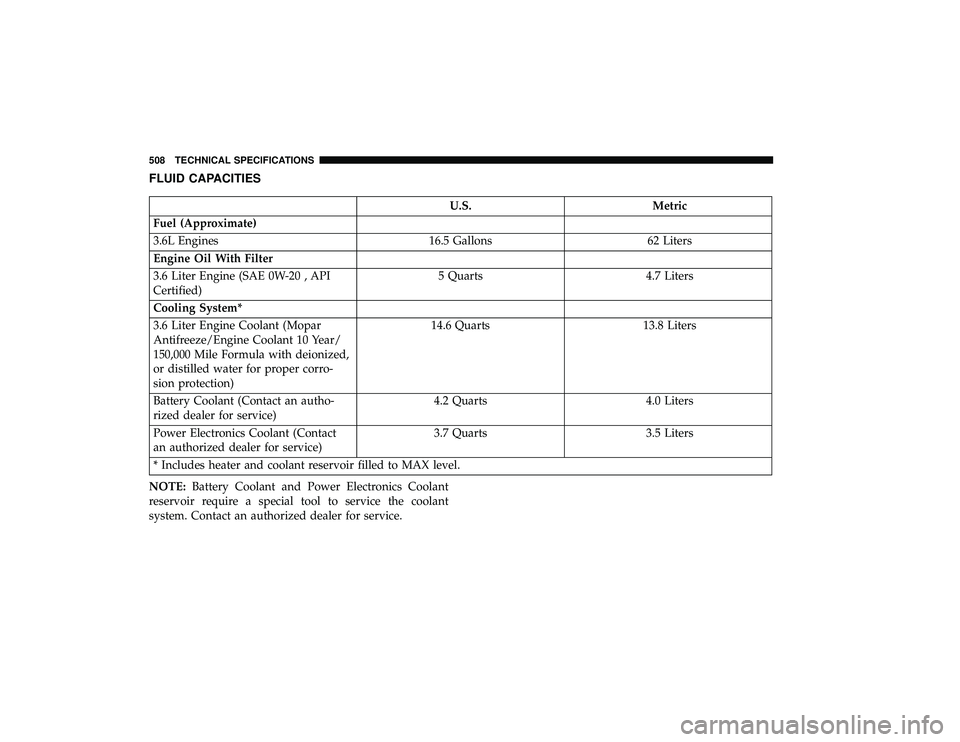
FLUID CAPACITIES
U.S.Metric
Fuel (Approximate)
3.6L Engines 16.5 Gallons62 Liters
Engine Oil With Filter
3.6 Liter Engine (SAE 0W-20 , API
Certified) 5 Quarts
4.7 Liters
Cooling System*
3.6 Liter Engine Coolant (Mopar
Antifreeze/Engine Coolant 10 Year/
150,000 Mile Formula with deionized,
or distilled water for proper corro-
sion protection) 14.6 Quarts
13.8 Liters
Battery Coolant (Contact an autho-
rized dealer for service) 4.2 Quarts
4.0 Liters
Power Electronics Coolant (Contact
an authorized dealer for service) 3.7 Quarts
3.5 Liters
* Includes heater and coolant reservoir filled to MAX level.
NOTE: Battery Coolant and Power Electronics Coolant
reservoir require a special tool to service the coolant
system. Contact an authorized dealer for service.
508 TECHNICAL SPECIFICATIONS
Page 511 of 620
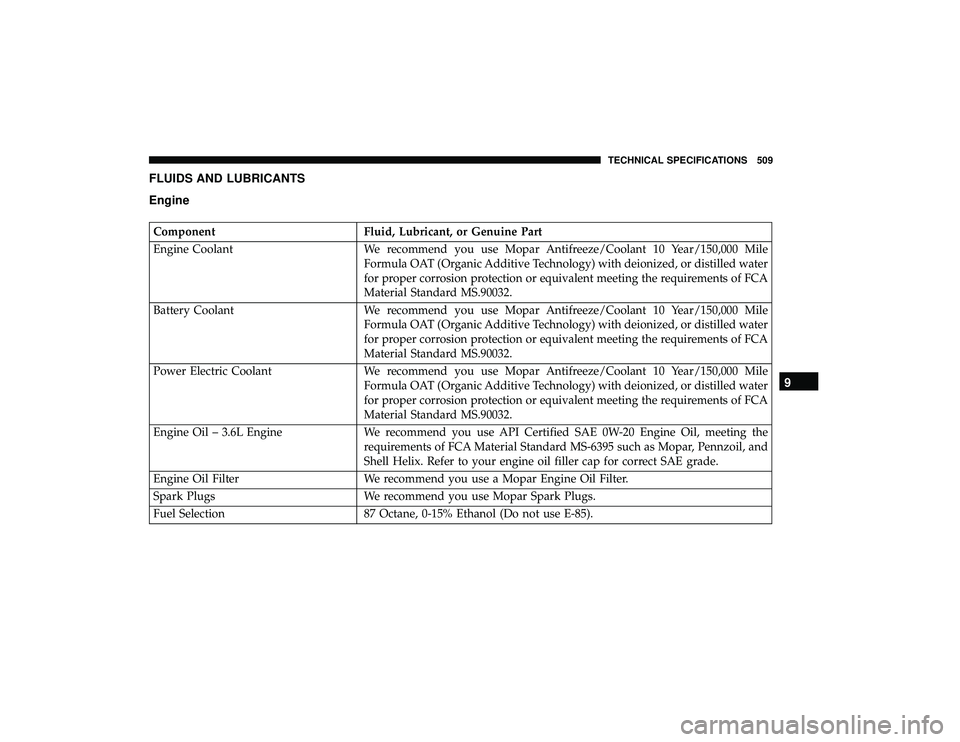
FLUIDS AND LUBRICANTS
Engine
ComponentFluid, Lubricant, or Genuine Part
Engine Coolant We recommend you use Mopar Antifreeze/Coolant 10 Year/150,000 Mile
Formula OAT (Organic Additive Technology) with deionized, or distilled water
for proper corrosion protection or equivalent meeting the requirements of FCA
Material Standard MS.90032.
Battery Coolant We recommend you use Mopar Antifreeze/Coolant 10 Year/150,000 Mile
Formula OAT (Organic Additive Technology) with deionized, or distilled water
for proper corrosion protection or equivalent meeting the requirements of FCA
Material Standard MS.90032.
Power Electric Coolant We recommend you use Mopar Antifreeze/Coolant 10 Year/150,000 Mile
Formula OAT (Organic Additive Technology) with deionized, or distilled water
for proper corrosion protection or equivalent meeting the requirements of FCA
Material Standard MS.90032.
Engine Oil – 3.6L Engine We recommend you use API Certified SAE 0W-20 Engine Oil, meeting the
requirements of FCA Material Standard MS-6395 such as Mopar, Pennzoil, and
Shell Helix. Refer to your engine oil filler cap for correct SAE grade.
Engine Oil Filter We recommend you use a Mopar Engine Oil Filter.
Spark Plugs We recommend you use Mopar Spark Plugs.
Fuel Selection 87 Octane, 0-15% Ethanol (Do not use E-85).
9
TECHNICAL SPECIFICATIONS 509
Page 547 of 620
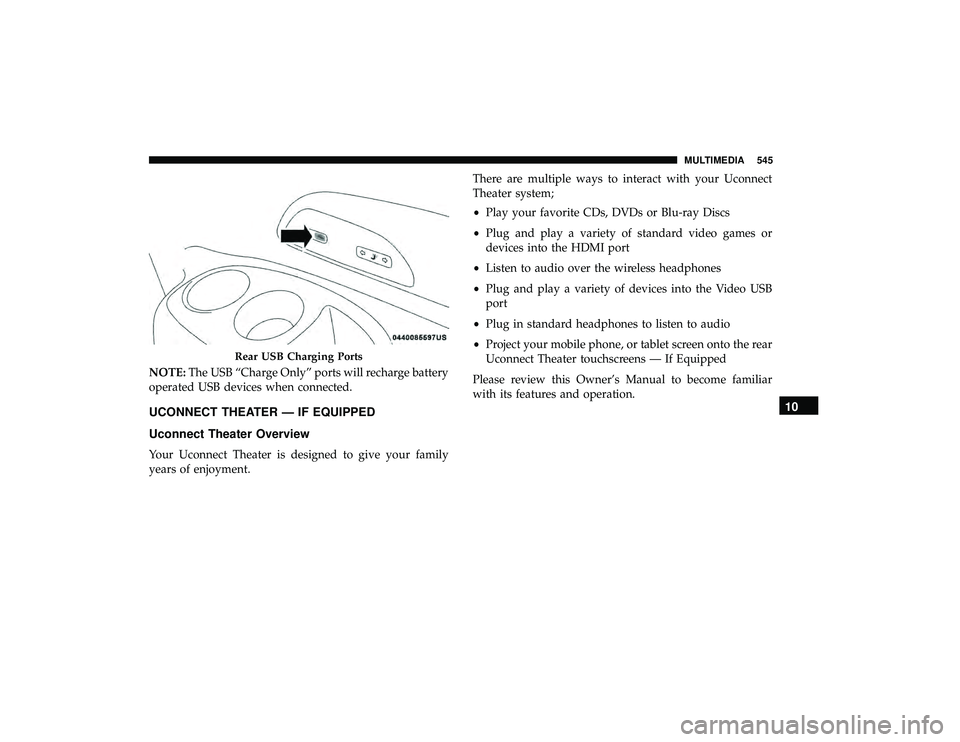
NOTE:The USB “Charge Only” ports will recharge battery
operated USB devices when connected.
UCONNECT THEATER — IF EQUIPPED
Uconnect Theater Overview
Your Uconnect Theater is designed to give your family
years of enjoyment. There are multiple ways to interact with your Uconnect
Theater system;
•
Play your favorite CDs, DVDs or Blu-ray Discs
• Plug and play a variety of standard video games or
devices into the HDMI port
• Listen to audio over the wireless headphones
• Plug and play a variety of devices into the Video USB
port
• Plug in standard headphones to listen to audio
• Project your mobile phone, or tablet screen onto the rear
Uconnect Theater touchscreens — If Equipped
Please review this Owner’s Manual to become familiar
with its features and operation.
Rear USB Charging Ports
10
MULTIMEDIA 545
Page 555 of 620
Replacing The Remote Control Batteries
Each remote control requires two AAA batteries for opera-
tion.
To replace the batteries:
1. Locate the battery compartment on the back of theremote, then slide the battery cover downward.
2. Remove the old batteries and follow battery recycling procedures for your area.
3. Install new batteries, making sure to orient them accord- ing to the polarity diagram shown inside the battery
compartment.
4. Replace the battery compartment cover.
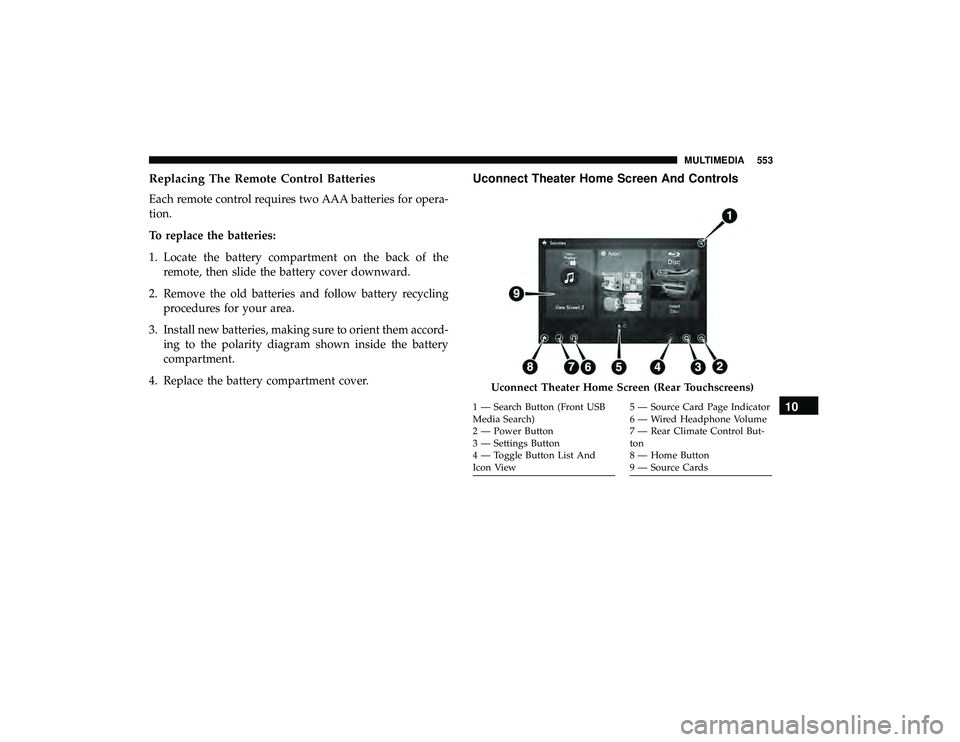
Uconnect Theater Home Screen And Controls
Uconnect Theater Home Screen (Rear Touchscreens)
1 — Search Button (Front USB
Media Search)
2 — Power Button
3 — Settings Button
4 — Toggle Button List And
Icon View5 — Source Card Page Indicator
6 — Wired Headphone Volume
7 — Rear Climate Control But-
ton
8 — Home Button
9 — Source Cards10
MULTIMEDIA 553
Page 564 of 620
Headphones Operation
The headphones receive two separate channels of audio
using an infrared transmitter from the video screens.
If no audio is heard after increasing the volume control,
there are a number of things that can be done to trouble-
shoot the issue:
•Verify that the screen is turned on.
• Check to see that the channel is not muted.
• Make sure that the headphones are on.
• Verify that the headphone channel selector button is on
the desired channel. This button switches between the
audio of screen 1 and screen 2.
• Install two new AAA type batteries in the headphones.
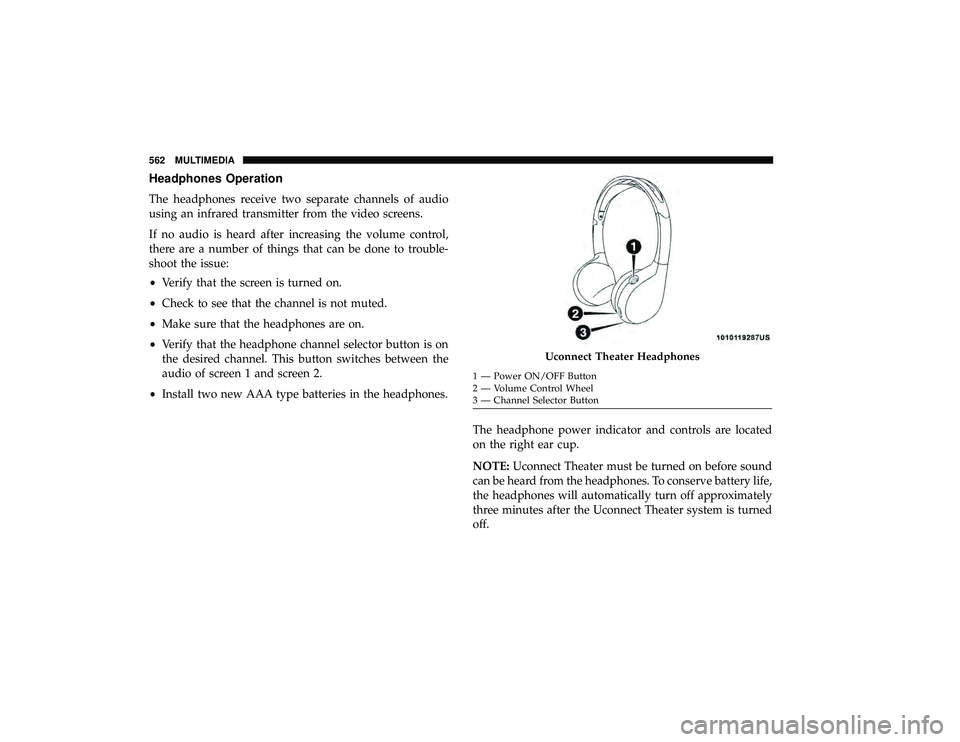
The headphone power indicator and controls are located
on the right ear cup.
NOTE:Uconnect Theater must be turned on before sound
can be heard from the headphones. To conserve battery life,
the headphones will automatically turn off approximately
three minutes after the Uconnect Theater system is turned
off.
Uconnect Theater Headphones
1 — Power ON/OFF Button
2 — Volume Control Wheel
3 — Channel Selector Button
562 MULTIMEDIA