lock CHRYSLER PT CRUISER 2008 1.G Service Manual
[x] Cancel search | Manufacturer: CHRYSLER, Model Year: 2008, Model line: PT CRUISER, Model: CHRYSLER PT CRUISER 2008 1.GPages: 488, PDF Size: 7.43 MB
Page 60 of 488

The Head/Thorax airbag system (if equipped) consists
of the following:
²AIRBAG Readiness Light (shared with the front airbag
system)
²Front SeatÐ side mounted Head/Thorax Airbags Ð if
equipped
²Airbag Control Module (shared with the front airbag
system)
²Side impact sensors
How The Airbag System Works
²
TheOccupant Restraint Controller (ORC)determines
if a frontal collision is severe enough to require the
airbags to inflate. The front airbag inflators are de-
signed to provide different rates of airbag inflation
from direction provided by the ORC. The ORC mayalso modify the rate of inflation based on the occupant
size provided by the Occupant Classification Module.
The ORC will not detect roll over.
The ORC also monitors the readiness of the electronic
parts of the system whenever the ignition switch is in
the START or RUN positions. These include all of the
items listed above except the steering wheel and
column, and knee blocker panels. If the key is in the
OFF position, in the ACC position, or not in the
ignition, the airbags are not on and will not inflate.
During a moderate-to-severe rear impact the ORC may
deploy the seat belt pretensioners alone.
Also, the ORC turns on the AIRBAG warning
light and PAD indicator light in the instrument
panel for six to eight seconds for a self-check
when the ignition is first turned on. After the
self-check, the AIRBAG warning light will turn off. The
PAD indicator light will function normally (Refer to
60 THINGS TO KNOW BEFORE STARTING YOUR VEHICLE
Page 69 of 488
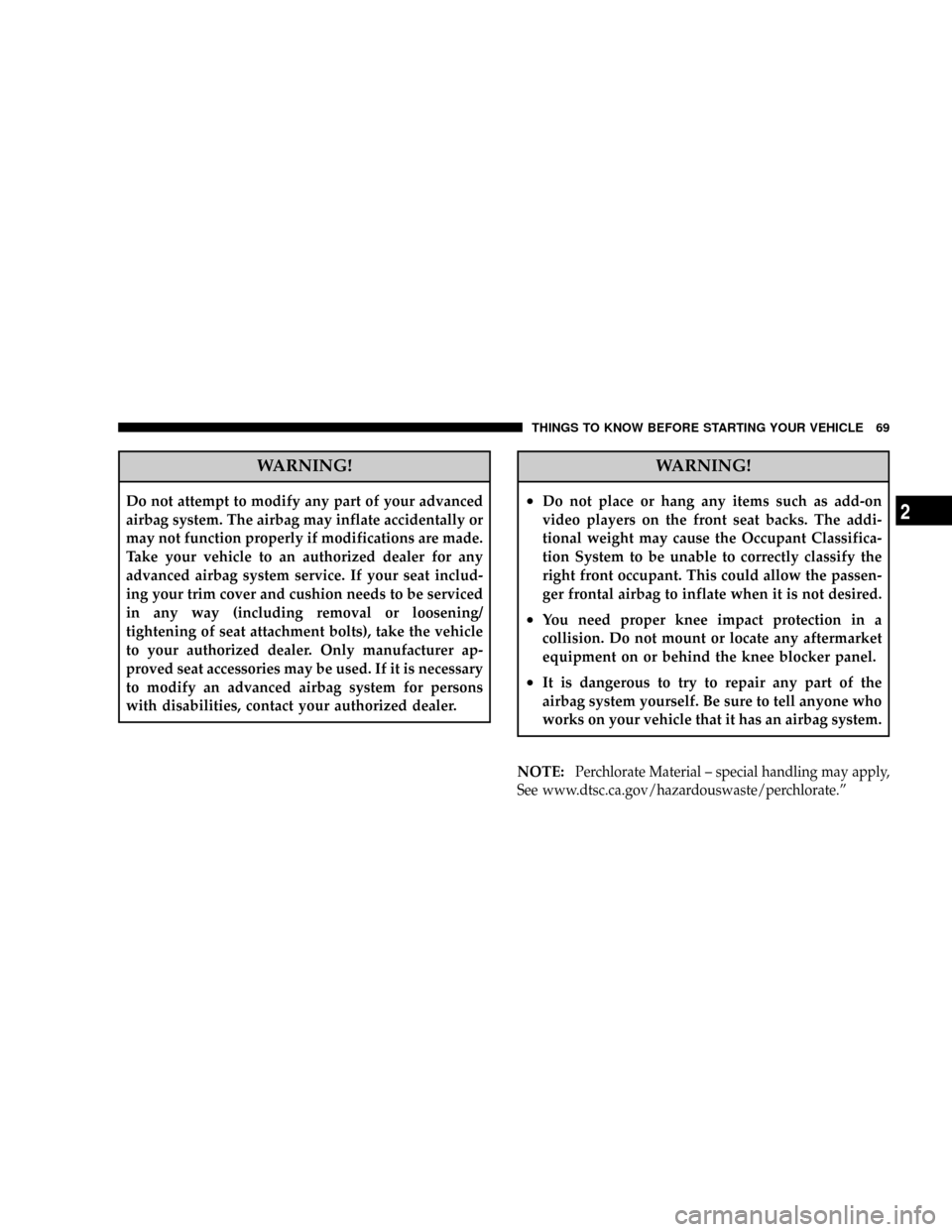
WARNING!
Do not attempt to modify any part of your advanced
airbag system. The airbag may inflate accidentally or
may not function properly if modifications are made.
Take your vehicle to an authorized dealer for any
advanced airbag system service. If your seat includ-
ing your trim cover and cushion needs to be serviced
in any way (including removal or loosening/
tightening of seat attachment bolts), take the vehicle
to your authorized dealer. Only manufacturer ap-
proved seat accessories may be used. If it is necessary
to modify an advanced airbag system for persons
with disabilities, contact your authorized dealer.
WARNING!
²Do not place or hang any items such as add-on
video players on the front seat backs. The addi-
tional weight may cause the Occupant Classifica-
tion System to be unable to correctly classify the
right front occupant. This could allow the passen-
ger frontal airbag to inflate when it is not desired.
²You need proper knee impact protection in a
collision. Do not mount or locate any aftermarket
equipment on or behind the knee blocker panel.
²It is dangerous to try to repair any part of the
airbag system yourself. Be sure to tell anyone who
works on your vehicle that it has an airbag system.
NOTE:
Perchlorate Material ± special handling may apply,
See www.dtsc.ca.gov/hazardouswaste/perchlorate.º
THINGS TO KNOW BEFORE STARTING YOUR VEHICLE 69
2
Page 75 of 488

WARNING!
²Improper installation can lead to failure of an
infant or child restraint. It could come loose in a
collision. The child could be badly injured or
killed. Follow the manufacturer's directions ex-
actly when installing an infant or child restraint.
²A rearward facing child restraint should only be
used in a rear seat. A rearward facing child re-
straint in the front seat may be struck by a deploy-
ing passenger airbag which may cause severe or
fatal injury to the infant.
Here are some tips on getting the most out of your child
restraint:
²Before buying any restraint system, make sure that it
has a label certifying that it meets all applicable Safety
Standards. We also recommend that you make surethat you can install the child restraint in the vehicle
where you will use it, before you buy it.
²The restraint must be appropriate for your child's
weight and height. Check the label on the restraint for
weight and height limits.
²Carefully follow the instructions that come with the
restraint. If you install the restraint improperly, it may
not work when you need it.
The passenger seat belts are equipped with either
cinching latch plates or seat belt retractors that can be
switched to an automatic locking mode, which are
designed to keep the lap portion tight around the child
restraint so that it is not necessary to use a locking clip.
If the seat belt has a cinching latch plate, pulling up on
the shoulder portion of the lap/shoulder belt will
tighten the belt. The cinching latch plate will keep the
belt tight, however, any seat belt system will loosen
with time, so check the belt occasionally and pull it
tight if necessary.
THINGS TO KNOW BEFORE STARTING YOUR VEHICLE 75
2
Page 76 of 488

If the seat belt has a switchable retractor, please refer to
Automatic-Locking Retractor (ALR) in this section.
²In the rear seat, you may have trouble tightening the
lap/shoulder belt on the child restraint because the
buckle or latch plate is too close to the belt path
opening on the restraint. Disconnect the latch plate
from the buckle and twist the short buckle end of the
belt several times to shorten it. Insert the latch plate
into the buckle with the release button facing out.
²If the belt still can't be tightened, or if by pulling and
pushing on the restraint loosens the belt, disconnect
the latch plate from the buckle, turn the latch plate
around, and insert the latch plate into the buckle
again. If you still can't make the child restraint secure,
try a different seating position.
²Buckle the child into the seat according to the child
restraint manufacturer's directions.
²When your child restraint is not in use, secure it in the
vehicle with the seat belt or remove it from the vehicle.
Don't leave it loose in the vehicle. In a sudden stop or
collision, it could strike the occupants or seat backs
and cause serious personal injury.
Automatic-Locking Retractor (ALR)
To operate the switchable retractor, pull the belt from the
retractor until there is enough to allow you to pass
through the child restraint and slide the latch plate into
the buckle. Then pull on the belt until it is all removed
from the retractor. Allow the belt to return into the
retractor, pulling on the excess webbing to tighten the lap
portion about the child restraint. Follow the instructions
of the child restraint manufacture.
NOTE:To reset this feature you must let all of the belt
webbing return into the retractor. You will not be able to
pull out more webbing until all of the webbing has been
returned back into the retractor.
76 THINGS TO KNOW BEFORE STARTING YOUR VEHICLE
Page 81 of 488

OCCUPANT RESTRAINTS (CONVERTIBLE)
Some of the most important safety features in your
vehicle are the restraint systems. These include:
²Front and rear seat belts for all passengers
²Front airbags for both the driver and front passenger
²Pretensioning and load-limiting retractors for the front
seat belts.
²Knee Blocker panels for front seat occupants.
²Supplemental front seat mounted side Head/Thorax
airbags for both the driver and front passenger (if
equipped).
²Front seat belt retractors that incorporate pretension-
ers to enhance occupant protection by managing oc-
cupant energy during an impact event.If you will be carrying children too small for adult-size
seat belts, your seat belts or the LATCH feature also, can
be used to hold infant and child restraint systems.
Please pay close attention to the information in this
section. It tells you how to use your restraint system
properly to keep you and your passengers as safe as
possible.
WARNING!
In a collision, you and your passengers can suffer
much greater injuries if you are not properly buckled
up. You can strike the interior of your vehicle or other
passengers, or you can be thrown out of the vehicle.
Always be sure you and others in your vehicle are
buckled up properly.
THINGS TO KNOW BEFORE STARTING YOUR VEHICLE 81
2
Page 82 of 488

Buckle up even though you are an excellent driver, even
on short trips. Someone on the road may be a poor driver
and cause a collision that includes you. This can happen
far away from home or on your own street.
Research has shown that seat belts save lives, and they
can reduce the seriousness of injuries in a collision. Some
of the worst injuries happen when people are thrown
from the vehicle. Seat belts reduce the possibility of
ejection and the risk of injury caused by striking the
inside of the vehicle.Everyone in a motor vehicle should
be belted at all times.
LAP/SHOULDER BELTS
All the seats in your vehicle are equipped with Lap/
Shoulder Belts.
The belt webbing retractor is designed to lock during
very sudden stops or collisions. This feature allows the
shoulder part of the belt to move freely with you undernormal conditions. But in a collision, the belt will lock
and reduce the risk of your striking the inside of the
vehicle or being thrown out.
WARNING!
²It is extremely dangerous to ride in a cargo area,
inside or outside of a vehicle. In a collision, people
riding in these areas are more likely to be seri-
ously injured or killed.
²Do not allow people to ride in any area of your
vehicle that is not equipped with seats and seat
belts.
²Be sure everyone in your vehicle is in a seat and
using a seat belt properly.
82 THINGS TO KNOW BEFORE STARTING YOUR VEHICLE
Page 90 of 488

DRIVER AND FRONT PASSENGER
SUPPLEMENTAL RESTRAINT SYSTEM (SRS)
This vehicle has airbags for both the driver and front
passenger as a supplement to the seat belt restraint
systems. The driver's front airbag is mounted in the
center of the steering wheel. The passenger's front airbag
is mounted in the instrument panel, above the glove
compartment. The words SRS AIRBAG are embossed on
the airbag covers.
Front Panel SRS Features
1 Ð Driver Airbag 3 Ð Passenger Knee Blocker
2 Ð Passenger Airbag 4 Ð Driver Knee Blocker 90 THINGS TO KNOW BEFORE STARTING YOUR VEHICLE
Page 91 of 488
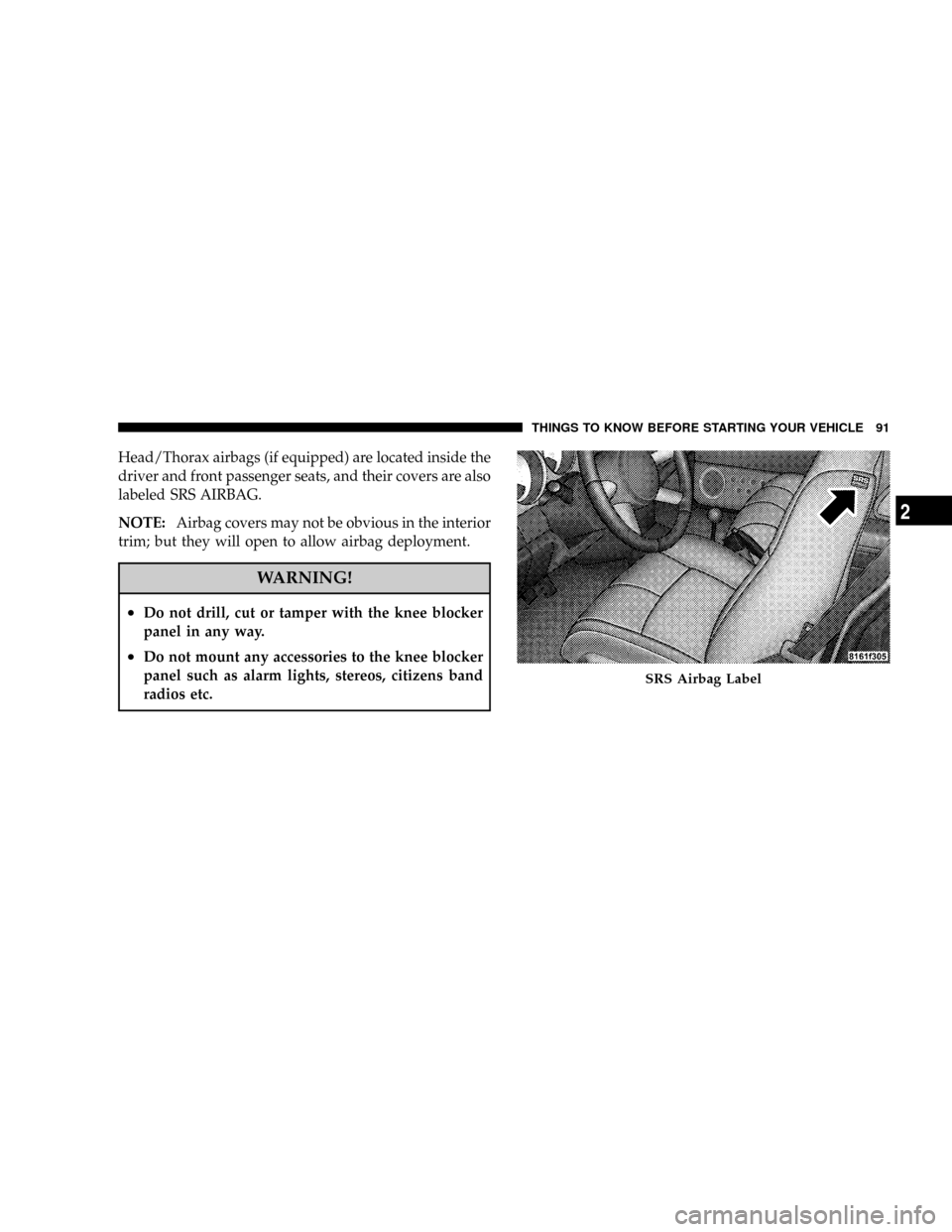
Head/Thorax airbags (if equipped) are located inside the
driver and front passenger seats, and their covers are also
labeled SRS AIRBAG.
NOTE:Airbag covers may not be obvious in the interior
trim; but they will open to allow airbag deployment.
WARNING!
²Do not drill, cut or tamper with the knee blocker
panel in any way.
²Do not mount any accessories to the knee blocker
panel such as alarm lights, stereos, citizens band
radios etc.
SRS Airbag Label
THINGS TO KNOW BEFORE STARTING YOUR VEHICLE 91
2
Page 92 of 488

WARNING!
²Do not put anything on or around the airbag
covers or attempt to manually open them. You may
damage the airbags and you could be injured
because the airbags are not there to protect you.
These protective covers for the airbag cushions are
designed to open only when the airbags are inflat-
ing.
²If your vehicle is equipped with Head/Thorax
airbags, do not use accessory seat covers or place
objects between you and the side airbags; the
performance could be adversely affected and/or
objects could be pushed into you, causing serious
injury.Airbags inflate in moderate to high speed impacts. Along
with seat belts and pretensioners, front airbags work with
knee impact blocker panels to provide improved protec-
tion for the driver and front passenger.
The seat belts are designed to protect you in many types
of collisions. The front airbags deploy in moderate to
severe frontal collisions. If your vehicle is equipped, the
Head/Thorax airbag on the crash side of the vehicle is
triggered in moderate to severe side collisions. In certain
types of collisions, both the front seat and Head/Thorax
airbags may be triggered. But even in collisions where
the airbags work, you need the seat belts to keep you in
the right position for the airbags to protect you properly.
NOTE:The passenger front airbag may not deploy even
when the driver front airbag has if the Occupant Classi-
fication System (refer to9Occupant Classification System9
in this section) has determined the passenger seat is
92 THINGS TO KNOW BEFORE STARTING YOUR VEHICLE
Page 94 of 488

WARNING!
²Relying on the airbags alone could lead to more
severe injuries in a collision. The airbags work
with your seat belt to restrain you properly. In
some collisions the airbags won't deploy at all.
Always wear your seat belts even though you have
airbags.
²Being too close to the steering wheel or instrument
panel during front airbag deployment could cause
serious injury. Airbags need room to inflate. Sit
back, comfortably extending your arms to reach
the steering wheel or instrument panel.
²If the vehicle has Head/Thorax airbags, they also
need room to inflate. Do not lean against the door.
Sit upright in the center of the seat.The front airbag system consists of the following:
²Occupant Restraint Controller
²Side Remote Acceleration Sensors (If Equipped)
²Airbag Warning Light
²Driver Airbag
²Passenger Airbag
²Front Seat Mounted Head/Thorax Airbags (if
equipped)
²Steering Wheel and Column
²Instrument Panel
²Driver and Front Passenger Knee Impact Blockers
²Front Acceleration Sensors
²Driver and Front Passenger Seat Belt Pretensioners
²Passenger Airbag Disable (PAD) Indicator Light
94 THINGS TO KNOW BEFORE STARTING YOUR VEHICLE