belt CHRYSLER PT CRUISER 2008 1.G Workshop Manual
[x] Cancel search | Manufacturer: CHRYSLER, Model Year: 2008, Model line: PT CRUISER, Model: CHRYSLER PT CRUISER 2008 1.GPages: 488, PDF Size: 7.43 MB
Page 112 of 488

Child restraints systems having attachments designed to
connect to the lower anchorages are now available. Child
restraints having tether straps and hooks for connection
to the top tether anchorage have been available for some
time. In fact, many child restraint manufacturers will
provide add-on tether strap kits for some of their older
products. Tether anchorage kits are also available for
most older vehicles.
Because the lower anchorages are to be introduced to
passenger carrying vehicles over a period of years, child
restraint systems having attachments for those anchor-
ages will continue to have features for installation in
vehicles using the lap or lap/shoulder belt. They will also
have tether straps, and you are urged to take advantage
of all of the available attachments provided with your
child restraint in any vehicle.
NOTE:When using the LATCH attaching system to
install a child restraint, please ensure that all seat beltsnot being used for occupant restraints are stowed and out
of reach of children. It is recommended that before
installing the child restraint, buckle the seat belt so the
seat belt is tucked behind the child restraint and out of
reach. If the buckled seat belt interferes with the child
restraint installation, instead of tucking the seat belt
behind the child restraint, route the seat belt through the
child restraint belt path and then buckle it. This should
stow the seat belt out of the reach of an inquisitive child.
Remind all children in the vehicle that the seat belts are
not toys and should not be played with, and never leave
your child unattended in the vehicle.
Installing the Child Restraint System
We urge that you carefully follow the directions of the
manufacturer when installing your child restraint. Many,
but not all, restraint systems will be equipped with
separate straps on each side, with each having a hook or
connector and a means for adjusting the tension in the
strap. Forward-facing toddler restraints and some
112 THINGS TO KNOW BEFORE STARTING YOUR VEHICLE
Page 113 of 488

rearward-facing infant restraints will also be equipped
with a tether strap with a hook and means for adjusting
the tension in the strap.
In general, you will first loosen the adjusters on the lower
and tether straps so that you can more easily attach the
hook or connector to the lower and tether anchorages.
The tether strap should be routed over the center of the
head form and attached to the tether anchor, located
behind the rear seat head form, in the convertible top
storage area. Then tighten all three straps as you push the
child restraint rearward and downward into the seat.
NOTE:To gain access to the anchorages, locate the child
tether anchorage decals on the carpet behind the rear seat
head forms and use a small screwdriver to pry the carpet
flap open. The carpet flap is attached in two different
places.Not all child restraint systems will be installed as we
have described here. Again, carefully follow the instruc-
tions that come with the child restraint system.
NOTE:If your child restraint seat is not LATCH com-
patible, install the restraint using the vehicle seat belts.
Tether Strap Mounting
THINGS TO KNOW BEFORE STARTING YOUR VEHICLE 113
2
Page 114 of 488
WARNING!
An incorrectly anchored tether strap could lead to
increased head motion and possible injury to the
child. Use only the anchor position directly behind
the child seat to secure a child restraint top tether
strap.
Children Too Large For Booster Seats
Children who are large enough to wear the shoulder belt
comfortably, and whose legs are long enough to bend
over the front of the seat when their back is against the
seat back, should use the lap/shoulder belt in a rear seat.
²Make sure that the child is upright in the seat.
²The lap portion should be low on the hips and as snug
as possible.
²Check belt fit periodically. A child's squirming or
slouching can move the belt out of position.
²If the shoulder belt contacts the face or neck, move the
child closer to the center of the vehicle. Never allow a
child to put the shoulder belt under an arm or behind
their back.
Transporting Pets
Airbags deploying in the front seat could harm your pet.
An unrestrained pet will be thrown about and possibly
injured, or injure a passenger during panic braking or in
a collision.
Pets should be restrained in the rear seat in pet harnesses
or pet carriers that are secured by seat belts.
114 THINGS TO KNOW BEFORE STARTING YOUR VEHICLE
Page 116 of 488
If it is necessary to sit in a parked vehicle with the engine
running, adjust your heating or cooling controls to force
outside air into the vehicle. Set the blower at high speed.
WARNING!
If you are required to drive with the deck lid/liftgate
open, make sure that all windows are closed, and the
climate control blower switch is set at high speed.
DO NOT use the recirculation mode.
Safety Checks You Should Make Inside The
Vehicle
Seat Belts
Inspect the belt system periodically, checking for cuts,
frays and loose parts. Damaged parts must be replaced
immediately. Do not disassemble or modify the system.Front seat belt assemblies must be replaced after a
collision. Rear seat belt assemblies must be replaced after
a collision if they have been damaged (bent retractor, torn
webbing, etc. If there is any question regarding belt or
retractor condition, replace the belt.
Airbag Light
The light should come on and remain on for 6 to 8
seconds as a bulb check when the ignition switch is first
turned ON. If the LED is not lit during starting, have it
checked. If the light stays on or comes on while driving,
have the system checked by an authorized dealer.
Defroster
Check operation by selecting the defrost mode and place
the blower control on high speed. You should be able to
feel the air directed against the windshield.
116 THINGS TO KNOW BEFORE STARTING YOUR VEHICLE
Page 123 of 488
CONVERTIBLE TOP OPERATION
WARNING!
The convertible top does not provide the structural
protection that a reinforced metal roof does, and the
fabric top cannot be expected to prevent the ejection
of the occupants of a vehicle in a collision. Therefore
it is important that all occupants wear their seat belts
at all times when riding in a convertible. Studies
have shown that it is generally safer to remain inside
a vehicle during a collision, than to be ejected from
the vehicle.
To Lower The Top:
NOTE:Thoroughly dry the convertible top and top
storage area, prior to leaving the top lowered for an
extended period of time. This will help prevent possible
mildew build-up.
CAUTION!
To avoid damage to the convertible top or its compo-
nents, your vehicle is equipped with a feature that
prevents convertible top operation at speeds over 10
mph (16 km/h).
UNDERSTANDING THE FEATURES OF YOUR VEHICLE 123
3
Page 164 of 488
SEATS
FRONT SEAT ADJUSTMENT
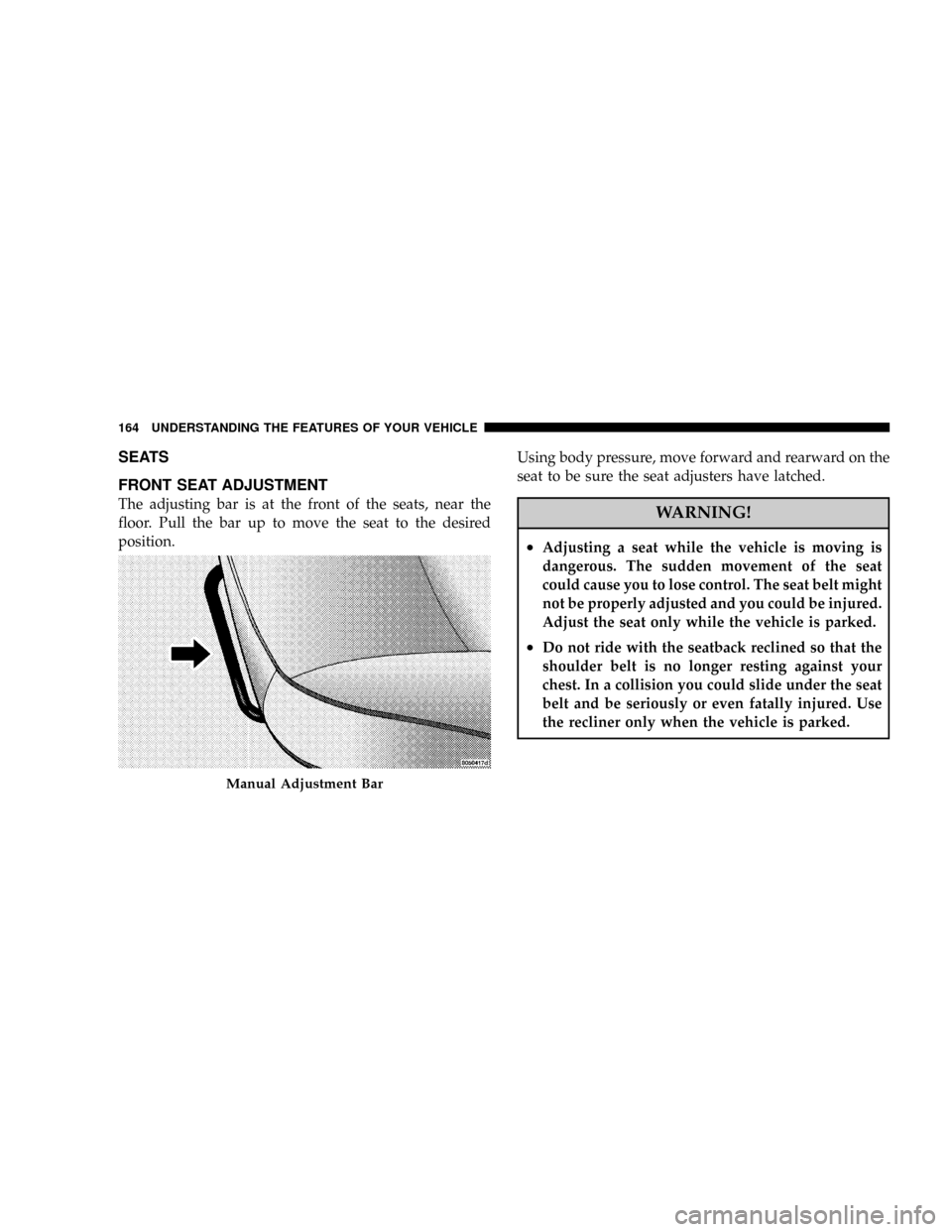
The adjusting bar is at the front of the seats, near the
floor. Pull the bar up to move the seat to the desired
position.Using body pressure, move forward and rearward on the
seat to be sure the seat adjusters have latched.WARNING!
²Adjusting a seat while the vehicle is moving is
dangerous. The sudden movement of the seat
could cause you to lose control. The seat belt might
not be properly adjusted and you could be injured.
Adjust the seat only while the vehicle is parked.
²Do not ride with the seatback reclined so that the
shoulder belt is no longer resting against your
chest. In a collision you could slide under the seat
belt and be seriously or even fatally injured. Use
the recliner only when the vehicle is parked.
Manual Adjustment Bar
164 UNDERSTANDING THE FEATURES OF YOUR VEHICLE
Page 165 of 488
POWER SEAT ADJUSTER Ð IF EQUIPPED
WARNING!
Do not ride with the seatback reclined so that the seat
belt is no longer resting against your chest. In a
collision you could slide under the seat belt and be
seriously or even fatally injured. Use the recliner
only when the vehicle is parked.
Six-Way Power Seat with Manual Recliner
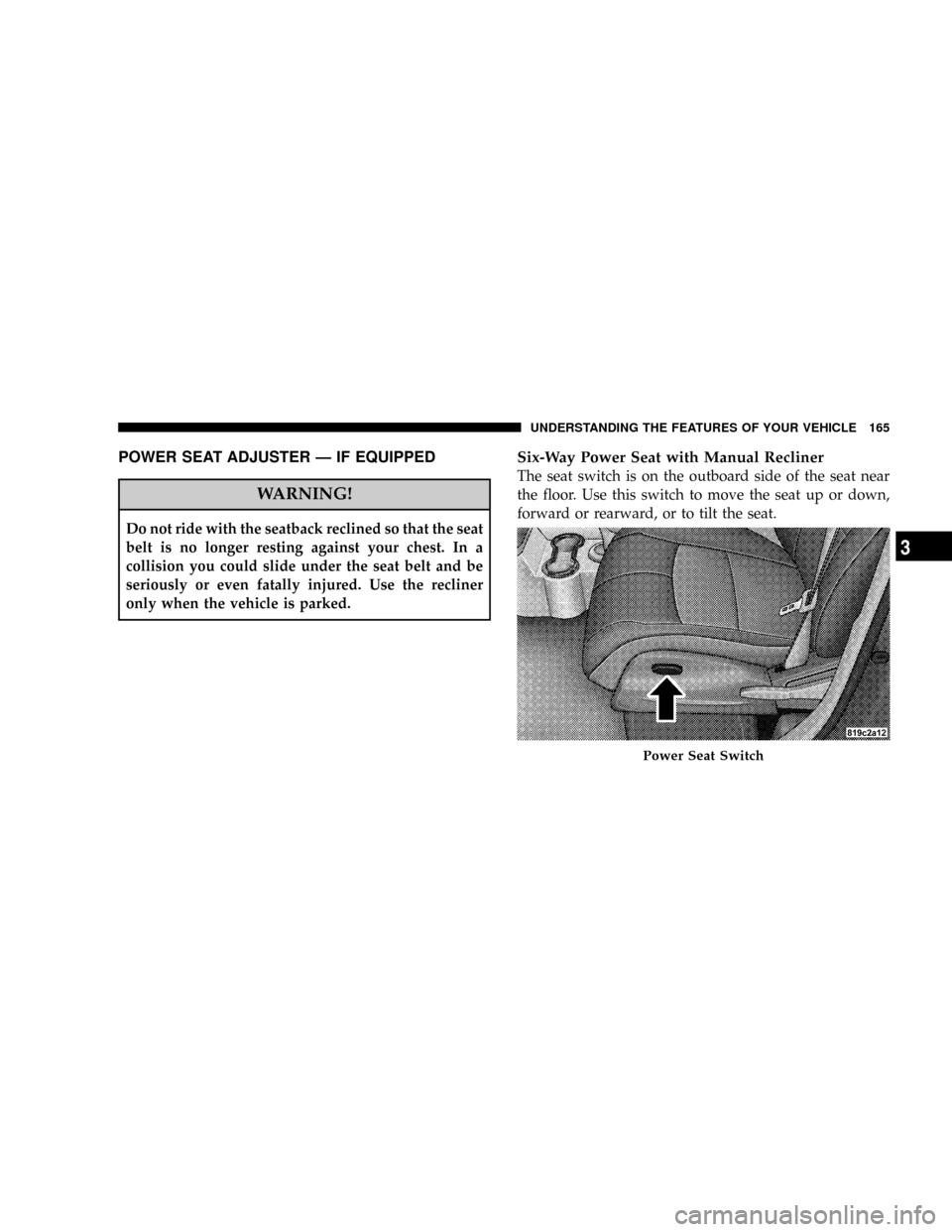
The seat switch is on the outboard side of the seat near
the floor. Use this switch to move the seat up or down,
forward or rearward, or to tilt the seat.
Power Seat Switch
UNDERSTANDING THE FEATURES OF YOUR VEHICLE 165
3
Page 172 of 488
WARNING!
²It is extremely dangerous to ride in a cargo area,
inside or outside of a vehicle. In a collision, people
riding in these areas are more likely to be seri-
ously injured or killed.
²Do not allow people to ride in any area of your
vehicle that is not equipped with seats and seat
belts
²Be sure that everyone in your vehicle is in a seat
and using a seat belt properly.
NOTE:
²If the rear center lap/shoulder belt appears to be
locked into place, check to verify that the seatback is
fully latched.
²If the seatback is properly latched and the rear center
lap/shoulder belt still does not operate properly check
and see if the Automatic Locking retractor (ALR)
system is activated.
WARNING!
The rear center lap/shoulder belt is equipped with a
lock-out feature to ensure that the seatback is in the
fully upright and locked position when occupied. If
the rear seatback is not fully upright and locked and
the rear center lap/shoulder belt can be pulled out of
the retractor, the vehicle should immediately be
taken to your dealer for service. Failure to follow this
warning could result in serious or fatal injury.
172 UNDERSTANDING THE FEATURES OF YOUR VEHICLE
Page 174 of 488
WARNING!
²It is extremely dangerous to ride in a cargo area,
inside or outside of a vehicle. In a collision, people
riding in these areas are more likely to be seri-
ously injured or killed.
²Do not allow people to ride in any area of your
vehicle that is not equipped with seats and seat
belts.
²Be sure that everyone in your vehicle is in a seat
and using a seat belt properly.NOTE:Prior to lifting either seatback to the upright
position, be sure that the seat belt is brought forward to
avoid trapping it behind the seatback.
CAUTION!
Ensure that the seat back is latched with a hard push
to engage the latch, noting the presence of seat back
rubber-overslam bumpers that need to be overcome.
Check that the seat back release knobs are pushed
fully forward in order to allow the latch to engage.
174 UNDERSTANDING THE FEATURES OF YOUR VEHICLE
Page 180 of 488
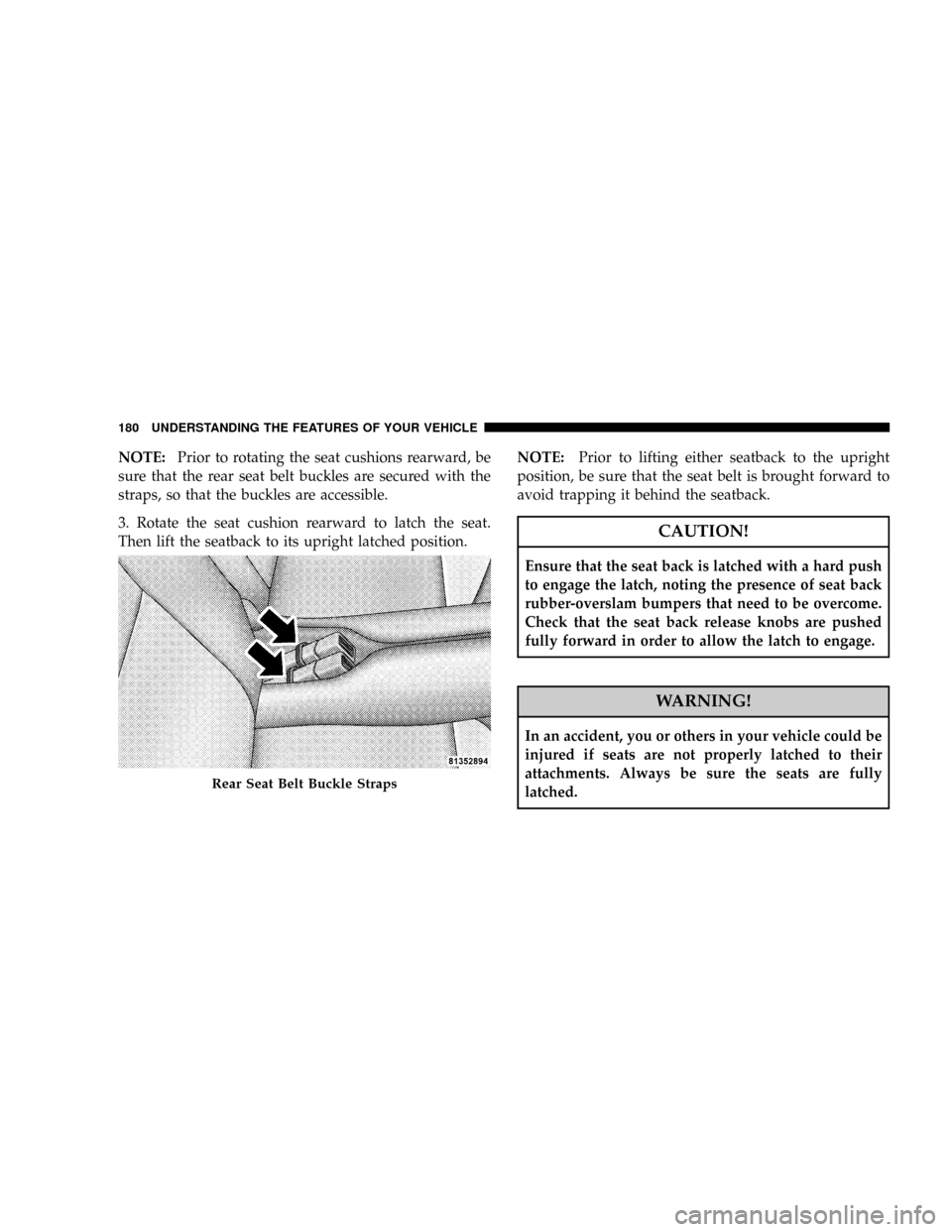
NOTE:Prior to rotating the seat cushions rearward, be
sure that the rear seat belt buckles are secured with the
straps, so that the buckles are accessible.
3. Rotate the seat cushion rearward to latch the seat.
Then lift the seatback to its upright latched position.NOTE:Prior to lifting either seatback to the upright
position, be sure that the seat belt is brought forward to
avoid trapping it behind the seatback.
CAUTION!
Ensure that the seat back is latched with a hard push
to engage the latch, noting the presence of seat back
rubber-overslam bumpers that need to be overcome.
Check that the seat back release knobs are pushed
fully forward in order to allow the latch to engage.
WARNING!
In an accident, you or others in your vehicle could be
injured if seats are not properly latched to their
attachments. Always be sure the seats are fully
latched.
Rear Seat Belt Buckle Straps
180 UNDERSTANDING THE FEATURES OF YOUR VEHICLE