service CHRYSLER PT CRUISER 2008 1.G Repair Manual
[x] Cancel search | Manufacturer: CHRYSLER, Model Year: 2008, Model line: PT CRUISER, Model: CHRYSLER PT CRUISER 2008 1.GPages: 488, PDF Size: 7.43 MB
Page 395 of 488
WARNING!
Fluid level should be checked on a level surface and
with the engine off to prevent injury from moving
parts and to insure accurate fluid level reading. Do
not overfill. Use only manufacturers recommended
power steering fluid.
If necessary, add fluid to restore to the proper indicated
level. With a clean cloth, wipe any spilled fluid from all
surfaces. Refer to Fluids, Lubricants, and Genuine Parts
for correct fluid types.
FRONT SUSPENSION BALL JOINTS
There are two front suspension lower ball joints that are
permanently lubricated. Inspect these ball joints when-
ever under vehicle service is done. Damaged seals and
their corresponding potentially damaged ball joints must
be replaced.
STEERING LINKAGE
The tie rod end ball joints should be inspected for
external leakage and damage when other maintenance is
performed.
BODY LUBRICATION
Locks and all body pivot points, including such items as
seat tracks, doors, liftgate and hood hinges, should be
lubricated periodically to assure quiet, easy operation
and to protect against rust and wear. Prior to the appli-
cation of any lubricant, the parts concerned should be
wiped clean to remove dust and grit; after lubricating
excess oil and grease should be removed. Particular
attention should also be given to hood latching compo-
nents to insure proper function. When performing other
underhood services, the hood latch, release mechanism
and safety catch should be cleaned and lubricated.
The external lock cylinders should be lubricated twice a
year, preferably in the fall and spring. Apply a small
MAINTAINING YOUR VEHICLE 395
7
Page 402 of 488

The radiator normally remains completely full, so there is
no need to remove the radiator cap unless checking for
coolant freeze point or replacing coolant. Advise your
service attendant of this. As long as the engine operating
temperature is satisfactory, the coolant bottle need only
be checked once a month.
When additional coolant is needed to maintain the
proper level, it should be added to the coolant bottle. Do
not overfill.
Points To Remember
NOTE:When the vehicle is stopped after a few miles (a
few kilometers) of operation, you may observe vapor
coming from the front of the engine compartment. This is
normally a result of moisture from rain, snow, or high
humidity accumulating on the radiator and being vapor-
ized when the thermostat opens, allowing hot coolant to
enter the radiator.If an examination of your engine compartment shows no
evidence of radiator or hose leaks, the vehicle may be
safely driven. The vapor will soon dissipate.
²Do not overfill the coolant recovery bottle.
²Check coolant freeze point in the radiator and in the
coolant recovery bottle. If antifreeze needs to be
added, contents of coolant recovery bottle must also be
protected against freezing.
²If frequent coolant additions are required, or if the
level in the coolant recovery bottle does not drop when
the engine cools, the cooling system should be pres-
sure tested for leaks.
²Maintain coolant concentration at 50% HOAT engine
coolant (minimum) and distilled water for proper
corrosion protection of your engine which contains
aluminum components.
402 MAINTAINING YOUR VEHICLE
Page 404 of 488
FUEL SYSTEM CONNECTIONS
Electronic Fuel Injection high pressure fuel systems are
designed with tubes and special connects, connections
and clamps which have unique material characteristics to
provide adequate sealing and resist attack by deterio-
rated gasoline.
You are urged to use only the manufactures-specified
tubes, connections and clamps, or their equivalent in
material and specification, in any fuel system servicing.
BRAKE SYSTEM
In order to assure brake system performance, all brake
system components should be inspected periodically.
Suggested service intervals can be found in the ªMainte-
nance Scheduleº in this manual.
WARNING!
Riding the brakes can lead to brake failure and
possibly an accident. Driving with your foot resting
or riding on the brake pedal can result in abnormally
high brake temperatures, excessive lining wear, and
possible brake damage. You wouldn't have your full
braking capacity in an emergency.
Brake, Power Steering and Oil Cooler System
Hoses
When servicing the vehicle for scheduled maintenance,
inspect the surface of the hoses and nylon tubing for
evidence of heat and mechanical damage. Hard and
404 MAINTAINING YOUR VEHICLE
Page 405 of 488
brittle rubber, cracking, tears, cuts, abrasions, and exces-
sive swelling suggest deterioration of the rubber. Particu-
lar attention should be made to examining those hose
surfaces nearest to high heat sources, such as the exhaust
manifold.
Inspect all hose clamps and couplings to make sure they
are secure and no leaks are present.
Insure nylon tubing in these areas has not melted or
collapsed.
NOTE:Often, fluids such as oil, power steering fluid,
and brake fluid are used during assembly plant opera-
tions to ease the assembly of hoses to couplings. There-
fore, oil wetness at the hose-coupling area is not neces-
sarily an indication of leakage. Actual dripping of hot
fluid when systems are under pressure (during vehicle
operation) should be noted before a hose is replaced
based on leakage.NOTE:Inspection of brake hoses should be done when-
ever the brake system is serviced and at every engine oil
change. Inspect hydraulic brake hoses for surface crack-
ing, scuffing, or worn spots. If there is any evidence of
cracking, scuffing, or worn spots, the hose should be
replaced immediately! Eventual deterioration of the hose
can take place resulting in a possibility of a burst failure.
WARNING!
Worn brake hoses can burst and cause brake failure.
You could have an accident. If you see any signs of
cracking, scuffing, or worn spots, have the brake
hoses replaced immediately.
MAINTAINING YOUR VEHICLE 405
7
Page 406 of 488

Master Cylinder - Brake Fluid Level Check
Check the fluid level in the master cylinder immediately
if the brake system warning light indicates system fail-
ure.
Check the fluid level in the master cylinder when per-
forming underhood services.
Clean the top of the master cylinder area before removing
the cap. If necessary, add fluid to bring the fluid level up
to the requirements described on the brake fluid reser-
voir.
Overfilling of fluid is not recommended because it may
cause leaking in the system.
Fluid level can be expected to fall as the brake pads wear.
Brake fluid level should be checked when pads are
replaced. However, low fluid level may be caused by a
leak and a checkup may be needed.Use only manufacturers recommended brake fluid. Refer
to ªFluids, Lubricants, and Genuine Partsº for the correct
fluid type.
NOTE:If your vehicle is equipped with aManual
transaxle, the Brake Fluid Reservoir supplies fluid to
both the Brake System and the Clutch Release System.
The two systems are separated in the reservoir and a leak
in one system will not affect the other system. The
Manual TransaxleClutch Release System should not
require fluid replacement during the life of the vehicle. If
the Brake Fluid Reservoir is low, and the brake system
does not indicate any leaks or other problems, it may be
a result of a leak in the Hydraulic Clutch Release System.
See your local authorized dealer for service.
Use only manufacturers recommended brake fluid, refer
to Fluids, Lubricants and Genuine Parts for correct fluid
type.
406 MAINTAINING YOUR VEHICLE
Page 408 of 488

AUTOMATIC TRANSAXLE
The automatic transaxle and differential assembly are
contained within a single housing.
The fluid level in the automatic transaxle should be
checked whenever the vehicle is serviced. Operation with
an improper fluid level will greatly reduce the life of the
transaxle and the fluid.
FLUID LEVEL CHECK Ð FOUR-CYLINDER
ENGINES
Use the following procedure to check the automatic
transaxle fluid level properly:
1. Park the vehicle on level ground.
2. Run the engine at curb idle speed for a minimum of 60
seconds.
3. Apply the parking brake fully.4. Place the gear selector momentarily in each gear
position ending with the lever in ªPº (Park).
5. Wipe the area around the dipstick clean to eliminate
the possibility of dirt entering the transaxle.
6. Remove the dipstick and determine if the fluid is hot
or cold. Hot fluid is approximately 180É F (82É C), which
is the normal operating temperature after the vehicle is
driven at least 15 miles (24 km). Hot fluid cannot be held
comfortably between the fingertips. Cold fluid is at a
temperature below 80ÉF (27ÉC).
7. Wipe the dipstick clean and reinsert until seated. Then,
remove dipstick and note the reading.
a. If the fluid is hot, the reading should be in the
crosshatched area marked ªHOTº (between the upper
two holes in the dipstick).
b. If the fluid is cold, the fluid level should be between
the lower two holes in the area marked ªCOLD.º
408 MAINTAINING YOUR VEHICLE
Page 434 of 488
EMISSIONS CONTROL SYSTEM MAINTENANCE
The Scheduled Maintenance services listed inbold type
must be done at the times or mileages specified to ensure
the continued proper functioning of the emission control
system. These, and all other maintenance services in-
cluded in this manual, should be done to provide best
vehicle performance and reliability. More frequent main-
tenance may be needed for vehicles in severe operating
conditions, such as dusty areas and very short trip
driving.
Inspection and service should also be done any time a
malfunction is suspected.
NOTE:Maintenance, replacement, or repair of the emis-
sions control devices and systems on your vehicle may be
performed by any automotive repair establishment or
individual using any automotive part that has been
certified pursuant to U.S. EPA or, in the State of Califor-
nia, California Air Resources Board regulations.
MAINTENANCE SCHEDULE
There are three maintenance schedules that showre-
quiredservice for your vehicle.
First is ScheduleªBºÐALL ENGINES. It is for vehicles
that are operated under the conditions that are listed
below and at the beginning of the schedule.
²Day and night temperatures are below 32É F (0É C).
²Stop and go driving.
²Extensive engine idling.
²Driving in dusty conditions.
²Short trips of less than 10 miles (16 km).
²More than 50% of your driving is at sustained high
speeds during hot weather, above 90É F (32É C).
²Trailer towing.²L
434 MAINTENANCE SCHEDULES
8
M
A
I
N
T
E
N
A
N
C
E
S
C
H
E
D
U
L
E
S
Page 435 of 488
²Taxi, police, or delivery service (commercial ser-
vice).²L
²Off-road or desert operation.
²If equipped for and operating with E-85 (ethanol)
fuel.
NOTE:IfANYof these apply to you then change your
engine oil every 3,000 miles (5 000 km) or 3 months,
whichever comes first, and follow schedule ªBÐAll
Enginesº of the9Maintenance Schedules9section of this
manual.
NOTE:IFANYof these apply to you then flush and
replace the engine coolant every 102,000 miles (170 000
km) or 60 months, whichever comes first, and follow
schedule ªBÐAll Enginesº of the9Maintenance Sched-
ules9section of this manual.
NOTE:Most vehicles are operated under the conditions
listed for Schedule9B9ÐALL ENGINES.Second is ScheduleªAºÐNON TURBO. It is for vehicles
that are not operated under any of the conditions listed
under Schedule9B9ÐALL ENGINES.
Third is ScheduleªAºÐTURBO. It is for vehicles that are
not operated under any of the conditions listed under
Schedule9B9ÐALL ENGINES.
Use the schedule that best describes your driving condi-
tions. Where time and mileage are listed, follow the
interval that occurs first.
CAUTION!
Failure to perform the required maintenance items
may result in damage to the vehicle.
MAINTENANCE SCHEDULES 435
8
M
A
I
N
T
E
N
A
N
C
E
S
C
H
E
D
U
L
E
S
Page 437 of 488
SCHEDULE ªBºÐALL ENGINES
Follow schedule ªBºÐAll Engines if you usually operate
your vehicle under one or more of the following condi-
tions.
Change the automatic transmission fluid and filter every
60,000 miles (100 000 km) if the vehicle is usually
operated under one or more of the conditions marked
with anL.
Change the manual transaxle fluid every 48,000 miles (80
000 km) if the vehicle is usually operated under one or
more of the conditions marked with an ².
²Day and night temperatures are below 32É F (0É C).
²Stop and go driving.
²Extensive engine idling.
²Driving in dusty conditions.
²Short trips of less than 10 miles (16.2 km).
²More than 50% of your driving is at sustained high
speeds during hot weather, above 90É F (32É C).
²Trailer towing.²L
²Taxi, police, or delivery service (commercial ser-
vice).²L
²Off-road or desert operation.
²If equipped for and operating with E-85 (ethanol)
fuel.
NOTE:IfANYof these apply to you then change your
engine oil every 3,000 miles (5 000 km) or 3 months,
whichever comes first, and follow schedule ªBÐAll
Enginesº of the9Maintenance Schedules9section of this
manual.
SCHEDULE ªBºÐALL ENGINES 437
8
M
A
I
N
T
E
N
A
N
C
E
S
C
H
E
D
U
L
E
S
Page 447 of 488
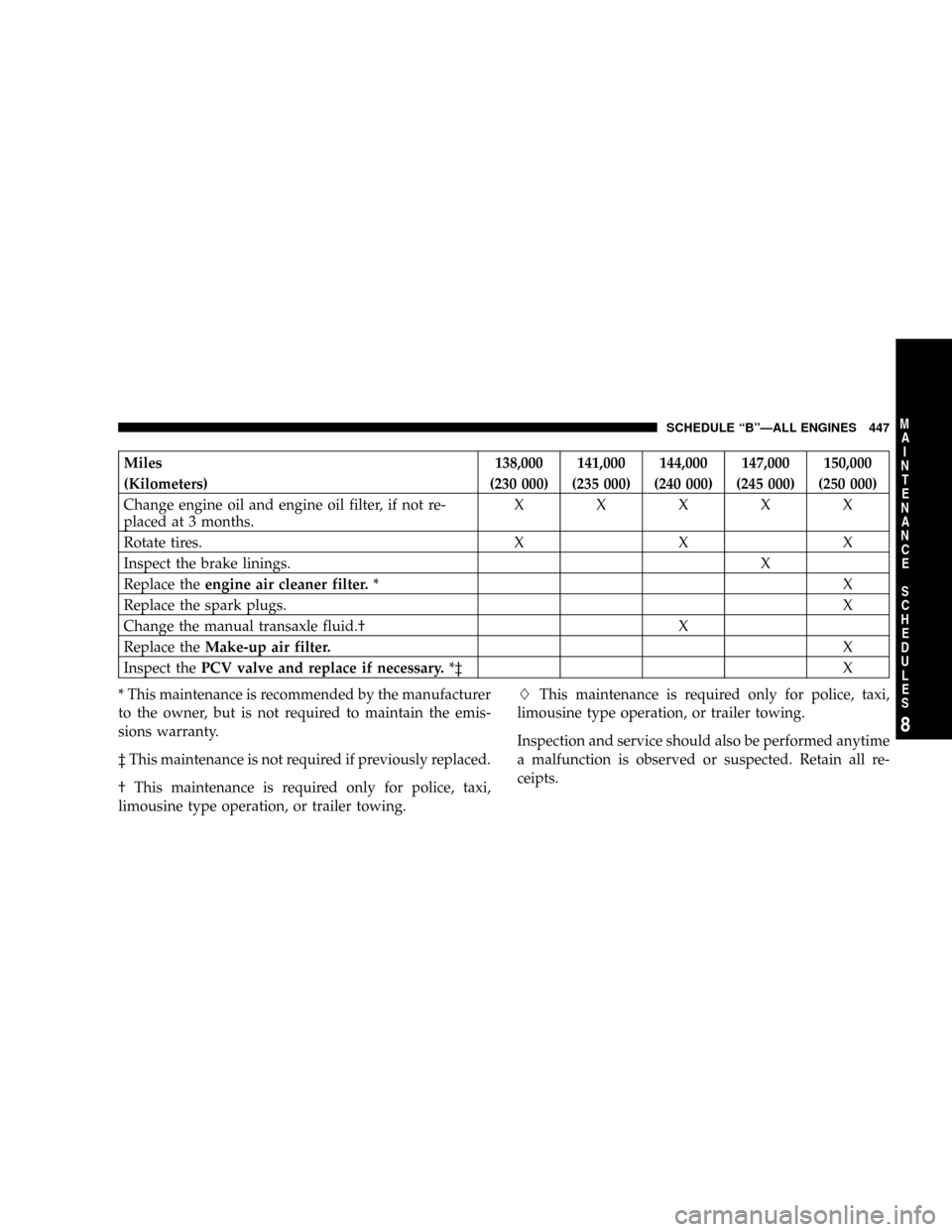
Miles 138,000 141,000 144,000 147,000 150,000
(Kilometers) (230 000) (235 000) (240 000) (245 000) (250 000)
Change engine oil and engine oil filter, if not re-
placed at 3 months.XXXXX
Rotate tires. X X X
Inspect the brake linings. X
Replace theengine air cleaner filter.*X
Replace the spark plugs.X
Change the manual transaxle fluid.² X
Replace theMake-up air filter.X
Inspect thePCV valve and replace if necessary.*³ X
* This maintenance is recommended by the manufacturer
to the owner, but is not required to maintain the emis-
sions warranty.
³ This maintenance is not required if previously replaced.
² This maintenance is required only for police, taxi,
limousine type operation, or trailer towing.LThis maintenance is required only for police, taxi,
limousine type operation, or trailer towing.
Inspection and service should also be performed anytime
a malfunction is observed or suspected. Retain all re-
ceipts.
SCHEDULE ªBºÐALL ENGINES 447
8
M
A
I
N
T
E
N
A
N
C
E
S
C
H
E
D
U
L
E
S