warning CHRYSLER PT CRUISER 2008 1.G Repair Manual
[x] Cancel search | Manufacturer: CHRYSLER, Model Year: 2008, Model line: PT CRUISER, Model: CHRYSLER PT CRUISER 2008 1.GPages: 488, PDF Size: 7.43 MB
Page 115 of 488
ENGINE BREAK-IN RECOMMENDATIONS
A long break-in period is not required for the engine in
your vehicle.
Drive moderately during the first 300 mi (500 km). After
the initial 60 mi (100 km), speeds up to 50 or 55 mph (80
or 90 km/h) are desirable.
While cruising, brief full-throttle acceleration, within the
limits of local traffic laws, contributes to a good break-in.
Wide-open throttle acceleration in low gear can be detri-
mental and should be avoided.
The engine oil installed in the engine at the factory is a
high-quality energy-conserving type lubricant. Oil
changes should be consistent with anticipated climate
conditions under which vehicle operations will occur. For
the recommended viscosity and quality grades, refer to
ªMaintenance Proceduresº in Section 7 of this manual.
NON-DETERGENT OR STRAIGHT MINERAL OILS
MUST NEVER BE USED.A new engine may consume some oil during its first few
thousand miles (kilometers) of operation. This should be
considered as a normal part of the break-in and not
interpreted as an indication of difficulty.
SAFETY TIPS
Exhaust Gas
WARNING!
Exhaust gases can injure or kill. They contain carbon
monoxide (CO) which is colorless and odorless.
Breathing it can make you unconscious and can
eventually poison you. To avoid breathing (CO)
follow the safety tips below.
Do not run the engine in a closed garage or in confined
areas any longer than needed to move your vehicle in or
out of the area.
THINGS TO KNOW BEFORE STARTING YOUR VEHICLE 115
2
Page 116 of 488
If it is necessary to sit in a parked vehicle with the engine
running, adjust your heating or cooling controls to force
outside air into the vehicle. Set the blower at high speed.
WARNING!
If you are required to drive with the deck lid/liftgate
open, make sure that all windows are closed, and the
climate control blower switch is set at high speed.
DO NOT use the recirculation mode.
Safety Checks You Should Make Inside The
Vehicle
Seat Belts
Inspect the belt system periodically, checking for cuts,
frays and loose parts. Damaged parts must be replaced
immediately. Do not disassemble or modify the system.Front seat belt assemblies must be replaced after a
collision. Rear seat belt assemblies must be replaced after
a collision if they have been damaged (bent retractor, torn
webbing, etc. If there is any question regarding belt or
retractor condition, replace the belt.
Airbag Light
The light should come on and remain on for 6 to 8
seconds as a bulb check when the ignition switch is first
turned ON. If the LED is not lit during starting, have it
checked. If the light stays on or comes on while driving,
have the system checked by an authorized dealer.
Defroster
Check operation by selecting the defrost mode and place
the blower control on high speed. You should be able to
feel the air directed against the windshield.
116 THINGS TO KNOW BEFORE STARTING YOUR VEHICLE
Page 123 of 488
CONVERTIBLE TOP OPERATION
WARNING!
The convertible top does not provide the structural
protection that a reinforced metal roof does, and the
fabric top cannot be expected to prevent the ejection
of the occupants of a vehicle in a collision. Therefore
it is important that all occupants wear their seat belts
at all times when riding in a convertible. Studies
have shown that it is generally safer to remain inside
a vehicle during a collision, than to be ejected from
the vehicle.
To Lower The Top:
NOTE:Thoroughly dry the convertible top and top
storage area, prior to leaving the top lowered for an
extended period of time. This will help prevent possible
mildew build-up.
CAUTION!
To avoid damage to the convertible top or its compo-
nents, your vehicle is equipped with a feature that
prevents convertible top operation at speeds over 10
mph (16 km/h).
UNDERSTANDING THE FEATURES OF YOUR VEHICLE 123
3
Page 136 of 488
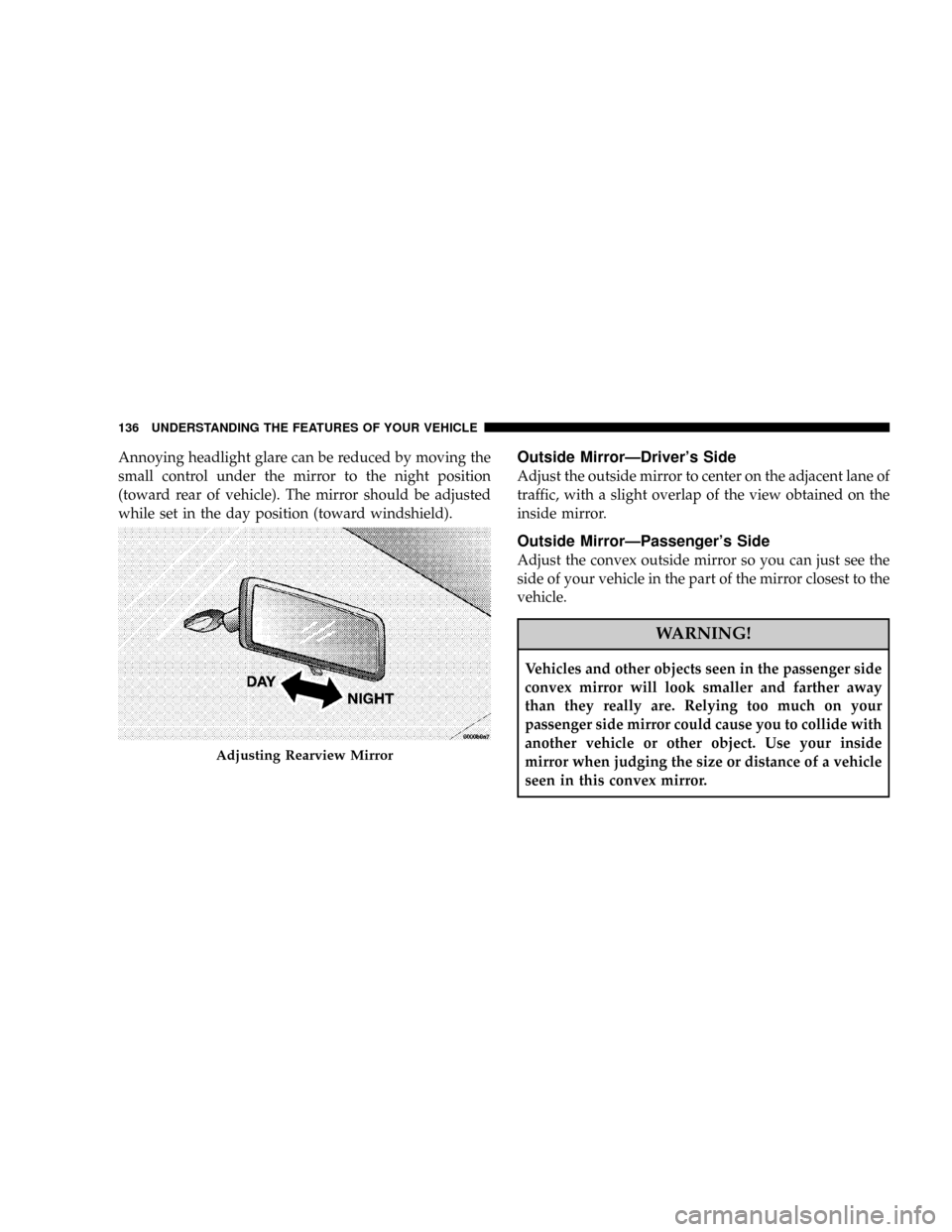
Annoying headlight glare can be reduced by moving the
small control under the mirror to the night position
(toward rear of vehicle). The mirror should be adjusted
while set in the day position (toward windshield).Outside MirrorÐDriver's Side
Adjust the outside mirror to center on the adjacent lane of
traffic, with a slight overlap of the view obtained on the
inside mirror.
Outside MirrorÐPassenger's Side
Adjust the convex outside mirror so you can just see the
side of your vehicle in the part of the mirror closest to the
vehicle.
WARNING!
Vehicles and other objects seen in the passenger side
convex mirror will look smaller and farther away
than they really are. Relying too much on your
passenger side mirror could cause you to collide with
another vehicle or other object. Use your inside
mirror when judging the size or distance of a vehicle
seen in this convex mirror.
Adjusting Rearview Mirror
136 UNDERSTANDING THE FEATURES OF YOUR VEHICLE
Page 164 of 488
SEATS
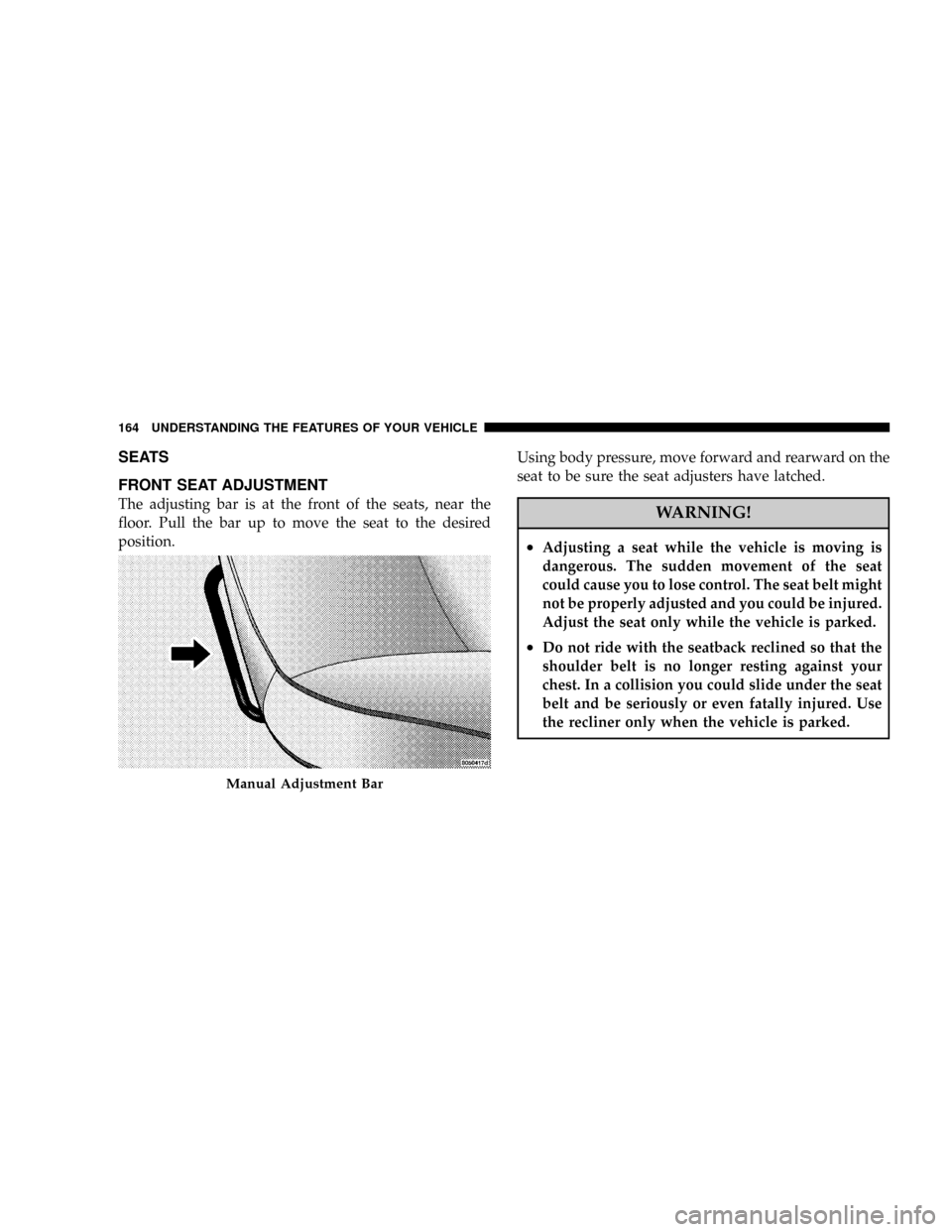
FRONT SEAT ADJUSTMENT
The adjusting bar is at the front of the seats, near the
floor. Pull the bar up to move the seat to the desired
position.Using body pressure, move forward and rearward on the
seat to be sure the seat adjusters have latched.WARNING!
²Adjusting a seat while the vehicle is moving is
dangerous. The sudden movement of the seat
could cause you to lose control. The seat belt might
not be properly adjusted and you could be injured.
Adjust the seat only while the vehicle is parked.
²Do not ride with the seatback reclined so that the
shoulder belt is no longer resting against your
chest. In a collision you could slide under the seat
belt and be seriously or even fatally injured. Use
the recliner only when the vehicle is parked.
Manual Adjustment Bar
164 UNDERSTANDING THE FEATURES OF YOUR VEHICLE
Page 165 of 488
POWER SEAT ADJUSTER Ð IF EQUIPPED
WARNING!
Do not ride with the seatback reclined so that the seat
belt is no longer resting against your chest. In a
collision you could slide under the seat belt and be
seriously or even fatally injured. Use the recliner
only when the vehicle is parked.
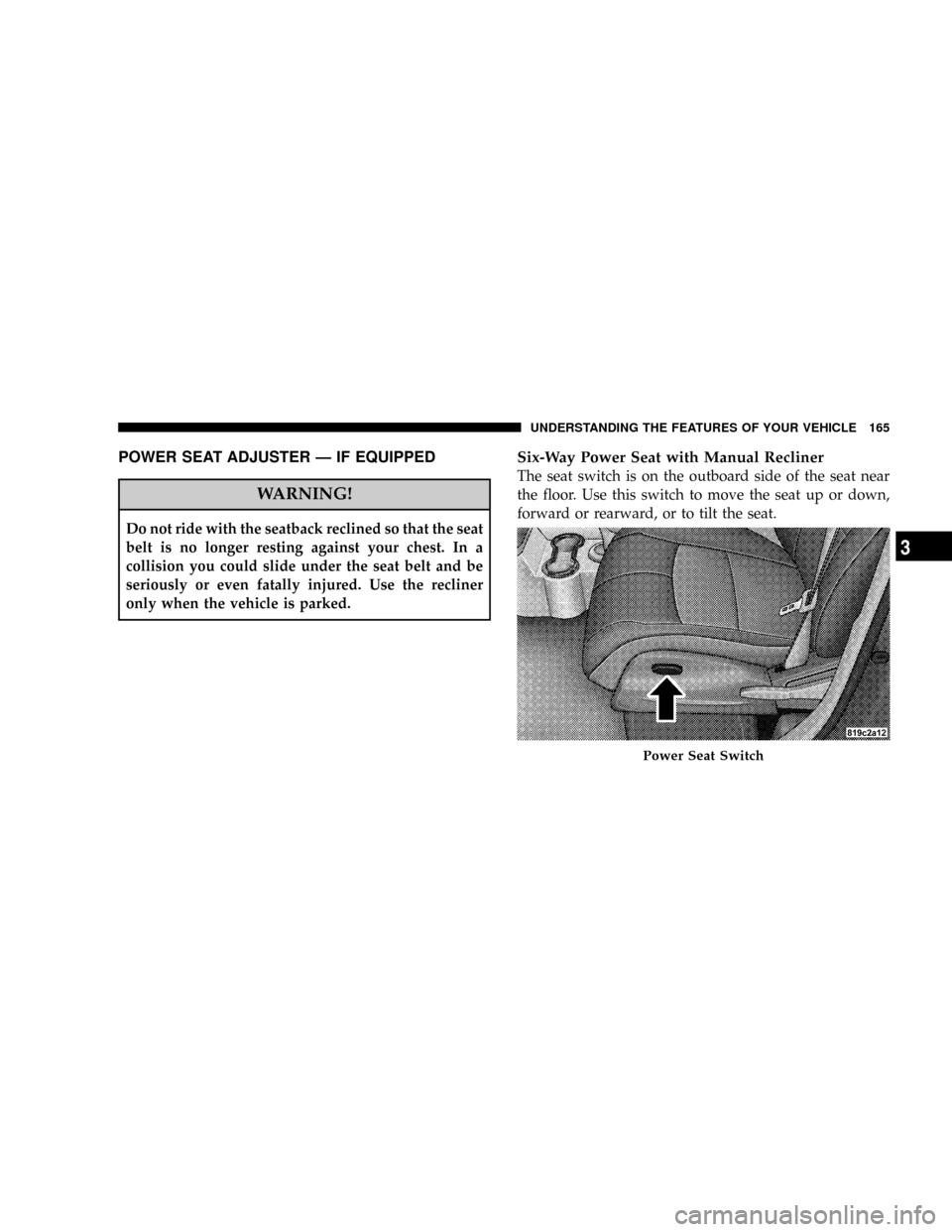
Six-Way Power Seat with Manual Recliner
The seat switch is on the outboard side of the seat near
the floor. Use this switch to move the seat up or down,
forward or rearward, or to tilt the seat.
Power Seat Switch
UNDERSTANDING THE FEATURES OF YOUR VEHICLE 165
3
Page 169 of 488
3. To return seat to a sitting position, rotate seat back
upright until it locks.
4. Push seat rearward until the track locks.
NOTE:The passenger front seat has a full recliner
memory, which will allow the seat back to returned to its
original position.
NOTE:The passenger front seat has a track memory,
which returns the seat to just past the half way point of
the track regardless of original position.
ADJUSTABLE HEAD RESTRAINTS
Head restraints can reduce the risk of whiplash injury in
the event of impact from the rear. Pull up or push down
on the head restraints so that the upper edge is as high as
practical. To raise the head restraint, pull up on the head
restraint. To lower the head restraint, push in the button
that is part of the head restraint rod guide, and push
down on the head restraint.
HEATED SEATS Ð IF EQUIPPED
WARNING!
Persons who are unable to feel pain to the skin
because of advanced age, chronic illness, diabetes,
spinal cord injury, medication, alcohol use, exhaus-
tion or other physical condition must exercise care
when using the seat heater. It may cause burns even
at low temperatures, especially if used for long
periods of time. Do not place anything on the seat
that insulates against heat, such as a blanket or
cushion. This may cause the seat heater to overheat.
UNDERSTANDING THE FEATURES OF YOUR VEHICLE 169
3
Page 172 of 488
WARNING!
²It is extremely dangerous to ride in a cargo area,
inside or outside of a vehicle. In a collision, people
riding in these areas are more likely to be seri-
ously injured or killed.
²Do not allow people to ride in any area of your
vehicle that is not equipped with seats and seat
belts
²Be sure that everyone in your vehicle is in a seat
and using a seat belt properly.
NOTE:
²If the rear center lap/shoulder belt appears to be
locked into place, check to verify that the seatback is
fully latched.
²If the seatback is properly latched and the rear center
lap/shoulder belt still does not operate properly check
and see if the Automatic Locking retractor (ALR)
system is activated.
WARNING!
The rear center lap/shoulder belt is equipped with a
lock-out feature to ensure that the seatback is in the
fully upright and locked position when occupied. If
the rear seatback is not fully upright and locked and
the rear center lap/shoulder belt can be pulled out of
the retractor, the vehicle should immediately be
taken to your dealer for service. Failure to follow this
warning could result in serious or fatal injury.
172 UNDERSTANDING THE FEATURES OF YOUR VEHICLE
Page 174 of 488
WARNING!
²It is extremely dangerous to ride in a cargo area,
inside or outside of a vehicle. In a collision, people
riding in these areas are more likely to be seri-
ously injured or killed.
²Do not allow people to ride in any area of your
vehicle that is not equipped with seats and seat
belts.
²Be sure that everyone in your vehicle is in a seat
and using a seat belt properly.NOTE:Prior to lifting either seatback to the upright
position, be sure that the seat belt is brought forward to
avoid trapping it behind the seatback.
CAUTION!
Ensure that the seat back is latched with a hard push
to engage the latch, noting the presence of seat back
rubber-overslam bumpers that need to be overcome.
Check that the seat back release knobs are pushed
fully forward in order to allow the latch to engage.
174 UNDERSTANDING THE FEATURES OF YOUR VEHICLE
Page 180 of 488
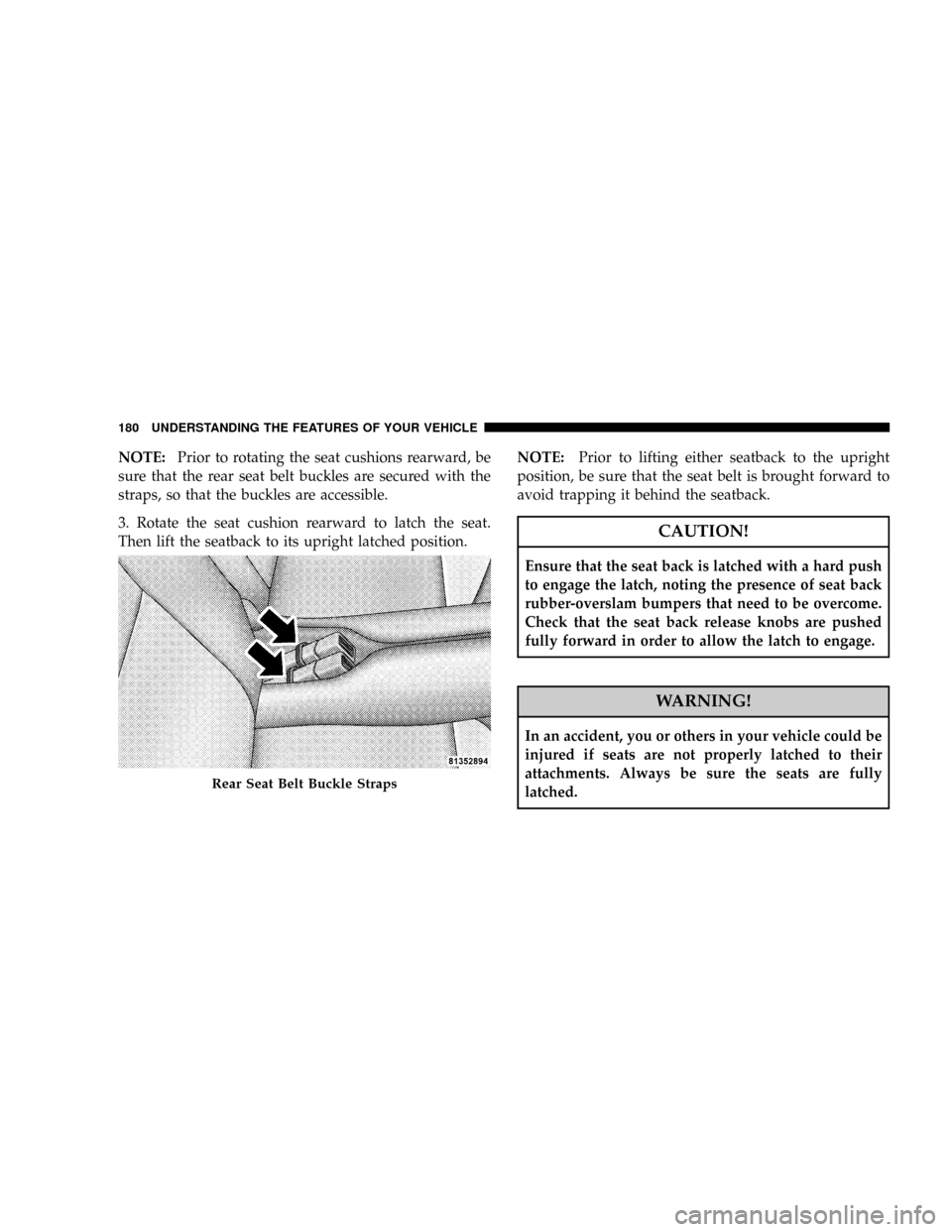
NOTE:Prior to rotating the seat cushions rearward, be
sure that the rear seat belt buckles are secured with the
straps, so that the buckles are accessible.
3. Rotate the seat cushion rearward to latch the seat.
Then lift the seatback to its upright latched position.NOTE:Prior to lifting either seatback to the upright
position, be sure that the seat belt is brought forward to
avoid trapping it behind the seatback.
CAUTION!
Ensure that the seat back is latched with a hard push
to engage the latch, noting the presence of seat back
rubber-overslam bumpers that need to be overcome.
Check that the seat back release knobs are pushed
fully forward in order to allow the latch to engage.
WARNING!
In an accident, you or others in your vehicle could be
injured if seats are not properly latched to their
attachments. Always be sure the seats are fully
latched.
Rear Seat Belt Buckle Straps
180 UNDERSTANDING THE FEATURES OF YOUR VEHICLE