ignition CHRYSLER PT CRUISER 2010 1.G Repair Manual
[x] Cancel search | Manufacturer: CHRYSLER, Model Year: 2010, Model line: PT CRUISER, Model: CHRYSLER PT CRUISER 2010 1.GPages: 368, PDF Size: 5.61 MB
Page 261 of 368
HAZARD WARNING FLASHERS
The Hazard Warning flasher switch is located on the
instrument panel, below the radio.Press the switch to turn on the Hazard Warning
flasher. When the switch is activated, all directional
turn signals will flash on and off to warn oncoming
traffic of an emergency. Press the switch a second time to
turn off the Hazard Warning flasher.
Do not use this emergency warning system when the
vehicle is in motion. Use it when your vehicle is disabled
and is creating a safety hazard for other motorists.
If it is necessary to leave the vehicle to go for service, the
Hazard Warning flasher will continue to operate with the
ignition key removed and the vehicle locked.
NOTE: With extended use, the Hazard Warning flasher
may wear down your battery.
IF YOUR ENGINE OVERHEATS
In any of the following situations, you can reduce the
potential for overheating by taking the appropriate ac-
tion.
•On the highways — Slow down.
•In city traffic — While stopped, put transaxle in
NEUTRAL, but do not increase engine idle speed.
260 WHAT TO DO IN EMERGENCIES
Page 265 of 368
Preparations For Jacking
1. Park the vehicle on a firm, level surface. Avoid ice or
slippery areas.
WARNING!
Do not attempt to change a tire on the side of the
vehicle close to moving traffic. Pull far enough off
the road to avoid the danger of being hit when
operating the jack or changing the wheel.
2. Set the parking brake.
3. Place the shift lever in PARK (automatic transaxle) or
REVERSE (manual transaxle).
4. Turn OFF the ignition.
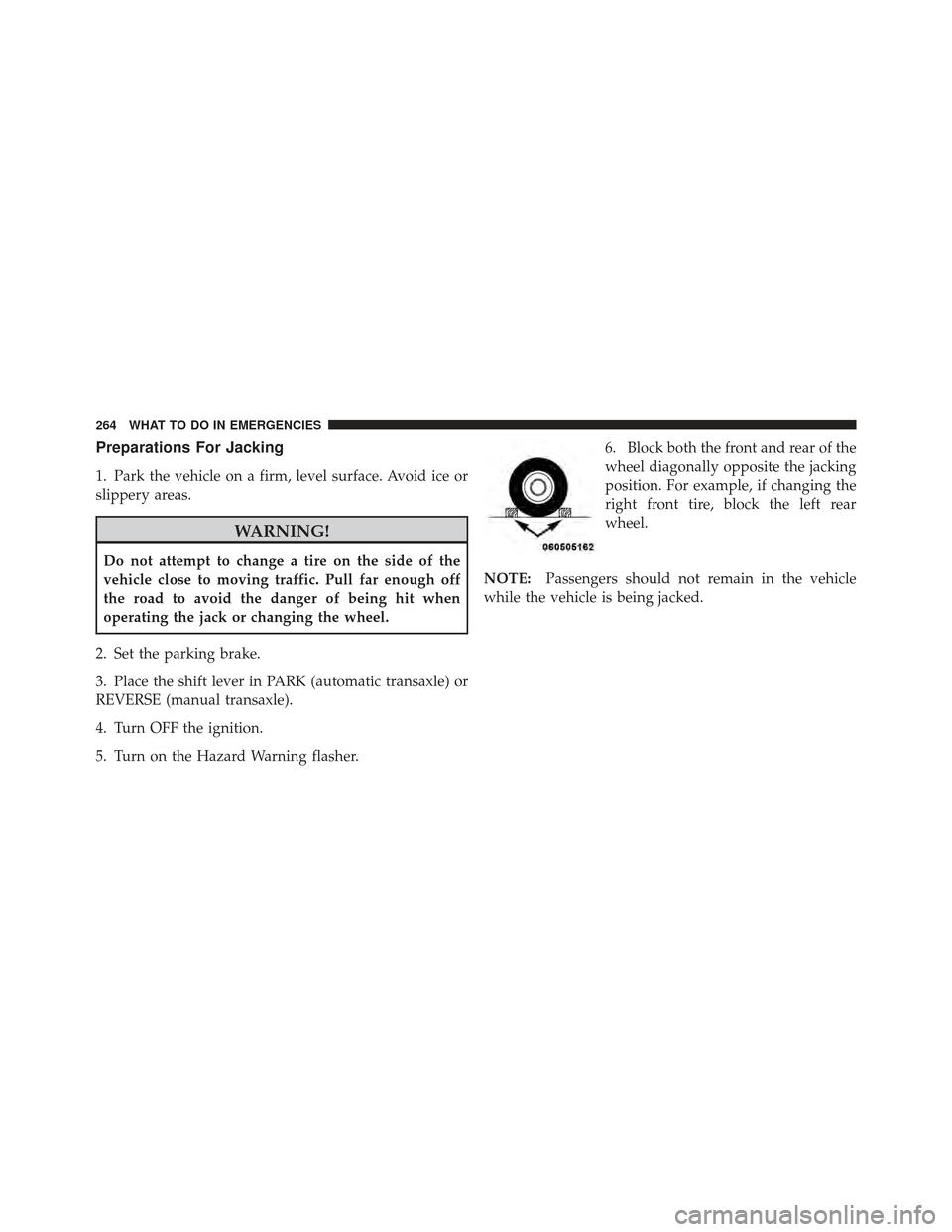
5. Turn on the Hazard Warning flasher. 6. Block both the front and rear of the
wheel diagonally opposite the jacking
position. For example, if changing the
right front tire, block the left rear
wheel.
NOTE: Passengers should not remain in the vehicle
while the vehicle is being jacked.
264 WHAT TO DO IN EMERGENCIES
Page 271 of 368

WARNING!
•Take care to avoid the radiator cooling fan when-
ever the hood is raised. It can start anytime the
ignition switch is on. You can be injured by
moving fan blades.
•Remove any metal jewelry such as watch bands or
bracelets that might make an inadvertent electrical
contact. You could be seriously injured.
•Batteries contain sulfuric acid that can burn your
skin or eyes and generate hydrogen gas which is
flammable and explosive. Keep open flames or
sparks away from the battery.
1. Set the parking brake, shift the automatic transmission
into PARK and turn the ignition to LOCK.
2. Turn off the heater, radio, and all unnecessary electri-
cal accessories. 3. If using another vehicle to jump-start the battery, park
the vehicle within the jumper cables reach, set the
parking brake and make sure the ignition is OFF.
WARNING!
Do not allow vehicles to touch each other as this
could establish a ground connection and personal
injury could result.
Jump-Starting Procedure
WARNING!
Failure to follow this procedure could result in per-
sonal injury or property damage due to battery ex-
plosion.
270 WHAT TO DO IN EMERGENCIES
Page 274 of 368
WARNING!
Fast spinning tires can be dangerous. Forces gener-
ated by excessive wheel speeds may cause tire dam-
age or failure. A tire could explode and injure some-
one. Do not spin your vehicle’s wheels faster than
30 mph (48 km/h) when you are stuck. And do not let
anyone near a spinning wheel, no matter what the
speed.
CAUTION!
Racing the engine or spinning the wheels too fast
may lead to transaxle overheating and failure. It can
also damage the tires. Do not spin the wheels above
30 mph (48 km/h).
TOWING A DISABLED VEHICLE
Towing With The Key-In-Ignition
Four-Speed Automatic Transaxle
Your vehicle may be towed under the following condi-
tions: The steering column must be unlocked and the
shift lever must be in NEUTRAL, the distance to be
towed must not exceed 100 miles (160 km), and the
towing speed must not exceed 44 mph (72 km/h). If the
transaxle is not operative, or if the vehicle is to be towed
more than 100 miles (160 km), the vehicle must be towed
with the front wheels off the ground to avoid damage to
the transaxle.
Manual Transaxle
Your vehicle may be towed in a forward direction, with
all four wheels on the ground, and the shift lever in the
NEUTRAL position. If the transaxle is not operative, the
vehicle must be towed with the front wheels off the
ground.
6
WHAT TO DO IN EMERGENCIES 273
Page 275 of 368
All Transaxles
CAUTION!
If the vehicle being towed requires steering, the
ignition switch must be in the ACC position, not in
the LOCK position.
Do not attempt to use sling-type equipment when
towing. When securing the vehicle to a flatbed truck,
do not attach it to front or rear suspension compo-
nents. Damage to your vehicle may result from
improper towing.
If it is necessary to use the accessories while being towed
(wipers, defrosters, etc.), the key must be in the ON
position, not the ACC position. Make certain the trans-
axle remains in NEUTRAL.
Towing Without The Key-In-Ignition
Special care must be taken when the vehicle is towed
with the ignition in the LOCK position. A dolly should be
used under the front wheels if the rear wheels are raised.
Proper towing equipment is necessary to prevent dam-
age to the vehicle.
Towing Behind Another Vehicle (Flat Towing with
all four wheels on the ground)
If your vehicle is equipped with a manual transaxle, it
may be towed in a forward direction, at any legal
highway speed, for any distance, if the transaxle is in
NEUTRAL.
If the ignition key is not available, vehicles with auto-
matic transaxles can not be flat towed at any time.
274 WHAT TO DO IN EMERGENCIES
Page 280 of 368

Indicator Light (MIL)” is functioning and is not on when
the engine is running, and that the OBD II system is
ready for testing.
Normally, the OBD II system will be ready. The OBD II
system maynotbe ready if your vehicle was recently
serviced, recently had a dead battery or a battery replace-
ment. If the OBD II system should be determined not
ready for the I/M test, your vehicle may fail the test.
Your vehicle has a simple ignition key-actuated test,
which you can use prior to going to the test station. To
check if your vehicle’s OBD II system is ready, you must
do the following:
1. Turn the ignition switch to the ON position, but do not
crank or start the engine.
2. If you crank or start the engine, you will have to start
this test over. 3. As soon as you turn the ignition switch to the ON
position, you will see the MIL symbol come on as part of
a normal bulb check.
4. Approximately 15 seconds later, one of two things will
happen:
a. The MIL will flash for about 10 seconds and then
return to being fully illuminated until you turn OFF
the ignition or start the engine. This means that your
vehicle’s OBD II system is not readyand you should
not proceed to the I/M station.
b. The MIL will not flash at all and will remain fully
illuminated until you turn OFF the ignition or start the
engine. This means that your vehicle’s OBD II system
is ready and you can proceed to the I/M station.
If your OBD II system is not ready,you should see your
authorized dealer or repair facility. If your vehicle was
recently serviced or had a battery failure or replacement,
7
MAINTAINING YOUR VEHICLE 279
Page 293 of 368
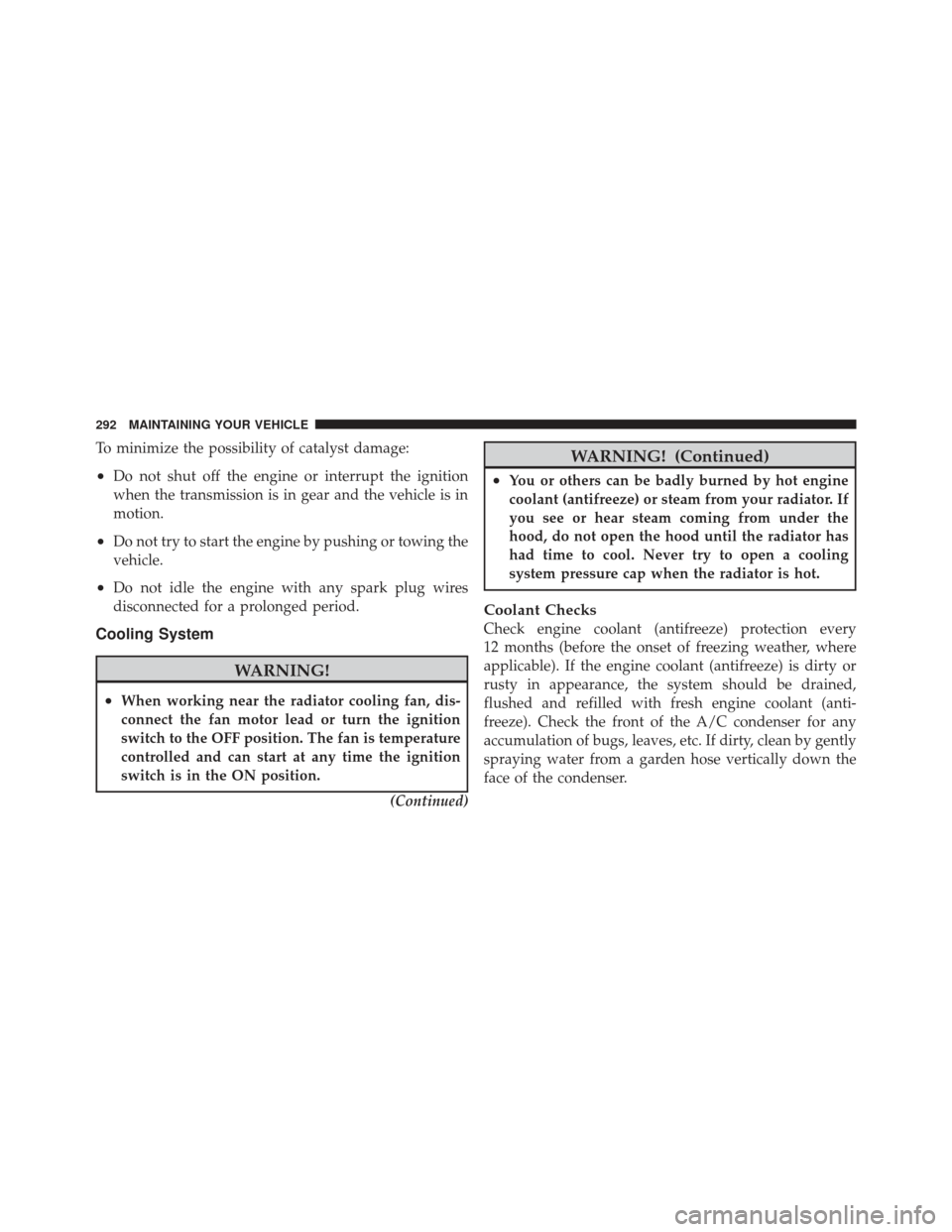
To minimize the possibility of catalyst damage:
•Do not shut off the engine or interrupt the ignition
when the transmission is in gear and the vehicle is in
motion.
•Do not try to start the engine by pushing or towing the
vehicle.
•Do not idle the engine with any spark plug wires
disconnected for a prolonged period.
Cooling System
WARNING!
•When working near the radiator cooling fan, dis-
connect the fan motor lead or turn the ignition
switch to the OFF position. The fan is temperature
controlled and can start at any time the ignition
switch is in the ON position.(Continued)
WARNING! (Continued)
•You or others can be badly burned by hot engine
coolant (antifreeze) or steam from your radiator. If
you see or hear steam coming from under the
hood, do not open the hood until the radiator has
had time to cool. Never try to open a cooling
system pressure cap when the radiator is hot.
Coolant Checks
Check engine coolant (antifreeze) protection every
12 months (before the onset of freezing weather, where
applicable). If the engine coolant (antifreeze) is dirty or
rusty in appearance, the system should be drained,
flushed and refilled with fresh engine coolant (anti-
freeze). Check the front of the A/C condenser for any
accumulation of bugs, leaves, etc. If dirty, clean by gently
spraying water from a garden hose vertically down the
face of the condenser.
292 MAINTAINING YOUR VEHICLE
Page 309 of 368
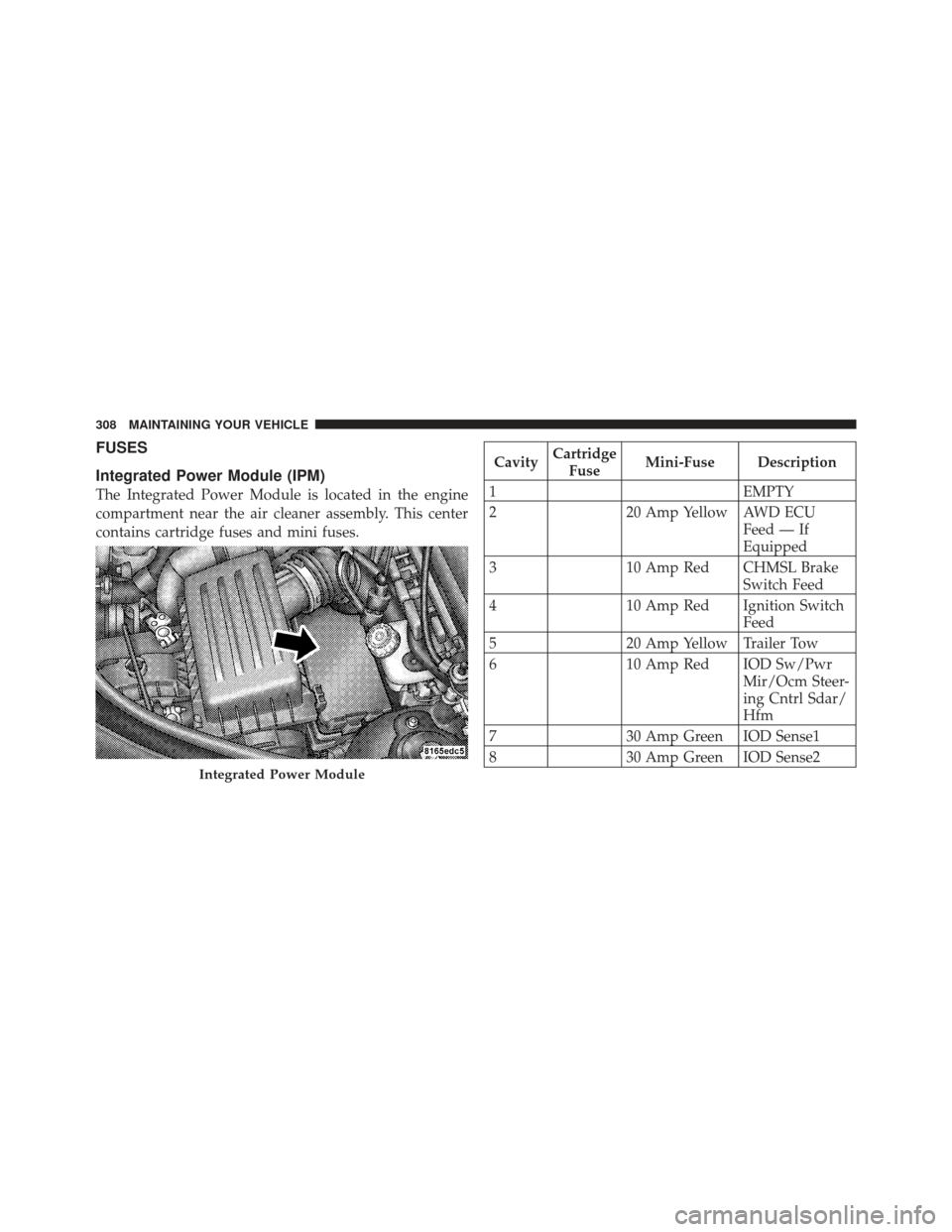
FUSES
Integrated Power Module (IPM)
The Integrated Power Module is located in the engine
compartment near the air cleaner assembly. This center
contains cartridge fuses and mini fuses.
CavityCartridge
Fuse Mini-Fuse Description
1 EMPTY
2 20 Amp Yellow AWD ECU
Feed — If
Equipped
3 10 Amp Red CHMSL Brake
Switch Feed
4 10 Amp Red Ignition Switch
Feed
5 20 Amp Yellow Trailer Tow
6 10 Amp Red IOD Sw/Pwr
Mir/Ocm Steer-
ing Cntrl Sdar/
Hfm
7 30 Amp Green IOD Sense1
8 30 Amp Green IOD Sense2
Integrated Power Module
308 MAINTAINING YOUR VEHICLE
Page 312 of 368
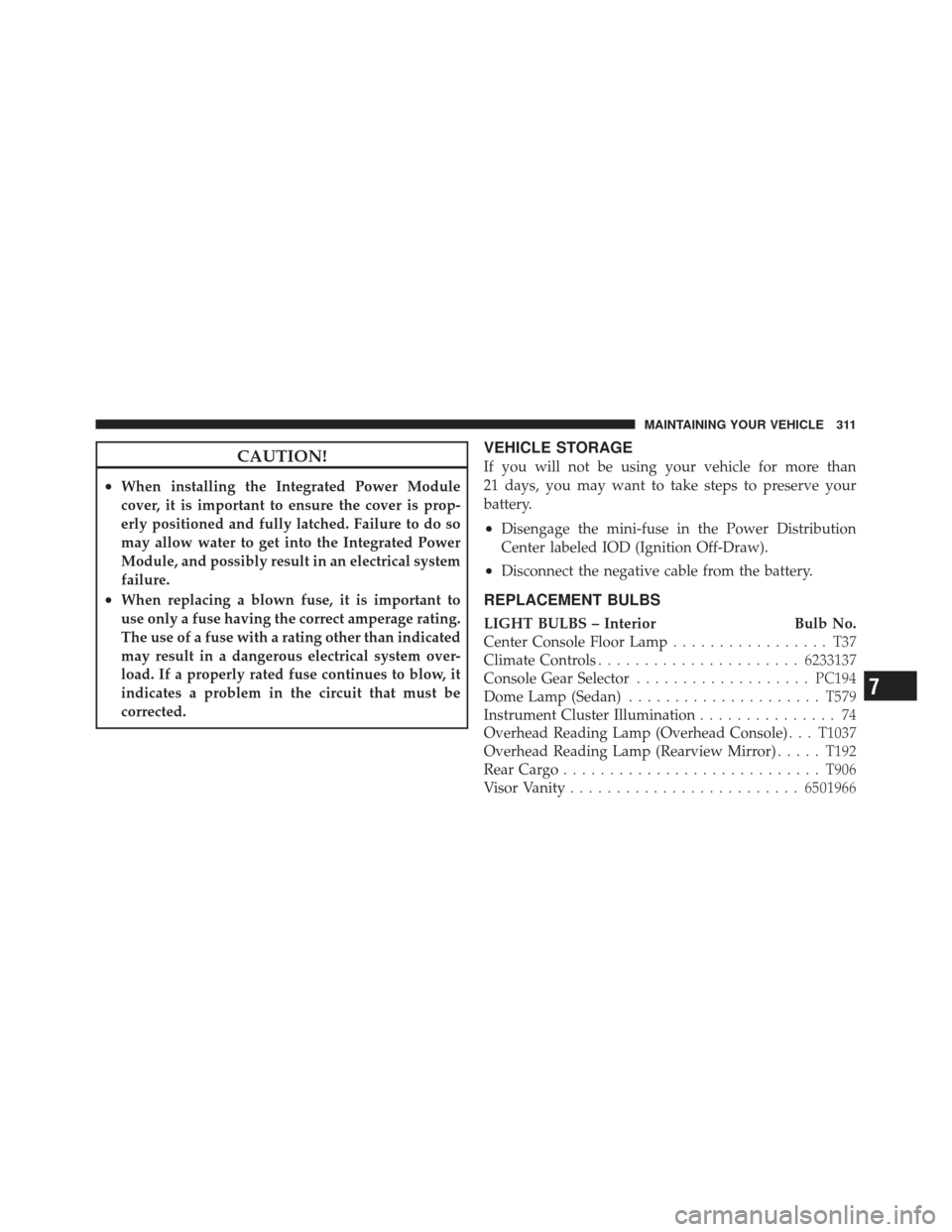
CAUTION!
•When installing the Integrated Power Module
cover, it is important to ensure the cover is prop-
erly positioned and fully latched. Failure to do so
may allow water to get into the Integrated Power
Module, and possibly result in an electrical system
failure.
•When replacing a blown fuse, it is important to
use only a fuse having the correct amperage rating.
The use of a fuse with a rating other than indicated
may result in a dangerous electrical system over-
load. If a properly rated fuse continues to blow, it
indicates a problem in the circuit that must be
corrected.
VEHICLE STORAGE
If you will not be using your vehicle for more than
21 days, you may want to take steps to preserve your
battery.
•Disengage the mini-fuse in the Power Distribution
Center labeled IOD (Ignition Off-Draw).
•Disconnect the negative cable from the battery.
REPLACEMENT BULBS
LIGHT BULBS – InteriorBulb No.
Center Console Floor Lamp ................. T37
Climate Controls ...................... 6233137
Console Gear Selector ................... PC194
Dome Lamp (Sedan) ..................... T579
Instrument Cluster Illumination ............... 74
Overhead Reading Lamp (Overhead Console) . . . T1037
Overhead Reading Lamp (Rearview Mirror) .....T192
Rear Cargo ............................ T906
Visor Vanity ......................... 6501966
7
MAINTAINING YOUR VEHICLE 311
Page 328 of 368
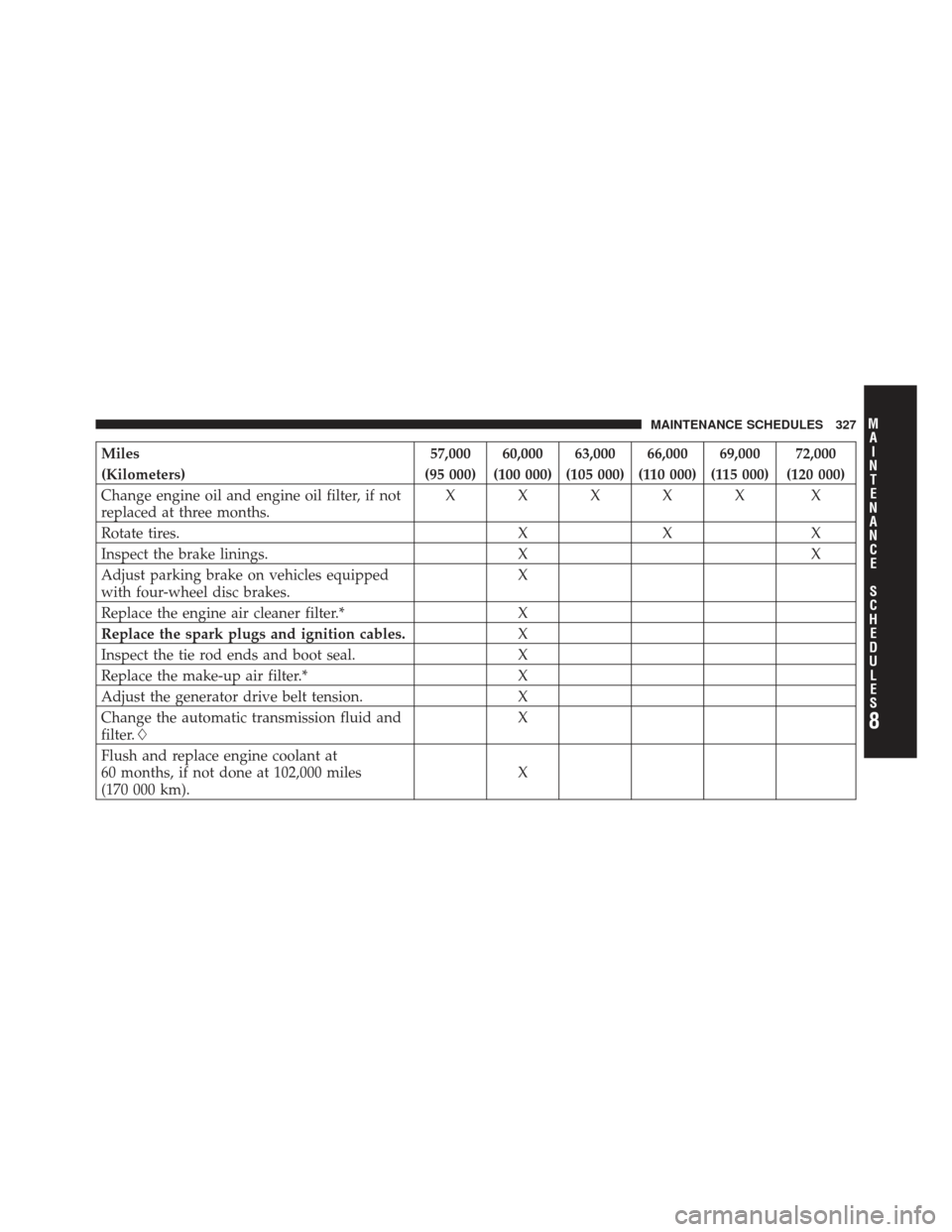
Miles57,000 60,000 63,000 66,000 69,000 72,000
(Kilometers) (95 000) (100 000) (105 000) (110 000) (115 000) (120 000)
Change engine oil and engine oil filter, if not
replaced at three months. XXXXX X
Rotate tires. XX X
Inspect the brake linings. XX
Adjust parking brake on vehicles equipped
with four-wheel disc brakes. X
Replace the engine air cleaner filter.* X
Replace the spark plugs and ignition cables. X
Inspect the tie rod ends and boot seal. X
Replace the make-up air filter.* X
Adjust the generator drive belt tension. X
Change the automatic transmission fluid and
filter.\b X
Flush and replace engine coolant at
60 months, if not done at 102,000 miles
(170 000 km). X
8
M
A I
N T
E
N A
N CE
S
C
H E
D
U L
E
SMAINTENANCE SCHEDULES 327