change time CHRYSLER SEBRING CONVERTIBLE 2004 2.G Owner's Manual
[x] Cancel search | Manufacturer: CHRYSLER, Model Year: 2004, Model line: SEBRING CONVERTIBLE, Model: CHRYSLER SEBRING CONVERTIBLE 2004 2.GPages: 271, PDF Size: 5.31 MB
Page 116 of 271

6 DISC CD CHANGER Ð IF EQUIPPED
The CD changer is located below the radio in the
instrument panel. The changer plays only 43¤4inch (12
cm) discs. The changer holds up to 6 discs. Each disc is
loaded and ejected through a single slot in front of the
changer. Each disc has a numbered button with an amber
light above it which, when illuminated, indicates that a
disc is loaded in that particular chamber.
Loading the CD Changer
When inserting the first CD into the changer if the radio
is on, wait until the single slot is illuminated on both
sides and simply insert the first disc.To insert additional CDs into the changer, the instructions
follow:
1. Select and press any numbered button without an
illuminated light above it.
2. Insert the CD while the light above the chosen button
is flashing and the two lights on either side of the slot are
illuminated.
3. Upon insertion, the CD will begin to play, and both the
button light and the lights in the corner of the loading
slot will illuminate.
4. Repeat the process for loading any additional CDs.
The CD player will stop while additional CDs are loaded.
Playing Discs
The radio will show the CD number, the CD track
number, and the Track Time Elapsed while the radio is in
the CD mode. If more than one CD is loaded in the
changer, the changer will automatically play the next disc
after playing the last track of the current disc.
116 UNDERSTANDING YOUR INSTRUMENT PANEL
Page 117 of 271

Seek Button
Press the top of this button on the radio once to play the
next track. Press the bottom of the button once to return
to the beginning of the current track. Press the bottom of
the button twice to play the previous track.
FF/TUNE/RW
Press the FF (fast forward) button and the CD player will
fast forward through the tracks until the button is re-
leased. Press the RW (rewind) button and the CD player
will reverse through the tracks until the button is re-
leased.
Mode Button
Press this button to toggle between radio and cd modes.
Program Button 1
Press this button to play the next available disc.
Program Button 4 (Random Play)
Press this button while the CD is playing to activate
Random Play. This feature plays the selections on the
current compact disc in random order to provide an
interesting change of pace. The CD changer stays in the
random play mode when changing to the next disc.
NOTE:The changer will not random play between
discs.
Press the top of the Seek button once to move to the next
randomly selected track. Press the bottom of the Seek
button to go back to the beginning of the track.
Press button 4 a second time to stop random play.
Program Button 5
Press this button to play the previous disc.
Time Button
Press this button to switch between time of day and CD
track time.
Changing Modes
While in the radio mode, if a cassette is loaded, press the
Mode button to switch to the tape mode. If a CD is
loaded, press the Mode button to select the CD mode. If
neither a tape nor CD is loaded, the radio will ignore the
command.
²Inserting either a tape or CD automatically starts that
mode of play.
UNDERSTANDING YOUR INSTRUMENT PANEL 117
4
Page 119 of 271

Pressing the center button will make the radio switch
between the various modes available (AM/FM/TAPE/
CD, Etc.).
The left hand control is a rocker type switch with a
push-button in the center. The function of the left hand
control is different depending on which mode you are in.
The following describes the left hand control operation in
each mode.
Radio Operation
Pressing the top of the switch will ªSeekº up for the next
listenable station and pressing the bottom of the switch
will ªSeekº down for the next listenable station.
The button located in the center of the left hand control
will tune to the next preset station that you have pro-
grammed in the radio preset push-button.
Tape Player
Pressing the top of the switch once will go to the next
selection on the cassette. Pressing the bottom of the
switch once will go to the beginning of the current
selection or to the beginning of the previous selection if it
is within the first 5 seconds of the current selection.If you press the switch up or down twice it plays the
second selection, three times, it will play the third, etc.
The button in the center of the left hand switch has no
function in this mode.
CD Player Ð Single Disc in Radio
Pressing the top of the switch once will go to the next
track on the CD. Pressing the bottom of the switch once
will go to the beginning of the current track or to the
beginning of the previous track if it is within one second
after the current track begins to play.
If you press the switch up or down twice it plays the
second track, three times, it will play the third, etc.
The button in the center of the left hand switch has no
function in this mode.
CD Player Ð 6 Disc CD Changer
Pressing the top of the switch once will go to the next
track on the CD. Pressing the bottom of the switch once
will go to the beginning of the current track or to the
beginning of the previous track if it is within one second
after the current track begins to play.
UNDERSTANDING YOUR INSTRUMENT PANEL 119
4
Page 120 of 271

If you press the switch up or down twice it plays the
second track, three times, it will play the third, etc.
The button in the center of the left hand switch will cause
the CD changer to play the next available disc.
CASSETTE TAPE AND PLAYER MAINTENANCE
To keep the cassette tapes and player in good condition,
take the following precautions:
1. Do not use cassette tapes longer than C-90; otherwise,
sound quality and tape durability will be greatly dimin-
ished.
2. Keep the cassette tape in its case to protect from
slackness and dust when it is not in use.
3. Keep the cassette tape away from direct sunlight, heat
and magnetic fields such as the radio speakers.
4. Before inserting a tape, make sure that the label is
tightly secured to the cassette.5. A loose tape should not be inserted into the radio.
Maintain your cassette tape player. The head and capstan
shaft in the cassette player can pick up dirt or tape
deposits each time a cassette is played. The result of
deposits on the capstan shaft may cause the tape to wrap
around and become lodged in the tape transport. The
other adverse condition is low or ªmuddyº sound from
one or both channels, as if the treble tone control were
turned all the way down. To prevent this, you should
periodically clean the head with a commercially available
WET cleaning cassette.
As preventive maintenance, clean the head about every
30 hours of use. If you wait until the head becomes very
dirty (noticeably poor sound), it may not be possible to
remove all deposits with a simple WET cleaning cassette.
120 UNDERSTANDING YOUR INSTRUMENT PANEL
Page 196 of 271

NOTE:Under no circumstances should oil change
intervals exceed 6,000 miles (10 000 km) or 6 months
whichever comes first.
Engine Oil Selection
For best performance and maximum protection under all
types of operating conditions,we recommend engine oils
that are API Certified and meet the requirements of
DaimlerChrysler's Material Standard MS-6395. Use Mo-
par or an equivalent oil meeting the specification MS-
6395.
American Petroleum Institute (API) Engine Oil
Identification Symbol
This symbol means that the oil has
been certified by the American
Petroleum Institute (API). We
only recommend API Certified en-
gine oils that meet the require-
ments of DaimlerChrysler's Mate-
rial Standard MS-6395. Use Mopar
or an equivalent oil meeting the
specification MS-6395.
Engine Oil Viscosity Chart
The proper SAE viscosity grade of engine oil should be
selected based on the following recommendation and be
within the operating temperature shown in the engine oil
viscosity chart.
Flexible Fuel Engine Oil
If you operate the vehicle on E-85 fuel either full or
part-time, use only Mopar Flexible Fuel 5W-30 engine oil
or an equivalent that meets the manufacturers Standard
MS-9214. Equivalent commercial Flexible Fuel engine oils
196 MAINTAINING YOUR VEHICLE
Page 206 of 271
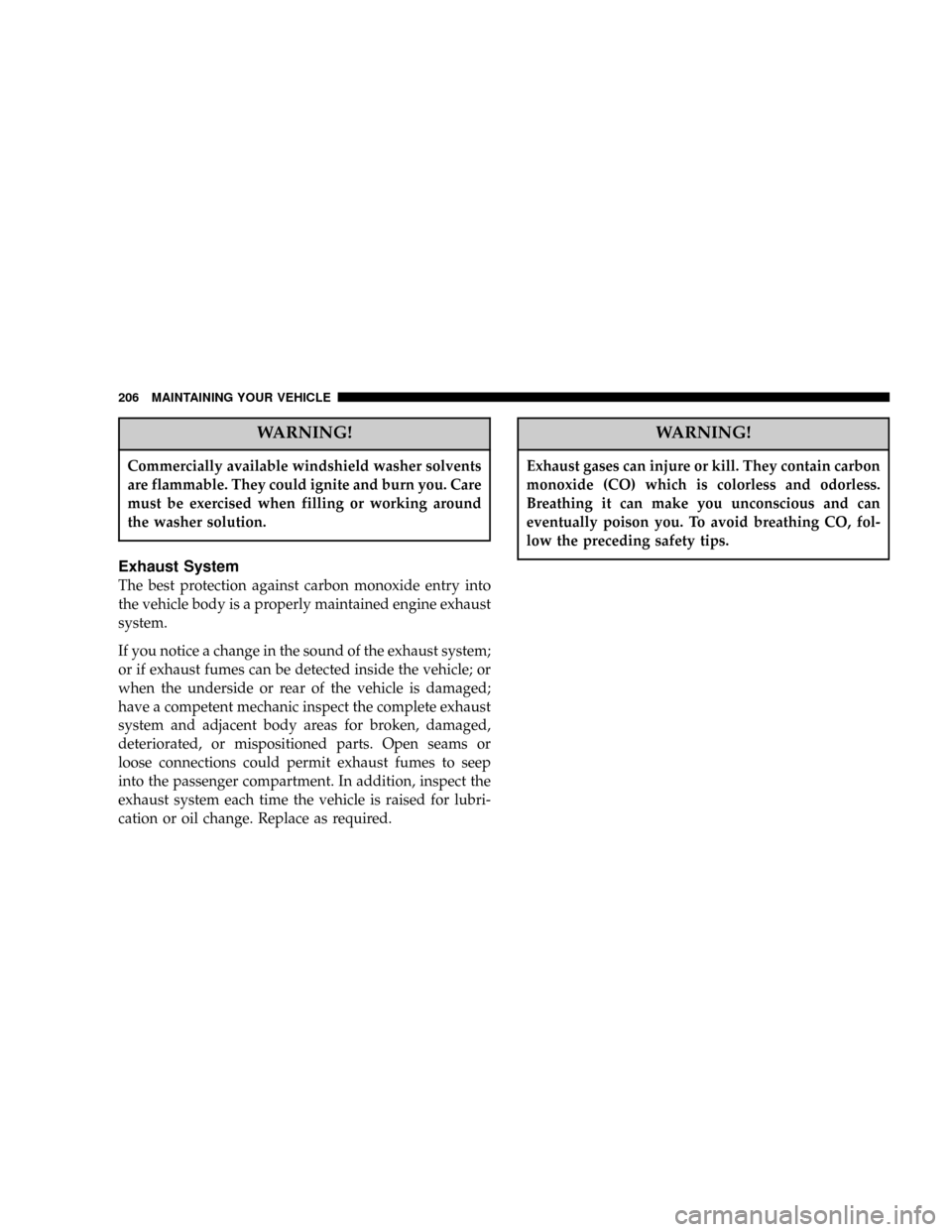
WARNING!
Commercially available windshield washer solvents
are flammable. They could ignite and burn you. Care
must be exercised when filling or working around
the washer solution.
Exhaust System
The best protection against carbon monoxide entry into
the vehicle body is a properly maintained engine exhaust
system.
If you notice a change in the sound of the exhaust system;
or if exhaust fumes can be detected inside the vehicle; or
when the underside or rear of the vehicle is damaged;
have a competent mechanic inspect the complete exhaust
system and adjacent body areas for broken, damaged,
deteriorated, or mispositioned parts. Open seams or
loose connections could permit exhaust fumes to seep
into the passenger compartment. In addition, inspect the
exhaust system each time the vehicle is raised for lubri-
cation or oil change. Replace as required.
WARNING!
Exhaust gases can injure or kill. They contain carbon
monoxide (CO) which is colorless and odorless.
Breathing it can make you unconscious and can
eventually poison you. To avoid breathing CO, fol-
low the preceding safety tips.
206 MAINTAINING YOUR VEHICLE
Page 210 of 271

over time. This is normal. If the coolant level is hard to
see, jostling the coolant bottle will make it easier to see.
There is no need to remove the radiator cap unless
checking for coolant freeze point, adding, or replacing
coolant. Advise your service attendant of this. As long as
the engine operating temperature is satisfactory, the
coolant bottle need only be checked once a month. Heater
performance may also be adversely affected by low
coolant levels.
When additional coolant is needed to maintain the
proper level, it should be added to the coolant bottle. Do
not overfill. Special procedures are required when filling
the engine cooling system of the 2.7L Engine. See your
authorized dealer for details.
Points to Remember
NOTE:
When the vehicle is stopped after a few miles of
operation, you may observe vapor coming from the front
of the engine compartment. This is normally a result of
moisture from rain, snow, or high humidity accumulating
on the radiator and being vaporized when the thermostat
opens, allowing hot water to enter the radiator.
If an examination of your engine compartment shows no
evidence of radiator or hose leaks, the vehicle may be
safely driven. The vapor will soon dissipate.
²Do not overfill the coolant bottle.
²Check coolant freeze point in the system.
²If frequent coolant additions are required, or if the
level in the bottle does not drop when the engine cools,
the cooling system should be pressure tested for leaks.
²Maintain coolant concentration of 50% ethylene glycol
(minimum) with recommended antifreeze for proper
corrosion protection of your engine that contains alu-
minum components.
²Make sure that the radiator and coolant bottle hoses
are not kinked or obstructed.
²Keep the front of the radiator clean. If your vehicle has
air conditioning, keep the front of the condenser clean,
also.
²Do not change the thermostat for summer or winter
operation. If replacement is ever necessary, install
210 MAINTAINING YOUR VEHICLE
Page 237 of 271
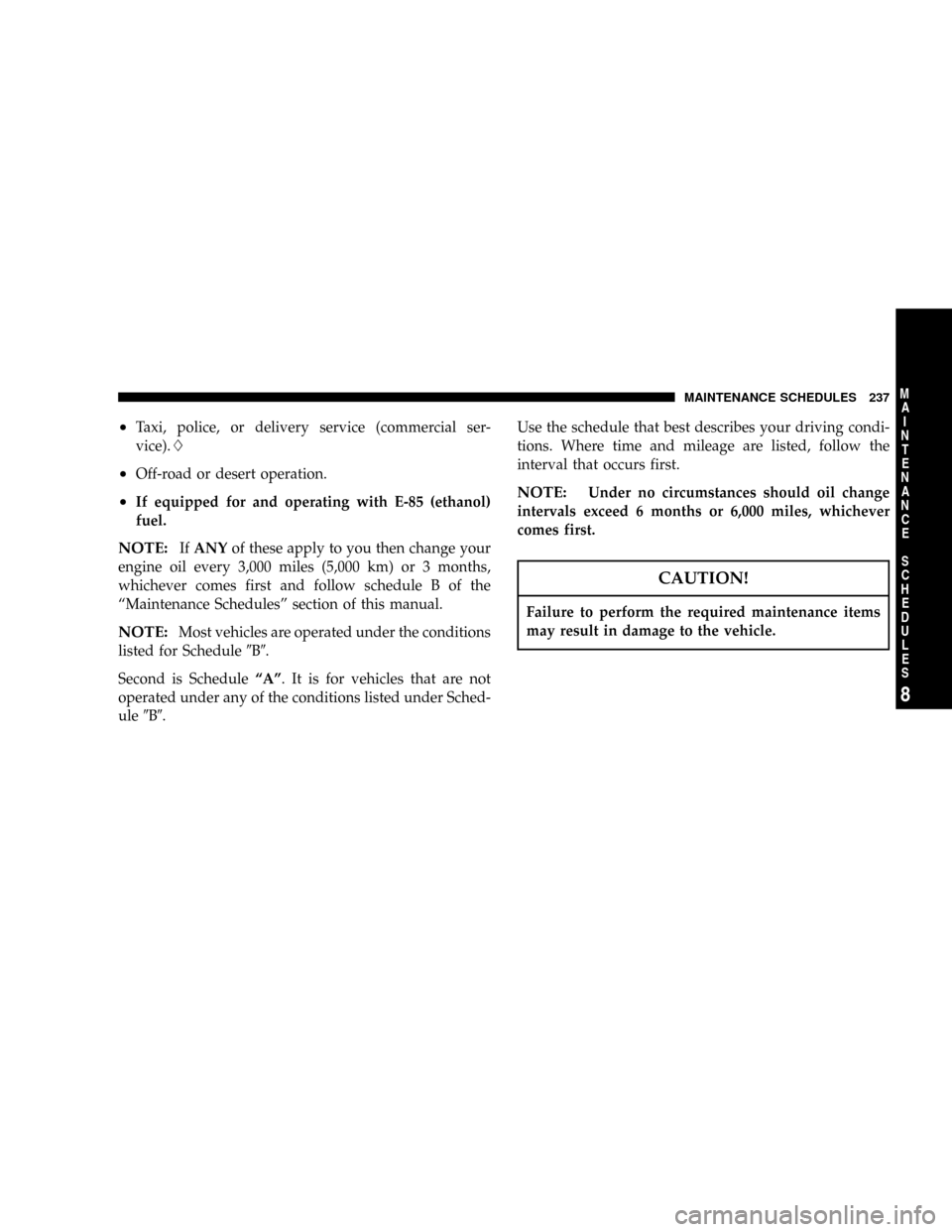
²Taxi, police, or delivery service (commercial ser-
vice).L
²Off-road or desert operation.
²If equipped for and operating with E-85 (ethanol)
fuel.
NOTE:IfANYof these apply to you then change your
engine oil every 3,000 miles (5,000 km) or 3 months,
whichever comes first and follow schedule B of the
ªMaintenance Schedulesº section of this manual.
NOTE:Most vehicles are operated under the conditions
listed for Schedule9B9.
Second is ScheduleªAº. It is for vehicles that are not
operated under any of the conditions listed under Sched-
ule9B9.Use the schedule that best describes your driving condi-
tions. Where time and mileage are listed, follow the
interval that occurs first.
NOTE:Under no circumstances should oil change
intervals exceed 6 months or 6,000 miles, whichever
comes first.
CAUTION!
Failure to perform the required maintenance items
may result in damage to the vehicle.
MAINTENANCE SCHEDULES 237
8
M
A
I
N
T
E
N
A
N
C
E
S
C
H
E
D
U
L
E
S
Page 245 of 271
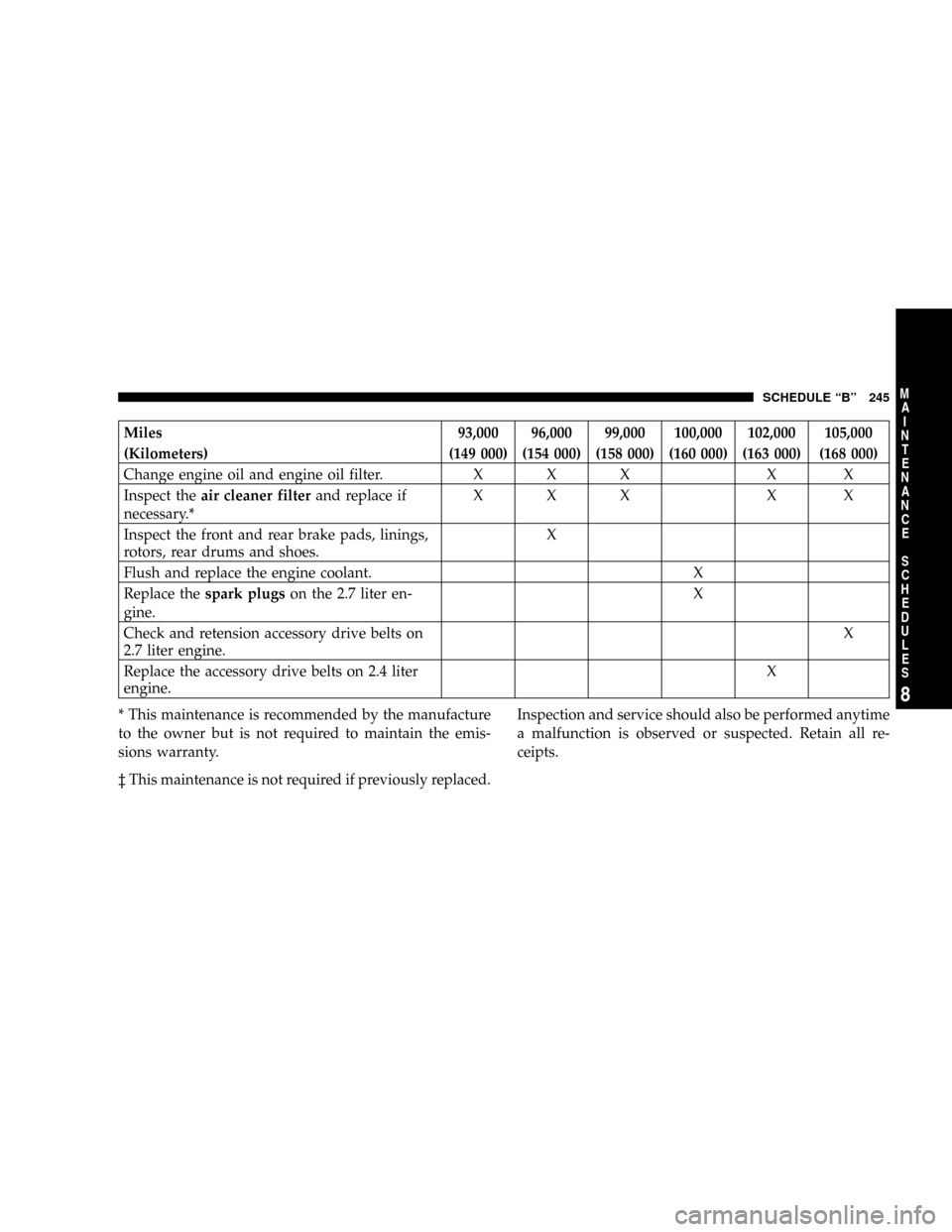
Miles 93,000 96,000 99,000 100,000 102,000 105,000
(Kilometers) (149 000) (154 000) (158 000) (160 000) (163 000) (168 000)
Change engine oil and engine oil filter. X X X X X
Inspect theair cleaner filterand replace if
necessary.*XXX X X
Inspect the front and rear brake pads, linings,
rotors, rear drums and shoes.X
Flush and replace the engine coolant. X
Replace thespark plugson the 2.7 liter en-
gine.X
Check and retension accessory drive belts on
2.7 liter engine.X
Replace the accessory drive belts on 2.4 liter
engine.X
* This maintenance is recommended by the manufacture
to the owner but is not required to maintain the emis-
sions warranty.
³ This maintenance is not required if previously replaced.Inspection and service should also be performed anytime
a malfunction is observed or suspected. Retain all re-
ceipts.
SCHEDULE ªBº 245
8
M
A
I
N
T
E
N
A
N
C
E
S
C
H
E
D
U
L
E
S
Page 248 of 271
![CHRYSLER SEBRING CONVERTIBLE 2004 2.G Owners Manual Miles 78,000 84,000 90,000 96,000 102,000
(Kilometers) (125 000) (134 000) (144 000) (154 000) (163 000)
[Months] [78] [84] [90] [96] [102]
Change engine oil and engine oil filter. X X X X X
Inspect t](/img/25/8538/w960_8538-247.png "CHRYSLER SEBRING CONVERTIBLE 2004 2.G Owners Manual Miles 78,000 84,000 90,000 96,000 102,000
(Kilometers) (125 000) (134 000) (144 000) (154 000) (163 000)
[Months] [78] [84] [90] [96] [102]
Change engine oil and engine oil filter. X X X X X
Inspect t")
Miles 78,000 84,000 90,000 96,000 102,000
(Kilometers) (125 000) (134 000) (144 000) (154 000) (163 000)
[Months] [78] [84] [90] [96] [102]
Change engine oil and engine oil filter. X X X X X
Inspect theair cleaner filterand replace if re-
quired.*XX XX
Replace theair cleaner filter.*X
Inspect the front and rear brake pads, linings, ro-
tors, rear drums and shoes.X
Replace thespark plugson 2.4 liter engine. X
Replace thespark plugson 2.7 liter engine. X
Check and replace, if necessary, thePCV valve.*³ X
Replace theengine timing belton 2.4 liter engine.* X
Check and retension alternator drive belts on 2.7
liter engine.X
Replace the accessory drive belts on 2.4L engine. X
* This maintenance is recommended by the manufacture
to the owner but is not required to maintain the emis-
sions warranty.
³ This maintenance is not required if previously replaced.Inspection and service should also be performed anytime
a malfunction is observed or suspected. Retain all re-
ceipts.
248 SCHEDULE ªAº
8
M
A
I
N
T
E
N
A
N
C
E
S
C
H
E
D
U
L
E
S