top CHRYSLER SEBRING CONVERTIBLE 2004 2.G Repair Manual
[x] Cancel search | Manufacturer: CHRYSLER, Model Year: 2004, Model line: SEBRING CONVERTIBLE, Model: CHRYSLER SEBRING CONVERTIBLE 2004 2.GPages: 271, PDF Size: 5.31 MB
Page 212 of 271
Inspect all hose clamps and couplings to make sure they
are secure and no leaks are present.
Insure nylon tubing in these areas has not melted or
collapsed.
NOTE:Often, fluids such as oil, power steering fluid,
and brake fluid are used during assembly plant opera-
tions to ease the assembly of hoses to couplings. There-
fore, oil wetness at the hose-coupling area is not neces-
sarily an indication of leakage. Actual dripping of hot
fluid when systems are under pressure (during vehicle
operation) should be noted before hose is replaced based
on leakage.
NOTE:Inspection of brake hoses should be done
whenever the brake system is serviced and every engine
oil change.
WARNING!
Worn brake hoses can burst and cause brake failure.
You could have an accident. If you see any signs of
cracking, scuffing, or worn spots, have the brake
hoses replaced immediately.
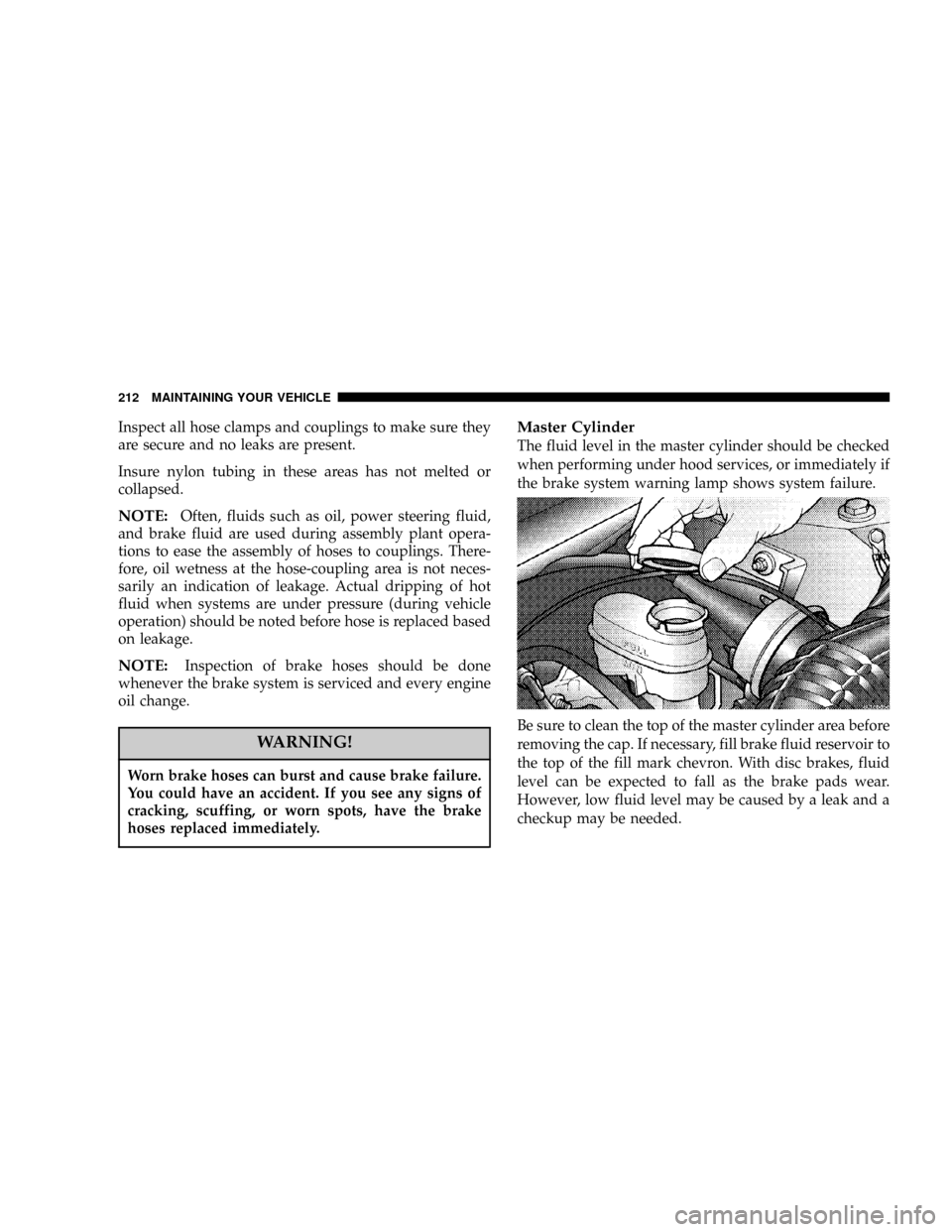
Master Cylinder
The fluid level in the master cylinder should be checked
when performing under hood services, or immediately if
the brake system warning lamp shows system failure.
Be sure to clean the top of the master cylinder area before
removing the cap. If necessary, fill brake fluid reservoir to
the top of the fill mark chevron. With disc brakes, fluid
level can be expected to fall as the brake pads wear.
However, low fluid level may be caused by a leak and a
checkup may be needed.
212 MAINTAINING YOUR VEHICLE
Page 216 of 271

Manual Transaxle
Use only the manufacturer's recommended transmission
fluid for the manual transaxle, NV-T350 or NV-T850, in
your vehicle. Refer to Recommended Fluids, Lubricants
and Genuine Parts section for correct fluid type. If it
becomes necessary to top off or replace completely, this
fluid should be used. The fill plug for the NV-T850 is
located on the aluminum rear end cover.
Fluid Level Check
Check the fluid level by removing the fill plug. The fluid
level should be between the bottom of the fill hole and apoint not more than 4.0 mm below the bottom of the hole.
Add fluid, if necessary, to maintain the proper level.
Frequency of Fluid Change
Under normal operating conditions, the fluid installed at
the factory will give satisfactory lubrication for the life of
the vehicle. Fluid changes are not necessary unless the
lubricant has become contaminated with water. If con-
taminated with water, the fluid should be changed im-
mediately.
Appearance Care And Protection From Corrosion
Protection of Body and Paint from Corrosion
Vehicle body care requirements vary according to geo-
graphic locations and usage. Chemicals that make roads
passable in snow and ice, and those that are sprayed on
trees and road surfaces during other seasons, are highly
corrosive to the metal in your vehicle. Outside parking,
which exposes your vehicle to airborne contaminants,
road surfaces on which the vehicle is operated, extreme
hot or cold weather and other extreme conditions will
have an adverse effect on paint, metal trim, and under-
body protection.
216 MAINTAINING YOUR VEHICLE
Page 219 of 271
Do not use cleaners, conditioners and protectants con-
taining silicon or bleach as these may cause gloss level
increases and/or discoloration.
You should not increase the gloss level, especially on top
of the instrument panel top surface. Higher gloss levels
will increase the reflectivity in the windshield that could
decrease visibility under bright light driving conditions.
WARNING!
Do not use volatile solvents for cleaning purposes.
Many are potentially flammable, and if used in
closed areas they may cause respiratory harm.
Leather Seat Care and Cleaning
CAUTION!
Never use polishes, oils, cleaning fluids, solvents,
detergents, or ammonia based cleaners to clean the
leather. The leather has already been pretreated. The
application of any leather conditioner may damage
the factory applied top coat.
Leather is best preserved by regular cleaning with a
damp soft cloth. Small particles of dirt can act as an
abrasive and damage the leather surface and should be
removed immediately with a damp cloth. Stubborn soils
can be removed easily with a soft cloth and Mopar Total
Clean. Care should be taken to avoid soaking the leather
with any liquid.
Cleaning Headlights
Your vehicle has plastic headlights that are lighter and
less susceptible to stone breakage than glass headlights.
MAINTAINING YOUR VEHICLE 219
7
Page 221 of 271
CONVERTIBLE TOP CARE
Immediate removal of any contaminant is recommended.
Regular washing of the top will enhance its life and
appearance, and make successive cleanings easier. Do not
subject the top to excessive heat. Frequently vacuum the
top and storage compartment.
Washing
Hand washing is highly recommended. Automatic car
washing equipment can damage the top material. If you
must use an automatic car wash, soft cloth systems are
preferred.
CAUTION!
Avoid high pressure car washes, as they can damage
the top material. Also, increased water pressure may
force water past the weather strips.
General Cleaning
Careful vacuuming of the top before washing is helpful
in removing dust and other foreign particles. Wash in
partial shade instead of direct sun. Wet the entire vehicle
before washing the top. The top should be washed with
a soft, natural bristle scrub brush, and a mild soap
solution such as liquid dish washing soap. Do not use
detergent.
CAUTION!
Never use an abrasive type cleaner or bleaches.
Cleaners should not contain silicones, organic sol-
vents, petroleum distillates or plasticizers. always
wait until the top is thoroughly dry before lowering
it into the storage area.
Scrub in all directions, covering an area of about two
square feet at a time. Avoid heavy scrubbing. Rinse the
entire vehicle with water to remove all soap and dirt from
the top fabric and to prevent streaking on painted and
chrome surfaces. Allow the top to dry before lowering.
MAINTAINING YOUR VEHICLE 221
7
Page 222 of 271

Vacuuming the top with a wet/dry shop vacuum will
decrease the top's drying time, ensure removal of all dirt,
and delete streaks in the material. Multiple cleanings
may be necessary to remove stubborn stains. If stains
persist, contact your local dealership for further sugges-
tions.
Cloth Top Additional Cleaning Procedure
For additional cleaning assistance in removing stubborn
stains, apply Mopar Convertible Cloth Top Cleaner #
4883061 to the complete stain, extending 2 inches (50
mm) beyond the stain. With a soft bristle brush, scrub in
all directions over the stain. Avoid heavy scrubbing.
Rinse the area with warm water. If the stain is still
apparent, repeat the cleaning procedure. When the stain
is no longer showing, rinse the complete top with warm
water. Let the top dry before lowering it.
Cloth Top Protection
For appearance purposes, you may wish to protect your
TwillfastŸ (cloth) top periodically. A fabric protectant
such as Scotchguardtis suggested. The top should be
clean and dry before application of the protectant.
CAUTION!
Avoid getting Scotchguardton the surrounding
weather strips, moldings, paint, or glass. Damage to
these items might occur.
Weather Strip Care
Lubricate all top and door glass weather strips periodi-
cally with Mopar Weather Strip Lubricant (part number
4773427), to keep them soft and pliable.
222 MAINTAINING YOUR VEHICLE
Page 223 of 271

FUSES
Underhood Fuses (Power Distribution Center)A Power Distribution Center is located in the engine
compartment, near the air cleaner. This information ap-
plies to vehicles built without the fuse and relay num-
bering embossed on the Power Distributuion Center Top
Cover.
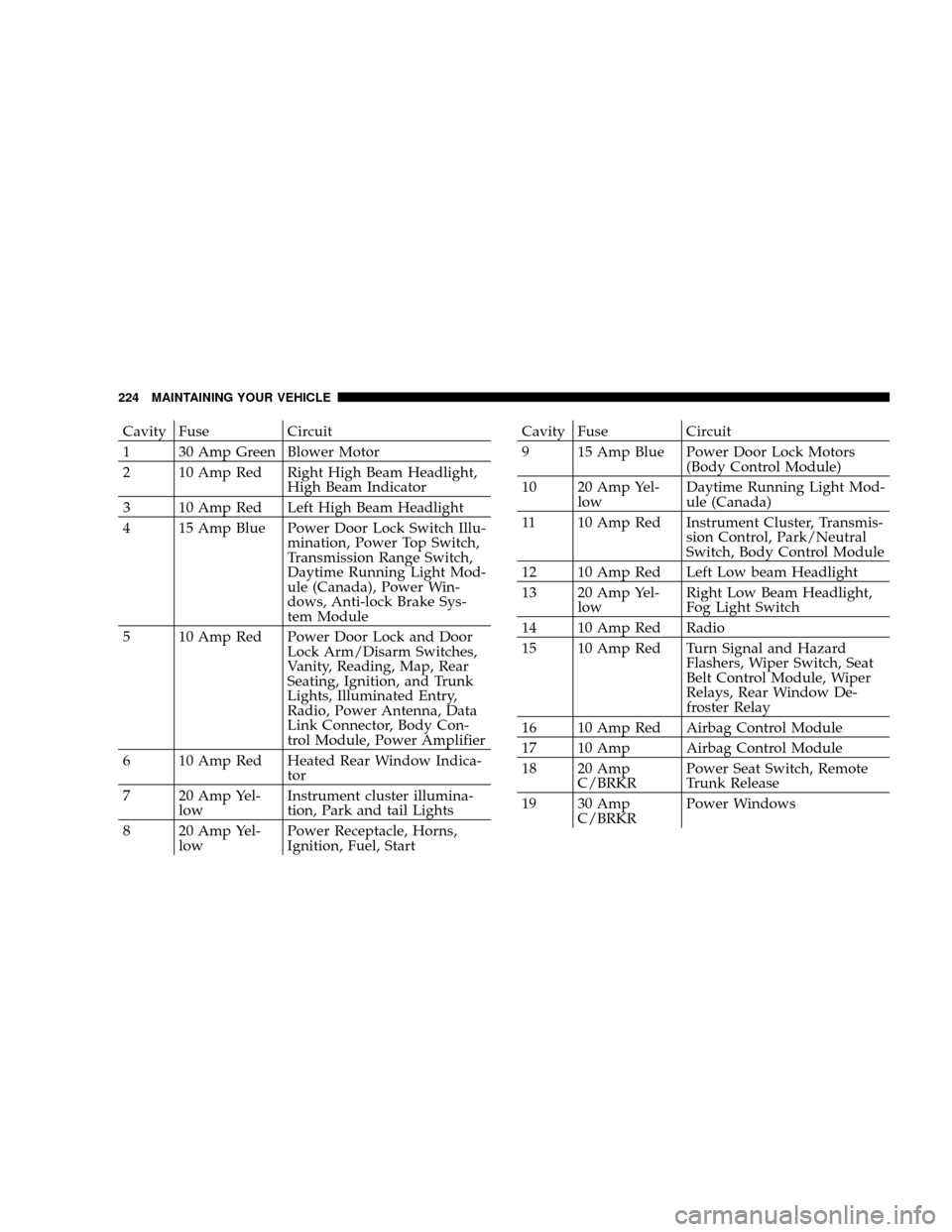
Interior Fuses
The fuse access panel is behind the end cover at the left
side of the instrument panel. To remove the panel, pull it
out, as shown.
MAINTAINING YOUR VEHICLE 223
7
Page 224 of 271
Cavity Fuse Circuit
1 30 Amp Green Blower Motor
2 10 Amp Red Right High Beam Headlight,
High Beam Indicator
3 10 Amp Red Left High Beam Headlight
4 15 Amp Blue Power Door Lock Switch Illu-
mination, Power Top Switch,
Transmission Range Switch,
Daytime Running Light Mod-
ule (Canada), Power Win-
dows, Anti-lock Brake Sys-
tem Module
5 10 Amp Red Power Door Lock and Door
Lock Arm/Disarm Switches,
Vanity, Reading, Map, Rear
Seating, Ignition, and Trunk
Lights, Illuminated Entry,
Radio, Power Antenna, Data
Link Connector, Body Con-
trol Module, Power Amplifier
6 10 Amp Red Heated Rear Window Indica-
tor
7 20 Amp Yel-
lowInstrument cluster illumina-
tion, Park and tail Lights
8 20 Amp Yel-
lowPower Receptacle, Horns,
Ignition, Fuel, StartCavity Fuse Circuit
9 15 Amp Blue Power Door Lock Motors
(Body Control Module)
10 20 Amp Yel-
lowDaytime Running Light Mod-
ule (Canada)
11 10 Amp Red Instrument Cluster, Transmis-
sion Control, Park/Neutral
Switch, Body Control Module
12 10 Amp Red Left Low beam Headlight
13 20 Amp Yel-
lowRight Low Beam Headlight,
Fog Light Switch
14 10 Amp Red Radio
15 10 Amp Red Turn Signal and Hazard
Flashers, Wiper Switch, Seat
Belt Control Module, Wiper
Relays, Rear Window De-
froster Relay
16 10 Amp Red Airbag Control Module
17 10 Amp Airbag Control Module
18 20 Amp
C/BRKRPower Seat Switch, Remote
Trunk Release
19 30 Amp
C/BRKRPower Windows
224 MAINTAINING YOUR VEHICLE
Page 225 of 271
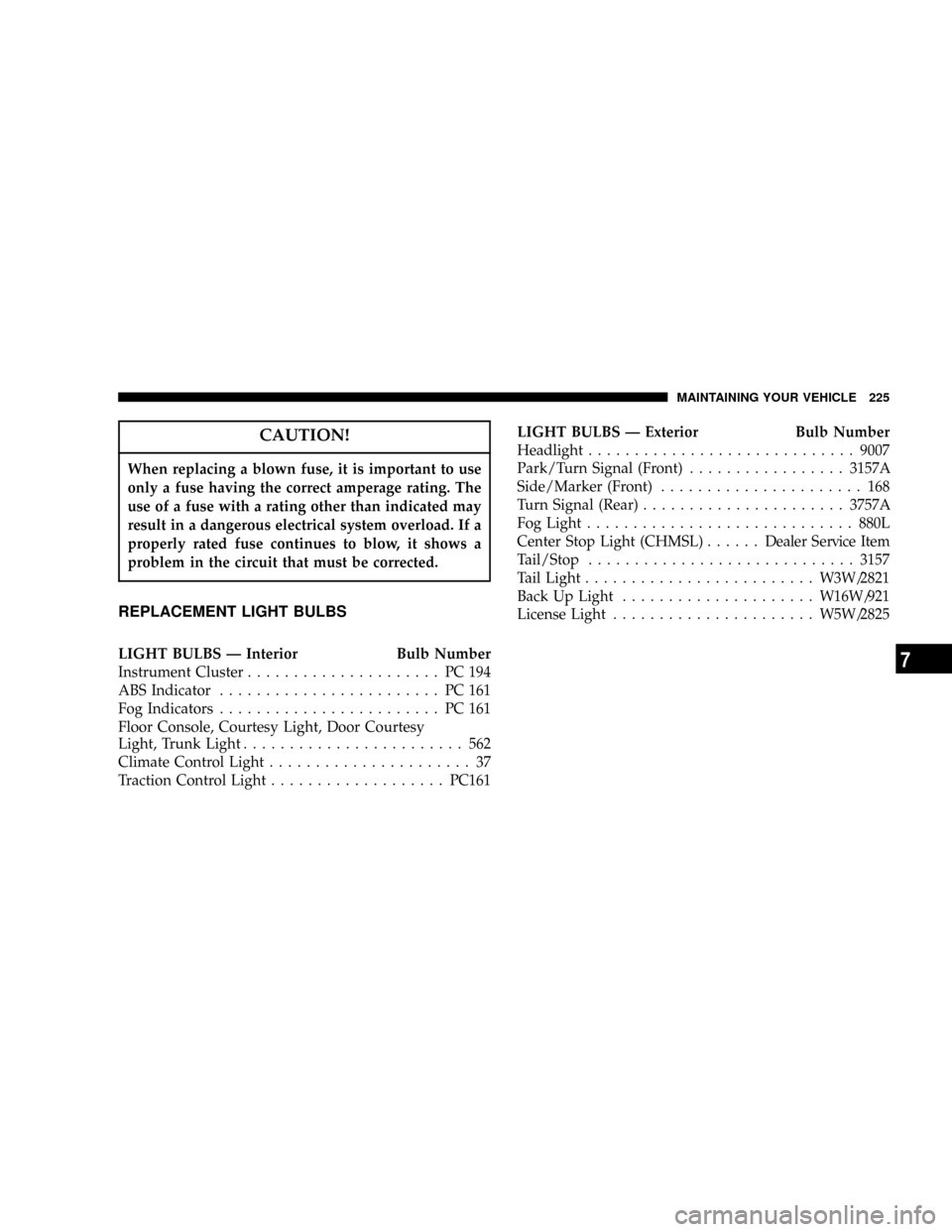
CAUTION!
When replacing a blown fuse, it is important to use
only a fuse having the correct amperage rating. The
use of a fuse with a rating other than indicated may
result in a dangerous electrical system overload. If a
properly rated fuse continues to blow, it shows a
problem in the circuit that must be corrected.
REPLACEMENT LIGHT BULBS
LIGHT BULBS Ð Interior Bulb Number
Instrument Cluster..................... PC194
ABS Indicator........................ PC161
Fog Indicators........................ PC161
Floor Console, Courtesy Light, Door Courtesy
Light, Trunk Light........................ 562
Climate Control Light...................... 37
Traction Control Light...................PC161LIGHT BULBS Ð Exterior Bulb Number
Headlight.............................9007
Park/Turn Signal (Front).................3157A
Side/Marker (Front)...................... 168
Turn Signal (Rear)......................3757A
Fog Light.............................880L
Center Stop Light (CHMSL)......Dealer Service Item
Tail/Stop.............................3157
Tail Light.........................W3W/2821
Back Up Light.....................W16W/921
License Light......................W5W/2825
MAINTAINING YOUR VEHICLE 225
7
Page 230 of 271

4. Turn the bulb and socket assembly counterclockwise
to remove it from the housing.
5. Install the new bulb and socket assembly, reattach the
wiring connector, and reinstall the fog light assembly.
Center Stoplight Bulb Replacement
You may wish to see your dealer for service of this light.
A detailed service procedure is contained in the manu-
facturer's Service Manual. Information on purchasing a
Service Manual can be found at the back of this Owner's
Manual.
Rear Light Bulb Replacement
1. Open the trunk and pull the trunk liner away to
expose the wiring connector and light housing plastic
retainers.
230 MAINTAINING YOUR VEHICLE
Page 236 of 271
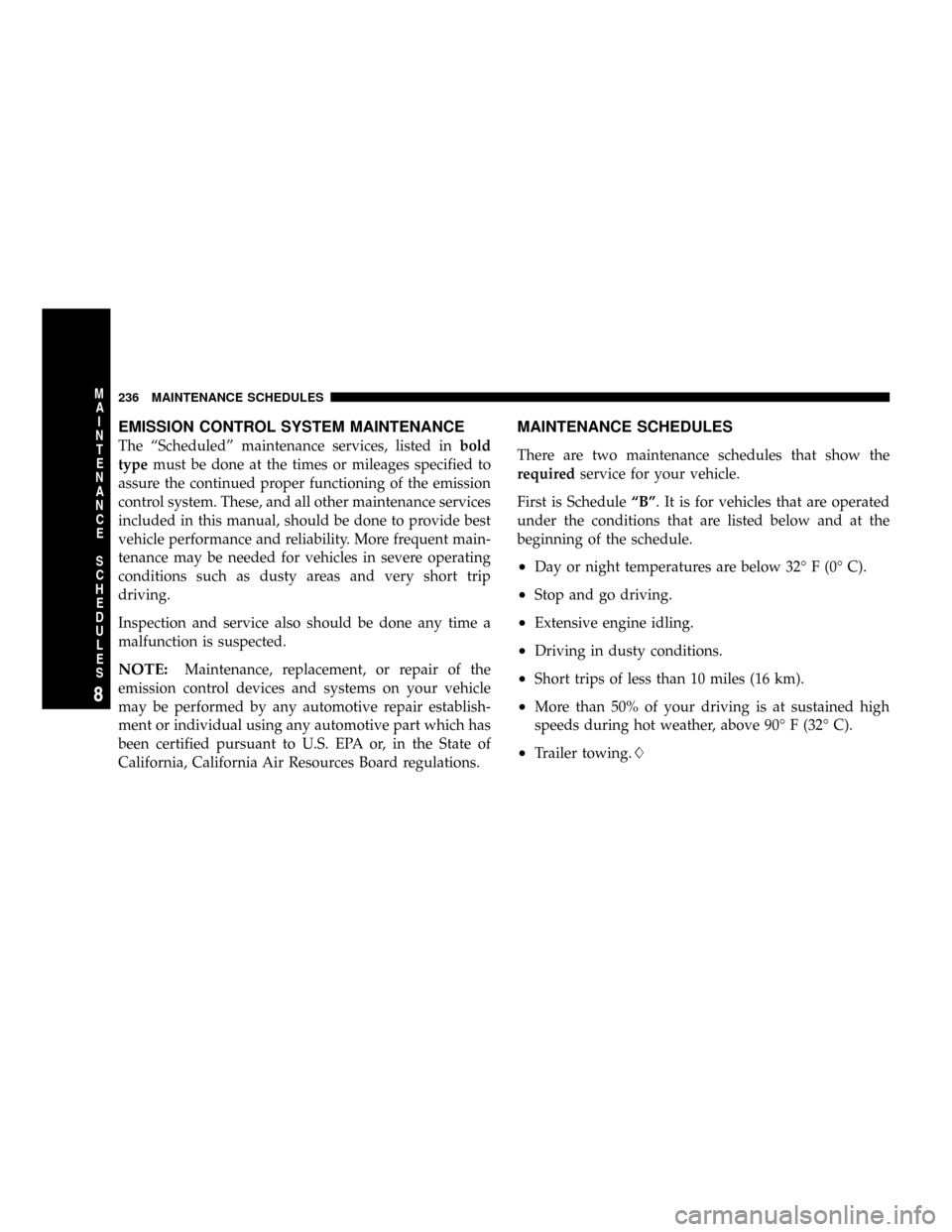
EMISSION CONTROL SYSTEM MAINTENANCE
The ªScheduledº maintenance services, listed inbold
typemust be done at the times or mileages specified to
assure the continued proper functioning of the emission
control system. These, and all other maintenance services
included in this manual, should be done to provide best
vehicle performance and reliability. More frequent main-
tenance may be needed for vehicles in severe operating
conditions such as dusty areas and very short trip
driving.
Inspection and service also should be done any time a
malfunction is suspected.
NOTE:Maintenance, replacement, or repair of the
emission control devices and systems on your vehicle
may be performed by any automotive repair establish-
ment or individual using any automotive part which has
been certified pursuant to U.S. EPA or, in the State of
California, California Air Resources Board regulations.
MAINTENANCE SCHEDULES
There are two maintenance schedules that show the
requiredservice for your vehicle.
First is ScheduleªBº. It is for vehicles that are operated
under the conditions that are listed below and at the
beginning of the schedule.
²Day or night temperatures are below 32É F (0É C).
²Stop and go driving.
²Extensive engine idling.
²Driving in dusty conditions.
²Short trips of less than 10 miles (16 km).
²More than 50% of your driving is at sustained high
speeds during hot weather, above 90É F (32É C).
²Trailer towing.L
236 MAINTENANCE SCHEDULES
8
M
A
I
N
T
E
N
A
N
C
E
S
C
H
E
D
U
L
E
S