Battery CHRYSLER SEBRING CONVERTIBLE 2008 3.G Owner's Guide
[x] Cancel search | Manufacturer: CHRYSLER, Model Year: 2008, Model line: SEBRING CONVERTIBLE, Model: CHRYSLER SEBRING CONVERTIBLE 2008 3.GPages: 454, PDF Size: 5.8 MB
Page 359 of 454

Your vehicle has a simple ignition key-actuated test,
which you can use prior to going to the test station. To
check if your vehicle's OBD system is ready, you must do
the following:
1. Insert your ignition key into the ignition switch.
2. Turn the ignition to the ON position, but do not crank
or start the engine.
3. If you crank or start the engine, you will have to start
this test over.
4. As soon as you turn your key to the ON position, you
will see your MIL symbol come on as part of a normal
bulb check.
5. Approximately 15 seconds later, one of two things will
happen:
a. The MIL will flash for about 10 seconds and then
return to being fully illuminated until you turn off theignition key or start the engine. This means that your
vehicle's OBD system isnot readyand you shouldnot
proceed to the I/M station.
b. The MIL will not flash at all and will remain fully
illuminated until you turn OFF the ignition key or start
the engine. This means that your vehicle's OBD system
isreadyand you can proceed to the I/M station.
If your OBD system isnot ready,you should see your
authorized dealer or repair facility. If your vehicle was
recently serviced or had a battery failure or replacement,
you may need to do nothing more than drive your
vehicle as you normally would in order for your OBD
system to update. A recheck with the above test routine
may then indicate that the system is now ready.
Regardless of whether your vehicle's OBD system is
ready or not ready, if the MIL symbol is illuminated
during normal vehicle operation, you should have your
MAINTAINING YOUR VEHICLE 359
7
Page 367 of 454
NOTE:Intentional tampering with emissions control
systems can result in civil penalties being assessed
against you.
WARNING!
A hot exhaust system can start a fire if you park over
materials that can burn. Such materials might be
grass or leaves coming into contact with your exhaust
system. Do not park or operate your vehicle in areas
where your exhaust system can contact anything that
can burn.
In unusual situations involving grossly malfunctioning
engine operation, a scorching odor may suggest severe
and abnormal catalyst overheating. If this occurs, stop
the vehicle, turn off the engine, and allow it to cool.
Service, including a tune up to manufacturer's specifica-
tions, should be obtained immediately.To minimize the possibility of catalyst damage:
²Do not shut off the engine or interrupt the ignition
when the transaxle is in gear and the vehicle is in
motion.
²Do not try to start the engine by pushing or towing the
vehicle.
²Do not idle the engine with any ignition coil connec-
tors disconnected for prolonged periods.
Maintenance-Free Battery
You will never have to add water, nor is periodic main-
tenance required.
NOTE:The battery is stored in a compartment behind
the left front fender and is accessible without removing
the tire and wheel. Remote battery terminals are located
in the engine compartment for jump-starting.
To access the battery, turn the steering wheel fully to the
right and remove the inner fender shield.
MAINTAINING YOUR VEHICLE 367
7
Page 368 of 454
WARNING!
²Battery fluid is a corrosive acid solution and can
burn or even blind you. Don't allow battery fluid
to contact your eyes, skin, or clothing. Don't lean
over a battery when attaching clamps. If acid
splashes in eyes or on skin, flush the area imme-
diately with large amounts of water.
²Battery gas is flammable and explosive. Keep
flame or sparks away from the battery. Don't use a
booster battery or any other booster source with an
output greater than 12 volts. Don't allow cable
clamps to touch each other.
²Battery posts, terminals, and related accessories
contain lead and lead compounds. Wash hands
after handling.
CAUTION!
²It is essential when replacing the cables on the
battery that the positive cable is attached to the
positive post and the negative cable is attached to
the negative post. Battery posts are marked posi-
tive (+) and negative (-) and identified on the
battery case. Cable clamps should be tight on the
terminal posts and free of corrosion. Apply grease
to posts and clamps after tightening.
²If a ªfast chargerº is used while the battery is in
the vehicle, disconnect both vehicle battery cables
before connecting the charger to battery. Do not
use a ªfast chargerº to provide starting voltage as
battery damage can result.
368 MAINTAINING YOUR VEHICLE
Page 396 of 454
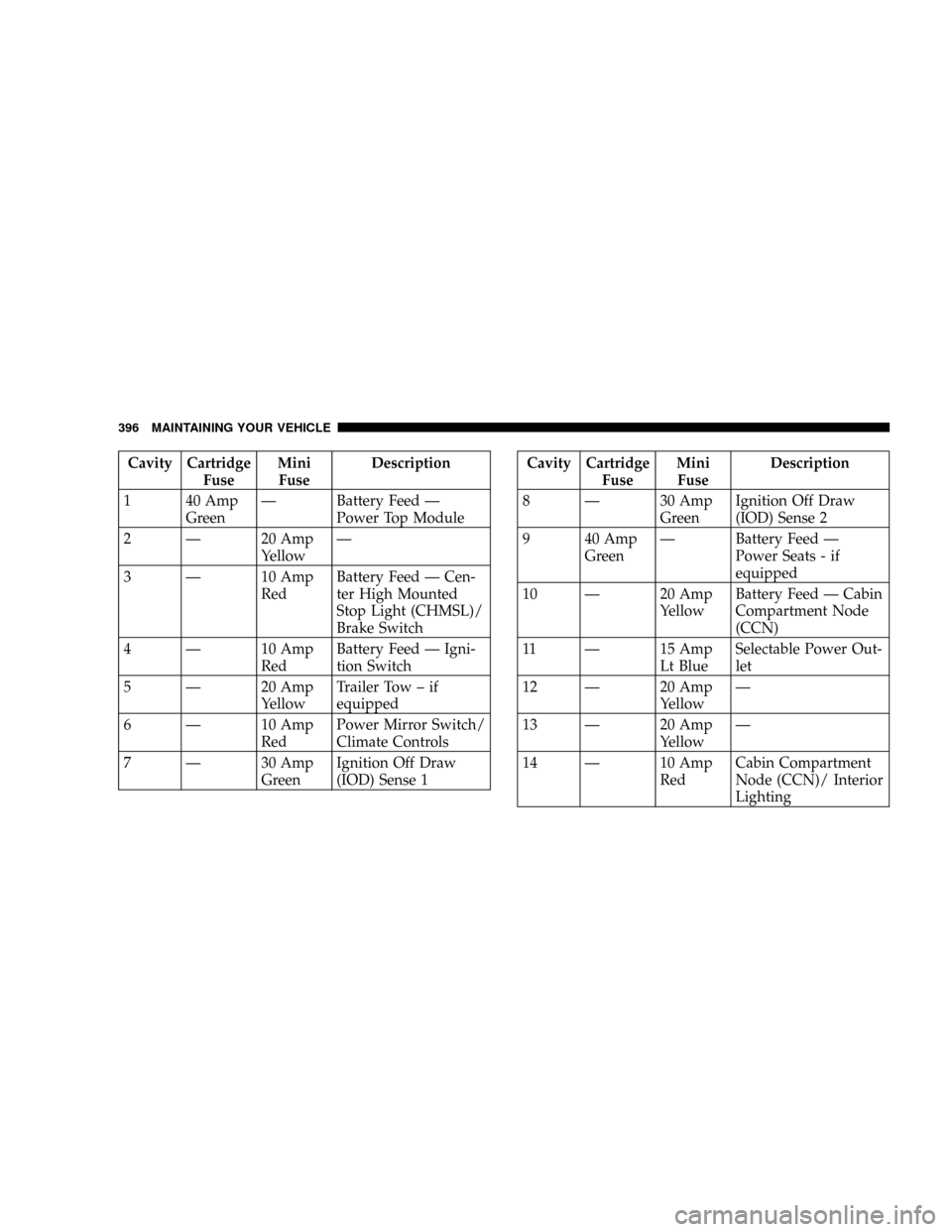
Cavity Cartridge
FuseMini
FuseDescription
1 40 Amp
GreenÐ Battery Feed Ð
Power Top Module
2 Ð 20 Amp
YellowÐ
3 Ð 10 Amp
RedBattery Feed Ð Cen-
ter High Mounted
Stop Light (CHMSL)/
Brake Switch
4 Ð 10 Amp
RedBattery Feed Ð Igni-
tion Switch
5 Ð 20 Amp
YellowTrailer Tow ± if
equipped
6 Ð 10 Amp
RedPower Mirror Switch/
Climate Controls
7 Ð 30 Amp
GreenIgnition Off Draw
(IOD) Sense 1Cavity Cartridge
FuseMini
FuseDescription
8 Ð 30 Amp
GreenIgnition Off Draw
(IOD) Sense 2
9 40 Amp
GreenÐ Battery Feed Ð
Power Seats - if
equipped
10 Ð 20 Amp
YellowBattery Feed Ð Cabin
Compartment Node
(CCN)
11 Ð 15 Amp
Lt BlueSelectable Power Out-
let
12 Ð 20 Amp
YellowÐ
13 Ð 20 Amp
YellowÐ
14 Ð 10 Amp
RedCabin Compartment
Node (CCN)/ Interior
Lighting
396 MAINTAINING YOUR VEHICLE
Page 397 of 454
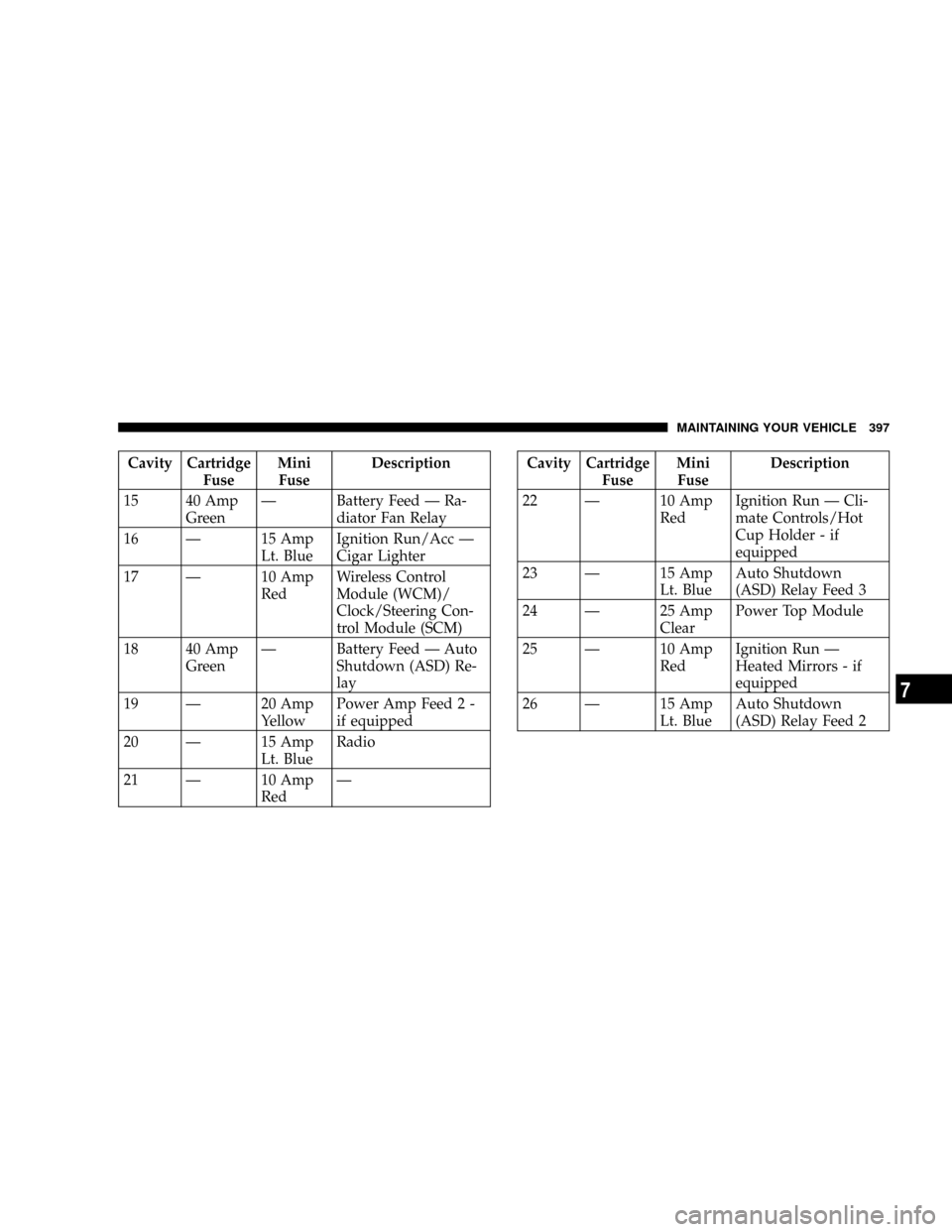
Cavity Cartridge
FuseMini
FuseDescription
15 40 Amp
GreenÐ Battery Feed Ð Ra-
diator Fan Relay
16 Ð 15 Amp
Lt. BlueIgnition Run/Acc Ð
Cigar Lighter
17 Ð 10 Amp
RedWireless Control
Module (WCM)/
Clock/Steering Con-
trol Module (SCM)
18 40 Amp
GreenÐ Battery Feed Ð Auto
Shutdown (ASD) Re-
lay
19 Ð 20 Amp
YellowPower Amp Feed 2 -
if equipped
20 Ð 15 Amp
Lt. BlueRadio
21 Ð 10 Amp
RedÐCavity Cartridge
FuseMini
FuseDescription
22 Ð 10 Amp
RedIgnition Run Ð Cli-
mate Controls/Hot
Cup Holder - if
equipped
23 Ð 15 Amp
Lt. BlueAuto Shutdown
(ASD) Relay Feed 3
24 Ð 25 Amp
ClearPower Top Module
25 Ð 10 Amp
RedIgnition Run Ð
Heated Mirrors - if
equipped
26 Ð 15 Amp
Lt. BlueAuto Shutdown
(ASD) Relay Feed 2
MAINTAINING YOUR VEHICLE 397
7
Page 398 of 454
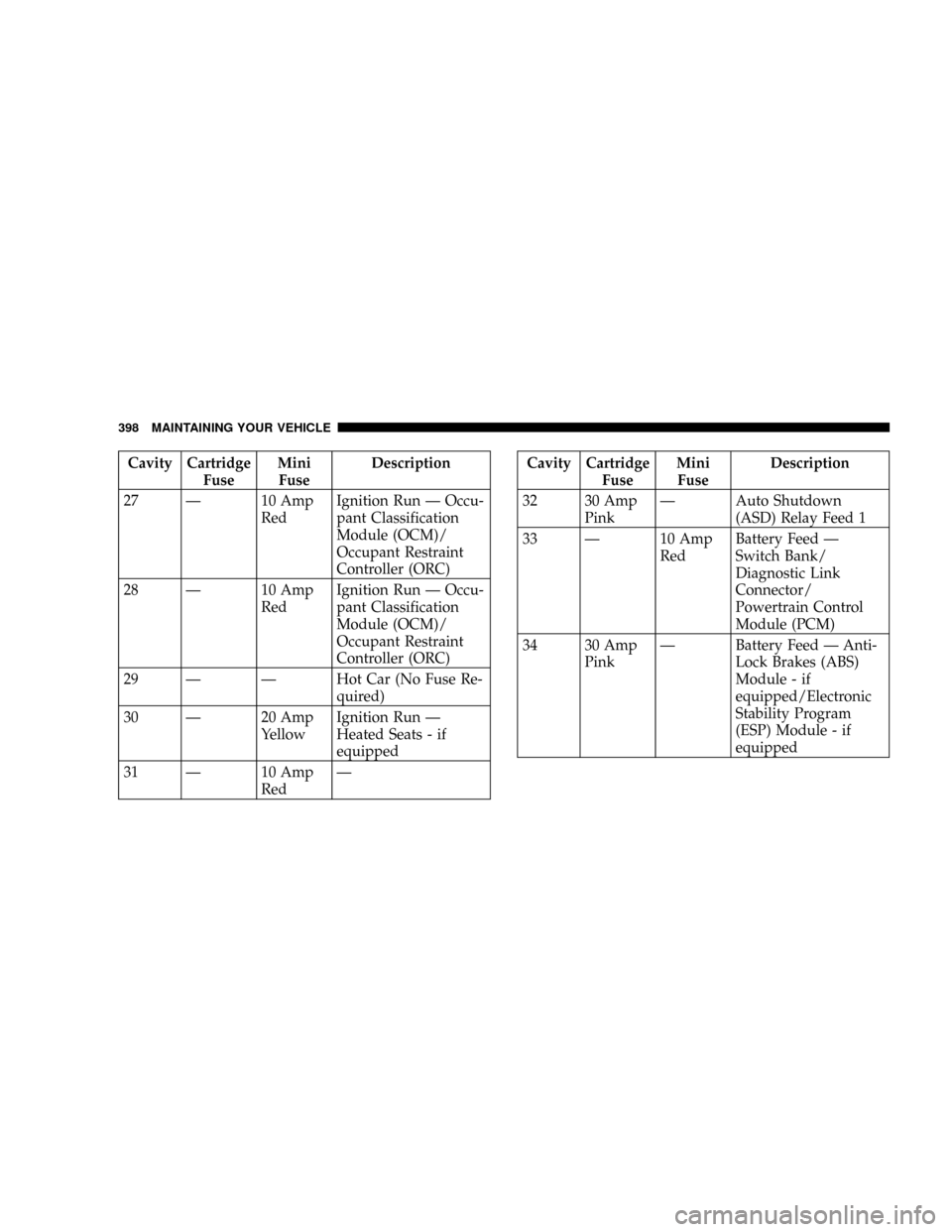
Cavity Cartridge
FuseMini
FuseDescription
27 Ð 10 Amp
RedIgnition Run Ð Occu-
pant Classification
Module (OCM)/
Occupant Restraint
Controller (ORC)
28 Ð 10 Amp
RedIgnition Run Ð Occu-
pant Classification
Module (OCM)/
Occupant Restraint
Controller (ORC)
29 Ð Ð Hot Car (No Fuse Re-
quired)
30 Ð 20 Amp
YellowIgnition Run Ð
Heated Seats - if
equipped
31 Ð 10 Amp
RedÐCavity Cartridge
FuseMini
FuseDescription
32 30 Amp
PinkÐ Auto Shutdown
(ASD) Relay Feed 1
33 Ð 10 Amp
RedBattery Feed Ð
Switch Bank/
Diagnostic Link
Connector/
Powertrain Control
Module (PCM)
34 30 Amp
PinkÐ Battery Feed Ð Anti-
Lock Brakes (ABS)
Module - if
equipped/Electronic
Stability Program
(ESP) Module - if
equipped
398 MAINTAINING YOUR VEHICLE
Page 399 of 454
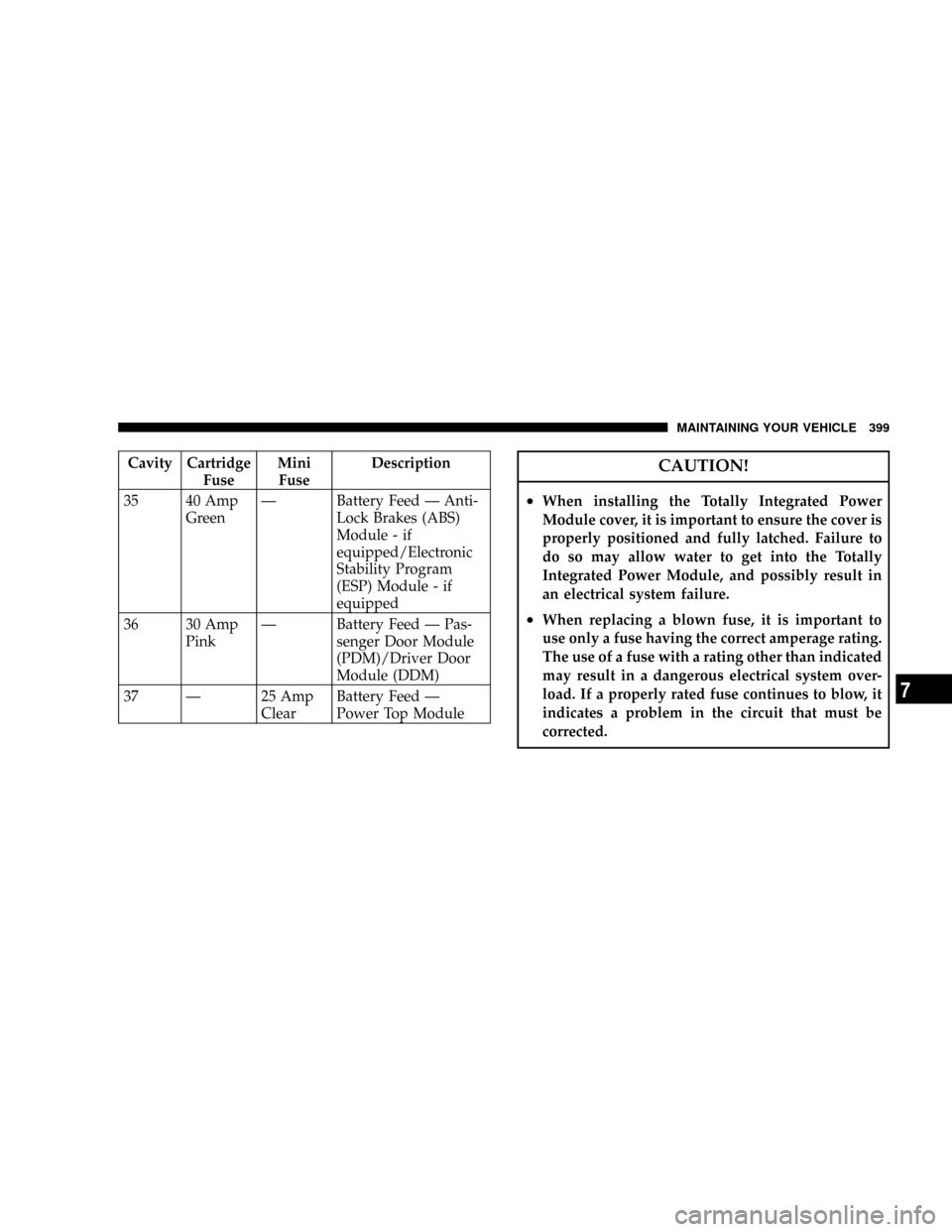
Cavity Cartridge
FuseMini
FuseDescription
35 40 Amp
GreenÐ Battery Feed Ð Anti-
Lock Brakes (ABS)
Module - if
equipped/Electronic
Stability Program
(ESP) Module - if
equipped
36 30 Amp
PinkÐ Battery Feed Ð Pas-
senger Door Module
(PDM)/Driver Door
Module (DDM)
37 Ð 25 Amp
ClearBattery Feed Ð
Power Top ModuleCAUTION!
²When installing the Totally Integrated Power
Module cover, it is important to ensure the cover is
properly positioned and fully latched. Failure to
do so may allow water to get into the Totally
Integrated Power Module, and possibly result in
an electrical system failure.
²When replacing a blown fuse, it is important to
use only a fuse having the correct amperage rating.
The use of a fuse with a rating other than indicated
may result in a dangerous electrical system over-
load. If a properly rated fuse continues to blow, it
indicates a problem in the circuit that must be
corrected.
MAINTAINING YOUR VEHICLE 399
7
Page 400 of 454

VEHICLE STORAGE
If you will not be using your vehicle for more than 21
days you may want to take steps to preserve your battery.
You may:
²Remove the IOD (Ignition Off-Draw) mini fuses from
the Totally Integrated Power Module located in the
engine compartment.
²Or, disconnect the batter negative cable.
REPLACEMENT BULBS
All the inside bulbs are brass or glass wedge base.
Aluminum base bulbs are not approved and should not
be used for replacement.
LIGHT BULBS Ð Interior Bulb Number
Front Courtesy/Reading Lights. . LED (Dealer Service)
Center Console Courtesy Light...........578/W5W
Glove Box Light......................... 194
Rear Compartment (Trunk) Light............. 579NOTE:For lighted switches, see your dealer for replace-
ment instructions.
LIGHTS BULBS Ð Outside Bulb No.
Low Beam Headlight.....................9006
High Beam Headlight.....................9005
Front Park/Turn Signal/Side Marker Light. . . 3457AK
Front Fog Light.....................9145//H10
Center High Mounted Stop Light (CHMSL)....W16W
(921)
Rear Tail/Stop..........................3057
Decklid Tail Light.......................T3.25
Rear Turn Signal.......................3757A
Backup Light..........................3157K
License Light........................... 168
400 MAINTAINING YOUR VEHICLE
Page 416 of 454
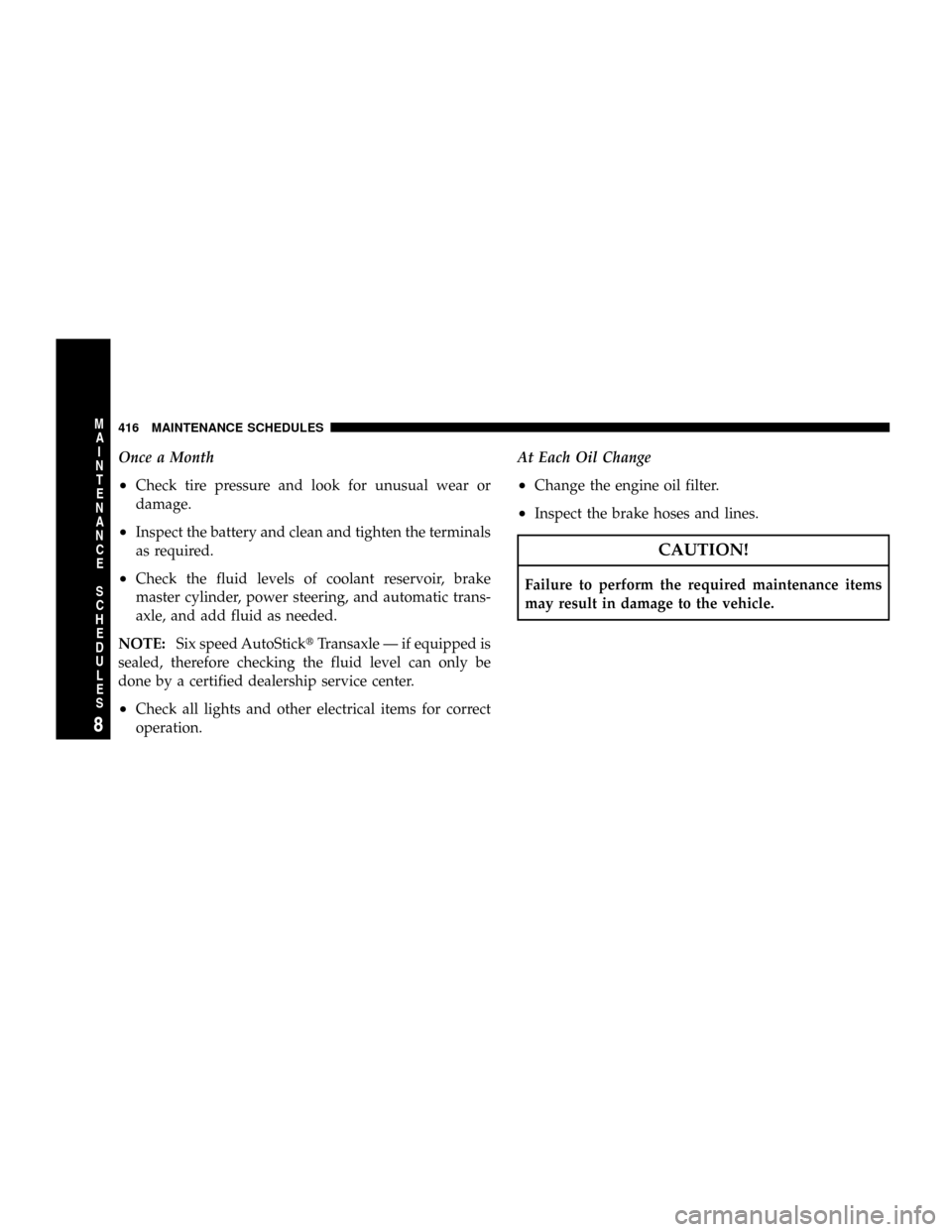
Once a Month
²Check tire pressure and look for unusual wear or
damage.
²Inspect the battery and clean and tighten the terminals
as required.
²Check the fluid levels of coolant reservoir, brake
master cylinder, power steering, and automatic trans-
axle, and add fluid as needed.
NOTE:Six speed AutoSticktTransaxle Ð if equipped is
sealed, therefore checking the fluid level can only be
done by a certified dealership service center.
²Check all lights and other electrical items for correct
operation.At Each Oil Change
²Change the engine oil filter.
²Inspect the brake hoses and lines.
CAUTION!
Failure to perform the required maintenance items
may result in damage to the vehicle.
416 MAINTENANCE SCHEDULES
8
M
A
I
N
T
E
N
A
N
C
E
S
C
H
E
D
U
L
E
S
Page 433 of 454

Automatic Dimming Mirror................. 96
Automatic Door Locks..................... 31
Automatic Headlights.................... 139
Automatic Oil Change Indicator........179,189,414
Automatic Temperature Control (ATC)......... 237
Automatic Transaxle................251,255,384
Adding Fluid...................384,385,412
Filter............................... 386
Fluid and Filter Changes................. 386
Fluid Level Check...................384,385
Interlock System....................256,257
Reset Mode.......................... 261
Selection Of Lubricant................... 412
Shifting............................. 255
Special Additives...................... 386
Autostick............................. 262
Back-Up Lights......................... 404
Ball Joints............................. 372Battery............................... 367
Emergency Starting..................... 344
Gas Caution.......................... 368
Jump Starting......................... 344
Keyless Transmitter Replacement (RKE)....... 26
Location..........................345,367
Bearings.............................. 387
Belts, Drive............................ 365
Belts, Seat............................40,75
Beverage Holder Cooled (Cup Holder)......... 164
Beverage Holder Heated (Cup Holder)........ 164
Body Mechanism Lubrication............... 372
B-Pillar Location........................ 284
Brake Assist System...................... 275
Brake Control System, Electronic............. 275
Brake Fluid............................ 412
Brake, Parking.......................... 264
Brake System........................267,381
Anti-Lock (ABS)....................... 268
INDEX 433
10