fuel CHRYSLER SEBRING COUPE 2004 2.G User Guide
[x] Cancel search | Manufacturer: CHRYSLER, Model Year: 2004, Model line: SEBRING COUPE, Model: CHRYSLER SEBRING COUPE 2004 2.GPages: 382, PDF Size: 2.23 MB
Page 112 of 382
CAUTION!
Do not drive with an extremely low fuel level;
running out of fuel could cause damage to the
catalytic converter.
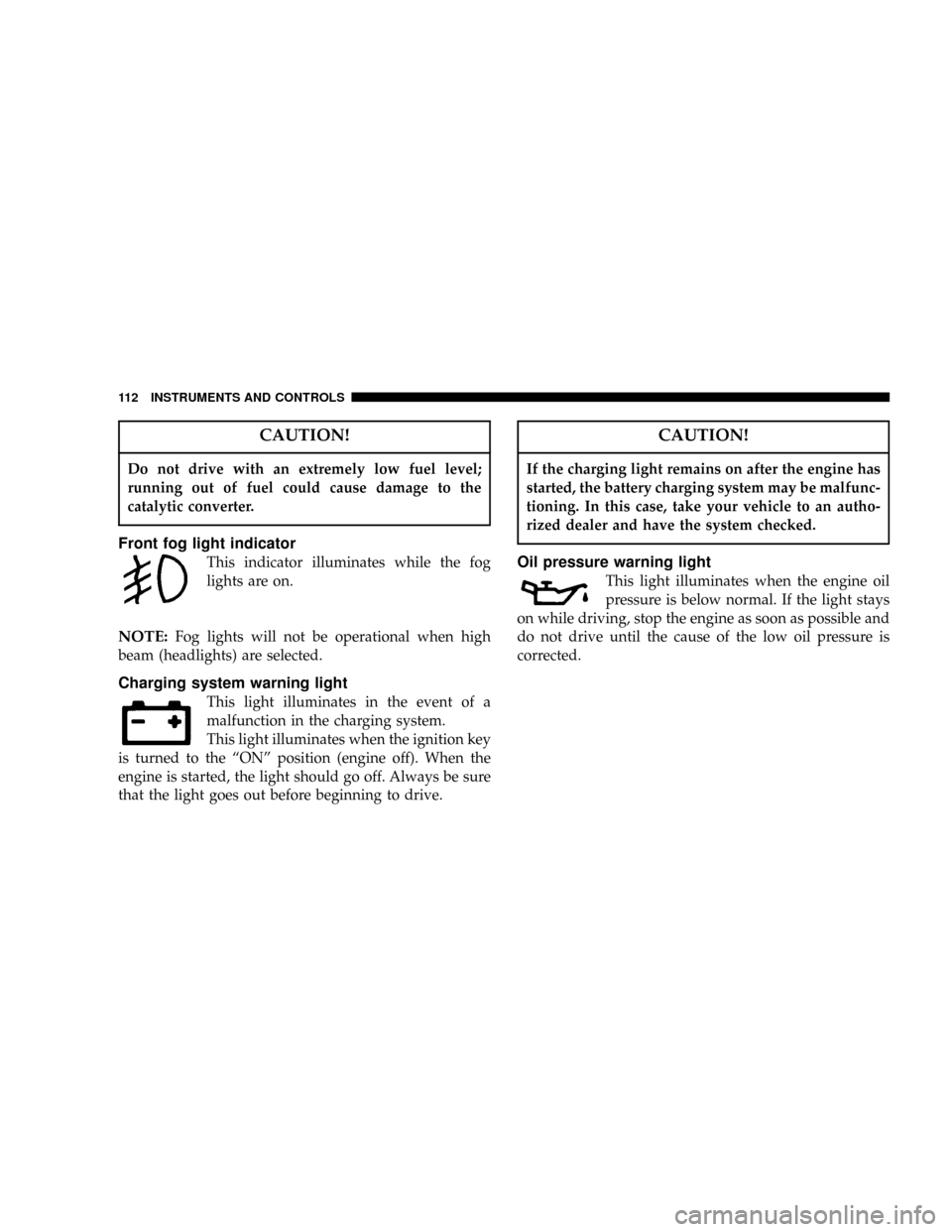
Front fog light indicator
This indicator illuminates while the fog
lights are on.
NOTE:Fog lights will not be operational when high
beam (headlights) are selected.
Charging system warning light
This light illuminates in the event of a
malfunction in the charging system.
This light illuminates when the ignition key
is turned to the ªONº position (engine off). When the
engine is started, the light should go off. Always be sure
that the light goes out before beginning to drive.
CAUTION!
If the charging light remains on after the engine has
started, the battery charging system may be malfunc-
tioning. In this case, take your vehicle to an autho-
rized dealer and have the system checked.
Oil pressure warning light
This light illuminates when the engine oil
pressure is below normal. If the light stays
on while driving, stop the engine as soon as possible and
do not drive until the cause of the low oil pressure is
corrected.
112 INSTRUMENTS AND CONTROLS
Page 114 of 382
CAUTION!
²Prolonged driving with the malfunction indicator
light on may result in further damage to the
emission control system. Continued driving could
also affect fuel economy and driveability.
²If the light does not illuminate when the ignition
key is turned to the ªONº position (bulb check),
have the system checked at an authorized dealer.
NOTE: Do not disconnect the battery cable when the
Malfunction indicator light (SERVICE ENGINE SOON) is
ON.
The engine electronic control module stores critical OBD
data, which may be lost if the battery is disconnected.
This can make rapid diagnosis more difficult.
If the fuel tank filler cap is not secured properly, the
light may come on. Be sure the fuel tank filler tube cap
is tightened every time you add fuel. (Turn the fuel
tank filler cap clockwise until you hear clicking
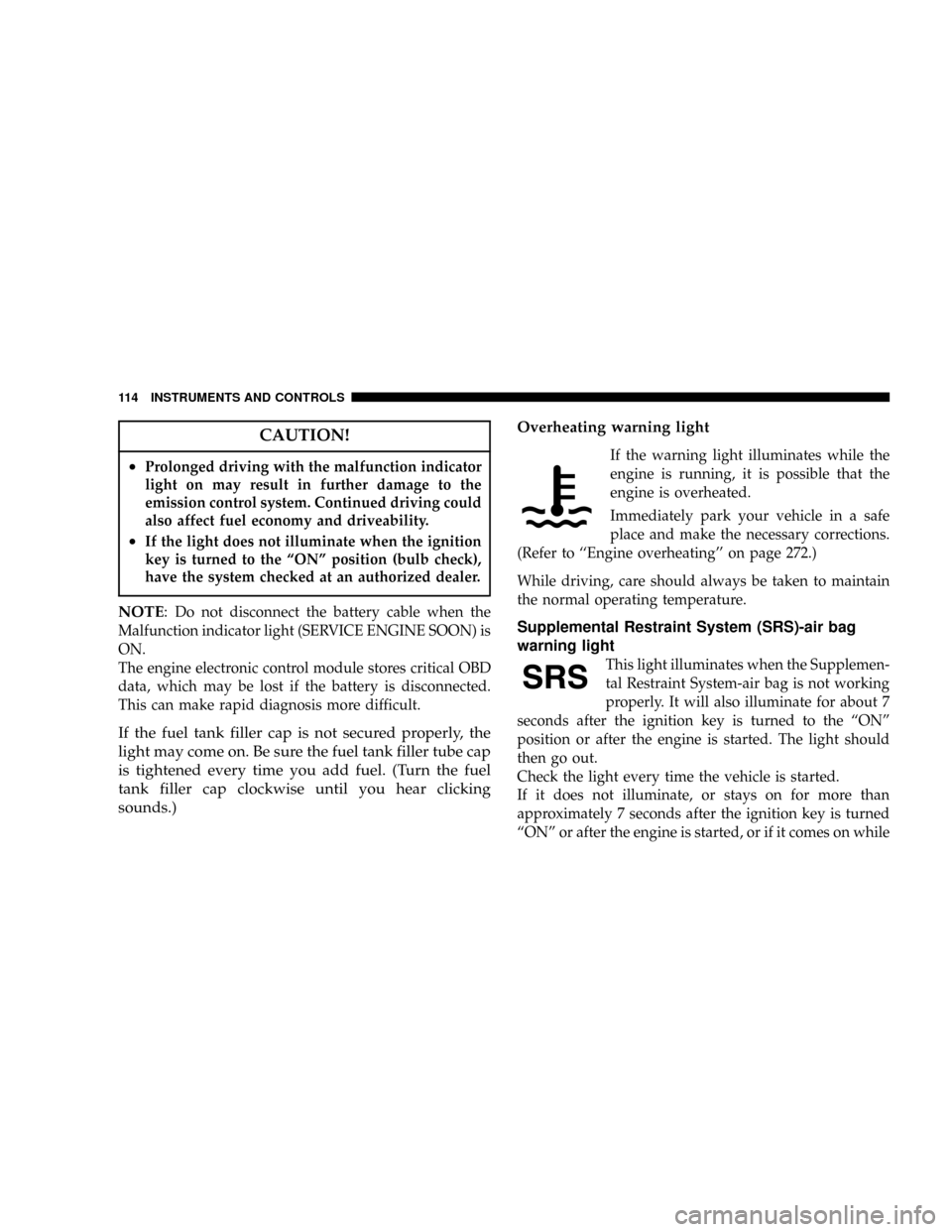
sounds.)Overheating warning light
If the warning light illuminates while the
engine is running, it is possible that the
engine is overheated.
Immediately park your vehicle in a safe
place and make the necessary corrections.
(Refer to ``Engine overheating'' on page 272.)
While driving, care should always be taken to maintain
the normal operating temperature.
Supplemental Restraint System (SRS)-air bag
warning light
This light illuminates when the Supplemen-
tal Restraint System-air bag is not working
properly. It will also illuminate for about 7
seconds after the ignition key is turned to the ªONº
position or after the engine is started. The light should
then go out.
Check the light every time the vehicle is started.
If it does not illuminate, or stays on for more than
approximately 7 seconds after the ignition key is turned
ªONº or after the engine is started, or if it comes on while
114 INSTRUMENTS AND CONTROLS
Page 139 of 382

STARTING AND DRIVING
CONTENTS
mBreak-in recommendations................142
mFuel selection.........................142
NGasoline additives.....................143
NOctane requirement....................143
NReformulated gasoline..................143
NGasoline/Oxygenate blends..............144
NMMT in gasoline......................144
NSulfur in gasoline......................144
NMaterials added to fuel..................145
NAdding fuel..........................145
mFuel economy.........................147
mIgnition switch........................147
mKey reminder chime....................148
mTheft protection........................149
mSteering lock..........................149
mStarting..............................149
NTips for starting.......................149
NNormal conditions.....................150
NFlooded engine.......................151
NAt extremely cold ambient temperature......151
mAutomatic transaxle (if so equipped)........151
NSelector lever operation.................152
5
Page 142 of 382
BREAK-IN RECOMMENDATIONS
Advanced automobile manufacturing techniques permit
you to operate your new vehicle without experiencing a
long break-in period of low-speed driving.
However, you can add to the future performance and
economy of your vehicle by observing the following
precautions during the first 300 miles (500 km).
It is recommended that you drive your vehicle at mod-
erate speeds during the break-in period.
1. Avoid racing the engine.
2. Avoid harsh driving such as fast starts, sudden accel-
eration, prolonged high-speed driving and abrupt appli-
cation of the brakes. These operations not only have a
detrimental effect on the engine but also cause increased
fuel and oil consumption, which could result in malfunc-
tion of engine components. Be particularly careful to
avoid wide-open throttle acceleration in low gear.
3. Do not overload the vehicle. Observe the seating
capacity. (See ªWeightsº page 359)
4. Do not use this vehicle for trailer towing during the
break-in period.
FUEL SELECTION
Your vehicle is designed to use unleaded gasoline only. It
is equipped with a fuel filler tube especially designed to
accept only the smaller diameter unleaded gasoline dis-
pensing nozzle.
WARNING!
Gasoline is highly flammable and explosive. You can
be burned or seriously injured when handling it.
When refueling this vehicle, always turn the engine
off and keep flames, sparks, and smoking materials
away. Always handle fuel in well-ventilated outdoor
areas.
142 STARTING AND DRIVING
Page 143 of 382
CAUTION!
Using leaded gasoline in your vehicle will damage
the engine, catalytic converter, and the oxygen sen-
sors. Further, using leaded gasoline is illegal, and
will void warranty coverage of the engine, catalytic
converter, and oxygen sensors.
Gasoline additives
Many fuel suppliers add detergents to their gasoline to
minimize fuel injector fouling and to control intake valve
deposits. These detergent gasolines are highly recom-
mended for use in your vehicle. They help keep your
engine in tune and your emission control system working
properly.
Octane requirement
2.4 liter engine model
Your vehicle is designed to operate on unleaded gasoline
having a minimum octane rating of 87 [(MON+RON)/2],
or 91 RON.
3.0 liter engine model
Your vehicle is designed to operate on regular grade
unleaded gasoline having a minimum octane rating of 87
[(MON+RON)/2], or 91 RON. If optimum performance
is wanted, it is recommended to use premium grade
unleaded gasoline having an octane rating of 91
[(MON+RON)/2], or 95 RON.
MON: Motor Octane Number
RON: Research Octane Number
Reformulated Gasoline
Many areas of the country require the use of cleaner
burning fuel referred to as ªReformulated Gasolineº.
Reformulated gasolines contain oxygenates, and are spe-
cially blended to reduce vehicle emissions and improve
air quality.
The manufacturer supports the use of reformulated gaso-
lines. Properly blended reformulated gasolines will pro-
vide excellent performance and durability of engine and
fuel system components.
STARTING AND DRIVING 143
5
Page 144 of 382

Gasoline/Oxygenate Blends
Some fuel suppliers blend unleaded gasoline with mate-
rials called oxygenates such as 10% ethanol, MTBE and
ETBE. Oxygenates are required in some areas of the
country during the winter months to reduce carbon
monoxide emissions. Fuels blended with these oxygen-
ates may be used in your vehicle.
CAUTION!
DO NOT use gasolines containing Methanol. Use of
these blends may result in starting and driveability
problems and may damage critical fuel system com-
ponents.
Problems that result from using methanol/gasoline
blends are not the responsibility of DaimlerChrysler Cor-
poration and may not be covered by the vehicle warranty.
While MTBE is an oxygenate made from Methanol, it does
not have the negative effects of Methanol.
MMT in Gasoline
MMT is a manganese containing metallic additive that is
blended into some gasoline to increase the octane num-
ber. Gasolines blended with MMT offer no performance
advantage over gasolines of the same octane number that
do not contain MMT. Gasolines blended with MMT have
shown to reduce spark plug life and reduce emission
system performance in some vehicles. DaimlerChrysler
Corporation recommends using gasolines without MMT.
Since the MMT content of gasoline may not be indicated
on the pump, you should ask your gasoline retailer
whether or not his/her gasoline contains MMT.
It is even more important to look for gasolines without
MMT in Canada because MMT can be used at higher
levels than allowed in the United States.
MMT is prohibited in both Federal and California refor-
mulated gasolines.
Sulfur in Gasoline
If you live in the Northeast United States, your vehicle
may have been designed to meet California low emission
standards with cleaner burning California reformulated
gasoline with low sulfur. If such fuels are not available in
144 STARTING AND DRIVING
Page 145 of 382
states adopting California emission standards, your ve-
hicle will operate satisfactorily on fuels meeting Federal
specifications, but emission control system performance
may be adversely affected.
Gasoline sold outside of California is permitted to have
higher sulfur levels which may affect the performance of
the vehicle's catalytic converter. This may cause the
Check Engine Light to illuminate. The manufacturer
recommends that you try a different brand of unleaded
gasoline having lower sulfur to determine if the problem
is fuel related prior to returning your vehicle to an
authorized dealer for service.
CAUTION!
If the Malfunction Indicator Light (Service Engine
Soon) is flashing, immediate service is required. See
the On Board Diagnostics paragraph in the Mainte-
nance section of this manual.
Materials Added to Fuel
All gasoline sold in the United States is required to
contain effective detergent additives. Use of additional
detergents or other additives is not needed under normal
conditions and would result in additional cost. Therefore
you should not have to add anything to the fuel.
Adding Fuel
NOTE:
The fuel tank filler tube has a restricting door
about 2 inches (50 mm) down from the opening. If fuel is
poured from a portable container, the container should
have a flexible nozzle long enough to force open the
restricting door.
CAUTION!
To avoid fuel spillage and overfilling, do not ªtop
offº the fuel tank after filling.
NOTE:When the fuel nozzle ªclicksº or shuts off, the
fuel tank is full.
STARTING AND DRIVING 145
5
Page 146 of 382
NOTE:Tighten the gas cap until you hear a ªclickingº
sound. This is an indication that the gas cap is properly
tightened.
The Malfunction Indicator Light (ªSERVICE ENGINE
SOONº) will come on if the gas cap is not properly
secured. Make sure that the gas cap is tightened each
time the vehicle is refueled.
WARNING!
A fire may result if gasoline is pumped into a
portable container that is inside of a vehicle. You
could be burned. Always place gas containers on the
ground while filling.
Fuel Filler Cap (Gas Cap)
The gas cap is behind the fuel filler door, on the passen-
ger's side of the vehicle. If the gas cap is lost or damaged,
be sure the replacement cap is for use with this vehicle.
CAUTION!
Damage to the fuel system or emission control
system could result from using an improper fuel
tank filler tube cap (gas cap). A poorly fitting cap
could let impurities into the fuel system.
CAUTION!
A poorly fitting gas cap may cause the Malfunction
Indicator Light (ªSERVICE ENGINE SOONº) to
turn on.
WARNING!
²Never have any smoking materials lit in or near
the vehicle when the gas cap is removed or the
tank filled.
²Never add fuel to the vehicle when the engine is
running.
146 STARTING AND DRIVING
Page 147 of 382

FUEL ECONOMY
Fuel economy is dependent on many factors. Your per-
sonal driving habits can have a significant effect on your
fuel economy. Several recommendations for achieving
maximum fuel economy are listed below.
1. When pulling away from traffic lights or stop signs,
accelerate slowly and smoothly.
2. When parked for even a short period, do not idle the
engine. Shut it off.
3. Plan your trips to avoid unnecessary stops.
4. Keep your tires inflated to the recommended pres-
sures.
5. For freeway driving, maintain a constant speed within
the posted limits when traffic, roadway and weather
conditions safely permit, for the best fuel economy.
6. Keep your air filter clean and your vehicle lubricated
according to the recommendations in this manual.
7. Keep your vehicle ªtuned-upº.
An out-of-tune engine wastes fuel and costs money.
8. Reduce excess vehicle load.
IGNITION SWITCH
LOCK
For vehicles with a manual transaxle, when removing the
key, push the key in at the ªACCº position and keep it
depressed until it is turned to the ªLOCKº position, and
remove the key.
For vehicles with an automatic transaxle: When remov-
ing the key, first set the gear selector lever to the ªPº
(PARK) position, and then turn the key to ªLOCKº and
remove it.
I21A0230
STARTING AND DRIVING 147
5
Page 149 of 382
THEFT PROTECTION
CAUTION!
Always remove the key from the ignition switch and
lock all doors when leaving the vehicle unattended.
Always try to park your vehicle in a well lighted
area.
The ignition key can only be removed in the ªLOCKº
position. If the key is left in the lock cylinder, a warning
chime sounds when the driver's door is opened.
NOTE: If your vehicle is equipped with a Theft-alarm
system, refer to ªTheft-alarm systemº.
STEERING LOCK
Withdraw the key and the steering wheel will be locked.
Turn the steering wheel to confirm that it is locked.
CAUTION!
If your vehicle needs to be towed, turn the key to the
(ACC(position to unlock the steering wheel.
STARTING
Tips for starting
1. Do not operate the starter motor continuously for
longer than 15 seconds at a time; doing so could run
down the battery. If the engine does not start, turn the
ignition switch back to ªLOCKº, wait a few seconds, and
then try again.
2. If the engine will not start because the battery is weak
or dead, refer to ªJump-starting the engineº section (page
273) for instructions on starting the engine.
3. The engine is well warmed up if the pointer of the
coolant temperature gauge starts to move. Extended
warm up operation will result in excessive fuel consump-
tion.
STARTING AND DRIVING 149
5