fuel CHRYSLER SEBRING COUPE 2004 2.G Owner's Guide
[x] Cancel search | Manufacturer: CHRYSLER, Model Year: 2004, Model line: SEBRING COUPE, Model: CHRYSLER SEBRING COUPE 2004 2.GPages: 382, PDF Size: 2.23 MB
Page 308 of 382
EMISSIONS TESTING
In some localities, it may be or will become a legal
requirement to ensure that all emissions components and
systems are functioning properly as a part of the test
procedure. The test center accomplishes this by checking
the On Board Diagnostic System system (OBD) with an
electronic scan tool. If your vehicle has recently been
serviced, the OBD system may have been reset to a9not
ready9condition because the OBD system has not had
sufficient time since the servicing to reconfirm that
emissions components are operating properly. In most
cases, a reasonable mix and amount of normal city and
highway driving and at least one overnight-off period
will be required to prepare your vehicle for this check;
however your DaimlerChrysler Motors Corporation
dealer has the equipment and procedures required to
make certain that the OBD system of your vehicle is
ready for the required testing.
ONBOARD DIAGNOSTIC SYSTEM (OBD II)
To meet new government regulations and promote
cleaner air, your vehicle is equipped with a sophisticated
onboard diagnostic system called OBD II. This systemmonitors the performance of the emissions, engine, and
automatic transaxle control systems. When these systems
are operating properly, your vehicle will provide excel-
lent performance and fuel economy, as well as engine
emissions well within current government regulations.
If any of these systems require service, the
OBD II system will turn on the Malfunction
Indicator Light. It will also store diagnostic
codes and other information to assist your
service technician in making repairs. Al-
though your vehicle will usually be driveable and not
need towing, see your dealer for service as soon as
possible.
CAUTION!
Prolonged driving with the light on could cause
further damage to the emission control system. It
could also affect fuel economy and driveability. The
vehicle must be serviced before any state emissions
tests can be performed.
308 MAINTENANCE
Page 309 of 382

If the light is flashing, severe catalytic converter damage
and power loss will soon occur. Immediate service is
required.
If the gas cap is not tightened properly, the light may
come on. Be sure the gas cap is tightened every time you
add fuel. Tighten the cap until you hear it ªclick.º
REPLACEMENT PARTS
Use of genuine Mopar parts for normal/scheduled main-
tenance and repairs is highly recommended to insure the
designed performance. Damage or failures caused by the
use of non-Mopar parts for maintenance and repairs will
not be covered by the DaimlerChrysler Motors Corpora-
tion warranty.
Fuel system (tank, filler tube, connections, and
fuel tank filler cap)
Check periodically for damage or leakage in the fuel lines
and connections, and check for damage and looseness of
the fuel tank filler tube cap. Particular attention should be
paid to examining those fuel lines nearest to high heat
sources such as the exhaust manifold.
WARNING!
If you see a fuel leak or if you smell fuel, do not
operate the vehicle. Any spark (including from the
ignition ), flame or smoking material could cause an
explosion or fire. Call an authorized dealer for
assistance.
Fuel hoses
Inspect the surfaces of hoses for evidence of heat and
mechanical damage, hard and brittle rubber, cracking,
tears, cuts and abrasions. Particular attention should be
paid to examining those hose surfaces nearest to high
heat sources such as the exhaust manifold. Inspect all
hose connections, such as clamps and couplings, to make
sure they are secure and that no leaks exist. If there is any
evidence of deterioration or damage, hoses should be
replaced immediately.
MAINTENANCE 309
9
Page 310 of 382
Air cleaner filter
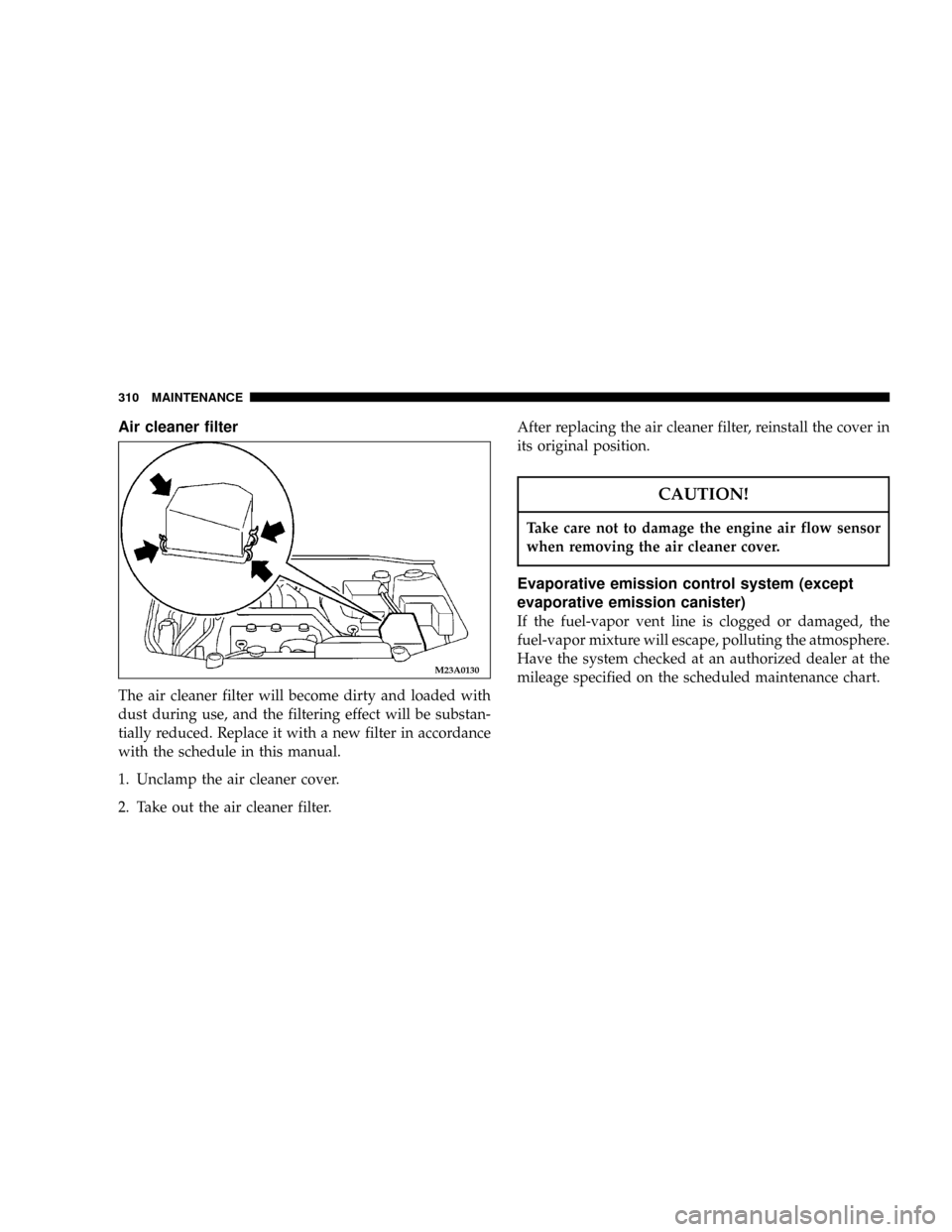
The air cleaner filter will become dirty and loaded with
dust during use, and the filtering effect will be substan-
tially reduced. Replace it with a new filter in accordance
with the schedule in this manual.
1. Unclamp the air cleaner cover.
2. Take out the air cleaner filter.After replacing the air cleaner filter, reinstall the cover in
its original position.
CAUTION!
Take care not to damage the engine air flow sensor
when removing the air cleaner cover.
Evaporative emission control system (except
evaporative emission canister)
If the fuel-vapor vent line is clogged or damaged, the
fuel-vapor mixture will escape, polluting the atmosphere.
Have the system checked at an authorized dealer at the
mileage specified on the scheduled maintenance chart.
M23A0130
310 MAINTENANCE
Page 315 of 382
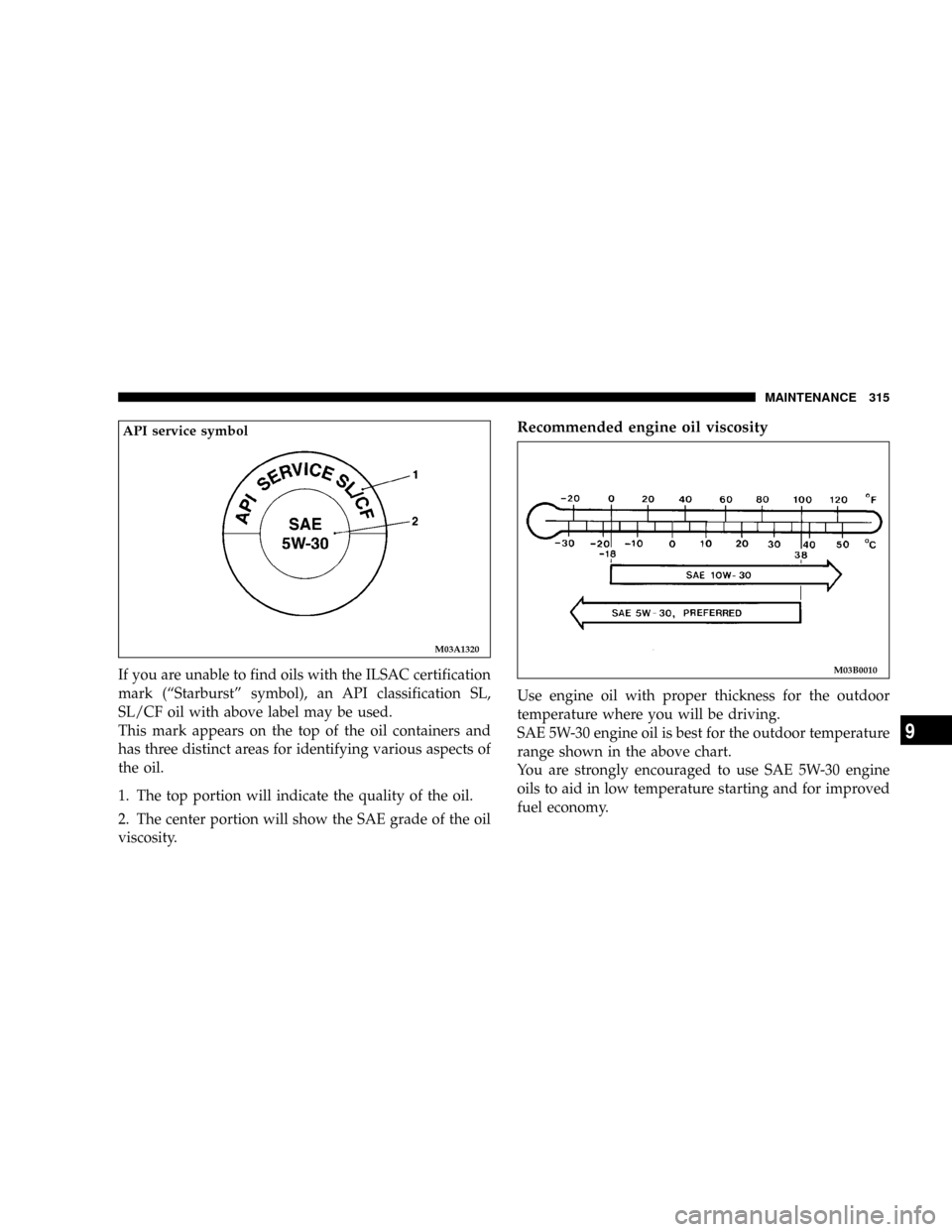
If you are unable to find oils with the ILSAC certification
mark (ªStarburstº symbol), an API classification SL,
SL/CF oil with above label may be used.
This mark appears on the top of the oil containers and
has three distinct areas for identifying various aspects of
the oil.
1. The top portion will indicate the quality of the oil.
2. The center portion will show the SAE grade of the oil
viscosity.
Recommended engine oil viscosity
Use engine oil with proper thickness for the outdoor
temperature where you will be driving.
SAE 5W-30 engine oil is best for the outdoor temperature
range shown in the above chart.
You are strongly encouraged to use SAE 5W-30 engine
oils to aid in low temperature starting and for improved
fuel economy.
M03A1320
API service symbol
M03B0010
MAINTENANCE 315
9
Page 328 of 382
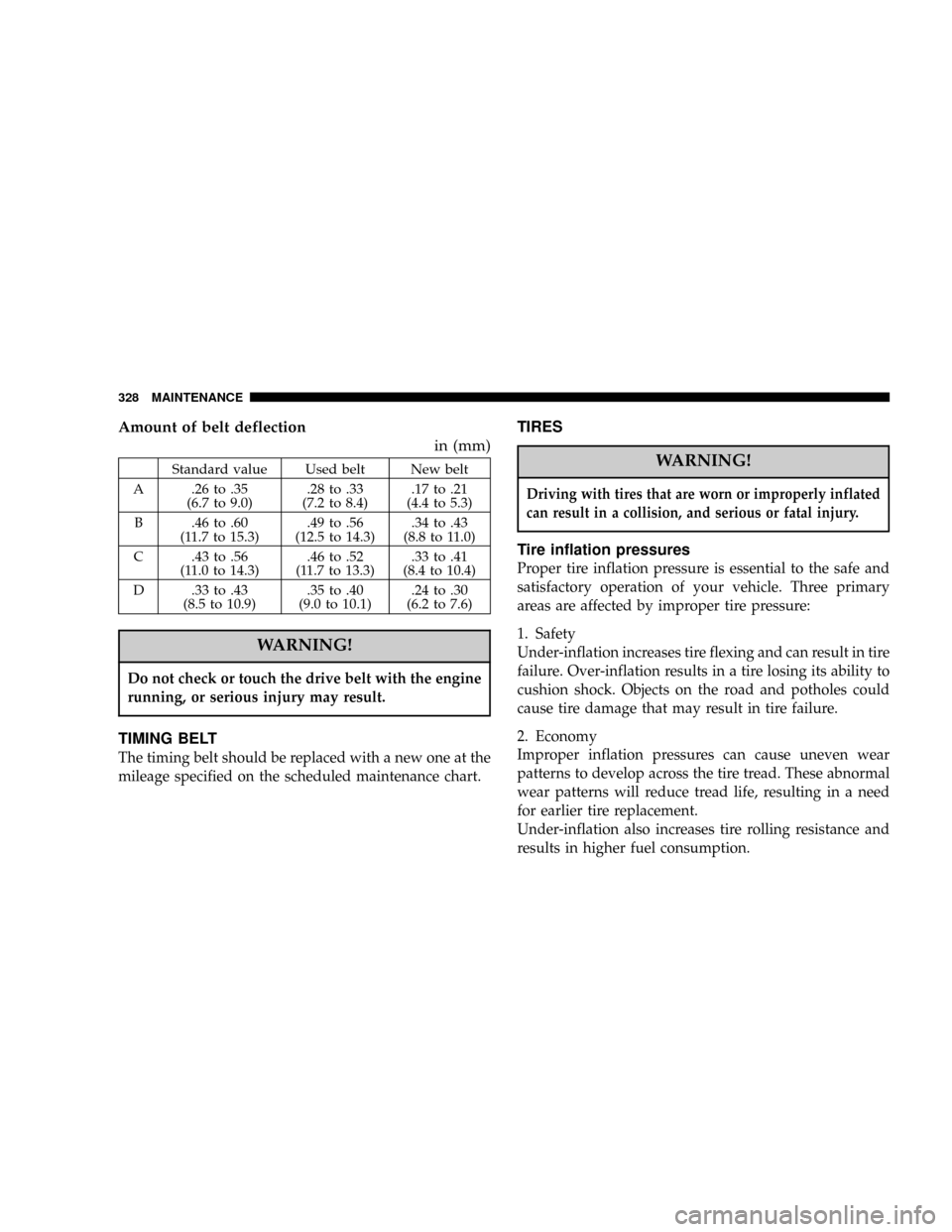
Amount of belt deflection
in (mm)
Standard value Used belt New belt
A .26 to .35
(6.7 to 9.0).28 to .33
(7.2 to 8.4).17 to .21
(4.4 to 5.3)
B .46 to .60
(11.7 to 15.3).49 to .56
(12.5 to 14.3).34 to .43
(8.8 to 11.0)
C .43 to .56
(11.0 to 14.3).46 to .52
(11.7 to 13.3).33 to .41
(8.4 to 10.4)
D .33 to .43
(8.5 to 10.9).35 to .40
(9.0 to 10.1).24 to .30
(6.2 to 7.6)
WARNING!
Do not check or touch the drive belt with the engine
running, or serious injury may result.
TIMING BELT
The timing belt should be replaced with a new one at the
mileage specified on the scheduled maintenance chart.
TIRES
WARNING!
Driving with tires that are worn or improperly inflated
can result in a collision, and serious or fatal injury.
Tire inflation pressures
Proper tire inflation pressure is essential to the safe and
satisfactory operation of your vehicle. Three primary
areas are affected by improper tire pressure:
1. Safety
Under-inflation increases tire flexing and can result in tire
failure. Over-inflation results in a tire losing its ability to
cushion shock. Objects on the road and potholes could
cause tire damage that may result in tire failure.
2. Economy
Improper inflation pressures can cause uneven wear
patterns to develop across the tire tread. These abnormal
wear patterns will reduce tread life, resulting in a need
for earlier tire replacement.
Under-inflation also increases tire rolling resistance and
results in higher fuel consumption.
328 MAINTENANCE
Page 329 of 382
3. Ride comfort and vehicle stability
Proper tire inflation pressures contribute to the excellent
ride quality built into your vehicle. Over-inflation pro-
duces an uncomfortable and jarring ride.
Under-inflation can produce a feeling of sluggish re-
sponse.
Unequal inflation pressures can produce erratic and
unpredictable vehicle response to steering maneuvers.
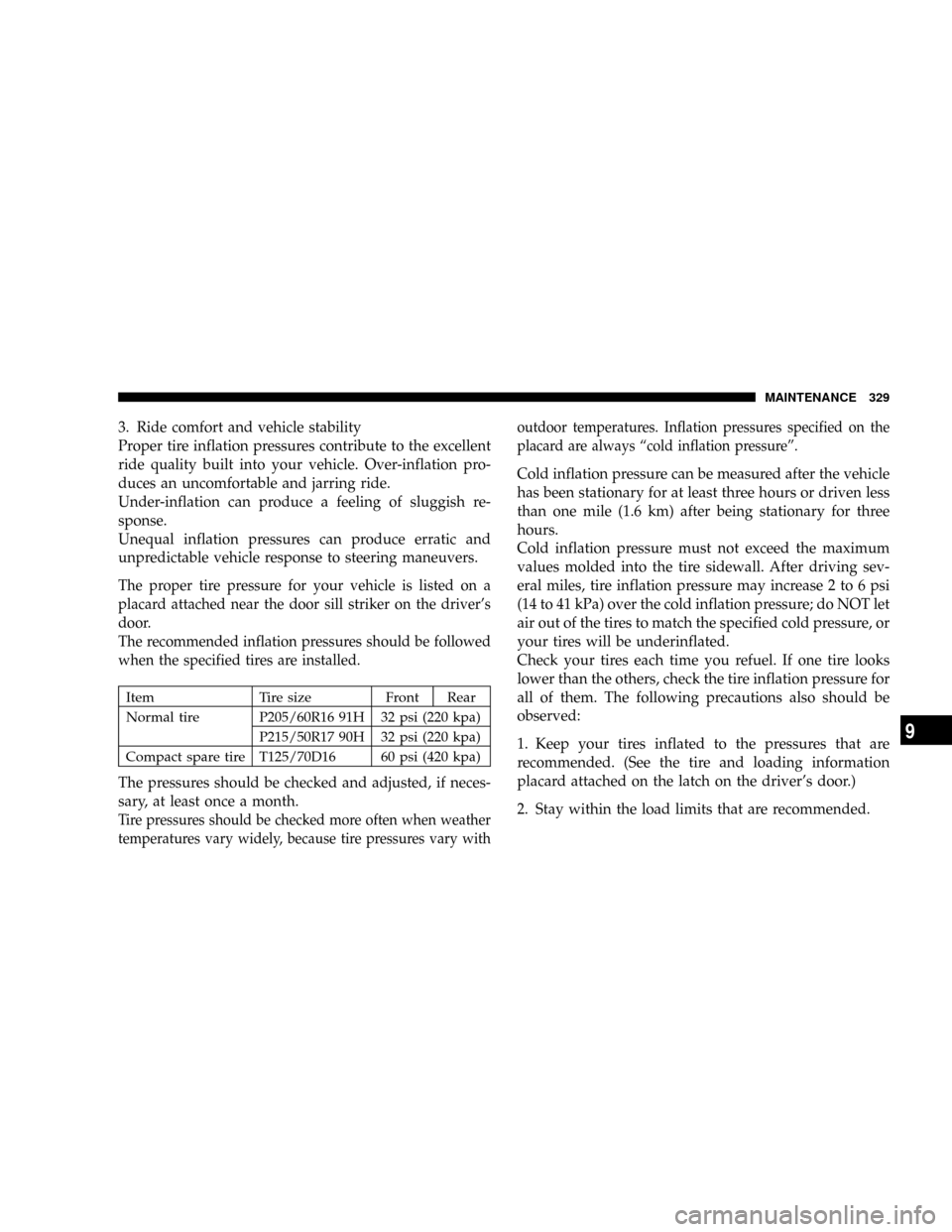
The proper tire pressure for your vehicle is listed on a
placard attached near the door sill striker on the driver's
door.
The recommended inflation pressures should be followed
when the specified tires are installed.
Item Tire size Front Rear
Normal tire P205/60R16 91H 32 psi (220 kpa)
P215/50R17 90H 32 psi (220 kpa)
Compact spare tire T125/70D16 60 psi (420 kpa)
The pressures should be checked and adjusted, if neces-
sary, at least once a month.
Tire pressures should be checked more often when weather
temperatures vary widely, because tire pressures vary withoutdoor temperatures. Inflation pressures specified on the
placard are always ªcold inflation pressureº.
Cold inflation pressure can be measured after the vehicle
has been stationary for at least three hours or driven less
than one mile (1.6 km) after being stationary for three
hours.
Cold inflation pressure must not exceed the maximum
values molded into the tire sidewall. After driving sev-
eral miles, tire inflation pressure may increase 2 to 6 psi
(14 to 41 kPa) over the cold inflation pressure; do NOT let
air out of the tires to match the specified cold pressure, or
your tires will be underinflated.
Check your tires each time you refuel. If one tire looks
lower than the others, check the tire inflation pressure for
all of them. The following precautions also should be
observed:
1. Keep your tires inflated to the pressures that are
recommended. (See the tire and loading information
placard attached on the latch on the driver's door.)
2. Stay within the load limits that are recommended.
MAINTENANCE 329
9
Page 336 of 382
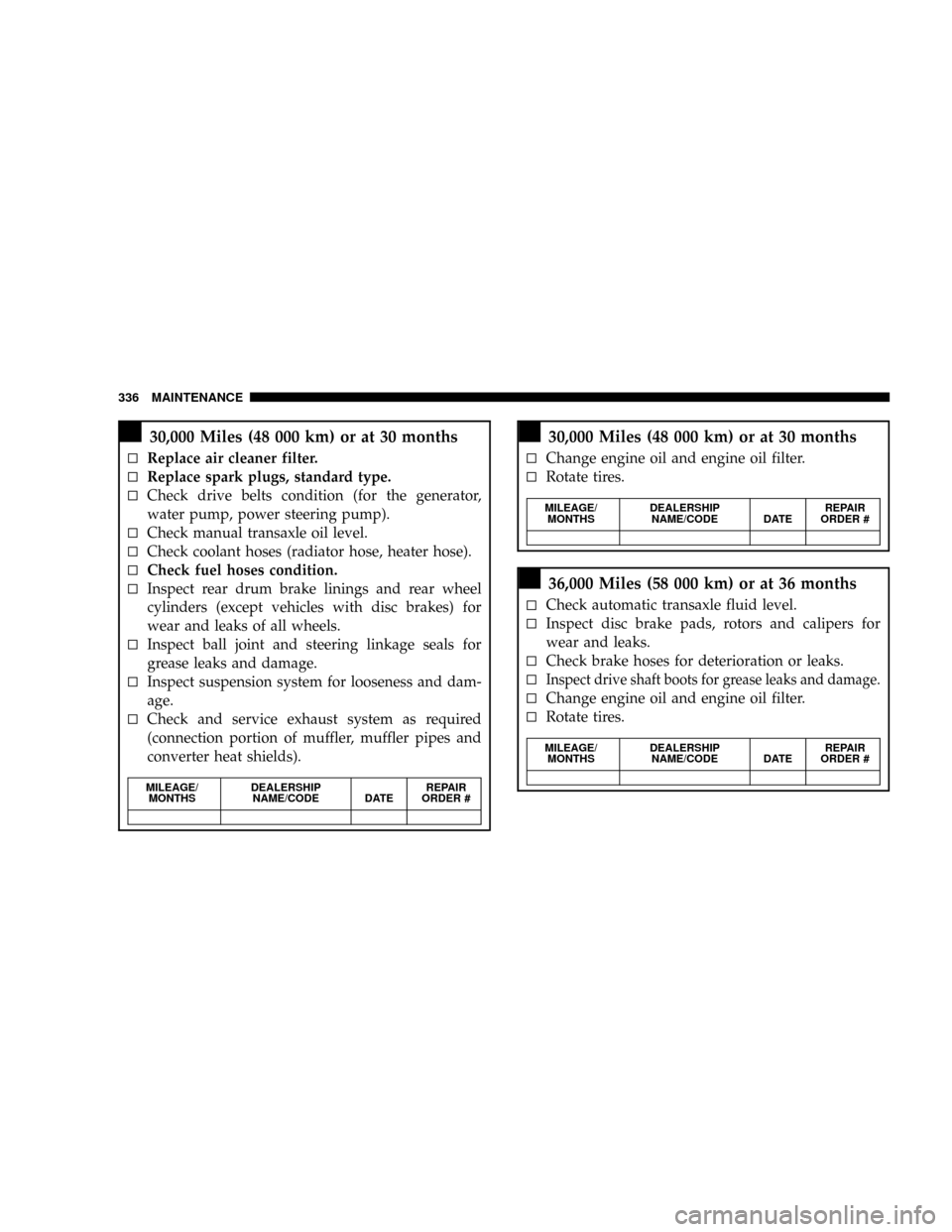
!30,000 Miles (48 000 km) or at 30 months
NReplace air cleaner filter.
NReplace spark plugs, standard type.
NCheck drive belts condition (for the generator,
water pump, power steering pump).
NCheck manual transaxle oil level.
NCheck coolant hoses (radiator hose, heater hose).
NCheck fuel hoses condition.
NInspect rear drum brake linings and rear wheel
cylinders (except vehicles with disc brakes) for
wear and leaks of all wheels.
NInspect ball joint and steering linkage seals for
grease leaks and damage.
NInspect suspension system for looseness and dam-
age.
NCheck and service exhaust system as required
(connection portion of muffler, muffler pipes and
converter heat shields).
MILEAGE/
MONTHSDEALERSHIP
NAME/CODE DATEREPAIR
ORDER #
!30,000 Miles (48 000 km) or at 30 months
NChange engine oil and engine oil filter.
NRotate tires.
MILEAGE/
MONTHSDEALERSHIP
NAME/CODE DATEREPAIR
ORDER #
!36,000 Miles (58 000 km) or at 36 months
NCheck automatic transaxle fluid level.
NInspect disc brake pads, rotors and calipers for
wear and leaks.
NCheck brake hoses for deterioration or leaks.
NInspect drive shaft boots for grease leaks and damage.
NChange engine oil and engine oil filter.
NRotate tires.
MILEAGE/
MONTHSDEALERSHIP
NAME/CODE DATEREPAIR
ORDER #
336 MAINTENANCE
Page 338 of 382
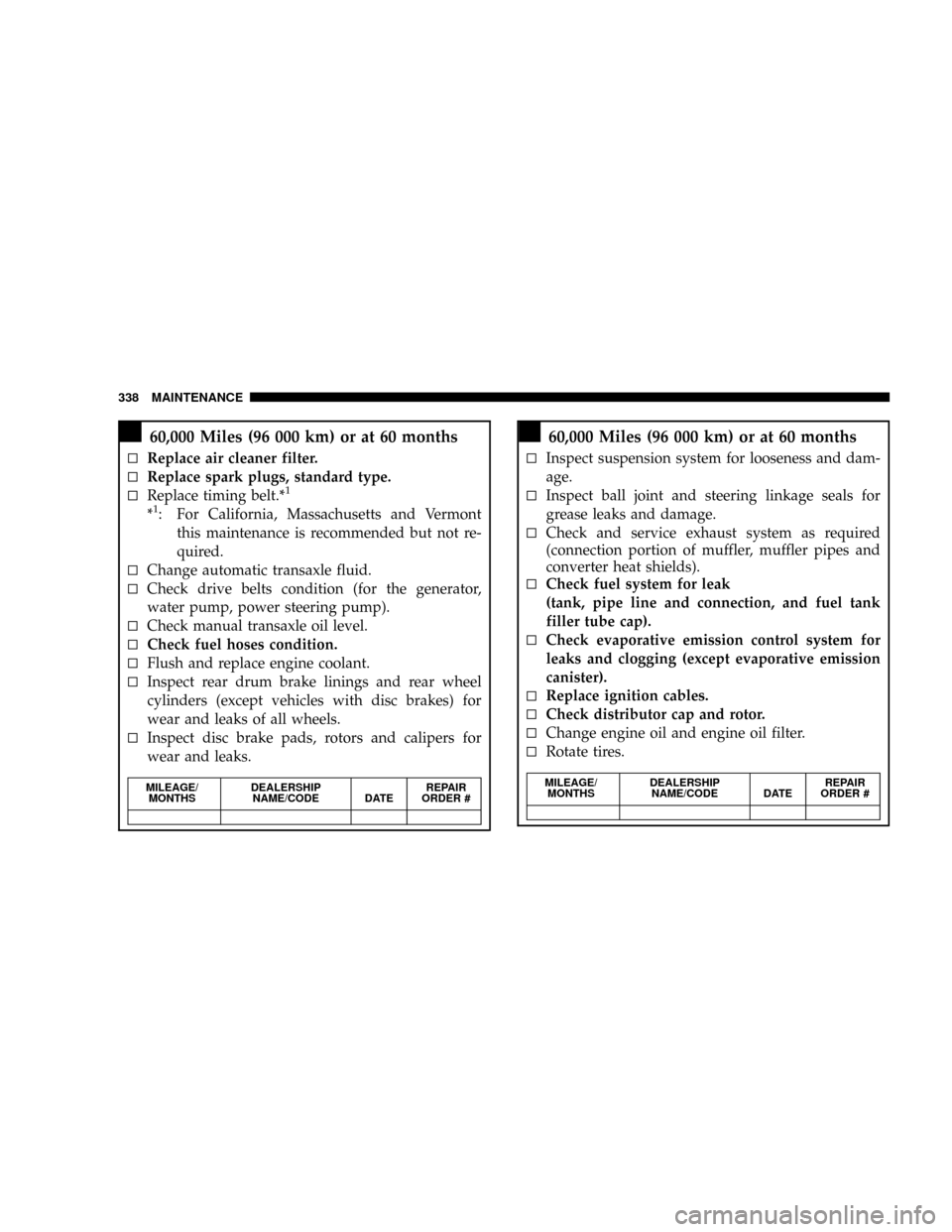
!60,000 Miles (96 000 km) or at 60 months
NReplace air cleaner filter.
NReplace spark plugs, standard type.
NReplace timing belt.*1
*1: For California, Massachusetts and Vermont
this maintenance is recommended but not re-
quired.
NChange automatic transaxle fluid.
NCheck drive belts condition (for the generator,
water pump, power steering pump).
NCheck manual transaxle oil level.
NCheck fuel hoses condition.
NFlush and replace engine coolant.
NInspect rear drum brake linings and rear wheel
cylinders (except vehicles with disc brakes) for
wear and leaks of all wheels.
NInspect disc brake pads, rotors and calipers for
wear and leaks.
MILEAGE/
MONTHSDEALERSHIP
NAME/CODE DATEREPAIR
ORDER #
!60,000 Miles (96 000 km) or at 60 months
NInspect suspension system for looseness and dam-
age.
NInspect ball joint and steering linkage seals for
grease leaks and damage.
NCheck and service exhaust system as required
(connection portion of muffler, muffler pipes and
converter heat shields).
NCheck fuel system for leak
(tank, pipe line and connection, and fuel tank
filler tube cap).
NCheck evaporative emission control system for
leaks and clogging (except evaporative emission
canister).
NReplace ignition cables.
NCheck distributor cap and rotor.
NChange engine oil and engine oil filter.
NRotate tires.
MILEAGE/
MONTHSDEALERSHIP
NAME/CODE DATEREPAIR
ORDER #
338 MAINTENANCE
Page 340 of 382
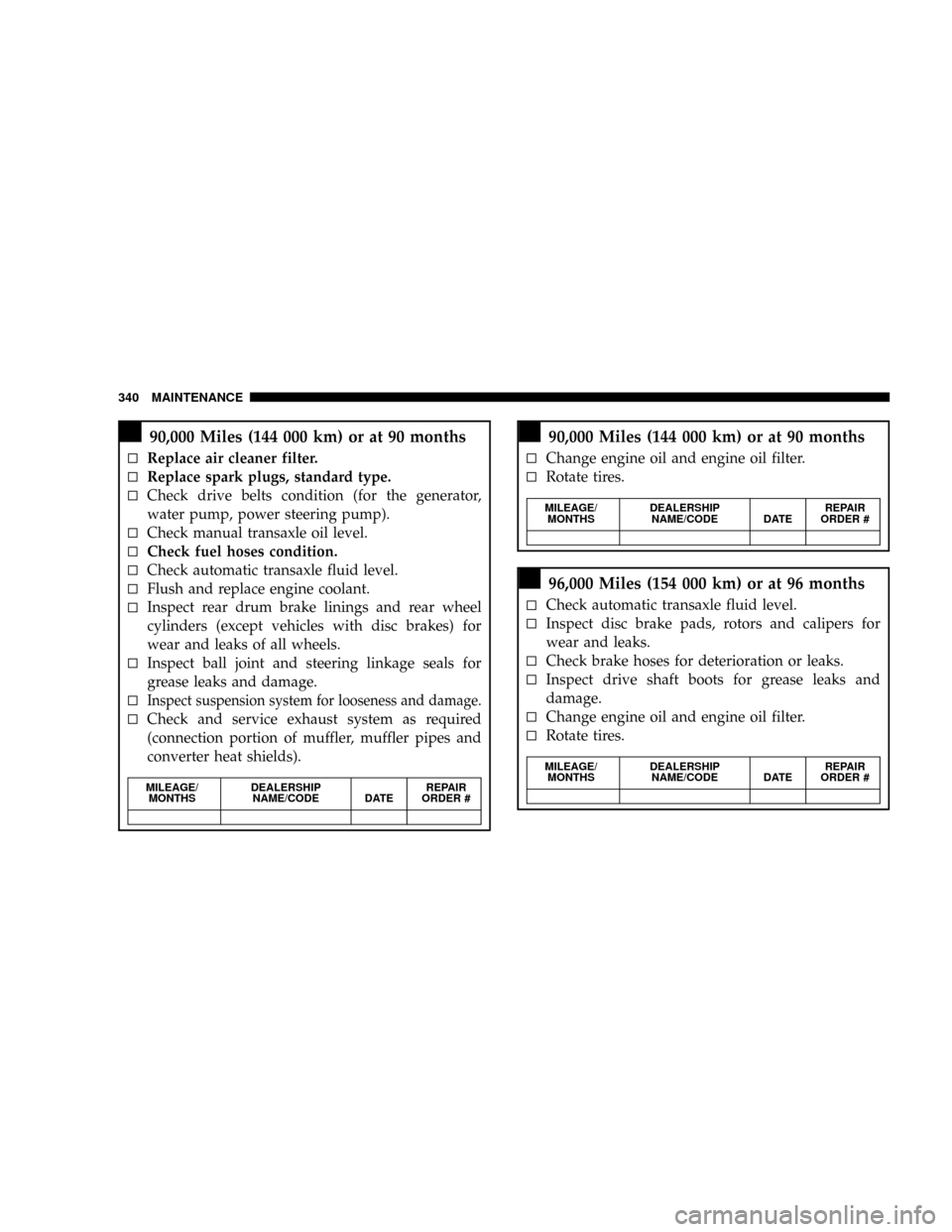
!90,000 Miles (144 000 km) or at 90 months
NReplace air cleaner filter.
NReplace spark plugs, standard type.
NCheck drive belts condition (for the generator,
water pump, power steering pump).
NCheck manual transaxle oil level.
NCheck fuel hoses condition.
NCheck automatic transaxle fluid level.
NFlush and replace engine coolant.
NInspect rear drum brake linings and rear wheel
cylinders (except vehicles with disc brakes) for
wear and leaks of all wheels.
NInspect ball joint and steering linkage seals for
grease leaks and damage.
NInspect suspension system for looseness and damage.
NCheck and service exhaust system as required
(connection portion of muffler, muffler pipes and
converter heat shields).
MILEAGE/
MONTHSDEALERSHIP
NAME/CODE DATEREPAIR
ORDER #
!90,000 Miles (144 000 km) or at 90 months
NChange engine oil and engine oil filter.
NRotate tires.
MILEAGE/
MONTHSDEALERSHIP
NAME/CODE DATEREPAIR
ORDER #
!96,000 Miles (154 000 km) or at 96 months
NCheck automatic transaxle fluid level.
NInspect disc brake pads, rotors and calipers for
wear and leaks.
NCheck brake hoses for deterioration or leaks.
NInspect drive shaft boots for grease leaks and
damage.
NChange engine oil and engine oil filter.
NRotate tires.
MILEAGE/
MONTHSDEALERSHIP
NAME/CODE DATEREPAIR
ORDER #
340 MAINTENANCE
Page 341 of 382

!102,000 Miles (163 000 km) or at 102 months
NReplace spark plugs, platinum-tipped type.
NReplace timing belt.*2
*2: Not required if belt was previously changed.
NChange engine oil and engine oil filter.
NRotate tires.
MILEAGE/
MONTHSDEALERSHIP
NAME/CODE DATEREPAIR
ORDER #
!108,000 Miles (173 000 km) or at 108 months
NCheck automatic transaxle fluid level.
NInspect disc brake pads, rotors and calipers for
wear and leaks.
NCheck brake hoses for deterioration or leaks.
NInspect drive shaft boots for grease leaks and damage.
NChange engine oil and engine oil filter.
NRotate tires.
MILEAGE/
MONTHSDEALERSHIP
NAME/CODE DATEREPAIR
ORDER #
!114,000 Miles (183 000 km) or at 114 months
NChange engine oil and engine oil filter.
NRotate tires.
MILEAGE/
MONTHSDEALERSHIP
NAME/CODE DATEREPAIR
ORDER #
!120,000 Miles (192 000 km) or at 120 months
NReplace air cleaner filter.
NReplace spark plugs, standard type.
NReplace timing belt.*1
*1:For California, Massachusetts and Vermont this
maintenance is recommended but not required.
NChange automatic transaxle fluid.
NCheck drive belts condition (for the generator,
water pump, power steering pump).
NCheck manual transaxle oil level.
NCheck fuel hoses condition.
MILEAGE/
MONTHSDEALERSHIP
NAME/CODE DATEREPAIR
ORDER #
MAINTENANCE 341
9