tow CHRYSLER SEBRING COUPE 2004 2.G User Guide
[x] Cancel search | Manufacturer: CHRYSLER, Model Year: 2004, Model line: SEBRING COUPE, Model: CHRYSLER SEBRING COUPE 2004 2.GPages: 382, PDF Size: 2.23 MB
Page 125 of 382

The intermittent intervals are adjustable from approxi-
mately 3 to 18 seconds by rotating the adjusting knob at
the end of the stalk.
LO = Slow
HI = Fast
INTERMITTENT WIPERS
Use the intermittent feature when weather conditions
make a single wiping cycle, with a pause between cycles,
desirable.For maximum delay between wipes, rotate the knob
toward you. To shorten the delay, rotate the knob away
from you.
The delay can be regulated between approximately 3 and
18 seconds.
NOTE:Vehicle speed is monitored and the delay will be
shortened when the vehicle is moving above 10 mph (16
km/h) and lengthened when the vehicle is moving below
10 mph (16 km/h).
E13A1510
Adjusting knob
FAST
SLOW
INSTRUMENTS AND CONTROLS 125
4
Page 126 of 382

WINDSHIELD WASHER
The windshield washer can be operated by pulling the
lever toward you to spray fluid when the ignition key is
in either the ªONº or ªACCº position.
When washer fluid is sprayed, the wipers will automati-
cally operate several times.
The spraying fluid stops when the lever is released.
PRECAUTIONS TO OBSERVE WHEN USING
WIPERS AND WASHERS
CAUTION!
If the washer is used in cold weather, the washer
fluid sprayed onto the glass might freeze, resulting
in poor visibility. Heat the glass with the defroster
before using the washer.
NOTE
1. Do not use the wipers when the glass is dry; this could
scratch the glass and wear the wiper blades prematurely.
2. Before operating the wipers in cold weather, check to
be sure that the wiper blades are not frozen to the
windshield. Attempting to operate the wipers while the
blades are frozen could damage the wiper motor.
3. If the wipers become blocked by ice or other deposits
on the glass, the motor may be damaged even if the
wiper switch is OFF. If obstruction occurs, park your
E13A1300
126 INSTRUMENTS AND CONTROLS
Page 141 of 382

mCruise/speed control....................187
NTo activate...........................188
NTo deactivate.........................192
NTo resume the set speed.................193
mTraction control (if so equipped)...........194
mCatalytic converter.....................195
mVehicle preparation before driving..........197
NSeat belts and seats....................197
NDefrosters...........................197
NTires...............................197NLights..............................198
NFluid leaks..........................198
NDriver..............................198
mSafe driving techniques..................198
mDriving, alcohol and drugs...............199
mTips for driving in various conditions........199
mOperation during cold weather............200
mTrailer Towing.........................201
NWarranty Requirements.................201
STARTING AND DRIVING 141
5
Page 142 of 382

BREAK-IN RECOMMENDATIONS
Advanced automobile manufacturing techniques permit
you to operate your new vehicle without experiencing a
long break-in period of low-speed driving.
However, you can add to the future performance and
economy of your vehicle by observing the following
precautions during the first 300 miles (500 km).
It is recommended that you drive your vehicle at mod-
erate speeds during the break-in period.
1. Avoid racing the engine.
2. Avoid harsh driving such as fast starts, sudden accel-
eration, prolonged high-speed driving and abrupt appli-
cation of the brakes. These operations not only have a
detrimental effect on the engine but also cause increased
fuel and oil consumption, which could result in malfunc-
tion of engine components. Be particularly careful to
avoid wide-open throttle acceleration in low gear.
3. Do not overload the vehicle. Observe the seating
capacity. (See ªWeightsº page 359)
4. Do not use this vehicle for trailer towing during the
break-in period.
FUEL SELECTION
Your vehicle is designed to use unleaded gasoline only. It
is equipped with a fuel filler tube especially designed to
accept only the smaller diameter unleaded gasoline dis-
pensing nozzle.
WARNING!
Gasoline is highly flammable and explosive. You can
be burned or seriously injured when handling it.
When refueling this vehicle, always turn the engine
off and keep flames, sparks, and smoking materials
away. Always handle fuel in well-ventilated outdoor
areas.
142 STARTING AND DRIVING
Page 149 of 382

THEFT PROTECTION
CAUTION!
Always remove the key from the ignition switch and
lock all doors when leaving the vehicle unattended.
Always try to park your vehicle in a well lighted
area.
The ignition key can only be removed in the ªLOCKº
position. If the key is left in the lock cylinder, a warning
chime sounds when the driver's door is opened.
NOTE: If your vehicle is equipped with a Theft-alarm
system, refer to ªTheft-alarm systemº.
STEERING LOCK
Withdraw the key and the steering wheel will be locked.
Turn the steering wheel to confirm that it is locked.
CAUTION!
If your vehicle needs to be towed, turn the key to the
(ACC(position to unlock the steering wheel.
STARTING
Tips for starting
1. Do not operate the starter motor continuously for
longer than 15 seconds at a time; doing so could run
down the battery. If the engine does not start, turn the
ignition switch back to ªLOCKº, wait a few seconds, and
then try again.
2. If the engine will not start because the battery is weak
or dead, refer to ªJump-starting the engineº section (page
273) for instructions on starting the engine.
3. The engine is well warmed up if the pointer of the
coolant temperature gauge starts to move. Extended
warm up operation will result in excessive fuel consump-
tion.
STARTING AND DRIVING 149
5
Page 161 of 382

ªNº NEUTRAL
The engine may be started in this position.
WARNING!
²Never move the lever to the ªNº position while
driving since you could accidentally move the
lever into the(P(or(R(position, damaging the
transaxle.
²To prevent the vehicle from rolling when stopped
on a slope, the engine should be started in the ªPº
(PARK) position, not in ªNº (NEUTRAL).
²Always keep your foot on the brake pedal when
the vehicle is in ªNº (NEUTRAL), or when shift-
ing into or out of ªNº (NEUTRAL), to maintain
control.
ªDº DRIVE
This position is used for most city and highway driving.
Engine shifting is done automatically, depending on road
conditions.
Selector positions Manual gate Autostick
Autostick is a driver-interactive transaxle that offers
manual gear shifting capability to provide you with more
control. Autostick allows you to maximize engine brak-
ing, eliminate undesirable upshifts and downshifts, and
improve overall vehicle performance. This system can
also provide you with more control during passing, city
driving, cold slippery conditions, mountain driving,
trailer towing, and many other situations.
Whether the vehicle is stationary or in motion, Autostick
is selected by pushing the selector lever from the ªDº
position into the manual gate. To return to ªDº range
operation, push the selector lever back into the main gate.
In Autostick, gear shifts can be made rapidly by moving
the selector lever backward and forward. In contrast to a
manual transaxle, the Autostick allows gear shifts with
the accelerator pedal depressed.
STARTING AND DRIVING 161
5
Page 168 of 382

Before leaving the vehicle, make sure that the parking
brake is set. To set the parking brake, pull up firmly on
the lever. Also place the gear selector in the Park position
(automatic transaxle) or Reverse (manual transaxle). To
release the parking brake, apply the brake pedal and pullup on the parking brake lever. Push the release button
and lower the lever fully.
When parking on a hill, it is important to set the parking
brake before placing the gear selector in Park, otherwise
the load on the transmission locking mechanism may
make it difficult to move the selector out of Park. As an
added precaution, turn the front wheels toward the curb
on a downhill grade and away from the curb on a uphill
grade.
I07A0020
I07A0030
168 STARTING AND DRIVING
Page 186 of 382
If the ªCALº is not displayed, but compass calibration is
required, press and hold the display switch for 12 sec-
onds, or until ªCALº is displayed. With ªCALº dis-
played, drive the vehicle in a circle at less than 5mph
(8km/h) or less until the ªCALº goes off.
Cleaning of the mirror
When cleaning the mirror, use a paper towel or similar
material dampened with glass cleaner. Do not spray glass
cleaner directly on the mirror as that may cause the liquid
cleaner to enter the mirror housing.
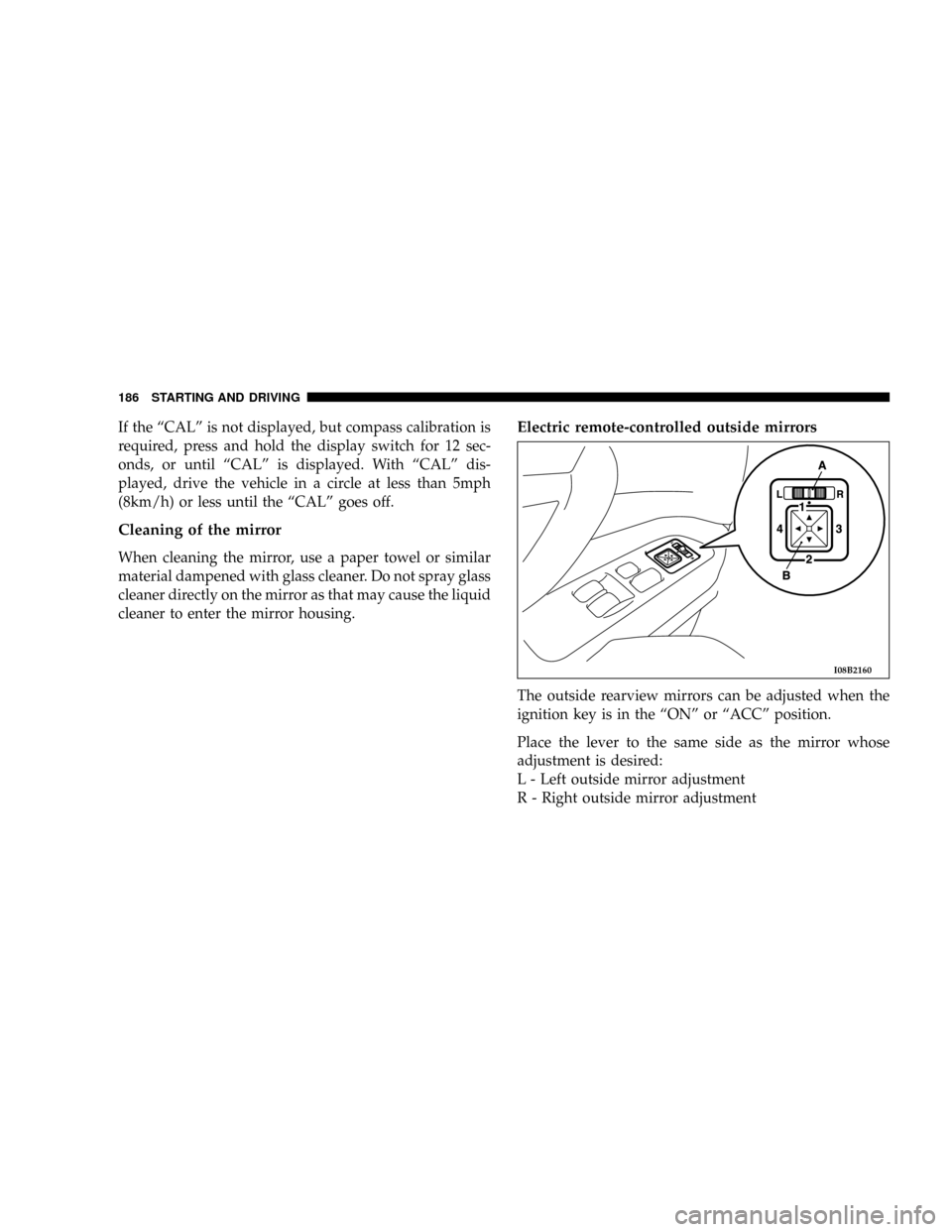
Electric remote-controlled outside mirrors
The outside rearview mirrors can be adjusted when the
ignition key is in the ªONº or ªACCº position.
Place the lever to the same side as the mirror whose
adjustment is desired:
L - Left outside mirror adjustment
R - Right outside mirror adjustment
I08B2160
186 STARTING AND DRIVING
Page 192 of 382
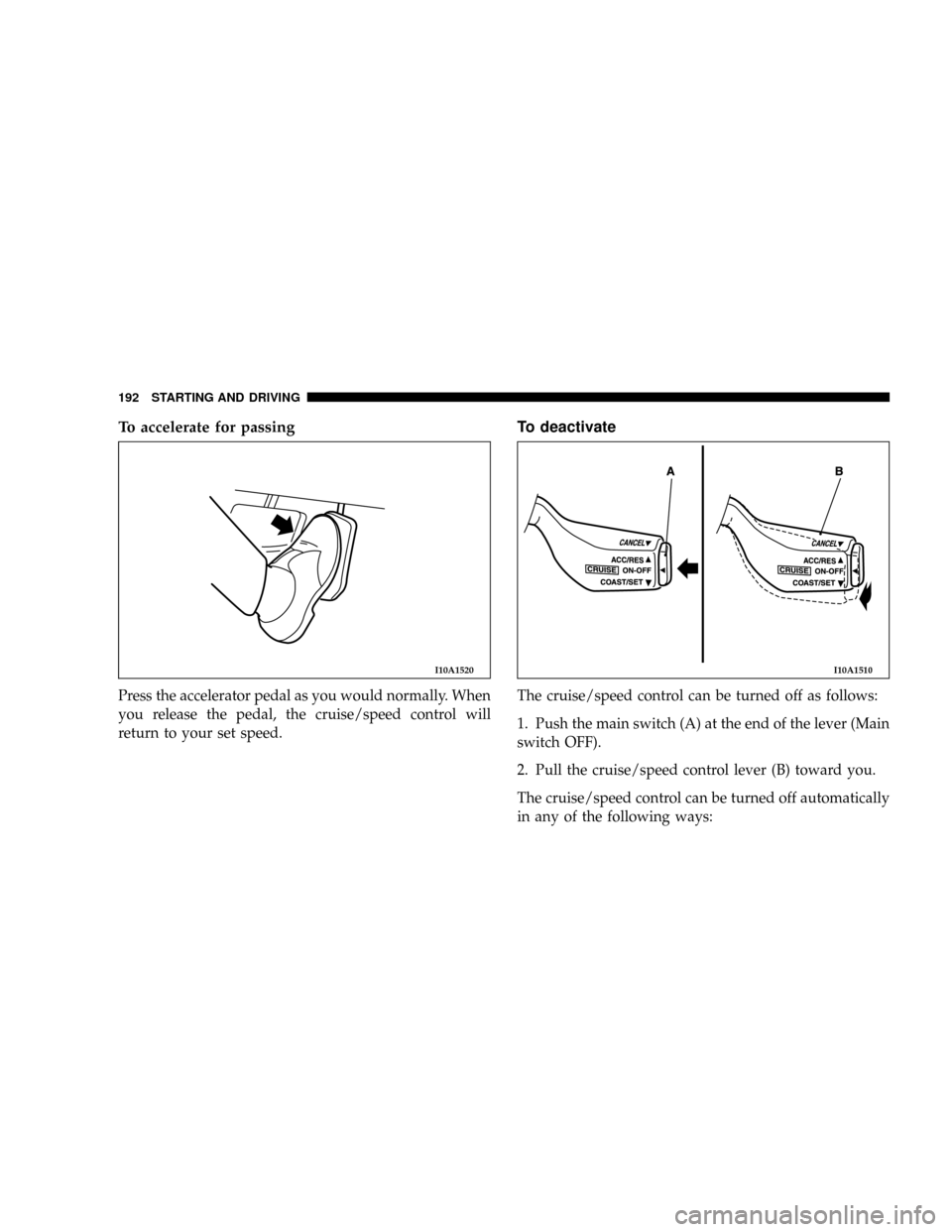
To accelerate for passing
Press the accelerator pedal as you would normally. When
you release the pedal, the cruise/speed control will
return to your set speed.
To deactivate
The cruise/speed control can be turned off as follows:
1. Push the main switch (A) at the end of the lever (Main
switch OFF).
2. Pull the cruise/speed control lever (B) toward you.
The cruise/speed control can be turned off automatically
in any of the following ways:
I10A1520I10A1510
192 STARTING AND DRIVING
Page 196 of 382

CAUTION!
Damage to the catalytic converter can result if your
vehicle is not kept in proper operating condition. In
the event of an engine malfunction, particularly one
involving engine misfire or other apparent loss of
performance, have your vehicle serviced promptly.
Prolonged operation of your vehicle while it is
overheated may result in damage to the converter
and vehicle.
WARNING!
²Do not park or operate this vehicle in areas where
combustible materials such as dry grass or leaves
can come in contact with a hot exhaust, since a fire
could occur.
²Undercoating should not be applied to the cata-
lytic converter.
To minimize the possibility of catalytic converter dam-
age:
1. Use UNLEADED GASOLINE ONLY of the type rec-
ommended in ªFuel selectionº.
2. Do not drive with an extremely low fuel level; running
out of fuel could damage the catalytic converter.
3. Do not shut off the engine or interrupt the ignition
when the transaxle is in gear and the vehicle is in motion.
4. Do not try to start the engine by pushing or towing the
vehicle. If the battery is weak or discharged, use jumper
cables to properly start the engine.
5. Do not idle the engine with any spark plug wires
disconnected or removed, such as when performing
diagnostic tests.
6. Do not idle the engine for prolonged periods if it is
idling roughly or otherwise obviously malfunctioning.
7. To prevent the catalytic converter from being dam-
aged due to unburned gas, do not race the engine when
turning off the ignition switch.
196 STARTING AND DRIVING