brake CHRYSLER SEBRING COUPE 2004 2.G Owner's Manual
[x] Cancel search | Manufacturer: CHRYSLER, Model Year: 2004, Model line: SEBRING COUPE, Model: CHRYSLER SEBRING COUPE 2004 2.GPages: 382, PDF Size: 2.23 MB
Page 156 of 382

Transaxle Reset Mode
The transaxle is monitored for abnormal conditions. If a
condition is detected that could cause damage, the trans-
axle automatically shifts into second gear. The transaxle
remains in second gear despite the forward gear selected.
Park (P), Reverse (R), and Neutral (N) will continue to
operate. This Reset feature allows the vehicle to be driven
to a dealer for service without damaging the transaxle.
If the problem has been momentary, the transaxle can be
reset to regain all forward gears.
²Stop the vehicle and shift into PARK (P).
²Turn the key to OFF then start the engine.
²Shift into ªDº and resume driving.
NOTE:Even if the transaxle can be reset, we recom-
mend that you visit a dealer at your earliest possible
convenience. Your dealer has diagnostic equipment to
determine if the problem could recur.
If the transaxle cannot be reset, dealer service is required.
AUTOMATIC TRANSAXLE AUTOSTICK
(IF SO EQUIPPED)
Designed for optimum control and equipped with adap-
tive control capabilities, the electronically controlled
transaxle optimally matches gear shifts to almost all
driving and road conditions.
DRIVING UPHILL
The transaxle may not upshift to a higher gear if the
computer determines the current speed cannot be main-
tained once a higher gear is engaged.
For smoother vehicle performance, if you release the
throttle while climbing a steep grade, the transaxle may
not upshift. This is normal, as the computer is controlling
the shifting. After reaching the top of the hill, normal gear
shift function will resume.
DRIVING DOWNHILL
When traveling down steep grades and depressing the
brake pedal, the computer may automatically select a
lower gear. This function assists engine braking efforts,
reducing the need to use the brakes.
156 STARTING AND DRIVING
Page 157 of 382

CAUTION!
The electronically controlled transaxle system is
strictly intended to provide supplementary func-
tions. When driving downhill under certain condi-
tions, or immediately after starting when the auto-
matic transaxle is cold, no automatic shift-down may
be made. The driver should shift down to a low gear
(3rd gear or 2nd gear), which will permit the engine
to exert a braking effect.
NOTE: During the brake-in period or immediately after
re-connection of the battery cable, the vehicle may not
shift smoothly. This does not indicate a faulty transmis-
sion. The transaxle system must have a short period to
learn parameters for proper shifting. Shifting will become
smooth after the transaxle has been shifted several times
by the electronic control system.
Selector lever operation
The transaxle has 4 forward gears and 1 reverse gear.
The individual gears are selected automatically, depend-
ing on the position of the gear selector lever, the speed of
the vehicle, and the position of the accelerator pedal.
The selector lever has 29gates9: the main gate and the
manual gate.
NOTE: For information on manual gate operation,
please refer to ªAutostickº on page 159.
I04B0060
Main gate
Manual gate
STARTING AND DRIVING 157
5
Page 158 of 382

In the main gate, the selector lever has 4 positions and
is equipped with a lock button (A) to prevent inad-
vertent selection of the wrong gear.Button (A) must be pushed while the brake pedal is
depressed to move the selector lever.
Button must be pushed to move the lever.
Button need not be pushed to move the lever.
I04S1580
A
I04A1430
158 STARTING AND DRIVING
Page 159 of 382
WARNING!
Always depress the brake pedal when shifting the
selector lever into a gear from the ªNº (NEUTRAL)
position. When beginning to drive, do not shift the
selector lever from the ªNº (NEUTRAL) position
while depressing the accelerator pedal; doing so may
cause the vehicle to ªjumpº forward or backward.
CAUTION!
If the button is always depressed to operate the
selector lever, the lever may be accidentally shifted
into the ªPº, ªRº position. Be sure not to depress the
button when performing the operations indicated by
in the illustration.
NOTE:
If the brake pedal is not depressed and held, the
shift-lock device activates to prevent the selector lever
from being moved from the ªPº (PARK) position.Indicator lights
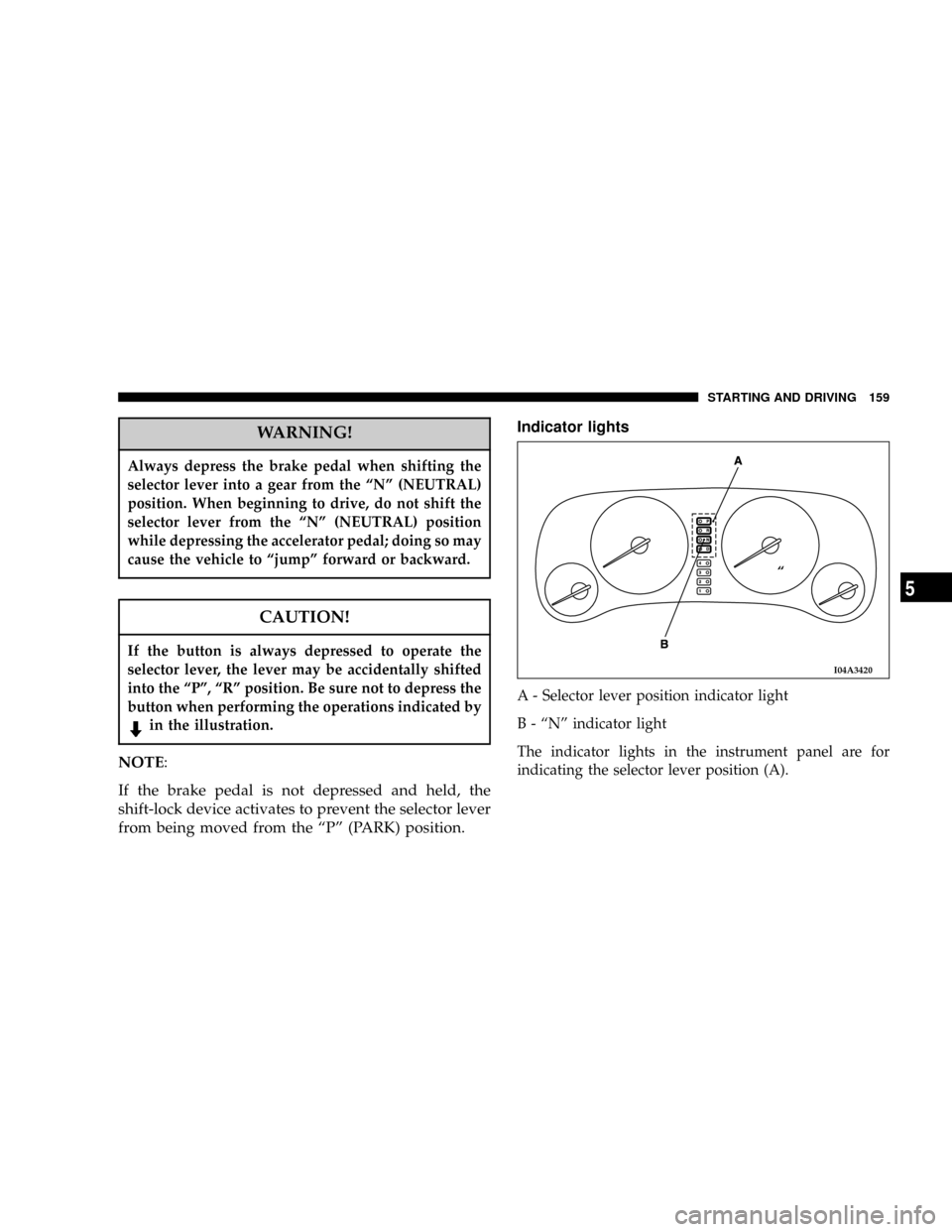
A - Selector lever position indicator light
B - ªNº indicator light
The indicator lights in the instrument panel are for
indicating the selector lever position (A).
I04A3420
ª
STARTING AND DRIVING 159
5
Page 161 of 382
ªNº NEUTRAL
The engine may be started in this position.
WARNING!
²Never move the lever to the ªNº position while
driving since you could accidentally move the
lever into the(P(or(R(position, damaging the
transaxle.
²To prevent the vehicle from rolling when stopped
on a slope, the engine should be started in the ªPº
(PARK) position, not in ªNº (NEUTRAL).
²Always keep your foot on the brake pedal when
the vehicle is in ªNº (NEUTRAL), or when shift-
ing into or out of ªNº (NEUTRAL), to maintain
control.
ªDº DRIVE
This position is used for most city and highway driving.
Engine shifting is done automatically, depending on road
conditions.
Selector positions Manual gate Autostick
Autostick is a driver-interactive transaxle that offers
manual gear shifting capability to provide you with more
control. Autostick allows you to maximize engine brak-
ing, eliminate undesirable upshifts and downshifts, and
improve overall vehicle performance. This system can
also provide you with more control during passing, city
driving, cold slippery conditions, mountain driving,
trailer towing, and many other situations.
Whether the vehicle is stationary or in motion, Autostick
is selected by pushing the selector lever from the ªDº
position into the manual gate. To return to ªDº range
operation, push the selector lever back into the main gate.
In Autostick, gear shifts can be made rapidly by moving
the selector lever backward and forward. In contrast to a
manual transaxle, the Autostick allows gear shifts with
the accelerator pedal depressed.
STARTING AND DRIVING 161
5
Page 163 of 382
3. In Autostick, downward shifts are made automatically
when the vehicle slows down. When the vehicle stops,
1st gear is automatically selected.
4. When starting out on slippery roads, push the selector
lever forward into the + (UP) position. This puts the
transmission into 2nd gear and is better for starting out
on slippery roads. Push the selector lever to the ±
(DOWN) side to shift back to 1st gear.
5. Move the selector lever gently between the manual
and main gates and between positions in the manual
gate. Undue force could damage the selector lever.Indication lights
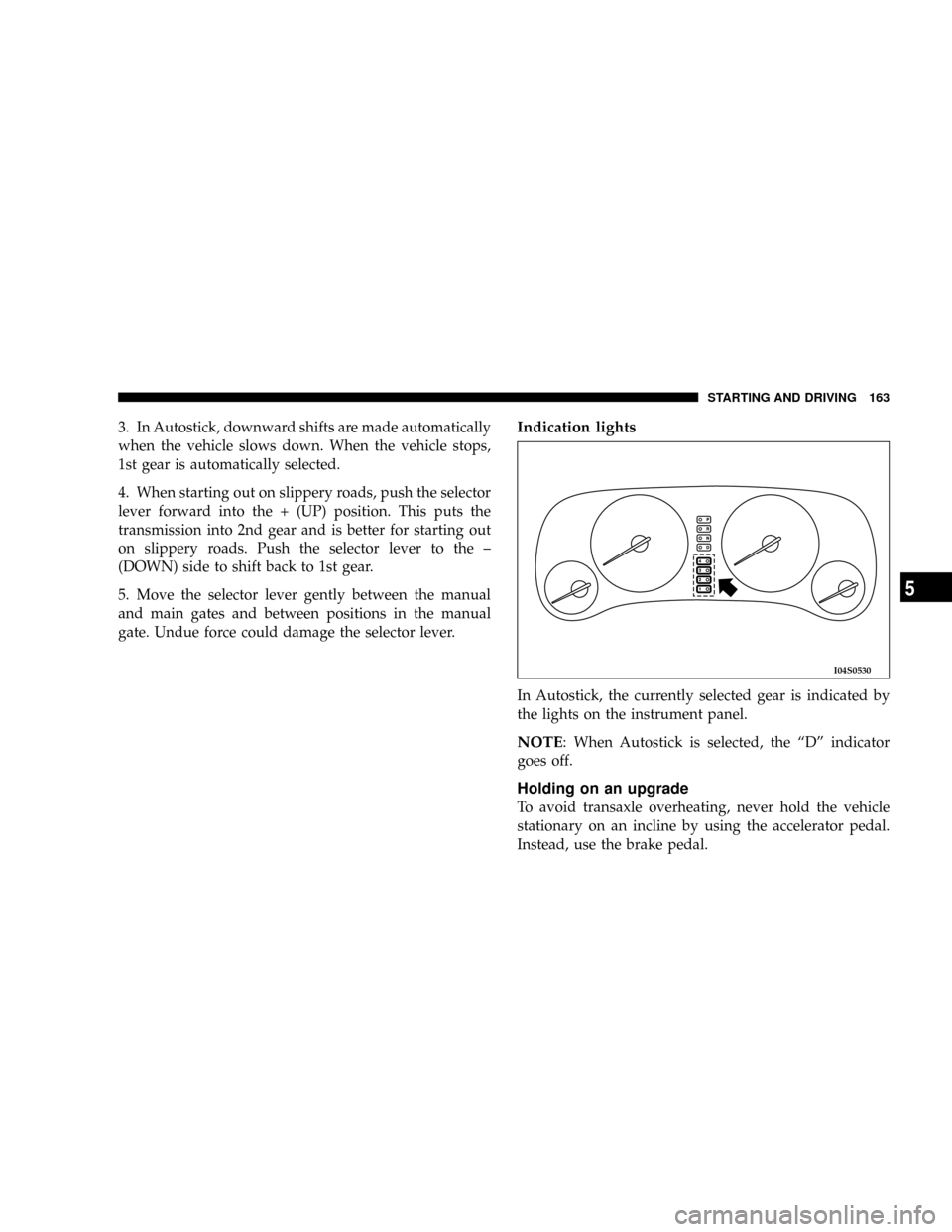
In Autostick, the currently selected gear is indicated by
the lights on the instrument panel.
NOTE: When Autostick is selected, the ªDº indicator
goes off.
Holding on an upgrade
To avoid transaxle overheating, never hold the vehicle
stationary on an incline by using the accelerator pedal.
Instead, use the brake pedal.
I04S0530
STARTING AND DRIVING 163
5
Page 166 of 382

At low altitude locations, shift at the vehicle speeds listed
for acceleration. Earlier upshifts during cruise conditions
(relatively steady speeds) will result in increased fuel
economy.
2.4 liter engine
Condition Upshift speeds
mph (km/h)
Acceleration Cruise
1st to 2nd 15 (25) 13 (20)
2nd to 3rd 23 (35) 18 (30)
3rd to 4th 34 (55) 33 (53)
4th to 5th 43 (70) 40 (65)
3.0 liter engine
Condition Upshift speeds
mph (km/h)
Acceleration Cruise
1st to 2nd 15 (25) 13 (20)
2nd to 3rd 23 (35) 21 (34)
3rd to 4th 34 (55) 33 (53)
4th to 5th 43 (70) 37 (60)
In high altitude locations, it should be upshifted as listed
below.
Condition Upshift speeds mph (km/h)
1st to 2nd 15 (25)
2nd to 3rd 25 (40)
3rd to 4th 40 (65)
4th to 5th 45 (70)
Downshifting
It is recommended that you downshift to a lower gear
according to the table as necessary to maintain desired
speeds.
Avoid downshifting at too high a speed; the engine may
suffer damage.
To maintain a safe speed and prolong brake life, shift
down to 2nd or 1st when descending a steep grade.
Downshifting is also important to avoid ªluggingº the
engine at too low a speed, such as when turning a corner
or when driving up a steep grade.
166 STARTING AND DRIVING
Page 167 of 382
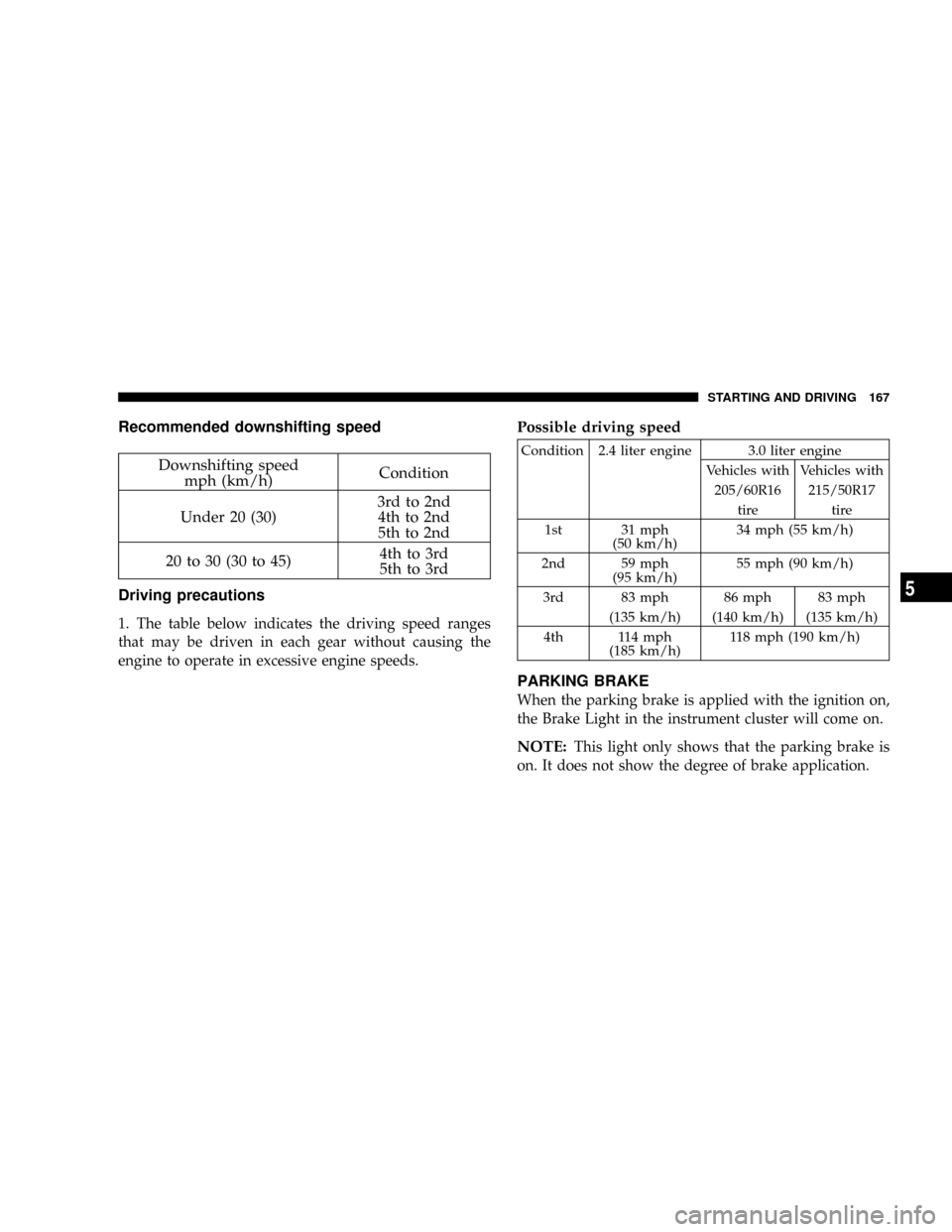
Recommended downshifting speed
Downshifting speed
mph (km/h)Condition
Under 20 (30)3rd to 2nd
4th to 2nd
5th to 2nd
20 to 30 (30 to 45)4th to 3rd
5th to 3rd
Driving precautions
1. The table below indicates the driving speed ranges
that may be driven in each gear without causing the
engine to operate in excessive engine speeds.
Possible driving speed
Condition 2.4 liter engine 3.0 liter engine
Vehicles with Vehicles with
205/60R16 215/50R17
tire tire
1st 31 mph
(50 km/h)34 mph (55 km/h)
2nd 59 mph
(95 km/h)55 mph (90 km/h)
3rd 83 mph 86 mph 83 mph
(135 km/h) (140 km/h) (135 km/h)
4th 114 mph
(185 km/h)118 mph (190 km/h)
PARKING BRAKE
When the parking brake is applied with the ignition on,
the Brake Light in the instrument cluster will come on.
NOTE:This light only shows that the parking brake is
on. It does not show the degree of brake application.
STARTING AND DRIVING 167
5
Page 168 of 382

Before leaving the vehicle, make sure that the parking
brake is set. To set the parking brake, pull up firmly on
the lever. Also place the gear selector in the Park position
(automatic transaxle) or Reverse (manual transaxle). To
release the parking brake, apply the brake pedal and pullup on the parking brake lever. Push the release button
and lower the lever fully.
When parking on a hill, it is important to set the parking
brake before placing the gear selector in Park, otherwise
the load on the transmission locking mechanism may
make it difficult to move the selector out of Park. As an
added precaution, turn the front wheels toward the curb
on a downhill grade and away from the curb on a uphill
grade.
I07A0020
I07A0030
168 STARTING AND DRIVING
Page 169 of 382

You should always apply the parking brake before leav-
ing the vehicle.
WARNING!
²Leaving children in a vehicle unattended is dan-
gerous for a number of reasons. A child or others
could be injured. Children should be warned not
to touch the parking brake or the gear selector.
Don't leave the keys in the ignition. A child could
operate power windows, other controls, or move
the vehicle.
²Be sure the parking brake is fully disengaged
before driving; failure to do so can lead to brake
failure and an accident.
BRAKE PEDAL
Excessive use of the brake can cause fading, resulting in
poor brake response and premature wear of brake lin-
ings.
When driving down a long or steep grade, use engine
braking by shifting the transaxle into a lower gear
(manual transaxle and Autostick A/T) or ª3º (THIRD) or
ª2º (SECOND) or ªLº (LOW) position (except Autostick
A/T).
WARNING!
Do not leave any objects on the floor near the brake
pedal or permit a floor mat to interfere with the
brake pedal. Doing so could prevent proper depres-
sion of the pedal. Make sure that the pedal can be
operated freely at all times.
STARTING AND DRIVING 169
5