steering CHRYSLER SEBRING COUPE 2004 2.G Owner's Manual
[x] Cancel search | Manufacturer: CHRYSLER, Model Year: 2004, Model line: SEBRING COUPE, Model: CHRYSLER SEBRING COUPE 2004 2.GPages: 382, PDF Size: 2.23 MB
Page 228 of 382

5. Seek down / Rewind APS button / Track down button
6. Volume down button
NOTE:
²Do not push two or more of the steering wheel
remote control switches at the same time.
How to adjust the volume
Volume up button - 2
The volume will increase when this button is pressed.
Volume down button - 6
The volume will decrease when this button is pressed.
To listen to the audio system
Select the desired mode by lightly pressing the Mode
change button (4). Every time the button is pressed, the
mode can be changed.
Radio (AM)!Radio (FM)!Tape!CD
NOTE:
²Tape or CD mode cannot be selected unless a tape or
CD is in the slot.
To listen to the radio
To select AM/FM mode
Mode change button - 4
Select the desired band (AM or FM) by pressing this
button.
Automatic tuning the radio
Seek up button - 1
Seek down button - 5
After pressing these buttons, release the buttons, and
reception of the selected station will begin.
To select the preset memory
Preset change button - 3
When the radio is on and this button is pressed, the
preset station frequencies are sequentially selected each
time the button is pressed; 1, 2, 3, 4, 5, 6, 7, 8, 9, 10, 1, 2 etc.
228 FOR PLEASANT DRIVING
Page 259 of 382

IF THE VEHICLE BREAKS DOWN
If the vehicle breaks down on the road, move to the
shoulder and activate the hazard warning flashers. If
there is no shoulder, or the shoulder is not safe, drive in
the right lane, slowly, with the hazard flashers activated,
until you reach a safe place to stop. Keep the flashers
activated.
If the engine quits
If the engine stops, power will be lost to the steering and
brakes, making steering and braking difficult.
1. The brake booster becomes inoperative and the brake
pedal will be harder to push than usual.
2. Since power steering system is not operative, the
steering wheel will be stiff when turning. Turn the wheel
with more effort than usual.
OPERATION UNDER ADVERSE DRIVING
CONDITIONS
If your vehicle becomes stuck in sand, mud or
snow
If the vehicle becomes stuck in snow, sand, or mud, it can
often be moved by a rocking motion. Turn your steering
wheel right and left to clear the area around the wheels.
Move the gearshift lever or selector lever rhythmically
between 1st and REVERSE position (with manual trans-
axle), ``L'' (Low) and ``R'' (REVERSE) position (with
automatic transaxle), Autostick and ``R'' (REVERSE) po-
sition (with automatic transaxle), while applying slight
pressure to the accelerator pedal.
Avoid racing the engine or spinning the wheels. Pro-
longed efforts to free a stuck vehicle may result in
overheating and transaxle failure.
Allow the engine to idle for a few minutes to let the
transaxle cool between rocking attempts.
If the vehicle remains stuck after several rocking at-
tempts, seek other assistance.
EMERGENCIES 259
8
Page 261 of 382

CAUTION!
²When driving in rain, a layer of water may form
between the tires and the road surface (hydroplan-
ing).
This reduces a tire's frictional resistance on the
road, resulting in loss of steering stability and
braking capability. When driving on a wet road,
observe the following:
(a) Drive your vehicle at a safe speed.
(b) Do not drive on worn tires.
(c) Always maintain the specified tire inflation
pressures.
On snowy or icy roads
1. When driving on a road covered by snow or ice, it is
recommended that you use snow tires.
CAUTION!
Tire chains are not recommended for your vehicle.
The clearance between the chains and the body is
small, and body damage may occur.
2. Drive slowly. Avoid any sudden starts or stops, abrupt
brake application or sharp cornering.
3. Depressing the brake pedal during travel on snowy or
icy roads may cause tire slippage and skidding. When a
skid occurs, take your foot off the accelerator. Steer gently
into the skid. Braking will differ, depending upon
whether you have anti-lock brakes (ABS). If you do have
ABS, brake by pressing the brake pedal firmly, and
keeping it pressed. If you do not have ABS (vehicles
without anti-lock braking system) pump the brake pedal
with short rapid jabs, each time fully applying and fully
releasing for greatest effect.
4. Allow extra distance between your vehicle and the
vehicle in front of you, and avoid sudden braking.
EMERGENCIES 261
8
Page 274 of 382

CAUTION!
²The emergency tire is to be used only temporarily
when the standard tire is damaged. Repair the
damaged tire as soon as possible. Replace the
emergency tire with the standard tire.
²After changing the tire and driving the vehicle
approximately 621 miles (1000 km), retighten the
wheel nuts to make sure that they are not loose.
²If the steering wheel vibrates after changing the
tire, have the tire checked for balance at an autho-
rized dealer.
²Avoid mixing one type of tire with another type or
using tires of a size other than the specified size.
Premature mechanical wear and reduced handling
may result.
ENGINE OVERHEATING
If the engine coolant temperature gauge indicator enters
the ªHº (hot) position, the engine may be overheated.
In any of the following situations, you can reduce the
potential for overheating by taking the appropriate ac-
tion.
²On the highways Ð Slow down.
²In city traffic Ð While stopped, put transaxle in
neutral, but do not increase engine idle speed.
NOTE:There are steps that you can take to slow down
an impending overheat condition. If your air conditioner
is on, turn it off. The air conditioning system adds heat to
the engine cooling system and turning off the A/C
removes this heat. You can also turn the Temperature
control to maximum heat, the Mode control to floor, and
the fan control to High. This allows the heater core to act
as a supplement to the radiator and aids in removing heat
from the engine cooling system.
274 EMERGENCIES
Page 280 of 382

WARNING!
²Always wear protective clothing and goggles
when working near the battery.
²Keep the battery out of the reach of children.
If your vehicle has anti-lock brakes
If the vehicle is driven without sufficient battery charge,
after the engine has been started by using booster cables,
the engine may misfire. This can cause the anti-lock
braking system warning light to blink on and off. This is
a result of insufficient battery voltage; it is not a malfunc-
tion of the brake system. If this happens, fully charge the
battery before driving.
TOWING
When towing your vehicle, all state and local regulations for
towing must be followed. Incorrect towing equipment could
damage your vehicle. When towing is required, contact a
professional towing service and make sure that flat bed type,
dolly type or wheel lift type towing equipment is used. Do
not attempt to be towed by another vehicle with a rope using
the tie-down hooks.
CAUTION!
²Tie-down hooks should never be used for towing
purposes.
²This vehicle can NOT be towed by a tow truck
using sling lift type equipment. This is to prevent
the bumper from deformation. If this vehicle is
towed, use wheel lift, dolly type or flat bed
equipment.
²Use the flat bed type, dolly type or dolly type
equipment if a vehicle has the following condi-
tions:
·Any of the transaxle, axles, steering system or
power train is damaged.
·Automatic transaxle fluid level is low.
280 EMERGENCIES
Page 281 of 382

CAUTION!
²Towing should only be done by a professional
tow service particularly if it will involve towing
on winding roads, hills or heavy traffic. If you
have any doubts, use a professional tow service.
TowingÐfront wheel lift
Place the gearshift lever (manual transaxle) to Neutral or
the selector lever (automatic transaxle) in the ªNº (NEU-
TRAL) position. Release the parking brake.
TowingÐrear wheel lift
Turn the ignition key to the ªACCº position and secure
the steering wheel in a straight-ahead position with a
rope or similar device. Never place the ignition key in the
ªLOCKº position. This will result in damage to the
steering lock mechanism.
If you have to tow an automatic transaxle model with the rear
wheels raised (with the front wheels on the ground):
Observe the following restricted towing speeds and distances.
·Speed: 30 mph (50 km/h)
·Distance: 18 miles (30 km)N25A0202
Sling lift type
Flat bed type
Dolly type
Wheel lift type
Front wheel lift
Rear wheel lift
EMERGENCIES 281
8
Page 304 of 382

NDisconnection and connection.............319
mAutomatic transaxle.....................321
NTo check the fluid level..................322
NProcedure for checking the fluid level.......322
mManual transaxle.......................323
mDisc brake pads, rear drum brake linings
and rear wheel cylinders.................323
mBrake hoses...........................323
mBall joint, steering linkage seal and drive
shaft boots...........................323
mSupplemental Restraint System (SRS)........323
mDoor hinges, rear hatch hinges, hood lock
release mechanism and safety catch
.........324
mExhaust system........................324
mWindshield wiper blades.................325
NWindshield washers....................325
mParking brake.........................326
mDrive belt (for generator, water pump, power
steering pump)
........................327
mTiming belt...........................328
mTi re s................................328
NTire inflation pressures..................328
NRadial ply tires.......................330
N
Tire pressure for sustained high-speed driving...330
NOversize tires........................330
NTire maintenance......................331
NCargo loads..........................331
NTread wear indicators...................331
NTire rotation.........................332
NTire chains...........................333
NSnow tires...........................333
mRegular Maintenance Schedule.............334
mSevere Maintenance Schedule..............343
304 MAINTENANCE
Page 305 of 382

VIEW OF ENGINE COMPARTMENT
1. Power steering fluid reservoir
2. Engine coolant reservoir
3. Engine oil filler cap
4. Engine oil level dipstick
5. Battery
6. Clutch fluid reservoir (manual transaxle only)7. Brake fluid reservoir
8. Windshield washer reservoir
9. Drive belt
10. Radiator cap
11. Automatic transaxle fluid level dipstick
12. Air cleaner filter
Q02A2510
2.4 liter engine
Q02A2520
3.0 liter engine
MAINTENANCE 305
9
Page 323 of 382

Special additives
DaimlerChrysler does not recommend the addition of
any fluid additives to the transaxle.
MANUAL TRANSAXLE
Add oil to maintain the proper level. Refill or change oil
according to the scheduled maintenance table.
Lubricant Gear Oil Classification GL-4
Viscosity range SAE75W-90 or 75W-85W
DISC BRAKE PADS, REAR DRUM BRAKE
LININGS AND REAR WHEEL CYLINDERS
Proper brakes are essential to safe operation of your
vehicle. Check brake pads and rear brake linings for
wear, and check rear wheel cylinders for leakage.
For proper braking performance, replace brake pads with
original equipment type pads.
BRAKE HOSES
Brake hoses and tubing should be checked for:
1. Severe surface cracking, scuffing or worn spots. If the
casing of the hose is exposed by cracks or abrasions in therubber hose cover, the hose should be replaced. Deterio-
ration of the hose could cause brake failure.
2. Faulty installation may cause twisting, or wheel, tire
or chassis interference.
BALL JOINT, STEERING LINKAGE SEAL AND
DRIVE SHAFT BOOTS
Check the following parts for damage and grease leak-
age:
1. Ball joint boots of the front suspension and steering
linkage
2. Bellows on both ends of the drive shaft
SUPPLEMENTAL RESTRAINT SYSTEM (SRS)
The entire SRS system must be inspected by an autho-
rized dealer 10 years after the vehicle manufacture date
shown on the certification label. [See ªSRS servicingº on
page 98.]
MAINTENANCE 323
9
Page 327 of 382
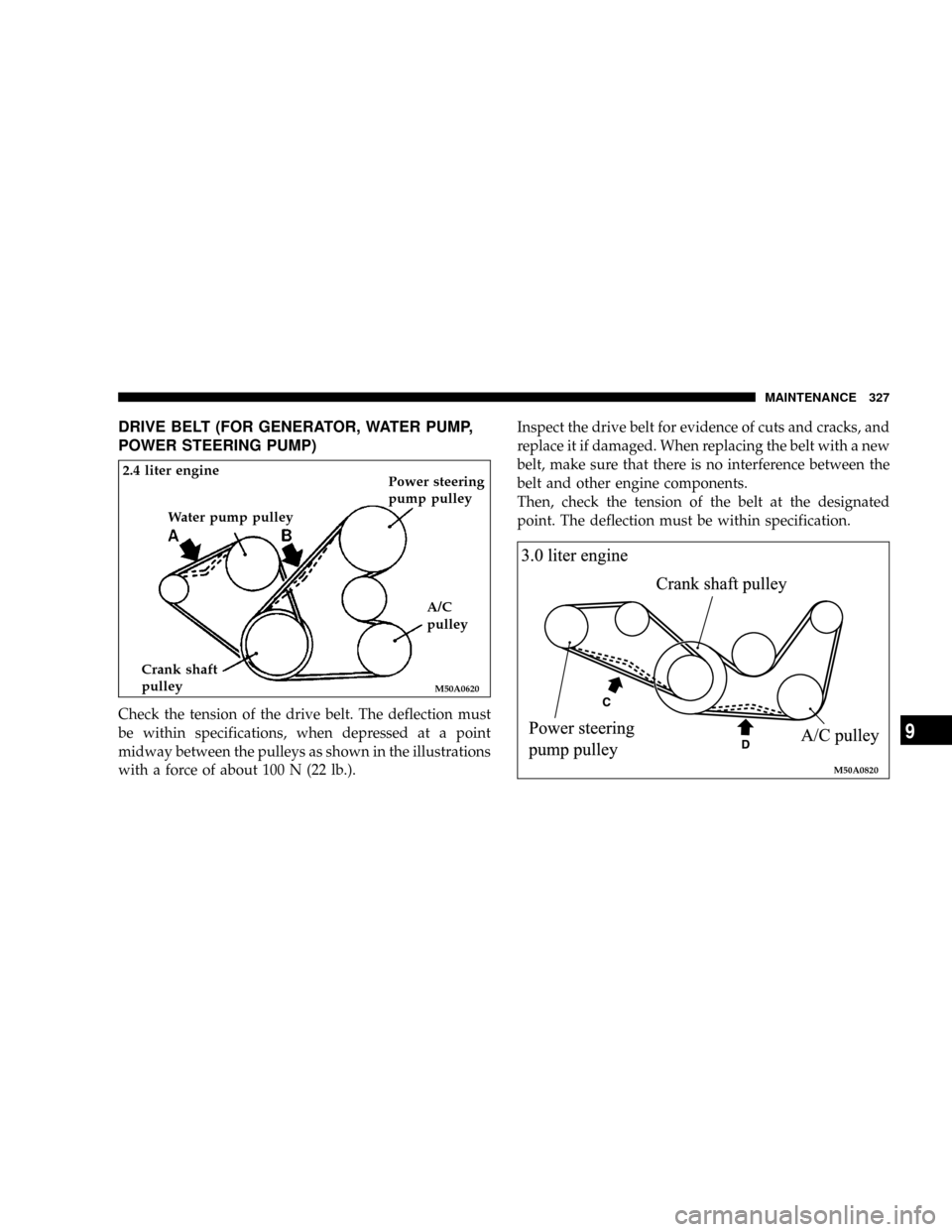
DRIVE BELT (FOR GENERATOR, WATER PUMP,
POWER STEERING PUMP)
Check the tension of the drive belt. The deflection must
be within specifications, when depressed at a point
midway between the pulleys as shown in the illustrations
with a force of about 100 N (22 lb.).Inspect the drive belt for evidence of cuts and cracks, and
replace it if damaged. When replacing the belt with a new
belt, make sure that there is no interference between the
belt and other engine components.
Then, check the tension of the belt at the designated
point. The deflection must be within specification.
M50A0620
Water pump pulley
Crank shaft
pulleyPower steering
pump pulley
A/C
pulley 2.4 liter engine
M50A0820
MAINTENANCE 327
9