warning CHRYSLER SEBRING COUPE 2005 2.G Owners Manual
[x] Cancel search | Manufacturer: CHRYSLER, Model Year: 2005, Model line: SEBRING COUPE, Model: CHRYSLER SEBRING COUPE 2005 2.GPages: 394, PDF Size: 2.47 MB
Page 279 of 394
connection. You wouldn't be able to start your vehicle,
and the bad ground could damage the electrical systems.
CAUTION!
Check the other vehicle. It must have a 12-volt
battery. If the other system isn't 12-volts, both sys-
tems can be damaged.
3. You could be injured if the vehicles move. Set the
parking brake firmly on each vehicle. Put an automatic
transaxle in ªPº (PARK) or a manual transaxle in ªNº
(Neutral). Turn the ignition key to the ªLOCKº position.
WARNING!
Turn the ignition key to the ªLOCKº position on
both vehicles.
Use care to make sure that the cables or your clothes
are never caught by the fan or drive belt. Personal
injury could result.
NOTE: Turn off all lights, heater and other electrical
loads. This will avoid sparks and help save both batter-
ies.
4. Make sure battery electrolyte is at the proper level.
(See ªBatteryº on page 321.)
WARNING!
If electrolyte fluid is not visible, or appears to be
frozen, do not attempt jump starting.
The battery might rupture or explode if the tempera-
ture is below the freezing point or if it is not filled to
the proper level.
EMERGENCIES 279
8
Page 281 of 394
6. Connect one end of the other jumper cable to the
negative (-) terminal of the booster battery (B), and the
other end to the engine block of the vehicle with the
discharged battery (A) at the point farthest from the
battery.WARNING!
²Be sure to observe the connecting sequence of¬
!!®!¯.
²Make sure that the connection¯is made to the
engine properly. If the connection is directly made
to the negative side of the battery, the flammable
gases generated from the battery might catch fire
and explode.
²When connecting the booster cable, do not con-
nect the positive (+) cable to the negative (-)
terminal. Otherwise sparks might cause explosion
of the battery.
²Use care not to have the booster cable caught in
the cooling fan or other rotating parts in the
engine compartment.
7. Start the engine in the vehicle which has the booster
battery, let the engine idle a few minutes, then start the
engine in the vehicle with the discharged battery.
8. After the engine is started, disconnect the cables in the
reverse order.
EMERGENCIES 281
8
Page 282 of 394
WARNING!
²Charging the battery installed in the vehicle
might cause the battery to catch fire and explode.
Or, damage to the vehicle could result. If it has to
be charged in that condition for unavoidable
reasons, disconnect the vehicle side negative lead.
²Keep sparks, cigarettes and flames away from the
battery because the battery may produce an explosion.
²Use adequate ventilation when charging or using
the battery in an enclosed space.
²Remove all the caps before charging the battery.
²Electrolyte (battery acid) is corrosive diluted sulfuric
acid. If electrolyte comes in contact with your hands,
eyes, clothes, or the painted surface of your vehicle,
thoroughly flush with water. If electrolyte gets in
your eyes, flush them thoroughly with water imme-
diately, and get prompt medical attention.
WARNING!
²Always wear protective clothing and goggles
when working near the battery.
²Keep the battery out of the reach of children.
If your vehicle has anti-lock brakes
If the vehicle is driven without sufficient battery charge,
after the engine has been started by using booster cables,
the engine may misfire. This can cause the anti-lock
braking system warning light to blink on and off. This is
a result of insufficient battery voltage; it is not a malfunc-
tion of the brake system. If this happens, fully charge the
battery before driving.
TOWING
When towing your vehicle, all state and local regulations for
towing must be followed. Incorrect towing equipment could
damage your vehicle. When towing is required, contact a
professional towing service and make sure that flat bed type,
dolly type or wheel lift type towing equipment is used. Do
not attempt to be towed by another vehicle with a rope using
the tie-down hooks.
282 EMERGENCIES
Page 288 of 394
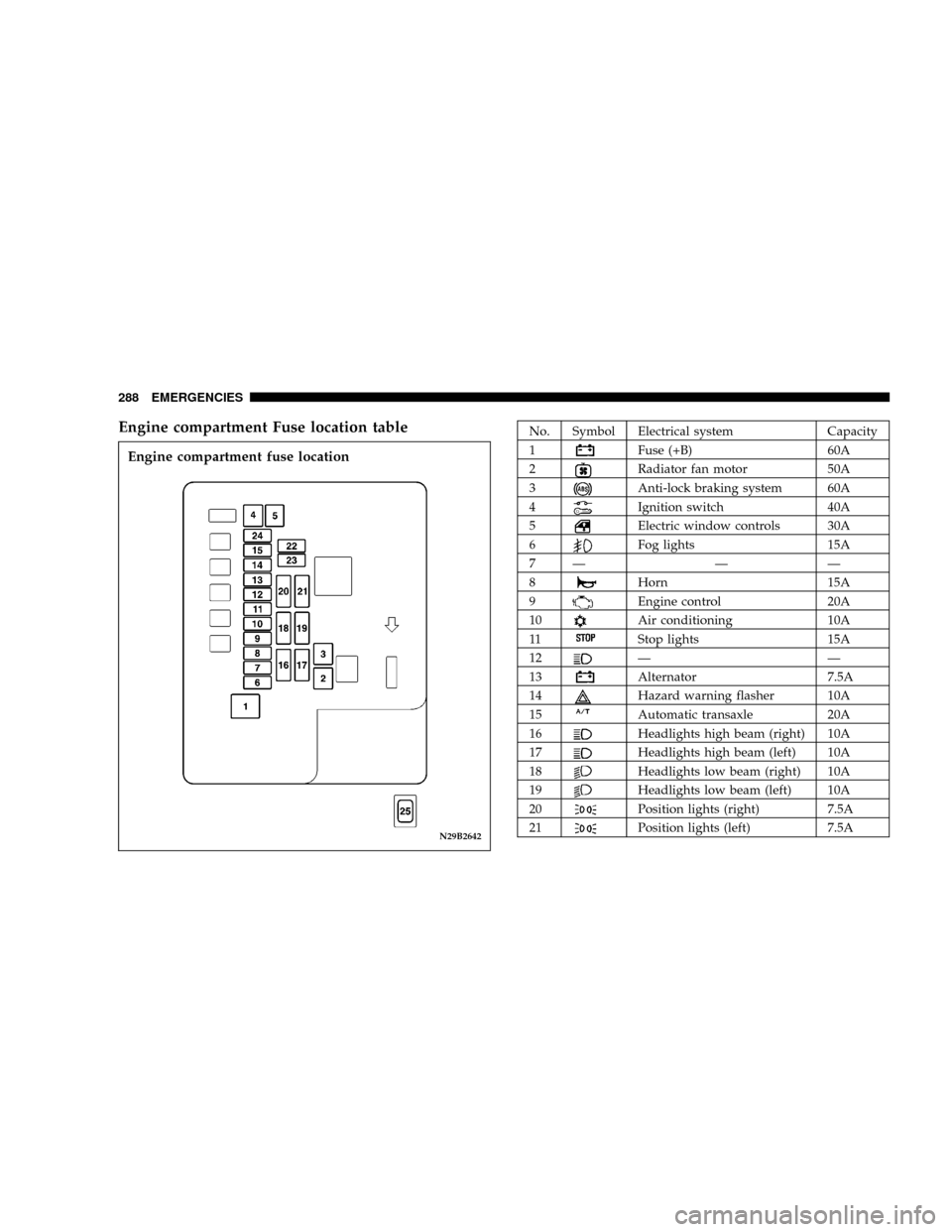
Engine compartment Fuse location tableNo. Symbol Electrical system Capacity
1
Fuse (+B) 60A
2
Radiator fan motor 50A
3
Anti-lock braking system 60A
4
Ignition switch 40A
5
Electric window controls 30A
6
Fog lights 15A
7Ð Ð Ð
8
Horn 15A
9
Engine control 20A
10
Air conditioning 10A
11
Stop lights 15A
12
ÐÐ
13
Alternator 7.5A
14
Hazard warning flasher 10A
15
Automatic transaxle 20A
16
Headlights high beam (right) 10A
17
Headlights high beam (left) 10A
18
Headlights low beam (right) 10A
19
Headlights low beam (left) 10A
20
Position lights (right) 7.5A
21
Position lights (left) 7.5AN29B2642
Engine compartment fuse location
288 EMERGENCIES
Page 308 of 394

NOTE: The Scheduled Maintenance Charts are located
in the rear of this maintenance section. Always refer to
the schedules for proper service intervals.
SERVICE PRECAUTIONS
Adequate care of your vehicle at regular intervals serves
to preserve the value and appearance as long as possible.
Some maintenance items can be performed by the owner,
while others should be done only by an authorized
dealer.
This section describes only those items which can be
performed by the owner. In the event a malfunction or
other problem is discovered, have it corrected by an
authorized dealer.
This section contains information on inspection mainte-
nance procedures that you can do yourself, if you so
desire. Follow the instructions and precautions for each
of the various procedures.
WARNING!
²When checking or servicing the inside of the
engine compartment, be sure the engine is
stopped and has had a chance to cool down.
²If it is necessary to do work in the engine com-
partment with the engine running, be especially
careful that your clothing, hair, etc. does not
become caught by the fan, drive belts, or other
moving parts.
308 MAINTENANCE
Page 309 of 394
WARNING!
²The fan may turn on automatically even if the
engine is not running; turn the ignition key to the
ªLOCKº position and remove the key to ensure
safety while you work in the engine compartment.
²Do not smoke, or allow open flames around fuel
or the battery. The fumes are flammable.
²Be extremely cautious when working around the
battery. It contains poisonous and corrosive sulfu-
ric acid.
²Do not get under your vehicle with just the car's
jack supporting it.
Always use properly rated automotive jack
stands.
²Improper handling of components and materials
used in the vehicle can endanger your personal
safety. Consult an authorized dealer if you have
questions.
EMISSION-CONTROL SYSTEM MAINTENANCE
Your vehicle is equipped with an emission-control sys-
tem which satisfies all requirements of the U.S. Environ-
mental Protection Agency. The emission-control system
consists of:
(1) a positive crankcase ventilation system
(2) an evaporative emission-control system
(3) an exhaust emission- control system.
The9Scheduled9maintenance services listed must be
performed at the times or mileages specified to assure the
continued proper functioning of the emission-control
system. These, and all other ªGeneralº maintenance
services included in this manual, should be performed to
provide the best vehicle performance and reliability.
More frequent maintenance may be needed for vehicles
driven under severe operating conditions such as dusty
areas and frequent start and stop driving.
In order to assure the proper function of the emission-
control system, it is recommended that you have your
vehicle inspected and maintained by an authorized
dealer in accordance with the schedule in this manual.
Inspection and service should also be performed any
time a malfunction is suspected.
MAINTENANCE 309
9
Page 311 of 394
If the light is flashing, severe catalytic converter damage
and power loss will soon occur. Immediate service is
required.
If the gas cap is not tightened properly, the light may
come on. Be sure the gas cap is tightened every time you
add fuel. Tighten the cap until you hear it ªclick.º
REPLACEMENT PARTS
Use of genuine Mopar parts for normal/scheduled main-
tenance and repairs is highly recommended to insure the
designed performance. Damage or failures caused by the
use of non-Mopar parts for maintenance and repairs will
not be covered by the DaimlerChrysler Motors Corpora-
tion warranty.
Fuel system (tank, filler tube, connections, and
fuel tank filler cap)
Check periodically for damage or leakage in the fuel lines
and connections, and check for damage and looseness of
the fuel tank filler tube cap. Particular attention should be
paid to examining those fuel lines nearest to high heat
sources such as the exhaust manifold.
WARNING!
If you see a fuel leak or if you smell fuel, do not
operate the vehicle. Any spark (including from the
ignition ), flame or smoking material could cause an
explosion or fire. Call an authorized dealer for
assistance.
Fuel hoses
Inspect the surfaces of hoses for evidence of heat and
mechanical damage, hard and brittle rubber, cracking,
tears, cuts and abrasions. Particular attention should be
paid to examining those hose surfaces nearest to high
heat sources such as the exhaust manifold. Inspect all
hose connections, such as clamps and couplings, to make
sure they are secure and that no leaks exist. If there is any
evidence of deterioration or damage, hoses should be
replaced immediately.
MAINTENANCE 311
9
Page 315 of 394
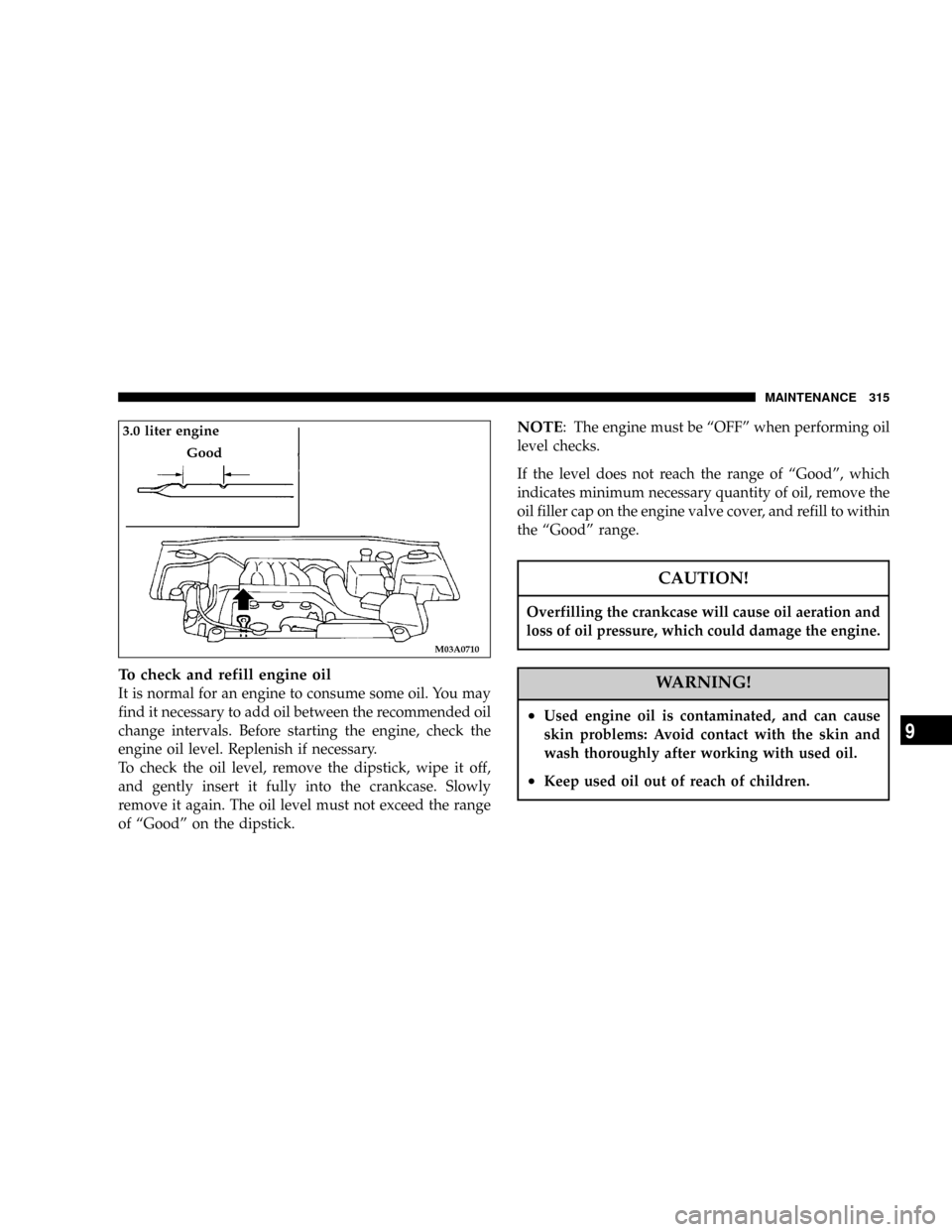
To check and refill engine oil
It is normal for an engine to consume some oil. You may
find it necessary to add oil between the recommended oil
change intervals. Before starting the engine, check the
engine oil level. Replenish if necessary.
To check the oil level, remove the dipstick, wipe it off,
and gently insert it fully into the crankcase. Slowly
remove it again. The oil level must not exceed the range
of ªGoodº on the dipstick.
NOTE: The engine must be ªOFFº when performing oil
level checks.
If the level does not reach the range of ªGoodº, which
indicates minimum necessary quantity of oil, remove the
oil filler cap on the engine valve cover, and refill to within
the ªGoodº range.
CAUTION!
Overfilling the crankcase will cause oil aeration and
loss of oil pressure, which could damage the engine.
WARNING!
²Used engine oil is contaminated, and can cause
skin problems: Avoid contact with the skin and
wash thoroughly after working with used oil.
²Keep used oil out of reach of children.
M03A0710
3.0 liter engine
Good
MAINTENANCE 315
9
Page 319 of 394

Radiator cap
The radiator cap must be fully tightened to prevent loss
of coolant and engine damage.
WARNING!
Make sure that the engine is thoroughly cooled
down before removing the radiator cap, otherwise
hot steam or boiling coolant may gush from the filler
port and scald you.
Points to remember
1. Do not overfill the reserve tank.
2. A special radiator cap is used to ensure sealing and to
allow the coolant to return from the reserve tank to the
radiator when the engine cools. If cap replacement is
necessary, use the proper cap.
3. Check the coolant freeze point in the radiator using
proper instruments, when it is safe to do so. If antifreeze
is added, the contents of the reserve tank must be
protected against freezing.
4. Keep the front of the radiator clean. Keep the front of
the condenser clean.5. If the temperature of the engine coolant does not rise
normally after engine warm-up, take the vehicle to an
authorized dealer to have the thermostat checked, and
replaced if necessary.
BRAKE FLUID
Recommended brake fluid conforming to DOT 3 or DOT 4
should be used. The reservoir cap must be fully tightened
to avoid contamination from foreign matter or moisture.
CAUTION!
²Do not allow petroleum-based fluid to contact,
mix with, or otherwise contaminate the brake
fluid. Seal damage will result.
²Take care in handling brake fluid as it may cause
damage to painted surfaces.
²Use only the specified brake fluid. Also, the
additives in different brands may result in a
chemical reaction when mixed together, so avoid
mixing different brands if possible.
²Keep the reservoir tank cap closed to prevent the
brake fluid from evaporating or absorbing moisture.
MAINTENANCE 319
9
Page 323 of 394
WARNING!
²If the battery goes flat, be sure to check the battery
electrolyte level before connecting booster cables.
²After checking the battery electrolyte level, make
sure the caps are fitted securely.
²If any of the caps has a loose fit, replace the
battery.
During cold weather
The capacity of the battery is reduced at low tempera-
tures. This is the result of its chemical and physical
properties and this is why a very cold battery, particu-
larly one that is not fully charged, will only deliver a
fraction of the starter current that is normally available.
It is recommended that you have the battery checked by
an authorized dealer before the start of cold weather and,
if necessary, have it charged or replaced. This not only
ensures reliable starting, but prolongs battery life.
Disconnection and connection
To disconnect the battery cable, stop the engine, discon-
nect the negative terminal first, then the positive termi-
nal. To reconnect the battery, first connect the positive
terminal and then the negative terminal, before starting
the vehicle.
MAINTENANCE 323
9