light CHRYSLER SEBRING COUPE 2005 2.G Owners Manual
[x] Cancel search | Manufacturer: CHRYSLER, Model Year: 2005, Model line: SEBRING COUPE, Model: CHRYSLER SEBRING COUPE 2005 2.GPages: 394, PDF Size: 2.47 MB
Page 271 of 394
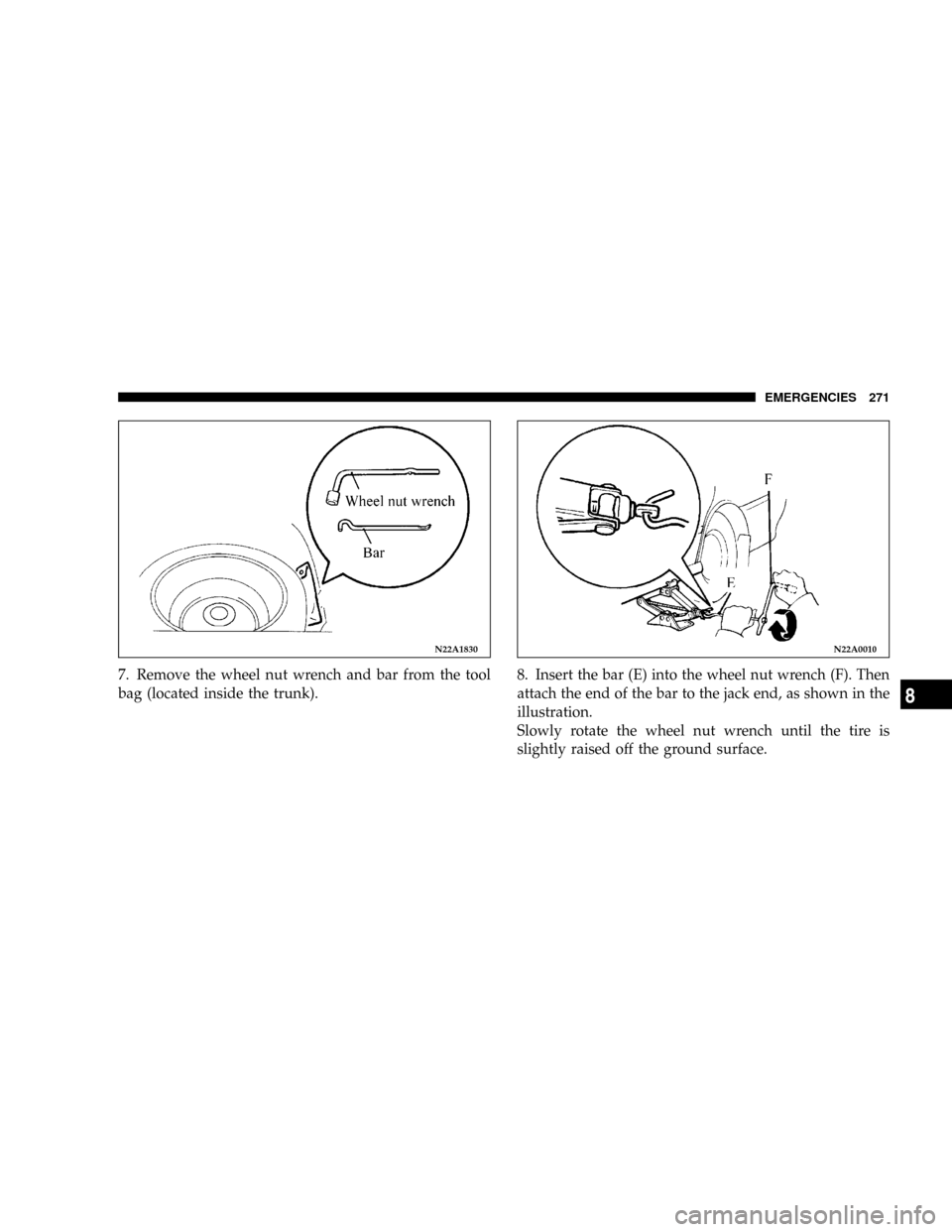
7. Remove the wheel nut wrench and bar from the tool
bag (located inside the trunk).8. Insert the bar (E) into the wheel nut wrench (F). Then
attach the end of the bar to the jack end, as shown in the
illustration.
Slowly rotate the wheel nut wrench until the tire is
slightly raised off the ground surface.
N22A1830N22A0010
EMERGENCIES 271
8
Page 279 of 394
connection. You wouldn't be able to start your vehicle,
and the bad ground could damage the electrical systems.
CAUTION!
Check the other vehicle. It must have a 12-volt
battery. If the other system isn't 12-volts, both sys-
tems can be damaged.
3. You could be injured if the vehicles move. Set the
parking brake firmly on each vehicle. Put an automatic
transaxle in ªPº (PARK) or a manual transaxle in ªNº
(Neutral). Turn the ignition key to the ªLOCKº position.
WARNING!
Turn the ignition key to the ªLOCKº position on
both vehicles.
Use care to make sure that the cables or your clothes
are never caught by the fan or drive belt. Personal
injury could result.
NOTE: Turn off all lights, heater and other electrical
loads. This will avoid sparks and help save both batter-
ies.
4. Make sure battery electrolyte is at the proper level.
(See ªBatteryº on page 321.)
WARNING!
If electrolyte fluid is not visible, or appears to be
frozen, do not attempt jump starting.
The battery might rupture or explode if the tempera-
ture is below the freezing point or if it is not filled to
the proper level.
EMERGENCIES 279
8
Page 282 of 394
WARNING!
²Charging the battery installed in the vehicle
might cause the battery to catch fire and explode.
Or, damage to the vehicle could result. If it has to
be charged in that condition for unavoidable
reasons, disconnect the vehicle side negative lead.
²Keep sparks, cigarettes and flames away from the
battery because the battery may produce an explosion.
²Use adequate ventilation when charging or using
the battery in an enclosed space.
²Remove all the caps before charging the battery.
²Electrolyte (battery acid) is corrosive diluted sulfuric
acid. If electrolyte comes in contact with your hands,
eyes, clothes, or the painted surface of your vehicle,
thoroughly flush with water. If electrolyte gets in
your eyes, flush them thoroughly with water imme-
diately, and get prompt medical attention.
WARNING!
²Always wear protective clothing and goggles
when working near the battery.
²Keep the battery out of the reach of children.
If your vehicle has anti-lock brakes
If the vehicle is driven without sufficient battery charge,
after the engine has been started by using booster cables,
the engine may misfire. This can cause the anti-lock
braking system warning light to blink on and off. This is
a result of insufficient battery voltage; it is not a malfunc-
tion of the brake system. If this happens, fully charge the
battery before driving.
TOWING
When towing your vehicle, all state and local regulations for
towing must be followed. Incorrect towing equipment could
damage your vehicle. When towing is required, contact a
professional towing service and make sure that flat bed type,
dolly type or wheel lift type towing equipment is used. Do
not attempt to be towed by another vehicle with a rope using
the tie-down hooks.
282 EMERGENCIES
Page 286 of 394

Fuse load capacities
The fuse cover lists the names of the electrical systems
and the fuse capacities. Spare fuses are contained in thecover of the instrument panel (driver 's side). Always use
a fuse of the same capacity for replacement.
Passenger compartment fuse location
Fuse location table
No. Symbol Electrical system Capacity
1
Audio 20A
2
ÐÐÐ
3
Sunroof 20A
4
SOCKETAccessory socket 15A
5
Rear window defogger 30A
6
Heater 30A
7
ÐÐÐ
8
ÐÐÐ
9
SOCKETAccessory socket 15A
10
Door lock 15A
11
Rear window wiper 15A
12
ÐÐ 15A
13
Relay 7.5A
14
R/C MIRElectric remote-controlled outside
mirror7.5A
15
ÐÐÐ
16
Cigarette lighter 15A
N29C0322
286 EMERGENCIES
Page 287 of 394

No. Symbol Electrical system Capacity
17
Engine Control 7.5A
18
Windshield wiper 20A
19
Door mirror heater 7.5A
20
Relay 7.5A
21
CRUISECruise control 7.5A
22
Back up light 7.5A
23
Gauge 7.5A
24
Engine control 10A
30A
25
ÐSpare fuse 20A
15A
10A
ISome fuses may not be installed on your vehicles,
depending on the vehicle model or specifications.
IThe table above shows the main equipment corre-
sponding to each fuse.
Spare fuse location
Spare fuses are contained in the cover of the instru-
ment panel (driver 's side). Always use a fuse of the
same capacity for replacement.
EMERGENCIES 287
8
Page 288 of 394
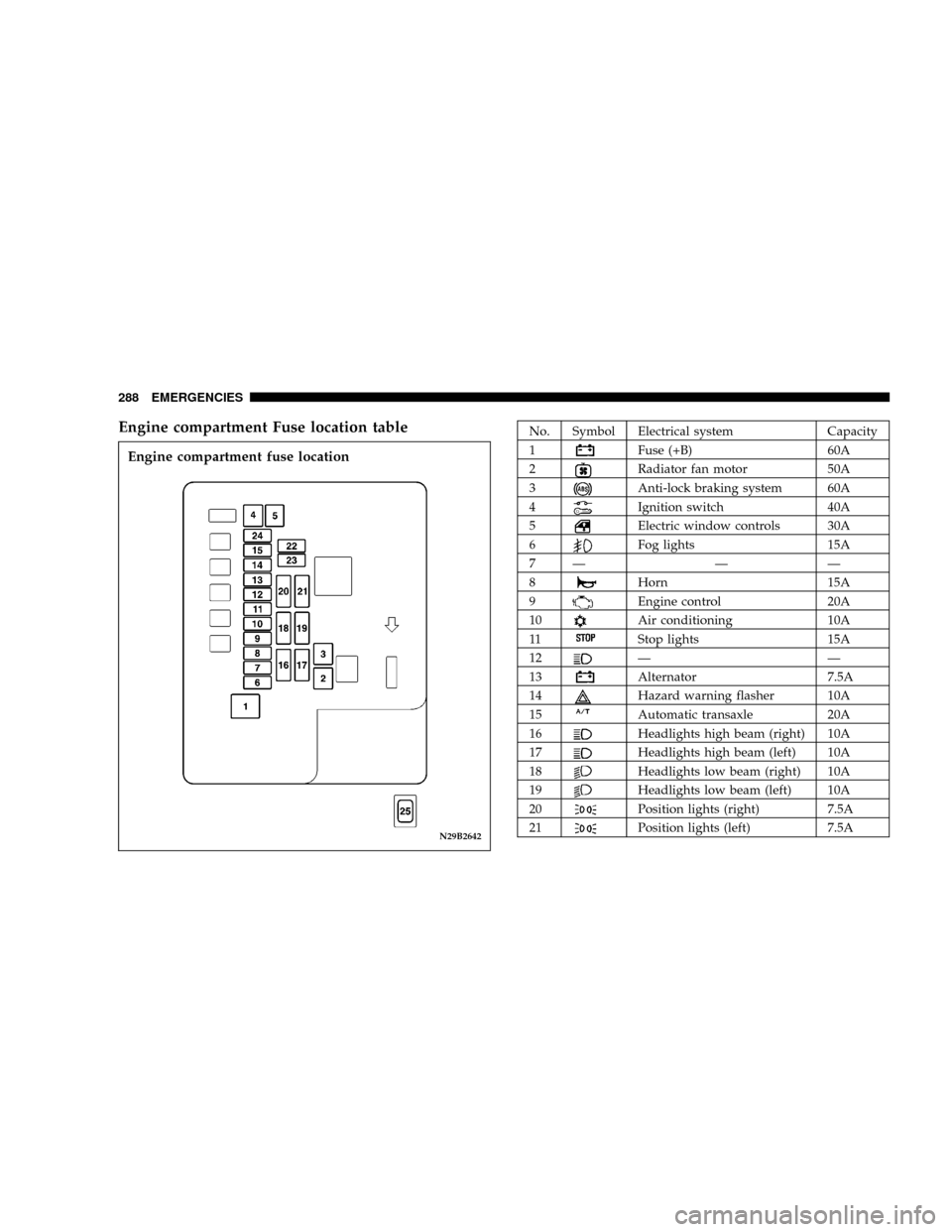
Engine compartment Fuse location tableNo. Symbol Electrical system Capacity
1
Fuse (+B) 60A
2
Radiator fan motor 50A
3
Anti-lock braking system 60A
4
Ignition switch 40A
5
Electric window controls 30A
6
Fog lights 15A
7Ð Ð Ð
8
Horn 15A
9
Engine control 20A
10
Air conditioning 10A
11
Stop lights 15A
12
ÐÐ
13
Alternator 7.5A
14
Hazard warning flasher 10A
15
Automatic transaxle 20A
16
Headlights high beam (right) 10A
17
Headlights high beam (left) 10A
18
Headlights low beam (right) 10A
19
Headlights low beam (left) 10A
20
Position lights (right) 7.5A
21
Position lights (left) 7.5AN29B2642
Engine compartment fuse location
288 EMERGENCIES
Page 289 of 394
No. Symbol Electrical system Capacity
22
Dome lights 10A
23
Audio 10A
24
Fuel pump 15A
25
Defroster 40A
²Some fuses may not be installed on your vehicle. Fuse
application depends on the vehicle model, specifica-
tions, or options.
7.5A BROWN
10A RED
15A LIGHT BLUE
20A YELLOW
30A GREEN
40A GREEN
50A RED
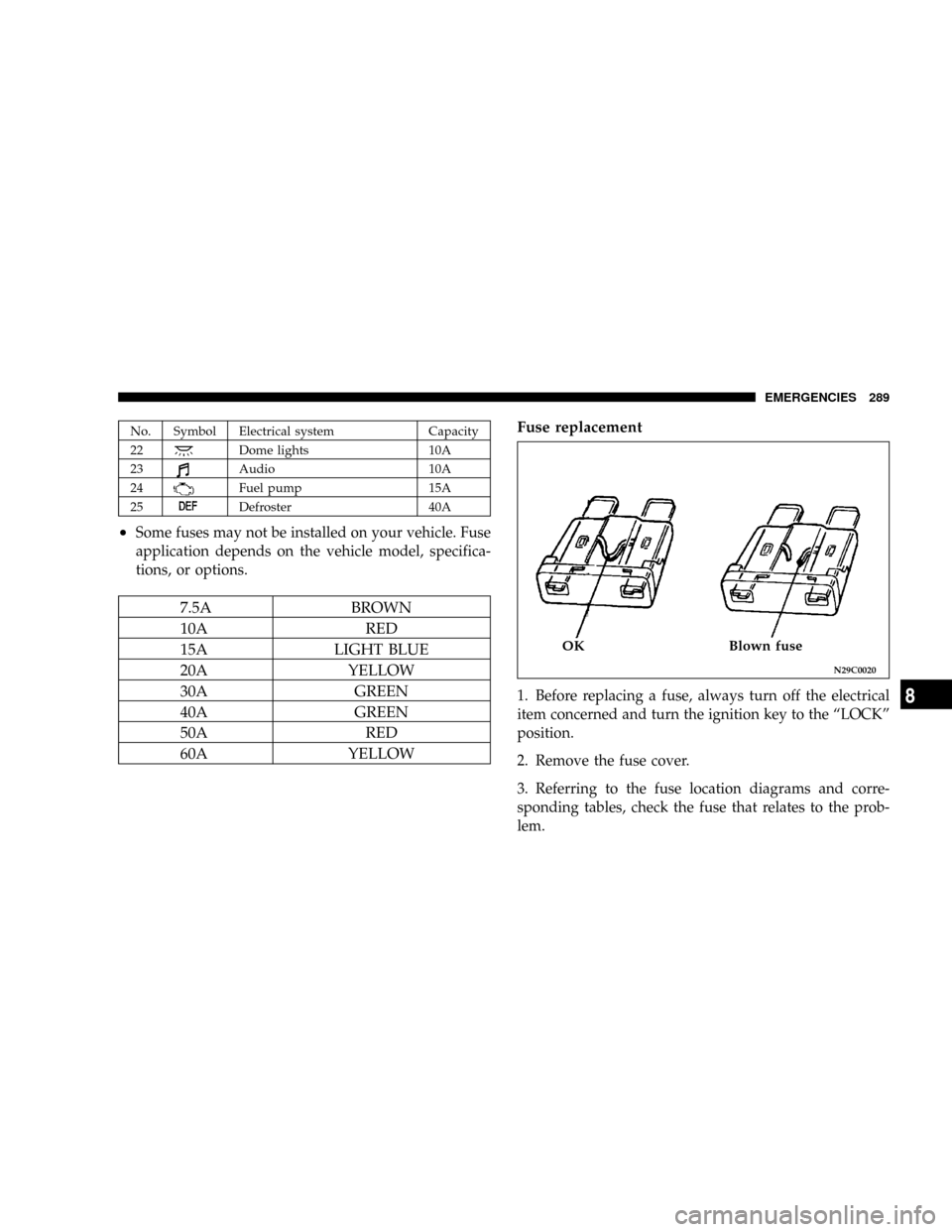
60A YELLOWFuse replacement
1. Before replacing a fuse, always turn off the electrical
item concerned and turn the ignition key to the ªLOCKº
position.
2. Remove the fuse cover.
3. Referring to the fuse location diagrams and corre-
sponding tables, check the fuse that relates to the prob-
lem.
N29C0020
OK Blown fuse
EMERGENCIES 289
8
Page 291 of 394
CAUTION!
²Never use a fuse with a capacity larger than that
specified or any substitute, such as wire, foil, etc.
Doing so will cause the circuit wiring to heat up
and could cause a fire.
²If the newly inserted fuse blows again after a
short time, have the electrical system checked by
an authorized dealer to find and correct the cause.
REPLACEMENT OF LIGHT BULBS
Before replacing a bulb, be sure the light is off. Do not
touch the glass part of the new bulb with your bare
fingers; the skin oil left on the glass will evaporate when
the bulb gets hot and the vapor will condense on the
reflector and dim the surface.
Bulb capacity
A bulb should only be replaced with a new bulb of the
same rating and type. The designation can be found on
the base of the bulb.
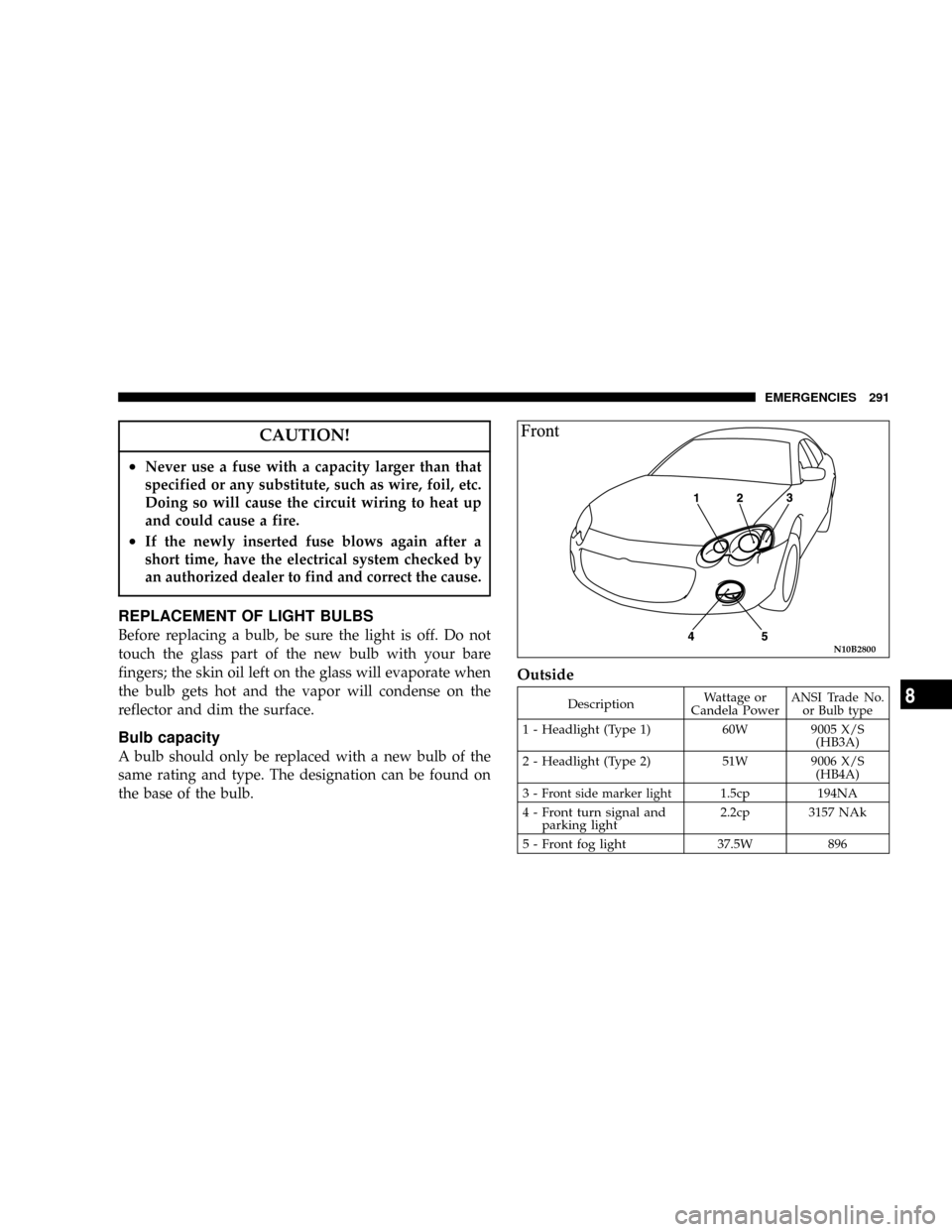
Outside
DescriptionWattage or
Candela PowerANSI Trade No.
or Bulb type
1 - Headlight (Type 1) 60W 9005 X/S
(HB3A)
2 - Headlight (Type 2) 51W 9006 X/S
(HB4A)
3-
Front side marker light1.5cp 194NA
4 - Front turn signal and
parking light2.2cp 3157 NAk
5 - Front fog light 37.5W 896
N10B2800
EMERGENCIES 291
8
Page 292 of 394
DescriptionWattage or
Candela PowerANSI Trade No.
or Bulb type
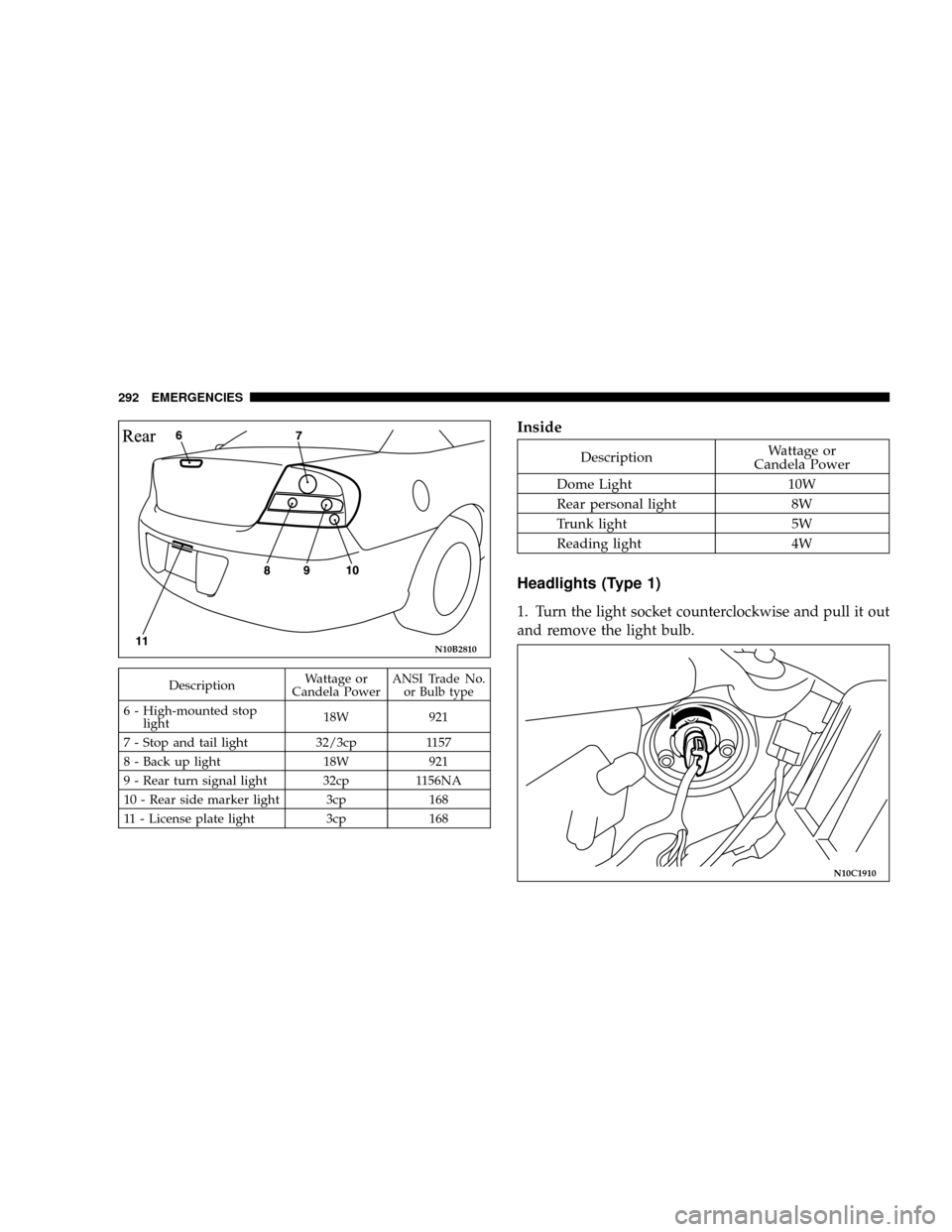
6 - High-mounted stop
light18W 921
7 - Stop and tail light 32/3cp 1157
8 - Back up light 18W 921
9 - Rear turn signal light 32cp 1156NA
10 - Rear side marker light 3cp 168
11 - License plate light 3cp 168
Inside
DescriptionWattage or
Candela Power
Dome Light 10W
Rear personal light 8W
Trunk light 5W
Reading light 4W
Headlights (Type 1)
1. Turn the light socket counterclockwise and pull it out
and remove the light bulb.
N10B2810
N10C1910
292 EMERGENCIES
Page 293 of 394
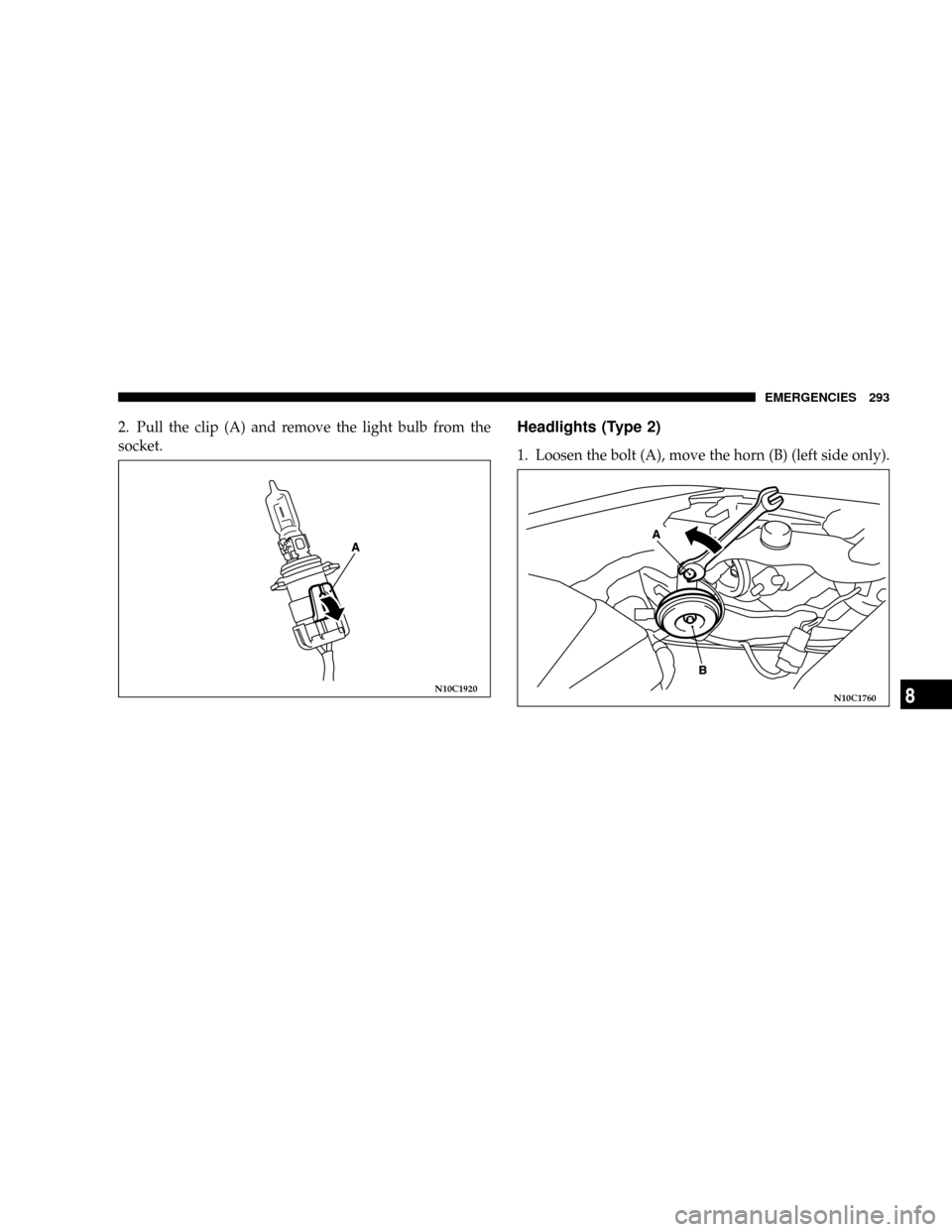
2. Pull the clip (A) and remove the light bulb from the
socket.Headlights (Type 2)
1. Loosen the bolt (A), move the horn (B) (left side only).
N10C1920N10C1760
EMERGENCIES 293
8