inflation pressure CHRYSLER TOWN AND COUNTRY 2010 5.G User Guide
[x] Cancel search | Manufacturer: CHRYSLER, Model Year: 2010, Model line: TOWN AND COUNTRY, Model: CHRYSLER TOWN AND COUNTRY 2010 5.GPages: 538, PDF Size: 10.55 MB
Page 371 of 538
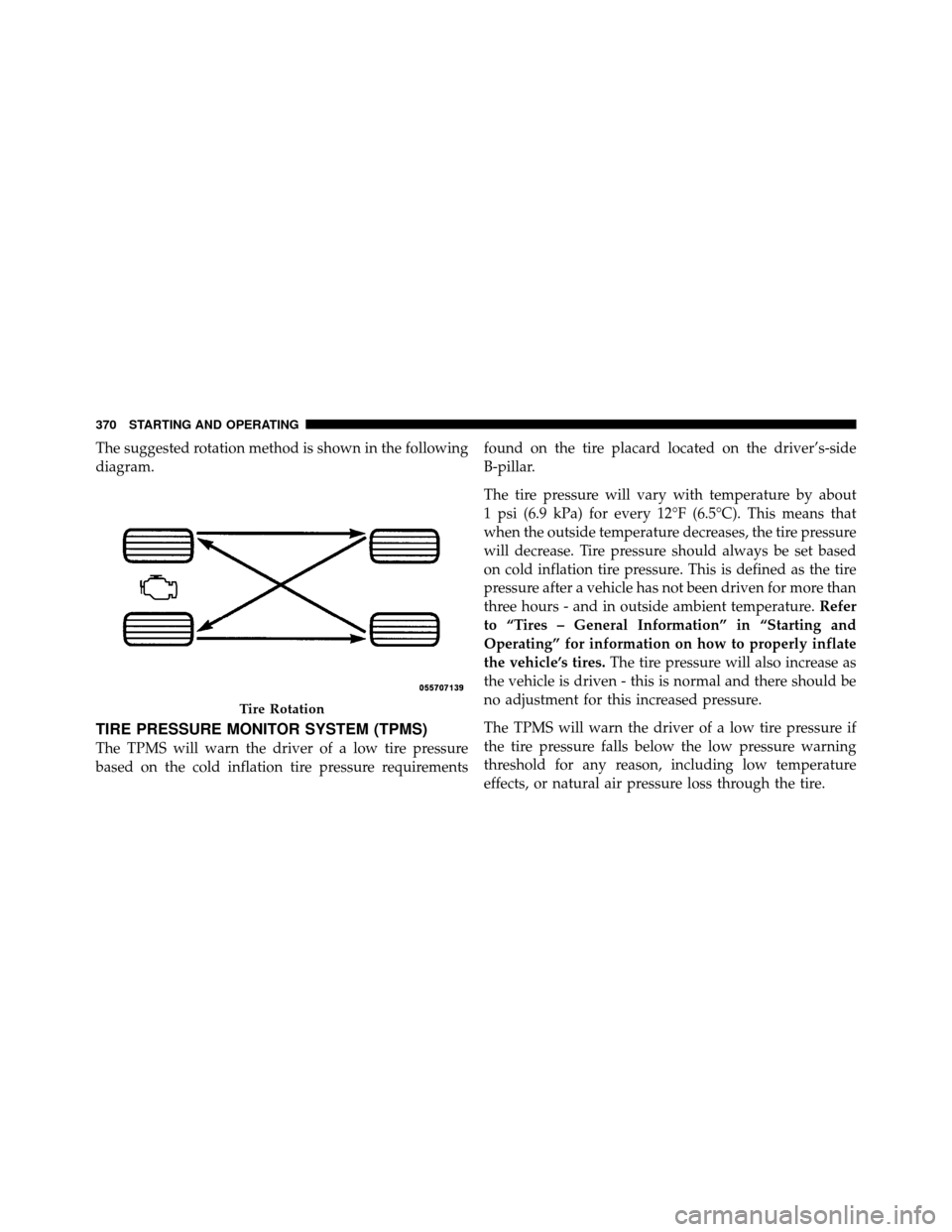
The suggested rotation method is shown in the following
diagram.
TIRE PRESSURE MONITOR SYSTEM (TPMS)
The TPMS will warn the driver of a low tire pressure
based on the cold inflation tire pressure requirementsfound on the tire placard located on the driver’s-side
B-pillar.
The tire pressure will vary with temperature by about
1 psi (6.9 kPa) for every 12°F (6.5°C). This means that
when the outside temperature decreases, the tire pressure
will decrease. Tire pressure should always be set based
on cold inflation tire pressure. This is defined as the tire
pressure after a vehicle has not been driven for more than
three hours - and in outside ambient temperature.
Refer
to “Tires – General Information” in “Starting and
Operating” for information on how to properly inflate
the vehicle’s tires. The tire pressure will also increase as
the vehicle is driven - this is normal and there should be
no adjustment for this increased pressure.
The TPMS will warn the driver of a low tire pressure if
the tire pressure falls below the low pressure warning
threshold for any reason, including low temperature
effects, or natural air pressure loss through the tire.
Tire Rotation
370 STARTING AND OPERATING
Page 373 of 538
CAUTION! (Continued)
•After inspecting or adjusting the tire pressure
always reinstall the valve stem cap. This will
prevent moisture and dirt from entering the valve
stem, which could damage the TPMS sensor.
NOTE:
•The TPMS is not intended to replace normal tire care
and maintenance, or to provide warning of a tire
failure or condition.
•The TPMS should not be used as a tire pressure gauge
while adjusting your tire pressure.
•Driving on a significantly under-inflated tire causes
the tire to overheat and can lead to tire failure.
Under-inflation also reduces fuel efficiency and tire
tread life, and may affect the vehicle’s handling and
stopping ability.
•The TPMS is not a substitute for proper tire mainte-
nance, and it is the driver’s responsibility to maintain
correct tire pressure, using an accurate tire pressure
gage, even if under-inflation has not reached the level
to trigger illumination of the “TPMS Warning Lamp.”
•Seasonal temperature changes will affect tire pressure,
and the TPMS will monitor the actual tire pressure in
the tire.
Base System
The TPMS uses wireless technology with wheel rim
mounted electronic sensors to monitor tire pressure lev-
els. Sensors, mounted to each wheel as part of the valve
stem, transmit tire pressure readings to the Receiver
Module.
NOTE: It is particularly important for you to check the
tire pressure in all of your tires regularly and to maintain
the proper pressure.
372 STARTING AND OPERATING
Page 374 of 538
The Basic TPMS consists of the following components:
•Receiver Module
•Four Tire Pressure Monitoring Sensors
•TPMS Telltale Warning Light
Tire Pressure Monitoring Low Tire Pressure
Warnings
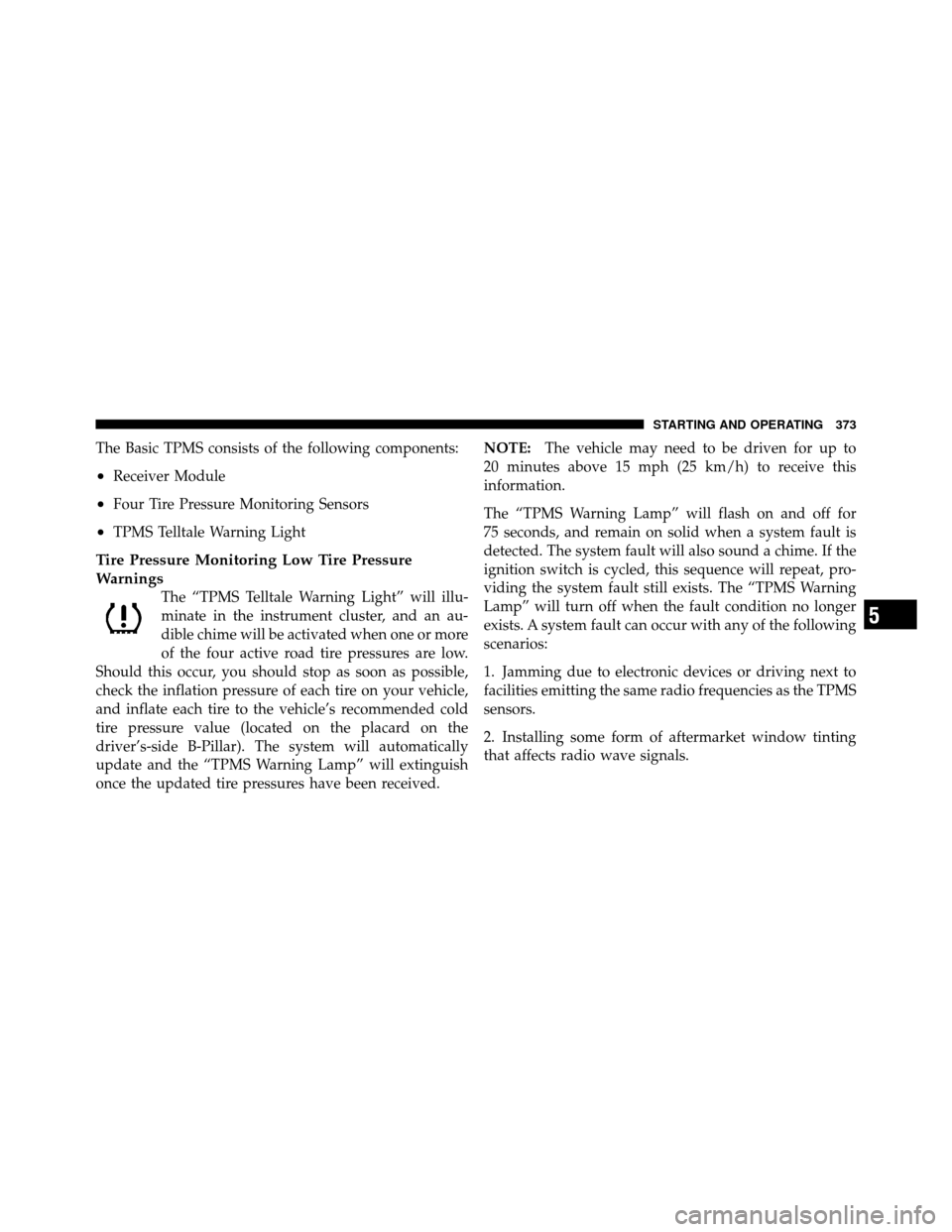
The “TPMS Telltale Warning Light” will illu-
minate in the instrument cluster, and an au-
dible chime will be activated when one or more
of the four active road tire pressures are low.
Should this occur, you should stop as soon as possible,
check the inflation pressure of each tire on your vehicle,
and inflate each tire to the vehicle’s recommended cold
tire pressure value (located on the placard on the
driver’s-side B-Pillar). The system will automatically
update and the “TPMS Warning Lamp” will extinguish
once the updated tire pressures have been received. NOTE:
The vehicle may need to be driven for up to
20 minutes above 15 mph (25 km/h) to receive this
information.
The “TPMS Warning Lamp” will flash on and off for
75 seconds, and remain on solid when a system fault is
detected. The system fault will also sound a chime. If the
ignition switch is cycled, this sequence will repeat, pro-
viding the system fault still exists. The “TPMS Warning
Lamp” will turn off when the fault condition no longer
exists. A system fault can occur with any of the following
scenarios:
1. Jamming due to electronic devices or driving next to
facilities emitting the same radio frequencies as the TPMS
sensors.
2. Installing some form of aftermarket window tinting
that affects radio wave signals.
5
STARTING AND OPERATING 373
Page 392 of 538
Rim Size
This is the rim size that is appropriate for the tire size
listed.
Inflation Pressure
This is the cold tire inflation pressure for your vehicle, for
all loading conditions up to full GAWR.
Curb Weight
The curb weight of a vehicle is defined as the total weight
of the vehicle with all fluids, including vehicle fuel, at full
capacity conditions, and with no occupants or cargo
loaded into the vehicle. The front and rear curb weight
values are determined by weighing your vehicle on a
commercial scale before any occupants or cargo are
added.
Overloading
The load carrying components (axle, springs, tires,
wheels, etc.) of your vehicle will provide satisfactory
service as long as you do not exceed the GVWR and front
and rear GAWR.
The best way to figure out the total weight of your
vehicle is to weigh it when it is fully loaded and ready for
operation. Weigh it on a commercial scale to ensure that
it is not over the GVWR.
Figure out the weight on the front and rear of the vehicle
separately. It is important that you distribute the load
evenly over the front and rear axles.
Overloading can cause potential safety hazards and
shorten useful service life. Heavier axles or suspension
components do not necessarily increase the vehicle’s
GVWR.
5
STARTING AND OPERATING 391
Page 405 of 538
WARNING! (Continued)
3. GAWR
4. Trailer tongue weight rating for that trailer hitch.
(This requirement may limit the ability to always
achieve the 10% to 15% range of trailer tongue weight
as a percentage of total trailer weight.)
Towing Requirements – Tires
•
Do not attempt to tow a trailer while using a compact
spare tire.
•Proper tire inflation pressures are essential to the safe
and satisfactory operation of your vehicle. Refer to
“Tires – General Information” in “Starting and Oper-
ating” for proper tire inflation procedures.
•Check the trailer tires for proper tire inflation pres-
sures before trailer usage.
•Check for signs of tire wear or visible tire damage
before towing a trailer. Refer to “Tires – General
Information” in “Starting and Operating” for the
proper inspection procedure.
•When replacing tires, refer to “Tires – General Infor-
mation” in “Starting and Operating” for proper tire
replacement procedures. Replacing tires with a higher
load carrying capacity will not increase the vehicle’s
GVWR and GAWR limits.
Towing Requirements – Trailer Brakes
•
Donot interconnect the hydraulic brake system or
vacuum system of your vehicle with that of the trailer.
This could cause inadequate braking and possible
personal injury.
404 STARTING AND OPERATING
Page 534 of 538

Steering Wheel Mounted Sound System
Controls.............................. 300
Storage ............................ 207,479
Storage Bin ............................ 207
Storage, Vehicle ...................... 321,479
Storing Your Vehicle ...................... 479
Stow \bn Go (Fold in Floor) Seats ............. 136
Sun Roof .............................. 198
Sunglasses Storage ....................... 190
Sunroof Maintenance ..................... 201
Supplemental Restraint System - Airbag ........ 68
Synthetic Engine Oil ...................... 443
System, Remote Starting .................... 27
Tachometer ............................ 240
Temperature Control, Automatic (ATC) ........ 312
Temperature Gauge, Engine Coolant .......242,413
Tether Anchor, Child Restraint ............... 93
Tilt Steering Column ..................... 171 Tire and Loading Information Placard
......... 357
Tire Identification Number (TIN) ............. 355
Tire Markings .......................... 352
Tire Safety Information .................... 352
Tires ........................... 104,361,515
Aging (Life of Tires) .................... 367
Air Pressure .......................... 361
Changing ............................ 413
Compact Spare ........................ 364
Flat Changing ........................ 423
General Information .................... 361
High Speed .......................... 363
Inflation Pressures ..................... 362
Jacking ........................... 413,416
Life of Tires .......................... 367
Load Capacity ..................... 357,358
Pressure Monitor System (TPMS) ........... 370
Pressure Warning Light .................. 234
Quality Grading ....................... 515
Radial .............................. 364
10
INDEX 533