AUX CHRYSLER VOYAGER 1996 User Guide
[x] Cancel search | Manufacturer: CHRYSLER, Model Year: 1996, Model line: VOYAGER, Model: CHRYSLER VOYAGER 1996Pages: 1938, PDF Size: 55.84 MB
Page 1858 of 1938
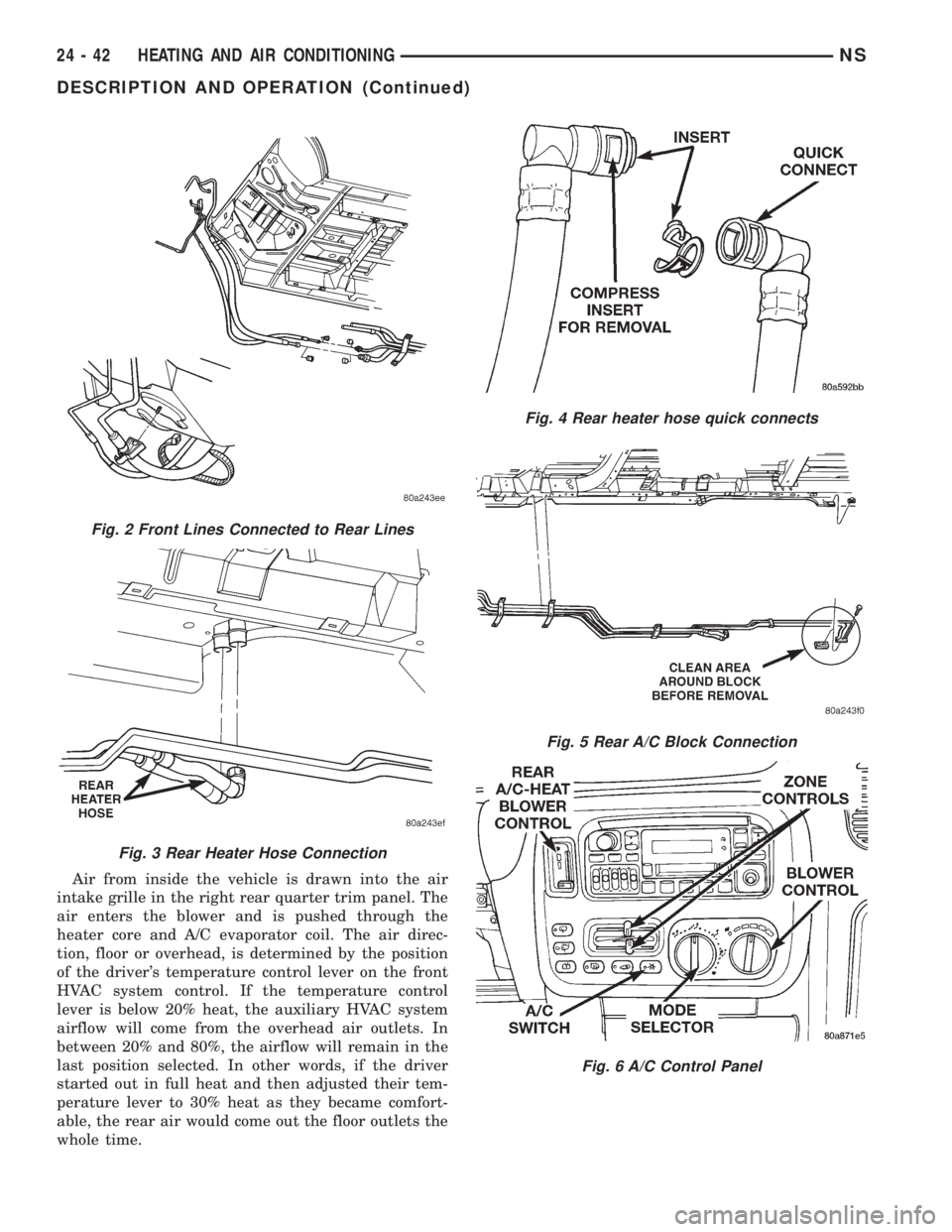
Air from inside the vehicle is drawn into the air
intake grille in the right rear quarter trim panel. The
air enters the blower and is pushed through the
heater core and A/C evaporator coil. The air direc-
tion, floor or overhead, is determined by the position
of the driver's temperature control lever on the front
HVAC system control. If the temperature control
lever is below 20% heat, the auxiliary HVAC system
airflow will come from the overhead air outlets. In
between 20% and 80%, the airflow will remain in the
last position selected. In other words, if the driver
started out in full heat and then adjusted their tem-
perature lever to 30% heat as they became comfort-
able, the rear air would come out the floor outlets the
whole time.
Fig. 2 Front Lines Connected to Rear Lines
Fig. 3 Rear Heater Hose Connection
Fig. 4 Rear heater hose quick connects
Fig. 5 Rear A/C Block Connection
Fig. 6 A/C Control Panel
24 - 42 HEATING AND AIR CONDITIONINGNS
DESCRIPTION AND OPERATION (Continued)
Page 1859 of 1938
DIAGNOSIS AND TESTING
DIAGNOSTIC PROCEDURES
When diagnosing electrical problems in the auxil-
iary rear heater or rear A/C system, refer to Group
8W, Wiring Diagrams.
When diagnosing problems in the auxiliary sys-
tems, refer to diagnostic sections for front heater A/C.
REMOVAL AND INSTALLATION
AIR DISTRIBUTION DUCT-A/C
REMOVAL
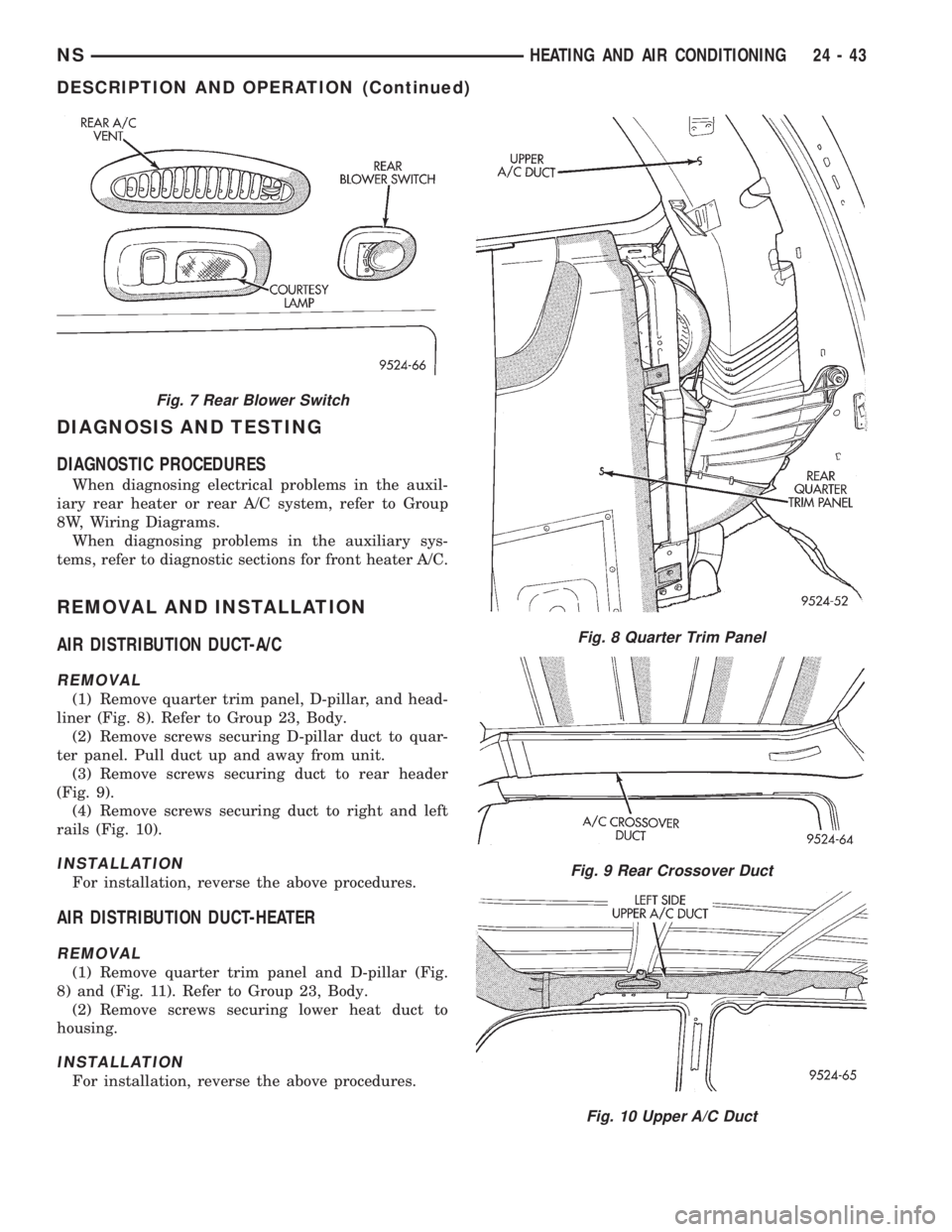
(1) Remove quarter trim panel, D-pillar, and head-
liner (Fig. 8). Refer to Group 23, Body.
(2) Remove screws securing D-pillar duct to quar-
ter panel. Pull duct up and away from unit.
(3) Remove screws securing duct to rear header
(Fig. 9).
(4) Remove screws securing duct to right and left
rails (Fig. 10).
INSTALLATION
For installation, reverse the above procedures.
AIR DISTRIBUTION DUCT-HEATER
REMOVAL
(1) Remove quarter trim panel and D-pillar (Fig.
8) and (Fig. 11). Refer to Group 23, Body.
(2) Remove screws securing lower heat duct to
housing.
INSTALLATION
For installation, reverse the above procedures.
Fig. 7 Rear Blower Switch
Fig. 8 Quarter Trim Panel
Fig. 9 Rear Crossover Duct
Fig. 10 Upper A/C Duct
NSHEATING AND AIR CONDITIONING 24 - 43
DESCRIPTION AND OPERATION (Continued)
Page 1861 of 1938
CAUTION: Do not damage the evaporator insulation
liner during installation.
(3) Carefully install the evaporator and expansion
valve straight into the unit. Do not scratch the seal-
ing surfaces with the plumbing extension tube pilots.
(4) Determine the amount of old refrigerant oil
drained from the evaporator. Add this amount (of
clean refrigerant oil) back into the system.
(5) Carefully align the expansion valve onto the
pilot tubes of the plumbing extension (do not scratch
the sealing surface). Install the bolt through the
plumbing plate into the unit sealing plate. Tighten
bolts to 2363 N´m (200630 inch pounds) torque.
(6) Install evaporator cover and blower scroll.
(7) Install quarter trim panel, evacuate/charge sys-
tem, and perform the performance test.
REAR AIR CONDITIONING LINES
WARNING: THE REFRIGERATION SYSTEM MUST
BE COMPLETELY EMPTY BEFORE PROCEEDING
WITH THIS OPERATION.
REMOVAL
(1) Hoist vehicle
(2) Remove compression fittings to the suction and
liquid lines located on the right, outboard side of the
underbody, rearward of the front crossmember. (Fig.
2)
(3) remove (1) bolt securing a/c lines to block
located on the right, outboard side of the underbody,
rearward of the rear wheel and tire. (Fig. 5)
(4) Remove (3) straps securing underbody lines.
(Fig. 1)
(5) Separate and remove a/c lines from vehicle.
INSTALLATION
(1) Before installation, replace all O-rings and gas-
kets. Coat all sealing surfaces with approved wax-
free refrigerant oil. Then, reverse the above
procedures.
(2) Evacuate and recharge system.
REAR HEATER A/C AIR OUTLETS
REMOVAL
Separate barrel from bezel by pulling outward.
INSTALLATION
For installation, push the outlet firmly into the
opening until it locks into place.
REAR HEATER-A/C AUXILIARY CONDENSER
If vehicle is equipped with a 3.3L or 3.8L engine
with rear heater and air conditioning, it will be
equipped with an auxiliary condenser. The auxiliarycondenser is mounted on the primary condenser in
front of the radiator. Both condenser must be
removed as an assembly and then separated.
WARNING: THE REFRIGERATION SYSTEM MUST
BE COMPLETELY EMPTY BEFORE PROCEEDING
WITH THIS OPERATION.
NOTE: Special effort must be used to keep all
R-134a system components moisture-free. Moisture
in the oil is very difficult to remove and will cause a
reliability problem with the compressor.
The condenser assembly must first be removed
from vehicle. Refer to CONDENSER ASSEMBLY
removal and installation in this section for service
procedures.
REMOVAL
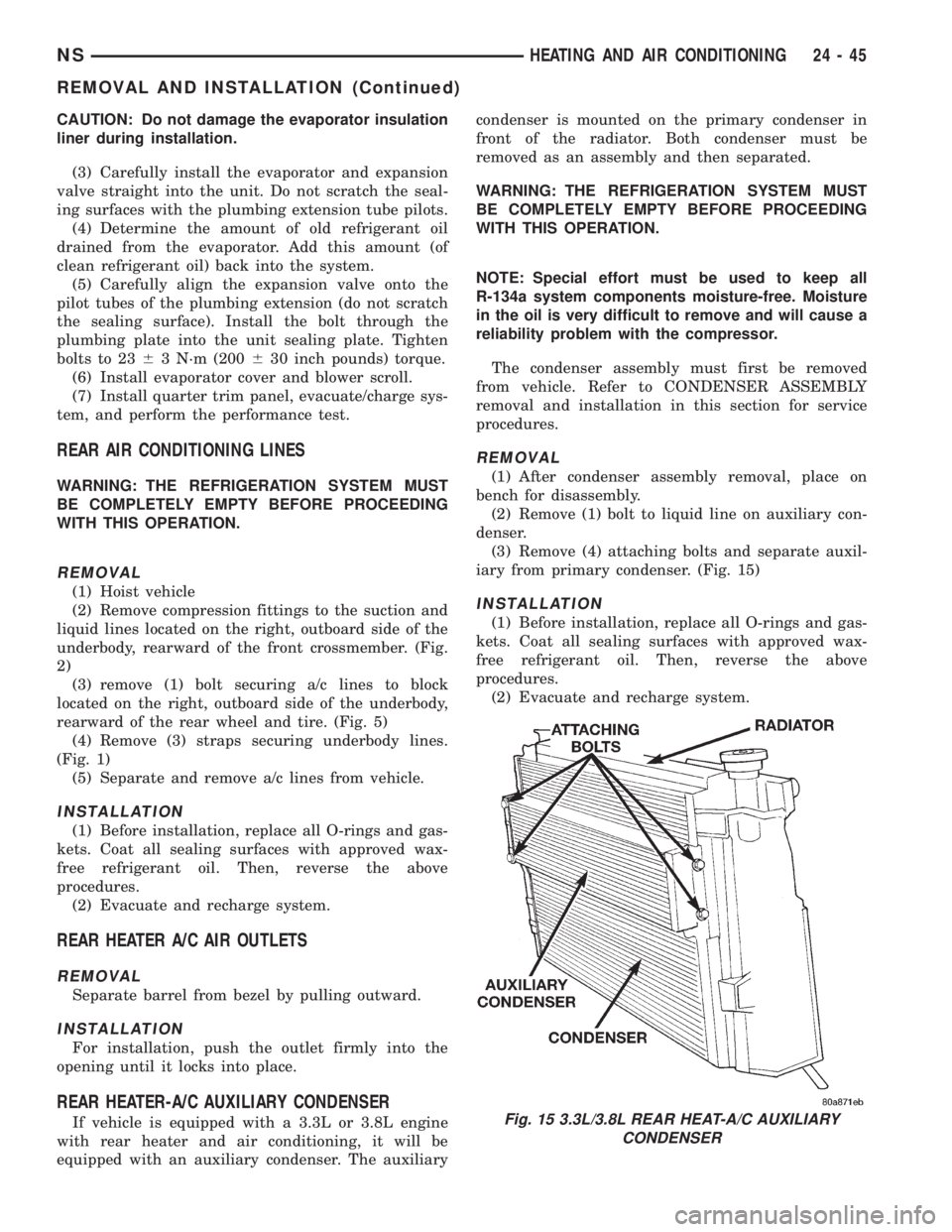
(1) After condenser assembly removal, place on
bench for disassembly.
(2) Remove (1) bolt to liquid line on auxiliary con-
denser.
(3) Remove (4) attaching bolts and separate auxil-
iary from primary condenser. (Fig. 15)
INSTALLATION
(1) Before installation, replace all O-rings and gas-
kets. Coat all sealing surfaces with approved wax-
free refrigerant oil. Then, reverse the above
procedures.
(2) Evacuate and recharge system.
Fig. 15 3.3L/3.8L REAR HEAT-A/C AUXILIARY
CONDENSER
NSHEATING AND AIR CONDITIONING 24 - 45
REMOVAL AND INSTALLATION (Continued)
Page 1864 of 1938
NOTE: If the heater core was emptied and was not
prefilled, it is necessary to thermal cycle the vehicle
TWICE. The heater core is positioned higher than
the radiator fill cap. Therefore the heater core will
not gravity fill to level. To thermal cycle the vehicle,
it must be operated till the thermostat opens, then
turned off and allowed to cool. In order to verify
that the auxiliary unit is filled completely, the follow-
ing procedure can be used:
²Vehicle at room temperature.
²Engine is brought up to operating temperature.
²Front unit is OFF, temperature slides are at full
HEAT position.
²Engine is at idle.
²With rear blower motor ON HIGH.
²Discharge air temperature, measured at the
dual register located on the C-pillar base, is between
135É and 145É F.
REAR HEATER CORE
REMOVAL
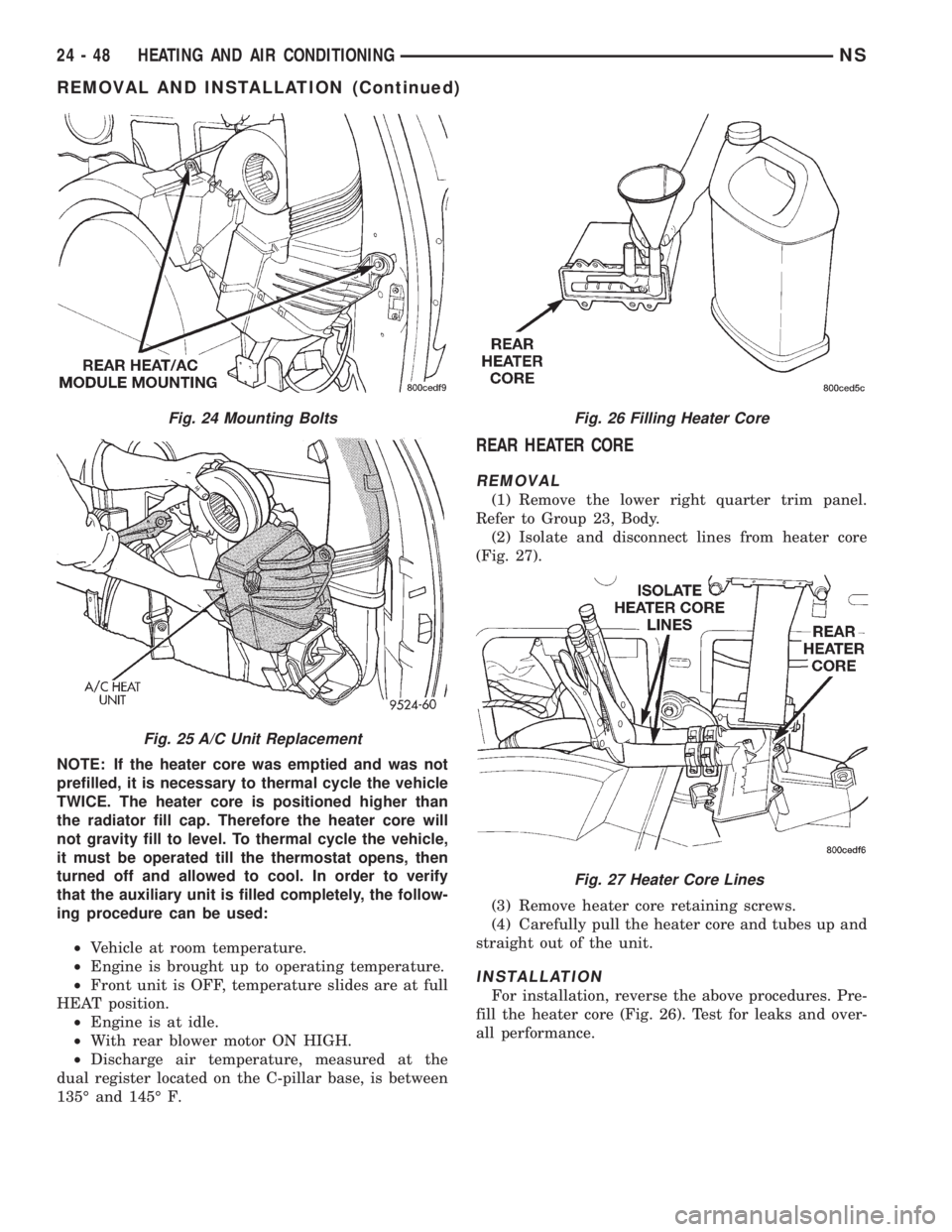
(1) Remove the lower right quarter trim panel.
Refer to Group 23, Body.
(2) Isolate and disconnect lines from heater core
(Fig. 27).
(3) Remove heater core retaining screws.
(4) Carefully pull the heater core and tubes up and
straight out of the unit.
INSTALLATION
For installation, reverse the above procedures. Pre-
fill the heater core (Fig. 26). Test for leaks and over-
all performance.
Fig. 24 Mounting Bolts
Fig. 25 A/C Unit Replacement
Fig. 26 Filling Heater Core
Fig. 27 Heater Core Lines
24 - 48 HEATING AND AIR CONDITIONINGNS
REMOVAL AND INSTALLATION (Continued)
Page 1865 of 1938
NOTE: If the heater core was emptied and was not
prefilled, it is necessary to thermal cycle the vehicle
TWICE. The heater core is positioned higher than
the radiator fill cap. Therefore the heater core will
not gravity fill to level. To thermal cycle the vehicle,
it must be operated till the thermostat opens, then
turned off and allowed to cool. In order to verify
that the auxiliary unit is filled completely, the follow-
ing procedure can be used:
²Vehicle at room temperature.
²Engine is brought up to operating temperature.
²Front unit is OFF, temperature slides are at full
HEAT position.
²Engine is at idle.
²With rear blower motor ON HIGH
²Discharge air temperature, measured at the
dual register located on the C-pillar base, is between
57ÉC to 62ÉC (135É and 145É F).
REAR HEATER LINES
REMOVAL
NOTE: Review Safety Precautions and Warnings
before proceeding with this operation.
(1) Partially drain engine cooling system. Refer to
Group 7, Engine Cooling.
(2) Loosen clamp at the front end of the hose
located at the right, outboard side of the underbody,
rearward of the front crossmember. (Fig. 2)
(3) Carefully rotate hose back and forth while tug-
ging slightly away from connector nipple. If the hose
will not come off, slice the hose at the connector nip-
ple and peel off heater hose. This method will require
heater hose replacement.
CAUTION: When removing hoses from outlet nip-
ples, do not use excessive force. Outlet nipples
may become damaged and leak engine coolant.
(4) Compress insert in rear heater hose quick con-
nection and pull downward on hose. (Fig. 4)(5) Remove (3) straps securing underbody lines.
(Fig. 1)
(6) Separate and remove rear heater lines from
vehicle.
INSTALLATION
For installation, reverse the above procedures.
MODE DOOR
REMOVAL
(1) Remove A/C unit.
(2) Place unit on bench.
(3) Remove heater core.
(4) Remove blower scroll.
(5) Remove evaporator cover.
(6) Remove A/C line to expansion valve mounting
nut.
(7) Carefully pull evaporator out of housing.
(8) Remove mode door actuator and gear exten-
sion.
(9) Remove Heater-A/C housing clips and screws.
(10) Separate housing halves.
(11) Remove mode door.
INSTALLATION
For installation, reverse the above procedures.
MODE DOOR ACTUATOR
REMOVAL
(1) Remove A/C unit.
(2) Place unit on bench.
(3) Remove mode door actuator connector.
(4) Remove mode door actuator mounting screws
and remove actuator.
INSTALLATION
For installation, reverse the above procedures.
NSHEATING AND AIR CONDITIONING 24 - 49
REMOVAL AND INSTALLATION (Continued)
Page 1932 of 1938

Generic Scan
Tool CodeDRB III Scan Tool Display
EEPROM Plausibility Ver Number Not Corresponding
P1685 Vehicle Theft Alarm Code Line Breakdown
P1690 Fan Control Open Circuit Fan #1
Fan Control Open Circuit Fan #2
Fan Control Short Circuit Fan #1
Fan Control Short Circuit Fan #2
P1695 A/C System Pressure Sensor Signal High Exceeded
A/C System Pressure Sensor Signal Low Exceeded
A/C System Pressure Supply Signal High Exceeded
A/C System Pressure Supply Signal Low Exceeded
P1703 Brake Signal Plaus With Redundant Contact
P1740 Clutch Signal Plausibilty
P1725 Inductive Aux. Speed Sensor Dynamic Plausibilty
Inductive Aux. Speed Sensor Overspeed Recognition
Inductive Aux Speed Sensor Plausibilty
Inductive Aux. Speed Sensor Static Plausibilty
25 - 4 EMISSION CONTROL SYSTEMNS/GS
DESCRIPTION AND OPERATION (Continued)