hood release CHRYSLER VOYAGER 1996 User Guide
[x] Cancel search | Manufacturer: CHRYSLER, Model Year: 1996, Model line: VOYAGER, Model: CHRYSLER VOYAGER 1996Pages: 1938, PDF Size: 55.84 MB
Page 296 of 1938

(4) Install bolt to hold bottom of generator to lower
pivot bracket.
(5) Install bolt to hold top of generator to mount
bracket.
(6) Install accessory drive belt, refer to Group 7,
Cooling System for proper procedures.
(7) Install windshield wiper housing, refer to
Group 8K, Windshield Wipers and Washers for
proper procedures.
(8) Connect battery negative cable.
(9) Verify generator charge rate.
GENERATORÐ3.3/3.8 L ENGINE
REMOVAL
(1) Release hood latch and open hood.
(2) Disconnect battery negative cable (Fig. 3).
(3) Remove windshield wiper housing, refer to
Group 8K, Windshield Wipers and Washers for
proper procedures.
(4) Remove accessory drive belt, refer to Group 7,
Cooling System for proper procedures.
(5) Remove bolt holding top of generator mount
bracket to engine air intake plenum (Fig. 7).
(6) Remove bolts holding outside of generator
mount bracket to generator mount plate.
(7) Remove bolt holding top of generator to mount
bracket.
(8) Remove generator mount bracket from vehicle.
(9) Rotate generator toward rear dash panel.
(10) Disconnect the push-in field wire connector
from back of generator (Fig. 6).
(11) Remove nut holding B+ wire terminal to back
of generator.
(12) Separate B+ terminal from generator.
(13) Remove bolt holding bottom of generator to
lower pivot bracket (Fig. 8).
(14) Remove generator from vehicle (Fig. 9).
INSTALLATION
(1) Place generator in position on vehicle.
Fig. 6 Generator±3.0L EngineFig. 7 Generator Mounting Bracket
Fig. 8 Generator pivot Bolt
Fig. 9 Generator±3.3/3.8 L Engine
8C - 10 CHARGING SYSTEMNS
REMOVAL AND INSTALLATION (Continued)
Page 362 of 1938
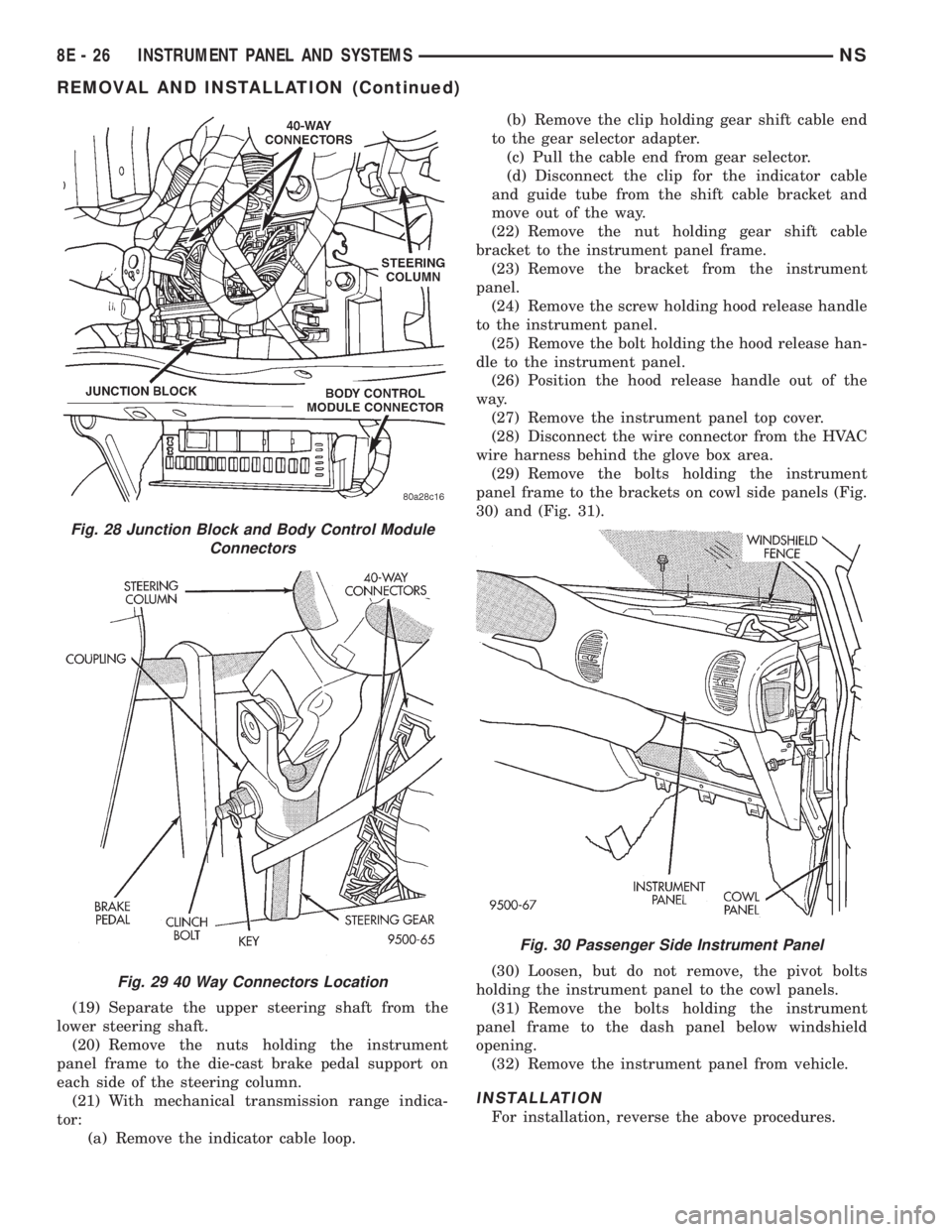
(19) Separate the upper steering shaft from the
lower steering shaft.
(20) Remove the nuts holding the instrument
panel frame to the die-cast brake pedal support on
each side of the steering column.
(21) With mechanical transmission range indica-
tor:
(a) Remove the indicator cable loop.(b) Remove the clip holding gear shift cable end
to the gear selector adapter.
(c) Pull the cable end from gear selector.
(d) Disconnect the clip for the indicator cable
and guide tube from the shift cable bracket and
move out of the way.
(22) Remove the nut holding gear shift cable
bracket to the instrument panel frame.
(23) Remove the bracket from the instrument
panel.
(24) Remove the screw holding hood release handle
to the instrument panel.
(25) Remove the bolt holding the hood release han-
dle to the instrument panel.
(26) Position the hood release handle out of the
way.
(27) Remove the instrument panel top cover.
(28) Disconnect the wire connector from the HVAC
wire harness behind the glove box area.
(29) Remove the bolts holding the instrument
panel frame to the brackets on cowl side panels (Fig.
30) and (Fig. 31).
(30) Loosen, but do not remove, the pivot bolts
holding the instrument panel to the cowl panels.
(31) Remove the bolts holding the instrument
panel frame to the dash panel below windshield
opening.
(32) Remove the instrument panel from vehicle.
INSTALLATION
For installation, reverse the above procedures.
Fig. 28 Junction Block and Body Control Module
Connectors
Fig. 29 40 Way Connectors Location
Fig. 30 Passenger Side Instrument Panel
8E - 26 INSTRUMENT PANEL AND SYSTEMSNS
REMOVAL AND INSTALLATION (Continued)
Page 393 of 1938
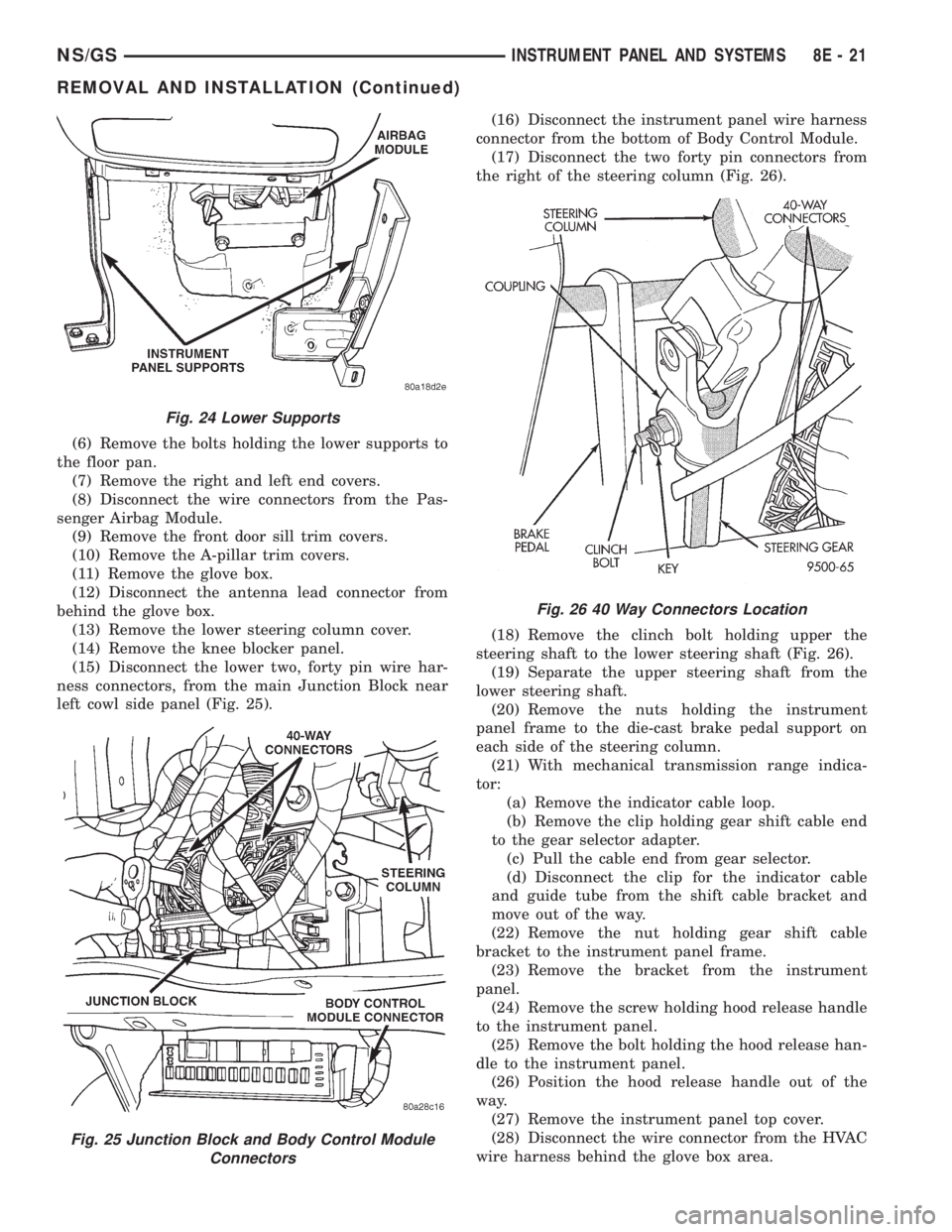
(6) Remove the bolts holding the lower supports to
the floor pan.
(7) Remove the right and left end covers.
(8) Disconnect the wire connectors from the Pas-
senger Airbag Module.
(9) Remove the front door sill trim covers.
(10) Remove the A-pillar trim covers.
(11) Remove the glove box.
(12) Disconnect the antenna lead connector from
behind the glove box.
(13) Remove the lower steering column cover.
(14) Remove the knee blocker panel.
(15) Disconnect the lower two, forty pin wire har-
ness connectors, from the main Junction Block near
left cowl side panel (Fig. 25).(16) Disconnect the instrument panel wire harness
connector from the bottom of Body Control Module.
(17) Disconnect the two forty pin connectors from
the right of the steering column (Fig. 26).
(18) Remove the clinch bolt holding upper the
steering shaft to the lower steering shaft (Fig. 26).
(19) Separate the upper steering shaft from the
lower steering shaft.
(20) Remove the nuts holding the instrument
panel frame to the die-cast brake pedal support on
each side of the steering column.
(21) With mechanical transmission range indica-
tor:
(a) Remove the indicator cable loop.
(b) Remove the clip holding gear shift cable end
to the gear selector adapter.
(c) Pull the cable end from gear selector.
(d) Disconnect the clip for the indicator cable
and guide tube from the shift cable bracket and
move out of the way.
(22) Remove the nut holding gear shift cable
bracket to the instrument panel frame.
(23) Remove the bracket from the instrument
panel.
(24) Remove the screw holding hood release handle
to the instrument panel.
(25) Remove the bolt holding the hood release han-
dle to the instrument panel.
(26) Position the hood release handle out of the
way.
(27) Remove the instrument panel top cover.
(28) Disconnect the wire connector from the HVAC
wire harness behind the glove box area.
Fig. 24 Lower Supports
Fig. 25 Junction Block and Body Control Module
Connectors
Fig. 26 40 Way Connectors Location
NS/GSINSTRUMENT PANEL AND SYSTEMS 8E - 21
REMOVAL AND INSTALLATION (Continued)
Page 424 of 1938
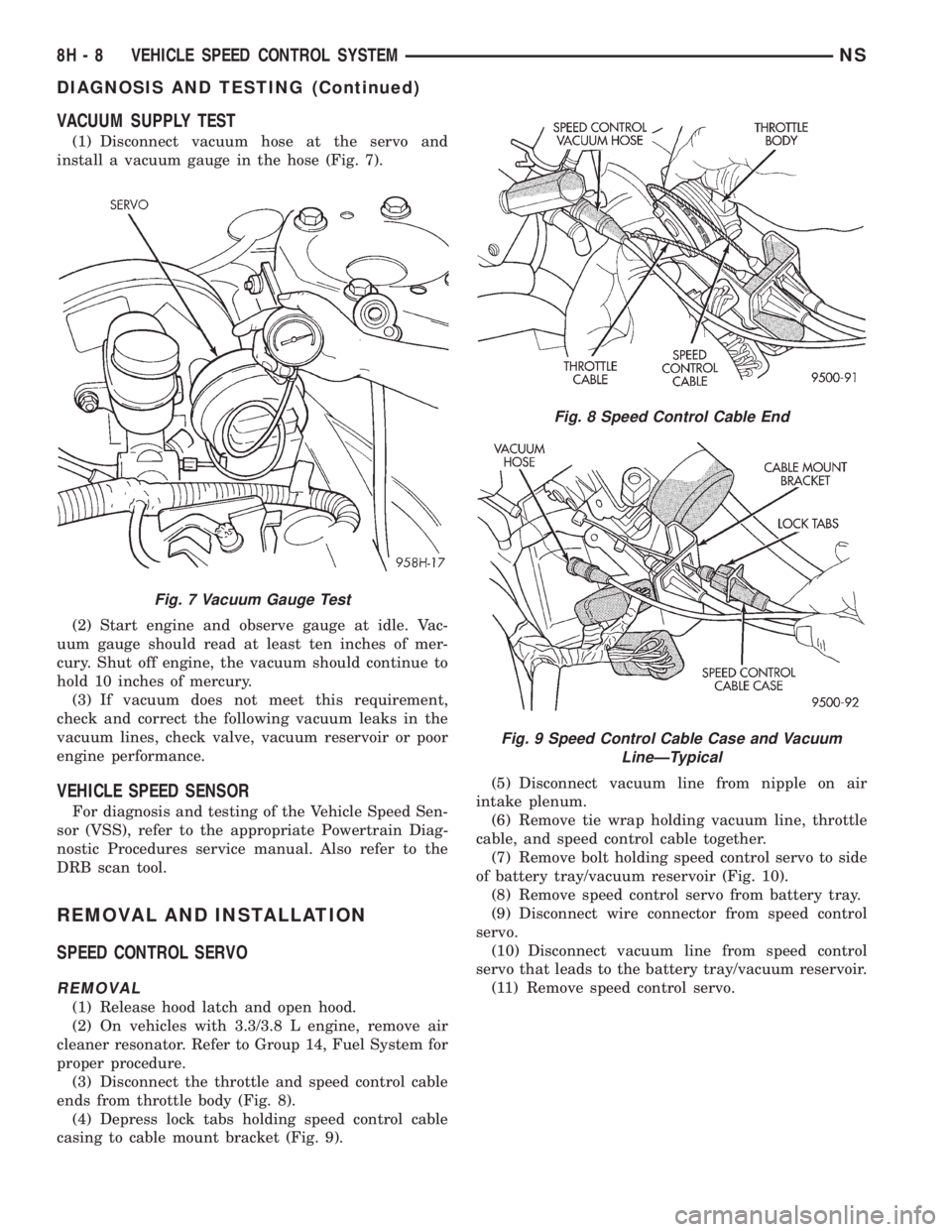
VACUUM SUPPLY TEST
(1) Disconnect vacuum hose at the servo and
install a vacuum gauge in the hose (Fig. 7).
(2) Start engine and observe gauge at idle. Vac-
uum gauge should read at least ten inches of mer-
cury. Shut off engine, the vacuum should continue to
hold 10 inches of mercury.
(3) If vacuum does not meet this requirement,
check and correct the following vacuum leaks in the
vacuum lines, check valve, vacuum reservoir or poor
engine performance.
VEHICLE SPEED SENSOR
For diagnosis and testing of the Vehicle Speed Sen-
sor (VSS), refer to the appropriate Powertrain Diag-
nostic Procedures service manual. Also refer to the
DRB scan tool.
REMOVAL AND INSTALLATION
SPEED CONTROL SERVO
REMOVAL
(1) Release hood latch and open hood.
(2) On vehicles with 3.3/3.8 L engine, remove air
cleaner resonator. Refer to Group 14, Fuel System for
proper procedure.
(3) Disconnect the throttle and speed control cable
ends from throttle body (Fig. 8).
(4) Depress lock tabs holding speed control cable
casing to cable mount bracket (Fig. 9).(5) Disconnect vacuum line from nipple on air
intake plenum.
(6) Remove tie wrap holding vacuum line, throttle
cable, and speed control cable together.
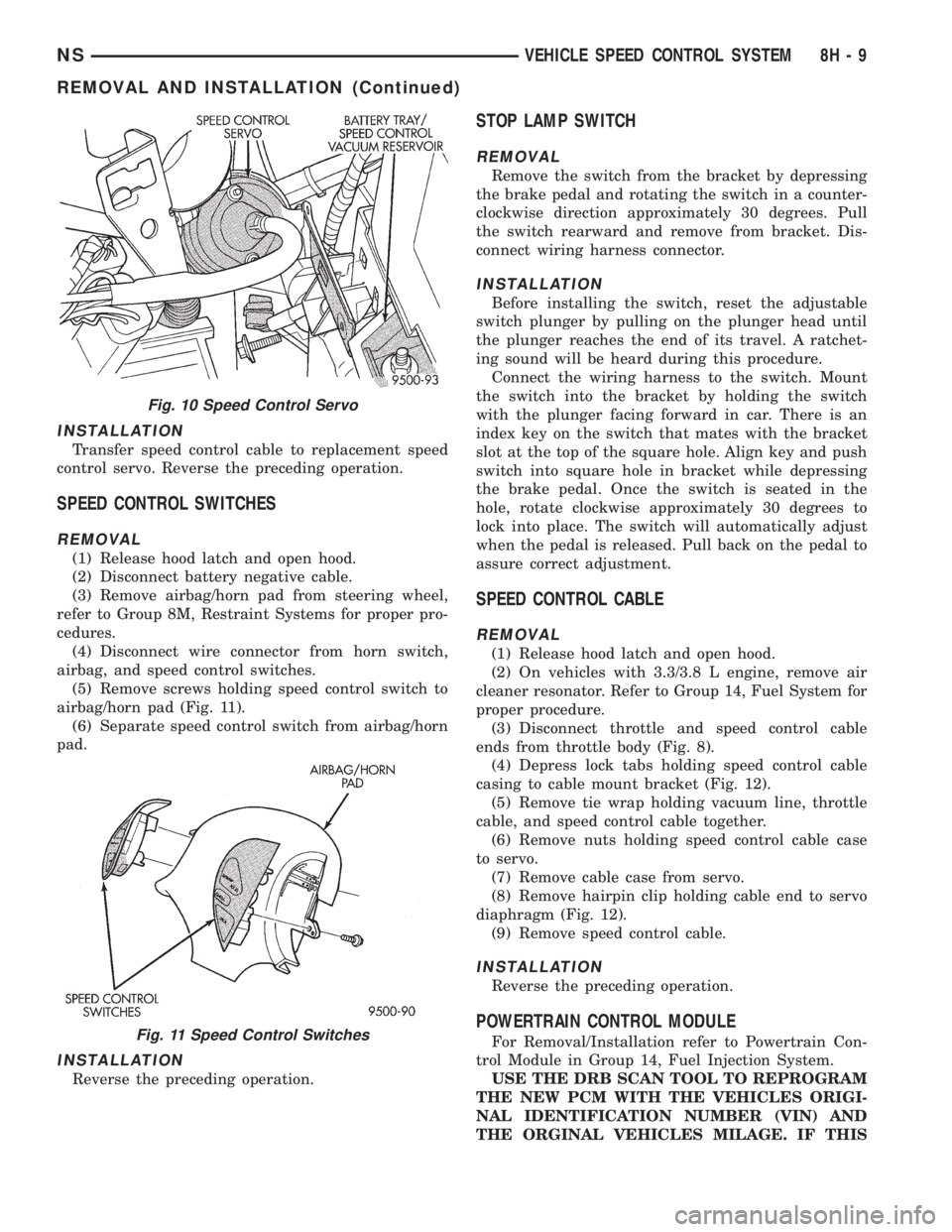
(7) Remove bolt holding speed control servo to side
of battery tray/vacuum reservoir (Fig. 10).
(8) Remove speed control servo from battery tray.
(9) Disconnect wire connector from speed control
servo.
(10) Disconnect vacuum line from speed control
servo that leads to the battery tray/vacuum reservoir.
(11) Remove speed control servo.
Fig. 7 Vacuum Gauge Test
Fig. 8 Speed Control Cable End
Fig. 9 Speed Control Cable Case and Vacuum
LineÐTypical
8H - 8 VEHICLE SPEED CONTROL SYSTEMNS
DIAGNOSIS AND TESTING (Continued)
Page 425 of 1938
INSTALLATION
Transfer speed control cable to replacement speed
control servo. Reverse the preceding operation.
SPEED CONTROL SWITCHES
REMOVAL
(1) Release hood latch and open hood.
(2) Disconnect battery negative cable.
(3) Remove airbag/horn pad from steering wheel,
refer to Group 8M, Restraint Systems for proper pro-
cedures.
(4) Disconnect wire connector from horn switch,
airbag, and speed control switches.
(5) Remove screws holding speed control switch to
airbag/horn pad (Fig. 11).
(6) Separate speed control switch from airbag/horn
pad.
INSTALLATION
Reverse the preceding operation.
STOP LAMP SWITCH
REMOVAL
Remove the switch from the bracket by depressing
the brake pedal and rotating the switch in a counter-
clockwise direction approximately 30 degrees. Pull
the switch rearward and remove from bracket. Dis-
connect wiring harness connector.
INSTALLATION
Before installing the switch, reset the adjustable
switch plunger by pulling on the plunger head until
the plunger reaches the end of its travel. A ratchet-
ing sound will be heard during this procedure.
Connect the wiring harness to the switch. Mount
the switch into the bracket by holding the switch
with the plunger facing forward in car. There is an
index key on the switch that mates with the bracket
slot at the top of the square hole. Align key and push
switch into square hole in bracket while depressing
the brake pedal. Once the switch is seated in the
hole, rotate clockwise approximately 30 degrees to
lock into place. The switch will automatically adjust
when the pedal is released. Pull back on the pedal to
assure correct adjustment.
SPEED CONTROL CABLE
REMOVAL
(1) Release hood latch and open hood.
(2) On vehicles with 3.3/3.8 L engine, remove air
cleaner resonator. Refer to Group 14, Fuel System for
proper procedure.
(3) Disconnect throttle and speed control cable
ends from throttle body (Fig. 8).
(4) Depress lock tabs holding speed control cable
casing to cable mount bracket (Fig. 12).
(5) Remove tie wrap holding vacuum line, throttle
cable, and speed control cable together.
(6) Remove nuts holding speed control cable case
to servo.
(7) Remove cable case from servo.
(8) Remove hairpin clip holding cable end to servo
diaphragm (Fig. 12).
(9) Remove speed control cable.
INSTALLATION
Reverse the preceding operation.
POWERTRAIN CONTROL MODULE
For Removal/Installation refer to Powertrain Con-
trol Module in Group 14, Fuel Injection System.
USE THE DRB SCAN TOOL TO REPROGRAM
THE NEW PCM WITH THE VEHICLES ORIGI-
NAL IDENTIFICATION NUMBER (VIN) AND
THE ORGINAL VEHICLES MILAGE. IF THIS
Fig. 10 Speed Control Servo
Fig. 11 Speed Control Switches
NSVEHICLE SPEED CONTROL SYSTEM 8H - 9
REMOVAL AND INSTALLATION (Continued)
Page 439 of 1938
REMOVAL AND INSTALLATION
MULTI-FUNCTION SWITCH
WARNING: BEFORE SERVICING A STEERING COL-
UMN EQUIPPED WITH AN AIRBAG REFER TO
GROUP 8M, RESTRAINT SYSTEMS FOR PROPER
AND SAFE SERVICE PROCEDURES.
REMOVAL
(1) Release hood latch and open hood.
(2) Disconnect and isolate battery negative cable.
(3) Remove upper and lower steering column
shrouds, refer to Group 19, Steering for proper pro-
cedures.
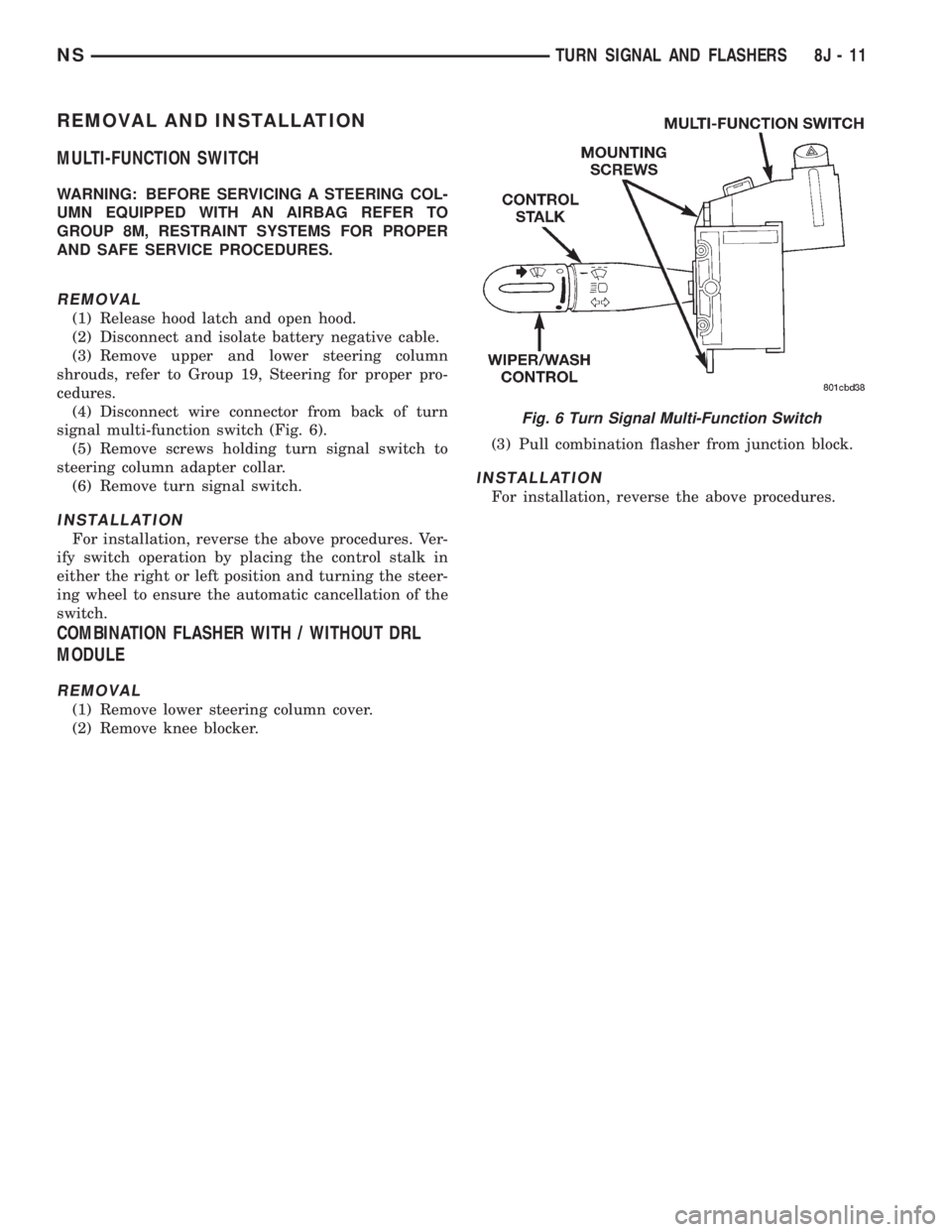
(4) Disconnect wire connector from back of turn
signal multi-function switch (Fig. 6).
(5) Remove screws holding turn signal switch to
steering column adapter collar.
(6) Remove turn signal switch.
INSTALLATION
For installation, reverse the above procedures. Ver-
ify switch operation by placing the control stalk in
either the right or left position and turning the steer-
ing wheel to ensure the automatic cancellation of the
switch.
COMBINATION FLASHER WITH / WITHOUT DRL
MODULE
REMOVAL
(1) Remove lower steering column cover.
(2) Remove knee blocker.(3) Pull combination flasher from junction block.
INSTALLATION
For installation, reverse the above procedures.
Fig. 6 Turn Signal Multi-Function Switch
NSTURN SIGNAL AND FLASHERS 8J - 11
Page 444 of 1938
MULTI-FUNCTION SWITCH
To test the windshield wiper and washer portion of
the multi-function switch:
(1) Remove the multi-function switch, refer to
removal procedures.
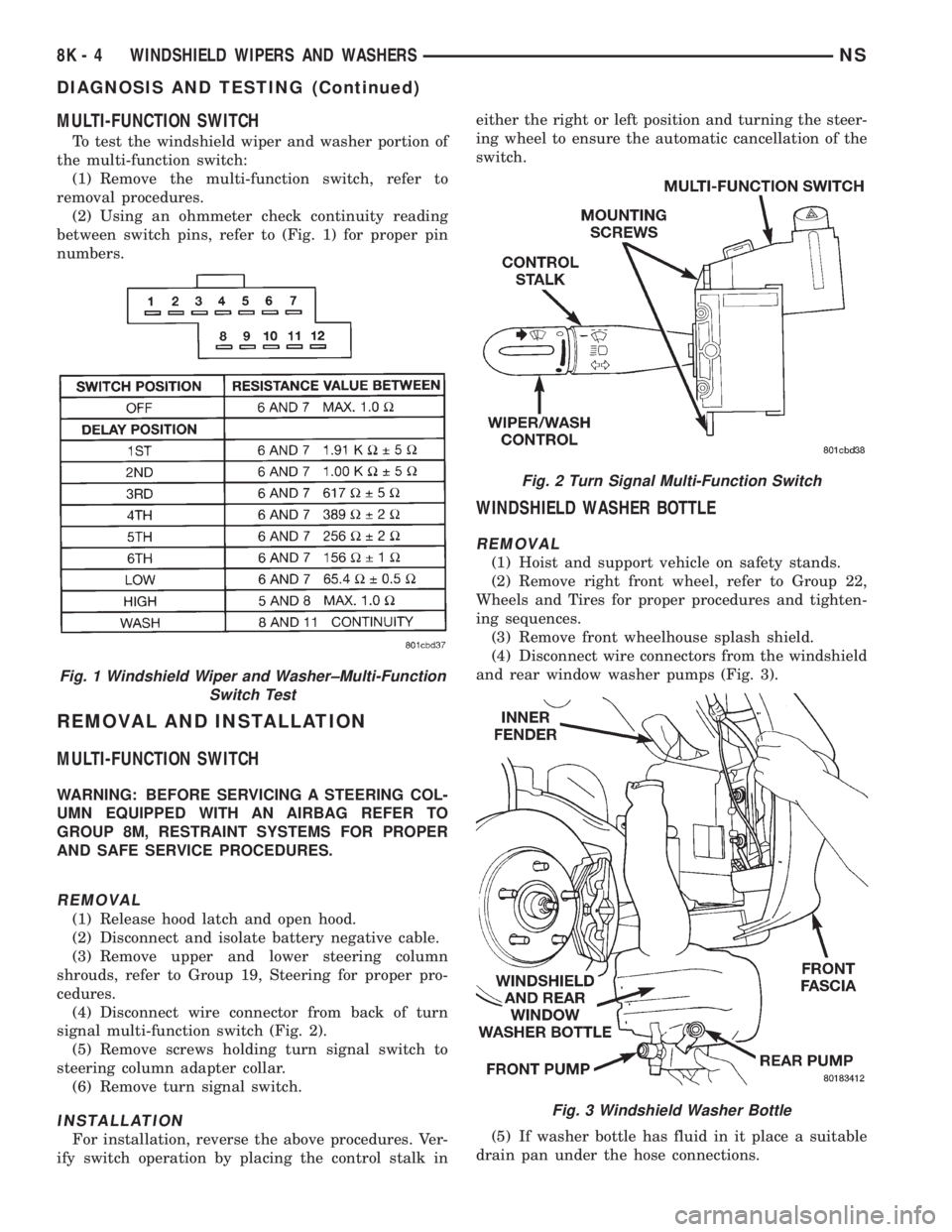
(2) Using an ohmmeter check continuity reading
between switch pins, refer to (Fig. 1) for proper pin
numbers.
REMOVAL AND INSTALLATION
MULTI-FUNCTION SWITCH
WARNING: BEFORE SERVICING A STEERING COL-
UMN EQUIPPED WITH AN AIRBAG REFER TO
GROUP 8M, RESTRAINT SYSTEMS FOR PROPER
AND SAFE SERVICE PROCEDURES.
REMOVAL
(1) Release hood latch and open hood.
(2) Disconnect and isolate battery negative cable.
(3) Remove upper and lower steering column
shrouds, refer to Group 19, Steering for proper pro-
cedures.
(4) Disconnect wire connector from back of turn
signal multi-function switch (Fig. 2).
(5) Remove screws holding turn signal switch to
steering column adapter collar.
(6) Remove turn signal switch.
INSTALLATION
For installation, reverse the above procedures. Ver-
ify switch operation by placing the control stalk ineither the right or left position and turning the steer-
ing wheel to ensure the automatic cancellation of the
switch.
WINDSHIELD WASHER BOTTLE
REMOVAL
(1) Hoist and support vehicle on safety stands.
(2) Remove right front wheel, refer to Group 22,
Wheels and Tires for proper procedures and tighten-
ing sequences.
(3) Remove front wheelhouse splash shield.
(4) Disconnect wire connectors from the windshield
and rear window washer pumps (Fig. 3).
(5) If washer bottle has fluid in it place a suitable
drain pan under the hose connections.
Fig. 1 Windshield Wiper and Washer±Multi-Function
Switch Test
Fig. 2 Turn Signal Multi-Function Switch
Fig. 3 Windshield Washer Bottle
8K - 4 WINDSHIELD WIPERS AND WASHERSNS
DIAGNOSIS AND TESTING (Continued)
Page 447 of 1938
WIPER ARM
CAUTION: The Driver side wiper arm must be parked
above the passenger side. Failure to do so will result
in damage to the arms, blades, or system.
REMOVAL
(1) Disengage the clip holding outside end of the
wiper arm pivot cover to the wiper arm.
(2) Lift the arm cap upward.
(3) Remove the nut holding wiper arm to the wiper
pivot.
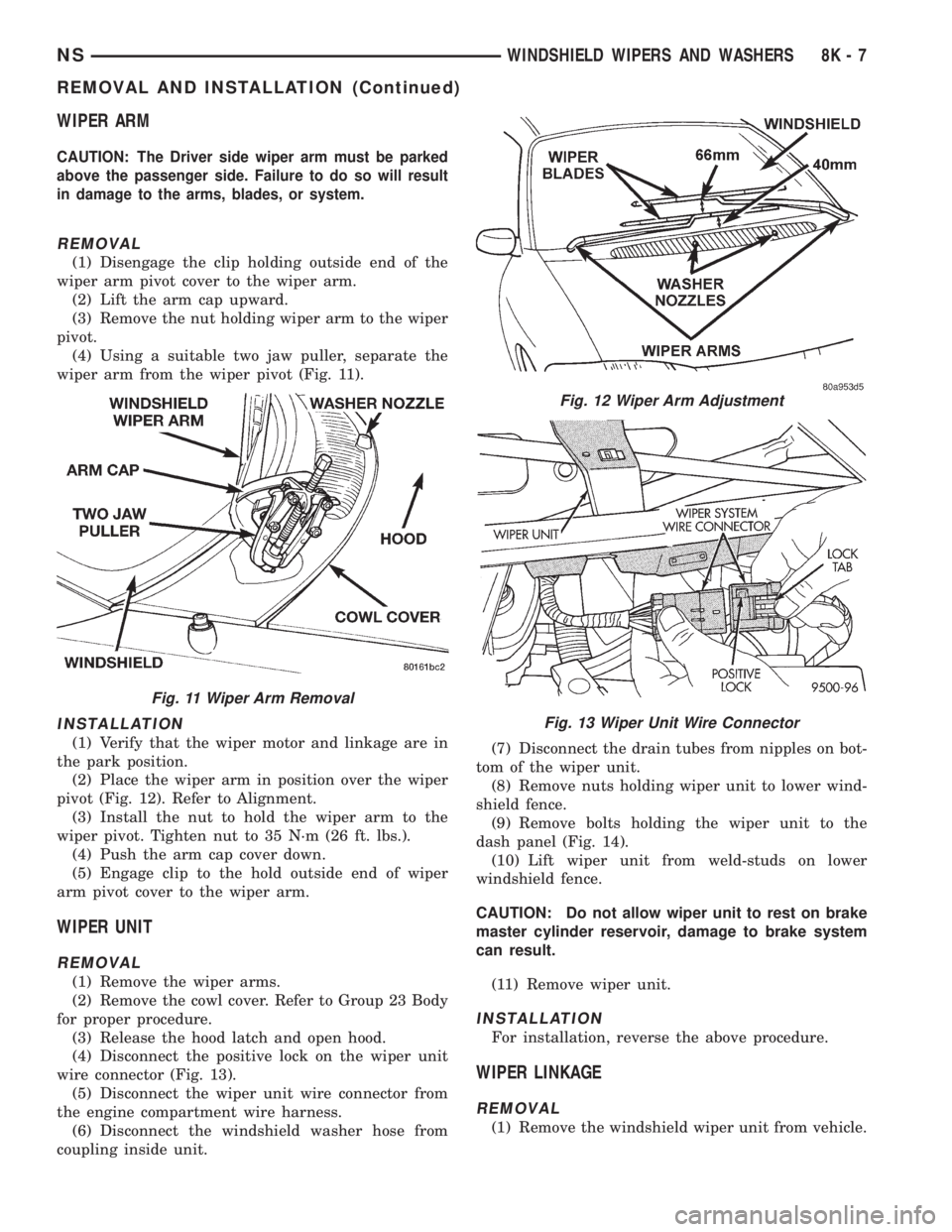
(4) Using a suitable two jaw puller, separate the
wiper arm from the wiper pivot (Fig. 11).
INSTALLATION
(1) Verify that the wiper motor and linkage are in
the park position.
(2) Place the wiper arm in position over the wiper
pivot (Fig. 12). Refer to Alignment.
(3) Install the nut to hold the wiper arm to the
wiper pivot. Tighten nut to 35 N´m (26 ft. lbs.).
(4) Push the arm cap cover down.
(5) Engage clip to the hold outside end of wiper
arm pivot cover to the wiper arm.
WIPER UNIT
REMOVAL
(1) Remove the wiper arms.
(2) Remove the cowl cover. Refer to Group 23 Body
for proper procedure.
(3) Release the hood latch and open hood.
(4) Disconnect the positive lock on the wiper unit
wire connector (Fig. 13).
(5) Disconnect the wiper unit wire connector from
the engine compartment wire harness.
(6) Disconnect the windshield washer hose from
coupling inside unit.(7) Disconnect the drain tubes from nipples on bot-
tom of the wiper unit.
(8) Remove nuts holding wiper unit to lower wind-
shield fence.
(9) Remove bolts holding the wiper unit to the
dash panel (Fig. 14).
(10) Lift wiper unit from weld-studs on lower
windshield fence.
CAUTION: Do not allow wiper unit to rest on brake
master cylinder reservoir, damage to brake system
can result.
(11) Remove wiper unit.
INSTALLATION
For installation, reverse the above procedure.
WIPER LINKAGE
REMOVAL
(1) Remove the windshield wiper unit from vehicle.
Fig. 11 Wiper Arm Removal
Fig. 12 Wiper Arm Adjustment
Fig. 13 Wiper Unit Wire Connector
NSWINDSHIELD WIPERS AND WASHERS 8K - 7
REMOVAL AND INSTALLATION (Continued)
Page 461 of 1938
EXTERIOR LAMP BULB SERVICE
INDEX
page page
REMOVAL AND INSTALLATION
CENTER HIGH MOUNTED STOP LAMP
(CHMSL) BULB........................ 13
FOG LAMP BULB ± TOWN and COUNTRY..... 11
FOG LAMP BULB........................ 10
FRONT PARKING AND TURN SIGNAL LAMP
BULB ± TOWN and COUNTRY............ 12
FRONT SIDE MARKER LAMP BULB TOWN and
COUNTRY............................ 11HEADLAMP BULB ± TOWN & COUNTRY....... 9
HEADLAMP BULB........................ 9
LICENSE PLATE LAMP BULB.............. 13
PARKING AND TURN SIGNAL BULB......... 11
TAIL, STOP, TURN SIGNAL AND BACK-UP
LAMP BULB.......................... 12
REMOVAL AND INSTALLATION
HEADLAMP BULB
REMOVAL
(1) Release hood latch and open hood.
(2) From behind radiator closure panel, disconnect
wire connector from back of headlamp bulb base.
(3) Rotate headlamp bulb retaining ring counter-
clockwise.
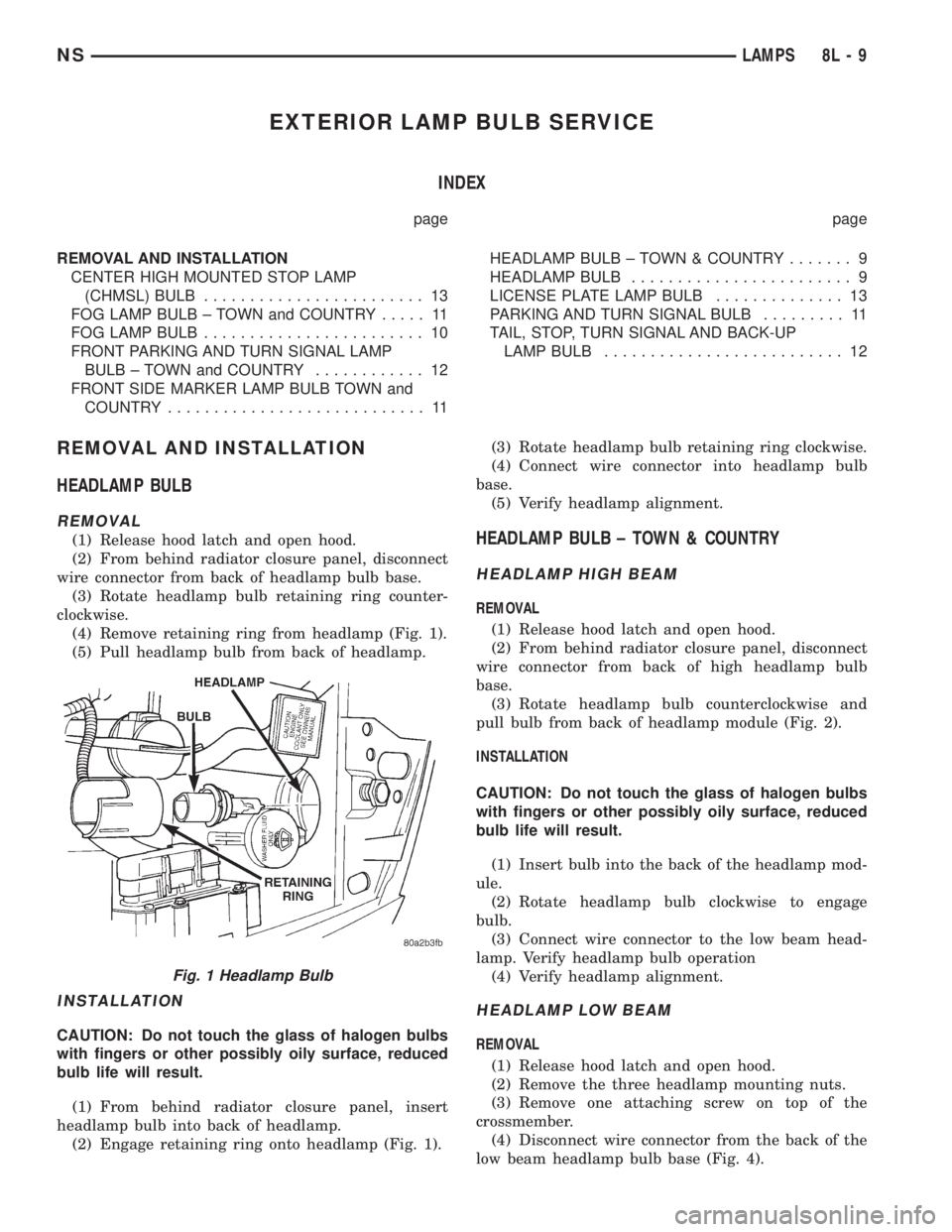
(4) Remove retaining ring from headlamp (Fig. 1).
(5) Pull headlamp bulb from back of headlamp.
INSTALLATION
CAUTION: Do not touch the glass of halogen bulbs
with fingers or other possibly oily surface, reduced
bulb life will result.
(1) From behind radiator closure panel, insert
headlamp bulb into back of headlamp.
(2) Engage retaining ring onto headlamp (Fig. 1).(3) Rotate headlamp bulb retaining ring clockwise.
(4) Connect wire connector into headlamp bulb
base.
(5) Verify headlamp alignment.
HEADLAMP BULB ± TOWN & COUNTRY
HEADLAMP HIGH BEAM
REMOVAL
(1) Release hood latch and open hood.
(2) From behind radiator closure panel, disconnect
wire connector from back of high headlamp bulb
base.
(3) Rotate headlamp bulb counterclockwise and
pull bulb from back of headlamp module (Fig. 2).
INSTALLATION
CAUTION: Do not touch the glass of halogen bulbs
with fingers or other possibly oily surface, reduced
bulb life will result.
(1) Insert bulb into the back of the headlamp mod-
ule.
(2) Rotate headlamp bulb clockwise to engage
bulb.
(3) Connect wire connector to the low beam head-
lamp. Verify headlamp bulb operation
(4) Verify headlamp alignment.
HEADLAMP LOW BEAM
REMOVAL
(1) Release hood latch and open hood.
(2) Remove the three headlamp mounting nuts.
(3) Remove one attaching screw on top of the
crossmember.
(4) Disconnect wire connector from the back of the
low beam headlamp bulb base (Fig. 4).
Fig. 1 Headlamp Bulb
NSLAMPS 8L - 9
Page 466 of 1938
EXTERIOR LAMP SERVICE
INDEX
page page
GENERAL INFORMATION
HEADLAMP DIMMER SWITCH.............. 14
HEADLAMP MODULE.................... 14
HEADLAMP SWITCH..................... 14
REMOVAL AND INSTALLATION
CENTER HIGH MOUNTED STOP LAMP
(CHMSL)............................. 17
FOG LAMP ± TOWN and COUNTRY......... 15
FOG LAMP............................. 14FRONT PARKING AND TURN SIGNAL LAMP ±
TOWN and COUNTRY.................. 15
FRONT SIDE MARKER LAMP TOWN and
COUNTRY............................ 15
HEADLAMP MODULE.................... 14
LICENSE PLATE LAMP................... 16
TAIL, STOP, TURN SIGNAL AND BACK-UP
LAMP............................... 16
GENERAL INFORMATION
HEADLAMP MODULE
Minor amounts of fogging may occur around the
edges of the headlamp lens when exposed to humid
conditions. This is considered normal. The fogging
will dissipate with increased ambient temperature or
headlamp usage.
HEADLAMP SWITCH
Service procedures for the headlamp switch can be
found in Group 8E, Instrument Panel and Gauges.
More information can be found in Group 8W, Wiring
Diagrams.
HEADLAMP DIMMER SWITCH
The headlamp dimmer switch is incorporated into
the multi-function (turn signal) switch. Proper proce-
dures can be found in Group 8J, Turn Signal and
Flashers. More information can be found in Group
8W, Wiring Diagrams.
REMOVAL AND INSTALLATION
HEADLAMP MODULE
REMOVAL
(1) Release hood latch and open hood.
(2) From inside engine compartment, remove nuts
holding headlamp module to radiator closure panel.
(3) Remove screw holding top of module to closure
panel.
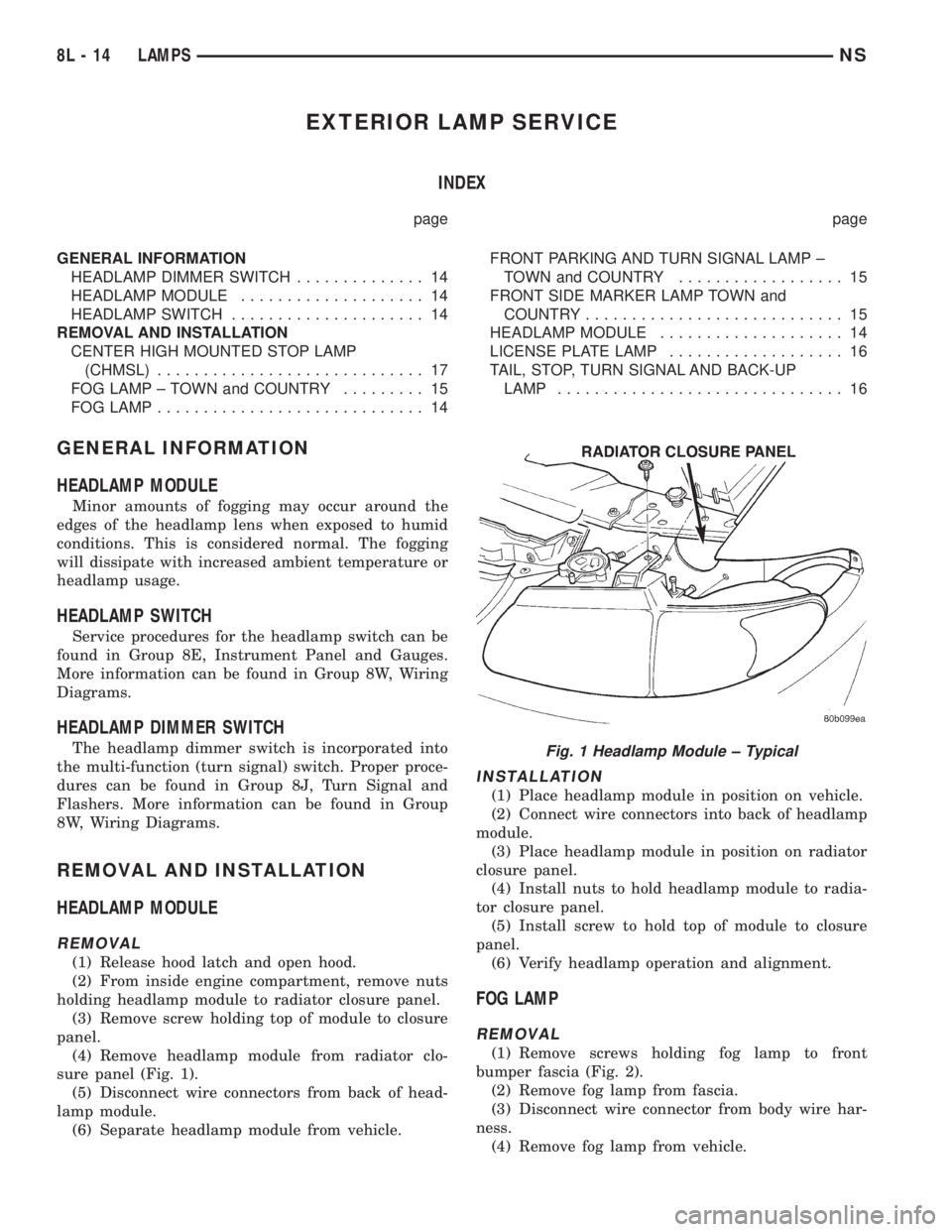
(4) Remove headlamp module from radiator clo-
sure panel (Fig. 1).
(5) Disconnect wire connectors from back of head-
lamp module.
(6) Separate headlamp module from vehicle.
INSTALLATION
(1) Place headlamp module in position on vehicle.
(2) Connect wire connectors into back of headlamp
module.
(3) Place headlamp module in position on radiator
closure panel.
(4) Install nuts to hold headlamp module to radia-
tor closure panel.
(5) Install screw to hold top of module to closure
panel.
(6) Verify headlamp operation and alignment.
FOG LAMP
REMOVAL
(1) Remove screws holding fog lamp to front
bumper fascia (Fig. 2).
(2) Remove fog lamp from fascia.
(3) Disconnect wire connector from body wire har-
ness.
(4) Remove fog lamp from vehicle.
Fig. 1 Headlamp Module ± Typical
8L - 14 LAMPSNS