transmission oil CHRYSLER VOYAGER 1996 User Guide
[x] Cancel search | Manufacturer: CHRYSLER, Model Year: 1996, Model line: VOYAGER, Model: CHRYSLER VOYAGER 1996Pages: 1938, PDF Size: 55.84 MB
Page 215 of 1938
COOLING SYSTEM
CONTENTS
page page
GENERAL INFORMATION
ACCESSORY DRIVE BELTS................ 1
AUTOMATIC TRANSMISSION OIL COOLERÐ
2.4L................................. 3
COOLANT RECOVERY SYSTEM (CRS)....... 3
COOLANT.............................. 3
COOLING SYSTEM....................... 2
ENGINE BLOCK HEATER.................. 5
ENGINE THERMOSTAT.................... 3
RADIATOR PRESSURE CAP................ 4
RADIATOR............................. 3
WATER PUMPS......................... 3
DESCRIPTION AND OPERATION
COOLANT PERFORMANCE................. 6
RADIATOR HOSES AND CLAMPS........... 6
WATER PIPESÐ3.0L ENGINE.............. 6
WATER PUMPÐ3.3/3.8L ENGINES.......... 7
WATER PUMPÐ2.4L ENGINE.............. 6
WATER PUMPÐ3.0L ENGINE.............. 6
DIAGNOSIS AND TESTING
ACCESSORY DRIVE BELT.................. 7
COOLING SYSTEM DIAGNOSIS............. 8
DEAERATION.......................... 16
ELECTRIC FAN MOTOR TEST.............. 14
LOW COOLANT LEVEL AERATION.......... 15
PRESSURE TESTING RADIATOR CAP....... 15
RADIATOR CAP TO FILLER NECK SEAL
PRESSURE RELIEF CHECK.............. 15
RADIATOR COOLANT FLOW TEST.......... 14
RADIATOR FAN CONTROL................ 14
TEMPERATURE GAUGE INDICATION........ 16
TESTING COOLING SYSTEM FOR LEAKS.... 14
SERVICE PROCEDURES
COOLANT LEVEL CHECKÐROUTINE........ 16
COOLANT LEVEL SERVICE................ 16COOLANTÐADDING ADDITIONAL.......... 16
COOLING SYSTEMÐDRAINING............ 16
COOLING SYSTEMÐREFILLING........... 16
REMOVAL AND INSTALLATION
ACCESSORY DRIVE BELTSÐ2.4L.......... 23
ACCESSORY DRIVE BELTSÐ3.0L.......... 24
ACCESSORY DRIVE BELTÐ3.3/3.8L........ 24
ENGINE BLOCK HEATER................. 23
FAN MODULE.......................... 22
RADIATOR DRAINCOCK.................. 21
RADIATOR............................ 21
THERMOSTATÐ2.4L ENGINE............. 19
THERMOSTATÐ3.0L ENGINE............. 20
THERMOSTATÐ3.3/3.8L ENGINES......... 20
WATER PUMP INLET TUBEÐ2.4L ENGINE . . . 17
WATER PUMPÐ3.3/3.8L ENGINES......... 19
WATER PUMPÐ2.4L ENGINE............ 17
WATER PUMPÐ3.0L ENGINE............. 18
CLEANING AND INSPECTION
ACCESSORY DRIVE BELT................. 25
CHEMICAL CLEANING................... 25
COOLING SYSTEM CLEANING............. 25
RADIATOR PRESSURE CAP............... 25
REVERSE FLUSHING THE ENGINE......... 25
REVERSE FLUSHING THE RADIATOR....... 25
WATER PUMP......................... 24
ADJUSTMENTS
BELT TENSION CHART................... 26
BELT TENSION GAUGE METHOD........... 26
PROPER BELT TENSION................. 25
SPECIFICATIONS
COOLING SYSTEM CAPACITY............. 26
TORQUE CHART........................ 26
SPECIAL TOOLS
COOLING............................. 26
GENERAL INFORMATION
ACCESSORY DRIVE BELTS
The accessory drive system utilizes two different
style of drive belts. The conventional V-belt and the
Poly-V belt are used to drive the generator, air con-
ditioning compressor, power steering pump and waterpump. Satisfactory performance of these belts
depends on belt condition and proper belt tension.
Belt tensioning should be performed with the aid of a
Burroughs gauge Special Tool C-4162. Because of
space limitations in the engine compartment, the use
of the gauge may be restricted. Raise the vehicle on a
hoist and then remove the splash shield to gain
access to the drive belts.
NSCOOLING SYSTEM 7 - 1
Page 216 of 1938
COOLING SYSTEM
The cooling system has a radiator, coolant, electric fan
motor, shroud, pressure cap, thermostat, coolant reserve
system, transmission oil cooler, a water pump to circulate
the coolant, hoses, and clamps to complete the circuit.
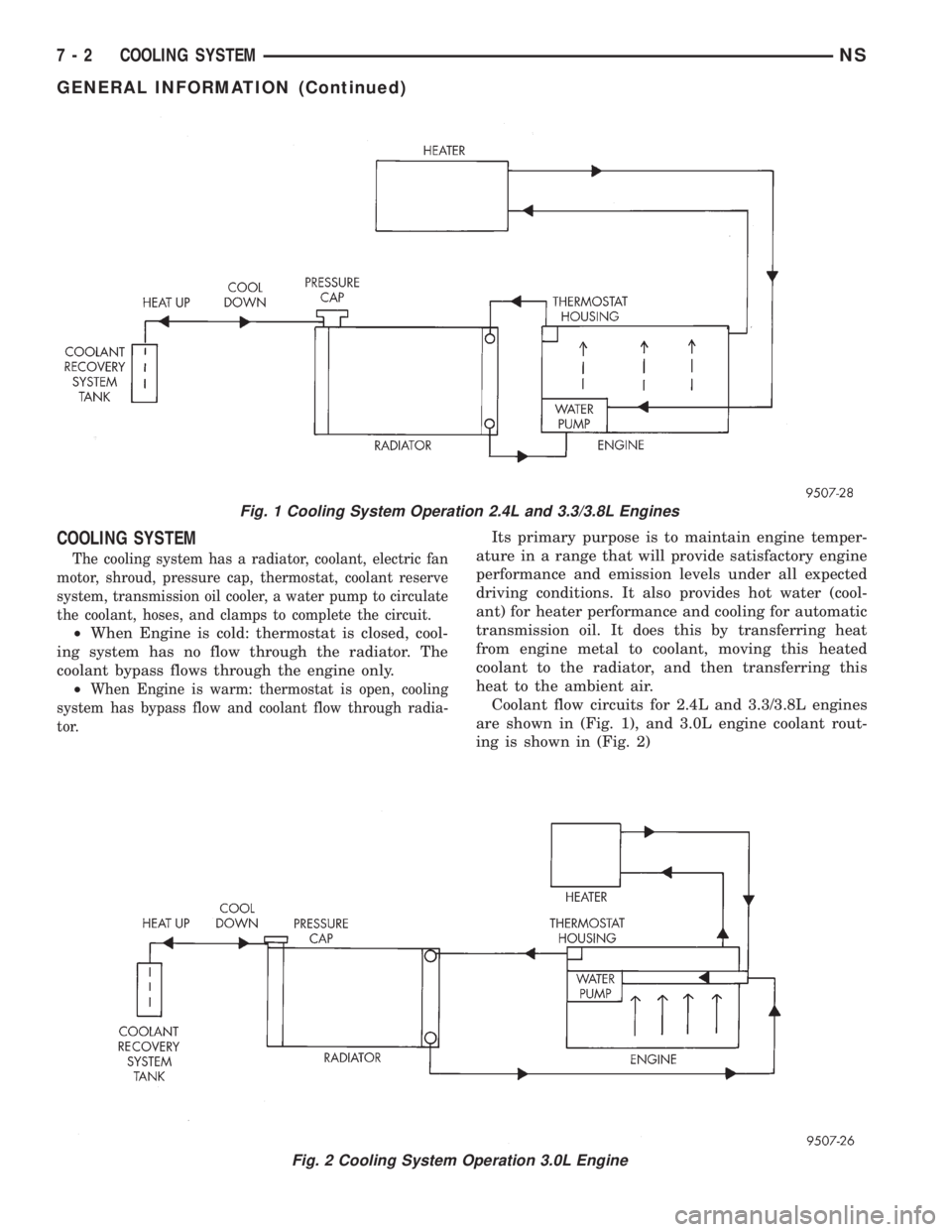
²When Engine is cold: thermostat is closed, cool-
ing system has no flow through the radiator. The
coolant bypass flows through the engine only.
²
When Engine is warm: thermostat is open, cooling
system has bypass flow and coolant flow through radia-
tor.
Its primary purpose is to maintain engine temper-
ature in a range that will provide satisfactory engine
performance and emission levels under all expected
driving conditions. It also provides hot water (cool-
ant) for heater performance and cooling for automatic
transmission oil. It does this by transferring heat
from engine metal to coolant, moving this heated
coolant to the radiator, and then transferring this
heat to the ambient air.
Coolant flow circuits for 2.4L and 3.3/3.8L engines
are shown in (Fig. 1), and 3.0L engine coolant rout-
ing is shown in (Fig. 2)
Fig. 1 Cooling System Operation 2.4L and 3.3/3.8L Engines
Fig. 2 Cooling System Operation 3.0L Engine
7 - 2 COOLING SYSTEMNS
GENERAL INFORMATION (Continued)
Page 217 of 1938
COOLANT RECOVERY SYSTEM (CRS)
This system works with the radiator pressure cap
to use thermal expansion and contraction of the cool-
ant to keep the coolant free of trapped air. Provides a
convenient and safe method for checking coolant
level and adjusting level at atmospheric pressure
without removing the radiator pressure cap. It also
provides some reserve coolant to cover deaeration
and evaporation or boiling losses. All vehicles are
equipped with this system and take various shapes
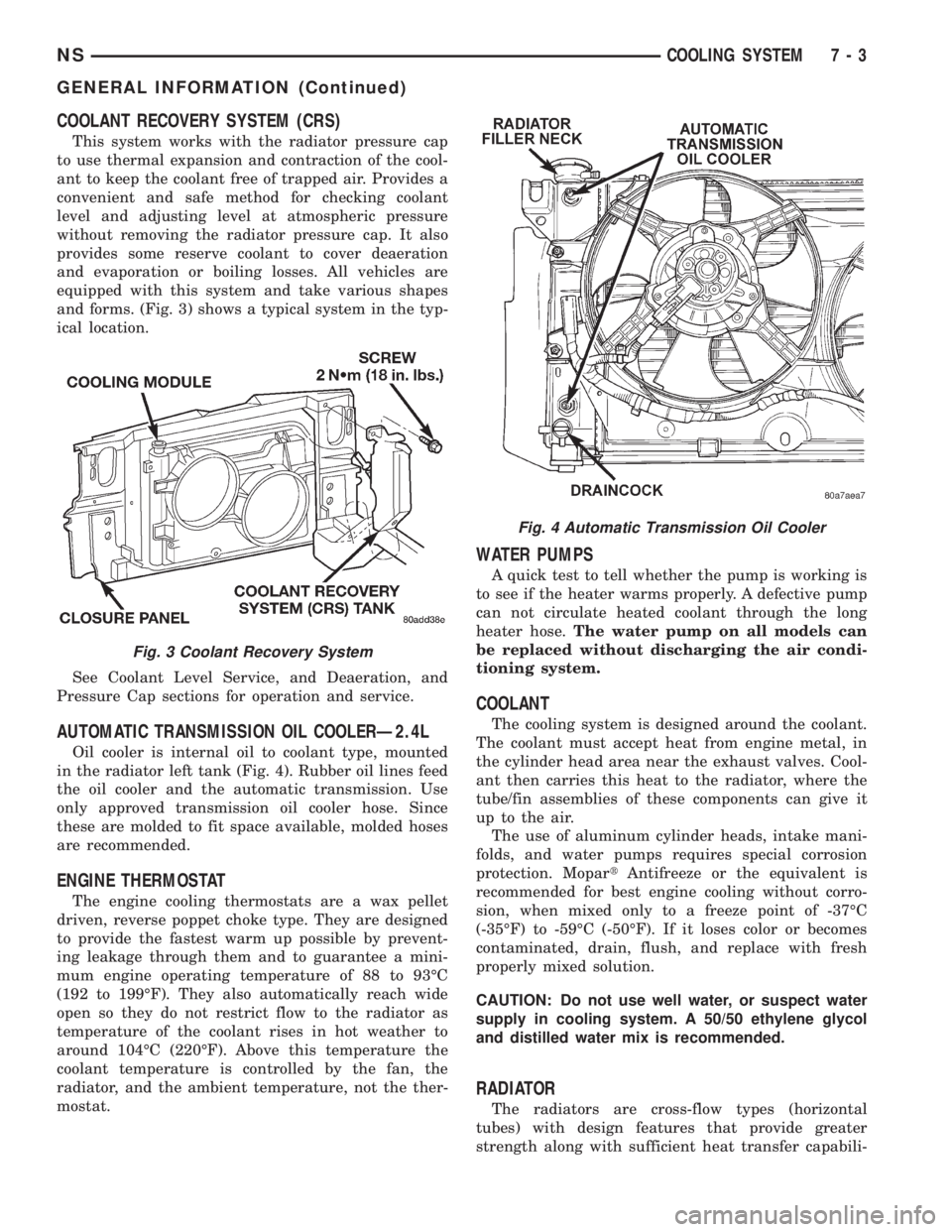
and forms. (Fig. 3) shows a typical system in the typ-
ical location.
See Coolant Level Service, and Deaeration, and
Pressure Cap sections for operation and service.
AUTOMATIC TRANSMISSION OIL COOLERÐ2.4L
Oil cooler is internal oil to coolant type, mounted
in the radiator left tank (Fig. 4). Rubber oil lines feed
the oil cooler and the automatic transmission. Use
only approved transmission oil cooler hose. Since
these are molded to fit space available, molded hoses
are recommended.
ENGINE THERMOSTAT
The engine cooling thermostats are a wax pellet
driven, reverse poppet choke type. They are designed
to provide the fastest warm up possible by prevent-
ing leakage through them and to guarantee a mini-
mum engine operating temperature of 88 to 93ÉC
(192 to 199ÉF). They also automatically reach wide
open so they do not restrict flow to the radiator as
temperature of the coolant rises in hot weather to
around 104ÉC (220ÉF). Above this temperature the
coolant temperature is controlled by the fan, the
radiator, and the ambient temperature, not the ther-
mostat.
WATER PUMPS
A quick test to tell whether the pump is working is
to see if the heater warms properly. A defective pump
can not circulate heated coolant through the long
heater hose.The water pump on all models can
be replaced without discharging the air condi-
tioning system.
COOLANT
The cooling system is designed around the coolant.
The coolant must accept heat from engine metal, in
the cylinder head area near the exhaust valves. Cool-
ant then carries this heat to the radiator, where the
tube/fin assemblies of these components can give it
up to the air.
The use of aluminum cylinder heads, intake mani-
folds, and water pumps requires special corrosion
protection. MopartAntifreeze or the equivalent is
recommended for best engine cooling without corro-
sion, when mixed only to a freeze point of -37ÉC
(-35ÉF) to -59ÉC (-50ÉF). If it loses color or becomes
contaminated, drain, flush, and replace with fresh
properly mixed solution.
CAUTION: Do not use well water, or suspect water
supply in cooling system. A 50/50 ethylene glycol
and distilled water mix is recommended.
RADIATOR
The radiators are cross-flow types (horizontal
tubes) with design features that provide greater
strength along with sufficient heat transfer capabili-
Fig. 3 Coolant Recovery System
Fig. 4 Automatic Transmission Oil Cooler
NSCOOLING SYSTEM 7 - 3
GENERAL INFORMATION (Continued)
Page 230 of 1938

at running operating temperature the high pressure
inlet tank runs full and the low pressure outlet tank
drops:
²Transmission oil will become hotter.
²High reading shown on the temperature gauge.
²Air in the coolant can cause loss of flow through
the heater.
²Exhaust gas leaks into the coolant also can
cause the same problems.
DEAERATION
Air can only be removed from the system by gath-
ering under the pressure cap. On the next heat up it
will be pushed past the pressure cap into the CRS
tank by thermal expansion of the coolant. It then
escapes to the atmosphere in the CRS tank and is
replaced with solid coolant on cool down.
TEMPERATURE GAUGE INDICATION
At idle with Air Conditioning off the temperature
gauge will rise slowly to about 5/8 gauge travel, the
fan will come on and the gauge will quickly drop to
about 1/2 gauge travel. This is normal.
SERVICE PROCEDURES
COOLANT LEVEL CHECKÐROUTINE
Do not remove radiator cap for routine cool-
ant level inspections.
The coolant reserve system provides a quick visual
method for determining the coolant level without
removing the radiator cap.With the engine cold
and not running,simply observe the level of the
coolant in the reserve tank (Fig. 3). The coolant level
should be between the minimum and maximum
marks.
COOLANTÐADDING ADDITIONAL
The radiator cap should not be removed.
When additional coolant is needed to maintain this
level, it should be added to the coolant reserve tank.
Use only 50/50 mix of ethylene glycol type antifreeze
and water.
CAUTION: Do not use well water, or suspect water
supply in cooling system. A 50/50 ethylene glycol
and distilled water mix is recommended.
COOLANT LEVEL SERVICE
The cooling system is closed and designed to main-
tain coolant level to the top of the radiator.
When servicing requires a coolant level check in
the radiator, the engine must beoffandnotunder
pressure. Drain several ounces of coolant from the
radiator draincock while observing the CoolantRecovery System (CRS) Tank. Coolant level in the
CRS tank should drop slightly. Then remove the radi-
ator cap. The radiator should be full to the top. If
not, and the coolant level in the CRS tank is at the
MIN mark there is an air leak in the CRS system.
Check hose or hose connections to the CRS tank,
radiator filler neck or the pressure cap seal to the
radiator filler neck for leaks.
COOLING SYSTEMÐDRAINING
Without removing radiator pressure cap and
with system not under pressure,shut engine off
and open draincock. The coolant reserve tank should
empty first, then remove radiator pressure cap. (if
not, see Testing Cooling System for leaks). To vent
2.4L engine remove the coolant temperature sensor
located above water outlet housing (Fig. 15). The 3.0/
3.3/3.8L engines have an air bleed vent on the ther-
mostat.
Removal of a sensor is required because the ther-
mostat does not have an air vent. Sensor removal
allows an air bleed for coolant to drain from the
engine block.
COOLING SYSTEMÐREFILLING
First clean system to remove old coolant, see Cool-
ing System Cleaning.
Fill the system, using the correct antifreeze as
described in the Coolant Section. Fill the system to
50 percent of its capacity with 100 percent glycol.
Then complete filling system with water. The 2.4L
engine requires venting by removal of the coolant
sensor on top of the water outlet connector (Fig. 15).
When coolant reaches this hole:
²Install coolant sensor and tighten to 7 N´m (60
in. lbs.) for 2.4L Engines.
Fig. 15 Coolant Temperature SensorÐ2.4L Engine
Drain/Fill
7 - 16 COOLING SYSTEMNS
DIAGNOSIS AND TESTING (Continued)
Page 235 of 1938
INSTALLATION
(1) Place a new gasket (dipped in water) on the
thermostat housing surface, center thermostat into
opening in the intake manifold water box.
(2) Place housing and gasket over the thermostat,
making sure thermostat is in the recess provided
(Fig. 28).
(3) Bolt housing to intake manifold, tighten bolts
to 28 N´m (250 in. lbs.).
(4) Refill the cooling system to the proper level.
Refer to Cooling System Refilling outlined in this sec-
tion for procedure.
RADIATOR
REMOVAL
(1) Disconnect negative cable from battery.
WARNING: DO NOT REMOVE THE CYLINDER
BLOCK PLUG OR THE RADIATOR DRAINCOCK
WITH THE SYSTEM HOT AND UNDER PRESSURE
BECAUSE SERIOUS BURNS FROM COOLANT CAN
OCCUR.
(2) Drain cooling system. Refer to Draining Cool-
ing System of this section.
(3) Remove air intake resonator.
(4) Remove coolant reserve system tank to filler
neck tube hose.
(5) Disconnect fans from the connector located on
the left side of the fan module.
(6) Remove the Coolant Recovery System (CRS)
tank retaining screw from the upper radiator closure
panel crossmember.
(7) Disconnect the upper radiator mounting
screws from the crossmember. Disconnect the engine
block heater wire if equipped.
(8) Remove the upper radiator closure panel
crossmember. Refer to Group 23 Body for procedure.
(9) Remove air cleaner assembly.
(10) Disconnect automatic transmission oil cooler
lines at radiator and plug.
(11) Disconnect inlet and outlet hoses from the
radiator. Remove the lower hose clip from the fan
module.
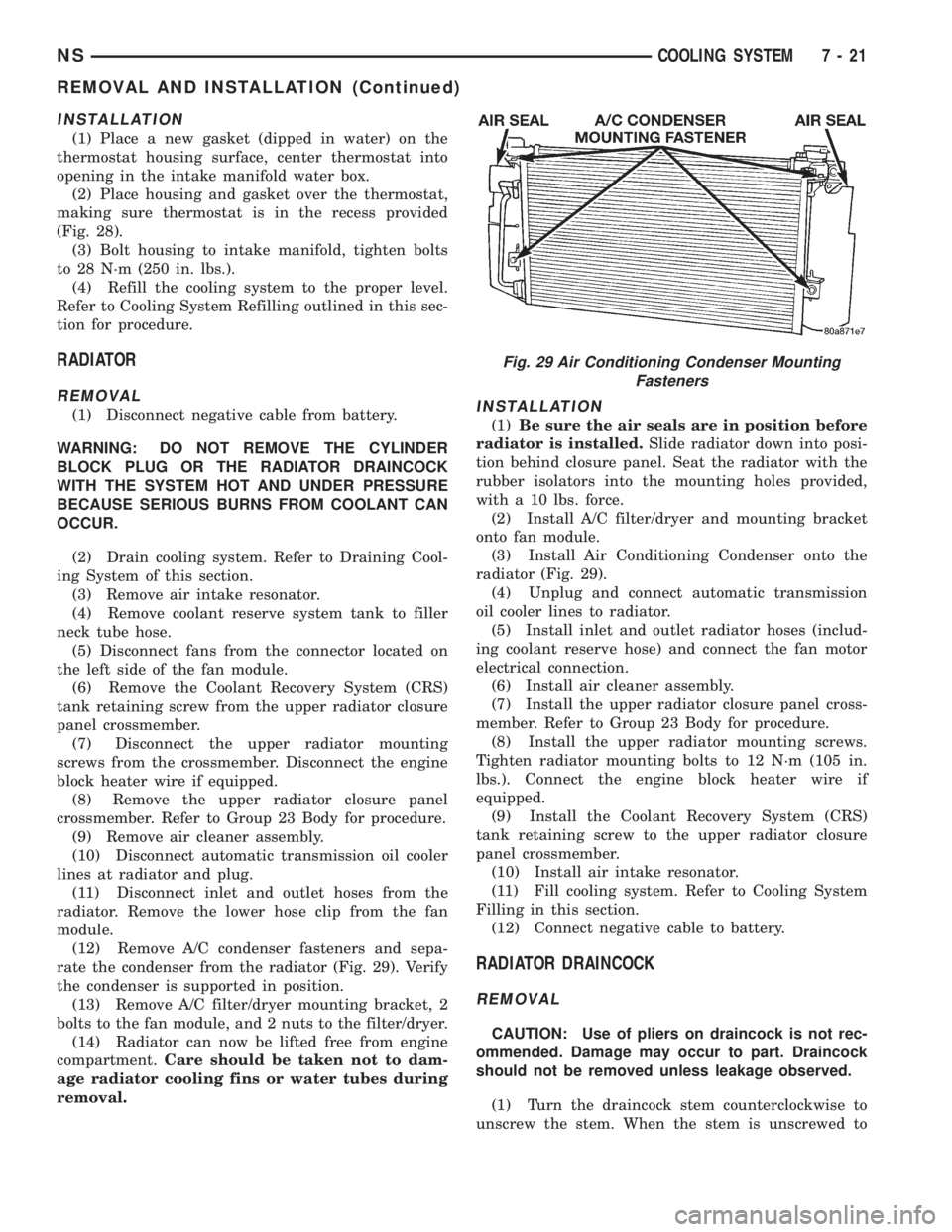
(12) Remove A/C condenser fasteners and sepa-
rate the condenser from the radiator (Fig. 29). Verify
the condenser is supported in position.
(13) Remove A/C filter/dryer mounting bracket, 2
bolts to the fan module, and 2 nuts to the filter/dryer.
(14) Radiator can now be lifted free from engine
compartment.Care should be taken not to dam-
age radiator cooling fins or water tubes during
removal.INSTALLATION
(1)Be sure the air seals are in position before
radiator is installed.Slide radiator down into posi-
tion behind closure panel. Seat the radiator with the
rubber isolators into the mounting holes provided,
with a 10 lbs. force.
(2) Install A/C filter/dryer and mounting bracket
onto fan module.
(3) Install Air Conditioning Condenser onto the
radiator (Fig. 29).
(4) Unplug and connect automatic transmission
oil cooler lines to radiator.
(5) Install inlet and outlet radiator hoses (includ-
ing coolant reserve hose) and connect the fan motor
electrical connection.
(6) Install air cleaner assembly.
(7) Install the upper radiator closure panel cross-
member. Refer to Group 23 Body for procedure.
(8) Install the upper radiator mounting screws.
Tighten radiator mounting bolts to 12 N´m (105 in.
lbs.). Connect the engine block heater wire if
equipped.
(9) Install the Coolant Recovery System (CRS)
tank retaining screw to the upper radiator closure
panel crossmember.
(10) Install air intake resonator.
(11) Fill cooling system. Refer to Cooling System
Filling in this section.
(12) Connect negative cable to battery.
RADIATOR DRAINCOCK
REMOVAL
CAUTION: Use of pliers on draincock is not rec-
ommended. Damage may occur to part. Draincock
should not be removed unless leakage observed.
(1) Turn the draincock stem counterclockwise to
unscrew the stem. When the stem is unscrewed to
Fig. 29 Air Conditioning Condenser Mounting
Fasteners
NSCOOLING SYSTEM 7 - 21
REMOVAL AND INSTALLATION (Continued)
Page 273 of 1938
STARTER
CONTENTS
page page
GENERAL INFORMATION
INTRODUCTION......................... 1
DESCRIPTION AND OPERATION
SUPPLY CIRCUIT AND CONTROL CIRCUIT.... 1
DIAGNOSIS AND TESTING
CONTROL CIRCUIT TEST.................. 1
FEED CIRCUIT RESISTANCE TEST........... 3
FEED CIRCUIT TEST...................... 4REMOVAL AND INSTALLATION
STARTERÐ2.4L ENGINE.................. 5
STARTERÐ3.0L ENGINE.................. 6
STARTERÐ3.3/3.8L ENGINE............... 6
SPECIFICATIONS
STARTER .............................. 7
TORQUE............................... 7
GENERAL INFORMATION
INTRODUCTION
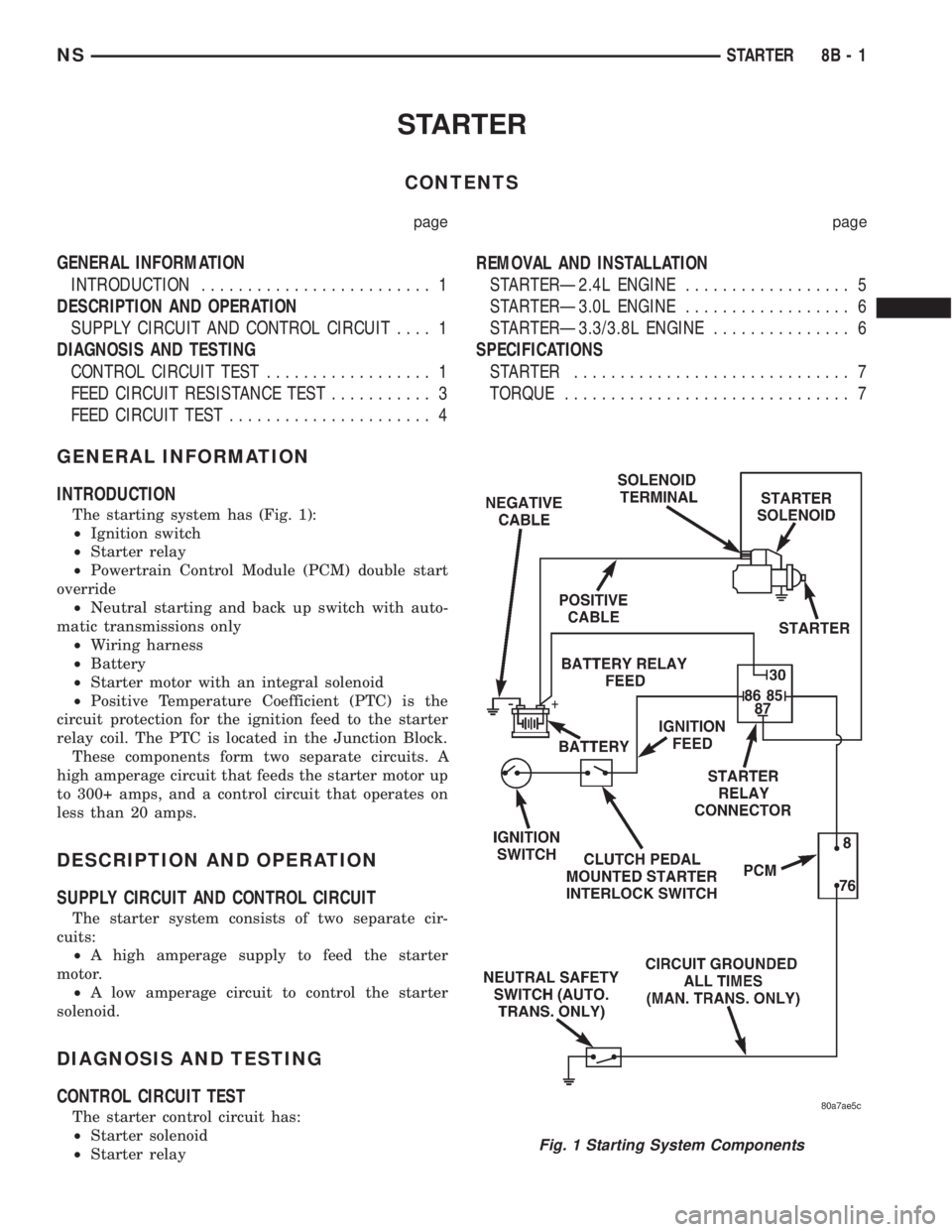
The starting system has (Fig. 1):
²Ignition switch
²Starter relay
²Powertrain Control Module (PCM) double start
override
²Neutral starting and back up switch with auto-
matic transmissions only
²Wiring harness
²Battery
²Starter motor with an integral solenoid
²Positive Temperature Coefficient (PTC) is the
circuit protection for the ignition feed to the starter
relay coil. The PTC is located in the Junction Block.
These components form two separate circuits. A
high amperage circuit that feeds the starter motor up
to 300+ amps, and a control circuit that operates on
less than 20 amps.
DESCRIPTION AND OPERATION
SUPPLY CIRCUIT AND CONTROL CIRCUIT
The starter system consists of two separate cir-
cuits:
²A high amperage supply to feed the starter
motor.
²A low amperage circuit to control the starter
solenoid.
DIAGNOSIS AND TESTING
CONTROL CIRCUIT TEST
The starter control circuit has:
²Starter solenoid
²Starter relay
Fig. 1 Starting System Components
NSSTARTER 8B - 1
Page 274 of 1938
²Transmission range sensor, or Park/Neutral
Position switch with automatic transmissions
²Clutch Pedal Position Switch with manual
transmissions
²Ignition switch
²Battery
²All related wiring and connections
CAUTION: Before performing any starter tests, the
ignition and fuel systems must be disabled.
²To disable ignition and fuel systems, disconnect
the Automatic Shutdown Relay (ASD). The ASD relay
is located in the in the Power Distribution Center
(PDC). Refer to the PDC cover for the proper relay
location.
STARTER SOLENOID
WARNING: CHECK TO ENSURE THAT THE TRANS-
MISSION IS IN THE PARK POSITION WITH THE
PARKING BRAKE APPLIED
(1) Verify battery condition. Battery must be in
good condition with a full charge before performing
any starter tests. Refer to Battery Tests.
(2) Perform Starter Solenoid test BEFORE per-
forming the starter relay test.
(3) Raise the vehicle.
(4) Perform a visual inspection of the starter/
starter solenoid for corrosion, loose connections or
faulty wiring.
(5) Lower the vehicle.
(6) Locate and remove the starter relay from the
Power Distribution Center (PDC). Refer to the PDC
label for relay identification and location.
(7) Connect a remote starter switch or a jumper
wire between the remote battery positive post and
terminal 87 of the starter relay connector.
(a) If engine cranks, starter/starter solenoid is
good. Go to the Starter Relay Test.
(b) If engine does not or solenoid chatters, check
wiring and connectors from starter relay to starter
solenoid for loose or corroded connections. Particu-
larly at starter terminals.
(c) Repeat test. If engine still fails to crank prop-
erly, trouble is within starter or starter mounted
solenoid, and replace starter.
STARTER RELAY
WARNING: CHECK TO ENSURE THAT THE TRANS-
MISSION IS IN THE PARK POSITION/NEUTRAL
WITH THE PARKING BRAKE APPLIED
RELAY TEST
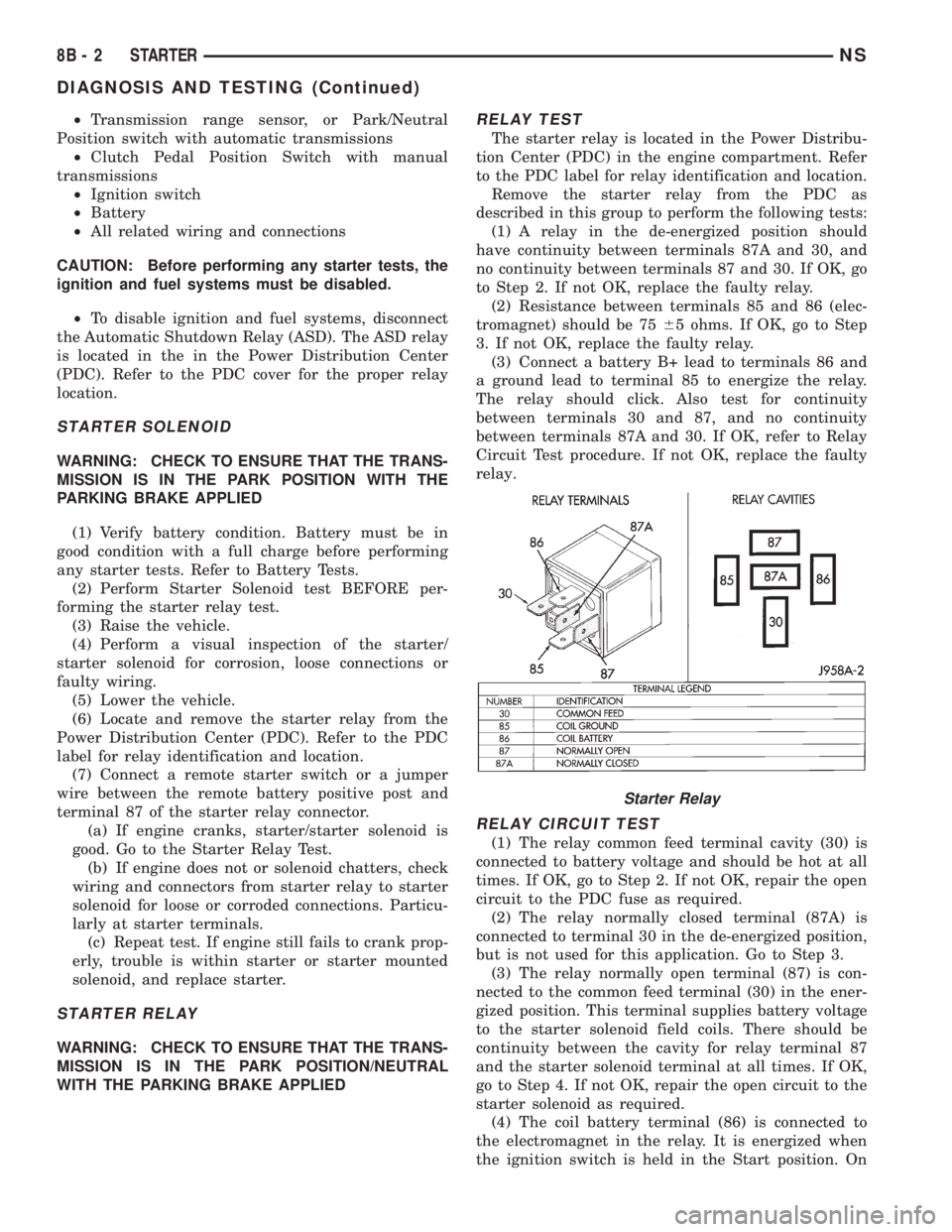
The starter relay is located in the Power Distribu-
tion Center (PDC) in the engine compartment. Refer
to the PDC label for relay identification and location.
Remove the starter relay from the PDC as
described in this group to perform the following tests:
(1) A relay in the de-energized position should
have continuity between terminals 87A and 30, and
no continuity between terminals 87 and 30. If OK, go
to Step 2. If not OK, replace the faulty relay.
(2) Resistance between terminals 85 and 86 (elec-
tromagnet) should be 7565 ohms. If OK, go to Step
3. If not OK, replace the faulty relay.
(3) Connect a battery B+ lead to terminals 86 and
a ground lead to terminal 85 to energize the relay.
The relay should click. Also test for continuity
between terminals 30 and 87, and no continuity
between terminals 87A and 30. If OK, refer to Relay
Circuit Test procedure. If not OK, replace the faulty
relay.
RELAY CIRCUIT TEST
(1) The relay common feed terminal cavity (30) is
connected to battery voltage and should be hot at all
times. If OK, go to Step 2. If not OK, repair the open
circuit to the PDC fuse as required.
(2) The relay normally closed terminal (87A) is
connected to terminal 30 in the de-energized position,
but is not used for this application. Go to Step 3.
(3) The relay normally open terminal (87) is con-
nected to the common feed terminal (30) in the ener-
gized position. This terminal supplies battery voltage
to the starter solenoid field coils. There should be
continuity between the cavity for relay terminal 87
and the starter solenoid terminal at all times. If OK,
go to Step 4. If not OK, repair the open circuit to the
starter solenoid as required.
(4) The coil battery terminal (86) is connected to
the electromagnet in the relay. It is energized when
the ignition switch is held in the Start position. On
Starter Relay
8B - 2 STARTERNS
DIAGNOSIS AND TESTING (Continued)
Page 275 of 1938
vehicles with a manual transmission, the clutch
pedal must be fully depressed for this test. Check for
battery voltage at the cavity for relay terminal 86
with the ignition switch in the Start position, and no
voltage when the ignition switch is released to the
On position. If OK, go to Step 5. If not OK with an
automatic transmission, check for an open or short
circuit to the ignition switch and repair, if required.
If the circuit to the ignition switch is OK, see the
Ignition Switch Test procedure in this group. If not
OK with a manual transmission, check the circuit
between the relay and the clutch pedal position
switch for an open or a short. If the circuit is OK, see
the Clutch Pedal Position Switch Test procedure in
this group.
(5) The coil ground terminal (85) is connected to
the electromagnet in the relay. On vehicles with an
automatic transmission, it is grounded through the
park/neutral position switch only when the gearshift
selector lever is in the Park or Neutral positions. On
vehicles with a manual transmission, it is grounded
at all times. Check for continuity to ground at the
cavity for relay terminal 85. If not OK with an auto-
matic transmission, check for an open or short circuit
to the park/neutral position switch and repair, if
required. If the circuit is OK, see the Park/Neutral
Position Switch Test procedure in this group. If not
OK with a manual transmission, repair the circuit to
ground as required.
SAFETY SWITCHES
For diagnostics,
²Clutch Pedal Position Switch, refer to Group 6,
Clutch.
²Park/Neutral Position Switch, refer to Group 21,
Transaxle
IGNITION SWITCH
After testing starter solenoid and relay, test igni-
tion switch and wiring. Refer to Group 8D, Ignition
Systems or Group 8W, Wiring Diagrams. Check all
wiring for opens or shorts, and all connectors for
being loose or corroded.
BATTERY
Refer to Group 8A, Battery for proper procedures.
ALL RELATED WIRING AND CONNECTORS
Refer to Group 8W, Wiring Diagrams,
FEED CIRCUIT RESISTANCE TEST
Before proceeding with this operation, review Diag-
nostic Preparation and Starter Feed Circuit Tests.
The following operation will require a voltmeter,
accurate to 1/10 of a volt.
CAUTION: Before performing any starter tests, the
ignition and fuel systems must be disabled.
(1) To disable the ignition and fuel systems, dis-
connect the Automatic Shutdown Relay (ASD). The
ASD relay is located in the Power Distribution Cen-
ter (PDC). Refer to the PDC cover for proper relay
location.
(2) With all wiring harnesses and components
properly connected, perform the following:
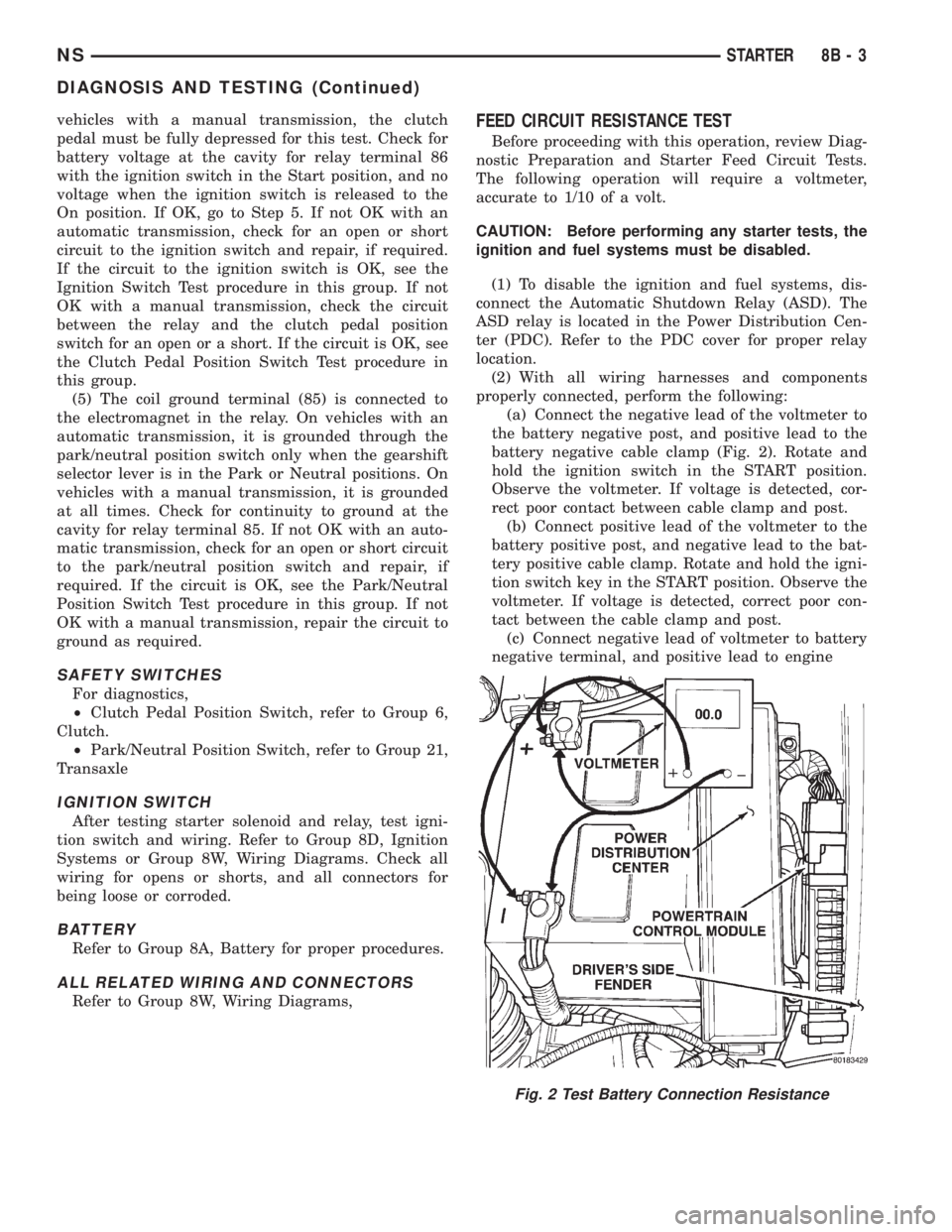
(a) Connect the negative lead of the voltmeter to
the battery negative post, and positive lead to the
battery negative cable clamp (Fig. 2). Rotate and
hold the ignition switch in the START position.
Observe the voltmeter. If voltage is detected, cor-
rect poor contact between cable clamp and post.
(b) Connect positive lead of the voltmeter to the
battery positive post, and negative lead to the bat-
tery positive cable clamp. Rotate and hold the igni-
tion switch key in the START position. Observe the
voltmeter. If voltage is detected, correct poor con-
tact between the cable clamp and post.
(c) Connect negative lead of voltmeter to battery
negative terminal, and positive lead to engine
Fig. 2 Test Battery Connection Resistance
NSSTARTER 8B - 3
DIAGNOSIS AND TESTING (Continued)
Page 581 of 1938
8W-10 POWER DISTRIBUTION
Component Page
A/C Compressor Clutch........................8W-10-29
A/C Compressor Clutch Relay................8W-10-10, 25, 29
Airbag Control Module........................8W-10-35
Automatic Shut Down Relay....................8W-10-9, 23
Battery.............................8W-10-8, 27, 28
Body Control Module...........8W-10-11, 14, 16, 17, 19, 21, 30, 32
BS15..................................8W-10-33
BS16..................................8W-10-34
BS19..................................8W-10-30
BS33..................................8W-10-25
Center Dome Lamp..........................8W-10-21
Cigar/Accessory Relay......................8W-10-10, 31
Clockspring..............................8W-10-30
Combination Flasher/DRL Module................8W-10-29, 32
Controller Anti-Lock Brake....................8W-10-15, 29
Courtesy Lamp Relay.........................8W-10-21
Crank Case Heater..........................8W-10-27
CS01..................................8W-10-21
CS02..................................8W-10-20
CS1 ..................................8W-10-21
Data Link Connector.........................8W-10-11
Diesel Power Relay.......................8W-10-9, 25, 29
Door Lock Relay............................8W-10-13
Door Unlock Relay..........................8W-10-13
Downstream Heated Oxygen Sensor.................8W-10-23
Driver Door Courtesy Lamp.....................8W-10-21
Driver Door Unlock Relay......................8W-10-13
Driver Power Mirror.......................8W-10-12, 22
EGR Solenoid.............................8W-10-25
Engine Starter Motor.......................8W-10-8, 16
Engine Starter Motor Relay....................8W-10-8, 16
ES01................................8W-10-27, 28
ES06................................8W-10-25, 29
ES07..................................8W-10-29
ES09..................................8W-10-8
ES11 ................................8W-10-8, 28
ES12..................................8W-10-23
ES26..................................8W-10-8
ES28..................................8W-10-8
ES29................................8W-10-25, 29
ES40..................................8W-10-27
ES99..................................8W-10-24
Fog Lamp Relay............................8W-10-33
Front Blower Motor..........................8W-10-18
Front Blower Motor Relay.....................8W-10-8, 18
Front Cigar Lighter/Power Outlet..................8W-10-31
Front Reading Lamps/Switch.....................8W-10-20
Front Wiper Switch..........................8W-10-19
FS01..................................8W-10-24
FS03..................................8W-10-23
Fuel Heater..............................8W-10-27
Fuel Heater Relay.........................8W-10-9, 27
Fuel Injector No. 1........................8W-10-23, 24
Fuel Injector No. 2........................8W-10-23, 24
Fuel Injector No. 3........................8W-10-23, 24
Fuel Injector No. 4........................8W-10-23, 24
Fuel Injector No. 5..........................8W-10-24
Fuel Injector No. 6..........................8W-10-24
Fuel Pump Module..........................8W-10-25
Fuel Pump Relay..........................8W-10-9, 26
Fuel Tank Module...........................8W-10-26
Fuse 1 (JB)..............................8W-10-17
Fuse 1 (PDC)...........................8W-10-14, 35
Fuse 2 (JB)............................8W-10-11, 16
Fuse 2 (PDC).............................8W-10-35
Fuse 3 (JB)..............................8W-10-17
Fuse 4 (JB)..............................8W-10-17
Fuse 4 (PDC).......................8W-10-10, 32, 33, 34
Fuse 5 (JB)..............................8W-10-17
Fuse 5 (PDC).......................8W-10-10, 32, 33, 34
Fuse 6 (JB)..............................8W-10-16
Fuse 6 (PDC).......................8W-10-10, 32, 33, 34
Fuse 7 (JB)..............................8W-10-12
Fuse 7 (PDC).......................8W-10-10, 32, 33, 34
Fuse 8 (JB)..............................8W-10-16
Fuse 8 (PDC)...........................8W-10-10, 31
Fuse 9 (JB)..............................8W-10-16
Fuse 9 (PDC)...........................8W-10-10, 30
Fuse 10 (JB)..............................8W-10-16
Fuse 10 (PDC)...........................8W-10-10, 29
Fuse 11 (JB)..............................8W-10-14
Fuse 11 (PDC)...........................8W-10-10, 29
Fuse 12 (JB)............................8W-10-14, 18
Fuse 12 (PDC)...........................8W-10-10, 29
Fuse 13 (PDC)...........................8W-10-10, 29
Fuse 15 (PDC)...........................8W-10-9, 28
Fuse 16 (JB)..............................8W-10-27
Fuse 16 (PDC)...........................8W-10-9, 26
Fuse 17 (PDC).......................8W-10-9, 23, 25, 29
Fuse 18 (PDC)...........................8W-10-9, 20Component Page
Fuse 19 (PDC)...........................8W-10-8, 19
Fuse 20 (PDC)...........................8W-10-8, 19
Fuse 21 (PDC)...........................8W-10-8, 18
Fuse 22 (PDC)...........................8W-10-8, 17
Fuse 23 (PDC)...........................8W-10-8, 16
Fuse 24 (PDC)...........................8W-10-8, 15
Fuse 25 (PDC)...........................8W-10-8, 15
Fuse 26 (PDC)...........................8W-10-8, 13
Fuse 27 (PDC)...........................8W-10-8, 12
Fuse 28 (PDC)...........................8W-10-9, 11
Fusible Link A11............................8W-10-8
Fusible Link A54............................8W-10-8
G100................................8W-10-27, 28
G103................................8W-10-27, 28
G200................................8W-10-14, 32
G300............................8W-10-14, 18, 19, 31
Generator............................8W-10-8, 23, 25
Glove Box Lamp............................8W-10-20
Glow Plug Relay..........................8W-10-8, 25
Headlamp Dimmer Switch......................8W-10-32
Headlamp Switch.........................8W-10-21, 34
High Beam Relay.....................8W-10-10, 32, 33, 34
High Note Horn............................8W-10-30
Horn Relay............................8W-10-10, 30
Horn Switch..............................8W-10-30
HS6D S02...............................8W-10-13
Ignition Coil Pack...........................8W-10-23
Ignition Switch........................8W-10-11, 14, 16
Instrument Cluster........................8W-10-11, 14
Junction Block..........8W-10-11, 12, 13, 14, 16, 17, 18, 20, 21, 22,
26, 27, 29, 30, 31, 32, 35
Key-In Halo Lamp..........................8W-10-21
Left Headlamp..........................8W-10-33, 34
Left Headlamp Leveling Motor....................8W-10-34
Left High Headlamp.........................8W-10-33
Left Liftgate Flood Lamp.......................8W-10-21
Left Mid Reading Lamp.....................8W-10-20, 21
Left Rear Reading Lamp.....................8W-10-20, 21
Left Visor/Vanity Mirror Lamps...................8W-10-20
Low Beam Relay.....................8W-10-10, 32, 33, 34
Low Note Horn............................8W-10-30
Memory Seat/Mirror Module.....................8W-10-11
Message Center......................8W-10-11, 14, 33, 34
Name Brand Speaker Relay.....................8W-10-16
Park Lamp Relay..........................8W-10-8, 17
Passenger Door Courtesy Lamp...................8W-10-21
Passenger Power Mirror.....................8W-10-12, 22
Power Distribution Center .8W-10-8, 9, 10, 11, 12, 13, 14, 15, 16, 17, 18, 19,
20, 23, 25, 26, 27, 28, 29, 30, 31, 32, 33, 34, 35
Power Mirror Fold Relay.......................8W-10-22
Power Mirror Switch.........................8W-10-20
Power Mirror Unfold Relay....................8W-10-21, 22
Power Seat Circuit Breaker.....................8W-10-13
Powertrain Control Module............8W-10-16, 23, 25, 26, 27, 29
PTC 1 (JB)......................8W-10-16, 26, 27, 29, 35
PTC 3 (JB)..............................8W-10-13
PTC 7 (JB)............................8W-10-16, 31
PTC 8 (JB)..............................8W-10-16
PTC 9 (JB)..............................8W-10-16
Radiator Fan Relay..........................8W-10-15
Radiator Fan Relay No. 1.......................8W-10-25
Radiator Fan Relay No. 2.....................8W-10-15, 25
Radiator Fan Relay No. 3.....................8W-10-19, 25
Radio..................................8W-10-11
Rear Cigar Lighter/Power Outlet...................8W-10-31
Rear Dome Lamp...........................8W-10-21
Rear Window Defogger........................8W-10-12
Rear Window Defogger Relay.....................8W-10-12
Remote Keyless Entry Module....................8W-10-11
Right Headlamp..........................8W-10-33, 34
Right Headlamp Leveling Motor...................8W-10-34
Right High Headlamp.........................8W-10-33
Right Liftgate Flood Lamp......................8W-10-21
Right Low Headlamp.........................8W-10-33
Right Mid Reading Lamp.....................8W-10-20, 21
Right Rear Reading Lamp....................8W-10-20, 21
Right Visor/Vanity Mirror Lamps..................8W-10-20
Sentry Key Immobilizer Module...................8W-10-20
Stop Lamp Switch...........................8W-10-29
Transmission Control Module..................8W-10-16, 28
Transmission Control Relay....................8W-10-9, 28
Transmission Control Solenoids...................8W-10-28
Universal Garage Door Opener....................8W-10-20
Upstream Heated Oxygen Sensor..................8W-10-23
Vehicle Speed Sensor.......................8W-10-27, 29
Washer Module............................8W-10-13
Wiper High/Low Relay........................8W-10-19
Wiper Module.............................8W-10-19
Wiper On Relay..........................8W-10-8, 19
NS/GS8W - 10 POWER DISTRIBUTION 8W - 10 - 1
Page 665 of 1938
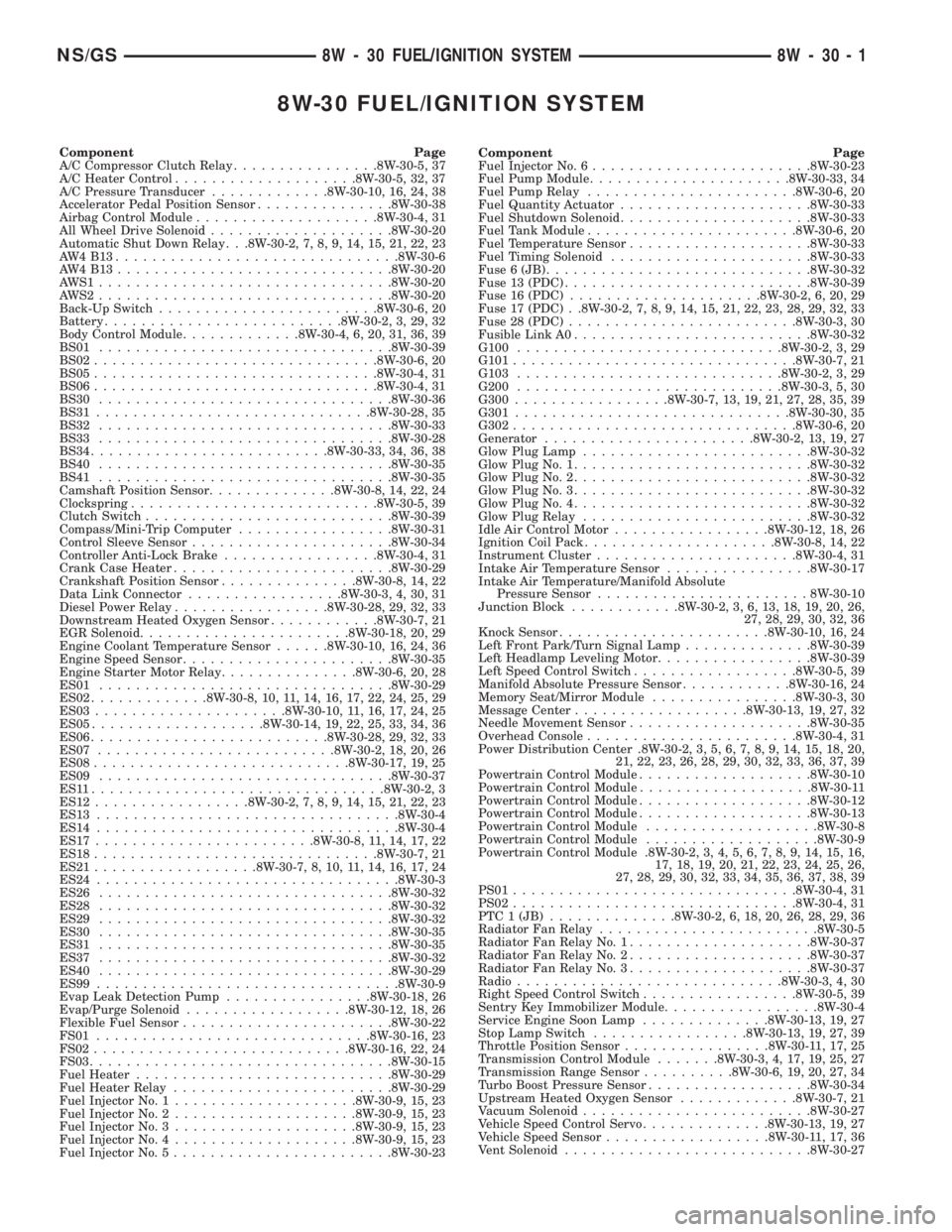
8W-30 FUEL/IGNITION SYSTEM
Component Page
A/C Compressor Clutch Relay................8W-30-5, 37
A/C Heater Control....................8W-30-5, 32, 37
A/C Pressure Transducer.............8W-30-10, 16, 24, 38
Accelerator Pedal Position Sensor...............8W-30-38
Airbag Control Module....................8W-30-4, 31
All Wheel Drive Solenoid....................8W-30-20
Automatic Shut Down Relay . . .8W-30-2, 7, 8, 9, 14, 15, 21, 22, 23
AW4B13...............................8W-30-6
AW4B13..............................8W-30-20
AWS1................................8W-30-20
AWS2................................8W-30-20
Back-Up Switch........................8W-30-6, 20
Battery..........................8W-30-2, 3, 29, 32
Body Control Module.............8W-30-4, 6, 20, 31, 36, 39
BS01................................8W-30-39
BS02...............................8W-30-6, 20
BS05...............................8W-30-4, 31
BS06...............................8W-30-4, 31
BS30................................8W-30-36
BS31..............................8W-30-28, 35
BS32................................8W-30-33
BS33................................8W-30-28
BS34..........................8W-30-33, 34, 36, 38
BS40................................8W-30-35
BS41................................8W-30-35
Camshaft Position Sensor..............8W-30-8, 14, 22, 24
Clockspring...........................8W-30-5, 39
Clutch Switch...........................8W-30-39
Compass/Mini-Trip Computer.................8W-30-31
Control Sleeve Sensor......................8W-30-34
Controller Anti-Lock Brake.................8W-30-4, 31
Crank Case Heater........................8W-30-29
Crankshaft Position Sensor...............8W-30-8, 14, 22
Data Link Connector.................8W-30-3, 4, 30, 31
Diesel Power Relay.................8W-30-28, 29, 32, 33
Downstream Heated Oxygen Sensor............8W-30-7, 21
EGR Solenoid.......................8W-30-18, 20, 29
Engine Coolant Temperature Sensor......8W-30-10, 16, 24, 36
Engine Speed Sensor.......................8W-30-35
Engine Starter Motor Relay...............8W-30-6, 20, 28
ES01................................8W-30-29
ES02.............8W-30-8, 10, 11, 14, 16, 17, 22, 24, 25, 29
ES03.....................8W-30-10, 11, 16, 17, 24, 25
ES05...................8W-30-14, 19, 22, 25, 33, 34, 36
ES06..........................8W-30-28, 29, 32, 33
ES07..........................8W-30-2, 18, 20, 26
ES08............................8W-30-17, 19, 25
ES09................................8W-30-37
ES11................................8W-30-2, 3
ES12.................8W-30-2, 7, 8, 9, 14, 15, 21, 22, 23
ES13.................................8W-30-4
ES14.................................8W-30-4
ES17........................8W-30-8, 11, 14, 17, 22
ES18...............................8W-30-7, 21
ES21..................8W-30-7, 8, 10, 11, 14, 16, 17, 24
ES24.................................8W-30-3
ES26................................8W-30-32
ES28................................8W-30-32
ES29................................8W-30-32
ES30................................8W-30-35
ES31................................8W-30-35
ES37................................8W-30-32
ES40................................8W-30-29
ES99.................................8W-30-9
Evap Leak Detection Pump................8W-30-18, 26
Evap/Purge Solenoid..................8W-30-12, 18, 26
Flexible Fuel Sensor.......................8W-30-22
FS01..............................8W-30-16, 23
FS02............................8W-30-16, 22, 24
FS03.................................8W-30-15
Fuel Heater............................8W-30-29
Fuel Heater Relay........................8W-30-29
Fuel Injector No. 1....................8W-30-9, 15, 23
Fuel Injector No. 2....................8W-30-9, 15, 23
Fuel Injector No. 3....................8W-30-9, 15, 23
Fuel Injector No. 4....................8W-30-9, 15, 23
Fuel Injector No. 5........................8W-30-23Component Page
Fuel Injector No. 6........................8W-30-23
Fuel Pump Module......................8W-30-33, 34
Fuel Pump Relay.......................8W-30-6, 20
Fuel Quantity Actuator.....................8W-30-33
Fuel Shutdown Solenoid.....................8W-30-33
Fuel Tank Module.......................8W-30-6, 20
Fuel Temperature Sensor....................8W-30-33
Fuel Timing Solenoid......................8W-30-33
Fuse 6 (JB).............................8W-30-32
Fuse 13 (PDC)...........................8W-30-39
Fuse 16 (PDC).....................8W-30-2, 6, 20, 29
Fuse 17 (PDC) . .8W-30-2, 7, 8, 9, 14, 15, 21, 22, 23, 28, 29, 32, 33
Fuse 28 (PDC).........................8W-30-3, 30
Fusible Link A0..........................8W-30-32
G100.............................8W-30-2, 3, 29
G101...............................8W-30-7, 21
G103.............................8W-30-2, 3, 29
G200.............................8W-30-3, 5, 30
G300.................8W-30-7, 13, 19, 21, 27, 28, 35, 39
G301..............................8W-30-30, 35
G302...............................8W-30-6, 20
Generator.......................8W-30-2, 13, 19, 27
Glow Plug Lamp.........................8W-30-32
Glow Plug No. 1..........................8W-30-32
Glow Plug No. 2..........................8W-30-32
Glow Plug No. 3..........................8W-30-32
Glow Plug No. 4..........................8W-30-32
Glow Plug Relay.........................8W-30-32
Idle Air Control Motor.................8W-30-12, 18, 26
Ignition Coil Pack.....................8W-30-8, 14, 22
Instrument Cluster......................8W-30-4, 31
Intake Air Temperature Sensor................8W-30-17
Intake Air Temperature/Manifold Absolute
Pressure Sensor.......................8W-30-10
Junction Block............8W-30-2, 3, 6, 13, 18, 19, 20, 26,
27, 28, 29, 30, 32, 36
Knock Sensor.......................8W-30-10, 16, 24
Left Front Park/Turn Signal Lamp..............8W-30-39
Left Headlamp Leveling Motor.................8W-30-39
Left Speed Control Switch..................8W-30-5, 39
Manifold Absolute Pressure Sensor............8W-30-16, 24
Memory Seat/Mirror Module................8W-30-3, 30
Message Center...................8W-30-13, 19, 27, 32
Needle Movement Sensor....................8W-30-35
Overhead Console.......................8W-30-4, 31
Power Distribution Center .8W-30-2, 3, 5, 6, 7, 8, 9, 14, 15, 18, 20,
21, 22, 23, 26, 28, 29, 30, 32, 33, 36, 37, 39
Powertrain Control Module...................8W-30-10
Powertrain Control Module...................8W-30-11
Powertrain Control Module...................8W-30-12
Powertrain Control Module...................8W-30-13
Powertrain Control Module...................8W-30-8
Powertrain Control Module...................8W-30-9
Powertrain Control Module .8W-30-2, 3, 4, 5, 6, 7, 8, 9, 14, 15, 16,
17, 18, 19, 20, 21, 22, 23, 24, 25, 26,
27, 28, 29, 30, 32, 33, 34, 35, 36, 37, 38, 39
PS01...............................8W-30-4, 31
PS02...............................8W-30-4, 31
PTC 1 (JB)..............8W-30-2, 6, 18, 20, 26, 28, 29, 36
Radiator Fan Relay........................8W-30-5
Radiator Fan Relay No. 1....................8W-30-37
Radiator Fan Relay No. 2....................8W-30-37
Radiator Fan Relay No. 3....................8W-30-37
Radio.............................8W-30-3, 4, 30
Right Speed Control Switch.................8W-30-5, 39
Sentry Key Immobilizer Module.................8W-30-4
Service Engine Soon Lamp..............8W-30-13, 19, 27
Stop Lamp Switch.................8W-30-13, 19, 27, 39
Throttle Position Sensor................8W-30-11, 17, 25
Transmission Control Module.......8W-30-3, 4, 17, 19, 25, 27
Transmission Range Sensor..........8W-30-6, 19, 20, 27, 34
Turbo Boost Pressure Sensor..................8W-30-34
Upstream Heated Oxygen Sensor.............8W-30-7, 21
Vacuum Solenoid.........................8W-30-27
Vehicle Speed Control Servo..............8W-30-13, 19, 27
Vehicle Speed Sensor..................8W-30-11, 17, 36
Vent Solenoid...........................8W-30-27
NS/GS8W - 30 FUEL/IGNITION SYSTEM 8W - 30 - 1