wheel bolt torque CHRYSLER VOYAGER 1996 User Guide
[x] Cancel search | Manufacturer: CHRYSLER, Model Year: 1996, Model line: VOYAGER, Model: CHRYSLER VOYAGER 1996Pages: 1938, PDF Size: 55.84 MB
Page 61 of 1938
(4) Install front brake caliper back over braking
disc and align with caliper mounting holes on steer-
ing knuckle (Fig. 62). Refer to Front Disc Brake Ser-
vice in the Brake Section of this service manual for
caliper installation procedure. Install the caliper
adapter to steering knuckle attaching bolts and
torque to 19 N´m (168 in. lbs.).
(5) Install wheel and tire assembly on vehicle.
Tighten the wheel mounting stud nuts in proper
sequence until all nuts are torqued to half specifica-
tion. Then repeat the tightening sequence to the full
specified torque of 129 N´m (95 ft. lbs.).
(6) Lower vehicle to the ground.
REAR WHEEL MOUNTING STUDS
REMOVE
CAUTION: If a wheel attaching stud needs to be
replaced in the hub and bearing assembly the studs
CAN NOT be hammered out of the hub flange. If astud is removed by hammering it out of the bearing
flange, damage to the hub and bearing assembly
will occur leading to premature hub and bearing
failure.
The following procedure and special tools shown
MUSTbe used when replacing wheel attaching
studs.
The hub and bearing assembly does not require
removal from the rear axle for replacement of the
wheel attaching studs.
(1) Raise vehicle on jackstands or centered on a
frame contact type hoist. See Hoisting in the Lubri-
cation and Maintenance section of this manual, for
the required lifting procedure to be used for this
vehicle.
(2) Remove the rear wheel and tire assembly.
(3) Remove the rear brake drum.
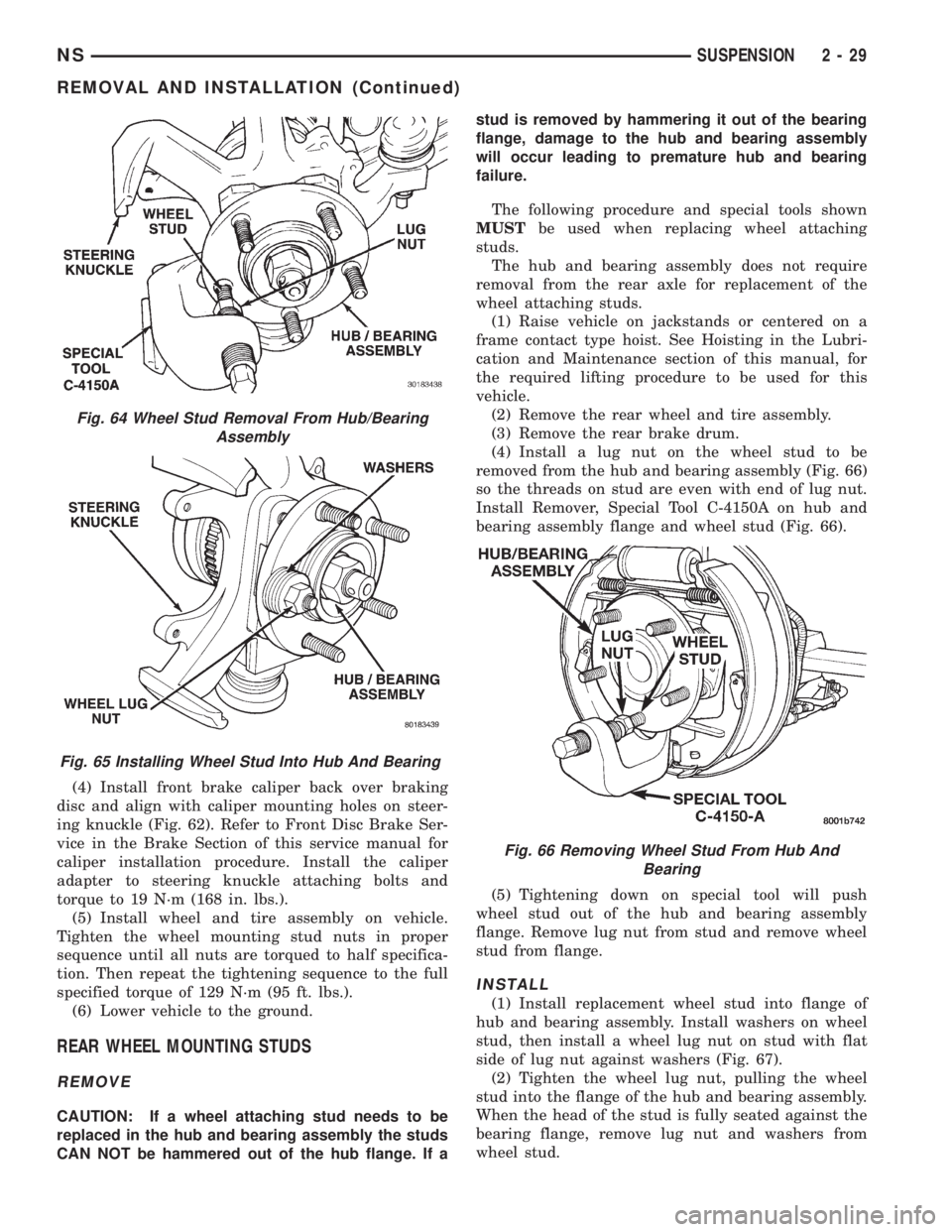
(4) Install a lug nut on the wheel stud to be
removed from the hub and bearing assembly (Fig. 66)
so the threads on stud are even with end of lug nut.
Install Remover, Special Tool C-4150A on hub and
bearing assembly flange and wheel stud (Fig. 66).
(5) Tightening down on special tool will push
wheel stud out of the hub and bearing assembly
flange. Remove lug nut from stud and remove wheel
stud from flange.
INSTALL
(1) Install replacement wheel stud into flange of
hub and bearing assembly. Install washers on wheel
stud, then install a wheel lug nut on stud with flat
side of lug nut against washers (Fig. 67).
(2) Tighten the wheel lug nut, pulling the wheel
stud into the flange of the hub and bearing assembly.
When the head of the stud is fully seated against the
bearing flange, remove lug nut and washers from
wheel stud.
Fig. 64 Wheel Stud Removal From Hub/Bearing
Assembly
Fig. 65 Installing Wheel Stud Into Hub And Bearing
Fig. 66 Removing Wheel Stud From Hub And
Bearing
NSSUSPENSION 2 - 29
REMOVAL AND INSTALLATION (Continued)
Page 68 of 1938
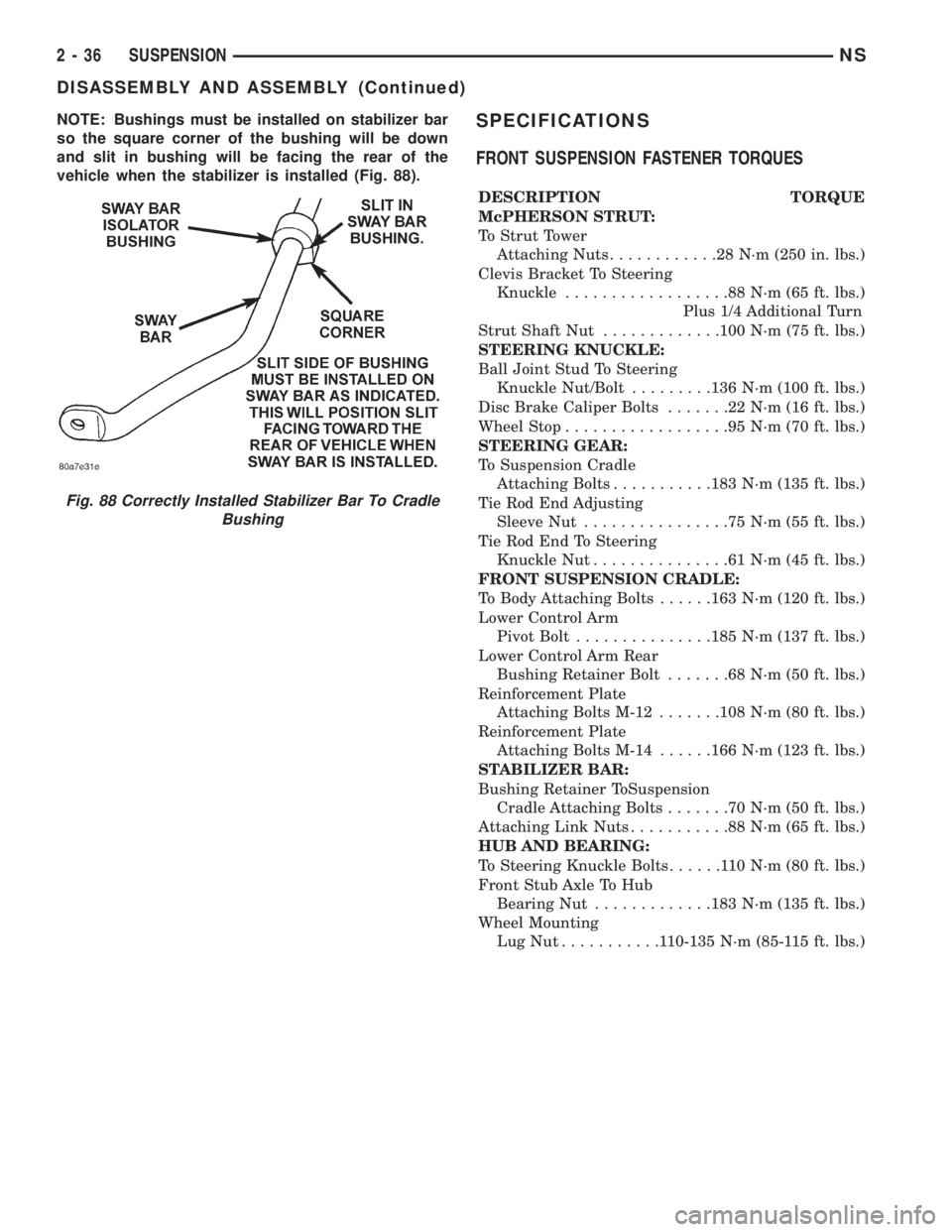
NOTE: Bushings must be installed on stabilizer bar
so the square corner of the bushing will be down
and slit in bushing will be facing the rear of the
vehicle when the stabilizer is installed (Fig. 88).SPECIFICATIONS
FRONT SUSPENSION FASTENER TORQUES
DESCRIPTION TORQUE
McPHERSON STRUT:
To Strut Tower
Attaching Nuts............28N´m(250 in. lbs.)
Clevis Bracket To Steering
Knuckle..................88N´m(65ft.lbs.)
Plus 1/4 Additional Turn
Strut Shaft Nut.............100 N´m (75 ft. lbs.)
STEERING KNUCKLE:
Ball Joint Stud To Steering
Knuckle Nut/Bolt.........136 N´m (100 ft. lbs.)
Disc Brake Caliper Bolts.......22N´m(16ft.lbs.)
Wheel Stop..................95N´m(70ft.lbs.)
STEERING GEAR:
To Suspension Cradle
Attaching Bolts...........183 N´m (135 ft. lbs.)
Tie Rod End Adjusting
Sleeve Nut................75N´m(55ft.lbs.)
Tie Rod End To Steering
Knuckle Nut...............61N´m(45ft.lbs.)
FRONT SUSPENSION CRADLE:
To Body Attaching Bolts......163 N´m (120 ft. lbs.)
Lower Control Arm
Pivot Bolt...............185 N´m (137 ft. lbs.)
Lower Control Arm Rear
Bushing Retainer Bolt.......68N´m(50ft.lbs.)
Reinforcement Plate
Attaching Bolts M-12.......108 N´m (80 ft. lbs.)
Reinforcement Plate
Attaching Bolts M-14......166 N´m (123 ft. lbs.)
STABILIZER BAR:
Bushing Retainer ToSuspension
Cradle Attaching Bolts.......70N´m(50ft.lbs.)
Attaching Link Nuts...........88N´m(65ft.lbs.)
HUB AND BEARING:
To Steering Knuckle Bolts......110N´m(80ft.lbs.)
Front Stub Axle To Hub
Bearing Nut.............183 N´m (135 ft. lbs.)
Wheel Mounting
LugNut...........110-135 N´m (85-115 ft. lbs.)
Fig. 88 Correctly Installed Stabilizer Bar To Cradle
Bushing
2 - 36 SUSPENSIONNS
DISASSEMBLY AND ASSEMBLY (Continued)
Page 76 of 1938
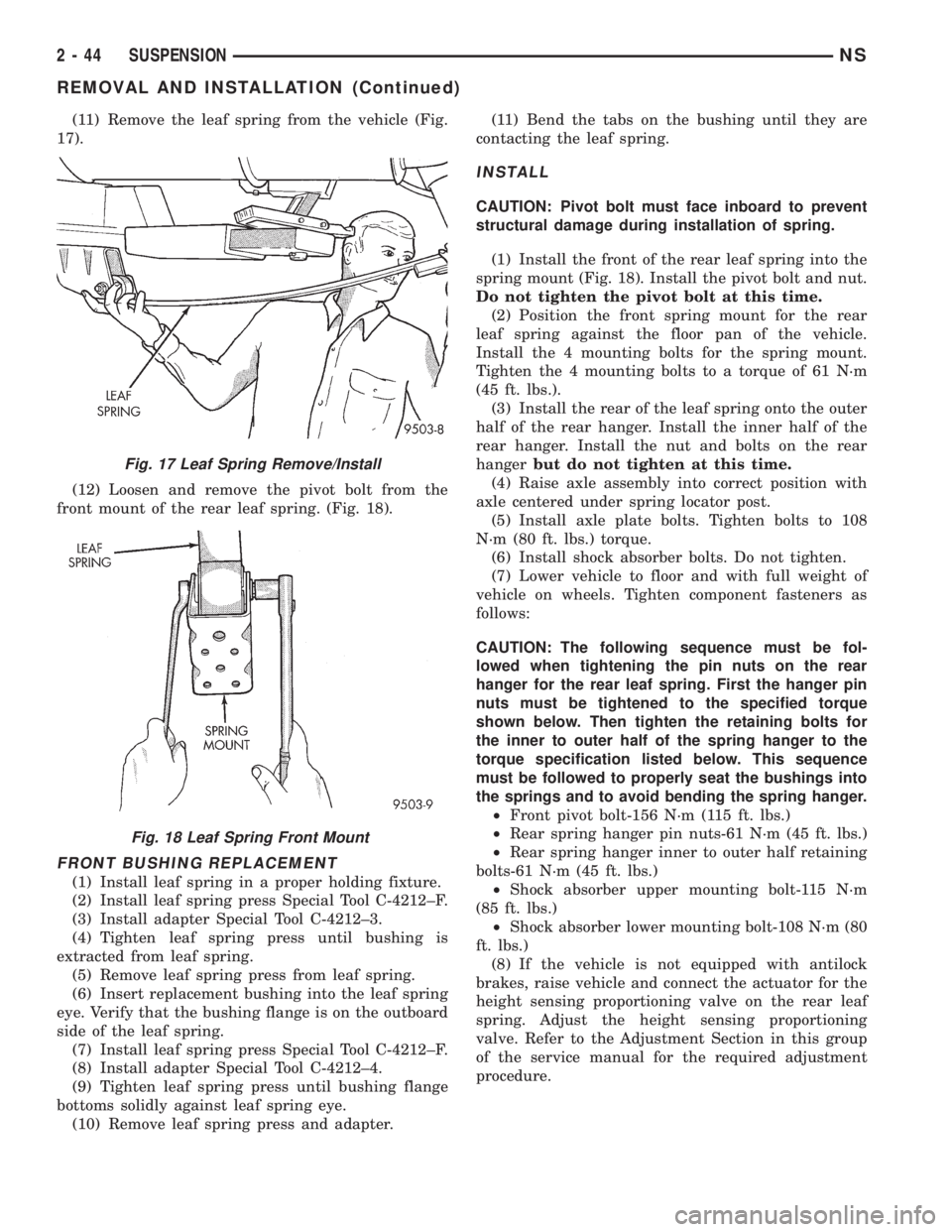
(11) Remove the leaf spring from the vehicle (Fig.
17).
(12) Loosen and remove the pivot bolt from the
front mount of the rear leaf spring. (Fig. 18).
FRONT BUSHING REPLACEMENT
(1) Install leaf spring in a proper holding fixture.
(2) Install leaf spring press Special Tool C-4212±F.
(3) Install adapter Special Tool C-4212±3.
(4) Tighten leaf spring press until bushing is
extracted from leaf spring.
(5) Remove leaf spring press from leaf spring.
(6) Insert replacement bushing into the leaf spring
eye. Verify that the bushing flange is on the outboard
side of the leaf spring.
(7) Install leaf spring press Special Tool C-4212±F.
(8) Install adapter Special Tool C-4212±4.
(9) Tighten leaf spring press until bushing flange
bottoms solidly against leaf spring eye.
(10) Remove leaf spring press and adapter.(11) Bend the tabs on the bushing until they are
contacting the leaf spring.
INSTALL
CAUTION: Pivot bolt must face inboard to prevent
structural damage during installation of spring.
(1) Install the front of the rear leaf spring into the
spring mount (Fig. 18). Install the pivot bolt and nut.
Do not tighten the pivot bolt at this time.
(2) Position the front spring mount for the rear
leaf spring against the floor pan of the vehicle.
Install the 4 mounting bolts for the spring mount.
Tighten the 4 mounting bolts to a torque of 61 N´m
(45 ft. lbs.).
(3) Install the rear of the leaf spring onto the outer
half of the rear hanger. Install the inner half of the
rear hanger. Install the nut and bolts on the rear
hangerbut do not tighten at this time.
(4) Raise axle assembly into correct position with
axle centered under spring locator post.
(5) Install axle plate bolts. Tighten bolts to 108
N´m (80 ft. lbs.) torque.
(6) Install shock absorber bolts. Do not tighten.
(7) Lower vehicle to floor and with full weight of
vehicle on wheels. Tighten component fasteners as
follows:
CAUTION: The following sequence must be fol-
lowed when tightening the pin nuts on the rear
hanger for the rear leaf spring. First the hanger pin
nuts must be tightened to the specified torque
shown below. Then tighten the retaining bolts for
the inner to outer half of the spring hanger to the
torque specification listed below. This sequence
must be followed to properly seat the bushings into
the springs and to avoid bending the spring hanger.
²Front pivot bolt-156 N´m (115 ft. lbs.)
²Rear spring hanger pin nuts-61 N´m (45 ft. lbs.)
²Rear spring hanger inner to outer half retaining
bolts-61 N´m (45 ft. lbs.)
²Shock absorber upper mounting bolt-115 N´m
(85 ft. lbs.)
²Shock absorber lower mounting bolt-108 N´m (80
ft. lbs.)
(8) If the vehicle is not equipped with antilock
brakes, raise vehicle and connect the actuator for the
height sensing proportioning valve on the rear leaf
spring. Adjust the height sensing proportioning
valve. Refer to the Adjustment Section in this group
of the service manual for the required adjustment
procedure.
Fig. 17 Leaf Spring Remove/Install
Fig. 18 Leaf Spring Front Mount
2 - 44 SUSPENSIONNS
REMOVAL AND INSTALLATION (Continued)
Page 77 of 1938

SHOCK ABSORBER
REMOVE/INSTALL
(1) Raise vehicle. Vehicle is to be raised and sup-
ported on jackstands or on a frame contact type
hoist. See Hoisting in the Lubrication And Mainte-
nance section of this service manual.
(2) Support the rear axle of the vehicle using 2
jackstands positioned at the outer ends of the axle.
NOTE: If the shock absorber lower mounting bolt
deflects upward during removal, raise axle by
adjusting the support jack. If the lower shock
absorber bolt deflects downward during removal,
lower the axle by adjusting the support jack.
(3) Remove the shock absorber lower mounting
bolt.
(4) While holding shock absorber, remove the
shock absorber upper mounting bolt.
(5) To install the shock absorber use the reverse
sequence of its removal.
(6) Lower the vehicle to the ground so the full
weight of the vehicle is supported by the suspension.
(7) Tighten the upper and lower shock absorber
mounting bolt to their specified torques.
REAR TRACK BAR
REMOVE
(1) Remove the nut and bolt mounting the track
bar to the rear axle (Fig. 19).
(2) Remove the nut and bolt attaching the track
bar to the track bar mount on the body of the vehicle.
Remove the track bar from the track bar mount.
INSTALL
(1) Install the track bar first into the body mount
for the track bar (Fig. 20). Install the track bar boltwith the head of the bolt facing toward the rear of
the vehicle (Fig. 21). Do not tighten.
(2) Install the track bar into its mounting bracket
on the rear axle (Fig. 19). Install the track bar bolt
with the head of the bolt facing toward the rear of
the vehicle. Do not tighten.
(3) Lower the vehicle to the ground until the full
weight of the vehicle is supported by the wheels.
Tighten both track bar attaching bolts to a torque of
95 N´m (70 ft. lbs.).
TRACK BAR MOUNT
REMOVE
(1) Remove the track bar from the track bar
mount.
(2) Remove the three bolts attaching the track bar
mount to the body (Fig. 22).
Fig. 19 Track Bar Mounting To Axle
Fig. 20 Track Bar Installation
Fig. 21 Track Bar Bolt Installation
NSSUSPENSION 2 - 45
REMOVAL AND INSTALLATION (Continued)
Page 79 of 1938
REMOVAL-HEAVY DUTY
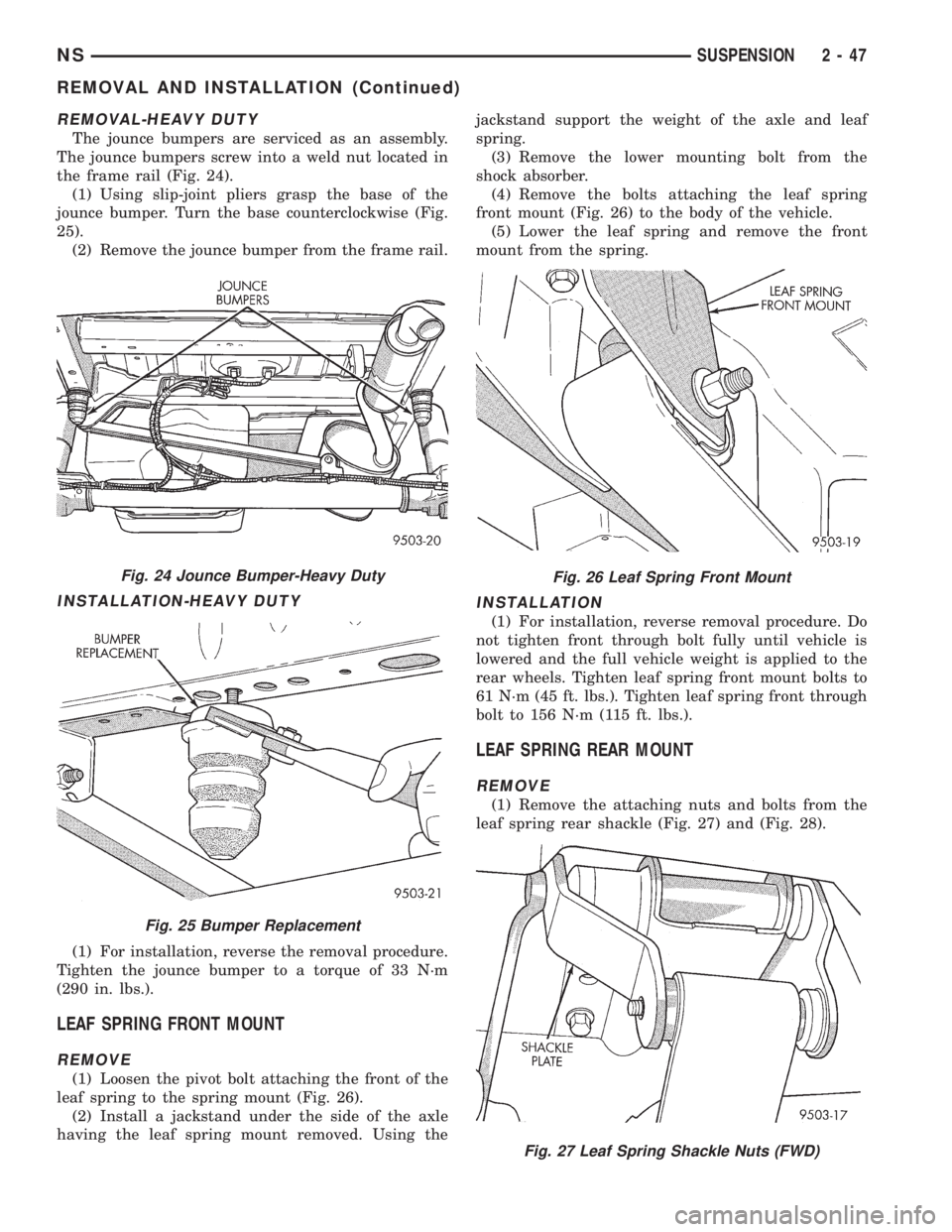
The jounce bumpers are serviced as an assembly.
The jounce bumpers screw into a weld nut located in
the frame rail (Fig. 24).
(1) Using slip-joint pliers grasp the base of the
jounce bumper. Turn the base counterclockwise (Fig.
25).
(2) Remove the jounce bumper from the frame rail.
INSTALLATION-HEAVY DUTY
(1) For installation, reverse the removal procedure.
Tighten the jounce bumper to a torque of 33 N´m
(290 in. lbs.).
LEAF SPRING FRONT MOUNT
REMOVE
(1) Loosen the pivot bolt attaching the front of the
leaf spring to the spring mount (Fig. 26).
(2) Install a jackstand under the side of the axle
having the leaf spring mount removed. Using thejackstand support the weight of the axle and leaf
spring.
(3) Remove the lower mounting bolt from the
shock absorber.
(4) Remove the bolts attaching the leaf spring
front mount (Fig. 26) to the body of the vehicle.
(5) Lower the leaf spring and remove the front
mount from the spring.
INSTALLATION
(1) For installation, reverse removal procedure. Do
not tighten front through bolt fully until vehicle is
lowered and the full vehicle weight is applied to the
rear wheels. Tighten leaf spring front mount bolts to
61 N´m (45 ft. lbs.). Tighten leaf spring front through
bolt to 156 N´m (115 ft. lbs.).
LEAF SPRING REAR MOUNT
REMOVE
(1) Remove the attaching nuts and bolts from the
leaf spring rear shackle (Fig. 27) and (Fig. 28).
Fig. 24 Jounce Bumper-Heavy Duty
Fig. 25 Bumper Replacement
Fig. 26 Leaf Spring Front Mount
Fig. 27 Leaf Spring Shackle Nuts (FWD)
NSSUSPENSION 2 - 47
REMOVAL AND INSTALLATION (Continued)
Page 80 of 1938
(2) Install a jackstand under the side of the axle
having the leaf spring mount removed. Using the
jackstand, support the weight of the axle and leaf
spring.
(3) Remove the lower mounting bolt from the
shock absorber.
(4) Remove the bolts attaching the leaf spring rear
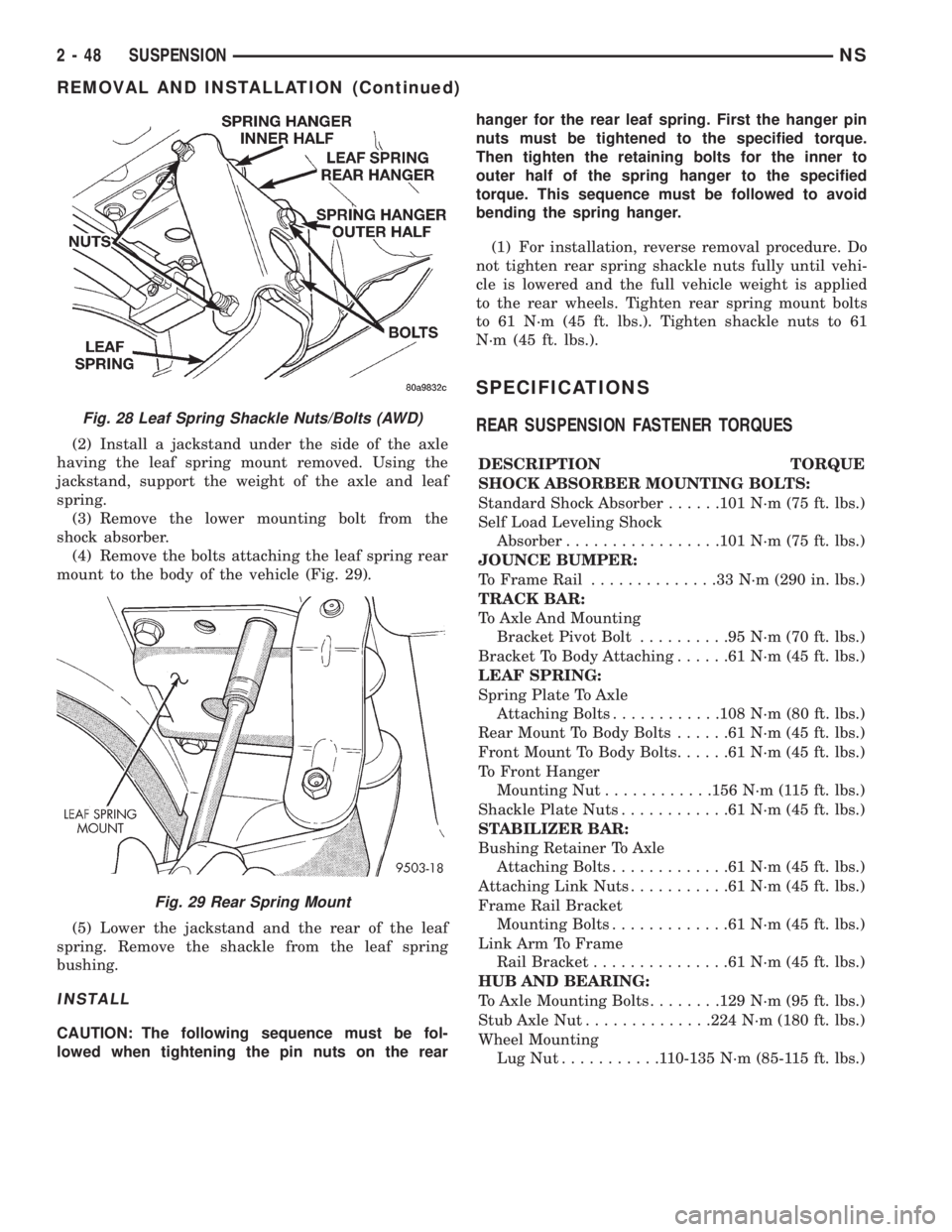
mount to the body of the vehicle (Fig. 29).
(5) Lower the jackstand and the rear of the leaf
spring. Remove the shackle from the leaf spring
bushing.
INSTALL
CAUTION: The following sequence must be fol-
lowed when tightening the pin nuts on the rearhanger for the rear leaf spring. First the hanger pin
nuts must be tightened to the specified torque.
Then tighten the retaining bolts for the inner to
outer half of the spring hanger to the specified
torque. This sequence must be followed to avoid
bending the spring hanger.
(1) For installation, reverse removal procedure. Do
not tighten rear spring shackle nuts fully until vehi-
cle is lowered and the full vehicle weight is applied
to the rear wheels. Tighten rear spring mount bolts
to 61 N´m (45 ft. lbs.). Tighten shackle nuts to 61
N´m (45 ft. lbs.).
SPECIFICATIONS
REAR SUSPENSION FASTENER TORQUES
DESCRIPTION TORQUE
SHOCK ABSORBER MOUNTING BOLTS:
Standard Shock Absorber......101 N´m (75 ft. lbs.)
Self Load Leveling Shock
Absorber.................101 N´m (75 ft. lbs.)
JOUNCE BUMPER:
To Frame Rail..............33N´m(290 in. lbs.)
TRACK BAR:
To Axle And Mounting
Bracket Pivot Bolt..........95N´m(70ft.lbs.)
Bracket To Body Attaching......61N´m(45ft.lbs.)
LEAF SPRING:
Spring Plate To Axle
Attaching Bolts............108 N´m (80 ft. lbs.)
Rear Mount To Body Bolts......61N´m(45ft.lbs.)
Front Mount To Body Bolts......61N´m(45ft.lbs.)
To Front Hanger
Mounting Nut............156 N´m (115 ft. lbs.)
Shackle Plate Nuts............61N´m(45ft.lbs.)
STABILIZER BAR:
Bushing Retainer To Axle
Attaching Bolts.............61N´m(45ft.lbs.)
Attaching Link Nuts...........61N´m(45ft.lbs.)
Frame Rail Bracket
Mounting Bolts.............61N´m(45ft.lbs.)
Link Arm To Frame
Rail Bracket...............61N´m(45ft.lbs.)
HUB AND BEARING:
To Axle Mounting Bolts........129 N´m (95 ft. lbs.)
Stub Axle Nut..............224 N´m (180 ft. lbs.)
Wheel Mounting
LugNut...........110-135 N´m (85-115 ft. lbs.)
Fig. 28 Leaf Spring Shackle Nuts/Bolts (AWD)
Fig. 29 Rear Spring Mount
2 - 48 SUSPENSIONNS
REMOVAL AND INSTALLATION (Continued)
Page 110 of 1938
(3) Remove the 2 caliper to steering knuckle guide
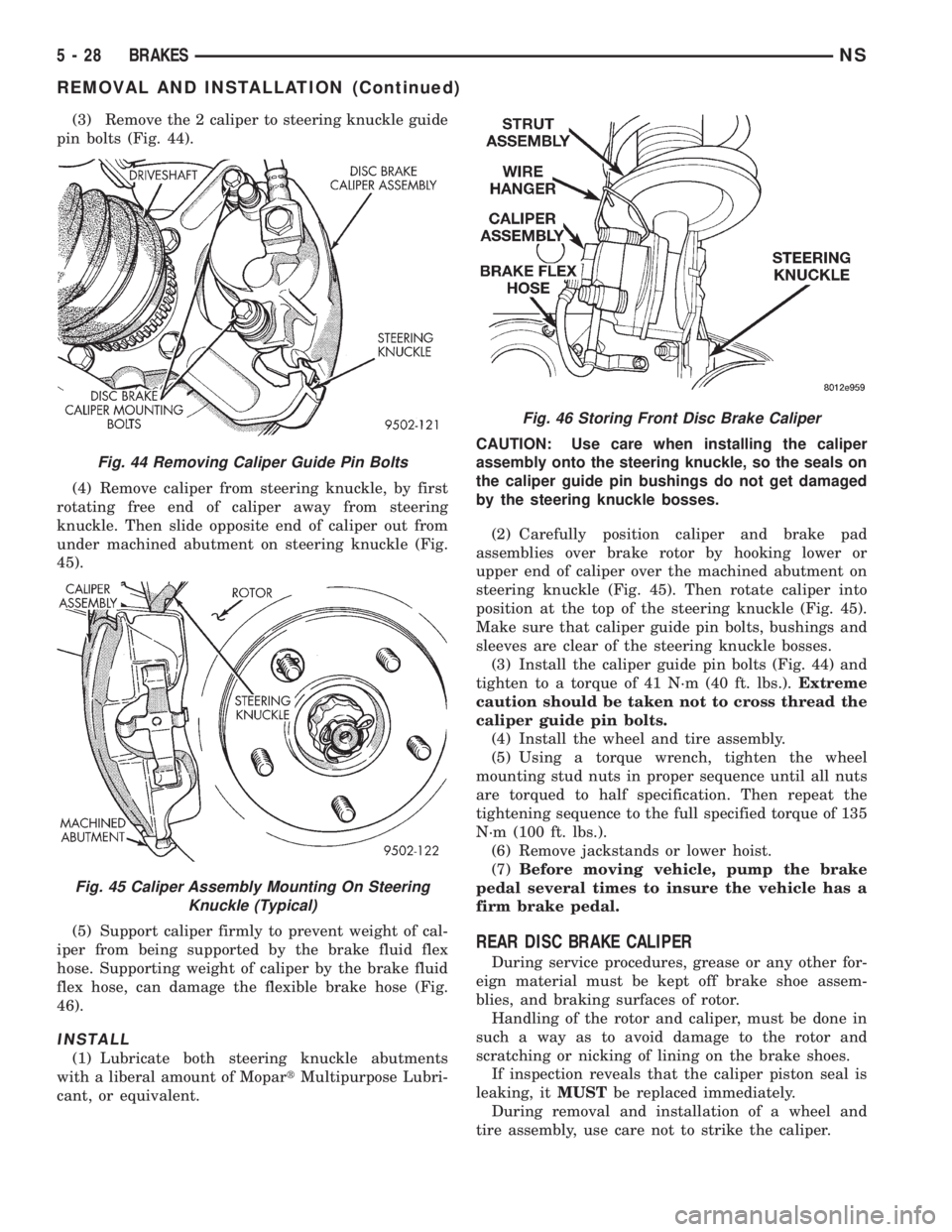
pin bolts (Fig. 44).
(4) Remove caliper from steering knuckle, by first
rotating free end of caliper away from steering
knuckle. Then slide opposite end of caliper out from
under machined abutment on steering knuckle (Fig.
45).
(5) Support caliper firmly to prevent weight of cal-
iper from being supported by the brake fluid flex
hose. Supporting weight of caliper by the brake fluid
flex hose, can damage the flexible brake hose (Fig.
46).
INSTALL
(1) Lubricate both steering knuckle abutments
with a liberal amount of MopartMultipurpose Lubri-
cant, or equivalent.CAUTION: Use care when installing the caliper
assembly onto the steering knuckle, so the seals on
the caliper guide pin bushings do not get damaged
by the steering knuckle bosses.
(2) Carefully position caliper and brake pad
assemblies over brake rotor by hooking lower or
upper end of caliper over the machined abutment on
steering knuckle (Fig. 45). Then rotate caliper into
position at the top of the steering knuckle (Fig. 45).
Make sure that caliper guide pin bolts, bushings and
sleeves are clear of the steering knuckle bosses.
(3) Install the caliper guide pin bolts (Fig. 44) and
tighten to a torque of 41 N´m (40 ft. lbs.).Extreme
caution should be taken not to cross thread the
caliper guide pin bolts.
(4) Install the wheel and tire assembly.
(5) Using a torque wrench, tighten the wheel
mounting stud nuts in proper sequence until all nuts
are torqued to half specification. Then repeat the
tightening sequence to the full specified torque of 135
N´m (100 ft. lbs.).
(6) Remove jackstands or lower hoist.
(7)Before moving vehicle, pump the brake
pedal several times to insure the vehicle has a
firm brake pedal.
REAR DISC BRAKE CALIPER
During service procedures, grease or any other for-
eign material must be kept off brake shoe assem-
blies, and braking surfaces of rotor.
Handling of the rotor and caliper, must be done in
such a way as to avoid damage to the rotor and
scratching or nicking of lining on the brake shoes.
If inspection reveals that the caliper piston seal is
leaking, itMUSTbe replaced immediately.
During removal and installation of a wheel and
tire assembly, use care not to strike the caliper.
Fig. 44 Removing Caliper Guide Pin Bolts
Fig. 45 Caliper Assembly Mounting On Steering
Knuckle (Typical)
Fig. 46 Storing Front Disc Brake Caliper
5 - 28 BRAKESNS
REMOVAL AND INSTALLATION (Continued)
Page 111 of 1938
REMOVE
(1) Raise vehicle on jackstands or centered on a
hoist. See Hoisting in the Lubrication and Mainte-
nance section of this manual.
(2) Remove rear wheel and tire assemblies from
vehicle.
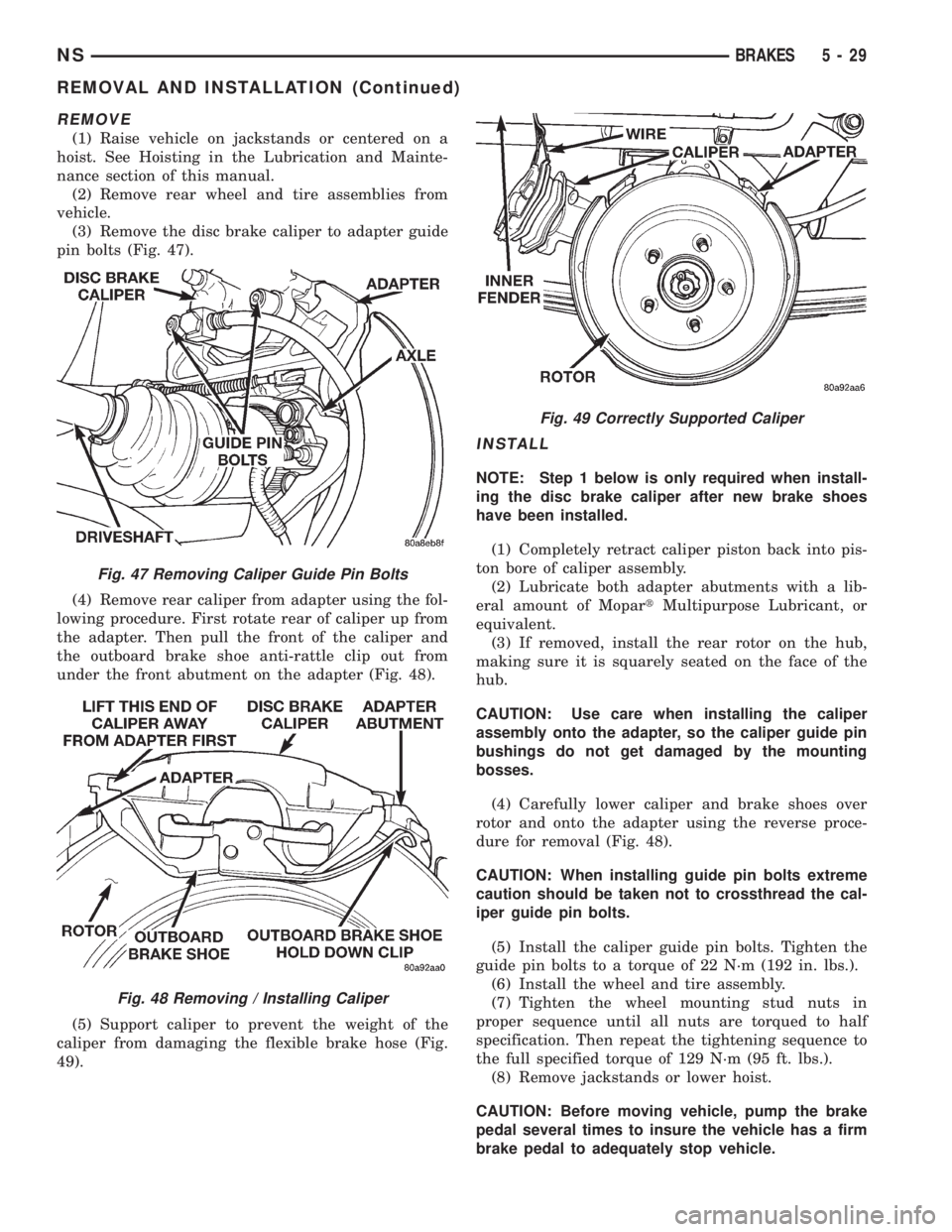
(3) Remove the disc brake caliper to adapter guide
pin bolts (Fig. 47).
(4) Remove rear caliper from adapter using the fol-
lowing procedure. First rotate rear of caliper up from
the adapter. Then pull the front of the caliper and
the outboard brake shoe anti-rattle clip out from
under the front abutment on the adapter (Fig. 48).
(5) Support caliper to prevent the weight of the
caliper from damaging the flexible brake hose (Fig.
49).
INSTALL
NOTE: Step 1 below is only required when install-
ing the disc brake caliper after new brake shoes
have been installed.
(1) Completely retract caliper piston back into pis-
ton bore of caliper assembly.
(2) Lubricate both adapter abutments with a lib-
eral amount of MopartMultipurpose Lubricant, or
equivalent.
(3) If removed, install the rear rotor on the hub,
making sure it is squarely seated on the face of the
hub.
CAUTION: Use care when installing the caliper
assembly onto the adapter, so the caliper guide pin
bushings do not get damaged by the mounting
bosses.
(4) Carefully lower caliper and brake shoes over
rotor and onto the adapter using the reverse proce-
dure for removal (Fig. 48).
CAUTION: When installing guide pin bolts extreme
caution should be taken not to crossthread the cal-
iper guide pin bolts.
(5) Install the caliper guide pin bolts. Tighten the
guide pin bolts to a torque of 22 N´m (192 in. lbs.).
(6) Install the wheel and tire assembly.
(7) Tighten the wheel mounting stud nuts in
proper sequence until all nuts are torqued to half
specification. Then repeat the tightening sequence to
the full specified torque of 129 N´m (95 ft. lbs.).
(8) Remove jackstands or lower hoist.
CAUTION: Before moving vehicle, pump the brake
pedal several times to insure the vehicle has a firm
brake pedal to adequately stop vehicle.
Fig. 47 Removing Caliper Guide Pin Bolts
Fig. 48 Removing / Installing Caliper
Fig. 49 Correctly Supported Caliper
NSBRAKES 5 - 29
REMOVAL AND INSTALLATION (Continued)
Page 115 of 1938
(5) Install the outboard brake shoe on the disc
brake caliper
CAUTION: Use care when installing the caliper
assembly onto the adapter, so the caliper guide pin
bushings do not get damaged by the mounting
bosses.
(6) Carefully lower caliper and brake shoes over
rotor and onto adapter, reversing the removal proce-
dure (Fig. 56)
CAUTION: When installing the caliper guide pin
bolts extreme caution should be taken not to
crossthread the guide pin bolts.
(7) Install the caliper guide pin bolts. Tighten the
guide pin bolts to a torque of 22 N´m (192 in. lbs.).
(8) Install the wheel and tire assembly.
(9) Tighten the wheel mounting stud nuts in
proper sequence until all nuts are torqued to half
specification. Then repeat the tightening sequence to
the full specified torque of 129 N´m (95 ft. lbs.).
(10) Remove jackstands or lower hoist.
CAUTION: Before moving vehicle, pump the brake
pedal several times to insure the vehicle has a firm
brake pedal to adequately stop the vehicle.
(11) Road test the vehicle and make several stops
to wear off any foreign material on the brakes and to
seat the brake shoe linings.
REAR BRAKE DRUM
REMOVE
(1) Remove the tire and wheel assembly from the
vehicle
Remove the park brake cable, for the wheel of the
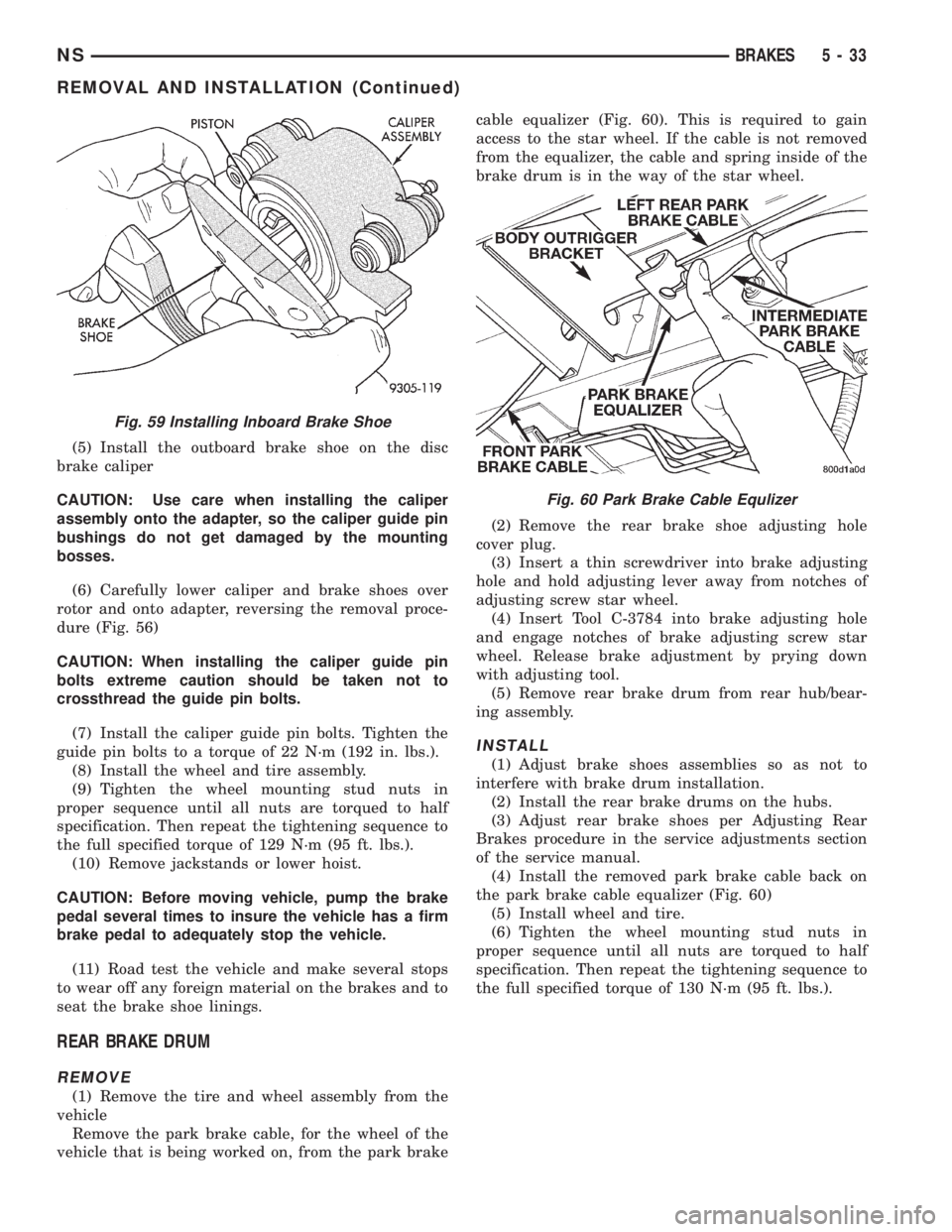
vehicle that is being worked on, from the park brakecable equalizer (Fig. 60). This is required to gain
access to the star wheel. If the cable is not removed
from the equalizer, the cable and spring inside of the
brake drum is in the way of the star wheel.
(2) Remove the rear brake shoe adjusting hole
cover plug.
(3) Insert a thin screwdriver into brake adjusting
hole and hold adjusting lever away from notches of
adjusting screw star wheel.
(4) Insert Tool C-3784 into brake adjusting hole
and engage notches of brake adjusting screw star
wheel. Release brake adjustment by prying down
with adjusting tool.
(5) Remove rear brake drum from rear hub/bear-
ing assembly.
INSTALL
(1) Adjust brake shoes assemblies so as not to
interfere with brake drum installation.
(2) Install the rear brake drums on the hubs.
(3) Adjust rear brake shoes per Adjusting Rear
Brakes procedure in the service adjustments section
of the service manual.
(4) Install the removed park brake cable back on
the park brake cable equalizer (Fig. 60)
(5) Install wheel and tire.
(6) Tighten the wheel mounting stud nuts in
proper sequence until all nuts are torqued to half
specification. Then repeat the tightening sequence to
the full specified torque of 130 N´m (95 ft. lbs.).
Fig. 59 Installing Inboard Brake Shoe
Fig. 60 Park Brake Cable Equlizer
NSBRAKES 5 - 33
REMOVAL AND INSTALLATION (Continued)
Page 119 of 1938
CAUTION: When installing the tension clip on the
automatic adjuster, it must be located on only the
threaded area of the adjuster assembly (Fig. 66). If
it is located on a non-threaded area of the adjuster,
the function of the automatic adjuster will be
affected.
(7) Install the tension clip (Fig. 66) attaching the
upper return spring to the automatic adjuster assem-
bly.
(8) Install the brake shoe to brake shoe lower
return springs on the brake shoes (Fig. 64) and (Fig.
65).
(9) Install automatic adjustment lever on the lead-
ing brake shoe of the rear brake assembly (Fig. 63).
(10) Install the actuating spring on the automatic
adjustment lever and leading brake shoe assembly
(Fig. 62).
(11) Verify that the automatic adjuster lever has
positive contact with the star wheel on the automatic
adjuster assembly.
(12) When all components of both rear brake
assemblies are correctly and fully installed, remove
the locking pliers from the front park brake cable.
(13) Adjust brake shoes assemblies so as not to
interfere with brake drum installation.
(14) Install the rear brake drums on the hubs.
(15) Adjust rear brake shoes per Adjusting Rear
Brakes procedure in the service adjustments section
of the service manual.
(16) Install the wheel and tire assembly.
(17) Push the park brake pedal to the floor once
and release pedal. This will automatically remove the
slack from and correctly adjust the park brake
cables.
(18) Tighten the wheel mounting stud nuts in
proper sequence until all nuts are torqued to half
specification. Then repeat the tightening sequence to
the full specified torque of 130 N´m (95 ft. lbs.).
(19) Road test vehicle. The automatic adjuster will
continue the brake adjustment during the road test
of the vehicle.
BRAKE SUPPORT PLATE (REAR DRUM BRAKES)
REMOVE
(1) Raise vehicle on jackstands or centered on a
frame contact type hoist. See Hoisting in the Lubri-
cation and Maintenance section of this service man-
ual for required lifting procedure.
(2) Remove wheel and tire.
(3) Remove brake drum from hub/bearing.
(4) Remove brake shoes from brake support plate.
Refer to Rear Brake Shoe Removal in the removal
and installation section in this group of the service
manual for the required procedure.(5) Disconnect the park brake cable from the park
brake actuation lever.
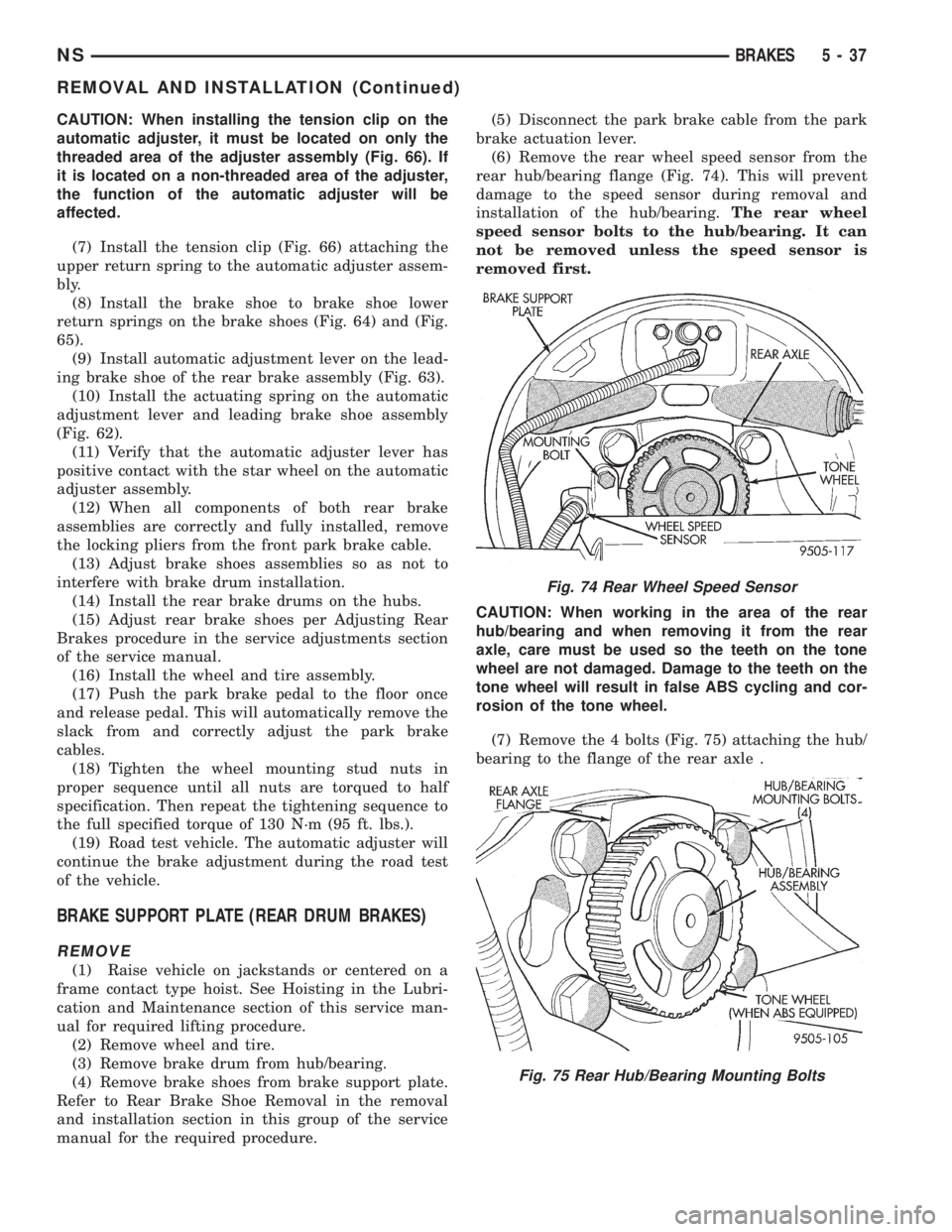
(6) Remove the rear wheel speed sensor from the
rear hub/bearing flange (Fig. 74). This will prevent
damage to the speed sensor during removal and
installation of the hub/bearing.The rear wheel
speed sensor bolts to the hub/bearing. It can
not be removed unless the speed sensor is
removed first.
CAUTION: When working in the area of the rear
hub/bearing and when removing it from the rear
axle, care must be used so the teeth on the tone
wheel are not damaged. Damage to the teeth on the
tone wheel will result in false ABS cycling and cor-
rosion of the tone wheel.
(7) Remove the 4 bolts (Fig. 75) attaching the hub/
bearing to the flange of the rear axle .
Fig. 74 Rear Wheel Speed Sensor
Fig. 75 Rear Hub/Bearing Mounting Bolts
NSBRAKES 5 - 37
REMOVAL AND INSTALLATION (Continued)