Heater hoses CHRYSLER VOYAGER 1996 Service Manual
[x] Cancel search | Manufacturer: CHRYSLER, Model Year: 1996, Model line: VOYAGER, Model: CHRYSLER VOYAGER 1996Pages: 1938, PDF Size: 55.84 MB
Page 130 of 1938
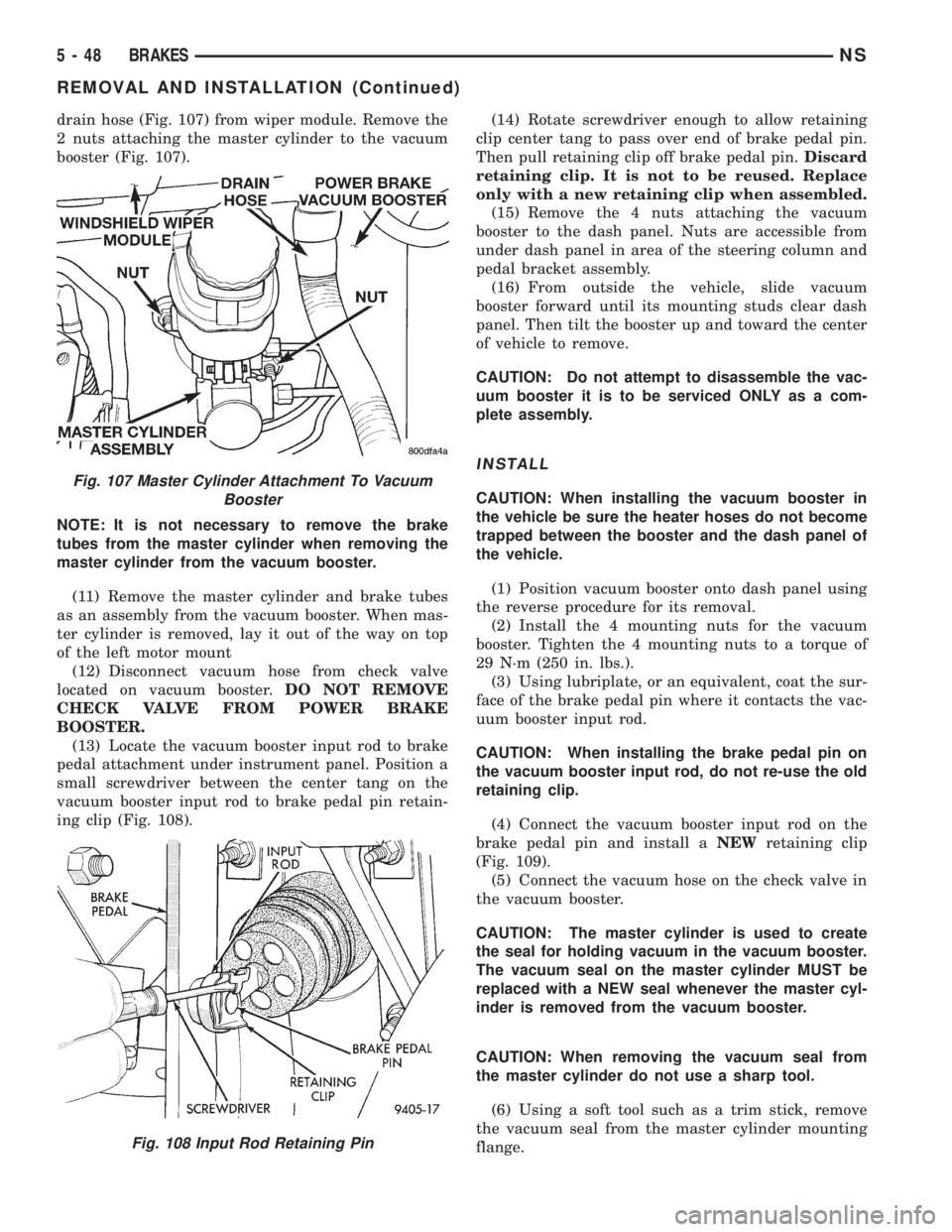
drain hose (Fig. 107) from wiper module. Remove the
2 nuts attaching the master cylinder to the vacuum
booster (Fig. 107).
NOTE: It is not necessary to remove the brake
tubes from the master cylinder when removing the
master cylinder from the vacuum booster.
(11) Remove the master cylinder and brake tubes
as an assembly from the vacuum booster. When mas-
ter cylinder is removed, lay it out of the way on top
of the left motor mount
(12) Disconnect vacuum hose from check valve
located on vacuum booster.DO NOT REMOVE
CHECK VALVE FROM POWER BRAKE
BOOSTER.
(13) Locate the vacuum booster input rod to brake
pedal attachment under instrument panel. Position a
small screwdriver between the center tang on the
vacuum booster input rod to brake pedal pin retain-
ing clip (Fig. 108).(14) Rotate screwdriver enough to allow retaining
clip center tang to pass over end of brake pedal pin.
Then pull retaining clip off brake pedal pin.Discard
retaining clip. It is not to be reused. Replace
only with a new retaining clip when assembled.
(15) Remove the 4 nuts attaching the vacuum
booster to the dash panel. Nuts are accessible from
under dash panel in area of the steering column and
pedal bracket assembly.
(16) From outside the vehicle, slide vacuum
booster forward until its mounting studs clear dash
panel. Then tilt the booster up and toward the center
of vehicle to remove.
CAUTION: Do not attempt to disassemble the vac-
uum booster it is to be serviced ONLY as a com-
plete assembly.
INSTALL
CAUTION: When installing the vacuum booster in
the vehicle be sure the heater hoses do not become
trapped between the booster and the dash panel of
the vehicle.
(1) Position vacuum booster onto dash panel using
the reverse procedure for its removal.
(2) Install the 4 mounting nuts for the vacuum
booster. Tighten the 4 mounting nuts to a torque of
29 N´m (250 in. lbs.).
(3) Using lubriplate, or an equivalent, coat the sur-
face of the brake pedal pin where it contacts the vac-
uum booster input rod.
CAUTION: When installing the brake pedal pin on
the vacuum booster input rod, do not re-use the old
retaining clip.
(4) Connect the vacuum booster input rod on the
brake pedal pin and install aNEWretaining clip
(Fig. 109).
(5) Connect the vacuum hose on the check valve in
the vacuum booster.
CAUTION: The master cylinder is used to create
the seal for holding vacuum in the vacuum booster.
The vacuum seal on the master cylinder MUST be
replaced with a NEW seal whenever the master cyl-
inder is removed from the vacuum booster.
CAUTION: When removing the vacuum seal from
the master cylinder do not use a sharp tool.
(6) Using a soft tool such as a trim stick, remove
the vacuum seal from the master cylinder mounting
flange.
Fig. 107 Master Cylinder Attachment To Vacuum
Booster
Fig. 108 Input Rod Retaining Pin
5 - 48 BRAKESNS
REMOVAL AND INSTALLATION (Continued)
Page 133 of 1938
clear dash panel. Then tilt the booster up and toward
the center of vehicle to remove.
CAUTION: Do not attempt to disassemble the
power brake vacuum booster it is to be serviced
ONLY as a complete assembly.
INSTALL
CAUTION: When installing the power brake vacuum
booster in the vehicle be sure the heater hoses do
not become trapped between the booster and the
dash panel of the vehicle.
(1) Position power brake booster onto dash panel
using the reverse procedure for its removal.
(2) Install the 4 power brake vacuum booster
mounting nuts. Tighten the 4 mounting nuts to a
torque of 29 N´m (250 in. lbs.).
(3) Using lubriplate, or an equivalent, coat the sur-
face of the brake pedal pin where it contacts the
brake vacuum booster input rod.
CAUTION: When installing the brake pedal pin on
the power brake vacuum booster input rod, do not
re-use the old retaining clip.
(4) Connect power brake vacuum booster input rod
on the brake pedal pin and install aNEWretaining
clip (Fig. 116).
(5) Connect the vacuum hose on the check valve in
the power brake vacuum booster.
CAUTION: The master cylinder is used to create
the seal for holding vacuum in the power brake vac-
uum booster. The vacuum seal on the master cylin-
der MUST be replaced with a NEW seal whenever
the master cylinder is removed from the power
brake vacuum booster.CAUTION: When removing the vacuum seal from
the master cylinder do not use a sharp tool.
(6) Using a soft tool such as a trim stick, remove
the vacuum seal from the master cylinder mounting
flange.
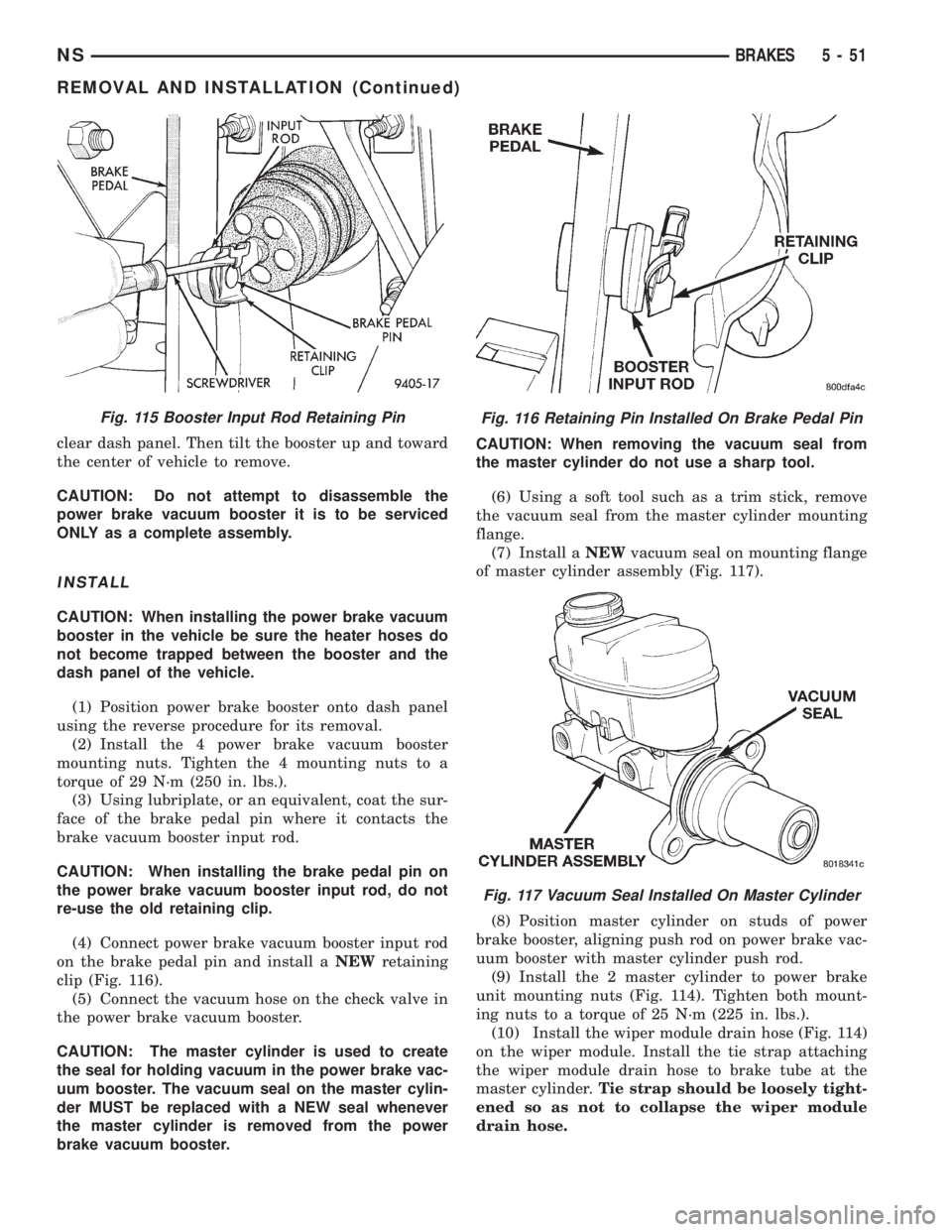
(7) Install aNEWvacuum seal on mounting flange
of master cylinder assembly (Fig. 117).
(8) Position master cylinder on studs of power
brake booster, aligning push rod on power brake vac-
uum booster with master cylinder push rod.
(9) Install the 2 master cylinder to power brake
unit mounting nuts (Fig. 114). Tighten both mount-
ing nuts to a torque of 25 N´m (225 in. lbs.).
(10) Install the wiper module drain hose (Fig. 114)
on the wiper module. Install the tie strap attaching
the wiper module drain hose to brake tube at the
master cylinder.Tie strap should be loosely tight-
ened so as not to collapse the wiper module
drain hose.
Fig. 115 Booster Input Rod Retaining PinFig. 116 Retaining Pin Installed On Brake Pedal Pin
Fig. 117 Vacuum Seal Installed On Master Cylinder
NSBRAKES 5 - 51
REMOVAL AND INSTALLATION (Continued)
Page 136 of 1938
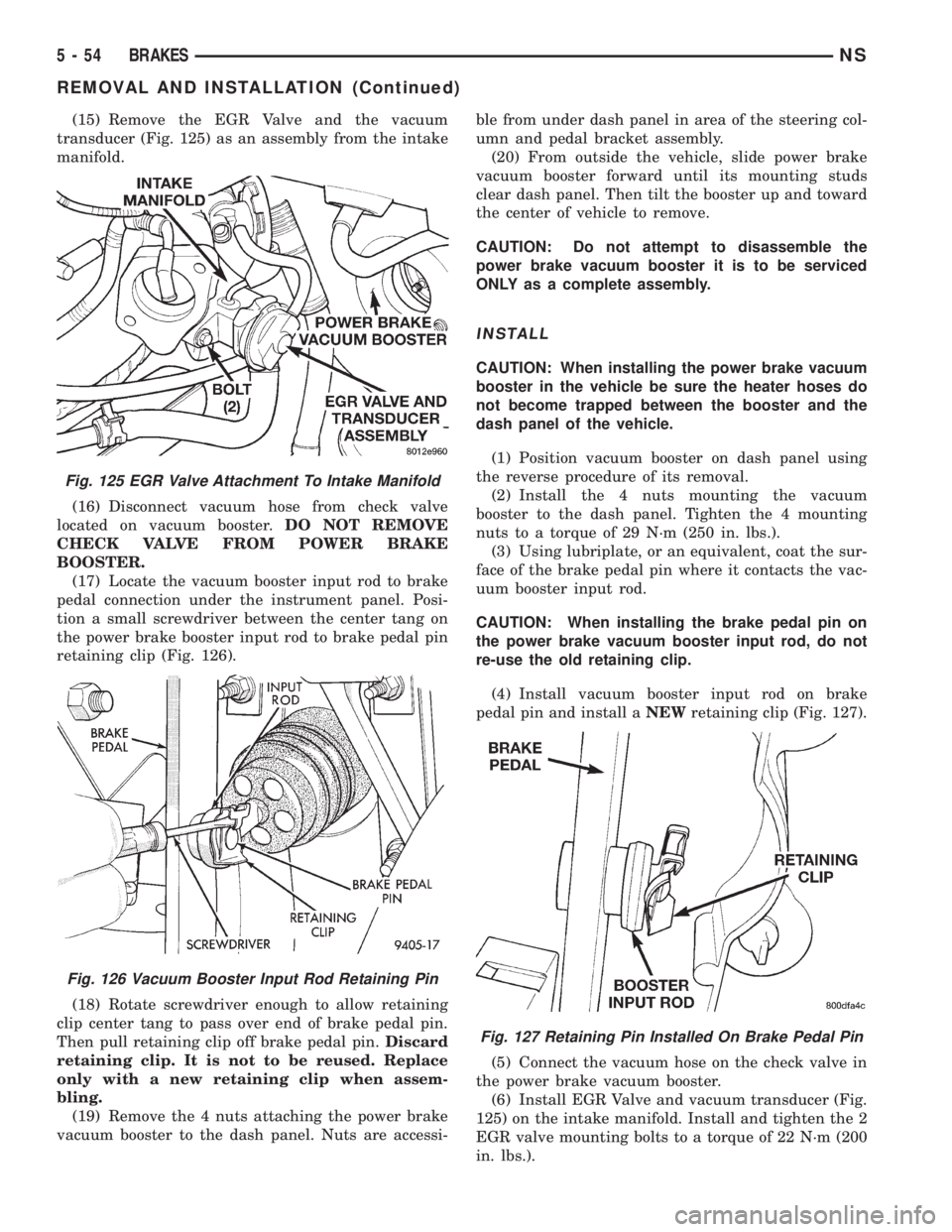
(15) Remove the EGR Valve and the vacuum
transducer (Fig. 125) as an assembly from the intake
manifold.
(16) Disconnect vacuum hose from check valve
located on vacuum booster.DO NOT REMOVE
CHECK VALVE FROM POWER BRAKE
BOOSTER.
(17) Locate the vacuum booster input rod to brake
pedal connection under the instrument panel. Posi-
tion a small screwdriver between the center tang on
the power brake booster input rod to brake pedal pin
retaining clip (Fig. 126).
(18) Rotate screwdriver enough to allow retaining
clip center tang to pass over end of brake pedal pin.
Then pull retaining clip off brake pedal pin.Discard
retaining clip. It is not to be reused. Replace
only with a new retaining clip when assem-
bling.
(19) Remove the 4 nuts attaching the power brake
vacuum booster to the dash panel. Nuts are accessi-ble from under dash panel in area of the steering col-
umn and pedal bracket assembly.
(20) From outside the vehicle, slide power brake
vacuum booster forward until its mounting studs
clear dash panel. Then tilt the booster up and toward
the center of vehicle to remove.
CAUTION: Do not attempt to disassemble the
power brake vacuum booster it is to be serviced
ONLY as a complete assembly.
INSTALL
CAUTION: When installing the power brake vacuum
booster in the vehicle be sure the heater hoses do
not become trapped between the booster and the
dash panel of the vehicle.
(1) Position vacuum booster on dash panel using
the reverse procedure of its removal.
(2) Install the 4 nuts mounting the vacuum
booster to the dash panel. Tighten the 4 mounting
nuts to a torque of 29 N´m (250 in. lbs.).
(3) Using lubriplate, or an equivalent, coat the sur-
face of the brake pedal pin where it contacts the vac-
uum booster input rod.
CAUTION: When installing the brake pedal pin on
the power brake vacuum booster input rod, do not
re-use the old retaining clip.
(4) Install vacuum booster input rod on brake
pedal pin and install aNEWretaining clip (Fig. 127).
(5) Connect the vacuum hose on the check valve in
the power brake vacuum booster.
(6) Install EGR Valve and vacuum transducer (Fig.
125) on the intake manifold. Install and tighten the 2
EGR valve mounting bolts to a torque of 22 N´m (200
in. lbs.).
Fig. 125 EGR Valve Attachment To Intake Manifold
Fig. 126 Vacuum Booster Input Rod Retaining Pin
Fig. 127 Retaining Pin Installed On Brake Pedal Pin
5 - 54 BRAKESNS
REMOVAL AND INSTALLATION (Continued)
Page 215 of 1938
COOLING SYSTEM
CONTENTS
page page
GENERAL INFORMATION
ACCESSORY DRIVE BELTS................ 1
AUTOMATIC TRANSMISSION OIL COOLERÐ
2.4L................................. 3
COOLANT RECOVERY SYSTEM (CRS)....... 3
COOLANT.............................. 3
COOLING SYSTEM....................... 2
ENGINE BLOCK HEATER.................. 5
ENGINE THERMOSTAT.................... 3
RADIATOR PRESSURE CAP................ 4
RADIATOR............................. 3
WATER PUMPS......................... 3
DESCRIPTION AND OPERATION
COOLANT PERFORMANCE................. 6
RADIATOR HOSES AND CLAMPS........... 6
WATER PIPESÐ3.0L ENGINE.............. 6
WATER PUMPÐ3.3/3.8L ENGINES.......... 7
WATER PUMPÐ2.4L ENGINE.............. 6
WATER PUMPÐ3.0L ENGINE.............. 6
DIAGNOSIS AND TESTING
ACCESSORY DRIVE BELT.................. 7
COOLING SYSTEM DIAGNOSIS............. 8
DEAERATION.......................... 16
ELECTRIC FAN MOTOR TEST.............. 14
LOW COOLANT LEVEL AERATION.......... 15
PRESSURE TESTING RADIATOR CAP....... 15
RADIATOR CAP TO FILLER NECK SEAL
PRESSURE RELIEF CHECK.............. 15
RADIATOR COOLANT FLOW TEST.......... 14
RADIATOR FAN CONTROL................ 14
TEMPERATURE GAUGE INDICATION........ 16
TESTING COOLING SYSTEM FOR LEAKS.... 14
SERVICE PROCEDURES
COOLANT LEVEL CHECKÐROUTINE........ 16
COOLANT LEVEL SERVICE................ 16COOLANTÐADDING ADDITIONAL.......... 16
COOLING SYSTEMÐDRAINING............ 16
COOLING SYSTEMÐREFILLING........... 16
REMOVAL AND INSTALLATION
ACCESSORY DRIVE BELTSÐ2.4L.......... 23
ACCESSORY DRIVE BELTSÐ3.0L.......... 24
ACCESSORY DRIVE BELTÐ3.3/3.8L........ 24
ENGINE BLOCK HEATER................. 23
FAN MODULE.......................... 22
RADIATOR DRAINCOCK.................. 21
RADIATOR............................ 21
THERMOSTATÐ2.4L ENGINE............. 19
THERMOSTATÐ3.0L ENGINE............. 20
THERMOSTATÐ3.3/3.8L ENGINES......... 20
WATER PUMP INLET TUBEÐ2.4L ENGINE . . . 17
WATER PUMPÐ3.3/3.8L ENGINES......... 19
WATER PUMPÐ2.4L ENGINE............ 17
WATER PUMPÐ3.0L ENGINE............. 18
CLEANING AND INSPECTION
ACCESSORY DRIVE BELT................. 25
CHEMICAL CLEANING................... 25
COOLING SYSTEM CLEANING............. 25
RADIATOR PRESSURE CAP............... 25
REVERSE FLUSHING THE ENGINE......... 25
REVERSE FLUSHING THE RADIATOR....... 25
WATER PUMP......................... 24
ADJUSTMENTS
BELT TENSION CHART................... 26
BELT TENSION GAUGE METHOD........... 26
PROPER BELT TENSION................. 25
SPECIFICATIONS
COOLING SYSTEM CAPACITY............. 26
TORQUE CHART........................ 26
SPECIAL TOOLS
COOLING............................. 26
GENERAL INFORMATION
ACCESSORY DRIVE BELTS
The accessory drive system utilizes two different
style of drive belts. The conventional V-belt and the
Poly-V belt are used to drive the generator, air con-
ditioning compressor, power steering pump and waterpump. Satisfactory performance of these belts
depends on belt condition and proper belt tension.
Belt tensioning should be performed with the aid of a
Burroughs gauge Special Tool C-4162. Because of
space limitations in the engine compartment, the use
of the gauge may be restricted. Raise the vehicle on a
hoist and then remove the splash shield to gain
access to the drive belts.
NSCOOLING SYSTEM 7 - 1
Page 216 of 1938
COOLING SYSTEM
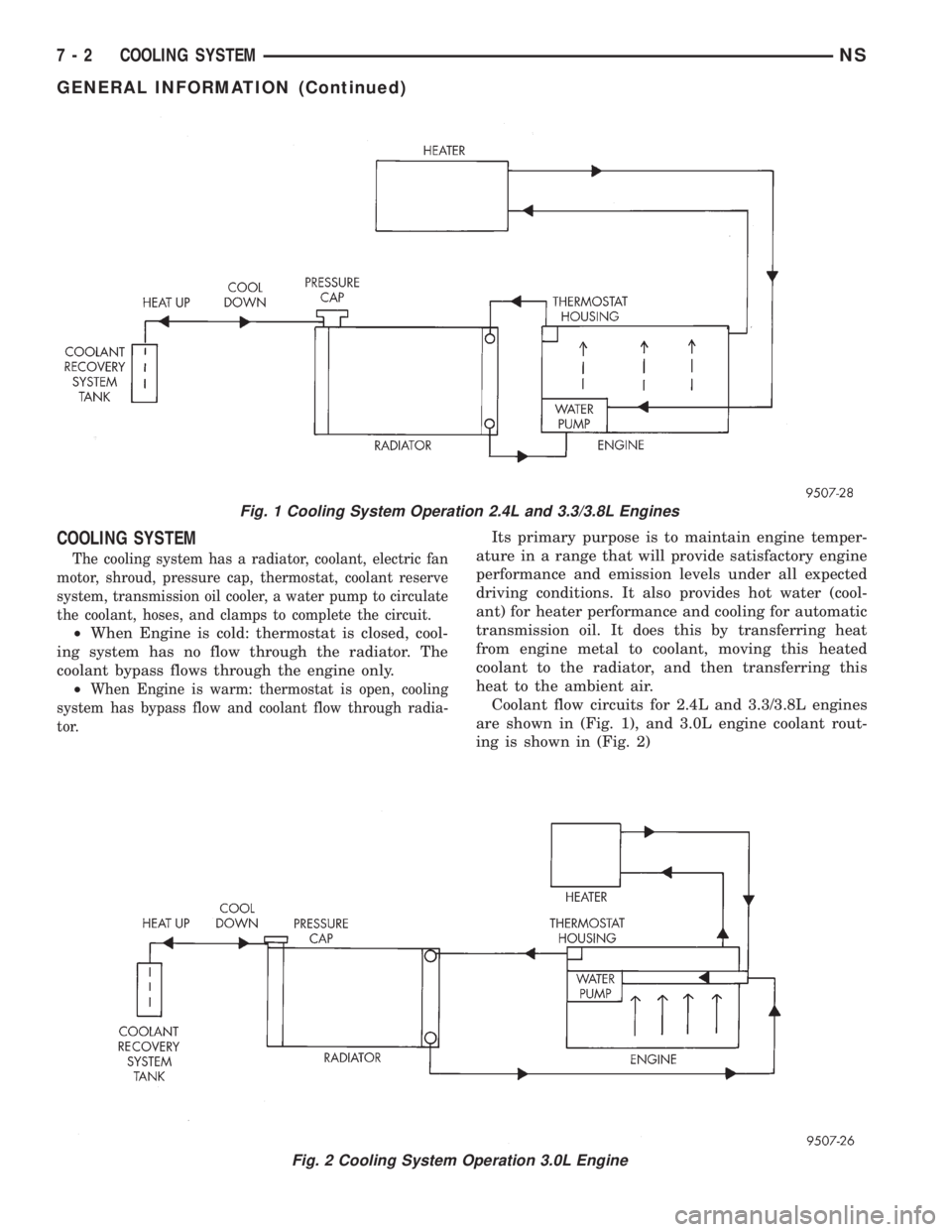
The cooling system has a radiator, coolant, electric fan
motor, shroud, pressure cap, thermostat, coolant reserve
system, transmission oil cooler, a water pump to circulate
the coolant, hoses, and clamps to complete the circuit.
²When Engine is cold: thermostat is closed, cool-
ing system has no flow through the radiator. The
coolant bypass flows through the engine only.
²
When Engine is warm: thermostat is open, cooling
system has bypass flow and coolant flow through radia-
tor.
Its primary purpose is to maintain engine temper-
ature in a range that will provide satisfactory engine
performance and emission levels under all expected
driving conditions. It also provides hot water (cool-
ant) for heater performance and cooling for automatic
transmission oil. It does this by transferring heat
from engine metal to coolant, moving this heated
coolant to the radiator, and then transferring this
heat to the ambient air.
Coolant flow circuits for 2.4L and 3.3/3.8L engines
are shown in (Fig. 1), and 3.0L engine coolant rout-
ing is shown in (Fig. 2)
Fig. 1 Cooling System Operation 2.4L and 3.3/3.8L Engines
Fig. 2 Cooling System Operation 3.0L Engine
7 - 2 COOLING SYSTEMNS
GENERAL INFORMATION (Continued)
Page 217 of 1938
COOLANT RECOVERY SYSTEM (CRS)
This system works with the radiator pressure cap
to use thermal expansion and contraction of the cool-
ant to keep the coolant free of trapped air. Provides a
convenient and safe method for checking coolant
level and adjusting level at atmospheric pressure
without removing the radiator pressure cap. It also
provides some reserve coolant to cover deaeration
and evaporation or boiling losses. All vehicles are
equipped with this system and take various shapes
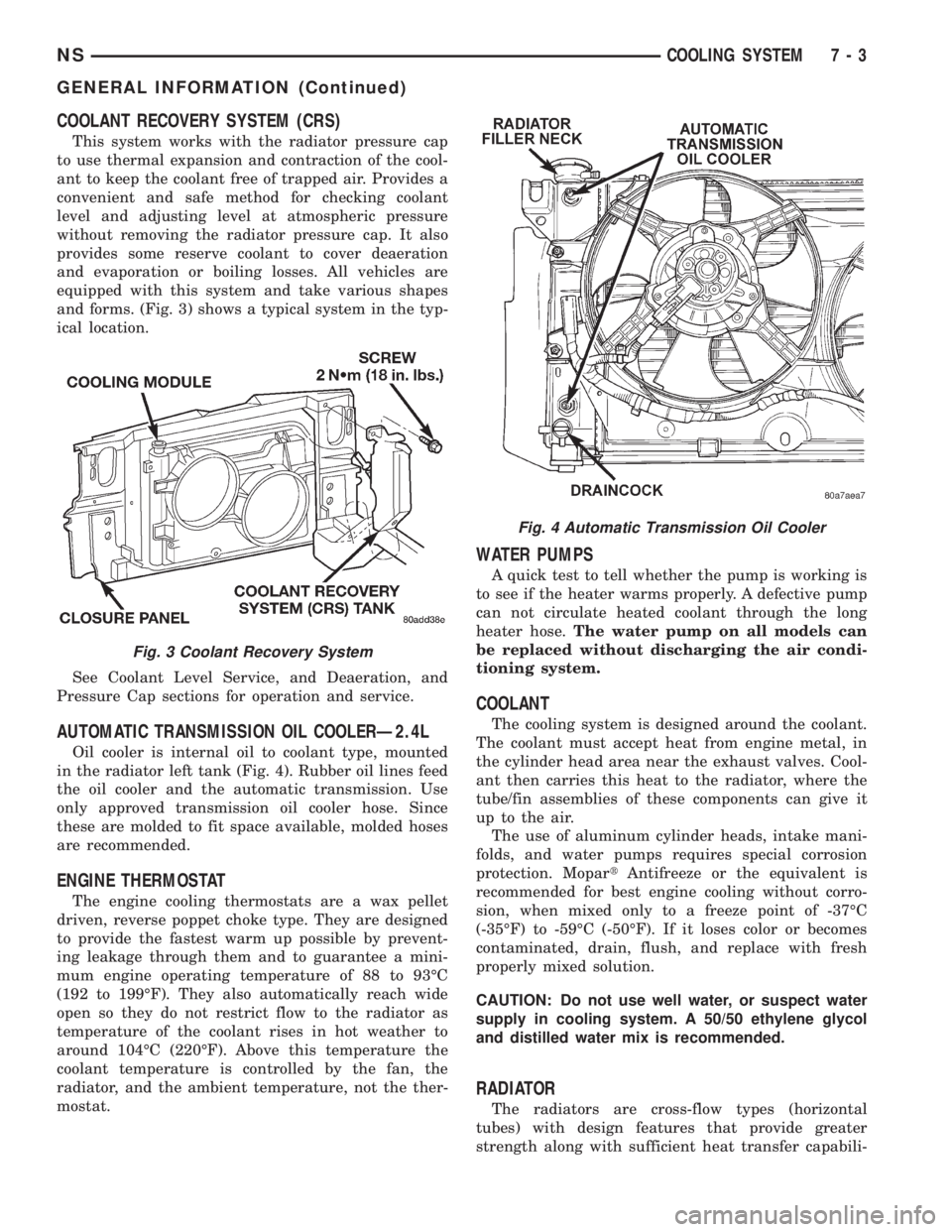
and forms. (Fig. 3) shows a typical system in the typ-
ical location.
See Coolant Level Service, and Deaeration, and
Pressure Cap sections for operation and service.
AUTOMATIC TRANSMISSION OIL COOLERÐ2.4L
Oil cooler is internal oil to coolant type, mounted
in the radiator left tank (Fig. 4). Rubber oil lines feed
the oil cooler and the automatic transmission. Use
only approved transmission oil cooler hose. Since
these are molded to fit space available, molded hoses
are recommended.
ENGINE THERMOSTAT
The engine cooling thermostats are a wax pellet
driven, reverse poppet choke type. They are designed
to provide the fastest warm up possible by prevent-
ing leakage through them and to guarantee a mini-
mum engine operating temperature of 88 to 93ÉC
(192 to 199ÉF). They also automatically reach wide
open so they do not restrict flow to the radiator as
temperature of the coolant rises in hot weather to
around 104ÉC (220ÉF). Above this temperature the
coolant temperature is controlled by the fan, the
radiator, and the ambient temperature, not the ther-
mostat.
WATER PUMPS
A quick test to tell whether the pump is working is
to see if the heater warms properly. A defective pump
can not circulate heated coolant through the long
heater hose.The water pump on all models can
be replaced without discharging the air condi-
tioning system.
COOLANT
The cooling system is designed around the coolant.
The coolant must accept heat from engine metal, in
the cylinder head area near the exhaust valves. Cool-
ant then carries this heat to the radiator, where the
tube/fin assemblies of these components can give it
up to the air.
The use of aluminum cylinder heads, intake mani-
folds, and water pumps requires special corrosion
protection. MopartAntifreeze or the equivalent is
recommended for best engine cooling without corro-
sion, when mixed only to a freeze point of -37ÉC
(-35ÉF) to -59ÉC (-50ÉF). If it loses color or becomes
contaminated, drain, flush, and replace with fresh
properly mixed solution.
CAUTION: Do not use well water, or suspect water
supply in cooling system. A 50/50 ethylene glycol
and distilled water mix is recommended.
RADIATOR
The radiators are cross-flow types (horizontal
tubes) with design features that provide greater
strength along with sufficient heat transfer capabili-
Fig. 3 Coolant Recovery System
Fig. 4 Automatic Transmission Oil Cooler
NSCOOLING SYSTEM 7 - 3
GENERAL INFORMATION (Continued)
Page 220 of 1938
DESCRIPTION AND OPERATION
WATER PIPESÐ3.0L ENGINE
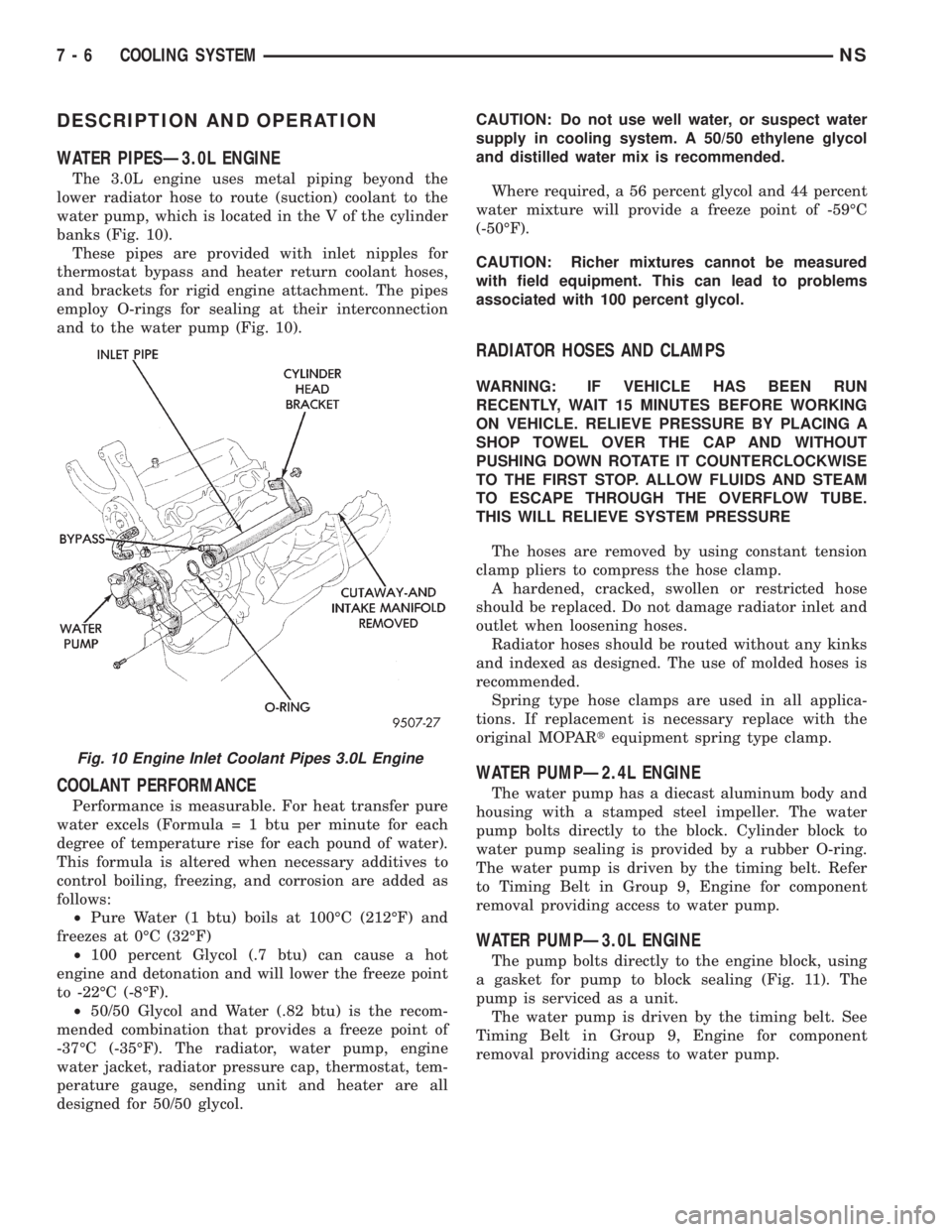
The 3.0L engine uses metal piping beyond the
lower radiator hose to route (suction) coolant to the
water pump, which is located in the V of the cylinder
banks (Fig. 10).
These pipes are provided with inlet nipples for
thermostat bypass and heater return coolant hoses,
and brackets for rigid engine attachment. The pipes
employ O-rings for sealing at their interconnection
and to the water pump (Fig. 10).
COOLANT PERFORMANCE
Performance is measurable. For heat transfer pure
water excels (Formula = 1 btu per minute for each
degree of temperature rise for each pound of water).
This formula is altered when necessary additives to
control boiling, freezing, and corrosion are added as
follows:
²Pure Water (1 btu) boils at 100ÉC (212ÉF) and
freezes at 0ÉC (32ÉF)
²100 percent Glycol (.7 btu) can cause a hot
engine and detonation and will lower the freeze point
to -22ÉC (-8ÉF).
²50/50 Glycol and Water (.82 btu) is the recom-
mended combination that provides a freeze point of
-37ÉC (-35ÉF). The radiator, water pump, engine
water jacket, radiator pressure cap, thermostat, tem-
perature gauge, sending unit and heater are all
designed for 50/50 glycol.CAUTION: Do not use well water, or suspect water
supply in cooling system. A 50/50 ethylene glycol
and distilled water mix is recommended.
Where required, a 56 percent glycol and 44 percent
water mixture will provide a freeze point of -59ÉC
(-50ÉF).
CAUTION: Richer mixtures cannot be measured
with field equipment. This can lead to problems
associated with 100 percent glycol.
RADIATOR HOSES AND CLAMPS
WARNING: IF VEHICLE HAS BEEN RUN
RECENTLY, WAIT 15 MINUTES BEFORE WORKING
ON VEHICLE. RELIEVE PRESSURE BY PLACING A
SHOP TOWEL OVER THE CAP AND WITHOUT
PUSHING DOWN ROTATE IT COUNTERCLOCKWISE
TO THE FIRST STOP. ALLOW FLUIDS AND STEAM
TO ESCAPE THROUGH THE OVERFLOW TUBE.
THIS WILL RELIEVE SYSTEM PRESSURE
The hoses are removed by using constant tension
clamp pliers to compress the hose clamp.
A hardened, cracked, swollen or restricted hose
should be replaced. Do not damage radiator inlet and
outlet when loosening hoses.
Radiator hoses should be routed without any kinks
and indexed as designed. The use of molded hoses is
recommended.
Spring type hose clamps are used in all applica-
tions. If replacement is necessary replace with the
original MOPARtequipment spring type clamp.
WATER PUMPÐ2.4L ENGINE
The water pump has a diecast aluminum body and
housing with a stamped steel impeller. The water
pump bolts directly to the block. Cylinder block to
water pump sealing is provided by a rubber O-ring.
The water pump is driven by the timing belt. Refer
to Timing Belt in Group 9, Engine for component
removal providing access to water pump.
WATER PUMPÐ3.0L ENGINE
The pump bolts directly to the engine block, using
a gasket for pump to block sealing (Fig. 11). The
pump is serviced as a unit.
The water pump is driven by the timing belt. See
Timing Belt in Group 9, Engine for component
removal providing access to water pump.
Fig. 10 Engine Inlet Coolant Pipes 3.0L Engine
7 - 6 COOLING SYSTEMNS
Page 228 of 1938
RADIATOR COOLANT FLOW TEST
To determine whether coolant is flowing through
the cooling system, use the following procedure:
(1) If engine is cold, idle engine until normal oper-
ating temperature is reached. Then feel the upper
radiator hose. If it is hot, coolant is circulating.
WARNING: DO NOT REMOVE RADIATOR PRES-
SURE CAP WITH THE SYSTEM HOT AND UNDER
PRESSURE BECAUSE SERIOUS BURNS FROM
COOLANT CAN OCCUR.
(2) Remove radiator pressure cap when engine is
cold, idle engine until thermostat opens, you should
observe coolant flow while looking down the filler
neck. Once flow is detected install radiator pressure
cap.
RADIATOR FAN CONTROL
Fan control is accomplished two ways. A pressure
transducer on the compressor discharge line sends a
signal to the Powertrain Control Module (PCM)
which will activate the fan. In addition to this con-
trol, the fan is turned on by the temperature of the
coolant which is sensed by the coolant temperature
sensor which sends the message to the PCM. The fan
will not run during cranking until the engine starts
no matter what the coolant temperature is.
CAUTION: The solid state fan relay is attached to
the left frame rail near the lower radiator support.
The relay bracket, and fastener are used to dissi-
pate heat from the relay. Ensure the relay is prop-
erly attached to prevent the following:
²Intermittent engine overheating.
²Relay ªthermalº shutdown, or relay damage.
ELECTRIC FAN MOTOR TEST
Refer to Powertrain Diagnostic Manual for proce-
dure.
TESTING COOLING SYSTEM FOR LEAKS
With engine not running, wipe the radiator filler
neck sealing seat clean. The radiator should be full.
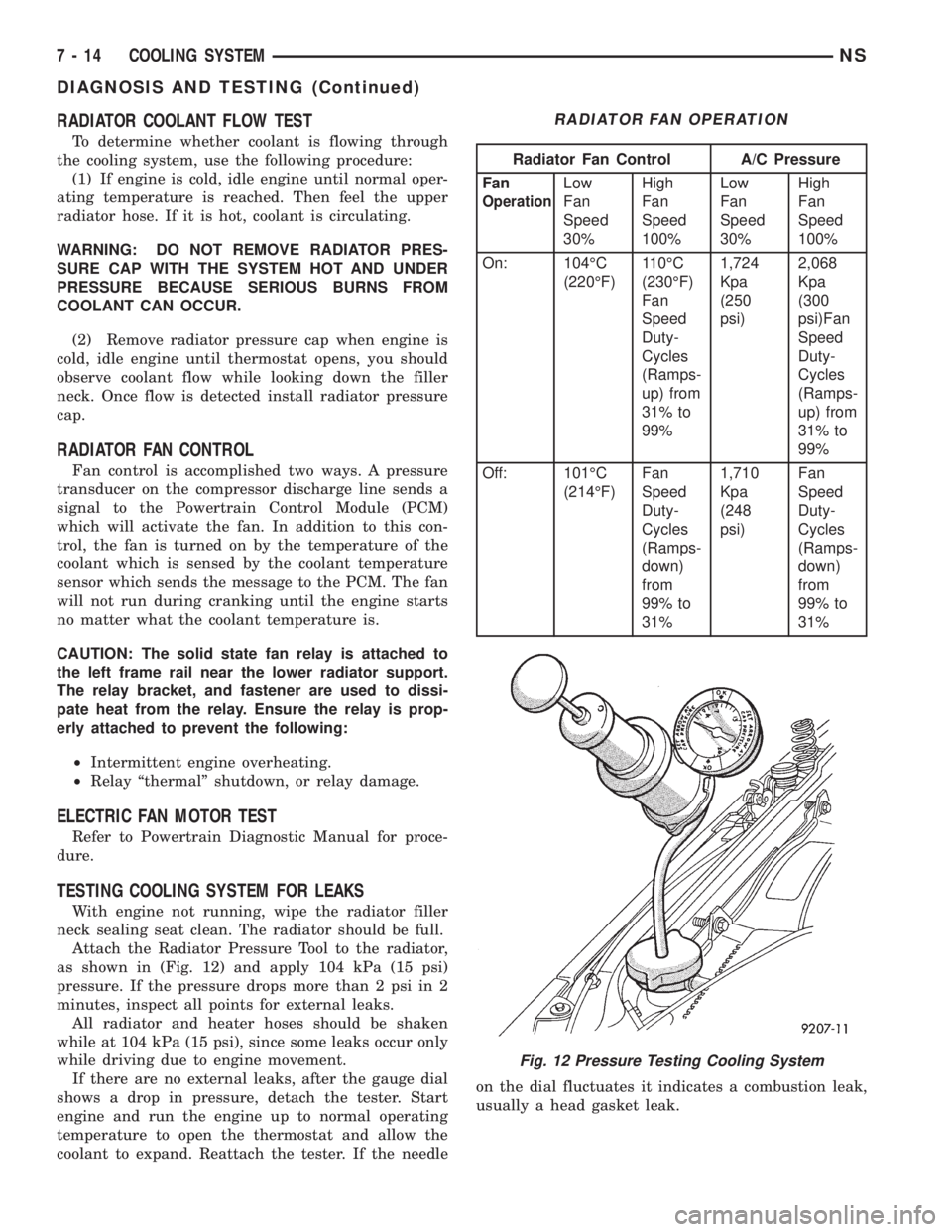
Attach the Radiator Pressure Tool to the radiator,
as shown in (Fig. 12) and apply 104 kPa (15 psi)
pressure. If the pressure drops more than 2 psi in 2
minutes, inspect all points for external leaks.
All radiator and heater hoses should be shaken
while at 104 kPa (15 psi), since some leaks occur only
while driving due to engine movement.
If there are no external leaks, after the gauge dial
shows a drop in pressure, detach the tester. Start
engine and run the engine up to normal operating
temperature to open the thermostat and allow the
coolant to expand. Reattach the tester. If the needleon the dial fluctuates it indicates a combustion leak,
usually a head gasket leak.
RADIATOR FAN OPERATION
Radiator Fan Control A/C Pressure
Fan
Operation
Low
Fan
Speed
30%High
Fan
Speed
100%Low
Fan
Speed
30%High
Fan
Speed
100%
On: 104ÉC
(220ÉF)110ÉC
(230ÉF)
Fan
Speed
Duty-
Cycles
(Ramps-
up) from
31% to
99%1,724
Kpa
(250
psi)2,068
Kpa
(300
psi)Fan
Speed
Duty-
Cycles
(Ramps-
up) from
31% to
99%
Off: 101ÉC
(214ÉF)Fan
Speed
Duty-
Cycles
(Ramps-
down)
from
99% to
31%1,710
Kpa
(248
psi)Fan
Speed
Duty-
Cycles
(Ramps-
down)
from
99% to
31%
Fig. 12 Pressure Testing Cooling System
7 - 14 COOLING SYSTEMNS
DIAGNOSIS AND TESTING (Continued)
Page 235 of 1938
INSTALLATION
(1) Place a new gasket (dipped in water) on the
thermostat housing surface, center thermostat into
opening in the intake manifold water box.
(2) Place housing and gasket over the thermostat,
making sure thermostat is in the recess provided
(Fig. 28).
(3) Bolt housing to intake manifold, tighten bolts
to 28 N´m (250 in. lbs.).
(4) Refill the cooling system to the proper level.
Refer to Cooling System Refilling outlined in this sec-
tion for procedure.
RADIATOR
REMOVAL
(1) Disconnect negative cable from battery.
WARNING: DO NOT REMOVE THE CYLINDER
BLOCK PLUG OR THE RADIATOR DRAINCOCK
WITH THE SYSTEM HOT AND UNDER PRESSURE
BECAUSE SERIOUS BURNS FROM COOLANT CAN
OCCUR.
(2) Drain cooling system. Refer to Draining Cool-
ing System of this section.
(3) Remove air intake resonator.
(4) Remove coolant reserve system tank to filler
neck tube hose.
(5) Disconnect fans from the connector located on
the left side of the fan module.
(6) Remove the Coolant Recovery System (CRS)
tank retaining screw from the upper radiator closure
panel crossmember.
(7) Disconnect the upper radiator mounting
screws from the crossmember. Disconnect the engine
block heater wire if equipped.
(8) Remove the upper radiator closure panel
crossmember. Refer to Group 23 Body for procedure.
(9) Remove air cleaner assembly.
(10) Disconnect automatic transmission oil cooler
lines at radiator and plug.
(11) Disconnect inlet and outlet hoses from the
radiator. Remove the lower hose clip from the fan
module.
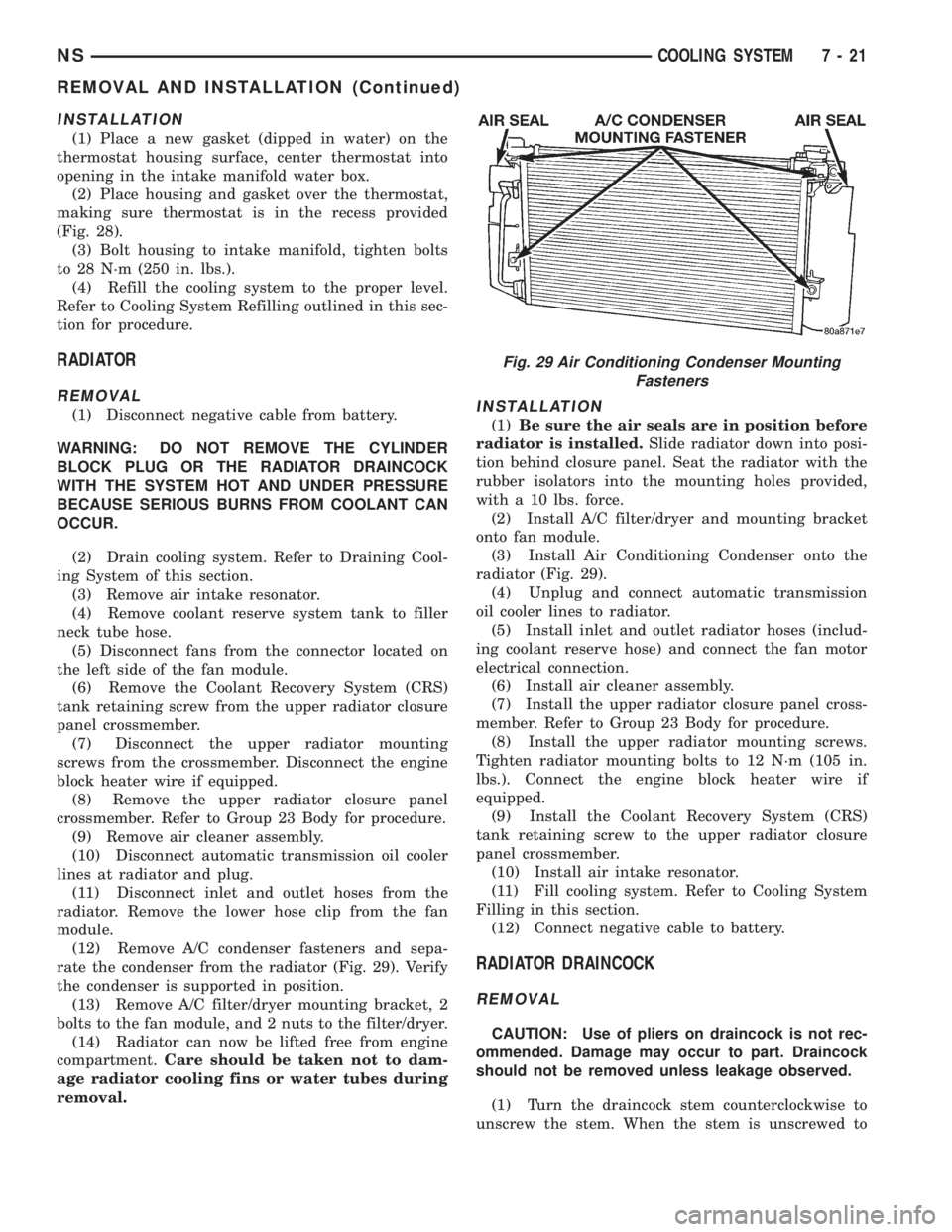
(12) Remove A/C condenser fasteners and sepa-
rate the condenser from the radiator (Fig. 29). Verify
the condenser is supported in position.
(13) Remove A/C filter/dryer mounting bracket, 2
bolts to the fan module, and 2 nuts to the filter/dryer.
(14) Radiator can now be lifted free from engine
compartment.Care should be taken not to dam-
age radiator cooling fins or water tubes during
removal.INSTALLATION
(1)Be sure the air seals are in position before
radiator is installed.Slide radiator down into posi-
tion behind closure panel. Seat the radiator with the
rubber isolators into the mounting holes provided,
with a 10 lbs. force.
(2) Install A/C filter/dryer and mounting bracket
onto fan module.
(3) Install Air Conditioning Condenser onto the
radiator (Fig. 29).
(4) Unplug and connect automatic transmission
oil cooler lines to radiator.
(5) Install inlet and outlet radiator hoses (includ-
ing coolant reserve hose) and connect the fan motor
electrical connection.
(6) Install air cleaner assembly.
(7) Install the upper radiator closure panel cross-
member. Refer to Group 23 Body for procedure.
(8) Install the upper radiator mounting screws.
Tighten radiator mounting bolts to 12 N´m (105 in.
lbs.). Connect the engine block heater wire if
equipped.
(9) Install the Coolant Recovery System (CRS)
tank retaining screw to the upper radiator closure
panel crossmember.
(10) Install air intake resonator.
(11) Fill cooling system. Refer to Cooling System
Filling in this section.
(12) Connect negative cable to battery.
RADIATOR DRAINCOCK
REMOVAL
CAUTION: Use of pliers on draincock is not rec-
ommended. Damage may occur to part. Draincock
should not be removed unless leakage observed.
(1) Turn the draincock stem counterclockwise to
unscrew the stem. When the stem is unscrewed to
Fig. 29 Air Conditioning Condenser Mounting
Fasteners
NSCOOLING SYSTEM 7 - 21
REMOVAL AND INSTALLATION (Continued)
Page 241 of 1938

COOLING SYSTEM
CONTENTS
page page
GENERAL INFORMATION
COOLANT PRESSURE BOTTLE............ 1
COOLING SYSTEM Ð 2.0L GASOLINE...... 1
COOLING SYSTEM Ð 2.5L VM DIESEL..... 1
LOW COOLANT LEVEL SENSOR........... 1
RADIATOR............................ 2
DESCRIPTION AND OPERATION
AUTOMATIC BELT TENSIONER............ 6
BELT TENSION......................... 5
COOLANT PERFORMANCE............... 5
PRESSURE/VENT CAP................... 4
THERMOSTAT OPERATION............... 4
THERMOSTAT......................... 6
WATER PUMP......................... 3
SERVICE PROCEDURES
ADDING ADDITIONAL COOLANT........... 7
DRAINING COOLING SYSTEM............. 7
REFILLING COOLING SYSTEM............ 7
REMOVAL AND INSTALLATION
ENGINE THERMOSTATÐ 2.0L GASOLINE . . . 9GENERATOR/POWER STEERING BELT Ð 2.5L
VM DIESEL......................... 10
RADIATOR Ð 2.5L VM DIESEL........... 9
THERMOSTAT Ð 2.5L VM DIESEL......... 9
WATER PUMP BELT Ð 2.5L VM DIESEL . . . 10
WATER PUMP Ð 2.0L GASOLINE......... 7
WATER PUMP Ð 2.5L VM DIESEL........ 8
CLEANING AND INSPECTION
WATER PUMP........................ 10
ADJUSTMENTS
BELT TENSION CHART................. 11
BELT TENSION GAUGE METHOD......... 11
SPECIFICATIONS
COOLING SYSTEM CAPACITY............ 12
TORQUE CHART...................... 12
SPECIAL TOOLS
COOLING............................ 12
GENERAL INFORMATION
COOLING SYSTEM Ð 2.0L GASOLINE
The 2.0L gasoline engine cooling system consists of
an engine cooling module, thermostat, coolant, a
water pump to circulate the coolant. The engine cool-
ing module may consist of a radiator, electric fan
motors, fan, shroud, coolant reserve system, hoses,
clamps, air condition condenser.
²When the Engine is cold: The thermostat is
closed; the cooling system has no flow through the
radiator. The coolant flows through the engine,
heater system and bypass.
²When the Engine is warm: Thermostat is open;
the cooling system has flow through radiator, engine,
heater system and bypass.
COOLING SYSTEM Ð 2.5L VM DIESEL
The cooling system has a radiator, coolant, electric
fan motors, shroud, pressure cap, thermostat, coolant
pressure bottle, hoses, a water pump to circulate the
coolant, to complete the circuit. Coolant flow for the
VM diesel engine is shown in (Fig. 1).
COOLANT PRESSURE BOTTLE
2.5L VM DIESEL
This system works with the pressure cap to use
thermal expansion and contraction of the coolant to
keep the coolant free of trapped air. It provides some
reserve coolant to cover minor leaks and evaporation
or boiling losses. The coolant pressure bottle location
for 2.5L diesel is above the cylinder head cover (Fig.
2).
LOW COOLANT LEVEL SENSOR
The low coolant level sensor checks for low coolant
level in the coolant tank. A signal will be sent from
this sensor to the Body Control Module (BCM). When
the BCM determines low coolant level for 30 contin-
uous seconds, the instrument panel mounted low
coolant level warning lamp will be illuminated. The
sensor is located on the front side of the coolant tank
(Fig. 4). For information, refer to Group 8E, Instru-
ment Panel and Gauges.
If this lamp is illuminated, it indicates the need to
fill the coolant tank and check for leaks.
NS/GSCOOLING SYSTEM 7 - 1