cooling CHRYSLER VOYAGER 1996 Service Manual
[x] Cancel search | Manufacturer: CHRYSLER, Model Year: 1996, Model line: VOYAGER, Model: CHRYSLER VOYAGER 1996Pages: 1938, PDF Size: 55.84 MB
Page 3 of 1938
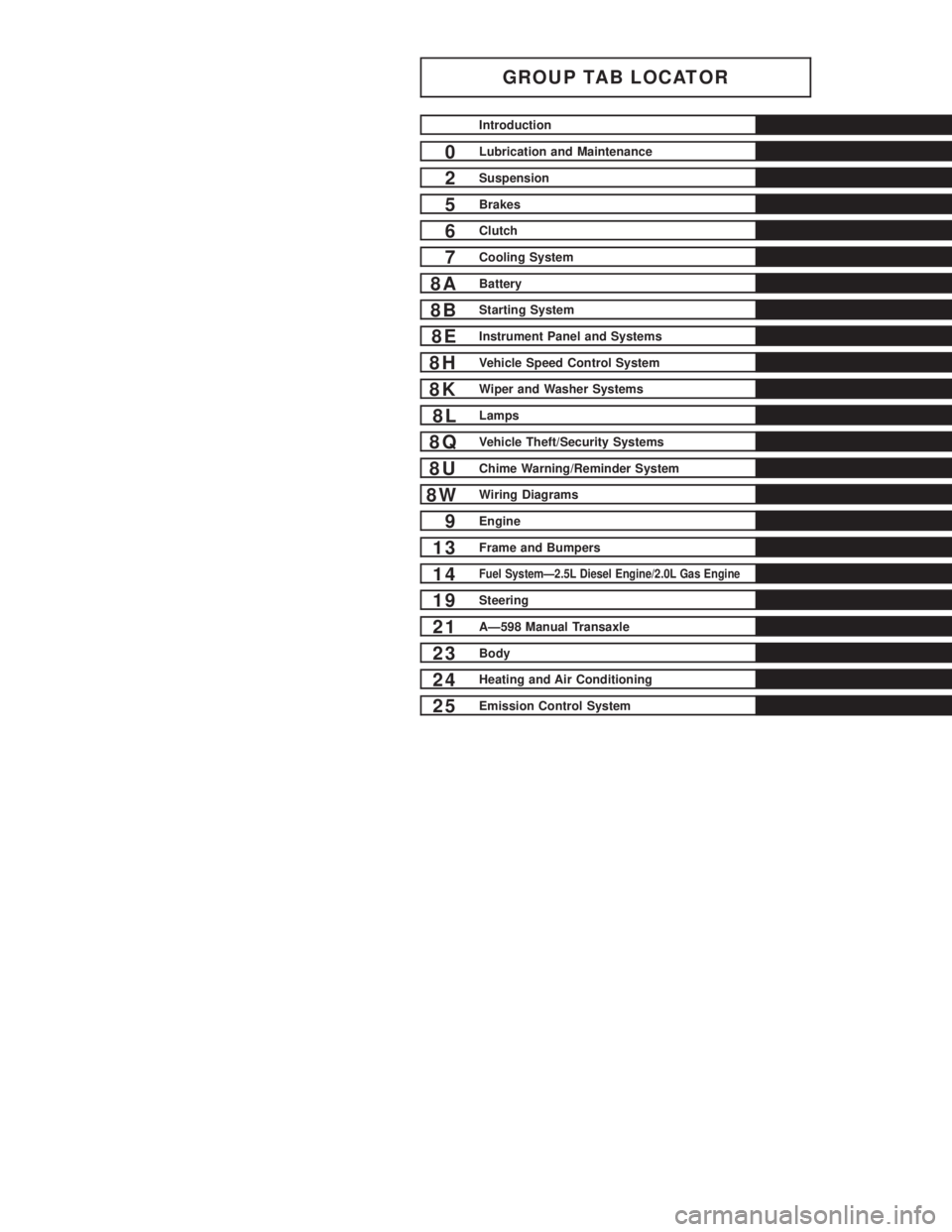
GROUP TAB LOCATOR
Introduction
0Lubrication and Maintenance
2Suspension
5Brakes
6Clutch
7Cooling System
8ABattery
8BStarting System
8EInstrument Panel and Systems
8HVehicle Speed Control System
8KWiper and Washer Systems
8LLamps
8QVehicle Theft/Security Systems
8UChime Warning/Reminder System
8WWiring Diagrams
9Engine
13Frame and Bumpers
14Fuel SystemÐ2.5L Diesel Engine/2.0L Gas Engine
19Steering
21AÐ598 Manual Transaxle
23Body
24Heating and Air Conditioning
25Emission Control System
Page 18 of 1938
ENGINE OIL
SAE VISCOSITY RATING INDICATES ENGINE OIL VISCOSITY
An SAE viscosity grade is used to specify the vis-
cosity of engine oil. SAE 30 specifies a single viscos-
ity engine oil. Engine oils also have multiple
viscosities. These are specified with a dual SAE vis-
cosity grade which indicates the cold-to-hot tempera-
ture viscosity range.
²SAE 30 = single grade engine oil.
²SAE 10W-30 = multiple grade engine oil.
API QUALITY CLASSIFICATION
The API Service Grade specifies the type of perfor-
mance the engine oil is intended to provide. The API
Service Grade specifications also apply to energy con-
serving engine oils.
Use engine oils that are API Service Certified.
5W-30 and 10W-30 MOPAR engine oils conform to
specifications.
Refer to Group 9, Engine for engine oil specifica-
tion.
GEAR LUBRICANTS
SAE ratings also apply to multiple grade gear
lubricants. In addition, API classification defines the
lubricants usage.LUBRICANTS AND GREASES
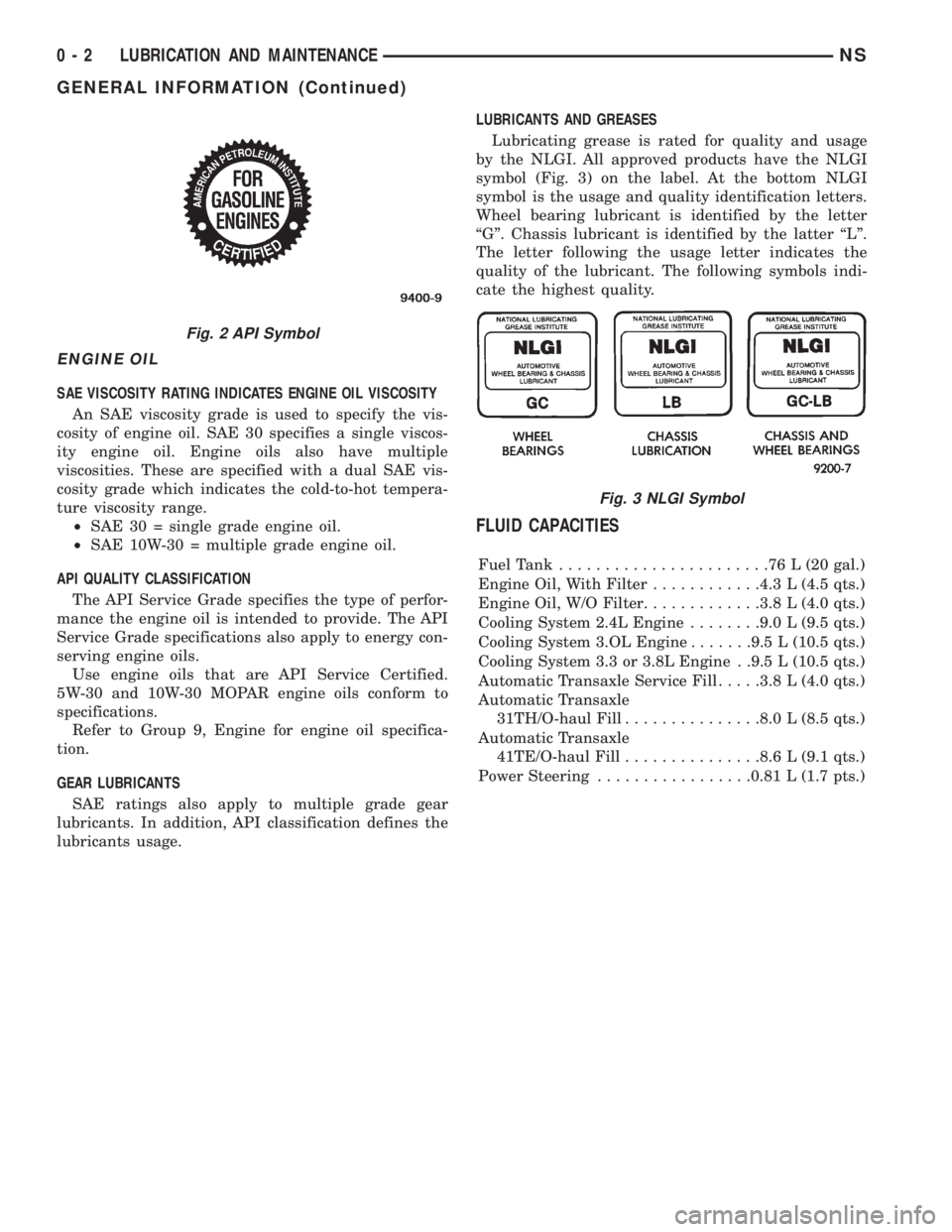
Lubricating grease is rated for quality and usage
by the NLGI. All approved products have the NLGI
symbol (Fig. 3) on the label. At the bottom NLGI
symbol is the usage and quality identification letters.
Wheel bearing lubricant is identified by the letter
ªGº. Chassis lubricant is identified by the latter ªLº.
The letter following the usage letter indicates the
quality of the lubricant. The following symbols indi-
cate the highest quality.
FLUID CAPACITIES
Fuel Tank.......................76L(20gal.)
Engine Oil, With Filter............4.3 L (4.5 qts.)
Engine Oil, W/O Filter.............3.8 L (4.0 qts.)
Cooling System 2.4L Engine........9.0 L (9.5 qts.)
Cooling System 3.OL Engine.......9.5 L (10.5 qts.)
Cooling System 3.3 or 3.8L Engine . .9.5 L (10.5 qts.)
Automatic Transaxle Service Fill.....3.8 L (4.0 qts.)
Automatic Transaxle
31TH/O-haul Fill...............8.0 L (8.5 qts.)
Automatic Transaxle
41TE/O-haul Fill...............8.6 L (9.1 qts.)
Power Steering.................0.81 L (1.7 pts.)
Fig. 2 API Symbol
Fig. 3 NLGI Symbol
0 - 2 LUBRICATION AND MAINTENANCENS
GENERAL INFORMATION (Continued)
Page 27 of 1938
LUBRICATION AND MAINTENANCE
CONTENTS
page page
GENERAL INFORMATION.................. 1
JUMP STARTING, HOISTING AND TOWING . . . 5MAINTENANCE SCHEDULES............... 2
GENERAL INFORMATION
INDEX
page page
GENERAL INFORMATION
ENGINE OIL Ð GASOLINE ENGINES........ 1
ENGINE OILÐDIESEL ENGINES............ 1FLUID CAPACITIES...................... 1
MANUAL TRANSMISSION FLUID
(A-558 and A-598 Models)................ 1
GENERAL INFORMATION
ENGINE OIL Ð GASOLINE ENGINES
Use only oils conforming to API (American Petro-
leum Institute) Quality SJ and Energy Conserving II,
or SH and Energy Conserving II, or ACEA A1±96.
SAE VISCOSITY GRADE
To assure of properly formulated engine oils, it is
recommended that SAE Grade 5W-30 engine oils that
meet Chrysler material standard MS-6395, be used.
SAE Grade 10W-30 oils are also acceptable when the
temperatures do not fall below 0ÉC. In areas where
these grades are not generally available, higher SAE
grades may be used.
Lubricants which have both an SAE grade number
and the proper API service classification shown on
the container should be used.
ENGINE OILÐDIESEL ENGINES
Use only Diesel Engine Oil meeting standardMIL-
2104Cor API ClassificationSG/CDorCCMC PD2.
SAE VISCOSITY GRADE
CAUTION: Low viscosity oils must have the proper
API quality or the CCMC G5 designation.
To assure of properly formulated engine oils, it is recom-
mended that SAE Grade 15W-40 engine oils that meet
Chrysler material standard MS-6395, be used. European
Grade 10W-40 oils are also acceptable.
Oils of the SAE 5W-30 or 10W-30 grade number
are preferred when minimum temperatures consis-
tently fall below -12ÉC.
MANUAL TRANSMISSION FLUID (A-558 and A-598
Models)
Use only SAE 10W-40 engine oils carrying the
European CCMC-G5 classification to fill the A-598
5±speed manual transmission.
FLUID CAPACITIES
Fuel Tank.............................76L
2.0L Gasoline Engine Oil with Filter........4.3L
2.5L VM Diesel Engine Oil With Filter......6.5L
2.0L Gasoline Engine Cooling System*.......6.0L
2.5L VM Diesel Engine Cooling System*....10.0 L
TransmissionÐ5-Speed Manual............2.2L
* Includes heater and coolant recovery tank filled
to Max level. Add 2.76L if equipped with Rear
Heater.
NS/GSLUBRICATION AND MAINTENANCE 0 - 1
Page 215 of 1938
COOLING SYSTEM
CONTENTS
page page
GENERAL INFORMATION
ACCESSORY DRIVE BELTS................ 1
AUTOMATIC TRANSMISSION OIL COOLERÐ
2.4L................................. 3
COOLANT RECOVERY SYSTEM (CRS)....... 3
COOLANT.............................. 3
COOLING SYSTEM....................... 2
ENGINE BLOCK HEATER.................. 5
ENGINE THERMOSTAT.................... 3
RADIATOR PRESSURE CAP................ 4
RADIATOR............................. 3
WATER PUMPS......................... 3
DESCRIPTION AND OPERATION
COOLANT PERFORMANCE................. 6
RADIATOR HOSES AND CLAMPS........... 6
WATER PIPESÐ3.0L ENGINE.............. 6
WATER PUMPÐ3.3/3.8L ENGINES.......... 7
WATER PUMPÐ2.4L ENGINE.............. 6
WATER PUMPÐ3.0L ENGINE.............. 6
DIAGNOSIS AND TESTING
ACCESSORY DRIVE BELT.................. 7
COOLING SYSTEM DIAGNOSIS............. 8
DEAERATION.......................... 16
ELECTRIC FAN MOTOR TEST.............. 14
LOW COOLANT LEVEL AERATION.......... 15
PRESSURE TESTING RADIATOR CAP....... 15
RADIATOR CAP TO FILLER NECK SEAL
PRESSURE RELIEF CHECK.............. 15
RADIATOR COOLANT FLOW TEST.......... 14
RADIATOR FAN CONTROL................ 14
TEMPERATURE GAUGE INDICATION........ 16
TESTING COOLING SYSTEM FOR LEAKS.... 14
SERVICE PROCEDURES
COOLANT LEVEL CHECKÐROUTINE........ 16
COOLANT LEVEL SERVICE................ 16COOLANTÐADDING ADDITIONAL.......... 16
COOLING SYSTEMÐDRAINING............ 16
COOLING SYSTEMÐREFILLING........... 16
REMOVAL AND INSTALLATION
ACCESSORY DRIVE BELTSÐ2.4L.......... 23
ACCESSORY DRIVE BELTSÐ3.0L.......... 24
ACCESSORY DRIVE BELTÐ3.3/3.8L........ 24
ENGINE BLOCK HEATER................. 23
FAN MODULE.......................... 22
RADIATOR DRAINCOCK.................. 21
RADIATOR............................ 21
THERMOSTATÐ2.4L ENGINE............. 19
THERMOSTATÐ3.0L ENGINE............. 20
THERMOSTATÐ3.3/3.8L ENGINES......... 20
WATER PUMP INLET TUBEÐ2.4L ENGINE . . . 17
WATER PUMPÐ3.3/3.8L ENGINES......... 19
WATER PUMPÐ2.4L ENGINE............ 17
WATER PUMPÐ3.0L ENGINE............. 18
CLEANING AND INSPECTION
ACCESSORY DRIVE BELT................. 25
CHEMICAL CLEANING................... 25
COOLING SYSTEM CLEANING............. 25
RADIATOR PRESSURE CAP............... 25
REVERSE FLUSHING THE ENGINE......... 25
REVERSE FLUSHING THE RADIATOR....... 25
WATER PUMP......................... 24
ADJUSTMENTS
BELT TENSION CHART................... 26
BELT TENSION GAUGE METHOD........... 26
PROPER BELT TENSION................. 25
SPECIFICATIONS
COOLING SYSTEM CAPACITY............. 26
TORQUE CHART........................ 26
SPECIAL TOOLS
COOLING............................. 26
GENERAL INFORMATION
ACCESSORY DRIVE BELTS
The accessory drive system utilizes two different
style of drive belts. The conventional V-belt and the
Poly-V belt are used to drive the generator, air con-
ditioning compressor, power steering pump and waterpump. Satisfactory performance of these belts
depends on belt condition and proper belt tension.
Belt tensioning should be performed with the aid of a
Burroughs gauge Special Tool C-4162. Because of
space limitations in the engine compartment, the use
of the gauge may be restricted. Raise the vehicle on a
hoist and then remove the splash shield to gain
access to the drive belts.
NSCOOLING SYSTEM 7 - 1
Page 216 of 1938
COOLING SYSTEM
The cooling system has a radiator, coolant, electric fan
motor, shroud, pressure cap, thermostat, coolant reserve
system, transmission oil cooler, a water pump to circulate
the coolant, hoses, and clamps to complete the circuit.
²When Engine is cold: thermostat is closed, cool-
ing system has no flow through the radiator. The
coolant bypass flows through the engine only.
²
When Engine is warm: thermostat is open, cooling
system has bypass flow and coolant flow through radia-
tor.
Its primary purpose is to maintain engine temper-
ature in a range that will provide satisfactory engine
performance and emission levels under all expected
driving conditions. It also provides hot water (cool-
ant) for heater performance and cooling for automatic
transmission oil. It does this by transferring heat
from engine metal to coolant, moving this heated
coolant to the radiator, and then transferring this
heat to the ambient air.
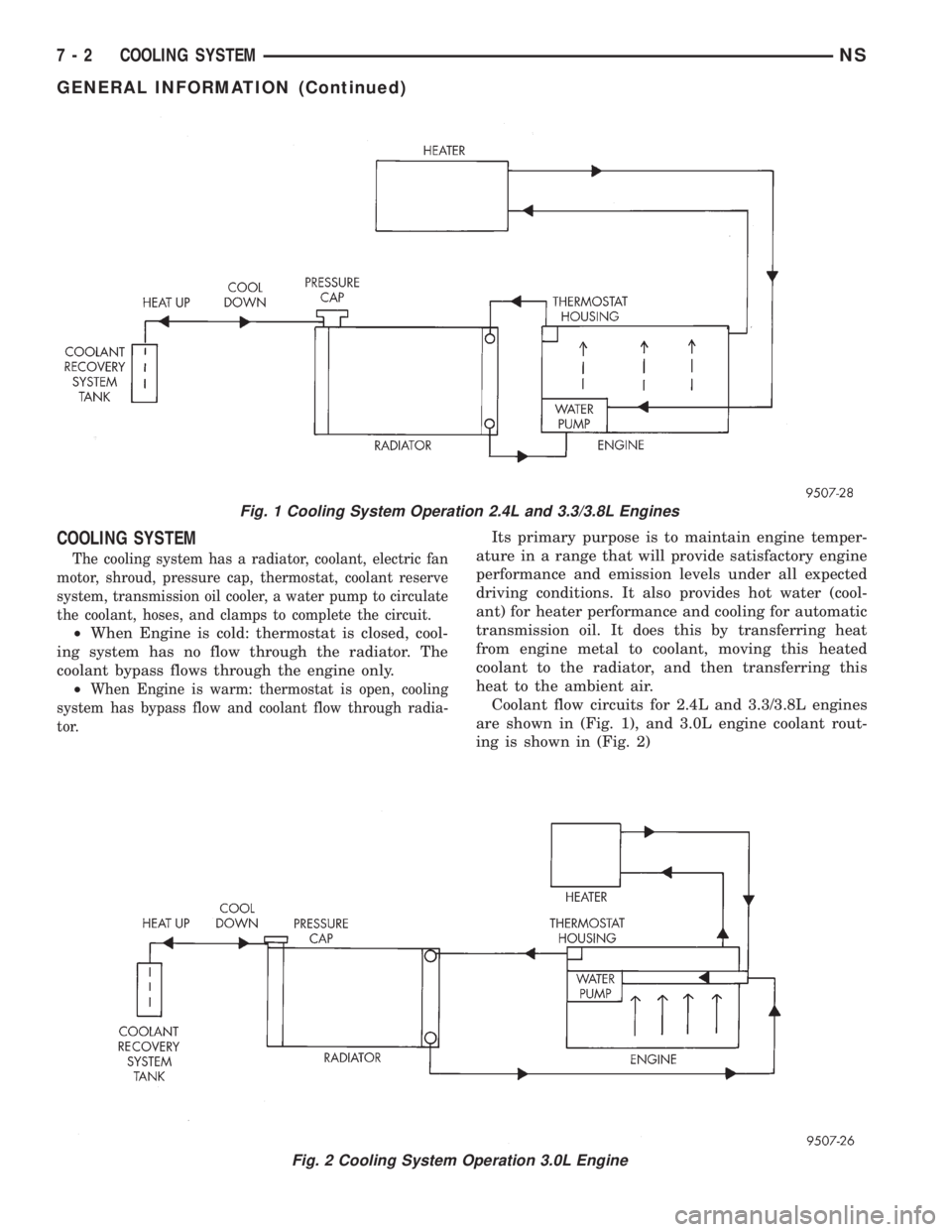
Coolant flow circuits for 2.4L and 3.3/3.8L engines
are shown in (Fig. 1), and 3.0L engine coolant rout-
ing is shown in (Fig. 2)
Fig. 1 Cooling System Operation 2.4L and 3.3/3.8L Engines
Fig. 2 Cooling System Operation 3.0L Engine
7 - 2 COOLING SYSTEMNS
GENERAL INFORMATION (Continued)
Page 217 of 1938
COOLANT RECOVERY SYSTEM (CRS)
This system works with the radiator pressure cap
to use thermal expansion and contraction of the cool-
ant to keep the coolant free of trapped air. Provides a
convenient and safe method for checking coolant
level and adjusting level at atmospheric pressure
without removing the radiator pressure cap. It also
provides some reserve coolant to cover deaeration
and evaporation or boiling losses. All vehicles are
equipped with this system and take various shapes
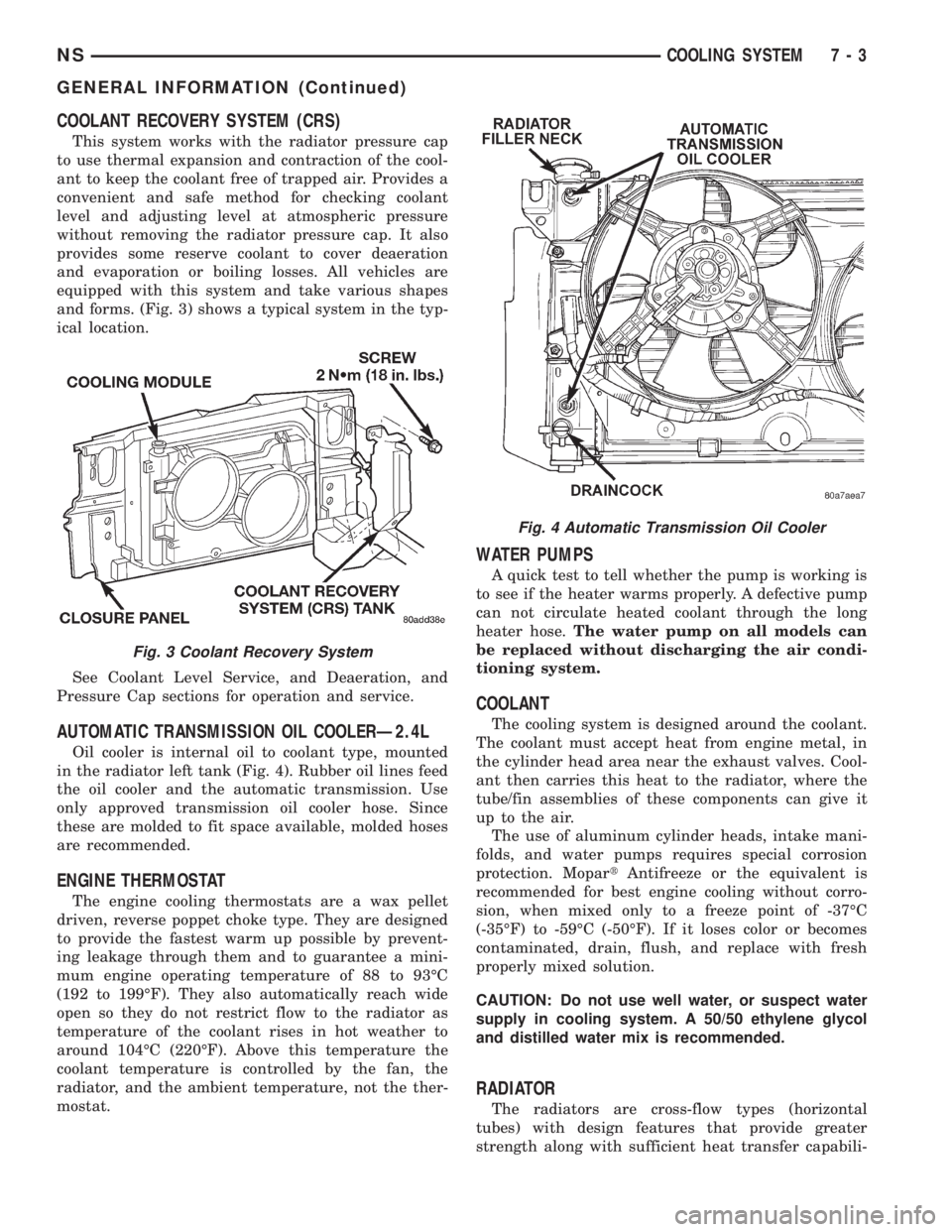
and forms. (Fig. 3) shows a typical system in the typ-
ical location.
See Coolant Level Service, and Deaeration, and
Pressure Cap sections for operation and service.
AUTOMATIC TRANSMISSION OIL COOLERÐ2.4L
Oil cooler is internal oil to coolant type, mounted
in the radiator left tank (Fig. 4). Rubber oil lines feed
the oil cooler and the automatic transmission. Use
only approved transmission oil cooler hose. Since
these are molded to fit space available, molded hoses
are recommended.
ENGINE THERMOSTAT
The engine cooling thermostats are a wax pellet
driven, reverse poppet choke type. They are designed
to provide the fastest warm up possible by prevent-
ing leakage through them and to guarantee a mini-
mum engine operating temperature of 88 to 93ÉC
(192 to 199ÉF). They also automatically reach wide
open so they do not restrict flow to the radiator as
temperature of the coolant rises in hot weather to
around 104ÉC (220ÉF). Above this temperature the
coolant temperature is controlled by the fan, the
radiator, and the ambient temperature, not the ther-
mostat.
WATER PUMPS
A quick test to tell whether the pump is working is
to see if the heater warms properly. A defective pump
can not circulate heated coolant through the long
heater hose.The water pump on all models can
be replaced without discharging the air condi-
tioning system.
COOLANT
The cooling system is designed around the coolant.
The coolant must accept heat from engine metal, in
the cylinder head area near the exhaust valves. Cool-
ant then carries this heat to the radiator, where the
tube/fin assemblies of these components can give it
up to the air.
The use of aluminum cylinder heads, intake mani-
folds, and water pumps requires special corrosion
protection. MopartAntifreeze or the equivalent is
recommended for best engine cooling without corro-
sion, when mixed only to a freeze point of -37ÉC
(-35ÉF) to -59ÉC (-50ÉF). If it loses color or becomes
contaminated, drain, flush, and replace with fresh
properly mixed solution.
CAUTION: Do not use well water, or suspect water
supply in cooling system. A 50/50 ethylene glycol
and distilled water mix is recommended.
RADIATOR
The radiators are cross-flow types (horizontal
tubes) with design features that provide greater
strength along with sufficient heat transfer capabili-
Fig. 3 Coolant Recovery System
Fig. 4 Automatic Transmission Oil Cooler
NSCOOLING SYSTEM 7 - 3
GENERAL INFORMATION (Continued)
Page 218 of 1938
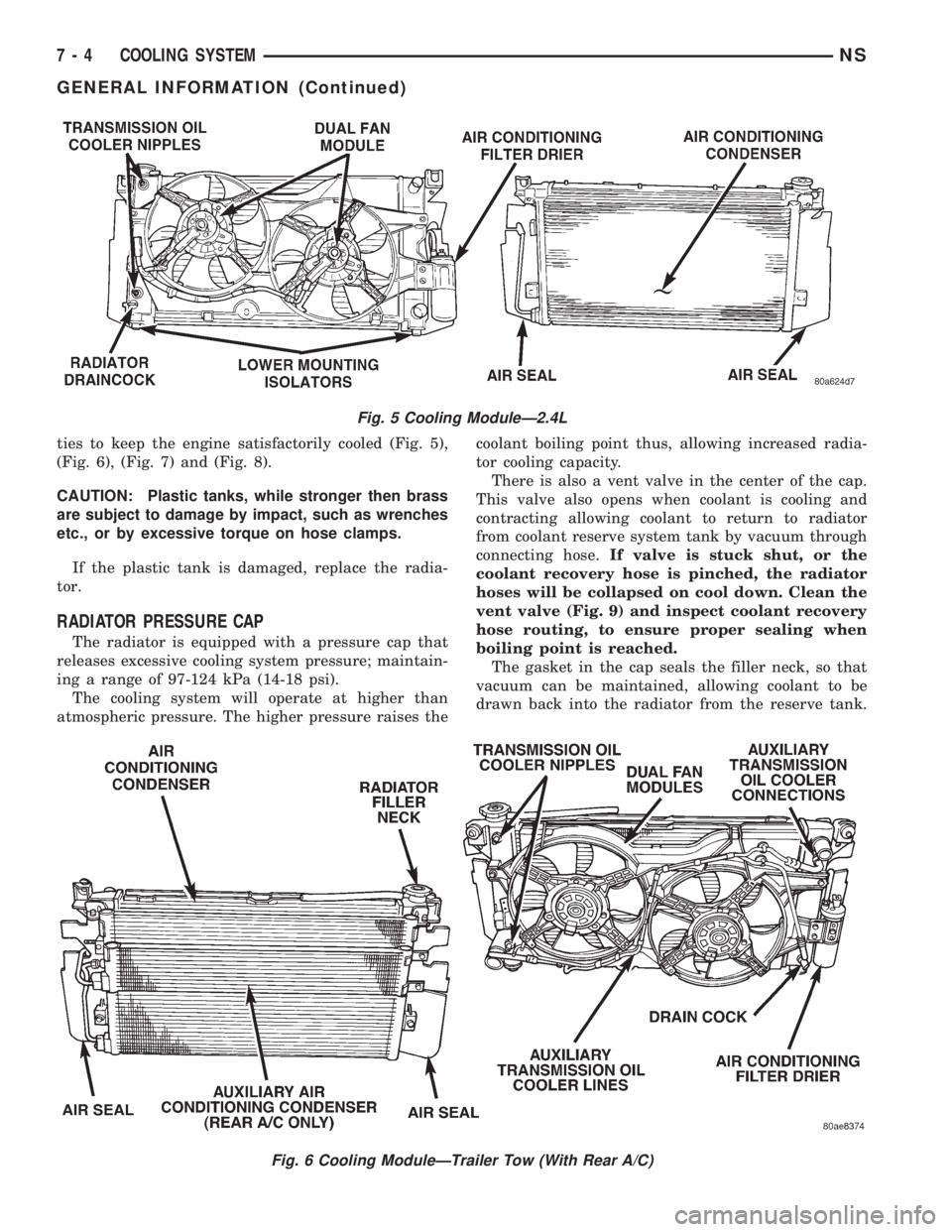
ties to keep the engine satisfactorily cooled (Fig. 5),
(Fig. 6), (Fig. 7) and (Fig. 8).
CAUTION: Plastic tanks, while stronger then brass
are subject to damage by impact, such as wrenches
etc., or by excessive torque on hose clamps.
If the plastic tank is damaged, replace the radia-
tor.
RADIATOR PRESSURE CAP
The radiator is equipped with a pressure cap that
releases excessive cooling system pressure; maintain-
ing a range of 97-124 kPa (14-18 psi).
The cooling system will operate at higher than
atmospheric pressure. The higher pressure raises thecoolant boiling point thus, allowing increased radia-
tor cooling capacity.
There is also a vent valve in the center of the cap.
This valve also opens when coolant is cooling and
contracting allowing coolant to return to radiator
from coolant reserve system tank by vacuum through
connecting hose.If valve is stuck shut, or the
coolant recovery hose is pinched, the radiator
hoses will be collapsed on cool down. Clean the
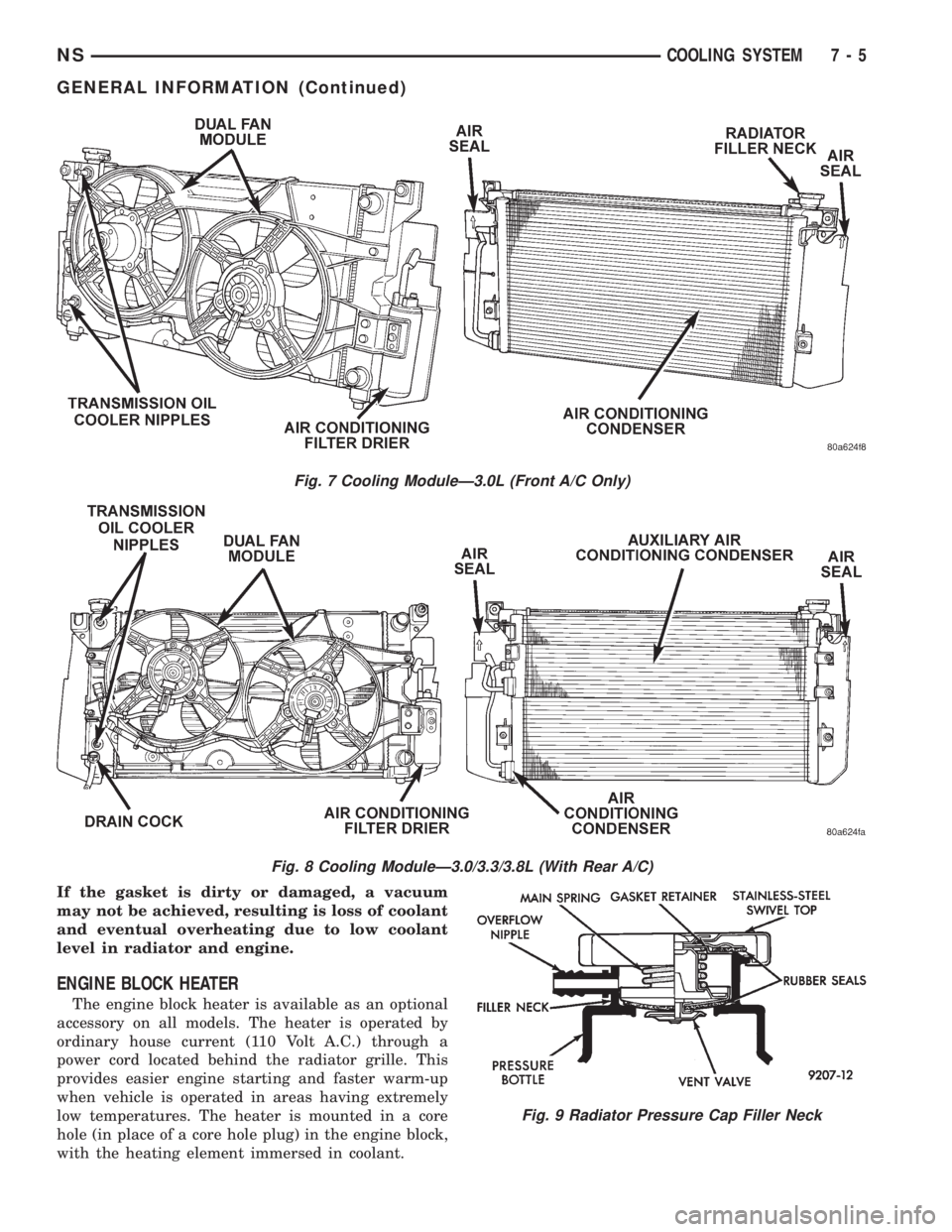
vent valve (Fig. 9) and inspect coolant recovery
hose routing, to ensure proper sealing when
boiling point is reached.
The gasket in the cap seals the filler neck, so that
vacuum can be maintained, allowing coolant to be
drawn back into the radiator from the reserve tank.
Fig. 5 Cooling ModuleÐ2.4L
Fig. 6 Cooling ModuleÐTrailer Tow (With Rear A/C)
7 - 4 COOLING SYSTEMNS
GENERAL INFORMATION (Continued)
Page 219 of 1938
If the gasket is dirty or damaged, a vacuum
may not be achieved, resulting is loss of coolant
and eventual overheating due to low coolant
level in radiator and engine.
ENGINE BLOCK HEATER
The engine block heater is available as an optional
accessory on all models. The heater is operated by
ordinary house current (110 Volt A.C.) through a
power cord located behind the radiator grille. This
provides easier engine starting and faster warm-up
when vehicle is operated in areas having extremely
low temperatures. The heater is mounted in a core
hole (in place of a core hole plug) in the engine block,
with the heating element immersed in coolant.
Fig. 7 Cooling ModuleÐ3.0L (Front A/C Only)
Fig. 8 Cooling ModuleÐ3.0/3.3/3.8L (With Rear A/C)
Fig. 9 Radiator Pressure Cap Filler Neck
NSCOOLING SYSTEM 7 - 5
GENERAL INFORMATION (Continued)
Page 220 of 1938
DESCRIPTION AND OPERATION
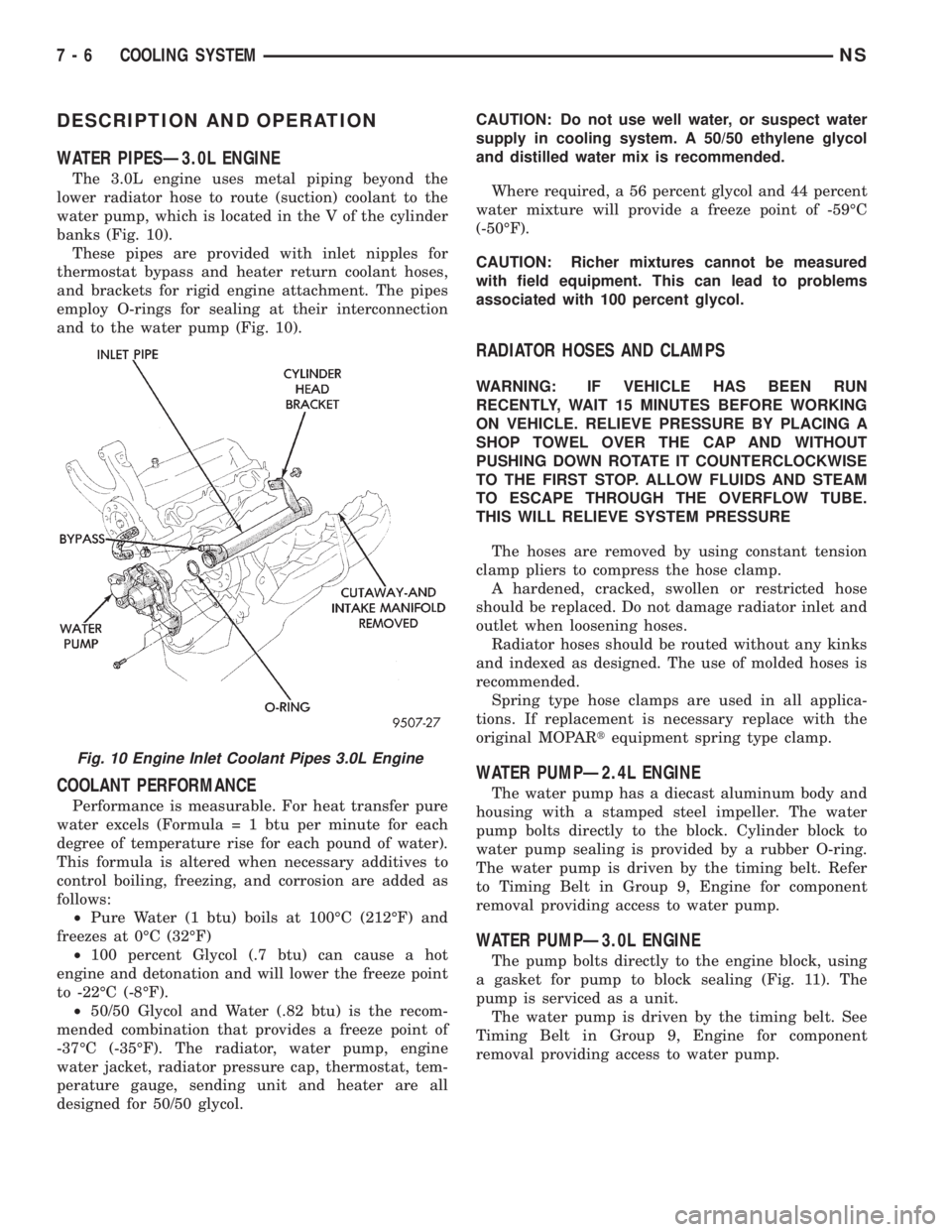
WATER PIPESÐ3.0L ENGINE
The 3.0L engine uses metal piping beyond the
lower radiator hose to route (suction) coolant to the
water pump, which is located in the V of the cylinder
banks (Fig. 10).
These pipes are provided with inlet nipples for
thermostat bypass and heater return coolant hoses,
and brackets for rigid engine attachment. The pipes
employ O-rings for sealing at their interconnection
and to the water pump (Fig. 10).
COOLANT PERFORMANCE
Performance is measurable. For heat transfer pure
water excels (Formula = 1 btu per minute for each
degree of temperature rise for each pound of water).
This formula is altered when necessary additives to
control boiling, freezing, and corrosion are added as
follows:
²Pure Water (1 btu) boils at 100ÉC (212ÉF) and
freezes at 0ÉC (32ÉF)
²100 percent Glycol (.7 btu) can cause a hot
engine and detonation and will lower the freeze point
to -22ÉC (-8ÉF).
²50/50 Glycol and Water (.82 btu) is the recom-
mended combination that provides a freeze point of
-37ÉC (-35ÉF). The radiator, water pump, engine
water jacket, radiator pressure cap, thermostat, tem-
perature gauge, sending unit and heater are all
designed for 50/50 glycol.CAUTION: Do not use well water, or suspect water
supply in cooling system. A 50/50 ethylene glycol
and distilled water mix is recommended.
Where required, a 56 percent glycol and 44 percent
water mixture will provide a freeze point of -59ÉC
(-50ÉF).
CAUTION: Richer mixtures cannot be measured
with field equipment. This can lead to problems
associated with 100 percent glycol.
RADIATOR HOSES AND CLAMPS
WARNING: IF VEHICLE HAS BEEN RUN
RECENTLY, WAIT 15 MINUTES BEFORE WORKING
ON VEHICLE. RELIEVE PRESSURE BY PLACING A
SHOP TOWEL OVER THE CAP AND WITHOUT
PUSHING DOWN ROTATE IT COUNTERCLOCKWISE
TO THE FIRST STOP. ALLOW FLUIDS AND STEAM
TO ESCAPE THROUGH THE OVERFLOW TUBE.
THIS WILL RELIEVE SYSTEM PRESSURE
The hoses are removed by using constant tension
clamp pliers to compress the hose clamp.
A hardened, cracked, swollen or restricted hose
should be replaced. Do not damage radiator inlet and
outlet when loosening hoses.
Radiator hoses should be routed without any kinks
and indexed as designed. The use of molded hoses is
recommended.
Spring type hose clamps are used in all applica-
tions. If replacement is necessary replace with the
original MOPARtequipment spring type clamp.
WATER PUMPÐ2.4L ENGINE
The water pump has a diecast aluminum body and
housing with a stamped steel impeller. The water
pump bolts directly to the block. Cylinder block to
water pump sealing is provided by a rubber O-ring.
The water pump is driven by the timing belt. Refer
to Timing Belt in Group 9, Engine for component
removal providing access to water pump.
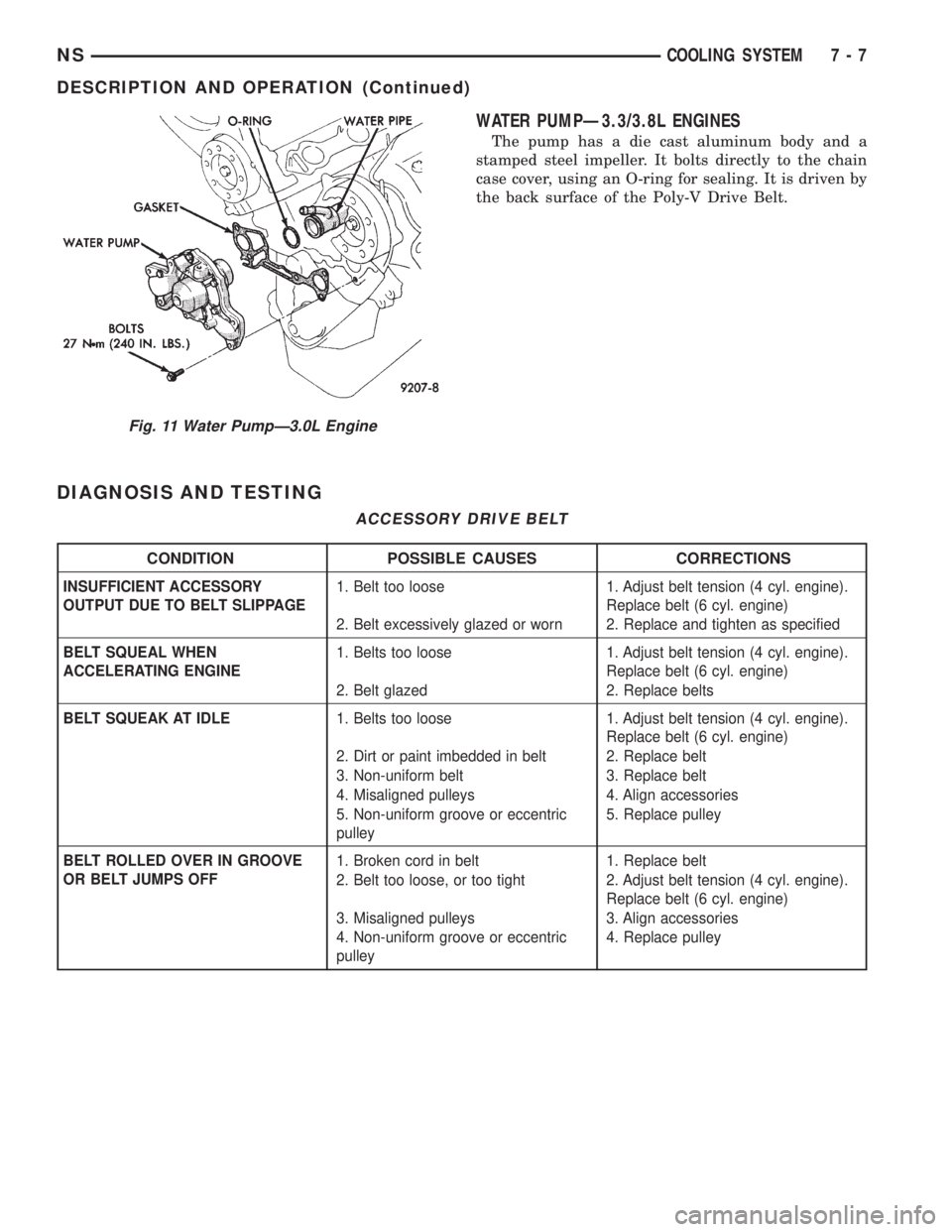
WATER PUMPÐ3.0L ENGINE
The pump bolts directly to the engine block, using
a gasket for pump to block sealing (Fig. 11). The
pump is serviced as a unit.
The water pump is driven by the timing belt. See
Timing Belt in Group 9, Engine for component
removal providing access to water pump.
Fig. 10 Engine Inlet Coolant Pipes 3.0L Engine
7 - 6 COOLING SYSTEMNS
Page 221 of 1938
WATER PUMPÐ3.3/3.8L ENGINES
The pump has a die cast aluminum body and a
stamped steel impeller. It bolts directly to the chain
case cover, using an O-ring for sealing. It is driven by
the back surface of the Poly-V Drive Belt.
DIAGNOSIS AND TESTING
Fig. 11 Water PumpÐ3.0L Engine
ACCESSORY DRIVE BELT
CONDITION POSSIBLE CAUSES CORRECTIONS
INSUFFICIENT ACCESSORY
OUTPUT DUE TO BELT SLIPPAGE1. Belt too loose 1. Adjust belt tension (4 cyl. engine).
Replace belt (6 cyl. engine)
2. Belt excessively glazed or worn 2. Replace and tighten as specified
BELT SQUEAL WHEN
ACCELERATING ENGINE1. Belts too loose 1. Adjust belt tension (4 cyl. engine).
Replace belt (6 cyl. engine)
2. Belt glazed 2. Replace belts
BELT SQUEAK AT IDLE1. Belts too loose 1. Adjust belt tension (4 cyl. engine).
Replace belt (6 cyl. engine)
2. Dirt or paint imbedded in belt 2. Replace belt
3. Non-uniform belt 3. Replace belt
4. Misaligned pulleys 4. Align accessories
5. Non-uniform groove or eccentric
pulley5. Replace pulley
BELT ROLLED OVER IN GROOVE
OR BELT JUMPS OFF1. Broken cord in belt 1. Replace belt
2. Belt too loose, or too tight 2. Adjust belt tension (4 cyl. engine).
Replace belt (6 cyl. engine)
3. Misaligned pulleys 3. Align accessories
4. Non-uniform groove or eccentric
pulley4. Replace pulley
NSCOOLING SYSTEM 7 - 7
DESCRIPTION AND OPERATION (Continued)