four wheel drive CHRYSLER VOYAGER 1996 Service Manual
[x] Cancel search | Manufacturer: CHRYSLER, Model Year: 1996, Model line: VOYAGER, Model: CHRYSLER VOYAGER 1996Pages: 1938, PDF Size: 55.84 MB
Page 24 of 1938
DISCONNECT CABLE CLAMPS AS FOLLOWS:
²Disconnect BLACK cable clamp from engine
ground on disabled vehicle.
²When using a Booster vehicle, disconnect
BLACK cable clamp from battery negative terminal.
Disconnect RED cable clamp from battery positive
terminal.
²Disconnect RED cable clamp from battery posi-
tive terminal on disabled vehicle.
TOWING RECOMMENDATIONS
WARNINGS AND CAUTIONS
WARNING: DO NOT ALLOW TOWING ATTACH-
MENT DEVICES TO CONTACT THE FUEL TANK OR
LINES, FUEL LEAK CAN RESULT.
DO NOT LIFT OR TOW VEHICLE BY FRONT OR
REAR BUMPER, OR BUMPER ENERGY ABSORBER
UNITS.
DO NOT GO UNDER A LIFTED VEHICLE IF NOT
SUPPORTED PROPERLY ON SAFETY STANDS.
DO NOT ALLOW PASSENGERS TO RIDE IN A
TOWED VEHICLE.
USE A SAFETY CHAIN THAT IS INDEPENDENT
FROM THE TOWING ATTACHMENT DEVICE.
CAUTION: Do not damage brake lines, exhaust sys-
tem, shock absorbers, sway bars, or any other
under vehicle components when attaching towing
device to vehicle.
Do not attach towing device to front or rear sus-
pension components.
Do not secure vehicle to towing device by the use
of front or rear suspension or steering components.
Remove or secure loose or protruding objects
from a damaged vehicle before towing.
Refer to state and local rules and regulations
before towing a vehicle.
Do not allow weight of towed vehicle to bear on
lower fascia, air dams, or spoilers.
RECOMMENDED TOWING EQUIPMENT
To avoid damage to bumper fascia and air dams
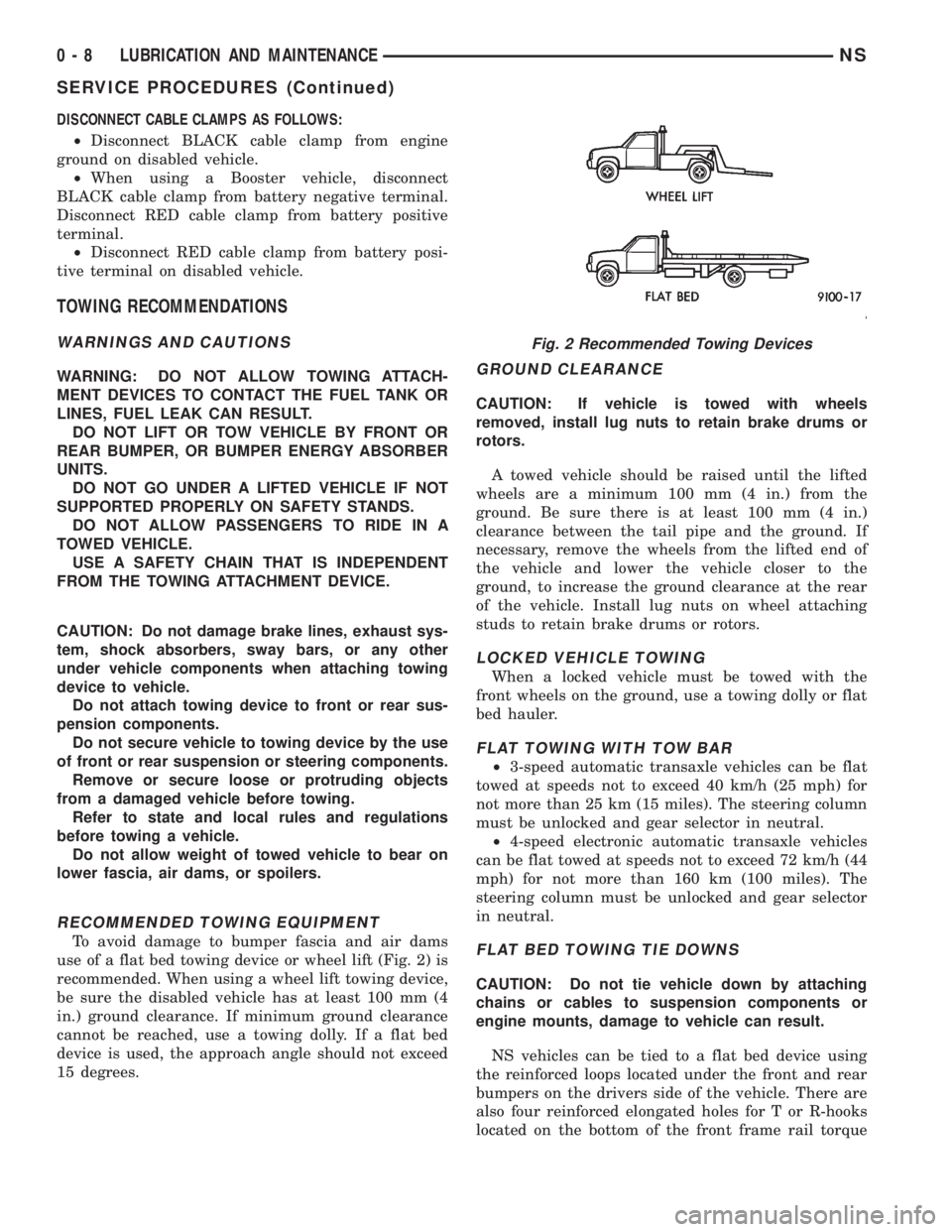
use of a flat bed towing device or wheel lift (Fig. 2) is
recommended. When using a wheel lift towing device,
be sure the disabled vehicle has at least 100 mm (4
in.) ground clearance. If minimum ground clearance
cannot be reached, use a towing dolly. If a flat bed
device is used, the approach angle should not exceed
15 degrees.
GROUND CLEARANCE
CAUTION: If vehicle is towed with wheels
removed, install lug nuts to retain brake drums or
rotors.
A towed vehicle should be raised until the lifted
wheels are a minimum 100 mm (4 in.) from the
ground. Be sure there is at least 100 mm (4 in.)
clearance between the tail pipe and the ground. If
necessary, remove the wheels from the lifted end of
the vehicle and lower the vehicle closer to the
ground, to increase the ground clearance at the rear
of the vehicle. Install lug nuts on wheel attaching
studs to retain brake drums or rotors.
LOCKED VEHICLE TOWING
When a locked vehicle must be towed with the
front wheels on the ground, use a towing dolly or flat
bed hauler.
FLAT TOWING WITH TOW BAR
²3-speed automatic transaxle vehicles can be flat
towed at speeds not to exceed 40 km/h (25 mph) for
not more than 25 km (15 miles). The steering column
must be unlocked and gear selector in neutral.
²4-speed electronic automatic transaxle vehicles
can be flat towed at speeds not to exceed 72 km/h (44
mph) for not more than 160 km (100 miles). The
steering column must be unlocked and gear selector
in neutral.
FLAT BED TOWING TIE DOWNS
CAUTION: Do not tie vehicle down by attaching
chains or cables to suspension components or
engine mounts, damage to vehicle can result.
NS vehicles can be tied to a flat bed device using
the reinforced loops located under the front and rear
bumpers on the drivers side of the vehicle. There are
also four reinforced elongated holes for T or R-hooks
located on the bottom of the front frame rail torque
Fig. 2 Recommended Towing Devices
0 - 8 LUBRICATION AND MAINTENANCENS
SERVICE PROCEDURES (Continued)
Page 32 of 1938
NS vehicles can be tied to a flat bed device using
the reinforced loops located under the front and rear
bumpers on the drivers side of the vehicle. There are
also four reinforced elongated holes for T or R-hooks
located on the bottom of the front frame rail torque
boxes behind the front wheels and forward of the
rear wheels inboard of the rocker panel weld seam.
TOWINGÐFRONT WHEEL LIFT
Chrysler International recommends that a vehicle
be towed with the front end lifted, whenever possible.
A 90 cm (36 in.) length of 4x4 wood beam can be
placed between the wheel lift device and the bottom
of the fascia to prevent damage to vehicle during the
lifting operation. The beam can removed after lifting
the front of the vehicle.
TOWINGÐREAR WHEEL LIFT
If a vehicle cannot be towed with the front wheels
lifted, the rear wheels can be lifted provided the fol-
lowing guide lines are observed.
CAUTION: Do not use steering column lock to
secure steering wheel during towing operation.
²On AWD vehicles, all four wheels must be free to
rotate. Use towing dollies at unlifted end of vehicle.
²Unlock steering column and secure steering
wheel in straight ahead position with a clamp device
designed for towing.
²4-speed electronic automatic transaxle vehicles
can be flat towed at speeds not to exceed 72 km/h (44
mph) for not more than 160 km (100 miles). The
steering column must be unlocked and gear selector
in neutral.
TOWINGÐTOW HOOKS
WARNING: Do not use the tow hook to lift the vehi-
cle off the ground.
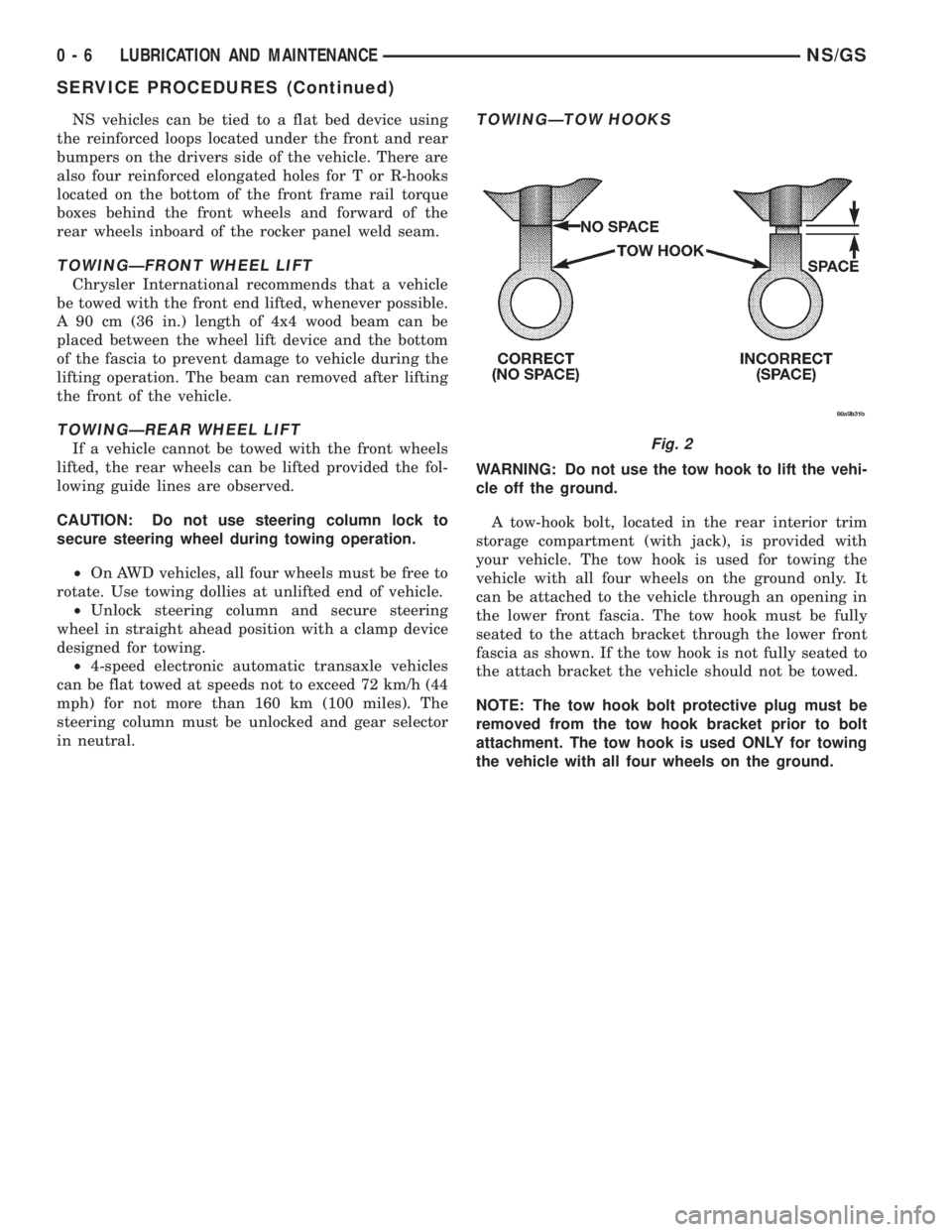
A tow-hook bolt, located in the rear interior trim
storage compartment (with jack), is provided with
your vehicle. The tow hook is used for towing the
vehicle with all four wheels on the ground only. It
can be attached to the vehicle through an opening in
the lower front fascia. The tow hook must be fully
seated to the attach bracket through the lower front
fascia as shown. If the tow hook is not fully seated to
the attach bracket the vehicle should not be towed.
NOTE: The tow hook bolt protective plug must be
removed from the tow hook bracket prior to bolt
attachment. The tow hook is used ONLY for towing
the vehicle with all four wheels on the ground.
Fig. 2
0 - 6 LUBRICATION AND MAINTENANCENS/GS
SERVICE PROCEDURES (Continued)
Page 42 of 1938
Mc PHERSON STRUT ASSEMBLY
The front suspension of the vehicle is supported by
coil springs positioned around the strut assembly.
The springs are contained between an upper seat,
located just below the top strut mount assembly and
a lower spring seat on the strut fluid reservoir.
The top of each strut assembly is bolted to the
upper fender reinforcement (strut tower) through a
rubber isolated mount.
The bottom of the strut assembly attaches to the
steering knuckle with two through bolts. Caster is a
fixed setting on all vehicles and is not adjustable
when an alignment is performed. In the event the
camber setting on a vehicle requires adjustment, a
service strut is available which will provide a method
by which the camber can be adjusted.
The strut assemblies on this vehicle are inter-con-
nected by the front stabilizer bar through 2 link
assemblies attaching the struts to the stabilizer bar.
STEERING KNUCKLE
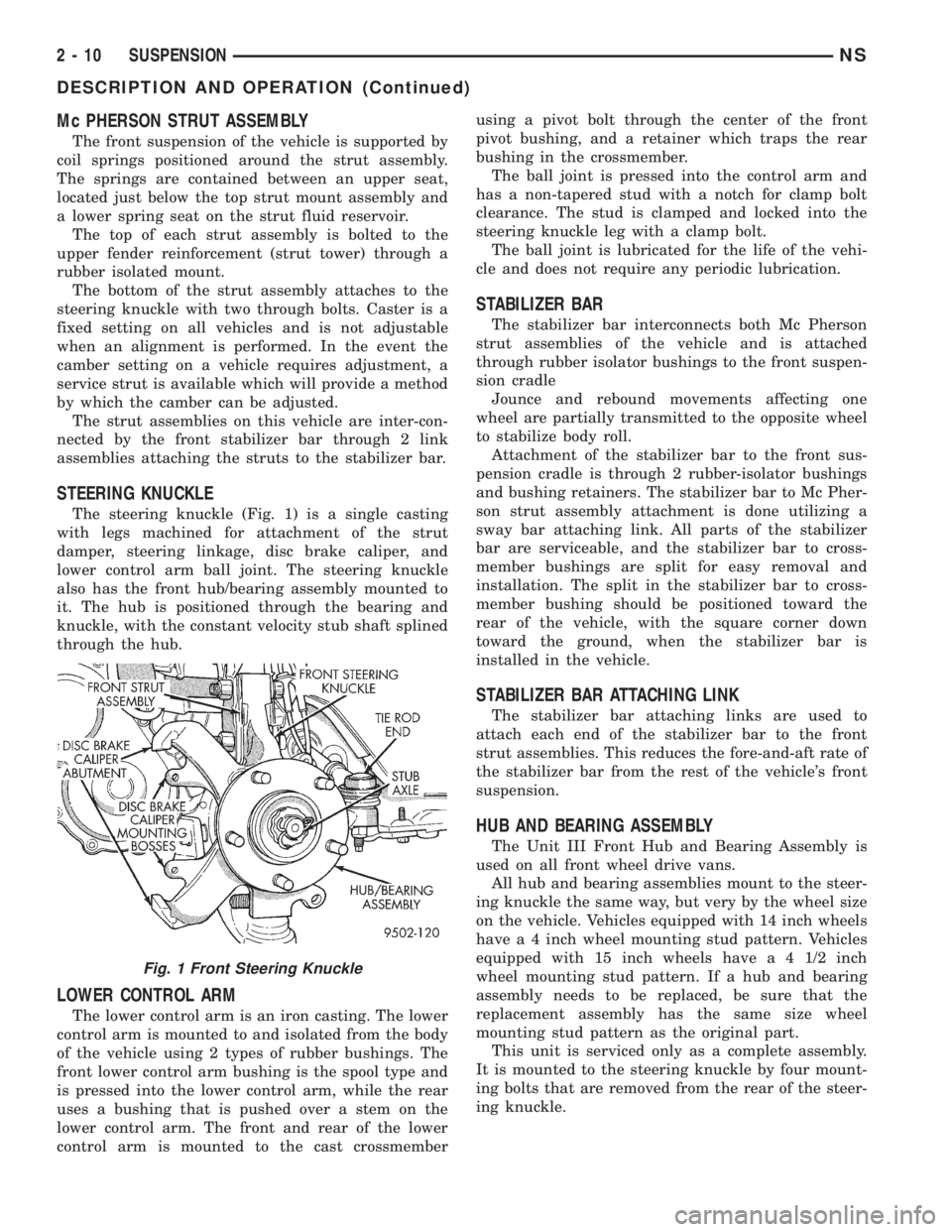
The steering knuckle (Fig. 1) is a single casting
with legs machined for attachment of the strut
damper, steering linkage, disc brake caliper, and
lower control arm ball joint. The steering knuckle
also has the front hub/bearing assembly mounted to
it. The hub is positioned through the bearing and
knuckle, with the constant velocity stub shaft splined
through the hub.
LOWER CONTROL ARM
The lower control arm is an iron casting. The lower
control arm is mounted to and isolated from the body
of the vehicle using 2 types of rubber bushings. The
front lower control arm bushing is the spool type and
is pressed into the lower control arm, while the rear
uses a bushing that is pushed over a stem on the
lower control arm. The front and rear of the lower
control arm is mounted to the cast crossmemberusing a pivot bolt through the center of the front
pivot bushing, and a retainer which traps the rear
bushing in the crossmember.
The ball joint is pressed into the control arm and
has a non-tapered stud with a notch for clamp bolt
clearance. The stud is clamped and locked into the
steering knuckle leg with a clamp bolt.
The ball joint is lubricated for the life of the vehi-
cle and does not require any periodic lubrication.
STABILIZER BAR
The stabilizer bar interconnects both Mc Pherson
strut assemblies of the vehicle and is attached
through rubber isolator bushings to the front suspen-
sion cradle
Jounce and rebound movements affecting one
wheel are partially transmitted to the opposite wheel
to stabilize body roll.
Attachment of the stabilizer bar to the front sus-
pension cradle is through 2 rubber-isolator bushings
and bushing retainers. The stabilizer bar to Mc Pher-
son strut assembly attachment is done utilizing a
sway bar attaching link. All parts of the stabilizer
bar are serviceable, and the stabilizer bar to cross-
member bushings are split for easy removal and
installation. The split in the stabilizer bar to cross-
member bushing should be positioned toward the
rear of the vehicle, with the square corner down
toward the ground, when the stabilizer bar is
installed in the vehicle.
STABILIZER BAR ATTACHING LINK
The stabilizer bar attaching links are used to
attach each end of the stabilizer bar to the front
strut assemblies. This reduces the fore-and-aft rate of
the stabilizer bar from the rest of the vehicle's front
suspension.
HUB AND BEARING ASSEMBLY
The Unit III Front Hub and Bearing Assembly is
used on all front wheel drive vans.
All hub and bearing assemblies mount to the steer-
ing knuckle the same way, but very by the wheel size
on the vehicle. Vehicles equipped with 14 inch wheels
have a 4 inch wheel mounting stud pattern. Vehicles
equipped with 15 inch wheels have a 4 1/2 inch
wheel mounting stud pattern. If a hub and bearing
assembly needs to be replaced, be sure that the
replacement assembly has the same size wheel
mounting stud pattern as the original part.
This unit is serviced only as a complete assembly.
It is mounted to the steering knuckle by four mount-
ing bolts that are removed from the rear of the steer-
ing knuckle.
Fig. 1 Front Steering Knuckle
2 - 10 SUSPENSIONNS
DESCRIPTION AND OPERATION (Continued)
Page 58 of 1938
CAUTION: Wheel bearing damage will result if
after loosening hub nut, vehicle is rolled on the
ground or the weight of the vehicle is allowed to be
supported by the tires.
(3) With the aid of a helper applying the brakes to
keep the front hub from turning,loosen but do not
removethe hub nut.The hub and driveshaft are
splined together through the knuckle (bearing)
and retained by the hub nut.
(4) Raise vehicle on jack stands or centered on a
frame contact type hoist. See Hoisting in the Lubri-
cation and Maintenance section of this manual, for
the required lifting procedure to be used for this
vehicle.
(5) Remove wheel lug nuts, and front tire and
wheel assembly.
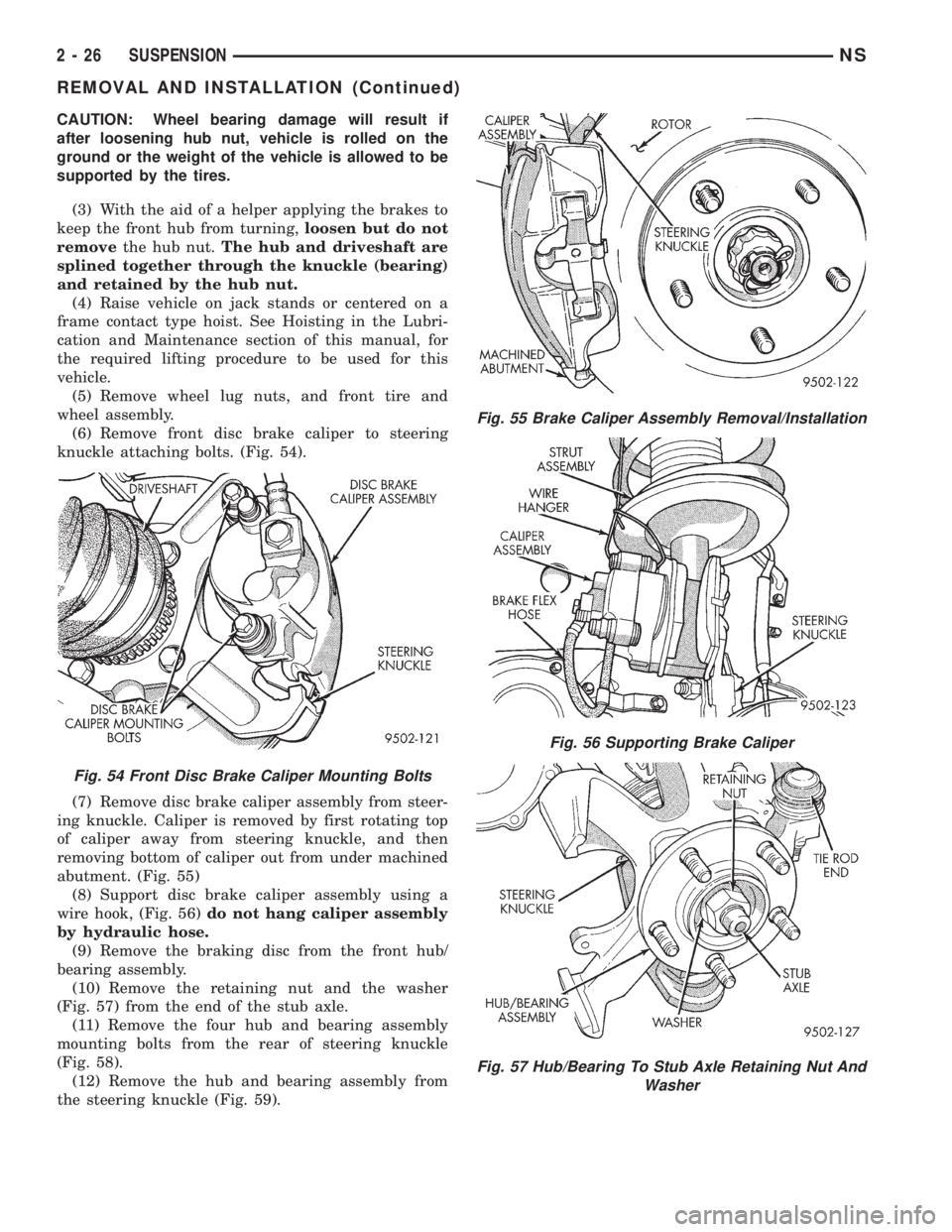
(6) Remove front disc brake caliper to steering
knuckle attaching bolts. (Fig. 54).
(7) Remove disc brake caliper assembly from steer-
ing knuckle. Caliper is removed by first rotating top
of caliper away from steering knuckle, and then
removing bottom of caliper out from under machined
abutment. (Fig. 55)
(8) Support disc brake caliper assembly using a
wire hook, (Fig. 56)do not hang caliper assembly
by hydraulic hose.
(9) Remove the braking disc from the front hub/
bearing assembly.
(10) Remove the retaining nut and the washer
(Fig. 57) from the end of the stub axle.
(11) Remove the four hub and bearing assembly
mounting bolts from the rear of steering knuckle
(Fig. 58).
(12) Remove the hub and bearing assembly from
the steering knuckle (Fig. 59).
Fig. 54 Front Disc Brake Caliper Mounting Bolts
Fig. 55 Brake Caliper Assembly Removal/Installation
Fig. 56 Supporting Brake Caliper
Fig. 57 Hub/Bearing To Stub Axle Retaining Nut And
Washer
2 - 26 SUSPENSIONNS
REMOVAL AND INSTALLATION (Continued)
Page 89 of 1938
(Fig. 8). The actuator assembly is mounted between
the height sensing proportioning valve and the actua-
tor bracket on the left rear leaf spring (Fig. 8). As the
rear height of the vehicle changes depending on the
load the vehicle is carrying the height change is
transferred to the height sensing proportioning valve.
This change in vehicle height is transferred through
the movement of the left rear leaf spring. As the posi-
tion of the left rear leaf spring changes this move-
ment is transferred through the actuator bracket
(Fig. 8) to the actuator assembly (Fig. 8) and then to
the proportioning valve.
Thus, the height sensing proportioning valve
allows the brake system to maintain the optimal
front to rear brake balance regardless of the vehicle
load condition. Under a light load condition, hydrau-
lic pressure to the rear brakes is minimized. As the
load condition of the vehicle increases, so does the
hydraulic pressure to the rear brakes.
The proportioning valve section of the valve oper-
ates by transmitting full input hydraulic pressure to
the rear brakes up to a certain point, called the split
point. Beyond the split point the proportioning valve
reduces the amount of hydraulic pressure to the rear
brakes according to a certain ratio. Thus, on light
brake applications, approximately equal hydraulic
pressure will be transmitted to the front and rear
brakes. At heavier brake applications, the hydraulic
pressure transmitted to the rear brakes will be lower
then the front brakes. This will prevent premature
rear wheel lock-up and skid.
The height sensing section of the valve thus
changes the split point of the proportioning valve,
based on the rear suspension height of the vehicle.
When the height of the rear suspension is low, the
proportioning valve interprets this as extra load and
the split point of the proportioning valve is raised to
allow more rear braking. When the height of the rear
suspension is high, the proportioning valve interprets
this as a lightly loaded vehicle and the split point of
the proportioning valve is lowered and rear braking
is reduced.
CHASSIS TUBES AND HOSES
The purpose of the chassis brake tubes and flex
hoses is to transfer the pressurized brake fluid devel-
oped by the master cylinder to the wheel brakes of
the vehicle. The chassis tubes are steel with a corro-
sion resistant coating applied to the external surfaces
and the flex hoses are made of reinforced rubber. The
rubber flex hoses allow for the movement of the vehi-
cles suspension.
MASTER CYLINDER
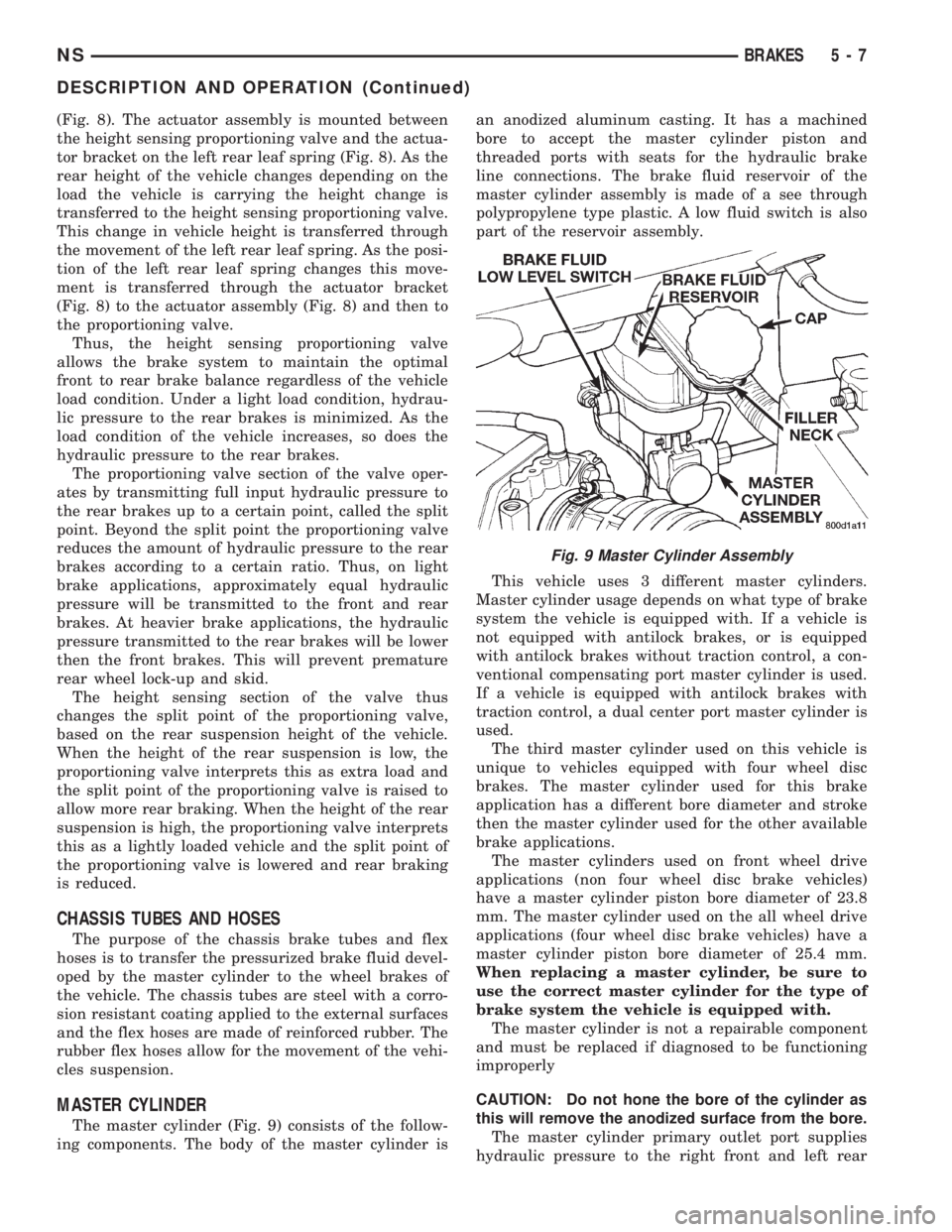
The master cylinder (Fig. 9) consists of the follow-
ing components. The body of the master cylinder isan anodized aluminum casting. It has a machined
bore to accept the master cylinder piston and
threaded ports with seats for the hydraulic brake
line connections. The brake fluid reservoir of the
master cylinder assembly is made of a see through
polypropylene type plastic. A low fluid switch is also
part of the reservoir assembly.
This vehicle uses 3 different master cylinders.
Master cylinder usage depends on what type of brake
system the vehicle is equipped with. If a vehicle is
not equipped with antilock brakes, or is equipped
with antilock brakes without traction control, a con-
ventional compensating port master cylinder is used.
If a vehicle is equipped with antilock brakes with
traction control, a dual center port master cylinder is
used.
The third master cylinder used on this vehicle is
unique to vehicles equipped with four wheel disc
brakes. The master cylinder used for this brake
application has a different bore diameter and stroke
then the master cylinder used for the other available
brake applications.
The master cylinders used on front wheel drive
applications (non four wheel disc brake vehicles)
have a master cylinder piston bore diameter of 23.8
mm. The master cylinder used on the all wheel drive
applications (four wheel disc brake vehicles) have a
master cylinder piston bore diameter of 25.4 mm.
When replacing a master cylinder, be sure to
use the correct master cylinder for the type of
brake system the vehicle is equipped with.
The master cylinder is not a repairable component
and must be replaced if diagnosed to be functioning
improperly
CAUTION: Do not hone the bore of the cylinder as
this will remove the anodized surface from the bore.
The master cylinder primary outlet port supplies
hydraulic pressure to the right front and left rear
Fig. 9 Master Cylinder Assembly
NSBRAKES 5 - 7
DESCRIPTION AND OPERATION (Continued)
Page 103 of 1938
NOTE: The following wheel sequence should be
used when bleeding the brake hydraulic system.
The use of this wheel sequence will ensure ade-
quate removal of all trapped air from the brake
hydraulic system.
²Left Rear Wheel
²Right Front Wheel
²Right Rear Wheel
²Left Front Wheel
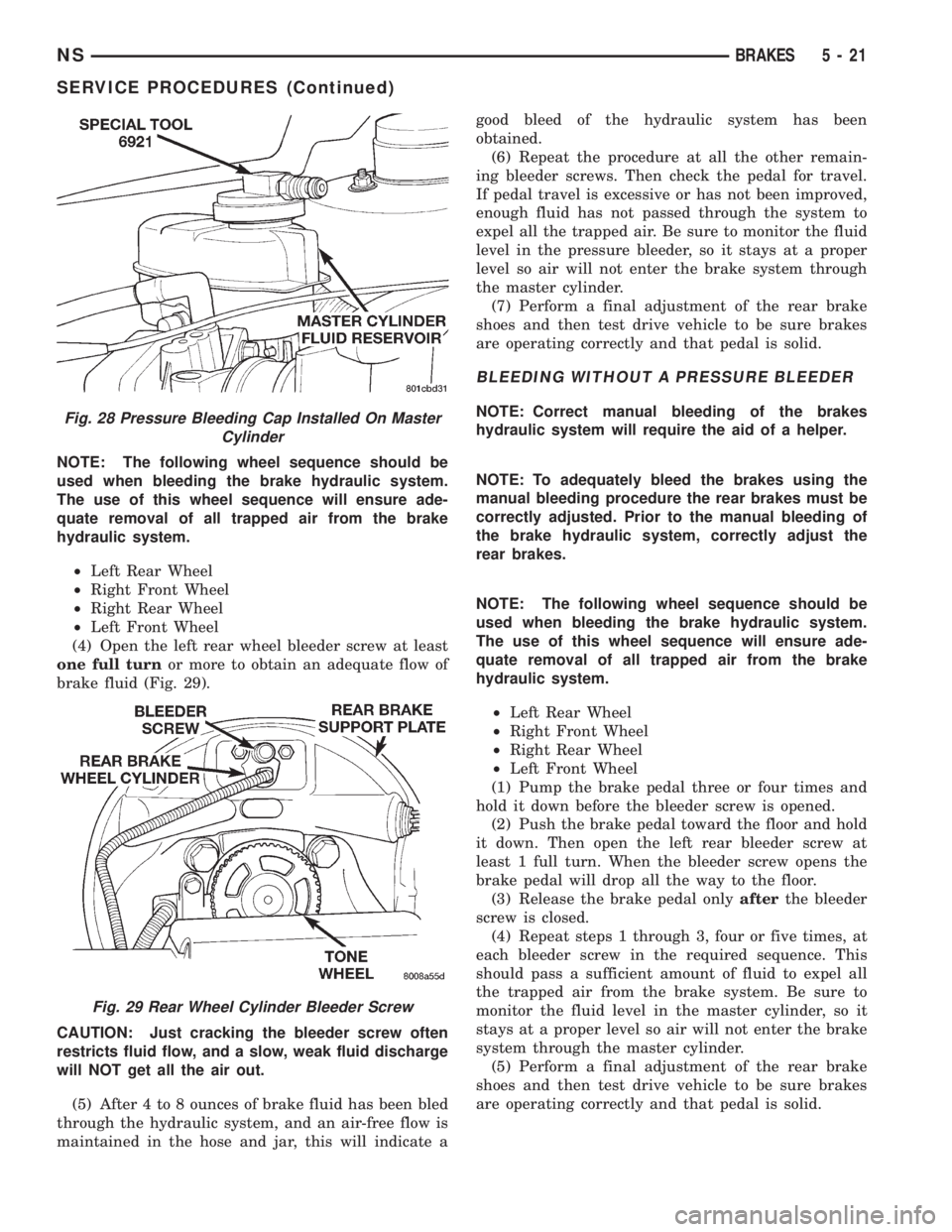
(4) Open the left rear wheel bleeder screw at least
one full turnor more to obtain an adequate flow of
brake fluid (Fig. 29).
CAUTION: Just cracking the bleeder screw often
restricts fluid flow, and a slow, weak fluid discharge
will NOT get all the air out.
(5) After 4 to 8 ounces of brake fluid has been bled
through the hydraulic system, and an air-free flow is
maintained in the hose and jar, this will indicate agood bleed of the hydraulic system has been
obtained.
(6) Repeat the procedure at all the other remain-
ing bleeder screws. Then check the pedal for travel.
If pedal travel is excessive or has not been improved,
enough fluid has not passed through the system to
expel all the trapped air. Be sure to monitor the fluid
level in the pressure bleeder, so it stays at a proper
level so air will not enter the brake system through
the master cylinder.
(7) Perform a final adjustment of the rear brake
shoes and then test drive vehicle to be sure brakes
are operating correctly and that pedal is solid.
BLEEDING WITHOUT A PRESSURE BLEEDER
NOTE: Correct manual bleeding of the brakes
hydraulic system will require the aid of a helper.
NOTE: To adequately bleed the brakes using the
manual bleeding procedure the rear brakes must be
correctly adjusted. Prior to the manual bleeding of
the brake hydraulic system, correctly adjust the
rear brakes.
NOTE: The following wheel sequence should be
used when bleeding the brake hydraulic system.
The use of this wheel sequence will ensure ade-
quate removal of all trapped air from the brake
hydraulic system.
²Left Rear Wheel
²Right Front Wheel
²Right Rear Wheel
²Left Front Wheel
(1) Pump the brake pedal three or four times and
hold it down before the bleeder screw is opened.
(2) Push the brake pedal toward the floor and hold
it down. Then open the left rear bleeder screw at
least 1 full turn. When the bleeder screw opens the
brake pedal will drop all the way to the floor.
(3) Release the brake pedal onlyafterthe bleeder
screw is closed.
(4) Repeat steps 1 through 3, four or five times, at
each bleeder screw in the required sequence. This
should pass a sufficient amount of fluid to expel all
the trapped air from the brake system. Be sure to
monitor the fluid level in the master cylinder, so it
stays at a proper level so air will not enter the brake
system through the master cylinder.
(5) Perform a final adjustment of the rear brake
shoes and then test drive vehicle to be sure brakes
are operating correctly and that pedal is solid.Fig. 28 Pressure Bleeding Cap Installed On Master
Cylinder
Fig. 29 Rear Wheel Cylinder Bleeder Screw
NSBRAKES 5 - 21
SERVICE PROCEDURES (Continued)
Page 126 of 1938

caliper adapter and hub/bearing are squarely seated
against the axle. Then tighten the hub/bearing
mounting bolts to a torque of 129 N´m (95 ft. lbs.).
(3) Install driveshaft in hub/bearing and on output
shaft of rear drive line module. Driveshaft is
installed by first sliding the outer joint of the drive-
shaft into the hub/bearing and then compressing the
inner joint on the driveshaft and installing it on the
output shaft the drive line module.
(4) Install rotor on hub/bearing.
(5) Carefully lower disc brake caliper and brake
shoes over rotor and onto caliper adapter by revers-
ing the removal procedure (Fig. 92).
CAUTION: When installing guide pin bolts extreme
caution should be taken not to crossthread the cal-
iper guide pin bolts.
(6) Install the disc brake caliper guide pin bolts
(Fig. 91). Tighten the guide pin bolts to a torque of
22 N´m (192 in. lbs.).
(7) Clean all foreign material off the threads of the
outer C/V joint stub shaft. Install the washer and
hub nut (Fig. 88) on the stub shaft of the outer C/V
joint.
(8) Lower vehicle.
(9) Set the park brake.This is required to keep
the driveshaft from rotating when tightening
and torquing the hub nut and driveshaft inner
joint to driveline module mounting nuts.
(10) Raise vehicle.
(11) Tighten the driveshaft inner joint to drive line
module output shaft mounting bolts (Fig. 89) to a
torque of 61 N´m (45 ft. lbs.).
(12) Tighten the outer C/V joint hub nut (Fig. 88)
to a torque of 244 N´m (180 ft. lbs.).
(13) Install the spring washer (Fig. 87) on the stub
shaft of the outer C/V joint.
(14) Install the nut retainer and cotter pin (Fig.
86) on the stub shaft of the outer C/V joint.
(15) Install the wheel speed sensor on the hub/
bearing and adapter. Install the wheel speed sensor
attaching bolt (Fig. 90). Tighten the wheel speed sen-
sor attaching bolt to a torque of 12 N´m (105 in. lbs).
(16) Install wheel and tire.
(17) Tighten the wheel mounting stud nuts in
proper sequence until all nuts are torqued to half
specification. Then repeat the tightening sequence to
the full specified torque of 129 N´m (95 ft. lbs.).
(18) Remove jackstands or lower hoist.
CAUTION: Before moving vehicle, pump the brake
pedal several times to insure the vehicle has a firm
brake pedal to adequately stop vehicle.
(19) Road test vehicle to ensure proper operation
of the brake system.MASTER CYLINDER
CAUTION: Different types of master cylinders are
used on this vehicle. Vehicles equipped with trac-
tion control use a center port master cylinder. Vehi-
cles not equipped with traction control use a
compensating port master cylinder. Be sure to ver-
ify if the vehicle is equipped with traction control
and that the correct replacement master cylinder is
used. Also, vehicles that are equipped with four
wheel disc brakes have a master with a different
size piston bore than the other master cylinders. If
a new master cylinder is being installed, be sure
the correct master cylinder is used for the type of
brake system the vehicle is equipped with.
REMOVE
CAUTION: Vacuum in the power brake booster
must be pumped down (removed) before removing
master cylinder from power brake booster. This is
necessary to prevent the power brake booster from
sucking in any contamination as the master cylin-
der is removed. This can be done simply by pump-
ing the brake pedal, with the vehicle's engine not
running, until a firm feeling brake pedal is achieved.
(1) With engine not running, pump the brake
pedal until a firm pedal is achieved (4-5 strokes).
CAUTION: Before removing the master cylinder
filler tube from the brake fluid reservoir, the filler
tube, brake fluid reservoir and master cylinder must
be thoroughly cleaned. This must be done to pre-
vent dirt particles from falling into the brake fluid
reservoir and entering the brakes hydraulic system.
(2) Thoroughly clean all surfaces of the filler neck,
brake fluid reservoir, and master cylinder. Use only a
solvent such as Mopar Brake Parts Cleaner or an
equivalent.
(3) Remove master cylinder filler tube from brake
fluid reservoir by pushing down and rotating (Fig.
97). Then remove the cap from the removed filler
tube and install it on the master cylinder reservoir.
(4) Remove vehicle wiring harness connector, from
the brake fluid level sensor, in master cylinder brake
fluid reservoir (Fig. 98).
(5) Disconnect the primary and secondary brake
tubes from the master cylinder housing (Fig. 99).
Install sealing plugs in the open brake tube outlets
on master cylinder assembly.
5 - 44 BRAKESNS
REMOVAL AND INSTALLATION (Continued)
Page 168 of 1938
ABS BRAKES OPERATION AND VEHICLE
PERFORMANCE
This ABS System represents the current state-of-
the-art in vehicle braking systems and offers the
driver increased safety and control during braking.
This is accomplished by a sophisticated system of
electrical and hydraulic components. As a result,
there are a few performance characteristics that may
at first seem different but should be considered nor-
mal. These characteristics are discussed below.
NORMAL BRAKING SYSTEM FUNCTION
Under normal braking conditions, the ABS System
functions the same as a standard brake system with
a diagonally split master cylinder and conventional
vacuum assist.
ABS SYSTEM OPERATION
If a wheel locking tendency is detected during a
brake application, the brake system will enter the
ABS mode. During ABS braking, hydraulic pressure
in the four wheel circuits is modulated to prevent
any wheel from locking. Each wheel circuit is
designed with a set of electric solenoids to allow mod-
ulation, although for vehicle stability, both rear
wheel solenoids receive the same electrical signal.
During an ABS stop, the brakes hydraulic system
is still diagonally split. However, the brake system
pressure is further split into four control channels.
During antilock operation of the vehicle's brake sys-
tem the front wheels are controlled independently
and are on two separate control channels and the
rear wheels of the vehicle are controlled together.
The system can build and release pressure at each
wheel, depending on signals generated by the wheel
speed sensors (WSS) at each wheel and received at
the Controller Antilock Brake (CAB).
ABS operation is available at all vehicle speeds
above 3 to 5 mph. Wheel lockup may be perceived at
the very end of an ABS stop and is considered nor-
mal.
VEHICLE HANDLING PERFORMANCE DURING
ABS BRAKING
It is important to remember that an antilock brake
system does not shorten a vehicle's stopping distance
under all driving conditions, but does provide
improved control of the vehicle while stopping. Vehi-
cle stopping distance is still dependent on vehicle
speed, weight, tires, road surfaces and other factors.
Though ABS provides the driver with some steer-
ing control during hard braking, there are conditions
however, where the system does not provide any ben-
efit. In particular, hydroplaning is still possible when
the tires ride on a film of water. This results in the
vehicles tires leaving the road surface rendering the
vehicle virtually uncontrollable. In addition, extremesteering maneuvers at high speed or high speed cor-
nering beyond the limits of tire adhesion to the road
surface may cause vehicle skidding, independent of
vehicle braking. For this reason, the ABS system is
termed Antilock instead of Anti-Skid.
NOISE AND BRAKE PEDAL FEEL
During ABS braking, some brake pedal movement
may be felt. In addition, ABS braking will create
ticking, popping and/or groaning noises heard by the
driver. This is normal due to pressurized fluid being
transferred between the master cylinder and the
brakes. If ABS operation occurs during hard braking,
some pulsation may be felt in the vehicle body due to
fore and aft movement of the suspension as brake
pressures are modulated.
At the end of an ABS stop, ABS will be turned off
when the vehicle is slowed to a speed of 3±4 mph.
There may be a slight brake pedal drop anytime that
the ABS is deactivated, such as at the end of the stop
when the vehicle speed is less then 3 mph or during
an ABS stop where ABS is no longer required. These
conditions will exist when a vehicle is being stopped
on a road surface with patches of ice, loose gravel or
sand on it. Also stopping a vehicle on a bumpy road
surface will activate ABS because of the wheel hop
caused by the bumps.
TIRE NOISE AND MARKS
Although the ABS system prevents complete wheel
lock-up, some wheel slip is desired in order to
achieve optimum braking performance. Wheel slip is
defined as follows, 0 percent slip means the wheel is
rolling freely and 100 percent slip means the wheel is
fully locked. During brake pressure modulation,
wheel slip is allowed to reach up to 25 to30%. This
means that the wheel rolling velocity is 25 to 30%
less than that of a free rolling wheel at a given vehi-
cle speed. This slip may result in some tire chirping,
depending on the road surface. This sound should not
be interpreted as total wheel lock-up.
Complete wheel lock up normally leaves black tire
marks on dry pavement. The ABS System will not
leave dark black tire marks since the wheel never
reaches a fully locked condition. Tire marks may
however be noticeable as light patched marks.
START UP CYCLE
When the ignition is turned on, a popping sound
and a slight brake pedal movement may be noticed.
Additionally, when the vehicle is first driven off a
humming may be heard and/or felt by the driver at
approximately 20 to 40 kph (12 to 25 mph). The ABS
warning lamp will also be on for up to 5 seconds
after the ignition is turned on. All of these conditions
are a normal function of ABS as the system is per-
forming a diagnosis check.
5 - 86 BRAKESNS
DESCRIPTION AND OPERATION (Continued)
Page 169 of 1938
PREMATURE ABS CYCLING
NOTE: When working on a vehicle which has a
complaint of premature ABS cycling it may be nec-
essary to use a DRB Scan Tool to detect and verify
the condition.
There is one complaint called Premature ABS
Cycling in which neither the Red Brake Warning
Lamp nor the Amber Antilock Lamp were illumi-
nated and no fault codes were stored in the CAB.
Symptoms of Premature ABS Cycling, include click-
ing sounds from the solenoids valves, pump motor
running and pulsations in the brake pedal. This con-
dition can occur at any braking rate of the vehicle
and on any type of road surface. This creates an
additional condition which needs to be correctly
assessed when diagnosing problems with the antilock
brake system.
The following conditions are common causes that
need to be checked when diagnosing a condition of
Premature ABS Cycling. Damaged tone wheels,
incorrect tone wheels, damage to a wheel speed sen-
sor mounting boss on a steering knuckle, a loose
wheel speed sensor mounting bolt, and excessive tone
wheel runout. Also, an excessively large tone wheel
to wheel speed sensor air gap can lead to the condi-
tion of Premature ABS Cycling. Special attention is
to be given to these components when diagnosing a
vehicle exhibiting the condition of Premature ABS
Cycling. After diagnosing the defective component,
repair or replace as required.
When the component repair or replacement is com-
pleted, test drive the vehicle to verify the condition of
Premature ABS Cycling has been corrected.
ABS BRAKE SYSTEM COMPONENTS
The following is a detailed description of the Teves
Mark 20 ABS brake system components. For infor-
mation on servicing the base brake system compo-
nents, see the base Brake System section of this
Service Manual.
ABS MASTER CYLINDER AND POWER BRAKE
BOOSTER
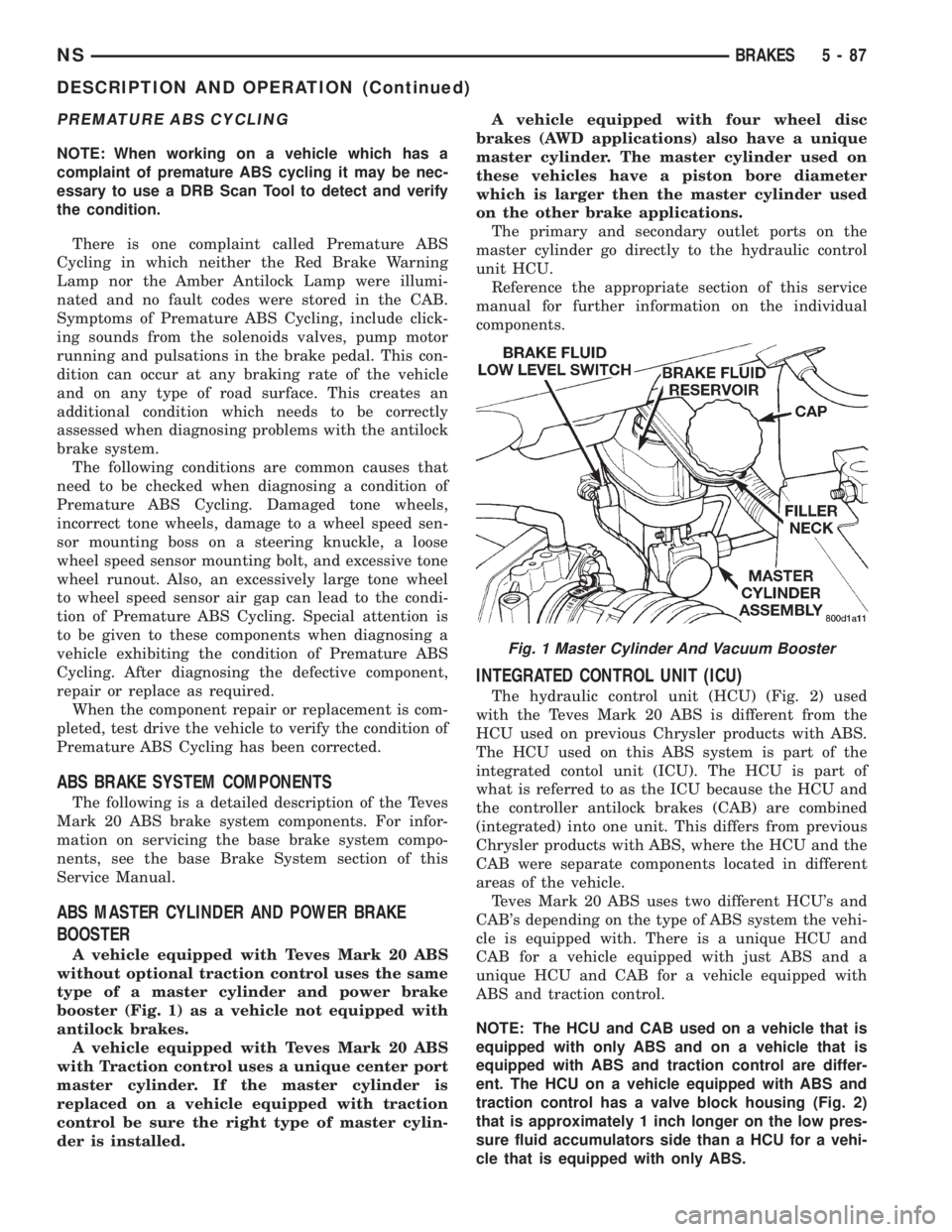
A vehicle equipped with Teves Mark 20 ABS
without optional traction control uses the same
type of a master cylinder and power brake
booster (Fig. 1) as a vehicle not equipped with
antilock brakes.
A vehicle equipped with Teves Mark 20 ABS
with Traction control uses a unique center port
master cylinder. If the master cylinder is
replaced on a vehicle equipped with traction
control be sure the right type of master cylin-
der is installed.A vehicle equipped with four wheel disc
brakes (AWD applications) also have a unique
master cylinder. The master cylinder used on
these vehicles have a piston bore diameter
which is larger then the master cylinder used
on the other brake applications.
The primary and secondary outlet ports on the
master cylinder go directly to the hydraulic control
unit HCU.
Reference the appropriate section of this service
manual for further information on the individual
components.
INTEGRATED CONTROL UNIT (ICU)
The hydraulic control unit (HCU) (Fig. 2) used
with the Teves Mark 20 ABS is different from the
HCU used on previous Chrysler products with ABS.
The HCU used on this ABS system is part of the
integrated contol unit (ICU). The HCU is part of
what is referred to as the ICU because the HCU and
the controller antilock brakes (CAB) are combined
(integrated) into one unit. This differs from previous
Chrysler products with ABS, where the HCU and the
CAB were separate components located in different
areas of the vehicle.
Teves Mark 20 ABS uses two different HCU's and
CAB's depending on the type of ABS system the vehi-
cle is equipped with. There is a unique HCU and
CAB for a vehicle equipped with just ABS and a
unique HCU and CAB for a vehicle equipped with
ABS and traction control.
NOTE: The HCU and CAB used on a vehicle that is
equipped with only ABS and on a vehicle that is
equipped with ABS and traction control are differ-
ent. The HCU on a vehicle equipped with ABS and
traction control has a valve block housing (Fig. 2)
that is approximately 1 inch longer on the low pres-
sure fluid accumulators side than a HCU for a vehi-
cle that is equipped with only ABS.
Fig. 1 Master Cylinder And Vacuum Booster
NSBRAKES 5 - 87
DESCRIPTION AND OPERATION (Continued)
Page 170 of 1938
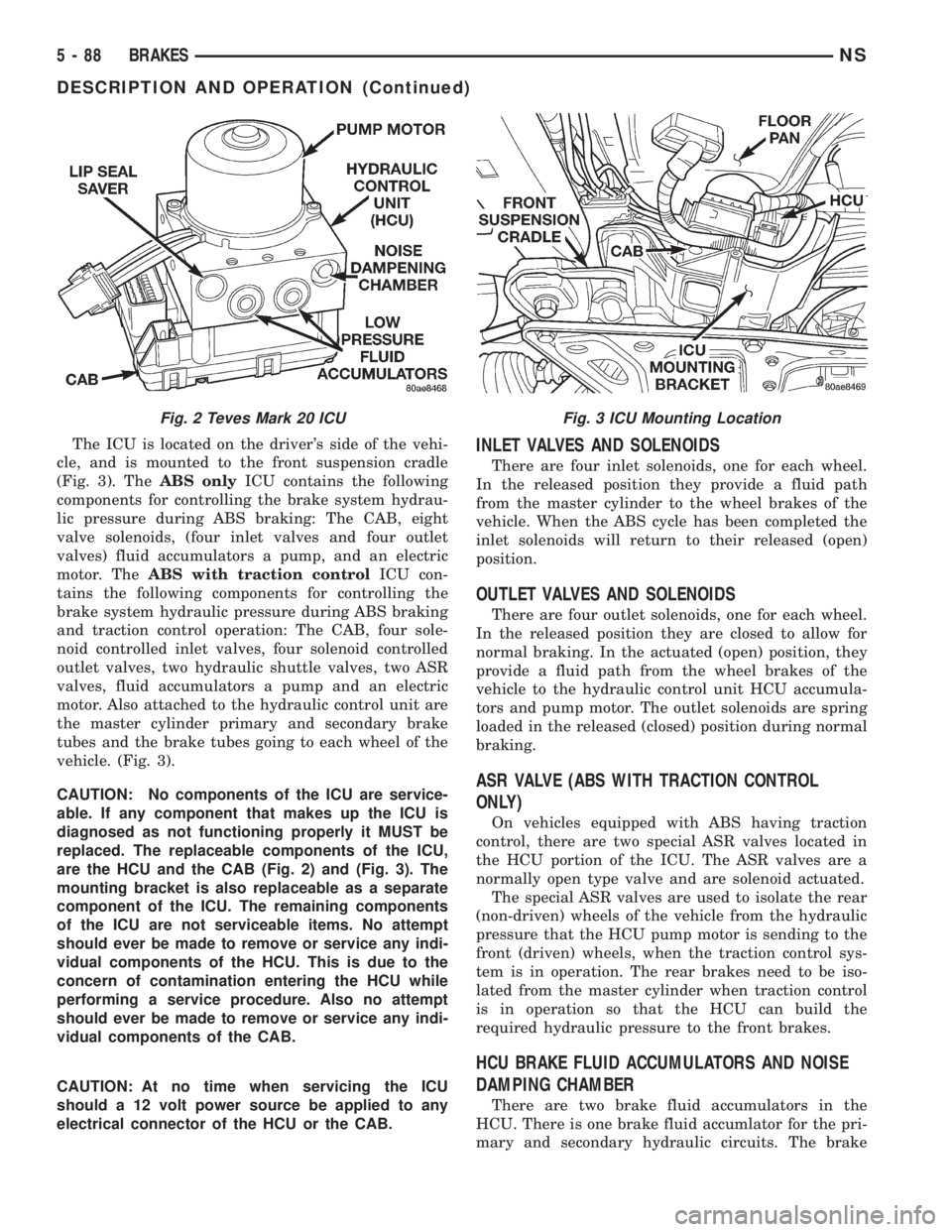
The ICU is located on the driver's side of the vehi-
cle, and is mounted to the front suspension cradle
(Fig. 3). TheABS onlyICU contains the following
components for controlling the brake system hydrau-
lic pressure during ABS braking: The CAB, eight
valve solenoids, (four inlet valves and four outlet
valves) fluid accumulators a pump, and an electric
motor. TheABS with traction controlICU con-
tains the following components for controlling the
brake system hydraulic pressure during ABS braking
and traction control operation: The CAB, four sole-
noid controlled inlet valves, four solenoid controlled
outlet valves, two hydraulic shuttle valves, two ASR
valves, fluid accumulators a pump and an electric
motor. Also attached to the hydraulic control unit are
the master cylinder primary and secondary brake
tubes and the brake tubes going to each wheel of the
vehicle. (Fig. 3).
CAUTION: No components of the ICU are service-
able. If any component that makes up the ICU is
diagnosed as not functioning properly it MUST be
replaced. The replaceable components of the ICU,
are the HCU and the CAB (Fig. 2) and (Fig. 3). The
mounting bracket is also replaceable as a separate
component of the ICU. The remaining components
of the ICU are not serviceable items. No attempt
should ever be made to remove or service any indi-
vidual components of the HCU. This is due to the
concern of contamination entering the HCU while
performing a service procedure. Also no attempt
should ever be made to remove or service any indi-
vidual components of the CAB.
CAUTION: At no time when servicing the ICU
should a 12 volt power source be applied to any
electrical connector of the HCU or the CAB.INLET VALVES AND SOLENOIDS
There are four inlet solenoids, one for each wheel.
In the released position they provide a fluid path
from the master cylinder to the wheel brakes of the
vehicle. When the ABS cycle has been completed the
inlet solenoids will return to their released (open)
position.
OUTLET VALVES AND SOLENOIDS
There are four outlet solenoids, one for each wheel.
In the released position they are closed to allow for
normal braking. In the actuated (open) position, they
provide a fluid path from the wheel brakes of the
vehicle to the hydraulic control unit HCU accumula-
tors and pump motor. The outlet solenoids are spring
loaded in the released (closed) position during normal
braking.
ASR VALVE (ABS WITH TRACTION CONTROL
ONLY)
On vehicles equipped with ABS having traction
control, there are two special ASR valves located in
the HCU portion of the ICU. The ASR valves are a
normally open type valve and are solenoid actuated.
The special ASR valves are used to isolate the rear
(non-driven) wheels of the vehicle from the hydraulic
pressure that the HCU pump motor is sending to the
front (driven) wheels, when the traction control sys-
tem is in operation. The rear brakes need to be iso-
lated from the master cylinder when traction control
is in operation so that the HCU can build the
required hydraulic pressure to the front brakes.
HCU BRAKE FLUID ACCUMULATORS AND NOISE
DAMPING CHAMBER
There are two brake fluid accumulators in the
HCU. There is one brake fluid accumlator for the pri-
mary and secondary hydraulic circuits. The brake
Fig. 2 Teves Mark 20 ICUFig. 3 ICU Mounting Location
5 - 88 BRAKESNS
DESCRIPTION AND OPERATION (Continued)