fuel CHRYSLER VOYAGER 2000 Diagnostic Manual
[x] Cancel search | Manufacturer: CHRYSLER, Model Year: 2000, Model line: VOYAGER, Model: CHRYSLER VOYAGER 2000Pages: 364, PDF Size: 2.17 MB
Page 291 of 364

TEST ACTION APPLICABILITY
28 Record the Fuel Pressure Gauge reading.
Ignition Key Off.
Warning: The Fuel System must be opened and may be under high pressure.
Release Fuel pressure.
Remove the Fuel Pressure Gauge.
Install adapter 6631 between Fuel Filter Outlet and Chassis Fuel Supply Tube.
Connect Fuel Pressure Gauge to adapter 6631.
Ignition On, Engine Not Running.
With DRB, actuate the ASD Fuel System.
Record the Fuel Pressure Gauge reading.
Compare this reading with the previous reading.
Is the fuel pressure at least 2 psi higher than the previous reading?ENGINE - 2.0L,
2.4L I-4 DOHC
and/or ENGINE -
3.3L V6 FFV and/or
ENGINE - 3.3L V6
and/or ENGINE -
3.8L V6
Ye s®Repair restriction in Chassis Fuel Supply Line between Fuel
Filter and Fuel Rail.
Perform Powertrain Verification Test VER-1A.
No®Go To 29
29 If there are no potential causes remaining, the Fuel Pump Module is assumed to be
defective.
View repair options.ENGINE - 2.0L,
2.4L I-4 DOHC
and/or ENGINE -
3.3L V6 FFV and/or
ENGINE - 3.3L V6
and/or ENGINE -
3.8L V6
Repair
Replace Fuel Pump Module.
Perform Powertrain Verification Test VER-1A.
30 Ignition Off.
Disconnect the Fuel Pump Harness Connector.
Note: Check connectors - Clean/repair as necessary.
Caution: It is critical that the Fuel Pump Connector has a clean and tight
connection.
With an Ohmmeter, measure the Fuel Pump Ground Circuit.
Is the resistance below 5.0 ohms?ENGINE - 2.0L,
2.4L I-4 DOHC
and/or ENGINE -
3.3L V6 FFV and/or
ENGINE - 3.3L V6
and/or ENGINE -
3.8L V6
Ye s®Go To 31
No®Repair the open Fuel Pump Ground Circuit.
Perform Powertrain Verification Test VER-1A.
31 Ignition Off.
Disconnect the Fuel Pump Relay.
Check connectors - Clean/repair as necessary.
Ignition On , Engine Not Running.
With a Voltmeter, measure the Fuel Pump Relay Fused B(+) Circuit.
Is the voltage above 10.0 volts?ENGINE - 2.0L,
2.4L I-4 DOHC
and/or ENGINE -
3.3L V6 FFV and/or
ENGINE - 3.3L V6
and/or ENGINE -
3.8L V6
Ye s®Go To 32
No®Repair the open Fuel Pump Relay Fused B(+) Circuit.
Perform Powertrain Verification Test VER-1A.
285
STARTING
* CHECKING THE FUEL SYSTEM ÐContinued
ProCarManuals.com
Page 292 of 364

TEST ACTION APPLICABILITY
32 Ignition Off.
Disconnect the Fuel Pump Harness Connector.
Note; Check connectors - Clean/repair as necessary.
Caution: It is critical that the Fuel Pump Connector has a clean and tight
connection.
Ignition On, Engine Not Running.
Actuate the ASD Fuel System test.
With a Voltmeter, measure the Fuel Pump Relay Output Circuit.
Is the voltage above 10.0 volts?ENGINE - 2.0L,
2.4L I-4 DOHC
and/or ENGINE -
3.3L V6 FFV and/or
ENGINE - 3.3L V6
and/or ENGINE -
3.8L V6
Ye s®Go To 33
No®Repair the open Fuel Pump Relay Output Circuit.
Perform Powertrain Verification Test VER-1A.
33 Ignition Off.
Disconnect the Fuel Pump Relay.
Check connectors - Clean/repair as necessary.
Install a substitute Relay of the same part number for the Fuel Pump Relay.
Attempt to start the Engine.
Does the Engine start?ENGINE - 2.0L,
2.4L I-4 DOHC
and/or ENGINE -
3.3L V6 FFV and/or
ENGINE - 3.3L V6
and/or ENGINE -
3.8L V6
Ye s®Replace the Fuel Pump Relay.
Perform Powertrain Verification Test VER-1A.
No®Go To 34
34 Ignition Off.
If there are no potential causes remaining, the Fuel Pump is assumed to be defective.
View repair options.ENGINE - 2.0L,
2.4L I-4 DOHC
and/or ENGINE -
3.3L V6 FFV and/or
ENGINE - 3.3L V6
and/or ENGINE -
3.8L V6
Repair
Replace the Fuel Pump.
Perform Powertrain Verification Test VER-1A.
286
STARTING
* CHECKING THE FUEL SYSTEM ÐContinued
ProCarManuals.com
Page 294 of 364

Symptom:
* CHECKING THE SECONDARY IGNITION SYSTEM
POSSIBLE CAUSES
GOOD SPARK AT SPARK PLUG #1
AUTO SHUTDOWN RELAY OUTPUT CIRCUIT OPEN
AUTO SHUTDOWN RELAY OUTPUT CIRCUIT OPEN
COIL SECONDARY CABLE DEFECTIVE
FUSED B(+) CIRCUIT OPEN
FUSED B(+) CIRCUIT OPEN
IGNITION COIL CONNECTOR OBSERVABLE DEFECT
IGNITION COIL CONNECTOR OBSERVABLE DEFECT
IGNITION COIL DEFECTIVE
IGNITION COIL SECONDARY CABLE #1 DEFECTIVE
IGNITION COIL SECONDARY CABLE #4 DEFECTIVE
SECONDARY IGNITION COMPONENT(S) DEFECTIVE
SPARK PLUG CABLE #1 DEFECTIVE
AUTO SHUTDOWN RELAY DEFECTIVE
AUTO SHUTDOWN RELAY DEFECTIVE
IGNITION COIL DEFECTIVE
IGNITION COIL DEFECTIVE (RESISTANCE OUT OF RANGE)
SPARK PLUG #1 OR #4 DEFECTIVE
GOOD SPARK AT SPARK PLUG #1
GOOD SPARK AT SPARK PLUG #1
TEST ACTION APPLICABILITY
1 Ignition Off.
Disconnect the Spark Plug Cable at Spark Plug #1.
Connect the Cable to a Spark Tester.
Connect the Spark Tester to a good Ground.
Warning: Ensure that there are no Fuel or Fuel vapors present in or near
the Engine compartment before continuing with the test.
While cranking the Engine for 10 seconds, watch for spark.
Is there good spark?ENGINE - 3.0L V6
Ye s®Refer to Symptom list for further diagnostic tests.
No®Go To 2
288
STARTING
ProCarManuals.com
Page 297 of 364

TEST ACTION APPLICABILITY
12 Ignition Off.
Disconnect the Ignition Coil Connector.
Note: Check connectors - Clean/repair as necessary.
Disconnect the ASD Relay.
Note: Check connectors - Clean/repair as necessary.
Using a Jumper Wire connect the ASD Relay Output Circuit to Ground at the
Ignition Coil Connector.
With an Ohmmeter mesaure the ASD Output Circuit for resistance to Ground at the
Relay.
Is the resistance below 5.0 ohms?ENGINE - 3.0L V6
Ye s®Go To 13
No®Repair open ASD Relay Output Circuit.
Perform Powetrain Verification Test VER-1A.
13 Ignition Off.
Disconnect the ASD Relay.
Note: Check connectors - Clean/repair as necessary.
Ignition On, Engine Not Running.
With a Voltmeter, measure the Fused B(+) Circuit cavity B in ASD Relay Connector.
Is the voltage above 10 volts?ENGINE - 3.0L V6
Ye s®Replace the Auto Shutdown Relay.
Perform Powertrain Verification Test VER-1A.
No®Repair open Fused B+.
Perform Verification TEST VER-1A
14 Ignition Off.
Remove the Distributor Cap.
Is the Distributor Rotor loose?ENGINE - 3.0L V6
Ye s®Repair loose Distributor Rotor as necessary.
Perform Verification TEST VER-1A
No®Go To 15
15 If there are no potential causes remaining, the Distributor Drive System is assumed
to be defective.
View repair options.ENGINE - 3.0L V6
Repair
Repair the Distributor Drive System.
Perform Powertrain Verification Test VER-1A.
16 Ignition Off.
Disconnect the Spark Plug Cable at Spark Plug #1.
Connect the Cable to a Spark Tester.
Connect the Spark Tester to a good Ground.
Warning: Ensure that there are no Fuel or Fuel vapors present in or near
the Engine compartment before continuing with the test.
While cranking the Engine for 10 seconds, watch for spark.
Is there good spark?ENGINE - 2.0L
and 2.4L I-4 DOHC
Ye s®Refer to Symptom list for further diagnostic tests.
No®Go To 17
291
STARTING
* CHECKING THE SECONDARY IGNITION SYSTEM ÐContinued
ProCarManuals.com
Page 298 of 364

TEST ACTION APPLICABILITY
17 Ignition Off.
Disconnect the Spark Plug Cable at Spark Plug #2.
Connect the other end of the Cable to a Spark Tester.
Connect the Spark Tester to a good Ground.
Ensure that there are no fuel or fuel vapors present in or near the Engine
Compartment before continuing with the test.
While cranking the Engine for 10 seconds, watch for spark.
Is there good spark?ENGINE - 2.0L
and 2.4L I-4 DOHC
Ye s®Go To 18
No®Go To 22
18 Ignition Off.
Disconnect Ignition Coil Secondary Cables #1 and #4 from the Ignition Coil
Terminals.
Note: Check connectors - Clean/repair as necessary.
With Ohmmeter, test the resistance between Coil Terminals #1 and #4.
Is the resistance between 10.9 and 14.7 K ohms?ENGINE - 2.0L
and 2.4L I-4 DOHC
Ye s®Go To 19
No®Replace the Ignition Coil.
Perform Powertrain Verification Test VER-1A.
19 Ignition Off.
Disconnect Ignition Coil Secondary Cable #1 from the Ignition Coil Terminal.
Note: Check connectors - Clean/repair as necessary.
Disconnect the Ignition Coil Secondary Cable at Spark Plug #1.
Note: Check connectors - Clean/repair as necessary.
With Ohmmeter, test the resistance of Ignition Coil Secondary Cable #1.
Is the resistance below 15 K ohms?ENGINE - 2.0L
and 2.4L I-4 DOHC
Ye s®Go To 20
No®Replace Ignition Coil Secondary Cable #1.
Perform Powertrain Verification Test VER-1A.
20 Ignition Off.
Disconnect Ignition Coil Secondary Cable #4 from the Ignition Coil Terminal.
Note: Check connectors - Clean/repair as necessary.
Disconnect the Ignition Coil Secondary Cable at Spark Plug #4.
Note: Check connectors - Clean/repair as necessary.
With Ohmmeter, test the resistance of Ignition Coil Secondary Cable #4.
Is the resistance below 15 K ohms?ENGINE - 2.0L
and 2.4L I-4 DOHC
Ye s®Go To 21
No®Replace Ignition Coil Secondary Cable #4.
Perform Powertrain Verification Test VER-1A.
292
STARTING
* CHECKING THE SECONDARY IGNITION SYSTEM ÐContinued
ProCarManuals.com
Page 300 of 364

TEST ACTION APPLICABILITY
26 Ignition Off.
Disconnect the Spark Plug Cable at Spark Plug #1.
Connect the Cable to a Spark Tester.
Connect the Spark Tester to a good Ground.
Warning: Ensure that there are no Fuel or Fuel vapors present in or near
the Engine compartment before continuing with the test.
While cranking the Engine for 10 seconds, watch for spark.
Is there good spark?ENGINE - 2.0L,
2.4L I-4 DOHC
and/or ENGINE -
3.3L V6 and/or EN-
GINE - 3.8L V6
and/or ENGINE -
3.3L V6 FFV
Ye s®Refer to Symptom list for further diagnostic tests.
No®Go To 27
27 Ignition Off.
Disconnect the Spark Plug Cable at Spark Plug #2.
Connect the other end of the Cable to a Spark Tester.
Connect the Spark Tester to a good Ground.
Ensure that there are no fuel or fuel vapors present in or near the Engine
Compartment before continuing with the test.
While cranking the Engine for 10 seconds, watch for spark.
Is there good spark?ENGINE - 2.0L,
2.4L I-4 DOHC
and/or ENGINE -
3.3L V6 and/or EN-
GINE - 3.8L V6
and/or ENGINE -
3.3L V6 FFV
Ye s®Go To 28
No®Go To 29
28 Ignition Off.
Disconnect the Spark Plug Cable at Spark Plug #2.
Connect the other end of the Cable to a Spark Tester.
Connect the Spark Tester to a good Ground.
Ensure that there are no fuel or fuel vapors present in or near the Engine
Compartment before continuing with the test.
While cranking the Engine for 10 seconds, watch for spark.
Is there good spark?ENGINE - 2.0L,
2.4L I-4 DOHC
and/or ENGINE -
3.3L V6 and/or EN-
GINE - 3.8L V6
and/or ENGINE -
3.3L V6 FFV
Ye s®Replace Spark Plug Cable that was initially used to test for spark.
Perform Powertrain Verification Test VER-1A.
No®Test Complete.
29 Ignition Off.
Disconnect the Ignition Coil Connector.
Note: Check connectors - Clean/repair as necessary.
Inspect Terminals.
Is any Terminal damaged, pushed out, or miswired?ENGINE - 2.0L,
2.4L I-4 DOHC
and/or ENGINE -
3.3L V6 and/or EN-
GINE - 3.8L V6
and/or ENGINE -
3.3L V6 FFV
Ye s®Repair Terminal(s) for damage, pushout, or miswiring.
Perform Powertrain Verification Test VER-1A.
No®Go To 30
294
STARTING
* CHECKING THE SECONDARY IGNITION SYSTEM ÐContinued
ProCarManuals.com
Page 307 of 364
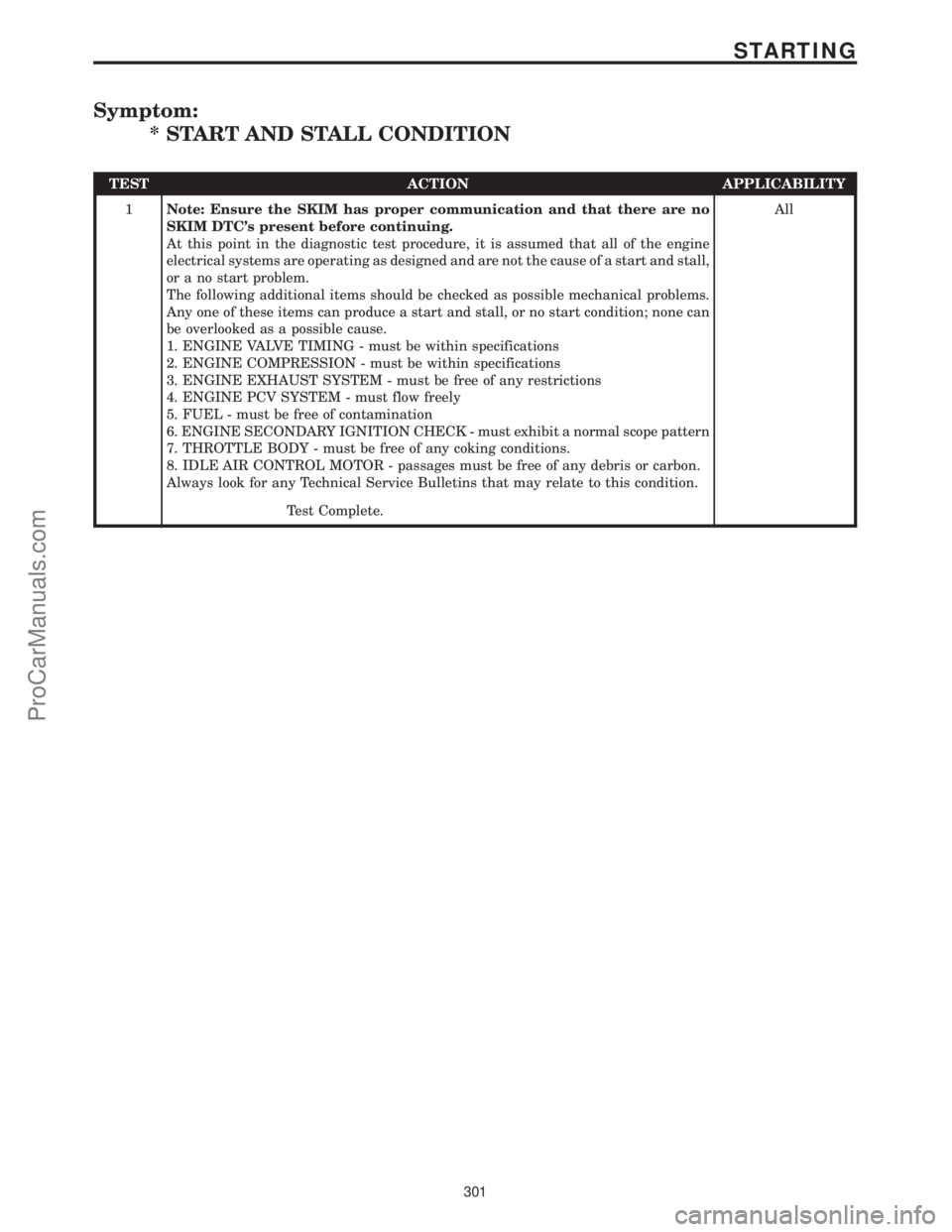
Symptom:
* START AND STALL CONDITION
TEST ACTION APPLICABILITY
1Note: Ensure the SKIM has proper communication and that there are no
SKIM DTC's present before continuing.
At this point in the diagnostic test procedure, it is assumed that all of the engine
electrical systems are operating as designed and are not the cause of a start and stall,
or a no start problem.
The following additional items should be checked as possible mechanical problems.
Any one of these items can produce a start and stall, or no start condition; none can
be overlooked as a possible cause.
1. ENGINE VALVE TIMING - must be within specifications
2. ENGINE COMPRESSION - must be within specifications
3. ENGINE EXHAUST SYSTEM - must be free of any restrictions
4. ENGINE PCV SYSTEM - must flow freely
5. FUEL - must be free of contamination
6. ENGINE SECONDARY IGNITION CHECK - must exhibit a normal scope pattern
7. THROTTLE BODY - must be free of any coking conditions.
8. IDLE AIR CONTROL MOTOR - passages must be free of any debris or carbon.
Always look for any Technical Service Bulletins that may relate to this condition.All
Test Complete.
301
STARTING
ProCarManuals.com
Page 323 of 364

Verification Tests
VERIFICATION TEST VER-1A APPLICABILITY
No Start Verification
Use this test to verify that a No Start condition has been repaired and that the vehicle can be
returned to the customer.
Note: If the Powertrain Control Module has been replaced and the correct VIN and
mileage have not been programmed, a DTC will be set in the ABS, Airbag and the
SKIM modules. In addition, if the vehicle is equipped with a Sentry Key Immobilizer
Module (SKIM), Secret Key data must be updated to enable starting. Refer to
GENERAL INFORMATION section for programming information for the PCM, SKIM
and the Transponder (ignition key).
1. Inspect the vehicle to ensure that all components related to the repair are connected
properly.
2. Inspect the engine oil for fuel contamination. Replace the oil and filter as necessary
3. Attempt to start the engine.
4. If the No Start condition is still present, refer to the symptom list and perform diagnostic
testing as necessary. Refer to any Technical Service Bulletins that may apply.
5. Run the engine for one warm-up cycle to verify proper operation. With the DRBIIIt, confirm
that no DTC's are present and that all components are functioning properly.
6. If DTC's are present, refer to the symptom list and perform diagnostic testing as necessary.ALL
VERIFICATION TEST VER-2A APPLICABILITY
Non-OBDII Verification
Use this test to verify that a non-OBDII symptom has been repaired and that the vehicle can
be returned to the customer. A non-OBDII symptom is a comprehensive component related
symptom that is not the result of a failed OBDII major monitor.
Note: If the Powertrain Control Module has been replaced and the correct VIN and
mileage have not been programmed, a DTC will be set in the ABS, Airbag and the
SKIM modules. In addition, if the vehicle is equipped with a Sentry Key Immobilizer
Module (SKIM), Secret Key data must be updated to enable starting. Refer to
GENERAL INFORMATION section for programming information for the PCM, SKIM
and the Transponder (ignition key).
1. Inspect the vehicle to ensure that all components related to the repair are connected
properly.
2. With the DRBIIIt, Clear DTC's and Reset Memory (all engine values).
3. Run the engine for one warm-up cycle to verify proper operation.
4. Road test the vehicle. Use all accessories that may be related to this repair.
With the DRBIIIt, confirm that no DTC's are present and that all components are functioning
properly.
6. If this test is being performed after a No Trouble Code test, verify that the symptom is no
longer present. If the symptom is still present, or any other symptom or DTC is present, refer
to the symptom list for further diagnostic testing procedures. Check for any Technical Service
Bulletins that may apply.
7. If there are no DTC's present and all components are functioning properly, repair is
complete.ALL
317
VERIFICATION TESTS
ProCarManuals.com
Page 326 of 364

VERIFICATION TEST VER-5A APPLICABILITY
OBDII Road Test Verification
Use this test to verify that the OBDII symptom has been repaired and that the vehicle can be
returned to the customer. The proper way to verify that an OBDII DTC has been repaired is to
allow the PCM to run and pass the appropriate OBDII monitor(s).
Note: If the Powertrain Control Module has been changed and the correct VIN and
mileage have not been programmed, a DTC will be set in the ABS, Airbag and the
SKIM modules. In addition, if the vehicle is equipped with a Sentry Key Immobilizer
Module (SKIM), Secret Key data must be updated to enable starting. Refer to
GENERAL INFORMATION section for programming information for the PCM, SKIM
and the Transponder (ignition key).
1. Inspect the vehicle to ensure that all components related to the repair are connected
properly.
2. If any other DTC is present, refer to the symptom list for further diagnostic testing
procedures.
3. With the DRBIIIt, Clear DTC's.
4. In order for an OBDII monitor to run, certain pre-test conditions must be met. Refer to the
applicable OBDII monitor pre-test screen on the DRBIIItfor monitor enabling conditions.
5. Operate the vehicle within the enabling conditions and allow the applicable monitor to run.
While the monitor is running, the OBDII monitor screen on the DRBIIItwill display ªIN
PROGRESSº and the DRBIIItwill beep. After the monitor is complete, view the results. Refer
to the appropriate service information as necessary. A monitor may have to fail more than once
in order to set a DTC.
If the monitor fails, or the DTC returns, or any other symptom or DTC is present, refer to the
symptom list for further diagnostic testing procedures. Check for any Technical Service
Bulletins that may apply.
If there are no DTC's present and all components are functioning properly, the repair is
complete.ALL
Powertrain Verification Test VER-5A2 APPLICABILITY
Fuel System Lean/Rich or Misfire Verification
Use this test to verify that the Fuel System Lean, Fuel System Rich, or Misfire symptom has
been repaired and that the vehicle can be returned to the customer.
NOTE: If the Powertrain Control Module has been replaced and the correct VIN and
mileage have not been programmed, a DTC will be set in the ABS, Airbag and the
SKIM modules. In addition, if the vehicle is equipped with a Sentry Key Immobilizer
Module (SKIM), Secret KEY data must be updated to enable starting. Refer to
GENERAL INFORMATION section for programming information for the PCM, SKIM
and the Transponder (ignition key).
1. Inspect the vehicle to ensure that all components related to the repair are connected
properly.
2. If any other DTC is present, refer to the symptom list for further diagnostic testing
procedures.
3. With the DRBIIIt, monitor the Similar Conditions Window and attempt to duplicate the
conditions that the vehicle was operating at when the DTC was set. If the conditions can be
duplicated, the Good Trip counter will change to one or more.
4. If the DTC resets, or the OBDII monitor fails after running, or if any other symptom or DTC
is present, return to the symptom list and perform the appropriate diagnostic testing
procedures. Check for any Technical Service Bulletins that may apply.
5. If the monitor runs and the Good Trip Counter changes to one or more, the condition is no
longer present. If there are no DTCs and all components are functioning properly, the repair is
complete.ALL
320
VERIFICATION TESTS
Verification Tests ÐContinued
ProCarManuals.com
Page 328 of 364

Powertrain Verification Test VER-7A APPLICABILITY
SKIS Verfication
Use this test to verify that SKIM system symptom has been repaired and that the vehicle can
be returned to the customer.
Note: If the Powertrain Control Module has been replaced and the correct VIN and
mileage have not been programmed, a DTC will be set in the ABS, Airbag and SKIM
modules. In addition, if the vehicle is equipped with a Sentry Key Immobilizer
Module (SKIM), Secret Key data must be updated to enable starting. Refer to
GENERAL INFORMATION section for programmig information for the PCM, SKIM
and the Transponder (ignition key).
1.Inspect the vehicle to ensure that all components related to the repair are connected properly.
2. Inspect the engine oil for fuel contamination. Replace the oil and filter as necessary.
3. Start the engine.
4. Run the engine for one warm-up cycle to verify proper operation. With the DRBIIIt, confirm
that no DTCs are present and that all components are functioning properly. If the DTC is still
present refer to any Technical Service Bulletins that may apply.
5. If a different DTC(s) is present, refer to the symtom list and perform diagnostic testing as
necessary. If there are no DTCs present and all components are functioning correctly, repair is
now complete.All
322
VERIFICATION TESTS
Verification Tests ÐContinued
ProCarManuals.com