charging CHRYSLER VOYAGER 2001 Owners Manual
[x] Cancel search | Manufacturer: CHRYSLER, Model Year: 2001, Model line: VOYAGER, Model: CHRYSLER VOYAGER 2001Pages: 4284, PDF Size: 83.53 MB
Page 3812 of 4284
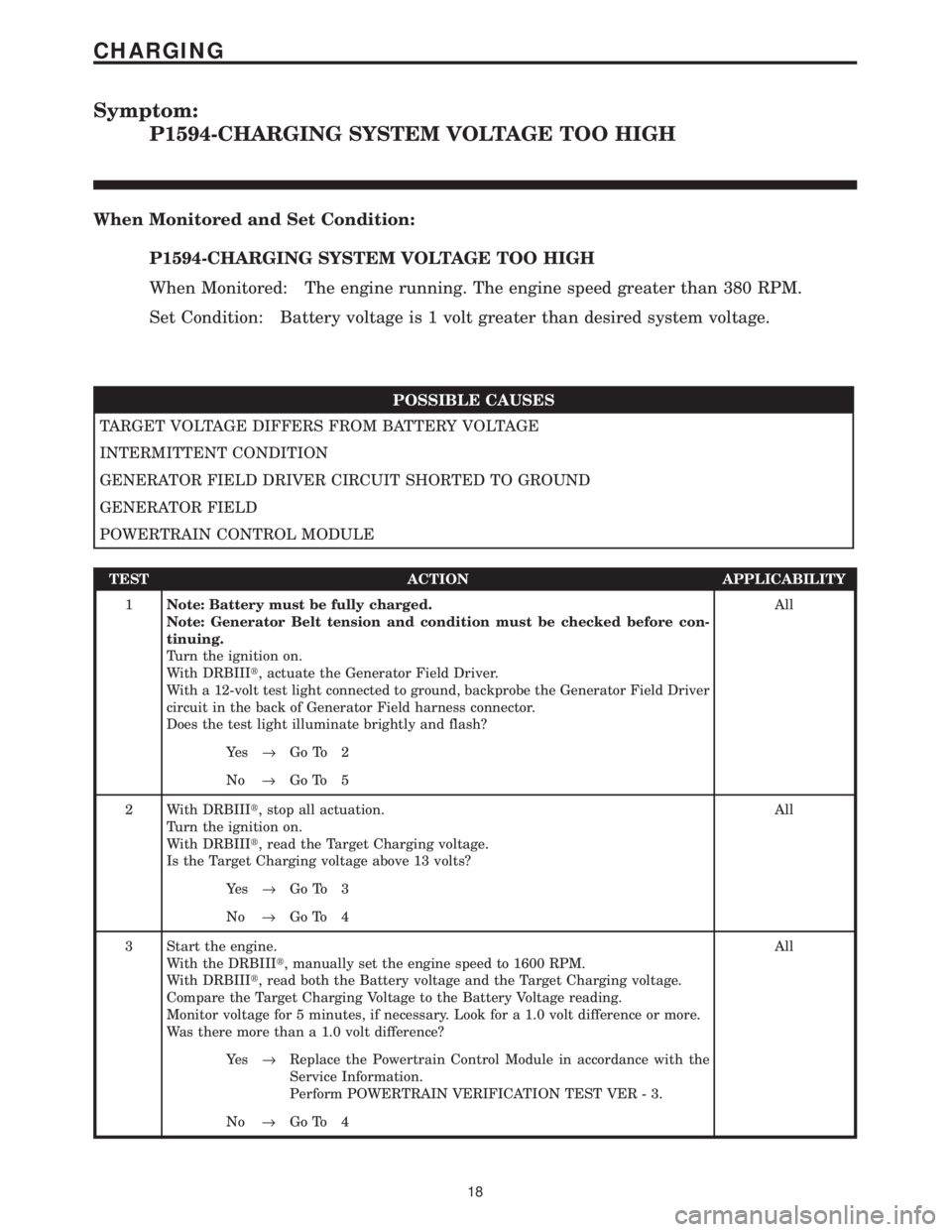
Symptom:
P1594-CHARGING SYSTEM VOLTAGE TOO HIGH
When Monitored and Set Condition:
P1594-CHARGING SYSTEM VOLTAGE TOO HIGH
When Monitored: The engine running. The engine speed greater than 380 RPM.
Set Condition: Battery voltage is 1 volt greater than desired system voltage.
POSSIBLE CAUSES
TARGET VOLTAGE DIFFERS FROM BATTERY VOLTAGE
INTERMITTENT CONDITION
GENERATOR FIELD DRIVER CIRCUIT SHORTED TO GROUND
GENERATOR FIELD
POWERTRAIN CONTROL MODULE
TEST ACTION APPLICABILITY
1Note: Battery must be fully charged.
Note: Generator Belt tension and condition must be checked before con-
tinuing.
Turn the ignition on.
With DRBIIIt, actuate the Generator Field Driver.
With a 12-volt test light connected to ground, backprobe the Generator Field Driver
circuit in the back of Generator Field harness connector.
Does the test light illuminate brightly and flash?All
Ye s®Go To 2
No®Go To 5
2 With DRBIIIt, stop all actuation.
Turn the ignition on.
With DRBIIIt, read the Target Charging voltage.
Is the Target Charging voltage above 13 volts?All
Ye s®Go To 3
No®Go To 4
3 Start the engine.
With the DRBIIIt, manually set the engine speed to 1600 RPM.
With DRBIIIt, read both the Battery voltage and the Target Charging voltage.
Compare the Target Charging Voltage to the Battery Voltage reading.
Monitor voltage for 5 minutes, if necessary. Look for a 1.0 volt difference or more.
Was there more than a 1.0 volt difference?All
Ye s®Replace the Powertrain Control Module in accordance with the
Service Information.
Perform POWERTRAIN VERIFICATION TEST VER - 3.
No®Go To 4
18
CHARGING
Page 3813 of 4284

TEST ACTION APPLICABILITY
4WARNING: WHEN THE ENGINE IS OPERATING, DO NOT STAND IN A
DIRECT LINE WITH THE FAN. DO NOT PUT YOUR HANDS NEAR THE
PULLEYS, BELTS OR FAN. DO NOT WEAR LOOSE CLOTHING.
NOTE: The conditions that set the DTC are not present at this time. The
following list may help in identifying the intermittent condition.
With the engine running at normal operating temperature, monitor the DRB
parameters related to the DTC while wiggling the wiring harness. Look for param-
eter values to change and/or a DTC to set.
Review the DRB Freeze Frame information. If possible, try to duplicate the
conditions under which the DTC was set.
Refer to any Technical Service Bulletins (TSB) that may apply.
Visually inspect the related wiring harness. Look for any chafed, pierced, pinched, or
partially broken wires.
Visually inspect the related wiring harness connectors. Look for broken, bent, pushed
out, or corroded terminals.
Were any of the above conditions present?All
Ye s®Repair as necessary
Perform POWERTRAIN VERIFICATION TEST VER - 3.
No®Test Complete.
5 Turn the ignition off.
Disconnect the PCM harness connector.
Disconnect the Generator Field harness connector.
Measure the resistance of the Generator Field Driver circuit from the PCM harness
connector to ground.
Is the resistance below 5.0 ohms?All
Ye s®Repair the Generator Field Driver circuit shorted to ground.
Perform POWERTRAIN VERIFICATION TEST VER - 3.
No®Go To 6
6 Turn the ignition off.
Disconnect the Generator Field harness connector.
Measure resistance of the Generator Field Driver terminal to ground.
Is the resistance below 5.0 ohms?All
Ye s®Repair or replace the shorted Generator as necessary.
Perform POWERTRAIN VERIFICATION TEST VER - 3.
No®Go To 7
7 If there are no possible causes remaining, view repair. All
Repair
Replace and program the Powertrain Control Module in accor-
dance with the Service Information.
Perform POWERTRAIN VERIFICATION TEST VER - 3.
19
CHARGING
P1594-CHARGING SYSTEM VOLTAGE TOO HIGH ÐContinued
Page 3814 of 4284

Symptom:
P1682-CHARGING SYSTEM VOLTAGE TOO LOW
When Monitored and Set Condition:
P1682-CHARGING SYSTEM VOLTAGE TOO LOW
When Monitored: With the ignition on. Engine RPM greater than 1152 RPM. With no
other charging system codes set.
Set Condition: The battery sensed voltage is 1 volt below the charging goal for 13.47
seconds. The PCM senses the battery voltage turns off the field driver and senses the
battery voltage again. If the voltages are the same, the code is set.
POSSIBLE CAUSES
BATTERY TEMPERATURE
B+ CIRCUIT HIGH RESISTANCE
GENERATOR GROUND HIGH RESISTANCE
INTERMITTENT CONDITION
GENERATOR FIELD DRIVER CIRCUIT OPEN
ASD RELAY OUTPUT CIRCUIT OPEN
GENERATOR
TEST ACTION APPLICABILITY
1NOTE: Inspect the vehicle for aftermarket accessories that may exceed the
Generator System output.
Turn the ignition off.
NOTE: The battery must be fully charged.
NOTE: The Generator belt tension and condition must be checked before
continuing.
Start the engine.
Allow the idle to stabilize.
With the DRBIIIt, read the Target Charging Voltage.
Is the Target Charging Voltage above 15.1 volts?All
Ye s®Go To 2
No®Go To 3
20
CHARGING
Page 3815 of 4284

TEST ACTION APPLICABILITY
2WARNING: WHEN THE ENGINE IS OPERATING, DO NOT STAND IN A
DIRECT LINE WITH THE FAN. DO NOT PUT YOUR HANDS NEAR THE
PULLEYS, BELTS OR FAN. DO NOT WEAR LOOSE CLOTHING.
Turn the ignition on.
NOTE: Ensure all wires are clear of the engine's moving parts.
Measure the voltage between the Generator B+ Terminal and the Battery+ Post.
Start the engine.
Is the voltage above 0.4 volt?All
Ye s®Repair the B+ circuit for high resistance between the Generator
and Battery.
Perform POWERTRAIN VERIFICATION TEST VER - 3.
No®Go To 3
3WARNING: WHEN THE ENGINE IS OPERATING, DO NOT STAND IN A
DIRECT LINE WITH THE FAN. DO NOT PUT YOUR HANDS NEAR THE
PULLEYS, BELTS OR FAN. DO NOT WEAR LOOSE CLOTHING.
Start the engine.
Warm the engine to operating temperature.
NOTE: Ensure all wires are clear of the engine's moving parts.
Measure the voltage between the Generator case and Battery ground post.
Is the voltage above 0.1 volt?All
Ye s®Repair Generator Ground for high resistance, Generator Case to
Battery ground side.
Perform POWERTRAIN VERIFICATION TEST VER - 3.
No®Go To 4
4 Start the engine.
WARNING: WHEN THE ENGINE IS OPERATING, DO NOT STAND IN A
DIRECT LINE WITH THE FAN. DO NOT PUT YOUR HANDS NEAR THE
PULLEYS, BELTS OR FAN. DO NOT WEAR LOOSE CLOTHING.
Turn on all accessories, manually set engine speed to 1600 RPM.
With DRBIIIt, read Target Charging and Charging voltage.
Compare the two readings.
Is there more than a 1.0 volt difference?All
Ye s®Go To 5
No®Go To 8
5 Turn the ignition off.
Disconnect the PCM harness connector.
Disconnect the Generator Field harness connector.
Measure the resistance of the Generator Field Driver circuit from the PCM harness
connector to Generator harness connector.
Is the resistance below 5.0 ohms?All
Ye s®Go To 6
No®Repair the Generator Field Driver circuit an open.
Perform POWERTRAIN VERIFICATION TEST VER - 3.
21
CHARGING
P1682-CHARGING SYSTEM VOLTAGE TOO LOW ÐContinued
Page 3816 of 4284

TEST ACTION APPLICABILITY
6 Disconnect the Generator Field harness connector.
Turn the ignition on.
With the DRBIIItactuate the Generator Field Driver.
Using a 12-volt test light connected to ground, probe the ASD Relay Output circuit.
Does the test light illuminate brightly?All
Ye s®Go To 7
No®Repair the ASD Relay Output circuit.
Perform POWERTRAIN VERIFICATION TEST VER - 3.
7 If there is no possible causes remaining, view repair. All
Ye s®Repair or replace the Generator as necessary..
Perform POWERTRAIN VERIFICATION TEST VER - 3.
8WARNING: WHEN THE ENGINE IS OPERATING, DO NOT STAND IN A
DIRECT LINE WITH THE FAN. DO NOT PUT YOUR HANDS NEAR THE
PULLEYS, BELTS OR FAN. DO NOT WEAR LOOSE CLOTHING.
NOTE: The conditions that set the DTC are not present at this time. The
following list may help in identifying the intermittent condition.
With the engine running at normal operating temperature, monitor the DRB
parameters related to the DTC while wiggling the wiring harness. Look for param-
eter values to change and/or a DTC to set.
Review the DRB Freeze Frame information. If possible, try to duplicate the
conditions under which the DTC was set.
Refer to any Technical Service Bulletins (TSB) that may apply.
Visually inspect the related wiring harness. Look for any chafed, pierced, pinched, or
partially broken wires.
Visually inspect the related wiring harness connectors. Look for broken, bent, pushed
out, or corroded terminals.
Were any of the above conditions present?All
Ye s®Repair as necessary
Perform POWERTRAIN VERIFICATION TEST VER - 3.
No®Test Complete.
22
CHARGING
P1682-CHARGING SYSTEM VOLTAGE TOO LOW ÐContinued
Page 4120 of 4284
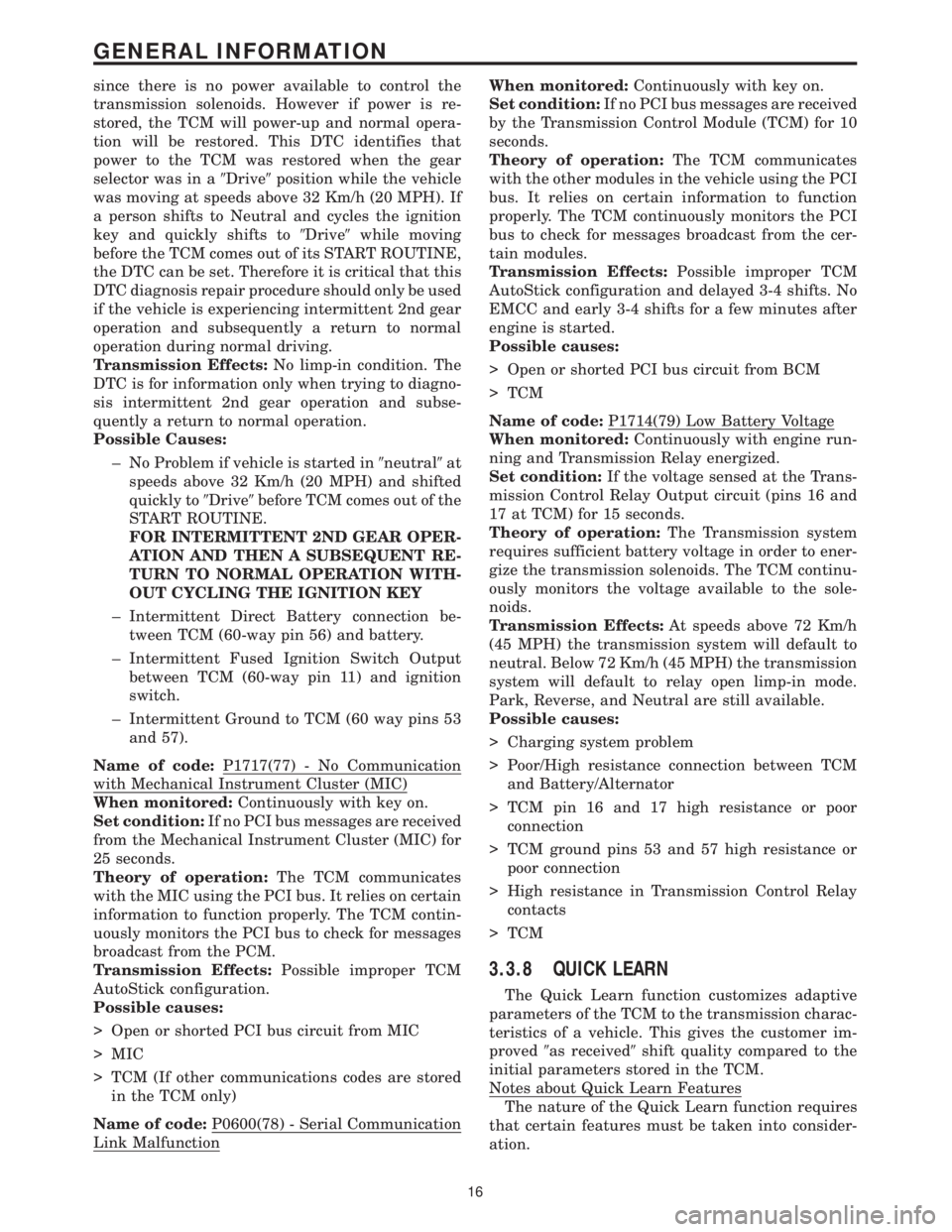
since there is no power available to control the
transmission solenoids. However if power is re-
stored, the TCM will power-up and normal opera-
tion will be restored. This DTC identifies that
power to the TCM was restored when the gear
selector was in a9Drive9position while the vehicle
was moving at speeds above 32 Km/h (20 MPH). If
a person shifts to Neutral and cycles the ignition
key and quickly shifts to9Drive9while moving
before the TCM comes out of its START ROUTINE,
the DTC can be set. Therefore it is critical that this
DTC diagnosis repair procedure should only be used
if the vehicle is experiencing intermittent 2nd gear
operation and subsequently a return to normal
operation during normal driving.
Transmission Effects:No limp-in condition. The
DTC is for information only when trying to diagno-
sis intermittent 2nd gear operation and subse-
quently a return to normal operation.
Possible Causes:
± No Problem if vehicle is started in9neutral9at
speeds above 32 Km/h (20 MPH) and shifted
quickly to9Drive9before TCM comes out of the
START ROUTINE.
FOR INTERMITTENT 2ND GEAR OPER-
ATION AND THEN A SUBSEQUENT RE-
TURN TO NORMAL OPERATION WITH-
OUT CYCLING THE IGNITION KEY
± Intermittent Direct Battery connection be-
tween TCM (60-way pin 56) and battery.
± Intermittent Fused Ignition Switch Output
between TCM (60-way pin 11) and ignition
switch.
± Intermittent Ground to TCM (60 way pins 53
and 57).
Name of code:P1717(77) - No Communication
with Mechanical Instrument Cluster (MIC)
When monitored:Continuously with key on.
Set condition:If no PCI bus messages are received
from the Mechanical Instrument Cluster (MIC) for
25 seconds.
Theory of operation:The TCM communicates
with the MIC using the PCI bus. It relies on certain
information to function properly. The TCM contin-
uously monitors the PCI bus to check for messages
broadcast from the PCM.
Transmission Effects:Possible improper TCM
AutoStick configuration.
Possible causes:
> Open or shorted PCI bus circuit from MIC
> MIC
> TCM (If other communications codes are stored
in the TCM only)
Name of code:P0600(78) - Serial Communication
Link Malfunction
When monitored:Continuously with key on.
Set condition:If no PCI bus messages are received
by the Transmission Control Module (TCM) for 10
seconds.
Theory of operation:The TCM communicates
with the other modules in the vehicle using the PCI
bus. It relies on certain information to function
properly. The TCM continuously monitors the PCI
bus to check for messages broadcast from the cer-
tain modules.
Transmission Effects:Possible improper TCM
AutoStick configuration and delayed 3-4 shifts. No
EMCC and early 3-4 shifts for a few minutes after
engine is started.
Possible causes:
> Open or shorted PCI bus circuit from BCM
> TCM
Name of code:P1714(79) Low Battery Voltage
When monitored:Continuously with engine run-
ning and Transmission Relay energized.
Set condition:If the voltage sensed at the Trans-
mission Control Relay Output circuit (pins 16 and
17 at TCM) for 15 seconds.
Theory of operation:The Transmission system
requires sufficient battery voltage in order to ener-
gize the transmission solenoids. The TCM continu-
ously monitors the voltage available to the sole-
noids.
Transmission Effects:At speeds above 72 Km/h
(45 MPH) the transmission system will default to
neutral. Below 72 Km/h (45 MPH) the transmission
system will default to relay open limp-in mode.
Park, Reverse, and Neutral are still available.
Possible causes:
> Charging system problem
> Poor/High resistance connection between TCM
and Battery/Alternator
> TCM pin 16 and 17 high resistance or poor
connection
> TCM ground pins 53 and 57 high resistance or
poor connection
> High resistance in Transmission Control Relay
contacts
> TCM
3.3.8 QUICK LEARN
The Quick Learn function customizes adaptive
parameters of the TCM to the transmission charac-
teristics of a vehicle. This gives the customer im-
proved9as received9shift quality compared to the
initial parameters stored in the TCM.
Notes about Quick Learn Features
The nature of the Quick Learn function requires
that certain features must be taken into consider-
ation.
16
GENERAL INFORMATION
Page 4179 of 4284

Symptom:
P1714-LOW BATTERY VOLTAGE
When Monitored and Set Condition:
P1714-LOW BATTERY VOLTAGE
When Monitored: With the engine running and the TCM has closed the Transmission
Control Relay.
Set Condition: If battery voltage at TCM Transmission Control Relay Output Sense
circuit is less than 10.0 volts for 15 seconds. *P-1714 generally indicates a gradually falling
battery voltage or resistive connections to the TCM.
POSSIBLE CAUSES
RELATED CHARGING SYSTEM DTCS
INTERMITTENT WIRING AND CONNECTORS
FUSED IGNITION SWITCH OUTPUT ( RUN/START) CIRCUIT OPEN
FUSED IGNITION SWITCH OUTPUT (START) CIRCUIT OPEN
GROUND CIRCUIT OPEN
FUSED B+ CIRCUIT
TRANS CONTROL RELAY OUTPUT TO TCM HIGH RESISTANCE
TCM - LOW BATTERY VOLTAGE
TEST ACTION APPLICABILITY
1NOTE: Low fluid level can be the cause of many Transmission problems. If
the fluid level is low locate and repair the leak then check and adjust the
fluid level per the Service Information.
NOTE: Always perform diagnostics with a fully charged battery to avoid
false symptoms.
With the DRBIIIt, read the engine DTC's. Check and repair all engine DTC's prior
to performing Transmission Symptom Diagnostics.
With the DRBIIIt, read Transmission DTC's. Record all DTC's and 1 Trip Failures.
NOTE: Diagnose 1 Trip Failures as a fully matured DTC.
Using the wiring diagram/schematic as a guide, inspect the wiring and connectors.
Repair as necessary.
Perform the Shift Lever Position Test. If the test does not pass, refer to Symptom test
for P0705 Check Shifter Signal.
For Gear Ratio DTC's, check and record all CVI's.
Most DTC's set on start up but some must be set by driving the vehicle such that all
diagnostic monitors have run.
NOTE: Verify flash level of Transmission Control Module. Some problems
are corrected by software upgrades to the Transmission Control Module.
NOTE: Check for applicable TSB's related to the symptom.
Perform this procedure prior to Symptom diagnosis.All
Continue
Go To 2
75
TRANSMISSION
Page 4180 of 4284

TEST ACTION APPLICABILITY
2 With the DRBIIIt, read the PCM DTC's.
Are any Charging System related DTC's stored in the PCM?All
Ye s®Refer to the Charging System category and repair any PCM
Charging System DTC's, before testing DTC P1714.
Perform 41TE TRANSMISSION VERIFICATION TEST - VER 1.
No®Go To 3
3 With the DRBIIIt, read Transmission DTC's.
With the DRBIIIt, Check the STARTS SINCE SET counter.
Note: This counter only applies to the last DTC set.
Is the Starts Since Set counter for P1714 set at 0?All
Ye s®Go To 4
No®Go To 10
4 Turn the ignition off to the lock position.
Disconnect the TCM harness connector.
Note: Check connectors - Clean/repair as necessary.
Ignition on, engine not running.
Using a 12-volt test light connected to ground, check the Fused Ignition Switch
Output circuit in the TCM harness connector.
NOTE: The test light must illuminate brightly. Compare the brightness to
that of a direct connection to the battery.
Does the test light illuminate brightly?All
Ye s®Go To 5
No®Repair the Fused Ignition Switch Output (Run/Start) circuit for
an open or high resistance.
Perform 41TE TRANSMISSION VERIFICATION TEST - VER 1.
5 Turn the ignition off to the lock position.
Disconnect the TCM harness connector.
Remove the Starter Relay from the IPM.
Turn the ignition switch to the start position.
Using a 12-volt test light connected to ground, check the Fused Ignition Switch
Output (Start) circuit in the TCM harness connector.
NOTE: The test light must illuminate brightly. Compare the brightness to
that of a direct connection to the battery.
Does the test light illuminate brightly?All
Ye s®Go To 6
No®Repair the Fused Ignition Switch Output (Start) circuit for an
open or high resistance. If the fuse is open make sure to check for
a short to ground.
Perform 41TE TRANSMISSION VERIFICATION TEST - VER 1.
Note: Reinstall the Starter Relay.
76
TRANSMISSION
P1714-LOW BATTERY VOLTAGE ÐContinued