fan CHRYSLER VOYAGER 2001 Owners Manual
[x] Cancel search | Manufacturer: CHRYSLER, Model Year: 2001, Model line: VOYAGER, Model: CHRYSLER VOYAGER 2001Pages: 4284, PDF Size: 83.53 MB
Page 1372 of 4284

Symptom:
P0833-CLUTCH PEDAL PLAUSIBILITY
POSSIBLE CAUSES
CLUTCH PEDAL SWITCH
CLUTCH PEDAL SWITCH SENSE CIRCUIT OPEN
CLUTCH PEDAL SWITCH SENSE CIRCUIT SHORTED TO GROUND
ECM
INTERMITTENT CONDITION
TEST ACTION APPLICABILITY
1 Turn the ignition on.
With the DRBIIItin Inputs/Outputs, read the Clutch switch states while pressing
and releasing the Clutch Pedal several times.
Did the DRB indicate the correct clutch pedal state when pressing and releasing the
Clutch Pedal?All
Ye s®Go To 2
No®Go To 3
2WARNING: WHEN THE ENGINE IS OPERATING, DO NOT STAND IN A
DIRECT LINE WITH THE FAN. DO NOT PUT YOUR HANDS NEAR THE
PULLEYS, BELTS OR FAN. DO NOT WEAR LOOSE CLOTHING.
Refer to any Technical Service Bulletins (TSB) that may apply.
Visually inspect the related wiring harness. Look for any chafed, pierced, pinched, or
partially broken wires.
Visually inspect the related wiring harness connectors. Look for broken, bent, pushed
out, or corroded terminals.
Were any of the above conditions present?All
Ye s®Repair as necessary.
No®Test Complete.
3 Turn the ignition off.
Disconnect the Clutch Pedal Switch harness connector.
Turn the ignition on.
With the DRBIIItin Inputs/Outputs, read the Clutch Switch state while using a
jumper wire to connect the Clutch Pedal Switch Sense circuit to ground at the Clutch
Pedal Switch harness connector.
NOTE: Leave jumper connected to ground for 5 seconds then disconnect
jumper and note DRB reading for both conditions.
Does the DRB display RELEASED and PRESSED?All
Ye s®Replace the Clutch Pedal Switch.
No®Go To 4
4 Turn the ignition off.
Disconnect the Clutch Pedal Switch harness connector.
Measure the resistance of the Clutch Pedal Switch Sense circuit.
Is the resistance below 10.0 ohms?All
Ye s®Go To 5
No®Repair the Clutch Pedal Switch Sense circuit for an open.
153
DRIVEABILITY - DIESEL
Page 1376 of 4284

TEST ACTION APPLICABILITY
6 Refer to the appropriate Service Information and perform the Fuel Pressure Test.
NOTE: The following is a list of problems that can cause the fuel pressure to
become out of specification: restricted fuel filter or fuel lines, failed fuel
pressure solenoid, air in fuel system, failed fuel sending unit, gelled fuel,
faulty injector.
Is the fuel pressure within specification?All
Ye s®Replace the Fuel Pressure Sensor in accordance with the Service
Information.
No®Repair as necessary in accordance with the Service Information.
7WARNING: WHEN THE ENGINE IS OPERATING, DO NOT STAND IN A
DIRECT LINE WITH THE FAN. DO NOT PUT YOUR HANDS NEAR THE
PULLEYS, BELTS OR FAN. DO NOT WEAR LOOSE CLOTHING.
NOTE: The conditions that set the DTC are not present at this time. The
following list may help in identifying the intermittent condition.
With the engine running and at normal operating temperature, monitor the DRB
parameters related to the DTC while wiggling the wiring harness. Look for param-
eter values to change and/or a DTC to set.
Review the DTC When Monitored and Set Conditions. If possible, try to duplicate the
conditions under which the DTC was set.
Refer to any Technical Service Bulletins (TSB) that may apply.
Visually inspect the related wiring harness. Look for any chafed, pierced, pinched, or
partially broken wires.
Visually inspect the related wiring harness connectors. Look for broken, bent, pushed
out, or corroded terminals.
Were any of the above conditions present?All
Ye s®Repair as necessary.
No®Test Complete.
157
DRIVEABILITY - DIESEL
P1130-FUEL RAIL PRESSURE MALFUNCTION LEAKAGE DETECTED Ð
Continued
Page 1380 of 4284

TEST ACTION APPLICABILITY
8WARNING: WHEN THE ENGINE IS OPERATING, DO NOT STAND IN A
DIRECT LINE WITH THE FAN. DO NOT PUT YOUR HANDS NEAR THE
PULLEYS, BELTS OR FAN. DO NOT WEAR LOOSE CLOTHING.
NOTE: The conditions that set the DTC are not present at this time.The
following list may help in identifying the intermittent condition.
With the engine running at normal operating temperature, monitor the DRB
parameters related to the DTC while wiggling the wiring harness. Look for param-
eter values to change and/or a DTC to set.
Review the DTC When Monitored and Set Conditions. If possible, try to duplicate the
conditions under which the DTC was set.
Refer to any Technical Service Bulletins (TSB) that may apply.
Visually inspect the related wiring harness. Look for any chafed, pierced, pinched, or
partially broken wires.
Visually inspect the related wiring harness connectors. Look for broken, bent, pushed
out, or corroded terminals.
Were any of the above conditions present?All
Ye s®Repair as necessary.
Perform ROAD TEST VERIFICATION - VER-2.
No®Test Complete.
161
DRIVEABILITY - DIESEL
P1131-FUEL PRESSURE SOLENOID OPEN CIRCUIT ÐContinued
Page 1382 of 4284

TEST ACTION APPLICABILITY
4 If there are no possible causes remaining, view repair. All
Repair
Replace and program the Engine Control Module in accordance
with the Service Information.
Perform ROAD TEST VERIFICATION - VER-2.
5WARNING: WHEN THE ENGINE IS OPERATING, DO NOT STAND IN A
DIRECT LINE WITH THE FAN. DO NOT PUT YOUR HANDS NEAR THE
PULLEYS, BELTS OR FAN. DO NOT WEAR LOOSE CLOTHING.
NOTE: The conditions that set the DTC are not present at this time. The
following list may help in identifying the intermittent condition.
With the engine running and at normal operating temperature, monitor the DRB
parameters related to the DTC while wiggling the wiring harness. Look for param-
eter values to change and/or a DTC to set.
Review the DTC When Monitored and Set Conditions. If possible, try to duplicate the
conditions under which the DTC was set.
Refer to any Technical Service Bulletins (TSB) that may apply.
Visually inspect the related wiring harness. Look for any chafed, pierced, pinched, or
partially broken wires.
Visually inspect the related wiring harness connectors. Look for broken, bent, pushed
out, or corroded terminals.
Were any of the above conditions present?All
Ye s®Repair as necessary.
Perform ROAD TEST VERIFICATION - VER-2.
No®Test Complete.
163
DRIVEABILITY - DIESEL
P1511-BATTERY SENSE LINE 1 VOLTAGE TOO HIGH ÐContinued
Page 1384 of 4284

TEST ACTION APPLICABILITY
4 Turn the ignition off.
Install a substitute relay in place of the Fuel Heater Relay.
Disconnect the ECM harness connectors.
Turn the ignition on.
Using a 12-volt test light connected to ground, check the Fuel Heater Relay Output
circuit.
Is the test light on?All
Ye s®Replace the initial Fuel Heater Relay.
Perform ROAD TEST VERIFICATION - VER-2.
No®Go To 5
5 Turn the ignition off.
Disconnect the ECM harness connectors.
Disconnect the Crankcase Vent Heater harness connector.
Disconnect the Fuel Heater harness connector.
Remove the Fuel Heater Relay from the IPM.
Measure the resistance between ground and the Battery(+) Sense circuit.
Is the resistance above 100k ohms?All
Ye s®Go To 6
No®Repair the Battery(+) Sense circuit for a short to ground.
Perform ROAD TEST VERIFICATION - VER-2.
6 If there are no possible causes remaining, view repair. All
Repair
Replace and program the Engine Control Module in accordance
with the Service Information.
Perform ROAD TEST VERIFICATION - VER-2.
7WARNING: WHEN THE ENGINE IS OPERATING, DO NOT STAND IN A
DIRECT LINE WITH THE FAN. DO NOT PUT YOUR HANDS NEAR THE
PULLEYS, BELTS OR FAN. DO NOT WEAR LOOSE CLOTHING.
NOTE: The conditions that set the DTC are not present at this time. The
following list may help in identifying the intermittent condition.
With the engine running and at normal operating temperature, monitor the DRB
parameters related to the DTC while wiggling the wiring harness. Look for param-
eter values to change and/or a DTC to set.
Review the DTC When Monitored and Set Conditions. If possible, try to duplicate the
conditions under which the DTC was set.
Refer to any Technical Service Bulletins (TSB) that may apply.
Visually inspect the related wiring harness. Look for any chafed, pierced, pinched, or
partially broken wires.
Visually inspect the related wiring harness connectors. Look for broken, bent, pushed
out, or corroded terminals.
Were any of the above conditions present?All
Ye s®Repair as necessary.
Perform ROAD TEST VERIFICATION - VER-2.
No®Test Complete.
165
DRIVEABILITY - DIESEL
P1511-BATTERY SENSE LINE 1 VOLTAGE TOO LOW ÐContinued
Page 1386 of 4284
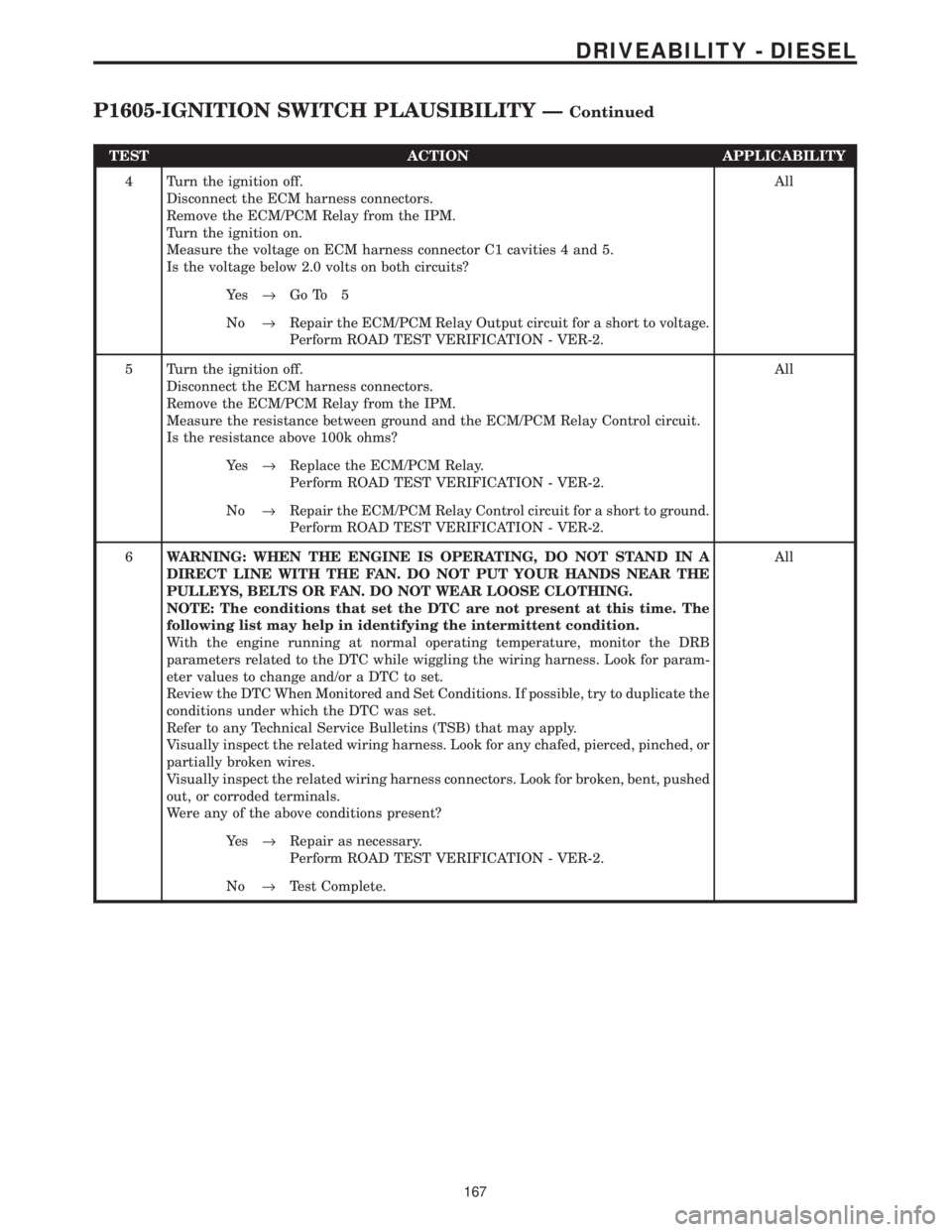
TEST ACTION APPLICABILITY
4 Turn the ignition off.
Disconnect the ECM harness connectors.
Remove the ECM/PCM Relay from the IPM.
Turn the ignition on.
Measure the voltage on ECM harness connector C1 cavities 4 and 5.
Is the voltage below 2.0 volts on both circuits?All
Ye s®Go To 5
No®Repair the ECM/PCM Relay Output circuit for a short to voltage.
Perform ROAD TEST VERIFICATION - VER-2.
5 Turn the ignition off.
Disconnect the ECM harness connectors.
Remove the ECM/PCM Relay from the IPM.
Measure the resistance between ground and the ECM/PCM Relay Control circuit.
Is the resistance above 100k ohms?All
Ye s®Replace the ECM/PCM Relay.
Perform ROAD TEST VERIFICATION - VER-2.
No®Repair the ECM/PCM Relay Control circuit for a short to ground.
Perform ROAD TEST VERIFICATION - VER-2.
6WARNING: WHEN THE ENGINE IS OPERATING, DO NOT STAND IN A
DIRECT LINE WITH THE FAN. DO NOT PUT YOUR HANDS NEAR THE
PULLEYS, BELTS OR FAN. DO NOT WEAR LOOSE CLOTHING.
NOTE: The conditions that set the DTC are not present at this time. The
following list may help in identifying the intermittent condition.
With the engine running at normal operating temperature, monitor the DRB
parameters related to the DTC while wiggling the wiring harness. Look for param-
eter values to change and/or a DTC to set.
Review the DTC When Monitored and Set Conditions. If possible, try to duplicate the
conditions under which the DTC was set.
Refer to any Technical Service Bulletins (TSB) that may apply.
Visually inspect the related wiring harness. Look for any chafed, pierced, pinched, or
partially broken wires.
Visually inspect the related wiring harness connectors. Look for broken, bent, pushed
out, or corroded terminals.
Were any of the above conditions present?All
Ye s®Repair as necessary.
Perform ROAD TEST VERIFICATION - VER-2.
No®Test Complete.
167
DRIVEABILITY - DIESEL
P1605-IGNITION SWITCH PLAUSIBILITY ÐContinued
Page 1388 of 4284

TEST ACTION APPLICABILITY
2 Turn the ignition on.
With the DRBIIIt, erase ECM DTCs.
Turn the ignition on and off several times pausing 10 seconds between each key cycle.
With the DRBIIIt, read the ECM DTCs.
Are any P1685 DTCs present?All
Ye s®Go To 3
No®Go To 4
3 Replace and program the SKIM in accordance with the Service Information.
Turn the ignition on.
With the DRBIIIt, erase ECM DTCs.
Turn the ignition on and off several times pausing for 10 seconds between key cycles.
With the DRBIIIt, read ECM DTCs.
Are there any P1685 DTC's present?All
Ye s®Replace and program the ECM in accordance with the Service
Information.
Perform ROAD TEST VERIFICATION - VER-2.
No®Test Complete.
4WARNING: WHEN THE ENGINE IS OPERATING, DO NOT STAND IN A
DIRECT LINE WITH THE FAN. DO NOT PUT YOUR HANDS NEAR THE
PULLEYS, BELTS OR FAN. DO NOT WEAR LOOSE CLOTHING.
NOTE: The conditions that set the DTC are not present at this time. The
following list may help in identifying the intermittent condition.
With the engine running at normal operating temperature, monitor the DRB
parameters related to the DTC while wiggling the wiring harness. Look for param-
eter values to change and/or a DTC to set.
Review the DTC When Monitored and Set Conditions. If possible, try to duplicate the
conditions under which the DTC was set.
Refer to any Technical Service Bulletins (TSB) that may apply.
Visually inspect the related wiring harness. Look for any chafed, pierced, pinched, or
partially broken wires.
Visually inspect the related wiring harness connectors. Look for broken, bent, pushed
out, or corroded terminals.
Were any of the above conditions present?All
Ye s®Repair as necessary.
Perform ROAD TEST VERIFICATION - VER-2.
No®Test Complete.
169
DRIVEABILITY - DIESEL
P1685-SKIM SYSTEM INVALID KEY CODE RECEIVED ÐContinued
Page 1393 of 4284

TEST ACTION APPLICABILITY
9 Turn the ignition on.
With the DRB III, read the PEDAL OUTPUT VOLTS.
With the accelerator pedal in the idle position, slowly depress the accelerator pedal
until the pedal is fully depressed.
NOTE: The PEDAL OUTPUT VOLTS should increase smoothly as the pedal
is depressed.
Does the voltage increase smoothly with the accelerator pedal travel?All
Ye s®Go To 10
No®Replace the Accelerator Pedal Position Sensor in accordance with
the Service Information.
Perform ROAD TEST VERIFICATION - VER-2.
10 Turn the ignition on.
With the DRB III, select Engine and with the custom display feature select Low Idle
Switch input and the Accel Pedal %.
Slowly depress and release the accelerator pedal several times while monitoring the
DRB III display.
NOTE: The Low Idle Switch state should change between 5% and 10% of
Accelerator Pedal position.
Did the Low Idle Switch state change between 5% and 10% of Accelerator Pedal
position?All
Ye s®Go To 11
No®Replace the Accelerator Pedal Position Sensor.
Perform ROAD TEST VERIFICATION - VER-2.
11WARNING: WHEN THE ENGINE IS OPERATING, DO NOT STAND IN A
DIRECT LINE WITH THE FAN. DO NOT PUT YOUR HANDS NEAR THE
PULLEYS, BELTS OR FAN. DO NOT WEAR LOOSE CLOTHING.
NOTE: The conditions that set the DTC are not present at this time. The
following list may help in identifying the intermittent condition.
With the engine running and at normal operating temperature, monitor the DRB
parameters related to the DTC while wiggling the wiring harness. Look for param-
eter values to change and/or a DTC to set.
Review the DTC When Monitored and Set Conditions. If possible, try to duplicate the
conditions under which the DTC was set.
Refer to any Technical Service Bulletins (TSB) that may apply.
Visually inspect the related wiring harness. Look for any chafed, pierced, pinched, or
partially broken wires.
Visually inspect the related wiring harness connectors. Look for broken, bent, pushed
out, or corroded terminals.
Were any of the above conditions present?All
Ye s®Repair as necessary.
Perform ROAD TEST VERIFICATION - VER-2.
No®Test Complete.
12 Turn the ignition off.
Disconnect the APP Sensor harness connector.
Disconnect the ECM harness connectors.
Measure the resistance of the APP Sensor Signal circuit.
Is the resistance below 10.0 ohms?All
Ye s®Go To 13
No®Repair the APP Sensor Signal circuit for an open
Perform ROAD TEST VERIFICATION - VER-2.
174
DRIVEABILITY - DIESEL
P2120-ACC PEDAL POSITION SENSOR 1 CKT PLAUSIBILITY ÐContinued
Page 1405 of 4284
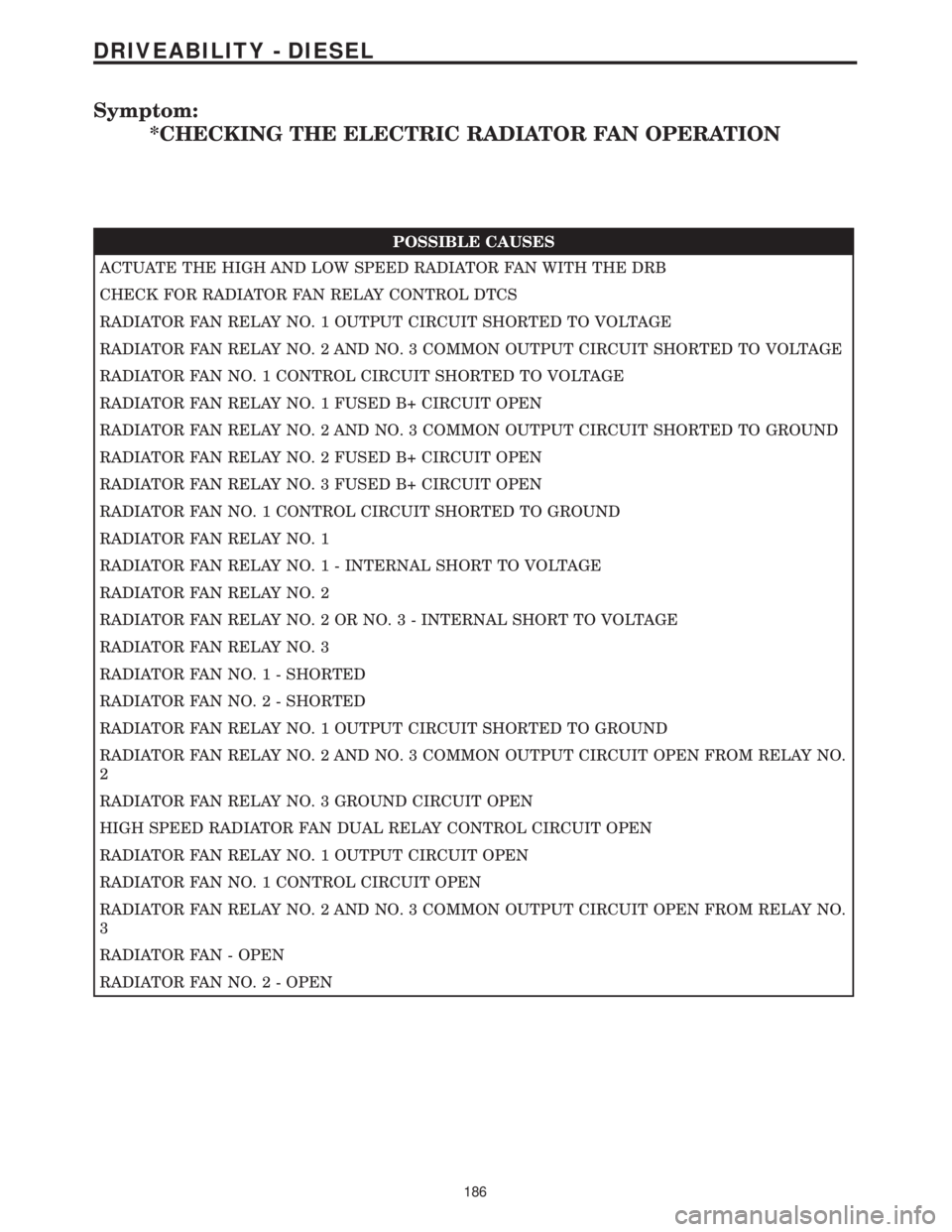
Symptom:
*CHECKING THE ELECTRIC RADIATOR FAN OPERATION
POSSIBLE CAUSES
ACTUATE THE HIGH AND LOW SPEED RADIATOR FAN WITH THE DRB
CHECK FOR RADIATOR FAN RELAY CONTROL DTCS
RADIATOR FAN RELAY NO. 1 OUTPUT CIRCUIT SHORTED TO VOLTAGE
RADIATOR FAN RELAY NO. 2 AND NO. 3 COMMON OUTPUT CIRCUIT SHORTED TO VOLTAGE
RADIATOR FAN NO. 1 CONTROL CIRCUIT SHORTED TO VOLTAGE
RADIATOR FAN RELAY NO. 1 FUSED B+ CIRCUIT OPEN
RADIATOR FAN RELAY NO. 2 AND NO. 3 COMMON OUTPUT CIRCUIT SHORTED TO GROUND
RADIATOR FAN RELAY NO. 2 FUSED B+ CIRCUIT OPEN
RADIATOR FAN RELAY NO. 3 FUSED B+ CIRCUIT OPEN
RADIATOR FAN NO. 1 CONTROL CIRCUIT SHORTED TO GROUND
RADIATOR FAN RELAY NO. 1
RADIATOR FAN RELAY NO. 1 - INTERNAL SHORT TO VOLTAGE
RADIATOR FAN RELAY NO. 2
RADIATOR FAN RELAY NO. 2 OR NO. 3 - INTERNAL SHORT TO VOLTAGE
RADIATOR FAN RELAY NO. 3
RADIATOR FAN NO. 1 - SHORTED
RADIATOR FAN NO. 2 - SHORTED
RADIATOR FAN RELAY NO. 1 OUTPUT CIRCUIT SHORTED TO GROUND
RADIATOR FAN RELAY NO. 2 AND NO. 3 COMMON OUTPUT CIRCUIT OPEN FROM RELAY NO.
2
RADIATOR FAN RELAY NO. 3 GROUND CIRCUIT OPEN
HIGH SPEED RADIATOR FAN DUAL RELAY CONTROL CIRCUIT OPEN
RADIATOR FAN RELAY NO. 1 OUTPUT CIRCUIT OPEN
RADIATOR FAN NO. 1 CONTROL CIRCUIT OPEN
RADIATOR FAN RELAY NO. 2 AND NO. 3 COMMON OUTPUT CIRCUIT OPEN FROM RELAY NO.
3
RADIATOR FAN - OPEN
RADIATOR FAN NO. 2 - OPEN
186
DRIVEABILITY - DIESEL
Page 1406 of 4284

TEST ACTION APPLICABILITY
1 Turn the ignition on.
With the DRBIIIt, read DTCs.
Are any Radiator Fan DTCs present?All
Ye s®Refer to symptom list for problems related to Radiator Fan
control.
Perform ROAD TEST VERIFICATION - VER-2.
No®Go To 2
2NOTE: The engine temperature must not be hot enough to cause the
radiator fans to be on with the key off.
Turn the ignition off.
Observe the radiator fans with the key off.
Is either radiator fan running with the key off?All
Ye s®Go To 3
No®Go To 6
3NOTE: The engine temperature must not be hot enough to cause the
radiator fans to be on with the key off.
Turn the ignition off.
Observe the radiator fans with the key off.
Which radiator fan(s) are running?All
Fan 1 and Fan 2
Go To 4
Fan 2 Only
Go To 5
4NOTE: The engine temperature must not be hot enough to cause the
radiator fans to be on with the key off.
Turn the ignition off.
Remove Radiator Fan Relay No. 1.
Observe the radiator fans.
Did the radiator fans stop running?All
Ye s®Replace Radiator Fan Relay No. 1.
Perform ROAD TEST VERIFICATION - VER-2.
No®Repair the Radiator Fan Relay No. 1 Output circuit for a short to
voltage.
Perform ROAD TEST VERIFICATION - VER-2.
5NOTE: The engine temperature must not be hot enough to cause the
radiator fans to be on with the key off.
Turn the ignition off.
One at a time, remove Radiator Fan Relay No. 2 and then Radiator Fan Relay No. 3.
Observe the radiator fans after disconnecting each relay.
Did the radiator fan stop running?All
Ye s®Replace Radiator Fan Relay that caused the radiator fan to stop.
Perform ROAD TEST VERIFICATION - VER-2.
No®Repair the Radiator Fan Relay No. 2 and No. 3 Common Output
circuit for a short to voltage.
Perform ROAD TEST VERIFICATION - VER-2.
187
DRIVEABILITY - DIESEL
*CHECKING THE ELECTRIC RADIATOR FAN OPERATION ÐContinued