fog light CHRYSLER VOYAGER 2001 User Guide
[x] Cancel search | Manufacturer: CHRYSLER, Model Year: 2001, Model line: VOYAGER, Model: CHRYSLER VOYAGER 2001Pages: 4284, PDF Size: 83.53 MB
Page 477 of 4284
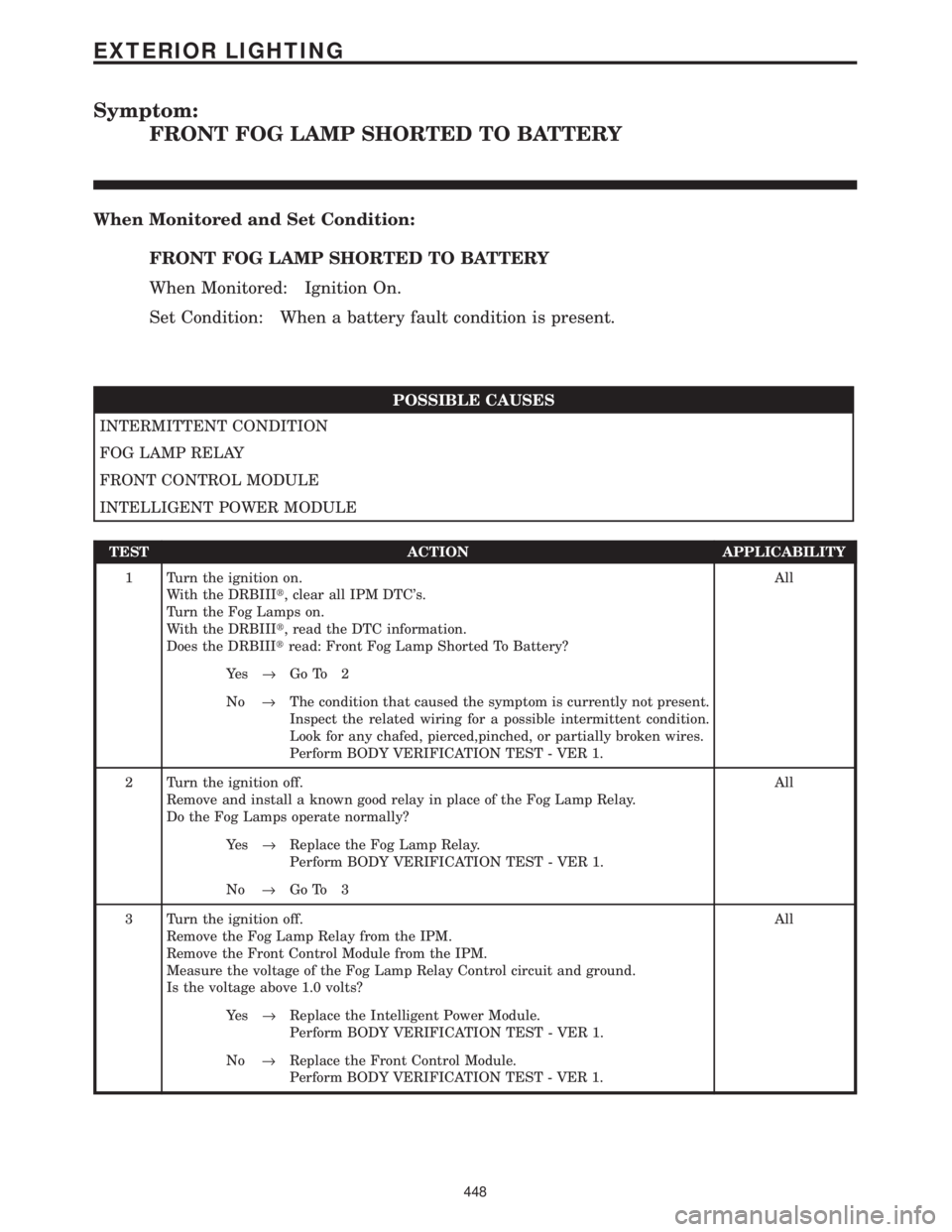
Symptom:
FRONT FOG LAMP SHORTED TO BATTERY
When Monitored and Set Condition:
FRONT FOG LAMP SHORTED TO BATTERY
When Monitored: Ignition On.
Set Condition: When a battery fault condition is present.
POSSIBLE CAUSES
INTERMITTENT CONDITION
FOG LAMP RELAY
FRONT CONTROL MODULE
INTELLIGENT POWER MODULE
TEST ACTION APPLICABILITY
1 Turn the ignition on.
With the DRBIIIt, clear all IPM DTC's.
Turn the Fog Lamps on.
With the DRBIIIt, read the DTC information.
Does the DRBIIItread: Front Fog Lamp Shorted To Battery?All
Ye s®Go To 2
No®The condition that caused the symptom is currently not present.
Inspect the related wiring for a possible intermittent condition.
Look for any chafed, pierced,pinched, or partially broken wires.
Perform BODY VERIFICATION TEST - VER 1.
2 Turn the ignition off.
Remove and install a known good relay in place of the Fog Lamp Relay.
Do the Fog Lamps operate normally?All
Ye s®Replace the Fog Lamp Relay.
Perform BODY VERIFICATION TEST - VER 1.
No®Go To 3
3 Turn the ignition off.
Remove the Fog Lamp Relay from the IPM.
Remove the Front Control Module from the IPM.
Measure the voltage of the Fog Lamp Relay Control circuit and ground.
Is the voltage above 1.0 volts?All
Ye s®Replace the Intelligent Power Module.
Perform BODY VERIFICATION TEST - VER 1.
No®Replace the Front Control Module.
Perform BODY VERIFICATION TEST - VER 1.
448
EXTERIOR LIGHTING
Page 543 of 4284

Symptom List:
A/C FAULT (STORED) - MANUAL A/C
BACKLIGHT DIMMING RX FAILURE (STORED) - MANUAL A/C
BLEND OVERCURRENT (STORED) - MANUAL A/C
CHECKSUM FAILURE (STORED) - MANUAL A/C
EVAPORATOR TEMPERATURE SENSOR CIRCUIT OPEN
(STORED) - MANUAL A/C
EVAPORATOR TEMPERATURE SENSOR CIRCUIT SHORT
(STORED) - MANUAL A/C
LOOPBACK FAILURE (STORED) - MANUAL A/C
LOOPBACK TEST FAILURE (STORED) - MANUAL A/C
MODE OVERCURRENT (STORED) - MANUAL A/C
NO BCM MESSAGE RECEIVED (STORED) - MANUAL A/C
NO PCM MESSAGE RECEIVED (STORED) - MANUAL A/C
PCM COMMUNICATION FAILURE (STORED) - MANUAL A/C
POWER FAULT (STORED) - MANUAL A/C
REAR BLEND OVERCURRENT (STORED) - MANUAL A/C
REAR BLEND POT CIRCUIT OPEN (STORED) - MANUAL A/C
REAR BLEND POT CIRCUIT SHORT (STORED) - MANUAL A/C
REAR DEFOG FAILURE (STORED) - MANUAL A/C
REAR MODE OVERCURRENT (STORED) - MANUAL A/C
RECIRC OVERCURRENT (STORED) - MANUAL A/C
RECIRCULATION FAULT (STORED) - MANUAL A/C
TX FAILURE (STORED) - MANUAL A/C
UNKNOWN FAULT DETECTED (STORED) - MANUAL A/C
VEHICLE ODOMETER FAILURE (STORED) - MANUAL A/C
ZONE OVERCURRENT (STORED) - MANUAL A/C
Test Note: All symptoms listed above are diagnosed using the same tests.
The title for the tests will be A/C FAULT (STORED) - MANUAL
A/C.
When Monitored and Set Condition:
A/C FAULT (STORED) - MANUAL A/C
When Monitored: With the ignition on.
Set Condition: This DTC will set if the A/C switch stays closed for 10 minutes.
BACKLIGHT DIMMING RX FAILURE (STORED) - MANUAL A/C
When Monitored: With the ignition on.
Set Condition: If the A/C - Heater Control Module does not receive the dimming function
message from the BCM for more than 5 seconds, then the A/C - Heater Control Module
LEDs will default to full brightness and the DTC will set.
514
HEATING & A/C
Page 596 of 4284

Symptom:
FRONT FOG LAMP INDICATOR OPEN
POSSIBLE CAUSES
INTERMITTENT WIRING AND CONNECTORS
FRONT FOG LAMP INDICATOR CIRCUIT OPEN
FRONT FOG LAMP INDICATOR GROUND CIRCUIT OPEN
FRONT FOG LAMP INDICATOR CIRCUIT SHORT TO VOLTAGE
HEADLAMP SWITCH
BODY CONTROL MODULE
TEST ACTION APPLICABILITY
1 Turn the ignition on.
With the DRBIIIt, record and erase Body Control Module DTC's.
Turn the ignition off, wait 15 seconds, then turn the ignition on.
Turn on the Front Fog Lamps.
With the DRBIIIt, read DTCs.
Does the DRBIIItdisplay FRONT FOG LAMP INDICATOR OPEN?All
Ye s®Go To 2
No®Go To 8
2 Turn the ignition off to the lock position.
Note: Check connectors - Clean/repair as necessary.
Ignition on, engine not running.
Turn ON the Front Fog Lamps.
Using a 12-volt test light connected to ground, back probe the Front Fog Lamp
Indicator circuit in the Headlamp Switch harness connector.
NOTE: The test light must illuminate brightly. Compare the brightness to
that of a direct connection to the battery.
Does the test light illuminate brightly?All
Ye s®Go To 3
No®Go To 6
3 Turn the ignition off to the lock position.
Disconnect the Body Control Module harness connector.
Disconnect the Headlamp Switch harness connector.
Note: Check connectors - Clean/repair as necessary.
Measure the resistance of the Front Fog Lamp Indicator Ground circuit from the
Body Control Module harness connector to the Headlamp Switch harness connector.
Is the resistance above 5.0 ohms?All
Ye s®Repair the Front Fog Lamp Indicator Ground circuit for an open.
Perform BODY VERIFICATION TEST - VER 1.
No®Go To 4
567
INSTRUMENT CLUSTER
Page 598 of 4284

Symptom:
FRONT FOG LAMP INDICATOR SHORT TO GROUND
POSSIBLE CAUSES
INTERMITTENT WIRING AND CONNECTORS
FRONT FOG LAMP INDICATOR CIRCUIT SHORT TO GROUND
HEADLAMP SWITCH
BODY CONTROL MODULE
TEST ACTION APPLICABILITY
1 Turn the ignition on.
With the DRBIIIt, record and erase Body Control Module DTC's.
Turn the ignition off, wait 15 seconds, then turn the ignition on.
With the DRBIIIt, read DTCs.
Does the DRBIIItdisplay FRONT FOG LAMP INDICATOR SHORT TO GROUND?All
Ye s®Go To 2
No®Go To 6
2 Turn the ignition off to the lock position.
Note: Check connectors - Clean/repair as necessary.
Ignition on, engine not running.
Turn ON the Front Fog Lamps.
Using a 12-volt test light connected to ground, back probe the Rear Fog Lamp
Indicator circuit in the Headlamp Switch harness connector.
NOTE: The test light must illuminate brightly. Compare the brightness to
that of a direct connection to the battery.
Does the test light illuminate brightly?All
Ye s®Go To 3
No®Go To 4
3 If there are no possible causes remaining, view repair. All
Repair
Replace the Headlamp Switch.
Perform BODY VERIFICATION TEST - VER 1.
4 Turn the ignition off to the lock position.
Disconnect the Body Control Module harness connector.
Disconnect the Headlamp Switch harness connector.
Note: Check connectors - Clean/repair as necessary.
Measure the resistance between ground and the Front Fog Lamp Indicator circuit.
Is the resistance below 5.0 ohms?All
Ye s®Repair the Front Fog Lamp Indicator circuit for a short to ground.
Perform BODY VERIFICATION TEST - VER 1.
No®Go To 5
5 If there are no possible causes remaining, view repair. All
Repair
Replace the Body Control Module.
Perform BODY VERIFICATION TEST - VER 1.
569
INSTRUMENT CLUSTER
Page 629 of 4284

Symptom:
REAR FOG INDICATOR OUTPUT OPEN
POSSIBLE CAUSES
INTERMITTENT WIRING AND CONNECTORS
REAR FOG LAMP INDICATOR CIRCUIT OPEN
REAR FOG LAMP INDICATOR GROUND CIRCUIT OPEN
REAR FOG LAMP INDICATOR CIRCUIT SHORT TO VOLTAGE
HEADLAMP SWITCH
BODY CONTROL MODULE
TEST ACTION APPLICABILITY
1 Turn the ignition on.
With the DRBIIIt, record and erase Body Control Module DTC's.
Turn the ignition off, wait 15 seconds, then turn the ignition on.
Turn on the Rear Fog Lamps.
With the DRBIIIt, read DTCs.
Does the DRBIIItdisplay REAR FOG LAMP INDICATOR OPEN?All
Ye s®Go To 2
No®Go To 8
2 Turn the ignition off to the lock position.
Note: Check connectors - Clean/repair as necessary.
Ignition on, engine not running.
Turn ON the Rear Fog Lamps.
Using a 12-volt test light connected to ground, back probe the Rear Fog Lamp
Indicator circuit in the Headlamp Switch harness connector.
NOTE: The test light must illuminate brightly. Compare the brightness to
that of a direct connection to the battery.
Does the test light illuminate brightly?All
Ye s®Go To 3
No®Go To 6
3 Turn the ignition off to the lock position.
Disconnect the Body Control Module harness connector.
Disconnect the Headlamp Switch harness connector.
Note: Check connectors - Clean/repair as necessary.
Measure the resistance of the Rear Fog Lamp Indicator Ground circuit from the Body
Control Module harness connector to the Headlamp Switch harness connector.
Is the resistance above 5.0 ohms?All
Ye s®Repair the Rear Fog Lamp Indicator Ground circuit for an open.
Perform BODY VERIFICATION TEST - VER 1.
No®Go To 4
600
INSTRUMENT CLUSTER
Page 631 of 4284

Symptom:
REAR FOG INDICATOR OUTPUT SHORT
POSSIBLE CAUSES
INTERMITTENT WIRING AND CONNECTORS
REAR FOG LAMP INDICATOR CIRCUIT SHORT TO GROUND
HEADLAMP SWITCH
BODY CONTROL MODULE
TEST ACTION APPLICABILITY
1 Turn the ignition on.
With the DRBIIIt, record and erase Body Control Module DTC's.
Turn the ignition off, wait 15 seconds, then turn the ignition on.
With the DRBIIIt, read DTCs.
Does the DRBIIItdisplay REAR FOG LAMP INDICATOR SHORT TO GROUND?All
Ye s®Go To 2
No®Go To 6
2 Turn the ignition off to the lock position.
Note: Check connectors - Clean/repair as necessary.
Ignition on, engine not running.
Turn ON the Rear Fog Lamps.
Using a 12-volt test light connected to ground, back probe the Rear Fog Lamp
Indicator circuit in the Headlamp Switch harness connector.
NOTE: The test light must illuminate brightly. Compare the brightness to
that of a direct connection to the battery.
Does the test light illuminate brightly?All
Ye s®Go To 3
No®Go To 4
3 If there are no possible causes remaining, view repair. All
Repair
Replace the Headlamp Switch.
Perform BODY VERIFICATION TEST - VER 1.
4 Turn the ignition off to the lock position.
Disconnect the Body Control Module harness connector.
Disconnect the Headlamp Switch harness connector.
Note: Check connectors - Clean/repair as necessary.
Measure the resistance between ground and the Rear Fog Lamp Indicator circuit.
Is the resistance below 5.0 ohms?All
Ye s®Repair the Rear Fog Lamp Indicator circuit for a short to ground.
Perform BODY VERIFICATION TEST - VER 1.
No®Go To 5
5 If there are no possible causes remaining, view repair. All
Repair
Replace the Body Control Module.
Perform BODY VERIFICATION TEST - VER 1.
602
INSTRUMENT CLUSTER
Page 1473 of 4284

FASTENER IDENTIFICATION
DESCRIPTION
The SAE bolt strength grades range from grade 2
to grade 8. The higher the grade number, the greater
the bolt strength. Identification is determined by the
line marks on the top of each bolt head. The actual
bolt strength grade corresponds to the number of line
marks plus 2. The most commonly used metric bolt
strength classes are 9.8 and 10.9. The metric
strength class identification number is imprinted on
the head of the bolt. The higher the class number,
the greater the bolt strength. Some metric nuts are
imprinted with a single-digit strength class on the
nut face. Refer to the Fastener Identification and
Fastener Strength Charts.
FASTENER USAGE
DESCRIPTION - FASTENER USAGE
WARNING: USE OF AN INCORRECT FASTENER
MAY RESULT IN COMPONENT DAMAGE OR PER-
SONAL INJURY.
Figure art, specifications and torque references in
this Service Manual are identified in metric and SAE
format.
During any maintenance or repair procedures, it is
important to salvage all fasteners (nuts, bolts, etc.)
for reassembly. If the fastener is not salvageable, a
fastener of equivalent specification must be used.
International Symbols
1 High Beam 13 Rear Window Washer
2 Fog Lamps 14 Fuel
3 Headlamp, Parking Lamps, Panel Lamps 15 Engine Coolant Temperature
4 Turn Warning 16 Battery Charging Condition
5 Hazard Warning 17 Engine Oil
6 Windshield Washer 18 Seat Belt
7 Windshield Wiper 19 Brake Failure
8 Windshield Wiper and Washer 20 Parking Brake
9 Windscreen Demisting and Defrosting 21 Front Hood
10 Ventilating Fan 22 Rear hood (Decklid)
11 Rear Window Defogger 23 Horn
12 Rear Window Wiper 24 Lighter
RSINTRODUCTION5
INTERNATIONAL SYMBOLS (Continued)
Page 1483 of 4284

FASTENER USAGE
DESCRIPTION
WARNING: USE OF AN INCORRECT FASTENER
MAY RESULT IN COMPONENT DAMAGE OR PER-
SONAL INJURY.
Figure art, specifications and torque references in
this Service Manual are identified in metric and SAE
format.
During any maintenance or repair procedures, it is
important to salvage all fasteners (nuts, bolts, etc.)
for reassembly. If the fastener is not salvageable, a
fastener of equivalent specification must be used.
THREADED HOLE REPAIR
DESCRIPTION
Most stripped threaded holes can be repaired using
a Helicoilt. Follow the vehicle or Helicoiltrecommen-
dations for application and repair procedures.
INTERNATIONAL VEHICLE
CONTROL & DISPLAY
SYMBOLS
DESCRIPTION
The graphic symbols illustrated in the following
International Control and Display Symbols Chart
(Fig. 4) are used to identify various instrument con-
trols. The symbols correspond to the controls and dis-
plays that are located on the instrument panel.
Fig. 4 INTERNATIONAL CONTROL AND DISPLAY SYMBOLS
1 High Beam 13 Rear Window Washer
2 Fog Lamps 14 Fuel
3 Headlamp, Parking Lamps, Panel Lamps 15 Engine Coolant Temperature
4 Turn Warning 16 Battery Charging Condition
5 Hazard Warning 17 Engine Oil
6 Windshield Washer 18 Seat Belt
7 Windshield Wiper 19 Brake Failure
8 Windshield Wiper and Washer 20 Parking Brake
9 Windscreen Demisting and Defrosting 21 Front Hood
10 Ventilating Fan 22 Rear hood (Decklid)
11 Rear Window Defogger 23 Horn
12 Rear Window Wiper 24 Lighter
RGINTRODUCTION5a
Page 1830 of 4284

²Front Fog Lamp Relay Actuation
²Front and Rear Blower Motor Relay Actuation
²Accessory Relay Actuation
²Electronic Back Light (EBL) Rear Defogger
²Horn Relay Actuation
²Park Lamp Relay Actuation
²Name Brand Speaker (NBS) Relay Actuation
²Headlamp Washer Relay Actuation
²Diesel Cabin Heater (Diesel Engine Vehicles)
The following inputs areReceived/Monitoredby
the Front Control Module:
²B+ Connection Detection
²Ambient Temperature Sensing
²Right/Left Park Lamp Outage
²Ignition Switch Start Only
²Ignition Switch Run and Start Only
²Washer Fluid Level
²Windshield Wiper Park
²Brake Fluid Level
²Back-Up switch
²Stop Lamp Sense
²Engine Crank Signal (Diesel Engine Vehicles)
²Horn Input
DIAGNOSIS AND TESTING - FRONT CONTROL
MODULE
The front control module is a printed circuit board
based module with a on-board micro-processor. The
front control module interfaces with other electronic
modules in the vehicle via the Programmable Com-
munications Interface (PCI) data bus (J1850). In
order to obtain conclusive testing the Programmable
Communications Interface (PCI) data bus network
and all of the electronic modules that provide inputs
to, or receive outputs from the front control module
must be checked. All PCI (J1850) communication
faults must be resolved prior to further diagnosing
any front control module related issues.
The front control module was designed to be diag-
nosed with an appropriate diagnostic scan tool, such
as the DRB IIIt. The most reliable, efficient, and
accurate means to diagnose the front control module
requires the use of a DRB IIItscan tool and the
proper Body Diagnostic Procedures manual.
Before any testing of the front control module is
attempted, the battery should be fully charged and
all wire harness and ground connections inspected
around the affected areas on the vehicle.
REMOVAL
(1) Disconnect the positive and negative battery
cables from the battery.
(2) Remove the battery from the vehicle. Refer to
the procedure in Battery Systems.(3) Using a long flat-pladed screwdriver, gently
twist the Intelligent Power Module (IPM) retaining
clip outboard to free the intelligent power module
from its mounting bracket (Fig. 6). Rotate intelligent
power module upward to access the Front Control
Module (FCM) retaining screws.
(4) Remove the front control module retaining
screws.
(5) Using both hands, pull the front control module
straight from the intelligent power module assembly
to disconnect the 49-way electrical connector (Fig. 7)
and remove the front control module from the vehi-
cle.
INSTALLATION
(1) Install the front control module in the intelli-
gent power module assembly by pushing the 49-way
electrical connector straight in (Fig. 7).
(2) Install the front control module retaining
screws. Torque the screws to 7 in. lbs.
(3) Rotate the intelligent power module assembly
downward to secure in mounting bracket.
(4) Install the battery in the vehicle. Refer to the
procedure in Battery Systems.
(5) Connect the positive and negative battery
cables.
NOTE: If the vehicle is not equipped with Name
Brand Speakers (NBS, Infinity) or Headlamp Wash-
ers the DRB IIITmust be used to Disable the appro-
priate relays in the Intelligent Power Module
Assembly.
Fig. 6 REMOVING INTELLIGENT POWER MODULE
8E - 6 ELECTRONIC CONTROL MODULESRS
FRONT CONTROL MODULE (Continued)
Page 1899 of 4284
WINDSHIELD GRID
DIAGNOSIS AND TESTING - SYSTEM TEST
Electrically heated rear window defogger or the
heated windshield wiper deicer operation can be
checked on the vehicle in the following manner:
(1) Turn the ignition switch to the ON position.
(2) Using a ammeter on the battery, turn the rear
defogger control switch to the ON position, a distinct
increase in amperage draw should be noted.
(3) The rear window defogger or the heated wind-
shield wiper deicer operation can be checked by feel-
ing the glass. A distinct difference in temperature
between the grid lines and adjacent clear glass can
be detected in 3 to 4 minutes of operation.
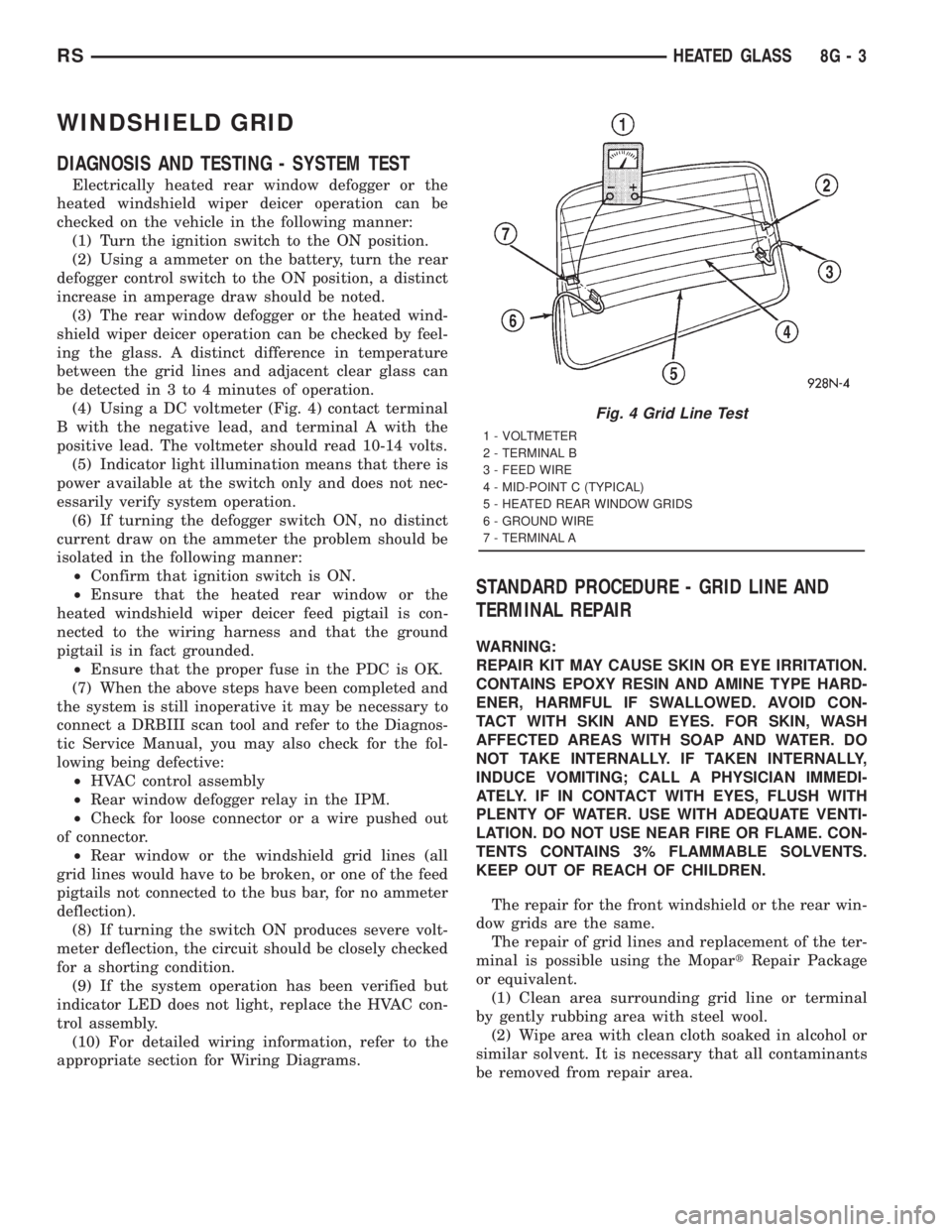
(4) Using a DC voltmeter (Fig. 4) contact terminal
B with the negative lead, and terminal A with the
positive lead. The voltmeter should read 10-14 volts.
(5) Indicator light illumination means that there is
power available at the switch only and does not nec-
essarily verify system operation.
(6) If turning the defogger switch ON, no distinct
current draw on the ammeter the problem should be
isolated in the following manner:
²Confirm that ignition switch is ON.
²Ensure that the heated rear window or the
heated windshield wiper deicer feed pigtail is con-
nected to the wiring harness and that the ground
pigtail is in fact grounded.
²Ensure that the proper fuse in the PDC is OK.
(7) When the above steps have been completed and
the system is still inoperative it may be necessary to
connect a DRBIII scan tool and refer to the Diagnos-
tic Service Manual, you may also check for the fol-
lowing being defective:
²HVAC control assembly
²Rear window defogger relay in the IPM.
²Check for loose connector or a wire pushed out
of connector.
²Rear window or the windshield grid lines (all
grid lines would have to be broken, or one of the feed
pigtails not connected to the bus bar, for no ammeter
deflection).
(8) If turning the switch ON produces severe volt-
meter deflection, the circuit should be closely checked
for a shorting condition.
(9) If the system operation has been verified but
indicator LED does not light, replace the HVAC con-
trol assembly.
(10) For detailed wiring information, refer to the
appropriate section for Wiring Diagrams.
STANDARD PROCEDURE - GRID LINE AND
TERMINAL REPAIR
WARNING:
REPAIR KIT MAY CAUSE SKIN OR EYE IRRITATION.
CONTAINS EPOXY RESIN AND AMINE TYPE HARD-
ENER, HARMFUL IF SWALLOWED. AVOID CON-
TACT WITH SKIN AND EYES. FOR SKIN, WASH
AFFECTED AREAS WITH SOAP AND WATER. DO
NOT TAKE INTERNALLY. IF TAKEN INTERNALLY,
INDUCE VOMITING; CALL A PHYSICIAN IMMEDI-
ATELY. IF IN CONTACT WITH EYES, FLUSH WITH
PLENTY OF WATER. USE WITH ADEQUATE VENTI-
LATION. DO NOT USE NEAR FIRE OR FLAME. CON-
TENTS CONTAINS 3% FLAMMABLE SOLVENTS.
KEEP OUT OF REACH OF CHILDREN.
The repair for the front windshield or the rear win-
dow grids are the same.
The repair of grid lines and replacement of the ter-
minal is possible using the MopartRepair Package
or equivalent.
(1) Clean area surrounding grid line or terminal
by gently rubbing area with steel wool.
(2) Wipe area with clean cloth soaked in alcohol or
similar solvent. It is necessary that all contaminants
be removed from repair area.
Fig. 4 Grid Line Test
1 - VOLTMETER
2 - TERMINAL B
3 - FEED WIRE
4 - MID-POINT C (TYPICAL)
5 - HEATED REAR WINDOW GRIDS
6 - GROUND WIRE
7 - TERMINAL A
RSHEATED GLASS8G-3