instrument panel CHRYSLER VOYAGER 2001 User Guide
[x] Cancel search | Manufacturer: CHRYSLER, Model Year: 2001, Model line: VOYAGER, Model: CHRYSLER VOYAGER 2001Pages: 4284, PDF Size: 83.53 MB
Page 46 of 4284
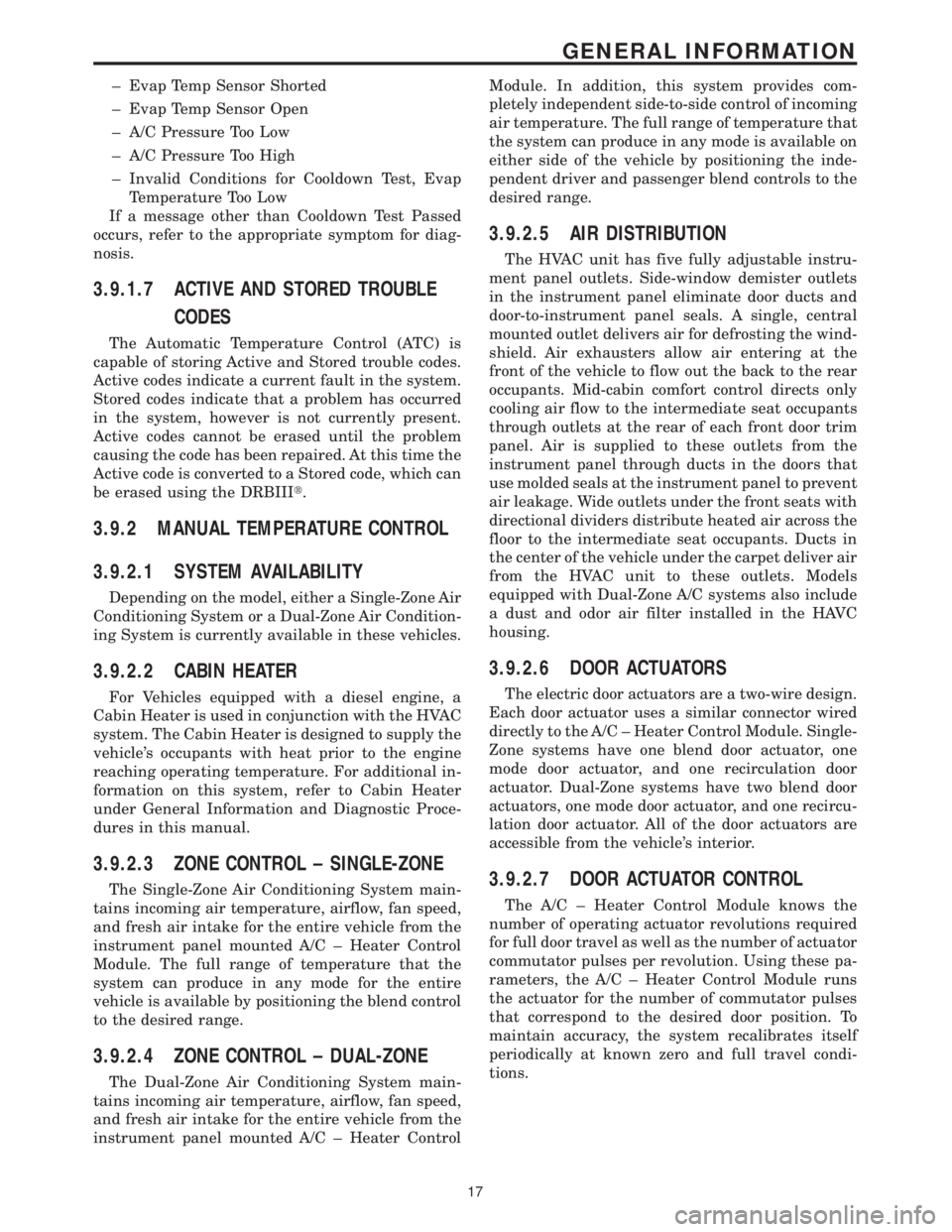
± Evap Temp Sensor Shorted
± Evap Temp Sensor Open
± A/C Pressure Too Low
± A/C Pressure Too High
± Invalid Conditions for Cooldown Test, Evap
Temperature Too Low
If a message other than Cooldown Test Passed
occurs, refer to the appropriate symptom for diag-
nosis.
3.9.1.7 ACTIVE AND STORED TROUBLE
CODES
The Automatic Temperature Control (ATC) is
capable of storing Active and Stored trouble codes.
Active codes indicate a current fault in the system.
Stored codes indicate that a problem has occurred
in the system, however is not currently present.
Active codes cannot be erased until the problem
causing the code has been repaired. At this time the
Active code is converted to a Stored code, which can
be erased using the DRBIIIt.
3.9.2 MANUAL TEMPERATURE CONTROL
3.9.2.1 SYSTEM AVAILABILITY
Depending on the model, either a Single-Zone Air
Conditioning System or a Dual-Zone Air Condition-
ing System is currently available in these vehicles.
3.9.2.2 CABIN HEATER
For Vehicles equipped with a diesel engine, a
Cabin Heater is used in conjunction with the HVAC
system. The Cabin Heater is designed to supply the
vehicle's occupants with heat prior to the engine
reaching operating temperature. For additional in-
formation on this system, refer to Cabin Heater
under General Information and Diagnostic Proce-
dures in this manual.
3.9.2.3 ZONE CONTROL ± SINGLE-ZONE
The Single-Zone Air Conditioning System main-
tains incoming air temperature, airflow, fan speed,
and fresh air intake for the entire vehicle from the
instrument panel mounted A/C ± Heater Control
Module. The full range of temperature that the
system can produce in any mode for the entire
vehicle is available by positioning the blend control
to the desired range.
3.9.2.4 ZONE CONTROL ± DUAL-ZONE
The Dual-Zone Air Conditioning System main-
tains incoming air temperature, airflow, fan speed,
and fresh air intake for the entire vehicle from the
instrument panel mounted A/C ± Heater ControlModule. In addition, this system provides com-
pletely independent side-to-side control of incoming
air temperature. The full range of temperature that
the system can produce in any mode is available on
either side of the vehicle by positioning the inde-
pendent driver and passenger blend controls to the
desired range.
3.9.2.5 AIR DISTRIBUTION
The HVAC unit has five fully adjustable instru-
ment panel outlets. Side-window demister outlets
in the instrument panel eliminate door ducts and
door-to-instrument panel seals. A single, central
mounted outlet delivers air for defrosting the wind-
shield. Air exhausters allow air entering at the
front of the vehicle to flow out the back to the rear
occupants. Mid-cabin comfort control directs only
cooling air flow to the intermediate seat occupants
through outlets at the rear of each front door trim
panel. Air is supplied to these outlets from the
instrument panel through ducts in the doors that
use molded seals at the instrument panel to prevent
air leakage. Wide outlets under the front seats with
directional dividers distribute heated air across the
floor to the intermediate seat occupants. Ducts in
the center of the vehicle under the carpet deliver air
from the HVAC unit to these outlets. Models
equipped with Dual-Zone A/C systems also include
a dust and odor air filter installed in the HAVC
housing.
3.9.2.6 DOOR ACTUATORS
The electric door actuators are a two-wire design.
Each door actuator uses a similar connector wired
directly to the A/C ± Heater Control Module. Single-
Zone systems have one blend door actuator, one
mode door actuator, and one recirculation door
actuator. Dual-Zone systems have two blend door
actuators, one mode door actuator, and one recircu-
lation door actuator. All of the door actuators are
accessible from the vehicle's interior.
3.9.2.7 DOOR ACTUATOR CONTROL
The A/C ± Heater Control Module knows the
number of operating actuator revolutions required
for full door travel as well as the number of actuator
commutator pulses per revolution. Using these pa-
rameters, the A/C ± Heater Control Module runs
the actuator for the number of commutator pulses
that correspond to the desired door position. To
maintain accuracy, the system recalibrates itself
periodically at known zero and full travel condi-
tions.
17
GENERAL INFORMATION
Page 548 of 4284

Symptom List:
BACKLIGHT DIMMING RX FAILURE (ACTIVE) - MANUAL A/C
NO BCM MESSAGE RECEIVED (ACTIVE) - MANUAL A/C
Test Note: All symptoms listed above are diagnosed using the same tests.
The title for the tests will be BACKLIGHT DIMMING RX
FAILURE (ACTIVE) - MANUAL A/C.
When Monitored and Set Condition:
BACKLIGHT DIMMING RX FAILURE (ACTIVE) - MANUAL A/C
When Monitored: With the ignition on.
Set Condition: If the A/C - Heater Control Module does not receive the dimming function
message from the BCM for more than 5 seconds, then the A/C - Heater Control Module
LEDs will default to full brightness and the DTC will set.
NO BCM MESSAGE RECEIVED (ACTIVE) - MANUAL A/C
When Monitored: With the igntion on.
Set Condition: If the A/C - Heater Control Module does not receive the dimming function
message from the BCM for more than 5 seconds, then the A/C - Heater Control Module
LEDs will default to full brightness and the DTC will set.
POSSIBLE CAUSES
ADDITIONAL CODE(S) PRESENT
A/C - HEATER CONTROL MODULE
BODY CONTROL MODULE - NO DIM MESSAGE TO A/C - HEATER CONTROL MODULE
TEST ACTION APPLICABILITY
1 Turn the ignition on.
With the DRBIIIt, read the BCM codes.
Does DRBIIItdisplay Headlamp Switch: Mismatch; STG; Open; or Panel Dim
Output Short?All
Ye s®Refer to symptoms Headlamp Switch Mismatch, Headlamp
Switch Shorted To Ground, and Headlamp Switch Open in the
Exterior Lighting catagory. Refer to symptom Panel Dimming
Output Short in the Instrument Cluster catagory.
Perform BODY VERIFICATION TEST - VER 1.
No®Go To 2
519
HEATING & A/C
Page 594 of 4284

Symptom:
EL PANEL SHORT
POSSIBLE CAUSES
CHECK EXTERIOR ILLUMINATION
CHECK OPERATION OF ALL GAUGES
VERIFY CONCERN
PANEL LAMP DRIVER CIRCUIT SHORT TO GROUND
PANEL LAMP DRIVER OPEN CIRCUIT
OPEN GROUND CIRCUIT
BCM PANEL LAMP DRIVER CIRCUIT INTERNAL FAILURE
INSTRUMENT CLUSTER PANEL LAMPS DRIVER INTERNAL FAILURE
TEST ACTION APPLICABILITY
1 Ignition on, engine not running.
Turn the Headlamp Switch to the ON position.
Monitor the Instrument Cluster gauges for illumination.
Are any Instrument Cluster gauges illuminated?All
Ye s®Go To 3
No®Go To 2
2 Ignition on, engine not running.
Turn the Headlamp Switch to the ON position.
Monitor the Instrument Cluster gauges for illumination.
Are all of the Instrument Cluster gauges illuminated?All
Ye s®Go To 3
No®Replace the Instrument Cluster.
Perform BODY VERIFICATION TEST - VER 1.
3 Ignition on, engine not running.
Turn the headlamp switch to the ON position.
Monitor the Headlamps for illumination.
Are the Headlamps illuminated?All
Ye s®Go To 4
No®Refer to EXTERIOR ILLUMINATION for the related symp-
tom(s).
Perform BODY VERIFICATION TEST - VER 1.
4 Ignition on, engine not running.
With the DRBIIIt, erase DTCs.
Cycle the ignition switch from OFF to ON.
Wait 1 to 2 minutes for the system to cycle.
With the DRBIIIt, read DTCs.
Did the DTC reset?All
Ye s®Go To 5
No®Perform the Instrument Cluster Self-Test and verify the concern.
Perform BODY VERIFICATION TEST - VER 1.
565
INSTRUMENT CLUSTER
Page 595 of 4284
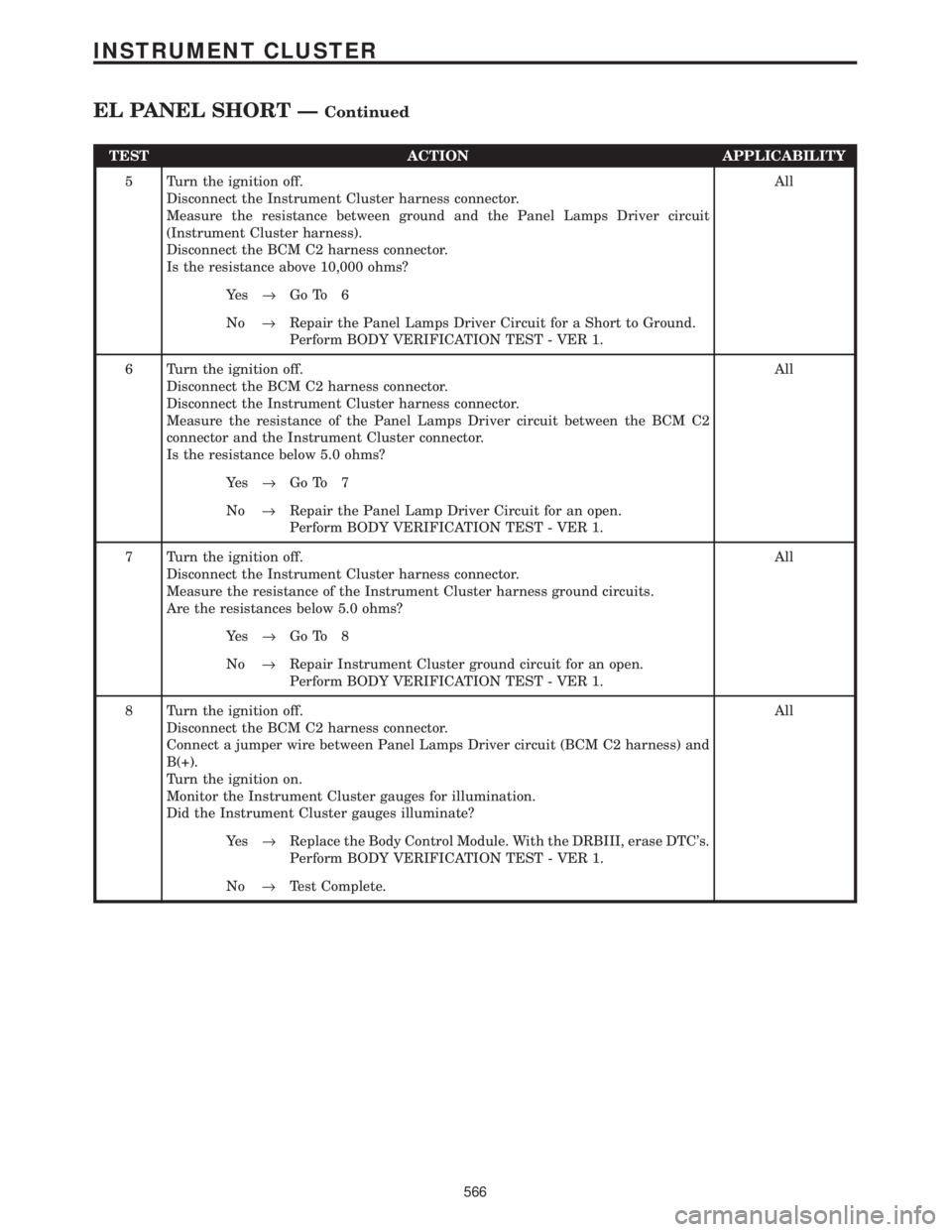
TEST ACTION APPLICABILITY
5 Turn the ignition off.
Disconnect the Instrument Cluster harness connector.
Measure the resistance between ground and the Panel Lamps Driver circuit
(Instrument Cluster harness).
Disconnect the BCM C2 harness connector.
Is the resistance above 10,000 ohms?All
Ye s®Go To 6
No®Repair the Panel Lamps Driver Circuit for a Short to Ground.
Perform BODY VERIFICATION TEST - VER 1.
6 Turn the ignition off.
Disconnect the BCM C2 harness connector.
Disconnect the Instrument Cluster harness connector.
Measure the resistance of the Panel Lamps Driver circuit between the BCM C2
connector and the Instrument Cluster connector.
Is the resistance below 5.0 ohms?All
Ye s®Go To 7
No®Repair the Panel Lamp Driver Circuit for an open.
Perform BODY VERIFICATION TEST - VER 1.
7 Turn the ignition off.
Disconnect the Instrument Cluster harness connector.
Measure the resistance of the Instrument Cluster harness ground circuits.
Are the resistances below 5.0 ohms?All
Ye s®Go To 8
No®Repair Instrument Cluster ground circuit for an open.
Perform BODY VERIFICATION TEST - VER 1.
8 Turn the ignition off.
Disconnect the BCM C2 harness connector.
Connect a jumper wire between Panel Lamps Driver circuit (BCM C2 harness) and
B(+).
Turn the ignition on.
Monitor the Instrument Cluster gauges for illumination.
Did the Instrument Cluster gauges illuminate?All
Ye s®Replace the Body Control Module. With the DRBIII, erase DTC's.
Perform BODY VERIFICATION TEST - VER 1.
No®Test Complete.
566
INSTRUMENT CLUSTER
EL PANEL SHORT ÐContinued
Page 624 of 4284

Symptom:
PANEL DIMMING OUTPUT SHORT
POSSIBLE CAUSES
INTERMITTENT WIRING AND CONNECTORS
EMIC DIMMING CIRCUIT SHORT TO GROUND
HEADLAMP SWITCH DIMMING CIRCUIT SHORT TO GROUND
HVAC MODULE DIMMING CIRCUIT SHORT TO GROUND
I/P MULTI-FUNCTION SWITCH DIMMING CIRCUIT SHORT TO GROUND
MIRROR SWITCH DIMMING CIRCUIT SHORT TO GROUND
RADIO DIMMING CIRCUIT SHORT TO GROUND
REAR BLOWER CONTROL SWITCH DIMMING CIRCUIT SHORT TO GROUND
EMIC
HEADLAMP SWITCH
I/P MULTI-FUNCTION SWITCH
MIRROR SWITCH
RADIO
REAR BLOWER CONTROL SWITCH
BODY CONTROL MODULE
HVAC MODULE
TEST ACTION APPLICABILITY
1 Turn the ignition on.
With the DRBIIIt, record and erase Body Control Module DTC's.
Turn the ignition off, wait 15 seconds, then turn the ignition on.
Turn on the Headlamps.
With the DRBIIIt, read DTCs.
Does the DRBIIItdisplay PANEL DIMMING OUTPUT SHORT?All
Ye s®Go To 2
No®Go To 17
2 Turn the ignition on.
With the DRBIIIt, erase Body Control Module DTCs.
Turn the ignition off to the lock position.
Disconnect the EMIC harness connector.
Turn the ignition on.
Turn the Headlamps on.
With the DRBIIIt, read DTCs.
Does the DRBIIItdisplay PANEL DIMMING OUTPUT SHORT?All
Ye s®Go To 3
No®Replace the EMIC in accordance with the Service Information.
Perform BODY VERIFICATION TEST - VER 1.
595
INSTRUMENT CLUSTER
Page 625 of 4284

TEST ACTION APPLICABILITY
3 Turn the ignition on.
With the DRBIIIt, erase Body Control Module DTCs.
Turn the ignition off to the lock position.
Disconnect the Headlamp Switch harness connector.
Turn the ignition on.
With the DRBIIIt, read DTCs.
Does the DRBIIItdisplay PANEL DIMMING OUTPUT SHORT?All
Ye s®Go To 4
No®Replace the Headlamp Switch in accordance with the Service
Information.
Perform BODY VERIFICATION TEST - VER 1.
4 Turn the ignition on.
With the DRBIIIt, erase Body Control Module DTCs.
Turn the ignition off to the lock position.
Disconnect the I/P Multi-Function Switch harness connector.
Turn the ignition on.
Turn the Headlamps on.
With the DRBIIIt, read DTCs.
Does the DRBIIItdisplay PANEL DIMMING OUTPUT SHORT?All
Ye s®Go To 5
No®Replace the I/P Multi-Function Switch in accordance with the
Service Information.
Perform BODY VERIFICATION TEST - VER 1.
5 Turn the ignition on.
With the DRBIIIt, erase Body Control Module DTCs.
Turn the ignition off to the lock position.
Disconnect the Mirror Switch harness connector.
Turn the ignition on.
Turn the Headlamps on.
With the DRBIIIt, read DTCs.
Does the DRBIIItdisplay PANEL DIMMING OUTPUT SHORT?All
Ye s®Go To 6
No®Replace the Mirror Switch in accordance with the Service Infor-
mation.
Perform BODY VERIFICATION TEST - VER 1.
6 Turn the ignition on.
With the DRBIIIt, erase Body Control Module DTCs.
Turn the ignition off to the lock position.
Disconnect the Rear Blower Control Switch harness connector.
Turn the ignition on.
Turn the Headlamps on.
With the DRBIIIt, read DTCs.
Does the DRBIIItdisplay PANEL DIMMING OUTPUT SHORT?All
Ye s®Go To 7
No®Replace the Rear Blower Control Switch in accordance with the
Service Information.
Perform BODY VERIFICATION TEST - VER 1.
596
INSTRUMENT CLUSTER
PANEL DIMMING OUTPUT SHORT ÐContinued
Page 626 of 4284

TEST ACTION APPLICABILITY
7 Turn the ignition on.
With the DRBIIIt, erase Body Control Module DTCs.
Turn the ignition off to the lock position.
Disconnect the HVAC Module harness connector.
Turn the ignition on.
Turn the Headlamps on.
With the DRBIIIt, read DTCs.
Does the DRBIIItdisplay PANEL DIMMING OUTPUT SHORT?All
Ye s®Go To 8
No®Replace the HVAC Module in accordance with the Service Infor-
mation.
Perform BODY VERIFICATION TEST - VER 1.
8 Turn the ignition on.
With the DRBIIIt, erase Body Control Module DTCs.
Turn the ignition off to the lock position.
Disconnect the Radio harness connector.
Turn the ignition on.
Turn the Headlamps on.
With the DRBIIIt, read DTCs.
Does the DRBIIItdisplay PANEL DIMMING OUTPUT SHORT?All
Ye s®Go To 9
No®Replace the Radio in accordance with the Service Information.
Perform BODY VERIFICATION TEST - VER 1.
9 Turn the ignition off to the lock position.
Disconnect the Body Control Module harness connector.
Disconnect the EMIC harness connector.
Note: Check connectors - Clean/repair as necessary.
Measure the resistance between ground and the EMIC Dimming circuit.
Is the resistance below 5.0 ohms?All
Ye s®Repair the EMIC Dimming circuit for a short to ground.
Perform BODY VERIFICATION TEST - VER 1.
No®Go To 10
10 Turn the ignition off to the lock position.
Disconnect the Body Control Module harness connector.
Disconnect the Headlamp Switch harness connector.
Note: Check connectors - Clean/repair as necessary.
Measure the resistance between ground and the Headlamp Switch Dimming circuit.
Is the resistance below 5.0 ohms?All
Ye s®Repair the Headlamp Switch Dimming circuit for a short to
ground.
Perform BODY VERIFICATION TEST - VER 1.
No®Go To 11
597
INSTRUMENT CLUSTER
PANEL DIMMING OUTPUT SHORT ÐContinued
Page 627 of 4284
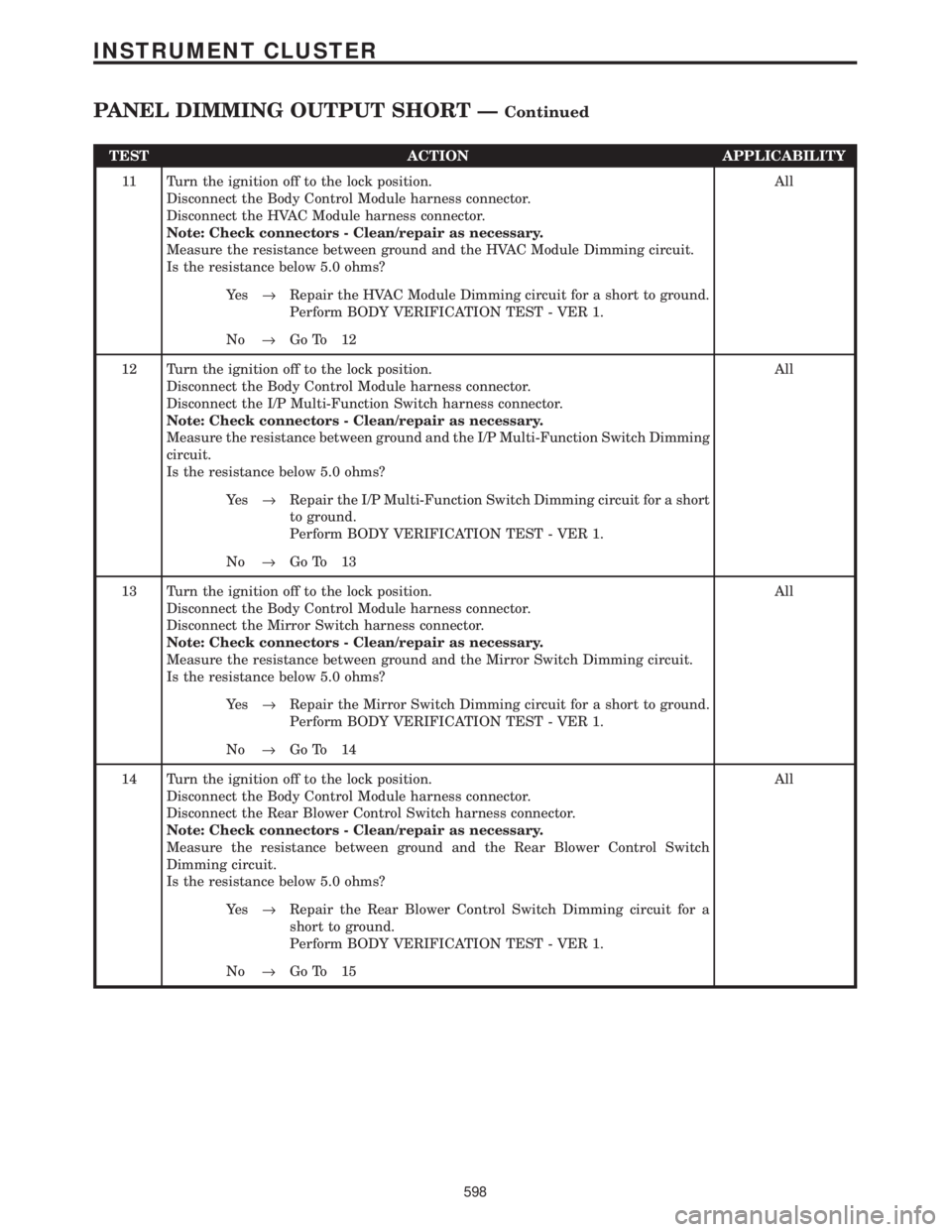
TEST ACTION APPLICABILITY
11 Turn the ignition off to the lock position.
Disconnect the Body Control Module harness connector.
Disconnect the HVAC Module harness connector.
Note: Check connectors - Clean/repair as necessary.
Measure the resistance between ground and the HVAC Module Dimming circuit.
Is the resistance below 5.0 ohms?All
Ye s®Repair the HVAC Module Dimming circuit for a short to ground.
Perform BODY VERIFICATION TEST - VER 1.
No®Go To 12
12 Turn the ignition off to the lock position.
Disconnect the Body Control Module harness connector.
Disconnect the I/P Multi-Function Switch harness connector.
Note: Check connectors - Clean/repair as necessary.
Measure the resistance between ground and the I/P Multi-Function Switch Dimming
circuit.
Is the resistance below 5.0 ohms?All
Ye s®Repair the I/P Multi-Function Switch Dimming circuit for a short
to ground.
Perform BODY VERIFICATION TEST - VER 1.
No®Go To 13
13 Turn the ignition off to the lock position.
Disconnect the Body Control Module harness connector.
Disconnect the Mirror Switch harness connector.
Note: Check connectors - Clean/repair as necessary.
Measure the resistance between ground and the Mirror Switch Dimming circuit.
Is the resistance below 5.0 ohms?All
Ye s®Repair the Mirror Switch Dimming circuit for a short to ground.
Perform BODY VERIFICATION TEST - VER 1.
No®Go To 14
14 Turn the ignition off to the lock position.
Disconnect the Body Control Module harness connector.
Disconnect the Rear Blower Control Switch harness connector.
Note: Check connectors - Clean/repair as necessary.
Measure the resistance between ground and the Rear Blower Control Switch
Dimming circuit.
Is the resistance below 5.0 ohms?All
Ye s®Repair the Rear Blower Control Switch Dimming circuit for a
short to ground.
Perform BODY VERIFICATION TEST - VER 1.
No®Go To 15
598
INSTRUMENT CLUSTER
PANEL DIMMING OUTPUT SHORT ÐContinued
Page 628 of 4284
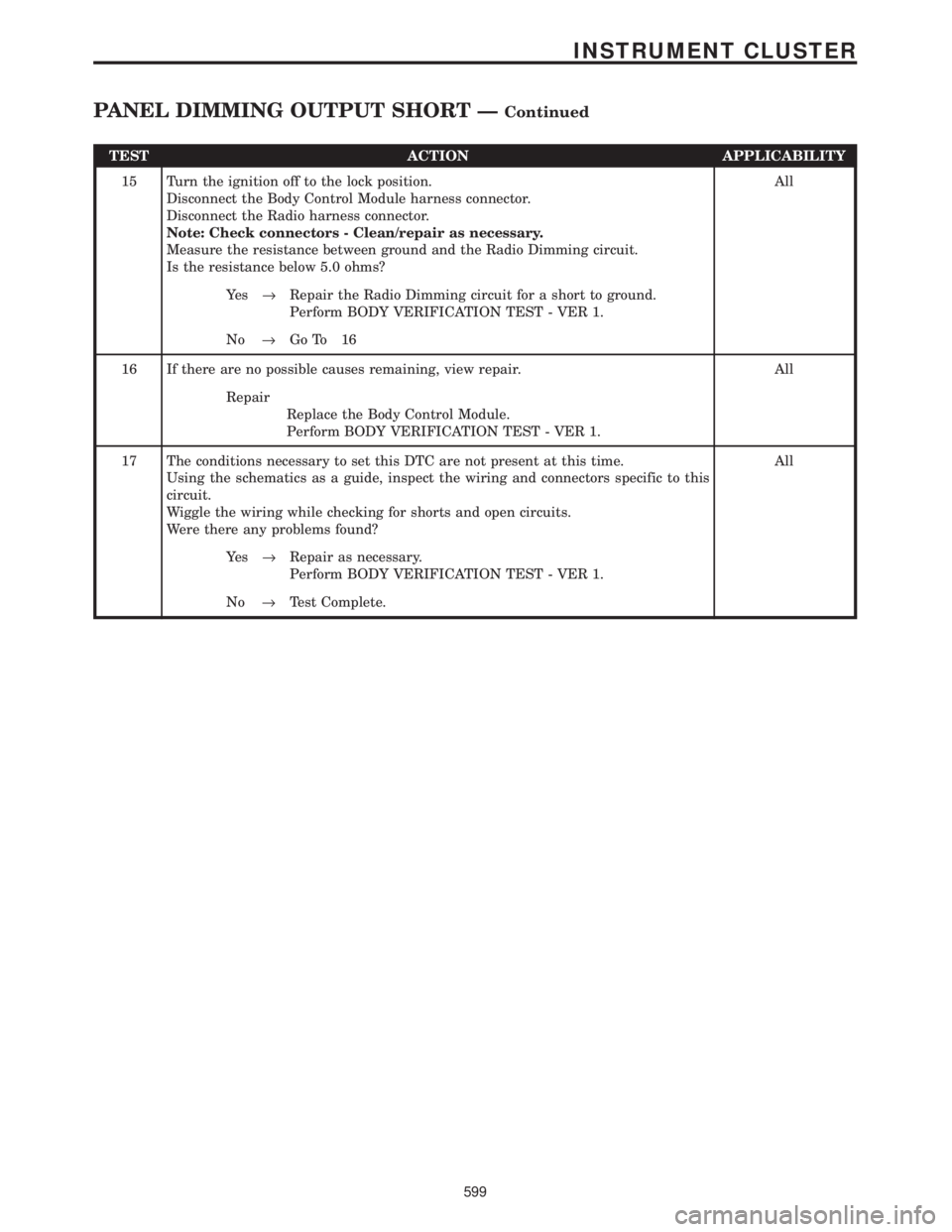
TEST ACTION APPLICABILITY
15 Turn the ignition off to the lock position.
Disconnect the Body Control Module harness connector.
Disconnect the Radio harness connector.
Note: Check connectors - Clean/repair as necessary.
Measure the resistance between ground and the Radio Dimming circuit.
Is the resistance below 5.0 ohms?All
Ye s®Repair the Radio Dimming circuit for a short to ground.
Perform BODY VERIFICATION TEST - VER 1.
No®Go To 16
16 If there are no possible causes remaining, view repair. All
Repair
Replace the Body Control Module.
Perform BODY VERIFICATION TEST - VER 1.
17 The conditions necessary to set this DTC are not present at this time.
Using the schematics as a guide, inspect the wiring and connectors specific to this
circuit.
Wiggle the wiring while checking for shorts and open circuits.
Were there any problems found?All
Ye s®Repair as necessary.
Perform BODY VERIFICATION TEST - VER 1.
No®Test Complete.
599
INSTRUMENT CLUSTER
PANEL DIMMING OUTPUT SHORT ÐContinued
Page 1045 of 4284

BODY CONTROL MODULE C4 - BLACK/GRAY 34 WAYCAV CIRCUIT FUNCTION
1 E18 20OR/LB (POWER
MIRRORS)PANEL LAMPS DRIVER (MIRROR SWITCH)
2 E12 20OR/GY PANEL LAMPS DRIVER (HVAC)
3 E19 20OR/BR PANEL LAMPS DRIVER (HEADLAMP SWITCH)
4 D9 20WT/GY RKE MODULE PROGRAM ENABLE
5 G150 20VT/BR INSTRUMENT CLUSTER WAKE UP SENSE
6 E17 20OR/YL (EXCEPT
BUILT-UP-EXPORT)PARADE MODE SIGNAL (RADIO)
7 P162 20LG/DG (BUILT-UP-
EXPORT)PASSENGER FOLDING MIRROR RELAY CONTROL
8 G69 20VT/WT (HIGH LINE) VTSS INDICATOR DRIVER
9 L161 20WT/LG LEFT TURN INDICATOR DRIVER
10 F504 20GY/PK IGNITION SWITCH OUTPUT (RUN)
11 E14 20OR/TN PANEL LAMPS DRIVER (RADIO)
12 E13 20OR/YL PANEL LAMPS DRIVER (INSTRUMENT CLUSTER)
13 X920 20GY/OR RADIO CONTROL MUX RETURN
14 G900 20VT/OR IGNITION SWITCH SENSE RETURN
15 - -
16 - -
17 L160 20WT/TN RIGHT TURN INDICATOR DRIVER
18 M26 20YL/DB HALO LAMP DRIVER
19 - -
20 - -
21 - -
22 G902 20VT/OR MULTI-FUNCTION SWITCH MUX RETURN
23 - -
24 - -
25 - -
26 M28 20YL/TN GLOVE BOX LAMP DRIVER
27 - -
28 - -
29 - -
30 - -
31 G96 20VT/DG REMOTE KEYLESS ENTRY INTERFACE
32 B27 20DG/WT TRACTION CONTROL SWITCH SENSE
33 P136 20TN/YL (BUILT-UP-
EXPORT)FOLDING MIRROR SWITCH SENSE
34 G26 20VT/OR CHIME DRIVER
C
O
N
N
E
C
T
O
R
P
I
N
O
U
T
S
1016
CONNECTOR PINOUTS