heating CHRYSLER VOYAGER 2001 Service Manual
[x] Cancel search | Manufacturer: CHRYSLER, Model Year: 2001, Model line: VOYAGER, Model: CHRYSLER VOYAGER 2001Pages: 4284, PDF Size: 83.53 MB
Page 4037 of 4284
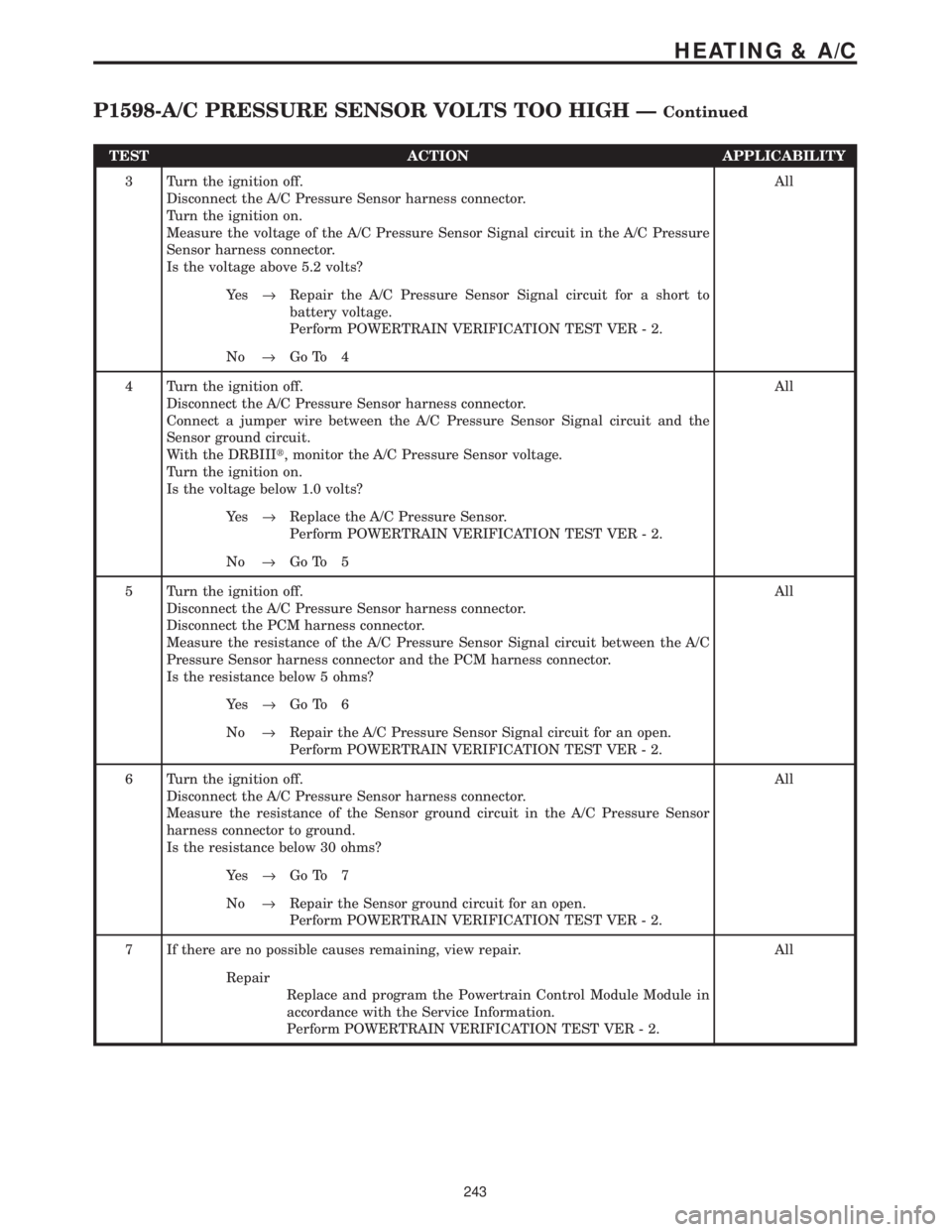
TEST ACTION APPLICABILITY
3 Turn the ignition off.
Disconnect the A/C Pressure Sensor harness connector.
Turn the ignition on.
Measure the voltage of the A/C Pressure Sensor Signal circuit in the A/C Pressure
Sensor harness connector.
Is the voltage above 5.2 volts?All
Ye s®Repair the A/C Pressure Sensor Signal circuit for a short to
battery voltage.
Perform POWERTRAIN VERIFICATION TEST VER - 2.
No®Go To 4
4 Turn the ignition off.
Disconnect the A/C Pressure Sensor harness connector.
Connect a jumper wire between the A/C Pressure Sensor Signal circuit and the
Sensor ground circuit.
With the DRBIIIt, monitor the A/C Pressure Sensor voltage.
Turn the ignition on.
Is the voltage below 1.0 volts?All
Ye s®Replace the A/C Pressure Sensor.
Perform POWERTRAIN VERIFICATION TEST VER - 2.
No®Go To 5
5 Turn the ignition off.
Disconnect the A/C Pressure Sensor harness connector.
Disconnect the PCM harness connector.
Measure the resistance of the A/C Pressure Sensor Signal circuit between the A/C
Pressure Sensor harness connector and the PCM harness connector.
Is the resistance below 5 ohms?All
Ye s®Go To 6
No®Repair the A/C Pressure Sensor Signal circuit for an open.
Perform POWERTRAIN VERIFICATION TEST VER - 2.
6 Turn the ignition off.
Disconnect the A/C Pressure Sensor harness connector.
Measure the resistance of the Sensor ground circuit in the A/C Pressure Sensor
harness connector to ground.
Is the resistance below 30 ohms?All
Ye s®Go To 7
No®Repair the Sensor ground circuit for an open.
Perform POWERTRAIN VERIFICATION TEST VER - 2.
7 If there are no possible causes remaining, view repair. All
Repair
Replace and program the Powertrain Control Module Module in
accordance with the Service Information.
Perform POWERTRAIN VERIFICATION TEST VER - 2.
243
HEATING & A/C
P1598-A/C PRESSURE SENSOR VOLTS TOO HIGH ÐContinued
Page 4038 of 4284

TEST ACTION APPLICABILITY
8NOTE: Ensure the A/C refrigerant System is properly charged per the
Service Information.
NOTE: The conditions that set the DTC are not present at this time. The
following list may help in identifying the intermittent condition.
WARNING: WHEN THE ENGINE IS OPERATING, DO NOT STAND IN A
DIRECT LINE WITH THE FAN. DO NOT PUT YOUR HANDS NEAR THE
PULLEYS, BELTS OR FAN. DO NOT WEAR LOOSE CLOTHING.
With the engine running at normal operating temperature, monitor the DRB
parameters related to the DTC while wiggling the wiring harness. Look for param-
eter values to change and/or a DTC to set.
Review the DRB Freeze Frame information. If possible, try to duplicate the
conditions under which the DTC was set.
Refer to any Technical Service Bulletins (TSB) that may apply.
Visually inspect the related wiring harness. Look for any chafed, pierced, pinched, or
partially broken wires.
Visually inspect the related wiring harness connectors. Look for broken, bent, pushed
out, or corroded terminals.
Were any of the above conditions present?All
Ye s®Repair as necessary
Perform POWERTRAIN VERIFICATION TEST VER - 2.
No®Test Complete.
244
HEATING & A/C
P1598-A/C PRESSURE SENSOR VOLTS TOO HIGH ÐContinued
Page 4039 of 4284

Symptom:
P1599-A/C PRESSURE SENSOR VOLTS TOO LOW
When Monitored and Set Condition:
P1599-A/C PRESSURE SENSOR VOLTS TOO LOW
When Monitored: Engine running. The A/C relay energized.
Set Condition: The A/C pressure sensor signal voltage at the PCM goes below 0.58 volts
for 2.6 seconds.
POSSIBLE CAUSES
INTERMITTENT CONDITION
5 VOLT SUPPLY CIRCUIT SHORTED TO GROUND
5 VOLT SUPPLY CIRCUIT OPEN
A/C PRESSURE SENSOR INTERNAL FAILURE
A/C PRESSURE SENSOR SIGNAL CIRCUIT SHORTED TO GROUND
A/C PRESSURE SENSOR SIGNAL CIRCUIT SHORTED TO SENSOR GROUND CIRCUIT
PCM 5 VOLT SUPPLY CIRCUIT
PCM A/C PRESSURE SENSOR SIGNAL
TEST ACTION APPLICABILITY
1NOTE: Ensure the A/C refrigerant System is properly charged per the
Service Information.
Start the engine.
With the DRBIIIt, read the A/C Pressure Sensor voltage.
Is the voltage below 0.6 volts.All
Ye s®Go To 2
No®Go To 10
2 Turn the ignition off.
Disconnect the A/C Pressure Sensor harness connector.
Turn the ignition on.
Measure the voltage of the 5 Volt Supply circuit in the A/C Pressure Sensor harness
connector.
Is the voltage between 4.5 to 5.2 volts?All
Ye s®Go To 3
No®Go To 7
245
HEATING & A/C
Page 4040 of 4284
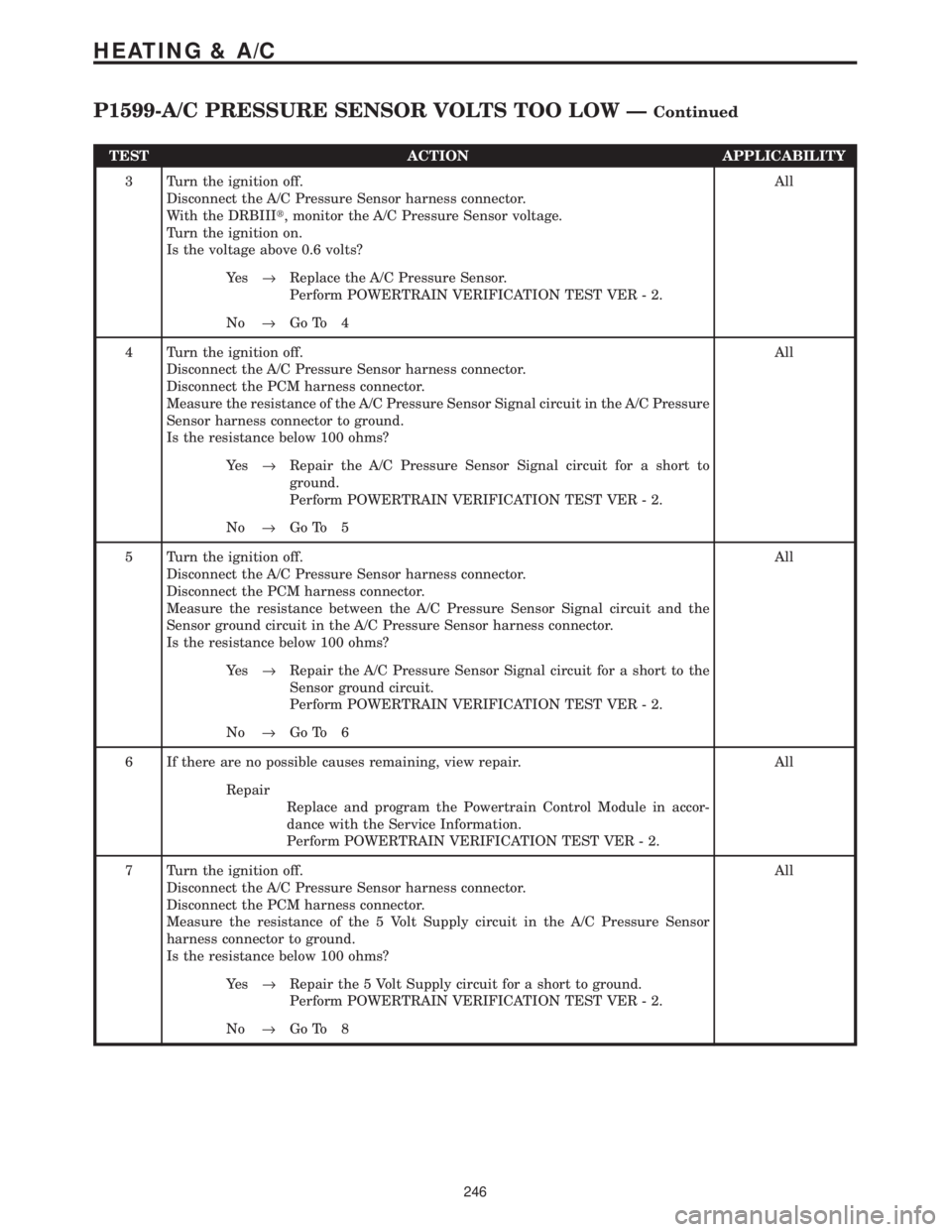
TEST ACTION APPLICABILITY
3 Turn the ignition off.
Disconnect the A/C Pressure Sensor harness connector.
With the DRBIIIt, monitor the A/C Pressure Sensor voltage.
Turn the ignition on.
Is the voltage above 0.6 volts?All
Ye s®Replace the A/C Pressure Sensor.
Perform POWERTRAIN VERIFICATION TEST VER - 2.
No®Go To 4
4 Turn the ignition off.
Disconnect the A/C Pressure Sensor harness connector.
Disconnect the PCM harness connector.
Measure the resistance of the A/C Pressure Sensor Signal circuit in the A/C Pressure
Sensor harness connector to ground.
Is the resistance below 100 ohms?All
Ye s®Repair the A/C Pressure Sensor Signal circuit for a short to
ground.
Perform POWERTRAIN VERIFICATION TEST VER - 2.
No®Go To 5
5 Turn the ignition off.
Disconnect the A/C Pressure Sensor harness connector.
Disconnect the PCM harness connector.
Measure the resistance between the A/C Pressure Sensor Signal circuit and the
Sensor ground circuit in the A/C Pressure Sensor harness connector.
Is the resistance below 100 ohms?All
Ye s®Repair the A/C Pressure Sensor Signal circuit for a short to the
Sensor ground circuit.
Perform POWERTRAIN VERIFICATION TEST VER - 2.
No®Go To 6
6 If there are no possible causes remaining, view repair. All
Repair
Replace and program the Powertrain Control Module in accor-
dance with the Service Information.
Perform POWERTRAIN VERIFICATION TEST VER - 2.
7 Turn the ignition off.
Disconnect the A/C Pressure Sensor harness connector.
Disconnect the PCM harness connector.
Measure the resistance of the 5 Volt Supply circuit in the A/C Pressure Sensor
harness connector to ground.
Is the resistance below 100 ohms?All
Ye s®Repair the 5 Volt Supply circuit for a short to ground.
Perform POWERTRAIN VERIFICATION TEST VER - 2.
No®Go To 8
246
HEATING & A/C
P1599-A/C PRESSURE SENSOR VOLTS TOO LOW ÐContinued
Page 4041 of 4284

TEST ACTION APPLICABILITY
8 Turn the ignition off.
Disconnect the A/C Pressure Sensor harness connector.
Disconnect the PCM harness connector.
Measure the resistance of the 5 Volt Supply circuit between the A/C Pressure Sensor
harness connector and the PCM harness connector.
Is the resistance below 5 ohms?All
Ye s®Go To 9
No®Repair the 5 Volt Supply circuit for an open.
Perform POWERTRAIN VERIFICATION TEST VER - 2.
9 If there are no possible causes remaining, view repair. All
Repair
Replace and program the Powertrain Control Module in accor-
dance with the Service Information.
Perform POWERTRAIN VERIFICATION TEST VER - 2.
10NOTE: Ensure the A/C refrigerant System is properly charges per the
Service Information.
WARNING: WHEN THE ENGINE IS OPERATING, DO NOT STAND IN A
DIRECT LINE WITH THE FAN. DO NOT PUT YOUR HANDS NEAR THE
PULLEYS, BELTS OR FAN. DO NOT WEAR LOOSE CLOTHING.
NOTE: The conditions that set the DTC are not present at this time. The
following list may help in identifying the intermittent condition.
With the engine running at normal operating temperature, monitor the DRB
parameters related to the DTC while wiggling the wiring harness. Look for param-
eter values to change and/or a DTC to set.
Review the DRB Freeze Frame information. If possible, try to duplicate the
conditions under which the DTC was set.
Refer to any Technical Service Bulletins (TSB) that may apply.
Visually inspect the related wiring harness. Look for any chafed, pierced, pinched, or
partially broken wires.
Visually inspect the related wiring harness connectors. Look for broken, bent, pushed
out, or corroded terminals.
Were any of the above conditions present?All
Ye s®Repair as necessary
Perform POWERTRAIN VERIFICATION TEST VER - 2.
No®Test Complete.
247
HEATING & A/C
P1599-A/C PRESSURE SENSOR VOLTS TOO LOW ÐContinued
Page 4124 of 4284
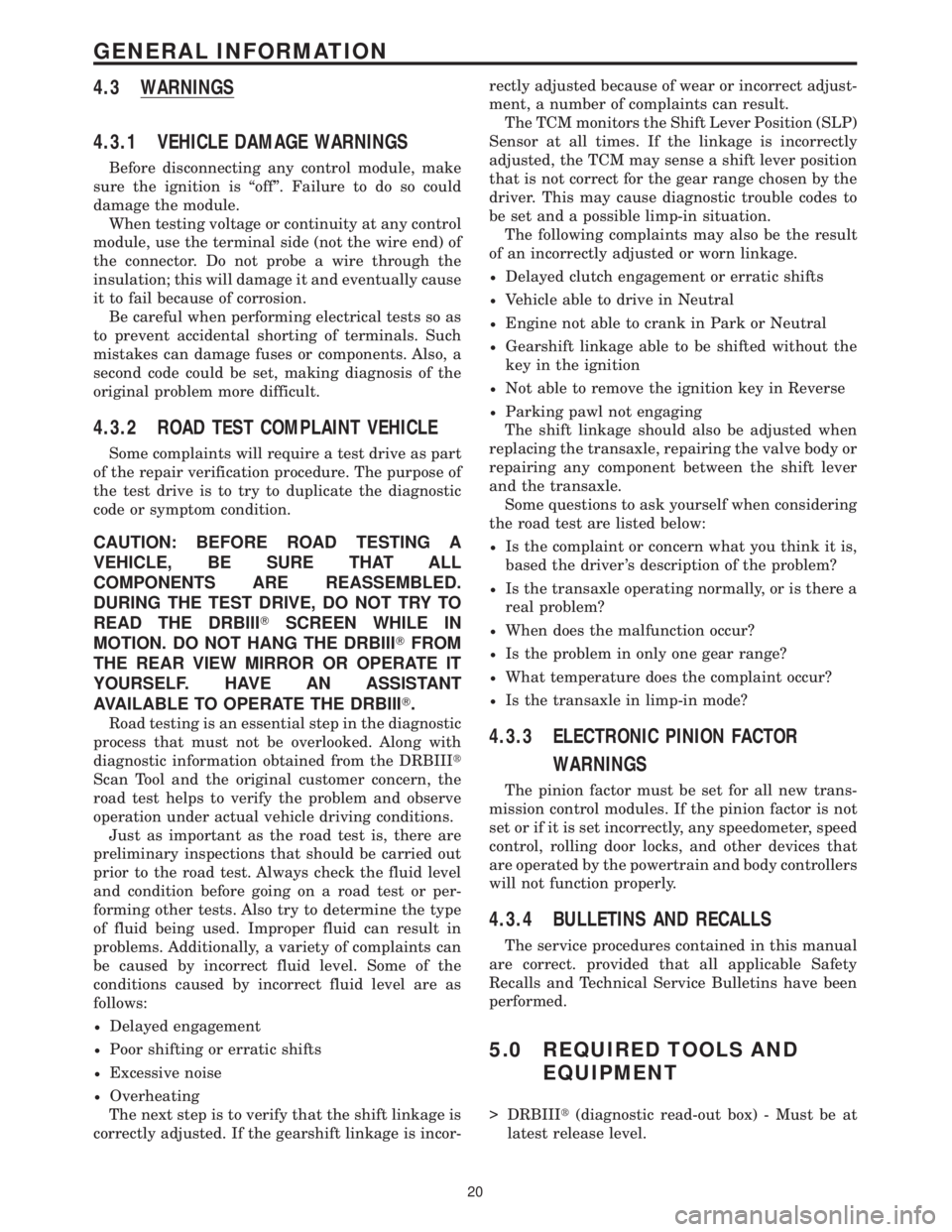
4.3 WARNINGS
4.3.1 VEHICLE DAMAGE WARNINGS
Before disconnecting any control module, make
sure the ignition is ªoffº. Failure to do so could
damage the module.
When testing voltage or continuity at any control
module, use the terminal side (not the wire end) of
the connector. Do not probe a wire through the
insulation; this will damage it and eventually cause
it to fail because of corrosion.
Be careful when performing electrical tests so as
to prevent accidental shorting of terminals. Such
mistakes can damage fuses or components. Also, a
second code could be set, making diagnosis of the
original problem more difficult.
4.3.2 ROAD TEST COMPLAINT VEHICLE
Some complaints will require a test drive as part
of the repair verification procedure. The purpose of
the test drive is to try to duplicate the diagnostic
code or symptom condition.
CAUTION: BEFORE ROAD TESTING A
VEHICLE, BE SURE THAT ALL
COMPONENTS ARE REASSEMBLED.
DURING THE TEST DRIVE, DO NOT TRY TO
READ THE DRBIIITSCREEN WHILE IN
MOTION. DO NOT HANG THE DRBIIITFROM
THE REAR VIEW MIRROR OR OPERATE IT
YOURSELF. HAVE AN ASSISTANT
AVAILABLE TO OPERATE THE DRBIIIT.
Road testing is an essential step in the diagnostic
process that must not be overlooked. Along with
diagnostic information obtained from the DRBIIIt
Scan Tool and the original customer concern, the
road test helps to verify the problem and observe
operation under actual vehicle driving conditions.
Just as important as the road test is, there are
preliminary inspections that should be carried out
prior to the road test. Always check the fluid level
and condition before going on a road test or per-
forming other tests. Also try to determine the type
of fluid being used. Improper fluid can result in
problems. Additionally, a variety of complaints can
be caused by incorrect fluid level. Some of the
conditions caused by incorrect fluid level are as
follows:
²Delayed engagement
²Poor shifting or erratic shifts
²Excessive noise
²Overheating
The next step is to verify that the shift linkage is
correctly adjusted. If the gearshift linkage is incor-rectly adjusted because of wear or incorrect adjust-
ment, a number of complaints can result.
The TCM monitors the Shift Lever Position (SLP)
Sensor at all times. If the linkage is incorrectly
adjusted, the TCM may sense a shift lever position
that is not correct for the gear range chosen by the
driver. This may cause diagnostic trouble codes to
be set and a possible limp-in situation.
The following complaints may also be the result
of an incorrectly adjusted or worn linkage.
²Delayed clutch engagement or erratic shifts
²Vehicle able to drive in Neutral
²Engine not able to crank in Park or Neutral
²Gearshift linkage able to be shifted without the
key in the ignition
²Not able to remove the ignition key in Reverse
²Parking pawl not engaging
The shift linkage should also be adjusted when
replacing the transaxle, repairing the valve body or
repairing any component between the shift lever
and the transaxle.
Some questions to ask yourself when considering
the road test are listed below:
²Is the complaint or concern what you think it is,
based the driver 's description of the problem?
²Is the transaxle operating normally, or is there a
real problem?
²When does the malfunction occur?
²Is the problem in only one gear range?
²What temperature does the complaint occur?
²Is the transaxle in limp-in mode?
4.3.3 ELECTRONIC PINION FACTOR
WARNINGS
The pinion factor must be set for all new trans-
mission control modules. If the pinion factor is not
set or if it is set incorrectly, any speedometer, speed
control, rolling door locks, and other devices that
are operated by the powertrain and body controllers
will not function properly.
4.3.4 BULLETINS AND RECALLS
The service procedures contained in this manual
are correct. provided that all applicable Safety
Recalls and Technical Service Bulletins have been
performed.
5.0 REQUIRED TOOLS AND
EQUIPMENT
> DRBIIIt(diagnostic read-out box) - Must be at
latest release level.
20
GENERAL INFORMATION
Page 4187 of 4284

Symptom:
P1738-HIGH TEMPERATURE OPERATION ACTIVATED
When Monitored and Set Condition:
P1738-HIGH TEMPERATURE OPERATION ACTIVATED
When Monitored: Whenever the engine is running.
Set Condition: Immediately when the Overheat shift schedule is activated (240 degrees
Trans oil temp).
POSSIBLE CAUSES
ENGINE COOLING SYSTEM MALFUNCTION
INCORRECT FLUID LEVEL
TRANSMISSION OIL COOLER PLUGGED
HIGH TEMPERATURE OPERATIONS ACTIVATED
TEST ACTION APPLICABILITY
1 Perform Engine Cooling System diagnostics per Service Information
Is the engine cooling system functioning properly?All
Ye s®Go To 2
No®Repair cause of engine overheating. Refer to Service Information
for additional repair information.
Perform 41TE TRANSMISSION VERIFICATION TEST - VER 1.
2 Check the Transmission Fluid level per the Service Information.
Is the Transmission Fluid Level at the proper level?All
Ye s®Go To 3
No®Repair any Transmission Fluid leak as necessary and adjust the
Transmission Fluid Level in accordance with the Service Infor-
mation.
Perform 41TE TRANSMISSION VERIFICATION TEST - VER 1.
3 Perform Cooler Flow Check per Service Information.
Did the cooler flow test pass?All
Ye s®Go To 4
No®Repair cause of plugged Transmission Oil Cooler. Flush or replace
Transmission Oil Cooler(s) as necessary per Service Information.
Perform 41TE TRANSMISSION VERIFICATION TEST - VER 1.
83
TRANSMISSION
Page 4188 of 4284
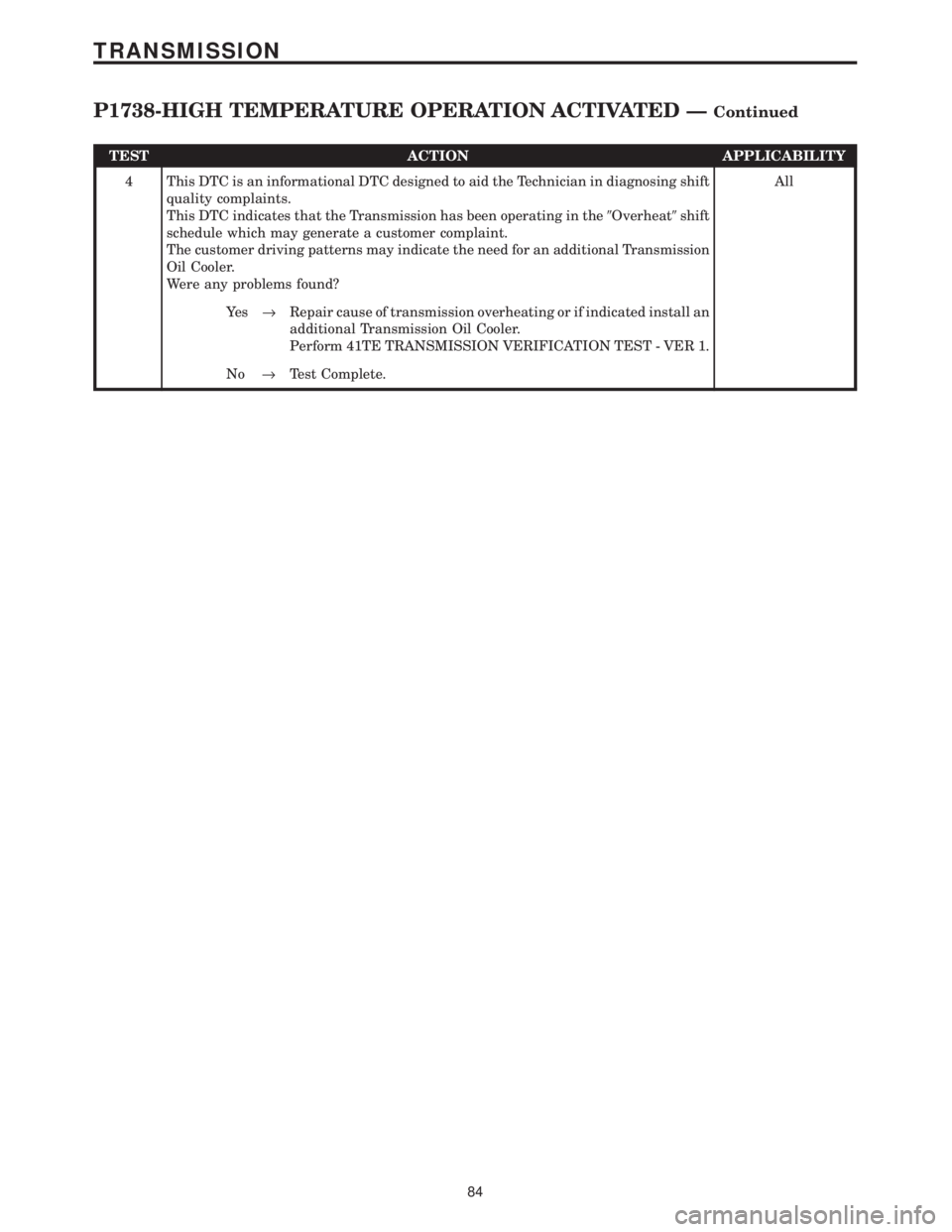
TEST ACTION APPLICABILITY
4 This DTC is an informational DTC designed to aid the Technician in diagnosing shift
quality complaints.
This DTC indicates that the Transmission has been operating in the9Overheat9shift
schedule which may generate a customer complaint.
The customer driving patterns may indicate the need for an additional Transmission
Oil Cooler.
Were any problems found?All
Ye s®Repair cause of transmission overheating or if indicated install an
additional Transmission Oil Cooler.
Perform 41TE TRANSMISSION VERIFICATION TEST - VER 1.
No®Test Complete.
84
TRANSMISSION
P1738-HIGH TEMPERATURE OPERATION ACTIVATED ÐContinued