tire size CHRYSLER VOYAGER 2001 Owner's Manual
[x] Cancel search | Manufacturer: CHRYSLER, Model Year: 2001, Model line: VOYAGER, Model: CHRYSLER VOYAGER 2001Pages: 4284, PDF Size: 83.53 MB
Page 3376 of 4284
CLEANING - ALUMINUM WHEEL CARE
Chrome plated and painted aluminum wheels
should be cleaned regularly using mild soap and
water to maintain their luster and to prevent corro-
sion.
Care must be taken in the selection of tire and
wheel cleaning chemicals and equipment to prevent
damage to the wheels. Any of the ªDO NOT USEº
items listed below WILL damage chrome plated and
painted aluminum wheels.
DO NOT USE:
²any abrasive metal cleaner
²any abrasive cleaning pad or brush
²any cleaner that contains an acid (this will
immediately react with and discolor the chromium
surface)
²chrome polish (unless it is buffed off immedi-
ately after application)
²oven cleaner
²a car wash that uses carbide-tipped wheel clean-
ing brushes
SPECIFICATIONS
WHEEL
SPECIFICATIONS
DESCRIPTION SPECIFICATION
Wheel Mounting (Lug)
Nut Hex Size19 mm
Wheel Mounting Stud
SizeM12 x 1.5 mm
TORQUE SPECIFICATIONS
DESCRIPTION N´mFt.
Lbs.In.
Lbs.
Wheel Mounting (Lug ) Nut 135 100 Ð
WHEEL COVER
DESCRIPTION
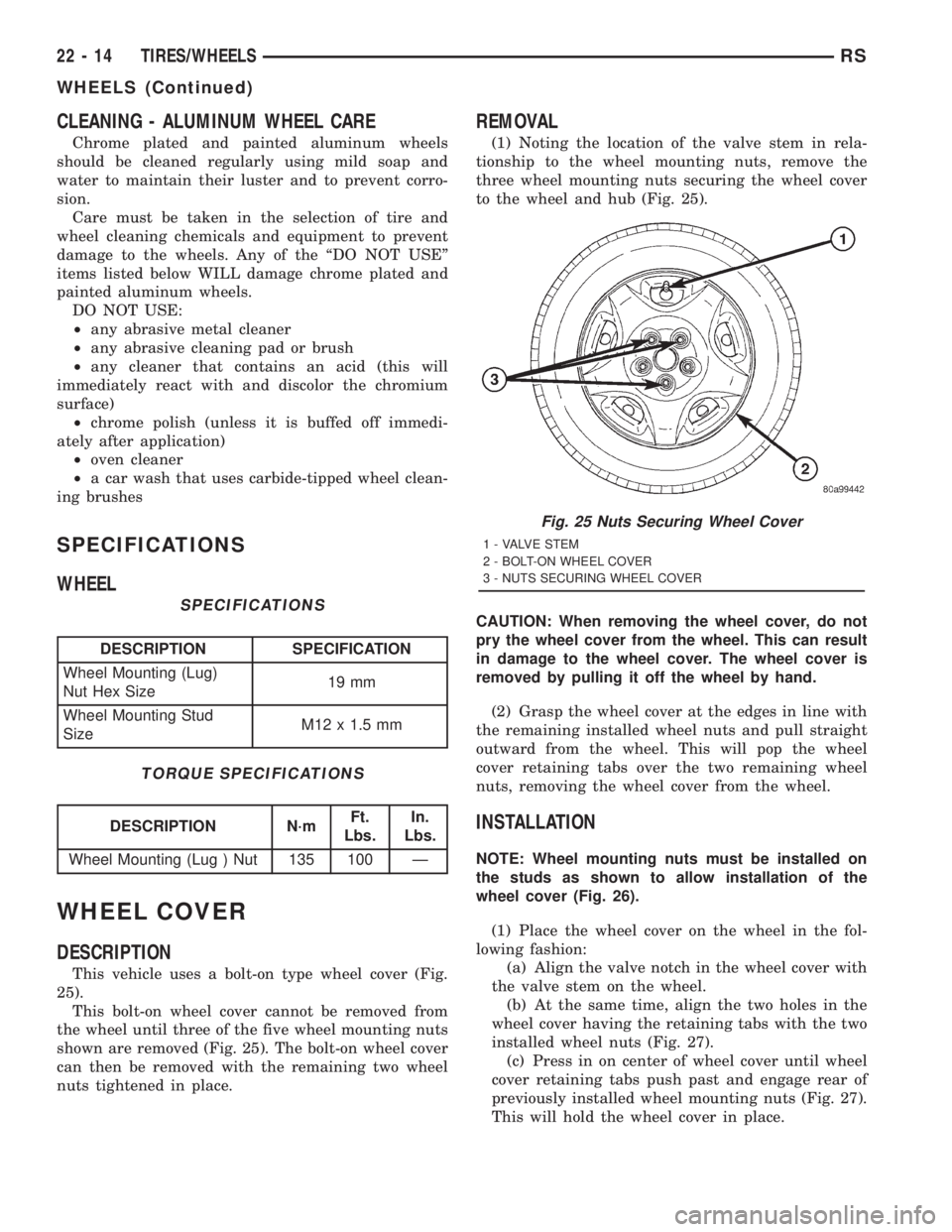
This vehicle uses a bolt-on type wheel cover (Fig.
25).
This bolt-on wheel cover cannot be removed from
the wheel until three of the five wheel mounting nuts
shown are removed (Fig. 25). The bolt-on wheel cover
can then be removed with the remaining two wheel
nuts tightened in place.
REMOVAL
(1) Noting the location of the valve stem in rela-
tionship to the wheel mounting nuts, remove the
three wheel mounting nuts securing the wheel cover
to the wheel and hub (Fig. 25).
CAUTION: When removing the wheel cover, do not
pry the wheel cover from the wheel. This can result
in damage to the wheel cover. The wheel cover is
removed by pulling it off the wheel by hand.
(2) Grasp the wheel cover at the edges in line with
the remaining installed wheel nuts and pull straight
outward from the wheel. This will pop the wheel
cover retaining tabs over the two remaining wheel
nuts, removing the wheel cover from the wheel.
INSTALLATION
NOTE: Wheel mounting nuts must be installed on
the studs as shown to allow installation of the
wheel cover (Fig. 26).
(1) Place the wheel cover on the wheel in the fol-
lowing fashion:
(a) Align the valve notch in the wheel cover with
the valve stem on the wheel.
(b) At the same time, align the two holes in the
wheel cover having the retaining tabs with the two
installed wheel nuts (Fig. 27).
(c) Press in on center of wheel cover until wheel
cover retaining tabs push past and engage rear of
previously installed wheel mounting nuts (Fig. 27).
This will hold the wheel cover in place.
Fig. 25 Nuts Securing Wheel Cover
1 - VALVE STEM
2 - BOLT-ON WHEEL COVER
3 - NUTS SECURING WHEEL COVER
22 - 14 TIRES/WHEELSRS
WHEELS (Continued)
Page 3631 of 4284
HEATING & AIR CONDITIONING
TABLE OF CONTENTS
page page
HEATING & AIR CONDITIONING
DESCRIPTION............................1
OPERATION.............................3
DIAGNOSIS AND TESTING..................4
A/C COOL DOWN TEST...................4
A/C PERFORMANCE TEST................5
HEATER PERFORMANCE TEST............6SPECIFICATIONS.........................7
CONTROLS - FRONT......................8
CONTROLS - REAR......................30
DISTRIBUTION - FRONT...................41
DISTRIBUTION - REAR....................54
PLUMBING - FRONT......................62
PLUMBING - REAR.......................96
HEATING & AIR
CONDITIONING
DESCRIPTION - SINGLE ZONE
A single zone heating and air conditioning system
allows one temperature setting for the entire vehicle.
The full range of temperatures that the system can
produce are available by rotating the temperature
control located in control panel.
The control panel and integral computer is
mounted in the instrument panel.
DESCRIPTION - DUAL ZONE
A manual Dual Zone Heating and Air Conditioning
system allows completely independent side-to-side
tempeture control of the discharge air.
The Dual Zone Heating and Air Conditioning sys-
tem includes a dust and odor air filter. The filter ele-
ment is the same size as the air conditioning
evaporator to ensure ample capacity. A door at the
base of the heating and air conditioning housing
below the glove box provides easy access to the filter
element.
The control panel and integral computer is located
in the instrument panel.
The instrument panel mounted control and inte-
gral computer contains:
²a power button which allows the system to be
completely turned off. Contains an LED that illumi-
nates to show when the function is operational.
²rear window defogger on/off switch. Contains an
LED that illuminates to show when the function is
operational.
²slide controls for completely independent side-to-
side temperature control of the discharged air. The
full range of temperature that the system can pro-
duce in any mode is available on either side of the
vehicle by independently positioning the slide con-
trols on the instrument panel.²air recirculation on/off switch. The Recirculate
button contains an LED that illuminates to show
when the function is in operation.
²air conditioning on/off switch. The Snowflake
button contains an LED that illuminates to shown
when the function is in operation.
²rotary knob for fan speed selection.
²a rotary knob for mode control.
DESCRIPTION - MANUAL THREE ZONE
The fully adjustable Three-Zone front and rear
heating and air conditioning system allows interme-
diate seat passengers the ability to regulate air tem-
perature as well as fan speed. All controls are
identified by ISO graphic symbols.
The Three Zone Heating and Air Conditioning sys-
tem includes a dust and odor air filter. The filter ele-
ment is the same size as the air conditioning
evaporator to ensure ample capacity. A door at the
base of the heating and air conditioning housing
below the glove box provides easy access to the filter
element.
FRONT CONTROL PANEL
The front control panel and integral computer is
mounted in the instrument panel.
The instrument panel mounted control and inte-
gral computer contains:
²a power button which allows the system to be
completely turned off.
²rear window defogger on/off switch.
²slide controls for completely independent side-to-
side temperature control of the discharge air. The full
range of temperature that the system can produce in
any mode is available on either side of the vehicle by
independently positioning the slide controls on the
instrument panel.
²air recirculation button. The Recirculate button
contains an LED that illuminates to show when the
function is in operation.
RSHEATING & AIR CONDITIONING24-1
Page 3694 of 4284

CAUTION: Do not overcharge the refrigerant sys-
tem. This will cause excessive compressor head
pressure and can cause noise and system failure.
CAUTION: Do not open the refrigerant system or
remove the sealing caps from a replacement com-
ponent until it is to be installed. This will prevent
contamination in the system.
CAUTION: Before disconnecting a component,
clean the outside of the fittings thoroughly to pre-
vent contamination from entering the refrigerant
system.
CAUTION: When it is necessary to open the refrig-
erant system, have everything needed to service
the system ready. Immediately after disconnecting a
component from the refrigerant system, seal the
open fittings with a cap or plug to prevent the
entrance of dirt and moisture. The refrigerant sys-
tem should not be left open to the atmosphere any
longer than necessary.
CAUTION: Before connecting an open refrigerant
fitting, always install a new seal or gasket. All fit-
tings with O-rings need to be coated with refriger-
ant oil before installation. Use only O-rings that are
the correct size and approved for use with R-134a
refrigerant. Failure to do so may result in a leak.
Coat the fitting and seal with clean refrigerant oil
before connecting. Unified plumbing connections
with gaskets cannot be serviced with O-rings. The
gaskets are not reusable and new gaskets do not
require lubrication before installing.
CAUTION: When installing a refrigerant line, avoid
sharp bends that may restrict refrigerant flow. A
good rule for the flexible hose refrigerant lines is to
keep the radius of all bends at least ten times the
diameter of the hose. Sharp bends will reduce the
flow of refrigerant.
CAUTION: Position the refrigerant lines away from
exhaust system components or any sharp edges,
which may damage the line. The flexible hose lines
should be routed so they are at least 80 millimeters
(3 inches) from the exhaust manifold. Inspect all
flexible refrigerant system hose lines at least once
a year to make sure they are in good condition and
properly routed.CAUTION: High pressures are produced in the
refrigerant system when it is operating. Extreme
care must be exercised to make sure that all refrig-
erant system connections are pressure tight.
CAUTION: Tighten refrigerant fittings only to the
specified torque. The aluminum fittings used in the
refrigerant system will not tolerate overtightening.
CAUTION: When disconnecting a refrigerant fitting,
use a wrench on both halves of the fitting. This will
prevent twisting of the refrigerant lines or tubes.
CAUTION: Refrigerant oil will absorb moisture from
the atmosphere if left uncapped. Do not open a
container of refrigerant oil until you are ready to
use it. Replace the cap on the oil container immedi-
ately after using. Store refrigerant oil only in a
clean, airtight, and moisture-free container.
CAUTION: All tools, including the refrigerant recy-
cling equipment, the manifold gauge set, and test
hoses should be kept clean and dry. Keep the work
area clean. Contamination of the refrigerant system
through careless work habits must be avoided. The
refrigerant system will remain chemically stable as
long as pure, moisture-free R-134a refrigerant and
refrigerant oil is used. Dirt, moisture, or air can
upset this chemical stability. Operational troubles
or serious damage can occur if foreign material is
introduced to the refrigerant system.
COMPRESSOR
DESCRIPTION
The compressor used on this vehicle can be one of
two models, depending upon the air conditioning sys-
tem in the vehicle. All vehicles use the Nippondenso
10S20H compressor. This compressor use an alumi-
num swash plate, teflon coated pistons and alumi-
num sleeveless cylinder walls. This compressor
includes an integral high pressure relief valve. The
compressor is secured low in the right front corner of
the engine compartment to a mounting bracket on
the cylinder block (2.4L engine), or directly to the cyl-
inder block (3.3L and 3.8L engines).is integral to the
compressor. This compressor cannot be repaired. If
faulty or damaged, the entire compressor must be
replaced. The compressor clutch, pulley, and clutch
coil are available for service replacement.
24 - 64 PLUMBING - FRONTRS
PLUMBING - FRONT (Continued)
Page 3959 of 4284
Symptom:
P0740-TORQ CONV CLU, NO RPM DROP AT LOCKUP (3SP AUTO
TRANS)
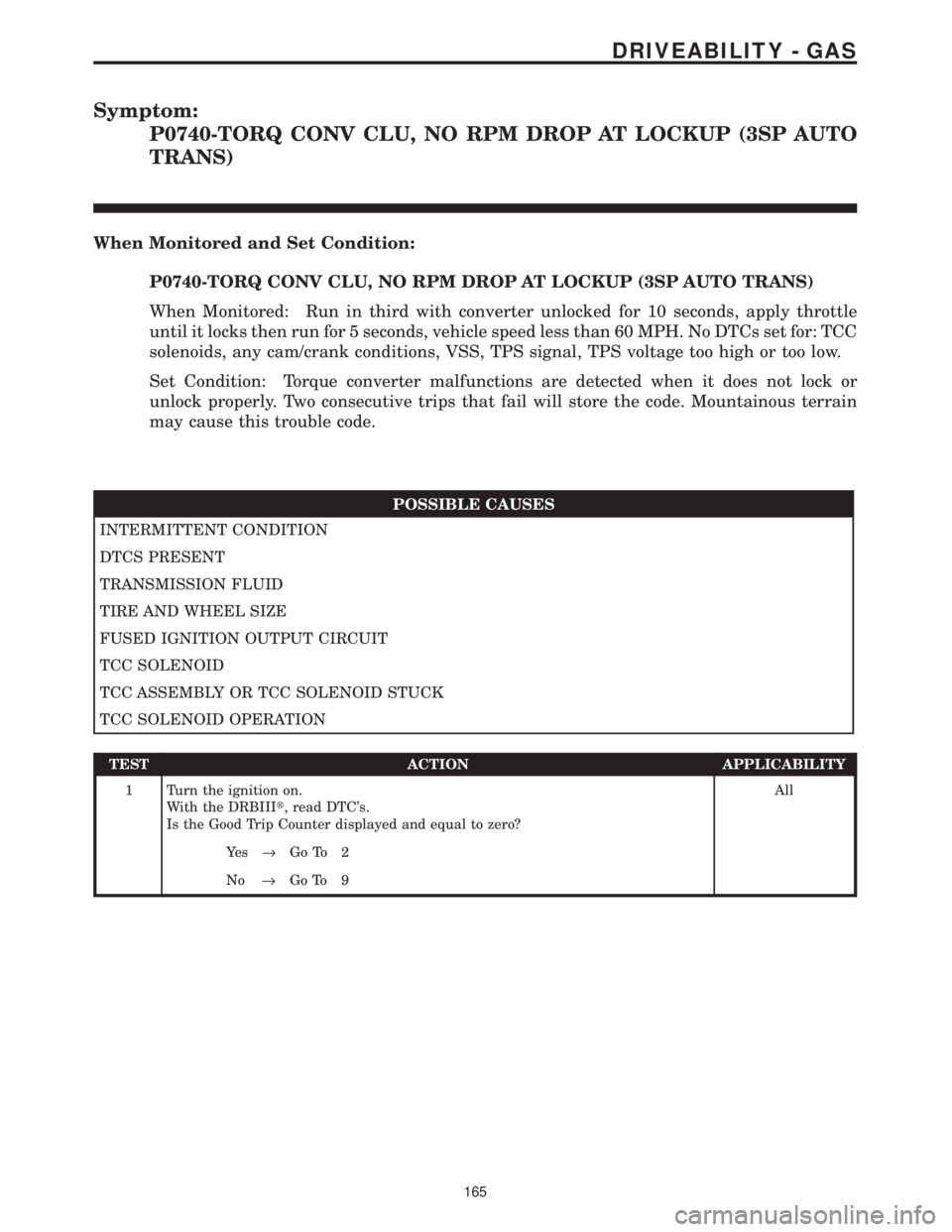
When Monitored and Set Condition:
P0740-TORQ CONV CLU, NO RPM DROP AT LOCKUP (3SP AUTO TRANS)
When Monitored: Run in third with converter unlocked for 10 seconds, apply throttle
until it locks then run for 5 seconds, vehicle speed less than 60 MPH. No DTCs set for: TCC
solenoids, any cam/crank conditions, VSS, TPS signal, TPS voltage too high or too low.
Set Condition: Torque converter malfunctions are detected when it does not lock or
unlock properly. Two consecutive trips that fail will store the code. Mountainous terrain
may cause this trouble code.
POSSIBLE CAUSES
INTERMITTENT CONDITION
DTCS PRESENT
TRANSMISSION FLUID
TIRE AND WHEEL SIZE
FUSED IGNITION OUTPUT CIRCUIT
TCC SOLENOID
TCC ASSEMBLY OR TCC SOLENOID STUCK
TCC SOLENOID OPERATION
TEST ACTION APPLICABILITY
1 Turn the ignition on.
With the DRBIIIt, read DTC's.
Is the Good Trip Counter displayed and equal to zero?All
Ye s®Go To 2
No®Go To 9
165
DRIVEABILITY - GAS
Page 3960 of 4284
TEST ACTION APPLICABILITY
2 Turn the ignition on.
With the DRBIIIt, read DTCs.
Are any of the following DTCs set in the PCM memory?
P0122 - Throttle Position Sensor Voltage Low
P0123 - Throttle Position Sensor High
P0320 - No Crank Reference Signal At PCM
P0743 - Torque Converter Clutch Solenoid/Trans Relay Circuits
P0300, P0301, P0302, P0303 or P0304 Misfire DTC(s)
Did any of the above DTCs set along with P0740All
Ye s®Refer to the Driveability Category and perform the appropriate
symptom before proceeding.
Perform 31TH TRANSMISSION VERIFICATION TEST - VER
1..
No®Go To 3
3 Check the transmission fluid level and condition.
Is the fluid level OK and free of contamination?All
Ye s®Go To 4
No®Repair the fliuld level and/or condition as necessary.
Perform 31TH TRANSMISSION VERIFICATION TEST - VER
1..
4 Inspect the front wheels and tires. Ensure the wheels and tires are the manufactures
recommended size.
Ensure both left and right wheels and tires are the same size.
Were any problems found?All
Ye s®Repair or replace as necessary.
Perform 31TH TRANSMISSION VERIFICATION TEST - VER
1..
No®Go To 5
5 Turn the ignition off.
Disconnect the TCC Solenoid harness connector.
Turn the ignition on.
Measure the voltage of the Fused Ignition Switch Output circuit in the TCC Solenoid
harness connector.
Is the voltage above 10.0 volts?All
Ye s®Go To 6
No®Repair the Fused Ignition Switch Output circuit for an open.
Perform 31TH TRANSMISSION VERIFICATION TEST - VER
1..
6 Turn the ignition off.
Disconnect the TCC Solenoid harness connector.
Measure the resistance across the TCC Solenoid.
Is the resistance between 30.0 and 50.0 ohms?All
Ye s®Go To 7
No®Replace the TCC Solenoid.
Perform 31TH TRANSMISSION VERIFICATION TEST - VER
1..
166
DRIVEABILITY - GAS
P0740-TORQ CONV CLU, NO RPM DROP AT LOCKUP (3SP AUTO TRANS)
Ð
Continued
Page 4121 of 4284

> Quick Learn should generally not be used as a
repair procedure unless directed by a repair or
diagnostic procedure. If the transmission system
is exhibiting a problem that you think is caused
by an invalid CVI, you should try to relearn the
value by performing the appropriate driving ma-
neuver. In most cases, if a quick learn makes a
vehicle shift better, the vehicle will return with
the same problem.
> Before performing Quick Learn, it is imperative
that the vehicle be shifted into OD with the
engine running and the oil level set to the correct
level. This step will purge air from the clutch
circuits to prevent erroneous clutch volume val-
ues which could cause poor initial shift quality.
> If an unused TCM is installed on a vehicle with a
HOT engine, Quick Learn will cause the TCM to
report a cold calculated oil temperature. This
requires monitoring the calculated oil tempera-
ture using the DRBIIIt. If the temperature is
below 15C (60É F), the transmission must be run
at idle or driven in gear until it goes above 15C
(60ÉF). If the temperature is above 93C (200ÉF),
the transmission must cool to below 93C (200ÉF).
> First gear is engaged in overdrive after Quick
Learn is completed. Place the vehicle in park
after performing Quick Learn.
The Quick Learn function should be performed:
± Upon installation of a new service TCM
± After replacement or rebuild of internal trans-
mission components or the torque converter
± If one or more of the clutch volumes indexes
(CVI's) contain skewed readings because of
abnormal conditions.
To perform the Quick Learn procedure, the fol-
lowing conditions must be met.
± It is imperative that the vehicle be shifted into
OD with the engine running and the oil level
set to the correct level. This step will purge the
air in the clutch circuits to prevent erroneous
clutch volume values, which could cause poor
initial shift quality.
± The brakes must be applied.
± The engine must be idling.
± The throttle angle (TP sensor) must be less
than 3 degrees.
± The shift lever position must stay in neutral
until prompted to shift into OD.
± The shift lever must stay in OD after the9Shift
to Overdrive9prompt until the DRBIIItindi-
cates the procedure is complete.
± The oil temperature must be between 15C
(60ÉF) and 93C (200ÉF).NOTE:The above conditions must be maintained
during the procedure to keep the procedure from
being aborted.
The Quick Learn procedure is performed with the
DRBIIItby selecting9Transmission9system then
9Miscellaneous9functions, then9Quick Learn9. Follow
the procedure instructions displayed on the DRBIIIt.
3.3.9 CLUTCH VOLUMES
The L-R clutch volume is updated when doing a
2-1 or 3-1 coast down shift. The transmission tem-
perature must be between 21-49C (70-120É F). The
clutch volume should be between 35 and 83.
The 2-4 clutch volume is updated when doing a
1-2 shift. The transmission temperature must be
above 43C (110ÉF). The clutch volume should be
between 20 and 77.
The OD clutch volume is updated when doing a
2-3 shift. The transmission temperature must be
above 43C (110ÉF). The clutch volume should be
between 40 and 150.
The UD clutch volume is updated when doing a
4-3 or 4-2 shift. The transmission temperature must
be above 43C (110ÉF). The clutch volume should be
between 24 and 70.
3.3.10 ELECTRONIC PINION FACTOR
The transmission output speed signal supplies
distance pulses to the powertrain control module
(PCM), which are used to calculate speed and
mileage. A pinion factor is stored in the transmis-
sion control module (TCM) in order to provide the
appropriate distance pulses for the vehicle. The
pinion factor is programmed into the TCM at the
assembly plant.
Using the following steps, the pinion factor can be
checked and/or reset using the DRBIIIt:
1. Select Transmission system, then Miscellaneous
functions, then Pinion Factor. The DRBIIItwill
display the current tire size.
2. If the tire size is incorrect, depress the Enter key
and then select the correct size.
3. Depress the Page Back key to exit the reset
procedure.
Notes About Electronic Pinion Factor Features
The nature of the electronic pinion factor requires that
certain features must be taken into consideration.
> If no pinion factor is stored in an installed TCM,
the vehicle speedometer will not operate, engine
speed will be limited to 2300 RPM, and catalyst
damage may occur.
> Selecting a wrong tire size will cause the speed-
ometer to be inaccurate and will also cause any
speed related features to operate improperly.
Note: After replacing the TCM, you must
reprogram pinion factor
17
GENERAL INFORMATION