fuel CHRYSLER VOYAGER 2001 Service Manual
[x] Cancel search | Manufacturer: CHRYSLER, Model Year: 2001, Model line: VOYAGER, Model: CHRYSLER VOYAGER 2001Pages: 4284, PDF Size: 83.53 MB
Page 3806 of 4284
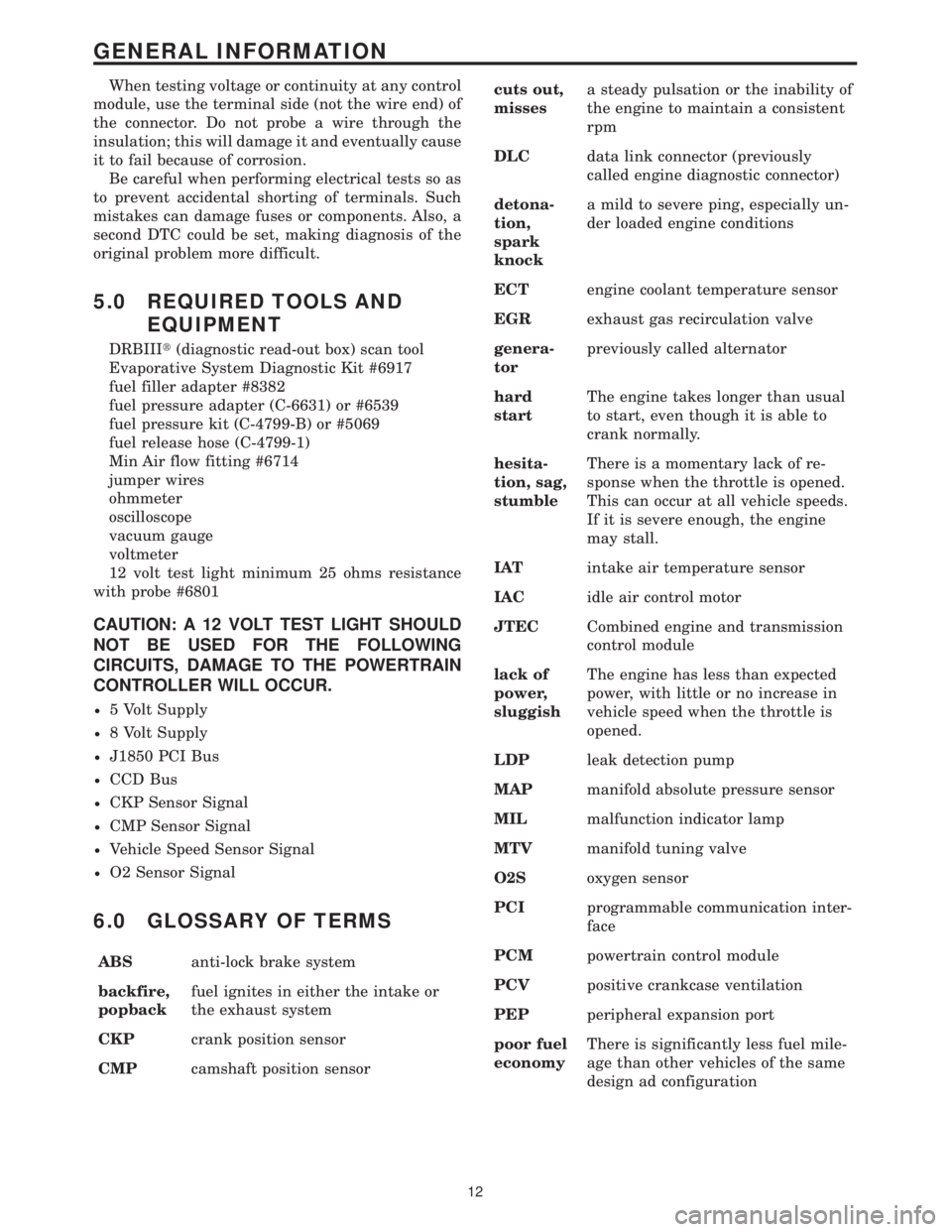
When testing voltage or continuity at any control
module, use the terminal side (not the wire end) of
the connector. Do not probe a wire through the
insulation; this will damage it and eventually cause
it to fail because of corrosion.
Be careful when performing electrical tests so as
to prevent accidental shorting of terminals. Such
mistakes can damage fuses or components. Also, a
second DTC could be set, making diagnosis of the
original problem more difficult.
5.0 REQUIRED TOOLS AND
EQUIPMENT
DRBIIIt(diagnostic read-out box) scan tool
Evaporative System Diagnostic Kit #6917
fuel filler adapter #8382
fuel pressure adapter (C-6631) or #6539
fuel pressure kit (C-4799-B) or #5069
fuel release hose (C-4799-1)
Min Air flow fitting #6714
jumper wires
ohmmeter
oscilloscope
vacuum gauge
voltmeter
12 volt test light minimum 25 ohms resistance
with probe #6801
CAUTION: A 12 VOLT TEST LIGHT SHOULD
NOT BE USED FOR THE FOLLOWING
CIRCUITS, DAMAGE TO THE POWERTRAIN
CONTROLLER WILL OCCUR.
²5 Volt Supply
²8 Volt Supply
²J1850 PCI Bus
²CCD Bus
²CKP Sensor Signal
²CMP Sensor Signal
²Vehicle Speed Sensor Signal
²O2 Sensor Signal
6.0 GLOSSARY OF TERMS
ABSanti-lock brake system
backfire,
popbackfuel ignites in either the intake or
the exhaust system
CKPcrank position sensor
CMPcamshaft position sensorcuts out,
missesa steady pulsation or the inability of
the engine to maintain a consistent
rpm
DLCdata link connector (previously
called engine diagnostic connector)
detona-
tion,
spark
knocka mild to severe ping, especially un-
der loaded engine conditions
ECTengine coolant temperature sensor
EGRexhaust gas recirculation valve
genera-
torpreviously called alternator
hard
startThe engine takes longer than usual
to start, even though it is able to
crank normally.
hesita-
tion, sag,
stumbleThere is a momentary lack of re-
sponse when the throttle is opened.
This can occur at all vehicle speeds.
If it is severe enough, the engine
may stall.
IATintake air temperature sensor
IACidle air control motor
JTECCombined engine and transmission
control module
lack of
power,
sluggishThe engine has less than expected
power, with little or no increase in
vehicle speed when the throttle is
opened.
LDPleak detection pump
MAPmanifold absolute pressure sensor
MILmalfunction indicator lamp
MTVmanifold tuning valve
O2Soxygen sensor
PCIprogrammable communication inter-
face
PCMpowertrain control module
PCVpositive crankcase ventilation
PEPperipheral expansion port
poor fuel
economyThere is significantly less fuel mile-
age than other vehicles of the same
design ad configuration
12
GENERAL INFORMATION
Page 3873 of 4284

Symptom List:
P0133-1/1 O2 SENSOR SLOW RESPONSE
P0139-1/2 O2 SENSOR SLOW RESPONSE
Test Note: All symptoms listed above are diagnosed using the same tests.
The title for the tests will be P0133-1/1 O2 SENSOR SLOW
RESPONSE.
When Monitored and Set Condition:
P0133-1/1 O2 SENSOR SLOW RESPONSE
When Monitored: Start and drive vehicle greater than 10 MPH with throttle open for a
minimum 200 seconds. Coolant greater than 70ÉC (158ÉF). EVAP Purge is active. Test
performs in idle drive.
Set Condition: The oxygen sensor signal voltage is switching from below 0.39 volts to
above 0.58 volts and back fewer times than required in 60 seconds. Two trip fault..
P0139-1/2 O2 SENSOR SLOW RESPONSE
When Monitored: Start engine. Allow engine to idle. For 1st part of test, if limits are
exceeded, test passes. If not, 2nd part of test runs. Engine running for grater than 295
seconds. amb/batt temp >44ÉF, Baro >22.139HG, MAP >13.8 & <21.69HG, RPM >1400 &
<2500 (4cylinder) RPM > 1120 & <1950(6 cylinder) and vss >22 and < 60 MPH.
Set Condition: The oxygen sensor signal voltage is has not switched below 0.35 volts to
above 0.53 volts in 411 seconds of engine run. Two trip fault.
POSSIBLE CAUSES
INTERMITTENT CONDITION
EXHAUST LEAK
O2 SENSOR SIGNAL CIRCUIT VOLTAGE DROP
O2 SENSOR GROUND CIRCUIT VOLTAGE DROP
O2 SENSOR
TEST ACTION APPLICABILITY
1NOTE: Check for contaminates that may have damaged the O2 Sensor:
contaminated fuel, unapproved silicone, oil and coolant.
Turn the ignition on.
With the DRBIIIt, read DTC's.
Is the Good Trip displayed and equal to zero?All
Ye s®Go To 2
No®Go To 6
79
DRIVEABILITY - GAS
Page 3875 of 4284

TEST ACTION APPLICABILITY
6NOTE: Check for contaminates that may have damaged the O2 Sensor:
contaminated fuel, unapproved silicone, oil and coolant.
WARNING: WHEN THE ENGINE IS OPERATING, DO NOT STAND IN A
DIRECT LINE WITH THE FAN. DO NOT PUT YOUR HANDS NEAR THE
PULLEYS, BELTS OR FAN. DO NOT WEAR LOOSE CLOTHING.
NOTE: The conditions that set the DTC are not present at this time. The
following list may help in identifying the intermittent condition.
With the engine running at normal operating temperature, monitor the DRB
parameters related to the DTC while wiggling the wiring harness. Look for param-
eter values to change and/or a DTC to set.
Review the DRB Freeze Frame information. If possible, try to duplicate the
conditions under which the DTC was set.
Refer to any Technical Service Bulletins (TSB) that may apply.
Visually inspect the related wiring harness. Look for any chafed, pierced, pinched, or
partially broken wires.
Visually inspect the related wiring harness connectors. Look for broken, bent, pushed
out, or corroded terminals.
Were any of the above conditions present?All
Ye s®Repair as necessary
Perform POWERTRAIN VERIFICATION TEST VER - 5.
No®Test Complete.
81
DRIVEABILITY - GAS
P0133-1/1 O2 SENSOR SLOW RESPONSE ÐContinued
Page 3876 of 4284

Symptom List:
P0134-1/1 O2 SENSOR STAYS AT CENTER
P0140-1/2 O2 SENSOR STAYS AT CENTER
Test Note: All symptoms listed above are diagnosed using the same tests.
The title for the tests will be P0134-1/1 O2 SENSOR STAYS AT
CENTER.
When Monitored and Set Condition:
P0134-1/1 O2 SENSOR STAYS AT CENTER
When Monitored: Engine running for greater than 121 second. Coolant Temperature
greater than 66ÉC (150.8ÉF). Engine in closed loop fuel control mode.
Set Condition: O2 signal voltage is between .35 volt and .58 volt for a total of 30 seconds
and than O2 signal volt is 1.5 volts for 60 seconds. One trip fault.
P0140-1/2 O2 SENSOR STAYS AT CENTER
When Monitored: Engine running for greater than 121 second. Coolant Temperature
greater than 66ÉC (150.8ÉF). Engine in closed loop fuel control mode. Vehicle Speed greater
than 40 MPH.
Set Condition: O2 signal voltage is between .35 volt and .58 volt for a total of 30 seconds
and than O2 signal volt is 1.5 volts for 60 seconds. Two trip fault.
POSSIBLE CAUSES
INTERMITTENT CONDITION
O2 SENSOR OPERATION
O2 SENSOR GROUND CIRCUIT OPEN
O2 SENSOR SIGNAL OPEN
O2 SENSOR GROUND CIRCUIT VOLTAGE DROP
O2 SENSOR SIGNAL CIRCUIT VOLTAGE DROP
PCM
TEST ACTION APPLICABILITY
1NOTE: Check for contaminates that may have damaged the O2 Sensor:
contaminated fuel, unapproved silicone, oil and coolant.
Turn the ignition on.
With the DRBIIIt, read DTC's.
Is the Good Trip displayed and equal to zero?All
Ye s®Go To 2
No®Go To 8
82
DRIVEABILITY - GAS
Page 3878 of 4284
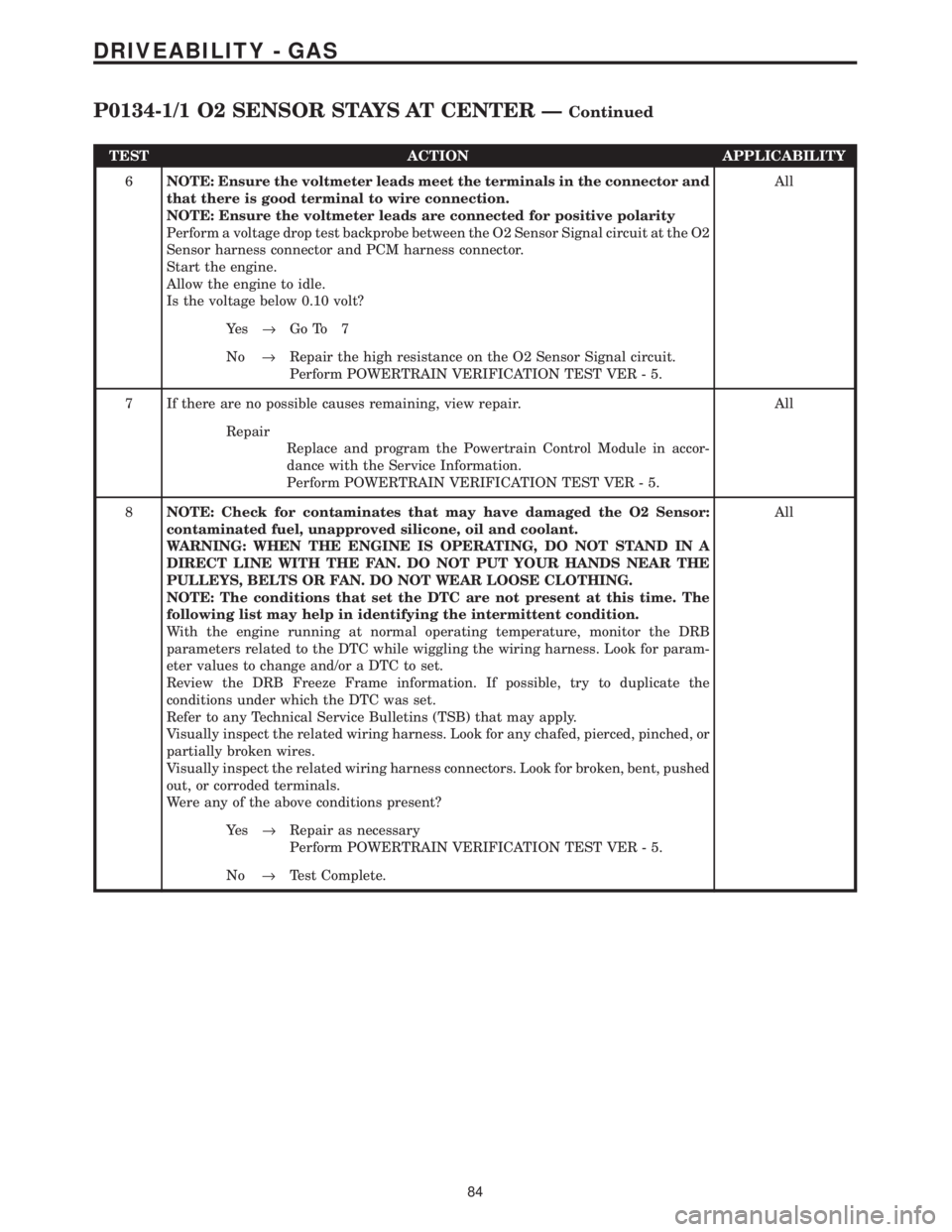
TEST ACTION APPLICABILITY
6NOTE: Ensure the voltmeter leads meet the terminals in the connector and
that there is good terminal to wire connection.
NOTE: Ensure the voltmeter leads are connected for positive polarity
Perform a voltage drop test backprobe between the O2 Sensor Signal circuit at the O2
Sensor harness connector and PCM harness connector.
Start the engine.
Allow the engine to idle.
Is the voltage below 0.10 volt?All
Ye s®Go To 7
No®Repair the high resistance on the O2 Sensor Signal circuit.
Perform POWERTRAIN VERIFICATION TEST VER - 5.
7 If there are no possible causes remaining, view repair. All
Repair
Replace and program the Powertrain Control Module in accor-
dance with the Service Information.
Perform POWERTRAIN VERIFICATION TEST VER - 5.
8NOTE: Check for contaminates that may have damaged the O2 Sensor:
contaminated fuel, unapproved silicone, oil and coolant.
WARNING: WHEN THE ENGINE IS OPERATING, DO NOT STAND IN A
DIRECT LINE WITH THE FAN. DO NOT PUT YOUR HANDS NEAR THE
PULLEYS, BELTS OR FAN. DO NOT WEAR LOOSE CLOTHING.
NOTE: The conditions that set the DTC are not present at this time. The
following list may help in identifying the intermittent condition.
With the engine running at normal operating temperature, monitor the DRB
parameters related to the DTC while wiggling the wiring harness. Look for param-
eter values to change and/or a DTC to set.
Review the DRB Freeze Frame information. If possible, try to duplicate the
conditions under which the DTC was set.
Refer to any Technical Service Bulletins (TSB) that may apply.
Visually inspect the related wiring harness. Look for any chafed, pierced, pinched, or
partially broken wires.
Visually inspect the related wiring harness connectors. Look for broken, bent, pushed
out, or corroded terminals.
Were any of the above conditions present?All
Ye s®Repair as necessary
Perform POWERTRAIN VERIFICATION TEST VER - 5.
No®Test Complete.
84
DRIVEABILITY - GAS
P0134-1/1 O2 SENSOR STAYS AT CENTER ÐContinued
Page 3884 of 4284

Symptom:
P0171-1/1 FUEL SYSTEM LEAN
When Monitored and Set Condition:
P0171-1/1 FUEL SYSTEM LEAN
When Monitored: With the engine running in closed loop mode, the ambient/battery
temperature above 20 deg. F and altitude below 8000 ft.
Set Condition: If the PCM multiplies short term compensation by long term adaptive and
a certain percentage is exceeded for two trips, a freeze frame is stored, the MIL illuminates
and a trouble code is stored.
POSSIBLE CAUSES
INTERMITTENT CONDITION
RESTRICTED FUEL SUPPLY LINE
FUEL PUMP INLET STRAINER PLUGGED
FUEL PUMP MODULE
O2 SENSOR
O2 SENSOR SIGNAL CIRCUIT SHORTED TO GROUND
O2 SENSOR HEATER OPERATION
TPS VOLTAGE GREATER THAN 0.92 VOLTS WITH THROTTLE CLOSED
TP SENSOR SWEEP
MAP SENSOR OPERATION
ECT SENSOR OPERATION
ENGINE MECHANICAL PROBLEM
FUEL FILTER/PRESSURE REGULATOR (HIGH)
PCM
TEST ACTION APPLICABILITY
1NOTE: Check for contaminates that may have damaged the O2 Sensor:
contaminated fuel, unapproved silicone, oil and coolant.
Turn the ignition on.
With the DRBIIIt, read DTC's.
Is the Good Trip displayed and equal to zero?All
Ye s®Go To 2
No®Go To 16
90
DRIVEABILITY - GAS
Page 3885 of 4284

TEST ACTION APPLICABILITY
2Warning: The fuel system is under a constant pressure (even with the engine
off). Before testing or servicing any fuel system hose, fitting or line, the fuel
system pressure must be released.
Install a fuel pressure gauge to the fuel rail.
Turn the ignition on.
With the DRBIIIt, actuate the ASD Fuel System test and observe the fuel pressure
gauge.
NOTE: Fuel pressure specification is 400 KPa +/- 34 KPa (58 psi +/- 5 psi).
Turn the ignition off.
Choose a conclusion that best matches your fuel pressure reading.All
Within Specification
Go To 3
Above Specification
Replace the fuel filter/pressure regulator.
Perform POWERTRAIN VERIFICATION TEST VER - 5.
Below Specification
Go To 13
Caution: Stop All Actuations.
3 Turn the ignition on
With the DRBIIIt, read the O2 Sensor voltage.
Is the voltage between 0.4 to 0.6 volts?All
Ye s®Go To 4
No®Go To 10
4 Turn the ignition off.
NOTE: Wait a minimum of 10 minutes to allow the O2 Sensor to cool down
before continuing the test. Allow the O2 Sensor voltage to stabilize between
0.4 to 0.6 volts.
Turn the ignition on.
With the DRBIIIt, actuate the O2 Heater Test.
With the DRBIIIt, monitor O2 Sensor voltage for at least 2 minutes.
Does the voltage stay between 0.4 and 0.6All
Ye s®Replace the O2 Sensor.
Perform POWERTRAIN VERIFICATION TEST VER - 5.
No®Go To 5
5 Turn the ignition on.
With the DRBIIIt, read TP Sensor voltage.
NOTE: The throttle must be against the stop.
Is the voltage 0.92 or less with the Throttle closed?All
Ye s®Go To 6
No®Check for a binding throttle condition. If OK, replace the Throttle
Position Sensor.
Perform POWERTRAIN VERIFICATION TEST VER - 5.
91
DRIVEABILITY - GAS
P0171-1/1 FUEL SYSTEM LEAN ÐContinued
Page 3886 of 4284
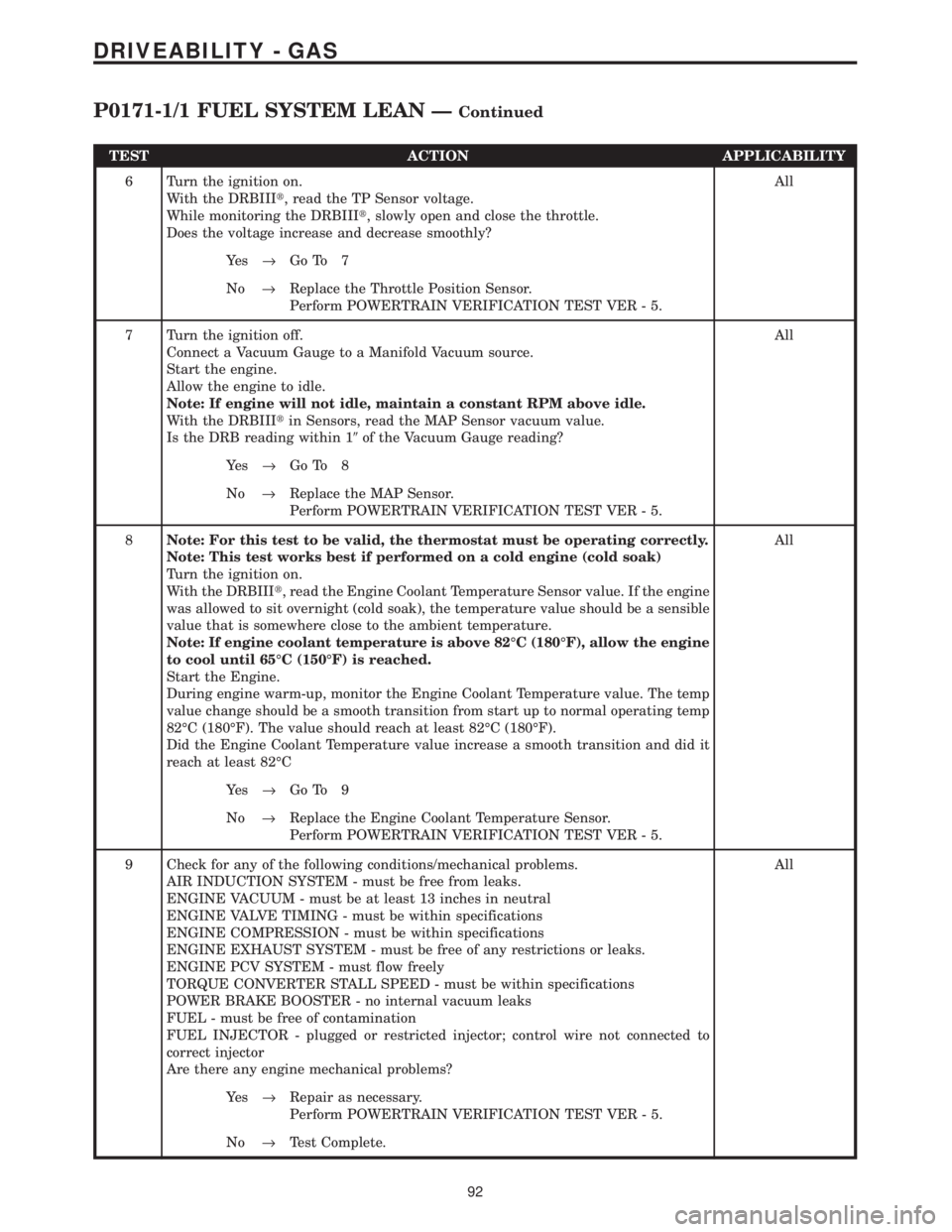
TEST ACTION APPLICABILITY
6 Turn the ignition on.
With the DRBIIIt, read the TP Sensor voltage.
While monitoring the DRBIIIt, slowly open and close the throttle.
Does the voltage increase and decrease smoothly?All
Ye s®Go To 7
No®Replace the Throttle Position Sensor.
Perform POWERTRAIN VERIFICATION TEST VER - 5.
7 Turn the ignition off.
Connect a Vacuum Gauge to a Manifold Vacuum source.
Start the engine.
Allow the engine to idle.
Note: If engine will not idle, maintain a constant RPM above idle.
With the DRBIIItin Sensors, read the MAP Sensor vacuum value.
Is the DRB reading within 19of the Vacuum Gauge reading?All
Ye s®Go To 8
No®Replace the MAP Sensor.
Perform POWERTRAIN VERIFICATION TEST VER - 5.
8Note: For this test to be valid, the thermostat must be operating correctly.
Note: This test works best if performed on a cold engine (cold soak)
Turn the ignition on.
With the DRBIIIt, read the Engine Coolant Temperature Sensor value. If the engine
was allowed to sit overnight (cold soak), the temperature value should be a sensible
value that is somewhere close to the ambient temperature.
Note: If engine coolant temperature is above 82ÉC (180ÉF), allow the engine
to cool until 65ÉC (150ÉF) is reached.
Start the Engine.
During engine warm-up, monitor the Engine Coolant Temperature value. The temp
value change should be a smooth transition from start up to normal operating temp
82ÉC (180ÉF). The value should reach at least 82ÉC (180ÉF).
Did the Engine Coolant Temperature value increase a smooth transition and did it
reach at least 82ÉCAll
Ye s®Go To 9
No®Replace the Engine Coolant Temperature Sensor.
Perform POWERTRAIN VERIFICATION TEST VER - 5.
9 Check for any of the following conditions/mechanical problems.
AIR INDUCTION SYSTEM - must be free from leaks.
ENGINE VACUUM - must be at least 13 inches in neutral
ENGINE VALVE TIMING - must be within specifications
ENGINE COMPRESSION - must be within specifications
ENGINE EXHAUST SYSTEM - must be free of any restrictions or leaks.
ENGINE PCV SYSTEM - must flow freely
TORQUE CONVERTER STALL SPEED - must be within specifications
POWER BRAKE BOOSTER - no internal vacuum leaks
FUEL - must be free of contamination
FUEL INJECTOR - plugged or restricted injector; control wire not connected to
correct injector
Are there any engine mechanical problems?All
Ye s®Repair as necessary.
Perform POWERTRAIN VERIFICATION TEST VER - 5.
No®Test Complete.
92
DRIVEABILITY - GAS
P0171-1/1 FUEL SYSTEM LEAN ÐContinued
Page 3887 of 4284

TEST ACTION APPLICABILITY
10 Turn the ignition on.
Disconnect the O2 Sensor harness connector.
With the DRBIIIt, monitor the O2 Sensor voltage.
Is the O2 Sensor voltage between 0.40 to 0.60 volts?All
Ye s®Replace the O2 Sensor
Perform POWERTRAIN VERIFICATION TEST VER - 5.
No®Go To 11
11 Turn the ignition off.
Disconnect the O2 Sensor harness connector.
Disconnect the PCM harness connector.
Measure the resistance of the O2 Sensor Signal circuit in the PCM harness connector
to ground.
Is the resistance below 5.0 ohms?All
Ye s®Repair the O2 Sensor Signal for a short to ground.
Perform POWERTRAIN VERIFICATION TEST VER - 5.
No®Go To 12
12 If there are no possible causes remaining, view repair. All
Repair
Replace and program the Powertrain Control Module in accor-
dance with the Service Information.
Perform POWERTRAIN VERIFICATION TEST VER - 5.
13 Turn the ignition off.
Warning: The fuel system is under a constant pressure (even with the engine
off). Before testing or servicing any fuel system hose, fitting or line, the fuel
system pressure must be released.
Raise vehicle on hoist, and disconnect the fuel pressure line at the fuel pump module.
Install special 5/16 fuel line adapter tool #6539 between disconnected fuel line and
the fuel pump module.
Attach a fuel pressure test gauge to the T fitting on tool #6539.
Turn the ignition on.
With the DRBIIIt, actuate the ASD Fuel System test and observe the fuel pressure
gauge.
NOTE: Fuel pressure specification is 400 KPa +/- 34 KPa (58.2 psi +/- 5 psi).
Is the fuel pressure within specification?All
Ye s®Repair or replace fuel supply line as necessary.
Perform POWERTRAIN VERIFICATION TEST VER - 5.
No®Go To 14
Caution: Stop All Actuations.
14 Turn the ignition off.
Warning: The fuel system is under a constant pressure (even with the engine
off). Before testing or servicing any fuel system hose,fitting or line, the fuel
system pressure must be released.
Remove the Fuel Pump Module and inspect the Fuel Inlet Strainer.
Is the Fuel Inlet Strainer plugged?All
Ye s®Replace the Fuel Pump Inlet Strainer.
Perform POWERTRAIN VERIFICATION TEST VER - 5.
No®Go To 15
93
DRIVEABILITY - GAS
P0171-1/1 FUEL SYSTEM LEAN ÐContinued
Page 3888 of 4284

TEST ACTION APPLICABILITY
15 If there are no possible causes remaining, view repair. All
Repair
Replace the Fuel Pump Module.
Perform POWERTRAIN VERIFICATION TEST VER - 5.
16NOTE: Check for contaminates that may have damaged the O2 Sensor:
contaminated fuel, unapproved silicone, oil and coolant.
WARNING: WHEN THE ENGINE IS OPERATING, DO NOT STAND IN A
DIRECT LINE WITH THE FAN. DO NOT PUT YOUR HANDS NEAR THE
PULLEYS, BELTS OR FAN. DO NOT WEAR LOOSE CLOTHING.
NOTE: The conditions that set the DTC are not present at this time. The
following list may help in identifying the intermittent condition.
With the engine running at normal operating temperature, monitor the DRB
parameters related to the DTC while wiggling the wiring harness. Look for param-
eter values to change and/or a DTC to set.
Review the DRB Freeze Frame information. If possible, try to duplicate the
conditions under which the DTC was set.
Refer to any Technical Service Bulletins (TSB) that may apply.
Visually inspect the related wiring harness. Look for any chafed, pierced, pinched, or
partially broken wires.
Visually inspect the related wiring harness connectors. Look for broken, bent, pushed
out, or corroded terminals.
Were any of the above conditions present?All
Ye s®Repair as necessary
Perform POWERTRAIN VERIFICATION TEST VER - 5.
No®Test Complete.
94
DRIVEABILITY - GAS
P0171-1/1 FUEL SYSTEM LEAN ÐContinued