fuel CHRYSLER VOYAGER 2001 Service Manual
[x] Cancel search | Manufacturer: CHRYSLER, Model Year: 2001, Model line: VOYAGER, Model: CHRYSLER VOYAGER 2001Pages: 4284, PDF Size: 83.53 MB
Page 3901 of 4284

TEST ACTION APPLICABILITY
11 With the DRBIIIt, read the FREEZE FRAME DATA.
Use the FREEZE FRAME DATA and attempt to determine the cause of the Misfire
DTC.
In the FREEZE FRAME DATA, is the engine RPM over 3000 and the operating temp
normal?All
Ye s®Test CMP and CKP signals with Lab Scope, check valve timing,
and perform running vacuum test.
Perform POWERTRAIN VERIFICATION TEST VER - 5.
No®Go To 12
12 Check for any of the following conditions/mechanical problems.
ENGINE VACUUM - must be at least 13 inches in neutral
ENGINE VALVE TIMING - must be within specifications
ENGINE COMPRESSION - must be within specifications
ENGINE EXHAUST SYSTEM - must be free of any restrictions or leaks.
ENGINE PCV SYSTEM - must flow freely
TORQUE CONVERTER STALL SPEED - must be within specifications
POWER BRAKE BOOSTER - no internal vacuum leaks
FUEL - must be free of contamination
FUEL INJECTOR - plugged or restricted injector; control wire not connected to
correct injector
Are there any engine mechanical problems?All
Ye s®Repair as necessary.
Perform POWERTRAIN VERIFICATION TEST VER - 5.
No®Test Complete.
107
DRIVEABILITY - GAS
P0300-MULTIPLE CYLINDER MIS-FIRE ÐContinued
Page 3925 of 4284

Symptom:
P0420-1/1 CATALYTIC CONVERTER EFFICIENCY
When Monitored and Set Condition:
P0420-1/1 CATALYTIC CONVERTER EFFICIENCY
When Monitored: After engine warm up to 70ÉC (158ÉF), 180 seconds of open throttle
operation, at a speed greater than 18 mph and less than 55 mph, with the engine at
1200-1700 rpm and MAP vacuum between 15.0 and 21.0 inches of mercury (Hg).
Set Condition: As catalyst efficiency deteriorates, the switch rate of the downstream O2
sensor approaches that of the upstream O2 sensor. If at any point during the test the
switch ratio reaches a predetermined value a counter is incremented by one.
POSSIBLE CAUSES
INTERMITTENT CONDITION
VISUALLY INSPECT CATALYTIC CONVERTER
EXHAUST LEAK
ENGINE MECHANICAL CONDITION
AGING O2 SENSOR
CATALYTIC CONVERTER
TEST ACTION APPLICABILITY
1NOTE: If a O2 Sensor DTC(s) set along with the Catalytic Converter
Efficiency DTC diagnose the O2 Sensor DTC(s) before continuing.
NOTE: Check for contaminates that may have damaged the O2 Sensor and
Catalytic Converter: contaminated fuel, unapproved silicone, oil and cool-
ant, repair necessary.
Turn the ignition on.
With the DRBIIIt, read DTC's.
Is the Good Trip displayed and equal to zero?All
Ye s®Go To 2
No®Go To 7
2 Inspect the Catalytic Converter for the following damage.
Damage Catalytic Converter, dent and holes.
Severe discoloration caused by overheating the Catalytic Converter.
Catalytic Converter broke internally.
Leaking Catalytic Converter.
Were any problems found?All
Ye s®Replace the Catalytic Converter. Repair the condition that may
have caused the failure.
Perform POWERTRAIN VERIFICATION TEST VER - 5.
No®Go To 3
131
DRIVEABILITY - GAS
Page 3926 of 4284

TEST ACTION APPLICABILITY
3 Start the engine.
Inspect the exhaust for leak between the engine and the O2 sensor.
Inspect the exhaust for leaks between the engine and the appropriate rear O2 Sensor.
Are there any exhaust leaks?All
Ye s®Repair or replace the leaking exhaust parts as necessary.
Perform POWERTRAIN VERIFICATION TEST VER - 5.
No®Go To 4
4 Check the exhaust for excessive smoke caused by an internal problem in the engine.
Is a engine mechanical condition present?All
Ye s®Repair the engine mechanical condition as necessary.
Perform POWERTRAIN VERIFICATION TEST VER - 5.
No®Go To 5
5 A new rear O2 Sensor along with an aging front O2 Sensor may cause the DTC to set.
Review the vehicles repair history.
Has the rear O2 Sensor been replace without replacing the front O2 Sensor?All
Ye s®Replace the O2 Sensor as necessary.
Perform POWERTRAIN VERIFICATION TEST VER - 5.
No®Go To 6
6 If there are no possible cause remaining, view repair. All
Repair
replace the Catalytic Converter.
Perform POWERTRAIN VERIFICATION TEST VER - 5.
7WARNING: WHEN THE ENGINE IS OPERATING, DO NOT STAND IN A
DIRECT LINE WITH THE FAN. DO NOT PUT YOUR HANDS NEAR THE
PULLEYS, BELTS OR FAN. DO NOT WEAR LOOSE CLOTHING.
NOTE: Check for contaminates that may have damaged the O2 Sensor and
Catalytic Converter: contaminated fuel, unapproved silicone, oil and cool-
ant, repair necessary.
NOTE: The conditions that set the DTC are not present at this time. The
following list may help in identifying the intermittent condition.
A new rear O2 Sensor along with a aging front O2 Sensor may cause the DTC to set.
Review repair history of the vehicle and repair as necessary.
With the engine running at normal operating temperature, monitor the DRB
parameters related to the DTC while wiggling the wiring harness. Look for param-
eter values to change and/or a DTC to set.
Review the DRB Freeze Frame information. If possible, try to duplicate the
conditions under which the DTC was set.
Refer to any Technical Service Bulletins (TSB) that may apply.
Visually inspect the related wiring harness connectors. Look for broken, bent, pushed
out, or corroded terminals.
Were any of the above conditions present?All
Ye s®Repair as necessary
Perform POWERTRAIN VERIFICATION TEST VER - 5.
No®Test Complete.
132
DRIVEABILITY - GAS
P0420-1/1 CATALYTIC CONVERTER EFFICIENCY ÐContinued
Page 3927 of 4284

Symptom:
P0441-EVAP PURGE FLOW MONITOR
When Monitored and Set Condition:
P0441-EVAP PURGE FLOW MONITOR
When Monitored: With engine temperature greater than 71ÉC (160ÉF), fuel control in
closed loop, engine idling for 200 seconds, no low fuel, MAP less than 23.6 inches mercury
and barometric altitude less than 8,000 feet.
Set Condition: After having passed the Leak Detection Pump (LDP) test, no air flow
through the evaporative system is detected by the evap monitor.
POSSIBLE CAUSES
INTERMITTENT CONDITION
EVAP PURGE SOLENOID LEAKS/STUCK OPEN
EVAP PURGE SOLENOID STUCK CLOSED
EVAP PURGE SOLENOID VACUUM SUPPLY
EVAP PURGE HOSE SOLENOID TO CANISTER
EVAP PURGE HOSE CANISTER TO FUEL TANK
EVAP CANISTER
TEST ACTION APPLICABILITY
1 Turn the ignition on.
With the DRBIIIt, read DTC's.
Is the Good Trip Counter displayed and equal to zero?All
Ye s®Go To 2
No®Go To 8
2NOTE: After disconnecting the Evap Purge Solenoid vacuum connections,
inspect the lines and solenoid for any signs of contamination from the EVAP
Canister. This may indicate a faulty rollover valve. Replace/repair as
necessary.
Turn the ignition off.
Disconnect the vacuum hoses at the Evap Purge Solenoid.
Using a hand vacuum pump, apply 10 inches of vacuum to the Evap Purge Solenoid
vacuum source port on the component side.
Does the Evap Purge Solenoid hold vacuum?All
Ye s®Go To 3
No®Replace the Evap Purge Solenoid.
Perform POWERTRAIN VERIFICATION TEST VER - 5.
133
DRIVEABILITY - GAS
Page 3928 of 4284
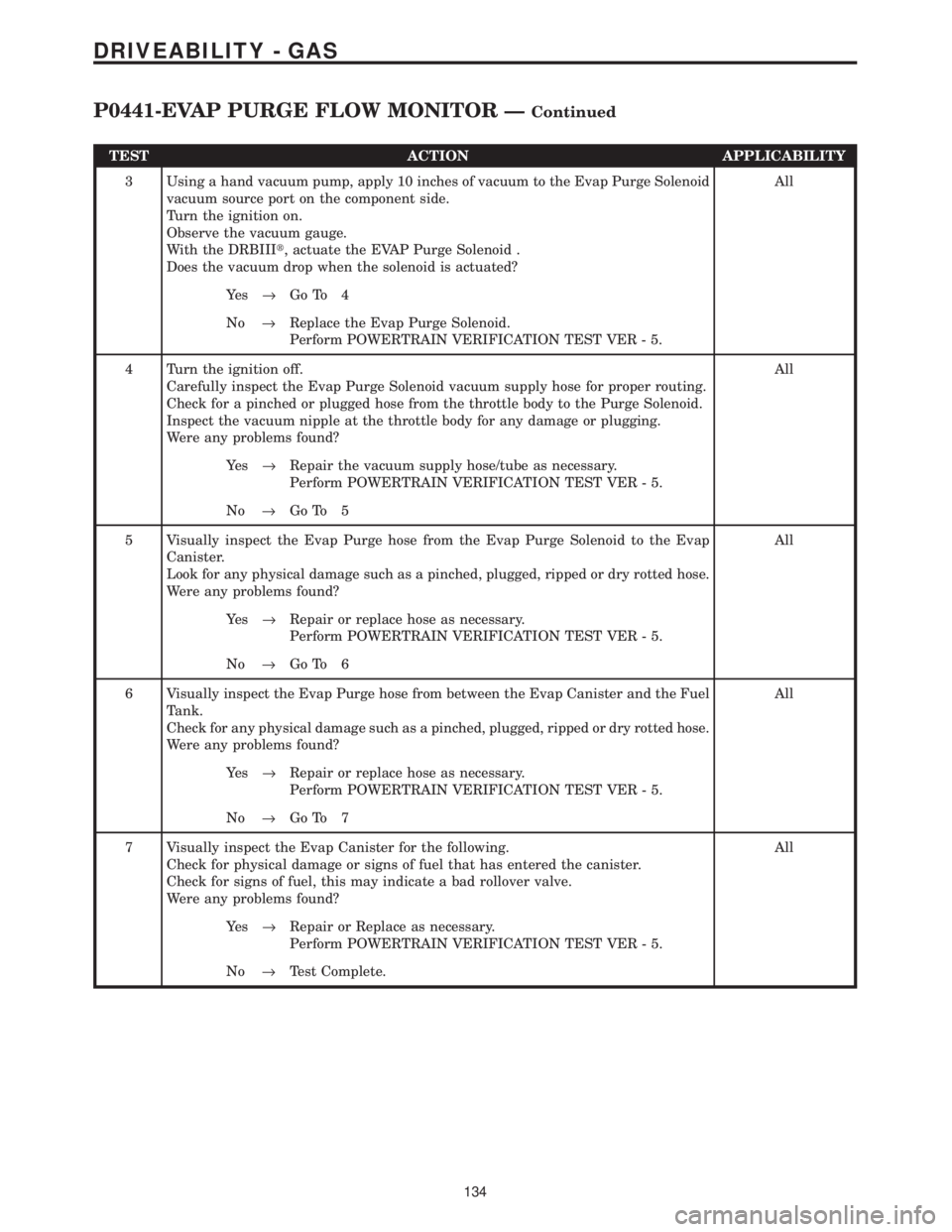
TEST ACTION APPLICABILITY
3 Using a hand vacuum pump, apply 10 inches of vacuum to the Evap Purge Solenoid
vacuum source port on the component side.
Turn the ignition on.
Observe the vacuum gauge.
With the DRBIIIt, actuate the EVAP Purge Solenoid .
Does the vacuum drop when the solenoid is actuated?All
Ye s®Go To 4
No®Replace the Evap Purge Solenoid.
Perform POWERTRAIN VERIFICATION TEST VER - 5.
4 Turn the ignition off.
Carefully inspect the Evap Purge Solenoid vacuum supply hose for proper routing.
Check for a pinched or plugged hose from the throttle body to the Purge Solenoid.
Inspect the vacuum nipple at the throttle body for any damage or plugging.
Were any problems found?All
Ye s®Repair the vacuum supply hose/tube as necessary.
Perform POWERTRAIN VERIFICATION TEST VER - 5.
No®Go To 5
5 Visually inspect the Evap Purge hose from the Evap Purge Solenoid to the Evap
Canister.
Look for any physical damage such as a pinched, plugged, ripped or dry rotted hose.
Were any problems found?All
Ye s®Repair or replace hose as necessary.
Perform POWERTRAIN VERIFICATION TEST VER - 5.
No®Go To 6
6 Visually inspect the Evap Purge hose from between the Evap Canister and the Fuel
Tank.
Check for any physical damage such as a pinched, plugged, ripped or dry rotted hose.
Were any problems found?All
Ye s®Repair or replace hose as necessary.
Perform POWERTRAIN VERIFICATION TEST VER - 5.
No®Go To 7
7 Visually inspect the Evap Canister for the following.
Check for physical damage or signs of fuel that has entered the canister.
Check for signs of fuel, this may indicate a bad rollover valve.
Were any problems found?All
Ye s®Repair or Replace as necessary.
Perform POWERTRAIN VERIFICATION TEST VER - 5.
No®Test Complete.
134
DRIVEABILITY - GAS
P0441-EVAP PURGE FLOW MONITOR ÐContinued
Page 3931 of 4284
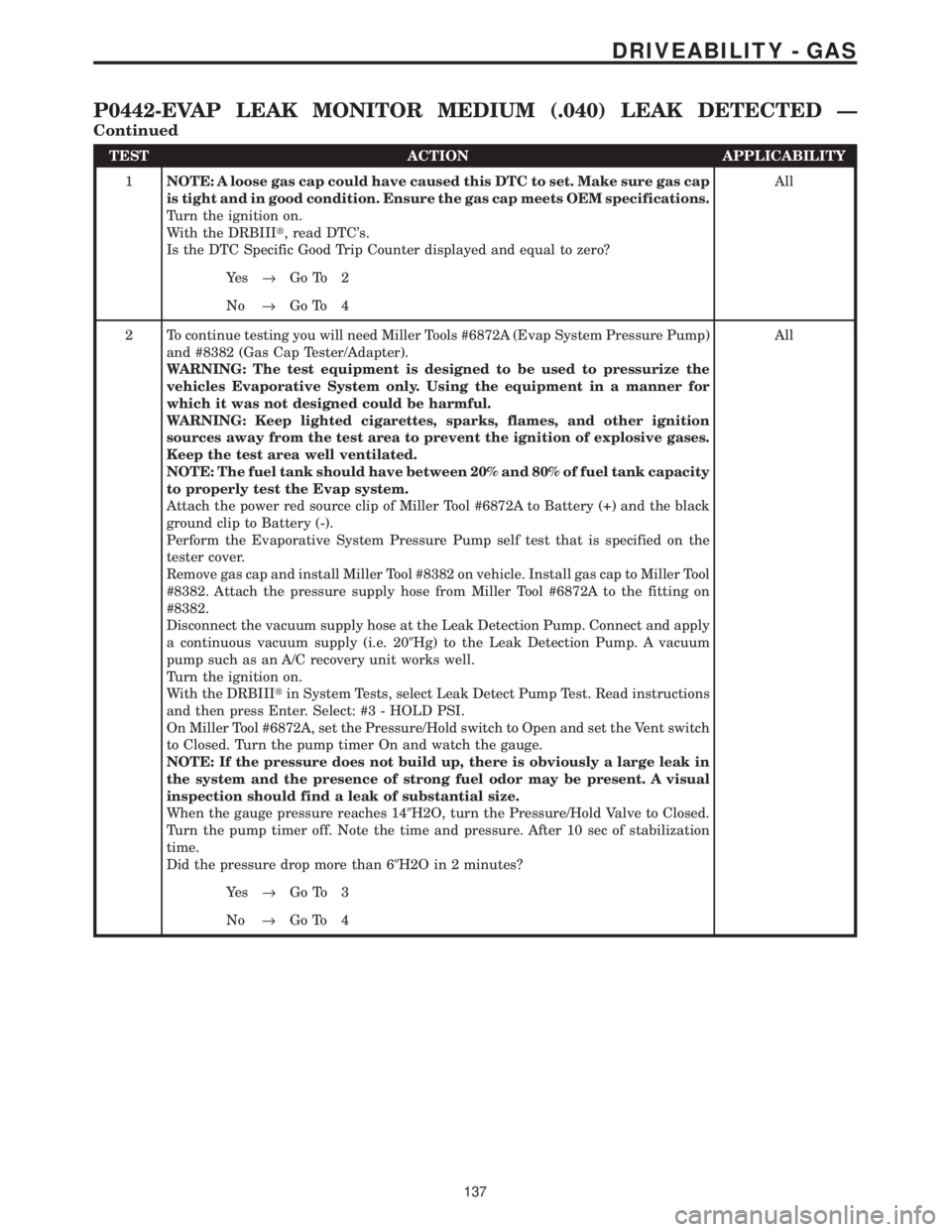
TEST ACTION APPLICABILITY
1NOTE: A loose gas cap could have caused this DTC to set. Make sure gas cap
is tight and in good condition. Ensure the gas cap meets OEM specifications.
Turn the ignition on.
With the DRBIIIt, read DTC's.
Is the DTC Specific Good Trip Counter displayed and equal to zero?All
Ye s®Go To 2
No®Go To 4
2 To continue testing you will need Miller Tools #6872A (Evap System Pressure Pump)
and #8382 (Gas Cap Tester/Adapter).
WARNING: The test equipment is designed to be used to pressurize the
vehicles Evaporative System only. Using the equipment in a manner for
which it was not designed could be harmful.
WARNING: Keep lighted cigarettes, sparks, flames, and other ignition
sources away from the test area to prevent the ignition of explosive gases.
Keep the test area well ventilated.
NOTE: The fuel tank should have between 20% and 80% of fuel tank capacity
to properly test the Evap system.
Attach the power red source clip of Miller Tool #6872A to Battery (+) and the black
ground clip to Battery (-).
Perform the Evaporative System Pressure Pump self test that is specified on the
tester cover.
Remove gas cap and install Miller Tool #8382 on vehicle. Install gas cap to Miller Tool
#8382. Attach the pressure supply hose from Miller Tool #6872A to the fitting on
#8382.
Disconnect the vacuum supply hose at the Leak Detection Pump. Connect and apply
a continuous vacuum supply (i.e. 209Hg) to the Leak Detection Pump. A vacuum
pump such as an A/C recovery unit works well.
Turn the ignition on.
With the DRBIIItin System Tests, select Leak Detect Pump Test. Read instructions
and then press Enter. Select: #3 - HOLD PSI.
On Miller Tool #6872A, set the Pressure/Hold switch to Open and set the Vent switch
to Closed. Turn the pump timer On and watch the gauge.
NOTE: If the pressure does not build up, there is obviously a large leak in
the system and the presence of strong fuel odor may be present. A visual
inspection should find a leak of substantial size.
When the gauge pressure reaches 149H2O, turn the Pressure/Hold Valve to Closed.
Turn the pump timer off. Note the time and pressure. After 10 sec of stabilization
time.
Did the pressure drop more than 69H2O in 2 minutes?All
Ye s®Go To 3
No®Go To 4
137
DRIVEABILITY - GAS
P0442-EVAP LEAK MONITOR MEDIUM (.040) LEAK DETECTED Ð
Continued
Page 3932 of 4284

TEST ACTION APPLICABILITY
3Note: A thorough visual inspection of the Evap system hoses, tubes, and
connections may save time in your diagnosis. Look for any physical damage
or signs of wetness at connections. The strong smell of fuel vapors may aid
diagnosis also.
To continue testing, you will need Miller Tool #6904A Ultrasonic Leak Detector.
NOTE: The LDP System Test should still be running. If the DRBIIIthas
timed out, restart the System Test.
Using Miller Tool #6872A, set the Pressure/Hold Switch to Open, and the Vent Switch
to Closed. Turn the pump timer on to pressurize/re-pressurize the Evap System.
Using the Ultrasonic Leak Detector, start listening for leaks in the Evap System.
Carefully leak test all hoses, tubes, and connections.
Were any leaks heard with the Ultrasonic Leak Detector?All
Ye s®Repair or replace the leaking component as necessary.
Perform POWERTRAIN VERIFICATION TEST VER - 5.
No®Test Complete.
4 At this time, the conditions required to set the DTC are not present.
Note: Use the Freeze Frame Data to help you duplicate the conditions that
set the DTC. Pay particular attention to the DTC set conditions, such as,
VSS, MAP, ECT, and Load.
Note: A thorough visual inspection of the Evap system hoses, tubes, and
connections may save time in your diagnosis. Look for any physical damage
or signs of wetness at connections. The strong smell of fuel vapors may aid
diagnosis also.
Note: Refer to any Technical Service Bulletins (TSB's) that may apply.
With the DRBIIItin System Tests, perform the LDP Monitor Test. This will force the
PCM to run the LDP Monitor. If the monitor fails, further diagnosis is required to
find faulty component. If the monitor passes, the condition is not present at this time.
Were any problems found?All
Ye s®Repair as necessary.
Perform POWERTRAIN VERIFICATION TEST VER - 5.
No®Test Complete.
138
DRIVEABILITY - GAS
P0442-EVAP LEAK MONITOR MEDIUM (.040) LEAK DETECTED Ð
Continued
Page 3936 of 4284
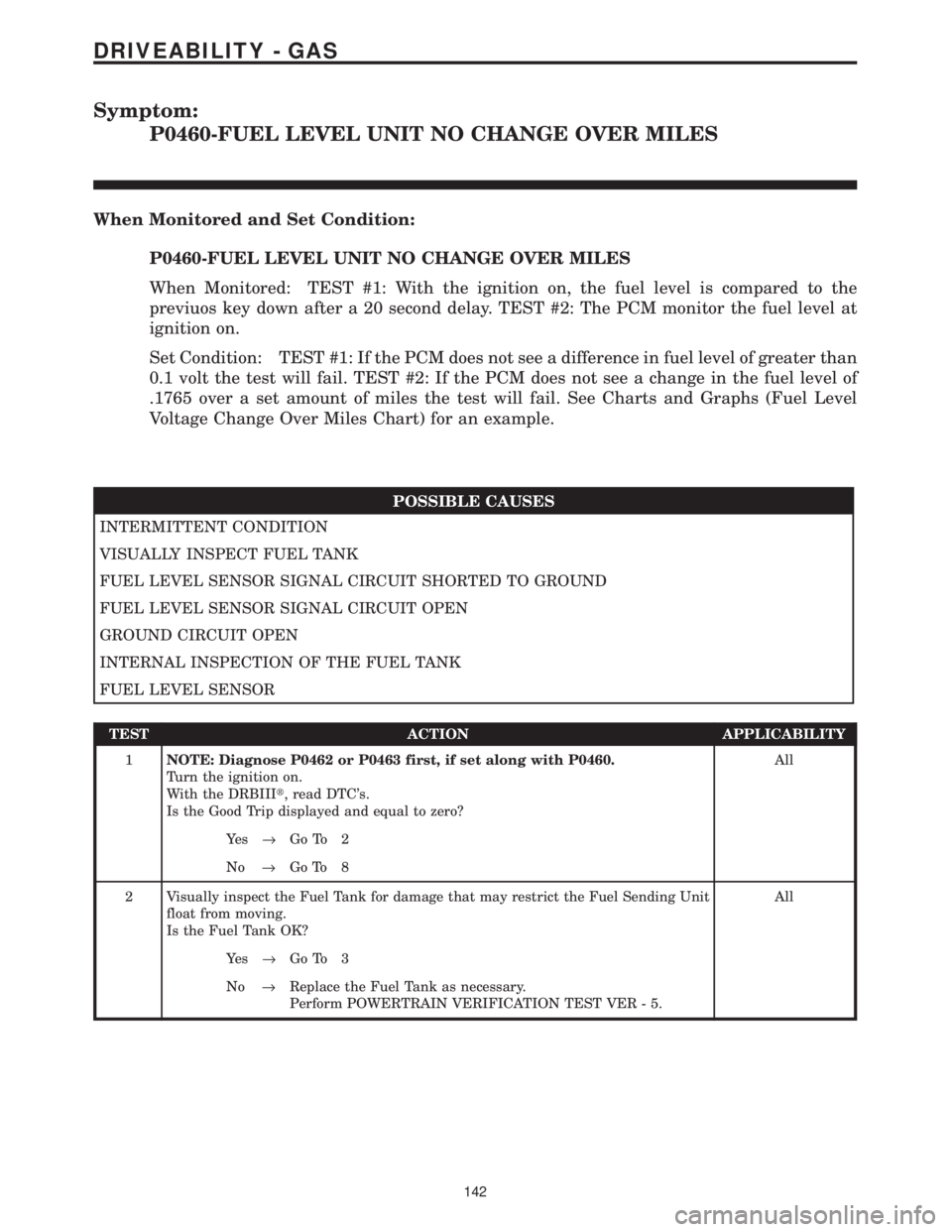
Symptom:
P0460-FUEL LEVEL UNIT NO CHANGE OVER MILES
When Monitored and Set Condition:
P0460-FUEL LEVEL UNIT NO CHANGE OVER MILES
When Monitored: TEST #1: With the ignition on, the fuel level is compared to the
previuos key down after a 20 second delay. TEST #2: The PCM monitor the fuel level at
ignition on.
Set Condition: TEST #1: If the PCM does not see a difference in fuel level of greater than
0.1 volt the test will fail. TEST #2: If the PCM does not see a change in the fuel level of
.1765 over a set amount of miles the test will fail. See Charts and Graphs (Fuel Level
Voltage Change Over Miles Chart) for an example.
POSSIBLE CAUSES
INTERMITTENT CONDITION
VISUALLY INSPECT FUEL TANK
FUEL LEVEL SENSOR SIGNAL CIRCUIT SHORTED TO GROUND
FUEL LEVEL SENSOR SIGNAL CIRCUIT OPEN
GROUND CIRCUIT OPEN
INTERNAL INSPECTION OF THE FUEL TANK
FUEL LEVEL SENSOR
TEST ACTION APPLICABILITY
1NOTE: Diagnose P0462 or P0463 first, if set along with P0460.
Turn the ignition on.
With the DRBIIIt, read DTC's.
Is the Good Trip displayed and equal to zero?All
Ye s®Go To 2
No®Go To 8
2 Visually inspect the Fuel Tank for damage that may restrict the Fuel Sending Unit
float from moving.
Is the Fuel Tank OK?All
Ye s®Go To 3
No®Replace the Fuel Tank as necessary.
Perform POWERTRAIN VERIFICATION TEST VER - 5.
142
DRIVEABILITY - GAS
Page 3937 of 4284

TEST ACTION APPLICABILITY
3 Turn the ignition off.
Disconnect the Fuel Pump Module harness connector.
Measure the resistance of the Fuel Level Sensor Signal circuit in the Fuel Pump
Module harness connector to ground.
Is the resistance below 100 ohms?All
Ye s®Repair the Fuel Level Sensor Signal circuit for a short to ground
Perform POWERTRAIN VERIFICATION TEST VER - 5.
No®Go To 4
4 Turn the ignition off.
Disconnect the Fuel Pump Module harness connector.
Disconnect the BCM harness connector.
Measure the resistance of the Fuel Level Sensor Signal circuit between the Fuel
Pump Module harness connector and the BCM harness connector.
Is the resistance below 5.0 ohms?All
Ye s®Go To 5
No®Repair the Fuel Level Sensor Signal circuit for an open.
Perform POWERTRAIN VERIFICATION TEST VER - 5.
5 Turn the ignition off.
Disconnect the Fuel Pump Module harness connector.
Measure the resistance of the Ground circuit in the Fuel Pump Module harness
connector to ground.
Is the resistance below 5.0 ohms?All
Ye s®Go To 6
No®Repair the Ground circuit for an open.
Perform POWERTRAIN VERIFICATION TEST VER - 5.
6WARNING: The fuel system is under a contant pressure even with the
engine off. Before opening the fuel system the fuel pressure must be release.
Relieve the fuel pressure in accordance with the servive information.
Remove the Fuel Tank in accordance with the Service Information.
Remove the Fuel Pump Module.
Visually inspect the inside of the Fuel Tank for any obstructions or deformities.
Inspect the Fuel Pump Module Float arm for damage.
Were any problem found?All
Ye s®Repair or replace as necessary.
Perform POWERTRAIN VERIFICATION TEST VER - 5.
No®Go To 7
7 If there are no possible causes remaining, view repair. All
Repair
Replace the Fuel Level Sensor.
Perform POWERTRAIN VERIFICATION TEST VER - 5.
143
DRIVEABILITY - GAS
P0460-FUEL LEVEL UNIT NO CHANGE OVER MILES ÐContinued
Page 3938 of 4284

TEST ACTION APPLICABILITY
8WARNING: WHEN THE ENGINE IS OPERATING, DO NOT STAND IN A
DIRECT LINE WITH THE FAN. DO NOT PUT YOUR HANDS NEAR THE
PULLEYS, BELTS OR FAN. DO NOT WEAR LOOSE CLOTHING.
NOTE: The conditions that set the DTC are not present at this time. The
following list may help in identifying the intermittent condition.
NOTE: Phsyically and Visually inspect the fuel tank for damage. if a
problem is found repair or replace as necessary.
With the engine running at normal operating temperature, monitor the DRB
parameters related to the DTC while wiggling the wiring harness. Look for param-
eter values to change and/or a DTC to set.
Review the DRB Freeze Frame information. If possible, try to duplicate the
conditions under which the DTC was set.
Refer to any Technical Service Bulletins (TSB) that may apply.
Visually inspect the related wiring harness. Look for any chafed, pierced, pinched, or
partially broken wires.
Visually inspect the related wiring harness connectors. Look for broken, bent, pushed
out, or corroded terminals.
Were any of the above conditions present?All
Ye s®Repair as necessary
Perform POWERTRAIN VERIFICATION TEST VER - 5.
No®Test Complete.
144
DRIVEABILITY - GAS
P0460-FUEL LEVEL UNIT NO CHANGE OVER MILES ÐContinued